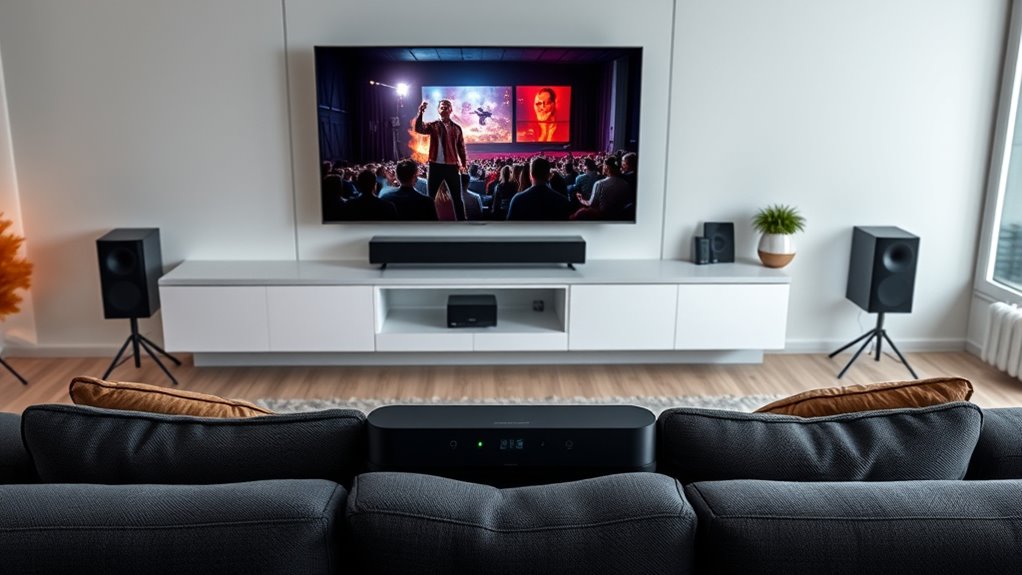

Home theater in a box systems bundle the main components for surround sound, but they differ in how much setup, flexibility, and room space they demand. My best overall pick is the Yamaha YHT-5960U, a receiver-based 5.1 system that offers a more complete home theater foundation than compact powered speakers. The Sony BRAVIA Theater System 6 is a simpler route with a soundbar and rear speakers, while the Energy Take Classic suits buyers who want a small conventional speaker package. The main tradeoff is between easy setup and the placement flexibility and upgrade options of a receiver-based system. Read on for the full breakdown, including which systems fit smaller rooms, beginner setups, and different budgets.

Get your wardrobe favorites delivered free with Prime
- Fast, free delivery on millions of items
- Prime Video, Amazon Music and more included
- Member-only deals all year
Key Takeaways
- The Yamaha YHT-5960U leads as the most complete receiver-based pick; it makes more sense for a buyer seeking a central system to build around than a compact all-in-one setup.
- The Sony BRAVIA Theater System 6 favors simpler installation with a soundbar and rear speakers, while the Yamaha packages require more component and speaker placement.
- The Energy Take Classic and Saiyin 5.0 represent different kinds of speaker-only simplicity: one is a compact 5.1 package with a subwoofer, while the other has five speakers and no listed subwoofer.
- The Rockville RHB70 is a 2.1 system, not a surround package, so it fits buyers prioritizing a straightforward powered speaker setup over discrete rear-channel effects.
- The two Yamaha YHT-4970U and YHT-4950U packages are not interchangeable: the listed 4970U highlights Dolby Atmos and newer HDMI capabilities, while the 4950U calls out Bluetooth.
| Energy 5.1 Take Classic Home Theater Speaker System, Black |  | Best for Speaker-First Surround Sound | System type: 5.1-channel home theater speaker system | Included components: Four satellite speakers, one center channel speaker, one powered subwoofer | Subwoofer power: 200 watts | VIEW ON AMAZON | See Our Full Breakdown |
| Yamaha YHT-4970U 5.1-Channel Home Theater System with Dolby Atmos and 4K/120, 8K/60 HDMI |  | Best for Modern Gaming and Connectivity | Model: YHT-4970U | AV receiver: Yamaha RX300A | Audio channels: 5.1 | VIEW ON AMAZON | See Our Full Breakdown |
| Sony BRAVIA Theater System 6 5.1-Channel Soundbar with Subwoofer and Rear Speakers |  | Best for a Simpler 5.1 Installation | Model: HTS60.UC2 | Channels: 5.1 | Speaker configuration: Soundbar, subwoofer, and rear speakers | VIEW ON AMAZON | See Our Full Breakdown |
| Yamaha YHT-4950U 4K Ultra HD 5.1-Channel Home Theater System with Bluetooth |  | Best Value Receiver-Based Package | Model: YHT-4950U | Audio configuration: 5.1-channel surround sound | Included components: AV receiver, five speakers, subwoofer, speaker wire | VIEW ON AMAZON | See Our Full Breakdown |
| Rockville RHB70 2.1 Powered Home Theater Speaker System |  | Best Compact Option for Small Rooms | Audio channels: 2.1 | Power output: 25W RMS, 50W program, 100W peak | Speakers: One 4-inch subwoofer and two 3-inch speakers | VIEW ON AMAZON | See Our Full Breakdown |
| Yamaha YHT-5960U 5.1-Channel Home Theater System |  | Best for Modern Gaming and TV Setups | Channels: 5.1 | Power: 80 watts | HDMI: HDMI 2.1; 4 inputs and 1 output | VIEW ON AMAZON | See Our Full Breakdown |
| Saiyin 5.0 Home Theater System, HiFi Surround Sound Speakers |  | Best for Receiver Owners Who Want Flexible Speaker Placement | Speaker configuration: 5.0; 4 bookshelf speakers and 1 center speaker | Bookshelf speaker power: 40W each | Center speaker power: 75W | VIEW ON AMAZON | See Our Full Breakdown |
| home theater in a box system | Connectivity |
|---|---|
| Energy 5.1 Take Classic Home T | — |
| Yamaha YHT-4970U 5.1-Channel H | — |
| Sony BRAVIA Theater System 6 5 | Bluetooth |
| Yamaha YHT-4950U 4K Ultra HD 5 | HDMI, Ethernet, coaxial, optical, USB, auxiliary, Bluetooth |
| Rockville RHB70 2.1 Powered Ho | Bluetooth, USB, SD card, RCA, 3.5mm AUX |
| Yamaha YHT-5960U 5.1-Channel H | HDMI, wireless streaming, and MusicCast |
| Saiyin 5.0 Home Theater System | — |
More Details on Our Top Picks
Energy 5.1 Take Classic Home Theater Speaker System, Black
The Energy Take Classic is a strong fit for buyers who want a separate 5.1 speaker set rather than a soundbar-based package. Four satellites and a dedicated center channel spread effects around the room, while the 200-watt powered subwoofer adds low-frequency impact for films. Its wall-mountable speakers offer placement flexibility, though the receiver is not included, so this is less of an all-in-one purchase than the Yamaha YHT-4970U or YHT-4950U packages.
Compared with the Sony BRAVIA Theater System 6, the Energy system calls for more speaker wiring and careful placement, but its individual speakers give buyers more freedom to arrange a conventional surround setup. I’d choose it for a room where that layout is practical; buyers seeking newer HDMI gaming features or a simpler soundbar installation should look at the Yamaha YHT-4970U instead.
Pros:- Includes four satellites, a center speaker, and a powered subwoofer for a conventional 5.1 layout
- 200-watt subwoofer with an 8-inch driver adds dedicated bass for movies
- Wall-mountable speakers provide flexible placement options
- Center channel and tweeters are designed to support clear dialogue and sound dispersion
Cons:- AV receiver is not listed among the included components
- Speaker wiring and placement take more work than with the Sony soundbar-based system
- No HDMI, video, or wireless streaming features are specified
Best for: Movie watchers who already own an AV receiver and can place or wall-mount five speakers around a dedicated listening area
Not ideal for: Buyers who need a complete receiver-and-speaker package, want minimal wiring, or cannot position surround speakers around the room
- System type:5.1-channel home theater speaker system
- Included components:Four satellite speakers, one center channel speaker, one powered subwoofer
- Subwoofer power:200 watts
- Subwoofer driver:8 inches
- Satellite and center drivers:3-inch poly-titanium woofer and 0.75-inch aluminum-dome tweeter
- Finish:High-gloss black
- Mounting:Wall mountable
Our verdict“Choose the Energy Take Classic if you have a receiver and want a flexible, separate-speaker 5.1 setup rather than a soundbar package.”
Yamaha YHT-4970U 5.1-Channel Home Theater System with Dolby Atmos and 4K/120, 8K/60 HDMI
The Yamaha YHT-4970U earns this spot by pairing a receiver, five speakers, and powered subwoofer with modern video connections. Its support for 4K/120, 8K/60, VRR, and ALLM makes it the most gaming-ready option here, while Dolby Atmos and DTS Virtual:X add immersive processing. Automatic room correction can help adapt the system to a room without relying entirely on manual tuning.
Compared with the YHT-4950U, this Yamaha adds newer high-frame-rate video support and Bluetooth Multipoint, making it the better match for current consoles and compatible TVs. The tradeoff is the same basic commitment to multiple wired speakers: it is not as quick to install as the Sony BRAVIA Theater System 6. Buyers should also check their sources and display for compatibility with the advanced video formats before choosing this package.
Pros:- Includes an AV receiver, five speakers, powered subwoofer, cables, and setup accessories
- Supports 4K/120, 8K/60, VRR, and ALLM for compatible gaming setups
- Dolby Atmos and DTS Virtual:X provide immersive audio processing
- Automatic room correction and Bluetooth Multipoint add setup and streaming flexibility
Cons:- Multiple speakers and wired connections require more installation work than the Sony soundbar system
- Advanced video features are useful only with compatible source devices and displays
- Bluetooth Multipoint pairs two source devices, but does not remove the need for speaker wiring
Best for: Console gamers and home theater buyers who want a complete wired 5.1 package with current high-frame-rate HDMI support
Not ideal for: People who want a near-cable-free setup, a compact soundbar installation, or do not need advanced gaming and video pass-through
- Model:YHT-4970U
- AV receiver:Yamaha RX300A
- Audio channels:5.1
- Included speakers:Two front, one center, and two surround speakers
- Audio formats:Dolby Atmos, DTS Virtual:X
- Video support:4K/120, 8K/60; Dolby Vision, HDR10+, HLG
- HDMI connectivity:Four inputs, one output; eARC/ARC
- Wireless connectivity:Bluetooth Multipoint; pairs two source devices
- Room correction:Automatic, with included setup microphone
Our verdict“Pick the YHT-4970U if gaming features and newer HDMI support matter more to you than a simpler soundbar-style setup.”
Sony BRAVIA Theater System 6 5.1-Channel Soundbar with Subwoofer and Rear Speakers
The Sony BRAVIA Theater System 6 is the lineup’s straightforward route to 5.1-channel sound without a separate AV receiver. A soundbar, subwoofer, rear speakers, and wireless rear amp form a package that is easier to fit into a living room than the multi-speaker Yamaha YHT-4970U or YHT-4950U arrangements. Dolby Atmos and DTS:X support broaden its format appeal, and a dedicated center channel is intended to keep dialogue distinct.
That convenience comes with less flexibility than a receiver-based system: buyers cannot choose their own speakers or receiver, and the supplied details list Bluetooth but not the Yamaha systems’ HDMI gaming and video capabilities. Voice Zoom 3 also requires a compatible BRAVIA TV. I’d favor Sony for a simpler living-room installation, while the YHT-4970U is the stronger fit for buyers prioritizing source connections and gaming features.
Pros:- Combines a soundbar, subwoofer, and rear speakers in a 5.1-channel package
- Supports Dolby Atmos and DTS:X
- Dedicated center channel is designed to aid dialogue clarity
- Bluetooth streaming and app or remote control offer convenient operation
Cons:- Voice Zoom 3 features require a compatible BRAVIA TV
- The listed connectivity does not specify the HDMI gaming and video features offered by the Yamaha YHT-4970U
- Soundbar and rear amplifier still need corded power
Best for: Living-room viewers who want included rear speakers and a subwoofer without purchasing and connecting a separate AV receiver
Not ideal for: Home theater builders who want receiver and speaker upgrade flexibility, or console gamers who need specified 4K/120 and VRR support
- Model:HTS60.UC2
- Channels:5.1
- Speaker configuration:Soundbar, subwoofer, and rear speakers
- Audio formats:Dolby Atmos, DTS:X
- Maximum output power:1000 watts
- Connectivity:Bluetooth
- Dimensions:3.6 × 35.7 × 2.6 inches
- Mounting:Tabletop or wall mount
- Included accessories:AC cord, HDMI cable, rear speakers, remote, soundbar, subwoofer, wireless rear amp
Our verdict“Choose Sony if you want a more living-room-friendly 5.1 package and do not need the receiver flexibility or gaming connections of the Yamaha systems.”
Yamaha YHT-4950U 4K Ultra HD 5.1-Channel Home Theater System with Bluetooth
The Yamaha YHT-4950U provides the key parts of a traditional 5.1 home theater in one package: receiver, five speakers, subwoofer, and speaker wire. Its 4K pass-through, Dolby Vision support, Bluetooth, and YPAO room optimization cover everyday movie, TV, and music use without adding a separate speaker shopping list. Compared with the Energy Take Classic, it includes a receiver and wiring, making it a more complete starting point.
Its main limitation beside the newer YHT-4970U is video capability: the YHT-4950U supports 4K at 60 frames per second, not the newer model’s listed 4K/120 and 8K/60 options. It also relies on wired speaker connections, unlike the simpler-to-place Sony soundbar package. I’d choose this Yamaha for buyers who want a conventional receiver setup and do not need the latest gaming pass-through features.
Pros:- Complete package includes an AV receiver, five speakers, subwoofer, and speaker wire
- 4K pass-through supports HDR formats including Dolby Vision and HLG
- YPAO room optimization can help adjust sound for the listening space
- Bluetooth supports wireless music and podcast playback
Cons:- Video pass-through is limited to 4K at 60 frames per second, unlike the YHT-4970U
- Speaker connections are wired, requiring cable routing around the room
- No wireless speaker functionality is specified
Best for: First-time receiver-based theater buyers who want the receiver, speakers, subwoofer, and wire together for movies, TV, and music
Not ideal for: Gamers seeking 4K/120 or 8K/60 pass-through, or buyers who want rear speakers without running speaker wire
- Model:YHT-4950U
- Audio configuration:5.1-channel surround sound
- Included components:AV receiver, five speakers, subwoofer, speaker wire
- HDMI ports:Four
- Video support:4K Ultra HD pass-through at 60 frames per second; HDR, Dolby Vision, HLG
- Connectivity:HDMI, Ethernet, coaxial, optical, USB, auxiliary, Bluetooth
- Power output:150 watts
- Frequency response:28 Hz–25 kHz
- Weight:51.8 pounds
Our verdict“Choose the YHT-4950U for a complete, conventional 5.1 receiver package if you do not need the YHT-4970U’s newer gaming video support.”
Rockville RHB70 2.1 Powered Home Theater Speaker System
The Rockville RHB70 is the compact outlier here: its 2.1-channel layout uses two small speakers and a 4-inch subwoofer, rather than the rear channels found in the Sony and Yamaha 5.1 systems. That makes it better suited to a desk, bedroom, or small TV setup than to buyers seeking enveloping theater surround. Its broad playback options—Bluetooth, USB, SD, RCA, and AUX—also make it useful as a small-room music system.
Unlike the receiver-based Yamaha packages, the RHB70 does not call for arranging five speakers and routing surround wire. The tradeoff is a narrower, less immersive sound field and a compact subwoofer that is not a substitute for the larger powered subs in the 5.1 options. I’d choose it when space and simple playback matter more than surround effects; for movie-focused room-filling sound, the Sony or Yamaha packages make more sense.
Pros:- Compact 2.1 setup suits desks and small rooms better than the larger 5.1 packages
- Supports Bluetooth, USB, SD card, RCA, and 3.5mm AUX playback
- Wood enclosure has a cherry finish
- Includes a remote, LED display, and front-panel controls
Cons:- Two-speaker layout does not provide the rear surround channels of the Sony or Yamaha systems
- 4-inch subwoofer is a smaller bass option than the powered subs in the 5.1 packages
- SD card capacity is limited to 32GB
Best for: Apartment dwellers, desk users, and bedroom TV owners who need compact powered speakers with several playback inputs
Not ideal for: Buyers seeking true 5.1 surround, larger-room movie impact, or a system built around an AV receiver
- Audio channels:2.1
- Power output:25W RMS, 50W program, 100W peak
- Speakers:One 4-inch subwoofer and two 3-inch speakers
- Connectivity:Bluetooth, USB, SD card, RCA, 3.5mm AUX
- Maximum SD card capacity:32GB
- Enclosure material:Wood
- Dimensions:4.73 × 9.65 × 10.64 inches
- Bluetooth range:32.8 feet
- Controls:Front-panel controls and remote
Our verdict“Pick the RHB70 for a compact TV or desktop setup with flexible playback, not for a room where true 5.1 movie surround is the goal.”
Yamaha YHT-5960U 5.1-Channel Home Theater System
The YHT-5960U is the more complete choice for buyers who want a receiver-based 5.1 system in one package without giving up newer video connections. Its four HDMI inputs support 4K/120Hz and 8K/60Hz, while eARC can carry TV audio back to the receiver; those features make it a stronger fit for current consoles and compatible TVs than the simpler Bluetooth-equipped Yamaha YHT-4950U. You also get five speakers, a subwoofer, wireless streaming, and YPAO room calibration to help adjust sound for the room. The tradeoff is a substantial 54-pound package and a receiver-speaker setup that needs more space and wiring than the Sony BRAVIA Theater System 6 soundbar. I’d choose this Yamaha for format flexibility, not for a minimalist installation.
Pros:- Includes an AV receiver, five speakers, and a subwoofer for a complete 5.1 setup.
- HDMI 2.1 supports 4K/120Hz and 8K/60Hz video passthrough.
- YPAO automatic room calibration can help tailor speaker output to the listening space.
- Wireless streaming and MusicCast add listening options beyond TV audio.
Cons:- The 54-pound system and listed 35 x 35 x 15-inch dimensions call for substantial space and careful placement.
- Separate speakers and wiring take more setup effort than the Sony BRAVIA Theater System 6 soundbar.
- Its modern video features offer less value for buyers with no compatible 4K/120Hz or 8K sources.
Best for: Console owners and TV-upgraders who want a complete wired 5.1 speaker system with modern HDMI gaming and video support.
Not ideal for: Apartment dwellers seeking a compact, low-cable setup, or buyers who do not need a receiver and advanced HDMI features.
- Channels:5.1
- Power:80 watts
- HDMI:HDMI 2.1; 4 inputs and 1 output
- Video support:4K/120Hz and 8K/60Hz
- Audio formats:Dolby TrueHD and DTS-HD Master Audio
- Included components:AV receiver, 5 speakers, and 1 subwoofer
- Connectivity:HDMI, wireless streaming, and MusicCast
- Room calibration:YPAO automatic room calibration
Our verdict“Choose the YHT-5960U if you want a complete receiver-based 5.1 package with current HDMI gaming support and have room for its speakers and wiring.”
Saiyin 5.0 Home Theater System, HiFi Surround Sound Speakers
The Saiyin 5.0 is a speaker set, not a turnkey home theater in a box: its four passive bookshelf speakers and center channel need a separate AV receiver or amplifier, and speaker wire is not included. That makes it a better match for someone building around existing equipment than the Yamaha YHT-5960U, which supplies the receiver and subwoofer as well as speakers. Saiyin’s wood enclosures and mountable, rearrangeable design offer a distinctive look and room-layout flexibility, while the 75W center speaker is aimed at keeping dialogue prominent. The main compromise is that this is a 5.0 package with no subwoofer, so buyers seeking stronger low-frequency effects must add one separately. I’d skip it if the goal is a ready-to-connect complete system.
Pros:- Five-speaker layout includes four bookshelf speakers and a dedicated center channel.
- Wood enclosures offer a vintage-style appearance.
- Flexible placement and mounting can suit varied room layouts.
- The 75W center speaker is specified separately from the 40W bookshelf speakers.
Cons:- Requires a separate AV receiver or amplifier, adding equipment and setup work.
- Speaker wires are not included.
- No subwoofer is included, leaving bass expansion to the buyer.
Best for: Home theater owners who already have a compatible AV receiver and subwoofer and want five passive speakers they can arrange or mount around the room.
Not ideal for: First-time buyers who need an all-in-one package, included amplification, speaker wire, and a subwoofer.
- Speaker configuration:5.0; 4 bookshelf speakers and 1 center speaker
- Bookshelf speaker power:40W each
- Center speaker power:75W
- Speaker type:Passive
- Enclosure material:Wood
- Included speakers:4 bookshelf speakers and 1 center speaker
Our verdict“Choose the Saiyin set if you already own amplification and a subwoofer and want flexible passive speakers, but pick the Yamaha YHT-5960U for a complete package.”

How We Picked
I ranked these home theater in a box systems by how well each package serves as a practical, coherent home theater setup, not by the length of its feature list. I weighed channel configuration, whether a subwoofer and receiver or soundbar are included, setup demands, connectivity called out in the product names, and how easily the system can fit different rooms and buyer skill levels. I also separated genuine surround packages from 2.1 systems, since a stereo-focused setup should not be treated as equivalent to discrete rear-channel sound.
The ranking favors complete, useful packages with a clear role and a reasonable balance of performance potential and usability. The Yamaha YHT-5960U ranks first for its receiver-based 5.1 format; the YHT-4970U and YHT-4950U follow as alternative Yamaha bundles with distinct connectivity priorities. The Sony earns a place for buyers who value simpler soundbar-style installation, while the Energy, Saiyin, and Rockville options rank lower for narrower strengths or less complete surround coverage. Product names alone do not establish every compatibility detail, so buyers should verify supported formats, included components, and connection needs before purchase.
| home theater in a box system | Connectivity |
|---|---|
| Energy 5.1 Take Classic Home T | — |
| Yamaha YHT-4970U 5.1-Channel H | — |
| Sony BRAVIA Theater System 6 5 | Bluetooth |
| Yamaha YHT-4950U 4K Ultra HD 5 | HDMI, Ethernet, coaxial, optical, USB, auxiliary, Bluetooth |
| Rockville RHB70 2.1 Powered Ho | Bluetooth, USB, SD card, RCA, 3.5mm AUX |
| Yamaha YHT-5960U 5.1-Channel H | HDMI, wireless streaming, and MusicCast |
| Saiyin 5.0 Home Theater System | — |
Factors to Consider When Choosing Home Theater In A Box Systems
Choosing among these systems is less about chasing the biggest format name and more about matching the package to your room, sources, and tolerance for setup. I would start with the listening layout and the connections you need, then decide how much room you can give speakers and a subwoofer.
Decide Whether You Need Discrete Surround
A 5.1 system gives you a center channel for dialogue, front left and right channels, rear surrounds, and a subwoofer, while a 2.1 package has no dedicated rear speakers. That difference matters most when you want effects to move around the room rather than simply hear fuller sound from the front. Do not assume a product described as a home theater system includes a full surround layout; check the listed channel count and included speakers. A soundbar with rear speakers can also create a surround setup, but its installation and speaker arrangement differ from a receiver-and-speaker package. If your room cannot accommodate rear speakers or wiring, a simpler front-focused system may be a more realistic choice than a 5.1 bundle you cannot position well.
Match the System to Your Room and Speaker Placement
Before choosing a package, map where the TV, seating, and possible rear speakers will go. A receiver-based system can offer more freedom in speaker placement, but that flexibility only helps if you can route cables and keep speakers sensibly positioned. Compact speakers may be easier to fit, though small cabinets do not remove the need to place a subwoofer and surrounds thoughtfully. Open-plan rooms, close neighbors, and shared walls can also limit how much bass you will use, so do not select a system on subwoofer presence alone. A common mistake is buying a multi-speaker bundle and placing every speaker beside the television; that gives up much of the spatial benefit. Choose the channel layout your room can actually support.
Check Source Connections Before You Buy
List every device you plan to connect, such as a game console, streaming box, disc player, and television, then compare that list with the system’s documented inputs and HDMI features. A feature mentioned in a product name does not, by itself, confirm that every device will pass through at the format you want. This is especially relevant when comparing the YHT-4970U, whose listing calls out 4K/120 and 8K/60 HDMI, with the YHT-4950U, which highlights Bluetooth. Verify the exact model specifications and your TV’s connection capabilities rather than relying on a broad compatibility label. Bluetooth can be useful for casual playback, but it does not replace the wired connections needed for a multi-device TV setup. Leave room for future devices if replacing the receiver or soundbar would be inconvenient.
Choose Between a Receiver and a Soundbar-Based Package
A receiver-based bundle separates the amplification and source connections from the speakers, which can make it a stronger starting point for buyers who want a traditional home theater arrangement. It also brings more setup steps: expect to place several speakers, connect components, and spend time configuring the system. A soundbar package consolidates much of the front-channel hardware and can be easier to position beneath a television, though it offers a different upgrade path from a conventional receiver system. The better fit depends on whether you value fewer components or more control over a multi-speaker layout. Do not pay for receiver flexibility if you have no space or intention to use it. Conversely, do not choose the simplest installation if your priority is a room-wide speaker arrangement.
Know What Is Included and What You May Need to Add
The phrase “in a box” is not a guarantee that every cable, stand, or mounting accessory needed for your room is included. Check the contents list for the receiver or soundbar, all speakers, subwoofer, remote, and any setup accessories, then note what your installation may require. A five-speaker package without a listed subwoofer is not the same as a 5.1 bundle, even if both use several speakers. You may also need suitable speaker wire, cable management, or furniture that gives speakers stable placement. Confirming these details before ordering avoids a setup that cannot be completed with the components on hand. Compatibility and included accessories can vary by exact package or seller listing, so use the model’s current documentation.
Pay More for Capabilities You Will Actually Use
Extra connectivity and receiver features are valuable only when they solve a real need, such as connecting newer gaming hardware or supporting a planned upgrade. If you mainly watch television from one source, a simpler system may be easier to live with than a feature-rich receiver package. Buyers who expect to add components or change speakers later should give more weight to the receiver-based options. Beginners who want fewer decisions may prefer a soundbar-centered bundle, even if it gives up some placement flexibility. Compare the full system’s capabilities with your devices and room rather than treating a longer feature list as a sign of better fit. The most sensible choice is the one whose included parts and connections match how you will use it.
Frequently Asked Questions
Is a 2.1 system enough if I want surround sound for movies?
A 2.1 system has left and right speakers plus a subwoofer, but it does not include dedicated rear channels. It can add stronger front-stage sound and bass compared with a TV’s built-in speakers, yet it will not provide the same discrete speaker placement as a 5.1 setup. The Rockville RHB70 belongs in that front-focused category, so choose it only if simplicity matters more than surround effects. If your goal is sound coming from behind the seating area, look for a package with rear speakers and confirm they are included. Room layout also matters: rear speakers need a sensible position to contribute to the experience.
Should I choose a Yamaha receiver package or the Sony soundbar system?
Choose a Yamaha receiver bundle if you want separate speakers and a central receiver to connect and manage your home theater components. That format offers a more traditional multi-speaker setup, but it requires more placement and wiring decisions. The Sony BRAVIA Theater System 6 is a better match if a soundbar-based front stage and included rear speakers sound easier to accommodate. Before deciding, check how many devices you need to connect and whether the system’s documented inputs support them. Your room and willingness to set up speakers matter as much as the brand or format.
Does a 5.0 system include a subwoofer?
A 5.0 label generally indicates five main channels without a dedicated subwoofer channel, unlike a 5.1 configuration. The Saiyin product is listed as a 5.0 speaker system, so buyers should not assume a subwoofer comes in the box. Check the package contents and whether the system supports adding a subwoofer before purchase if low-frequency effects are important to you. A separate subwoofer can also take up floor space and may need its own connection and placement. Choose based on both the sound you want and the parts you are prepared to install.
Are the Yamaha YHT-4970U and YHT-4950U interchangeable?
No; their listings call out different capabilities, so compare exact specifications rather than treating one as a cosmetic variation of the other. The YHT-4970U listing highlights Dolby Atmos and 4K/120 and 8K/60 HDMI, while the YHT-4950U listing highlights Bluetooth. Those labels do not answer every compatibility question, including how a particular source, television, and signal format will work together. Check the manufacturer’s documentation for the exact model and confirm the connections you need. Pick based on the devices and features you will use, not just the model number.
What should I check before ordering a home theater in a box system?
Confirm the exact channel layout and all included components, especially whether the package has a subwoofer and dedicated rear speakers. Then check the receiver or soundbar inputs against your TV and source devices, including any video formats you expect to pass through. Measure the room and plan speaker positions before buying; a full surround bundle needs space and practical cable routes. Review the contents list for speaker wire, mounting parts, and other accessories rather than assuming they are included. If you may expand the setup later, check the manufacturer’s stated upgrade and connection options.
Conclusion
For the strongest all-around receiver-based package in this lineup, I would start with the Yamaha YHT-5960U. The best value direction depends on which features you need: consider the Yamaha YHT-4950U if Bluetooth is a priority, or the Energy Take Classic if a compact 5.1 speaker package is the better fit. For a beginner who wants simpler placement, the Sony BRAVIA Theater System 6 is the clearest soundbar-based alternative. Buyers seeking a more feature-forward Yamaha package should compare the YHT-4970U against their actual HDMI and audio needs before choosing it as the premium option. For specific needs, choose the Rockville RHB70 for a straightforward 2.1 setup or the Saiyin 5.0 if five speakers without a listed subwoofer match your plan. My final advice is to decide first whether you need discrete rear-channel sound, then verify connections, room fit, and included components.