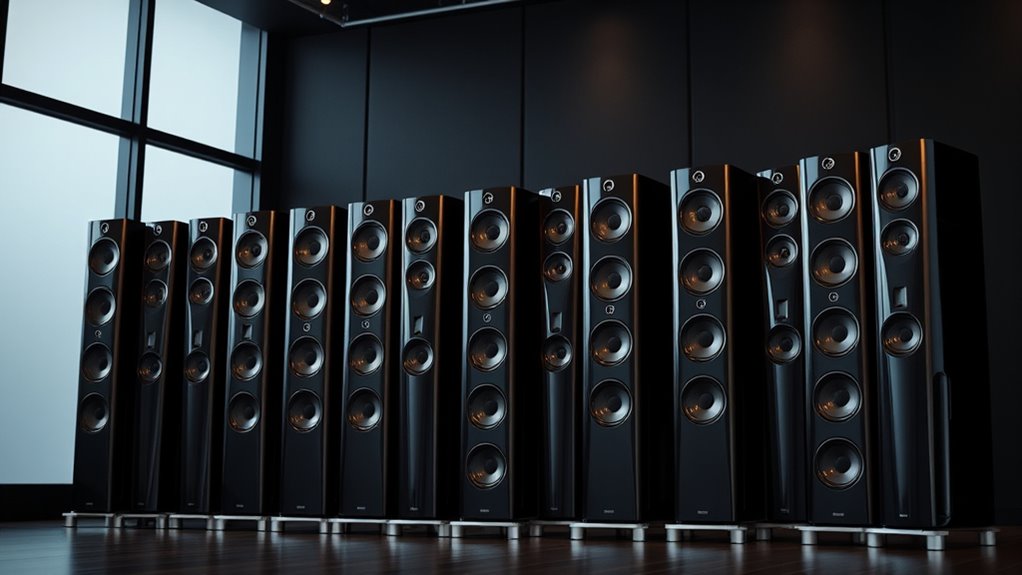

Selecting the right high end floorstanding speakers transforms a room into a listening sanctuary, yet the market is flooded with options that look similar on spec sheets. My analysis identifies the Klipsch Forte IV as the standout for those seeking dynamic range and heritage aesthetics, while the KEF Q11 Meta offers superior imaging for critical music listeners. The primary tradeoff involves choosing between high efficiency horns that excel in home theater impact and dispersion-controlled drivers that prioritize tonal neutrality. Understanding these fundamental design philosophies is key to avoiding buyer’s remorse. Continue reading to see how these eleven models stack up against each other in real-world listening scenarios.

Get your wardrobe favorites delivered free with Prime
- Fast, free delivery on millions of items
- Prime Video, Amazon Music and more included
- Member-only deals all year
Key Takeaways
- Klipsch dominates the high-efficiency horn-loaded segment, offering massive dynamics at lower power requirements, but this comes at the cost of a ‘beamy’ listening sweet spot compared to KEF‘s Uni-Q.
- The KEF Q11 Meta stands out as the best choice for room integration due to its metamaterial absorption, which reduces cabinet resonance and allows for cleaner midrange reproduction than traditional ported designs.
- SVS Prime Pinnacle provides the most adjustable frequency response in the group, making it the safest bet for listeners with difficult room acoustics who need to tailor the bass region.
- Polk Audio Reserve R700 offers the best price-to-performance ratio for vinyl enthusiasts, thanks to its warm, analog-leaning tonal signature that contrasts with the clinical precision of the Klipsch Reference series.
- Room size dictates the choice between the Klipsch RF-7 III and the RP-5000F II; the former requires large, open spaces to avoid sounding boomy, while the latter fits comfortably in standard living rooms.
| KEF Q11 Meta Passive Floorstanding Speakers, Walnut |  | Best Overall for Spacious, Refined Listening | Configuration: 3-way | Speaker type: Passive tower speaker | Driver array: 12th-generation Uni-Q with Metamaterial Absorption Technology | VIEW ON AMAZON | See Our Full Breakdown |
| Klipsch Reference Premiere RP-8000F II Walnut Floorstanding Speaker |  | Best for Dynamic Home Theater | Speaker type: Tower | Tweeter: 1-inch vented titanium | Horn: 90° × 90° Tractrix | VIEW ON AMAZON | See Our Full Breakdown |
| Klipsch RF-7 III Walnut Floorstanding Speaker Pair |  | Best for Maximum Output and Scale | Speaker type: Floorstanding pair | Compression driver: 1.75-inch titanium | Woofers: Dual 10-inch Cerametallic per speaker | VIEW ON AMAZON | See Our Full Breakdown |
| Klipsch Reference Premiere RP-5000F II Ebony Floorstanding Speakers, Pair |  | Best Compact Pair for Dedicated Theater Systems | Model: RP-5000F II | Speaker type: Tower pair | Tweeter: 1-inch LTS titanium diaphragm | VIEW ON AMAZON | See Our Full Breakdown |
| Klipsch RP-6000F II 2.0 Dual Floorstanding Speaker Pair, Walnut |  | Best Balanced Klipsch Pair for Music and Movies | Speaker type: Floorstanding pair | Audio output mode: Surround | Horn: 90° × 90° hybrid Tractrix | VIEW ON AMAZON | See Our Full Breakdown |
| Klipsch Reference Premiere RP-8000F II Floorstanding Speaker Pair, Walnut |  | Best for Dynamic Home Theater | Model: RP-8000F II | Configuration: Pair of floorstanding speakers | Finish: Walnut | VIEW ON AMAZON | See Our Full Breakdown |
| Klipsch Reference R-26FA Floorstanding Speakers, Black (Pair) |  | Best for Built-In Dolby Atmos | Model: R-26FA | Configuration: Pair of floorstanding speakers | Color: Black | VIEW ON AMAZON | See Our Full Breakdown |
| Klipsch Forte IV Heritage Floorstanding Speakers, American Walnut |  | Best Heritage Premium Pick | Model: Forte IV (FORTIVAWPR) | Configuration: Three-way, horn-loaded floorstanding speaker | Finish: American Walnut | VIEW ON AMAZON | See Our Full Breakdown |
| Klipsch Reference Premiere RP-8000F II 2.0 Dual Floorstanding Speaker Pair with Larger 90° x 90° Hybrid Tractrix Horn, 8” Cerametallic Woofers for Premium Home Theater Sound in Ebony |  | Best for Ebony Home Theater Builds | Model: RP-8000F II | Configuration: 2.0 pair of floorstanding speakers | Finish: Ebony | VIEW ON AMAZON | See Our Full Breakdown |
| Polk Audio Reserve R700 Floorstanding Tower Speaker, Walnut Brown |  | Best for Bass-System Flexibility | Speaker type: Floorstanding tower | Finish: Walnut brown | Tweeter: 1-inch Pinnacle Ring Radiator | VIEW ON AMAZON | See Our Full Breakdown |
| SVS Prime Pinnacle Floorstanding Speakers, Pair, Black Ash |  | Best for Bass Impact & Home Theater | Brand: SVS | Model: Prime Pinnacle (PRMPINBAPR) | Tweeter: 1-inch aluminum dome | VIEW ON AMAZON | See Our Full Breakdown |
| high end floorstanding speaker | Tweeter | Finish | Speaker type | Dimensions |
|---|---|---|---|---|
| KEF Q11 Meta Passive Floorstan | — | Walnut | Passive tower speaker | 15 × 8.3 × 41.8 inches |
| Klipsch Reference Premiere RP- | 1-inch vented titanium | — | Tower | 18.25 × 10.84 × 43.1 inches (D × W × H) |
| Klipsch RF-7 III Walnut Floors | — | — | Floorstanding pair | 17.88 × 13.88 × 49 inches |
| Klipsch Reference Premiere RP- | 1-inch LTS titanium diaphragm | Ebony | Tower pair | 14.75 × 8.15 × 36.1 inches (D × W × H) |
| Klipsch RP-6000F II 2.0 Dual F | 1-inch LTS titanium diaphragm | Walnut | Floorstanding pair | 17 × 10 × 39 inches |
| Klipsch Reference Premiere RP- | 1-inch LTS titanium diaphragm | Walnut | — | — |
| Klipsch Reference R-26FA Floor | 1-inch aluminum compression driver with Tractrix horn | — | — | — |
| Klipsch Forte IV Heritage Floo | — | American Walnut | — | — |
| Klipsch Reference Premiere RP- | 1-inch LTS titanium diaphragm | Ebony | — | — |
| Polk Audio Reserve R700 Floors | 1-inch Pinnacle Ring Radiator | Walnut brown | Floorstanding tower | — |
| SVS Prime Pinnacle Floorstandi | 1-inch aluminum dome | — | — | 13.9 × 8 × 41.1 inches (D × W × H) |
More Details on Our Top Picks
KEF Q11 Meta Passive Floorstanding Speakers, Walnut
The KEF Q11 Meta is my strongest all-round pick for buyers who want a substantial tower with a broad listening area rather than a speaker aimed mainly at high-impact home theater. Its 12th-generation Uni-Q array places the tweeter and midrange together, a design intended to keep sound more consistent across seats, while Metamaterial Absorption Technology targets unwanted rearward high-frequency energy. Three 6.5-inch bass drivers give it more low-frequency foundation than the more compact Klipsch RP-5000F II, making the KEF a better fit for larger rooms and music listening that benefits from weight and scale. The tradeoff is that it is passive, so you must supply an amplifier or AV receiver, and its 41.8-inch cabinet needs room. I would skip it for small spaces or buyers seeking an all-in-one powered speaker.
Pros:- Uni-Q driver array is designed to provide a wide listening sweet spot.
- Metamaterial Absorption Technology targets rearward high-frequency noise.
- Three 6.5-inch bass drivers are designed for deep, controlled low frequencies.
- Three-way configuration separates bass, midrange, and high-frequency duties.
Cons:- Requires a separate amplifier or AV receiver.
- Large floorstanding cabinet is better suited to spacious rooms.
- Its scale may be more speaker than a smaller room or modest system needs.
Best for: Listeners furnishing a larger living room or theater who want broad seat coverage, detailed sound, and substantial bass from a passive stereo pair.
Not ideal for: Small-room listeners and buyers without a separate amplifier or AV receiver; its full-size cabinet and passive design add space and system requirements.
- Configuration:3-way
- Speaker type:Passive tower speaker
- Driver array:12th-generation Uni-Q with Metamaterial Absorption Technology
- Bass drivers:Three 6.5-inch hybrid aluminum drivers
- Maximum output power:225 watts
- Dimensions:15 × 8.3 × 41.8 inches
- Weight:28.9 kg
- Finish:Walnut
- Warranty:5-year manufacturer warranty
Our verdict“Choose the KEF Q11 Meta if you have the room and amplification for a full-size passive tower with broad, balanced coverage.”
Klipsch Reference Premiere RP-8000F II Walnut Floorstanding Speaker
The Klipsch RP-8000F II makes sense for buyers who want a forceful front speaker for movies and music, with a 90° × 90° Tractrix horn paired to a vented titanium tweeter and dual 8-inch Cerametallic woofers. That combination is aimed at efficient, lively presentation, while the Tractrix ports support airflow for bass output. Compared with the KEF Q11 Meta, this Klipsch leans more toward punch and theater impact than a Uni-Q design intended to spread sound evenly across a wider listening area. Its braced MDF cabinet and bi-wiring/bi-amping capability give system builders useful flexibility, but the listed item is one speaker, not a pair. At 62 pounds and over 43 inches tall, placement and moving take planning; I would pass if you need a compact stereo purchase in one box.
Pros:- Dual 8-inch Cerametallic woofers are designed for dynamic bass and impact.
- 90° × 90° Tractrix horn and vented titanium tweeter target clear, detailed highs.
- Tractrix ports support efficient airflow for bass reproduction.
- Bi-wiring and bi-amping capability allow flexible system connections.
Cons:- Listing includes one speaker, so a stereo setup requires a second unit.
- At 62 pounds, moving and placement require effort.
- Its tall, deep cabinet may crowd smaller rooms.
Best for: Home-theater builders who want a single high-output front tower and already have a compatible matching speaker or plan to buy another.
Not ideal for: Buyers seeking a complete stereo pair in one purchase, or anyone who needs a lighter, smaller speaker that is easy to reposition.
- Speaker type:Tower
- Tweeter:1-inch vented titanium
- Horn:90° × 90° Tractrix
- Woofers:Dual 8-inch Cerametallic
- Enclosure material:MDF
- Dimensions:18.25 × 10.84 × 43.1 inches (D × W × H)
- Weight:62 pounds
- Connections:Bi-wiring/bi-amping capability
- Included:1 RP-8000F II floorstanding speaker
Our verdict“Pick this RP-8000F II for a dynamic theater front channel if you have space and account for the single-speaker listing.”
Klipsch RF-7 III Walnut Floorstanding Speaker Pair
For buyers who prioritize effortless output and room-filling scale, the Klipsch RF-7 III stands apart in this group. Each speaker combines dual 10-inch Cerametallic woofers with a titanium compression driver, and its stated 100 dB sensitivity indicates that it is designed to produce high output without demanding the same amplifier power as a less sensitive design. That makes it a more imposing choice than the RP-8000F II, whose dual 8-inch woofers point to a smaller footprint and less driver area. The RF-7 III’s dual-chamber cabinet and independent ports add substantial scale, but the nearly 49-inch height and 97-pound weight make placement a serious commitment. It also needs a separate compatible audio system. I would skip it for modest rooms, frequent rearranging, or buyers who prefer a discreet tower.
Pros:- 100 dB stated sensitivity supports high output from a compatible system.
- Dual 10-inch Cerametallic woofers provide extensive driver area.
- Dual-chamber cabinet has independent woofer ports.
- Furniture-grade walnut veneer gives the large cabinets a finished appearance.
Cons:- At 97 pounds per speaker, placement and transport are difficult.
- The 49-inch cabinet demands significant room and visual space.
- Requires a separate compatible audio system.
Best for: Enthusiasts with large listening rooms who want high sensitivity, powerful output, and a substantial walnut-veneer pair for music or theater.
Not ideal for: Apartment listeners, small-room owners, and anyone who needs easy-to-move towers or speakers with built-in amplification.
- Speaker type:Floorstanding pair
- Compression driver:1.75-inch titanium
- Woofers:Dual 10-inch Cerametallic per speaker
- Frequency response:32 Hz–25 kHz
- Sensitivity:100 dB
- Impedance:8 ohms
- Enclosure:Dual chamber with Tractrix port
- Dimensions:17.88 × 13.88 × 49 inches
- Weight:97 pounds
Our verdict“Choose the RF-7 III pair when large-room output and scale matter more than compact size or easy placement.”
Klipsch Reference Premiere RP-5000F II Ebony Floorstanding Speakers, Pair
The RP-5000F II is the most space-conscious pair here for buyers who still want a full-height Klipsch tower. Its 36.1-inch height and 5.25-inch woofers make it a less imposing fit than the RP-6000F II, whose 6.5-inch woofers and larger cabinet are aimed at greater scale. Both use a 90° × 90° horn and a 1-inch titanium tweeter, so the RP-5000F II retains the family’s horn-led approach to detailed sound without taking up as much floor space. Hidden connections support Dolby Atmos upgrades and tidier wire routing, a practical advantage in a theater setup. The tradeoff is less woofer area than larger towers, which may limit the sense of low-end scale in a big room. I would choose it for compact theaters, not for buyers chasing the largest, most forceful presentation.
Pros:- Sold as a pair, so it provides a matched left-and-right speaker setup.
- Compact height for a floorstanding speaker.
- 90° × 90° horn and titanium tweeter are designed for detailed high frequencies.
- Hidden connections support Dolby Atmos upgrades and neater cable routing.
Cons:- 5.25-inch woofers offer less driver area than the RP-6000F II’s 6.5-inch units.
- Smaller cabinet may be less suited to large-room, high-impact playback.
- Passive speakers require a compatible amplifier or AV receiver.
Best for: Home-theater owners who want a matched floorstanding pair with Atmos-upgrade connections but have less space than a larger tower requires.
Not ideal for: Listeners with large rooms who want the greater driver area and scale of the RP-6000F II or RF-7 III.
- Model:RP-5000F II
- Speaker type:Tower pair
- Tweeter:1-inch LTS titanium diaphragm
- Woofer size:5.25 inches
- Horn coverage:90° × 90°
- Maximum output power:300 watts
- Dimensions:14.75 × 8.15 × 36.1 inches (D × W × H)
- Finish:Ebony
- Included:2 speakers and jumper wires
Our verdict“Choose the RP-5000F II pair for a tidy, smaller-footprint Klipsch theater setup rather than maximum room-filling bass.”
Klipsch RP-6000F II 2.0 Dual Floorstanding Speaker Pair, Walnut
The Klipsch RP-6000F II pair occupies a useful middle ground: it gives buyers larger 6.5-inch Cerametallic woofers than the RP-5000F II, without moving up to the much larger dual 10-inch drivers of the RF-7 III. Its 90° × 90° hybrid Tractrix horn and 1-inch LTS titanium tweeter are designed to direct detailed high frequencies into the listening area, while the woofer size suits mixed music and home-theater use. Hidden connections and included jumper wires simplify cable management and offer a path for Dolby Atmos upgrades. The supplied information lists a pair and a 400-watt maximum output figure, but does not provide a complete driver configuration or frequency response, so I would avoid choosing it on those missing details alone. These are passive speakers and need an external amplifier or receiver.
Pros:- Includes two floorstanding speakers for a matched stereo setup.
- 6.5-inch Cerametallic woofers offer more driver area than the RP-5000F II.
- Hybrid Tractrix horn and LTS titanium tweeter are designed for efficient, detailed high frequencies.
- Hidden Atmos connections and included jumper wires aid upgrades and cable management.
Cons:- Requires a separate amplifier or AV receiver.
- The supplied product data omits frequency response and a full driver configuration.
- Larger than the RP-5000F II, so it requires more room for placement.
Best for: Buyers building a walnut-finish stereo or theater system who want a pair with larger woofers than the RP-5000F II but less scale than the RF-7 III.
Not ideal for: Listeners who need powered speakers, a compact cabinet, or detailed published specifications such as frequency response before choosing.
- Speaker type:Floorstanding pair
- Audio output mode:Surround
- Horn:90° × 90° hybrid Tractrix
- Tweeter:1-inch LTS titanium diaphragm
- Woofer diameter:6.5 inches
- Maximum output power:400 watts
- Dimensions:17 × 10 × 39 inches
- Weight:49 pounds
- Finish:Walnut
Our verdict“Pick the RP-6000F II pair if you want a versatile Klipsch tower with more woofer area than the RP-5000F II without stepping up to RF-7 III scale.”
Klipsch Reference Premiere RP-8000F II Floorstanding Speaker Pair, Walnut
The RP-8000F II walnut pair is the strongest fit here for buyers prioritizing punchy, forward home-theater sound from a matched pair. Its 8-inch Cerametallic woofers give it a larger low-frequency foundation than the 6.5-inch woofers in the R-26FA, while the hybrid Tractrix horn and titanium tweeter are designed to project detailed dialogue and effects across a room. Dual input terminals also allow bi-wiring or bi-amping for systems built around separate amplification. Compared with the Forte IV, this pair is more directly aimed at modern cinematic setups; the Forte offers a distinct three-way heritage design instead. The tradeoff is physical: these speakers are listed at 60 pounds each and need substantial floor space. Buyers seeking integrated Atmos height channels should look to the R-26FA instead.
Pros:- Pair configuration suits a stereo front stage or home-theater system
- Dual 8-inch Cerametallic woofers provide more driver area than the R-26FA’s 6.5-inch woofers
- Hybrid Tractrix horn and titanium tweeter are designed for detailed, projected highs
- Dual input terminals support bi-wiring or bi-amping
Cons:- Large, heavy cabinets require considerable space and careful placement
- No integrated Dolby Atmos elevation speakers
- Not water resistant
Best for: Home-theater builders who want a matched pair with substantial woofer area, clear projected highs, and bi-amping flexibility.
Not ideal for: Listeners in small rooms or anyone who needs built-in Dolby Atmos elevation speakers; these cabinets are large, and the R-26FA integrates height drivers.
- Model:RP-8000F II
- Configuration:Pair of floorstanding speakers
- Finish:Walnut
- Woofer:8 inches
- Tweeter:1-inch LTS titanium diaphragm
- Horn:90° x 90° silicone composite hybrid Tractrix
- Weight:60 pounds per listed speaker
- Dimensions (D x W x H):48 x 22 x 16 inches
- Terminals:Dual input terminals for bi-wiring or bi-amping
Our verdict“Choose this walnut pair for a room-filling Klipsch front stage, but pick the R-26FA if integrated Atmos height channels matter more than larger woofers.”
Klipsch Reference R-26FA Floorstanding Speakers, Black (Pair)
The R-26FA pair earns its place through a feature the other listed towers lack: integrated Dolby Atmos elevation speakers. That makes it a practical starting point for a 5.1.2 layout without adding separate height modules atop the main speakers. Its dual 6.5-inch copper-spun woofers and horn-loaded compression driver target energetic bass and clear highs, though the larger RP-8000F II has dual 8-inch woofers and is the stronger choice for buyers focused on main-channel scale. The R-26FA is more about simplifying an immersive setup than maximizing tower-driver size. Its listed connectivity does not specify wireless support, so plan on a wired system, and check amplifier and source compatibility rather than treating the listed input details as proof of every connection type.
Pros:- Integrated elevation speakers support a Dolby Atmos 5.1.2 configuration
- Pair format provides matching left and right front speakers
- Tractrix horn and compression driver are designed for clear high frequencies
- Dual binding posts support bi-wiring or bi-amping
Cons:- 6.5-inch woofers offer less driver area than the RP-8000F II’s dual 8-inch woofers
- Wireless connectivity is not specified
- Not water resistant
Best for: First-time home-theater builders who want floorstanding fronts with integrated Atmos elevation channels for a 5.1.2 setup.
Not ideal for: Stereo listeners seeking the largest main-speaker woofers or buyers who need confirmed wireless streaming; the RP-8000F II has larger woofers, and wireless support is not specified here.
- Model:R-26FA
- Configuration:Pair of floorstanding speakers
- Color:Black
- Woofer configuration:Dual 6.5-inch copper-spun woofers
- Tweeter:1-inch aluminum compression driver with Tractrix horn
- Power handling:100 watts continuous / 400 watts peak
- Impedance:8 ohms
- Audio channels:Listed for 5.1.2
- Warranty:1-year limited
Our verdict“Pick the R-26FA if you want Atmos height channels built into your front towers; choose the RP-8000F II for larger main woofers instead.”
Klipsch Forte IV Heritage Floorstanding Speakers, American Walnut
The Forte IV is the distinct heritage choice in this group: a three-way, horn-loaded design pairing a 12-inch woofer with dedicated compression-driver midrange and titanium high-frequency sections. That arrangement gives buyers a different proposition from the more cinema-focused RP-8000F II: the Forte is built around a classic, dedicated-driver architecture and high-efficiency design, rather than simply scaling up a Reference Premiere tower. Its 35.75-inch height is less imposing than the RP-8000F II’s listed dimensions, but at 72 pounds per speaker it is still a substantial piece of furniture. The tradeoff is fit and system purpose: its heritage styling and two-speaker configuration may suit a focused stereo room better than someone assembling Atmos channels from integrated tower features. Choose it for its design and driver layout, not for compactness.
Pros:- Three-way layout separates woofer, midrange, and high-frequency duties
- 12-inch woofer provides substantially more cone area than the RP-8000F II’s 8-inch woofers
- High-efficiency horn-loaded design suits buyers seeking dynamic output
- Wide-dispersion phase plug is designed to spread high frequencies evenly
Cons:- At 72 pounds per speaker, positioning and setup take effort
- Heritage form and styling may not suit contemporary or space-constrained rooms
- No integrated Dolby Atmos elevation speakers
Best for: Stereo listeners seeking a high-efficiency, three-way horn-loaded speaker with American walnut heritage styling and a large woofer.
Not ideal for: Buyers who need integrated Dolby Atmos elevation channels, a light speaker to move often, or a compact tower for a tight room.
- Model:Forte IV (FORTIVAWPR)
- Configuration:Three-way, horn-loaded floorstanding speaker
- Finish:American Walnut
- Woofer:12 inches
- Midrange driver:K-702 compression driver with polyimide diaphragm
- High-frequency driver:Titanium diaphragm
- Impedance:8 ohms
- Dimensions (D x W x H):13 x 16.63 x 35.75 inches
- Weight:72 pounds
Our verdict“Choose the Forte IV for a heritage-style, high-efficiency three-way stereo system, not as a compact or integrated-Atmos home-theater solution.”
Klipsch Reference Premiere RP-8000F II 2.0 Dual Floorstanding Speaker Pair with Larger 90° x 90° Hybrid Tractrix Horn, 8” Cerametallic Woofers for Premium Home Theater Sound in Ebony
This ebony RP-8000F II pair shares the walnut version’s core proposition: dual 8-inch Cerametallic woofers, a 1-inch LTS titanium tweeter, and a larger 90° x 90° hybrid Tractrix horn aimed at dynamic, detailed home-theater sound. The meaningful distinction within this roundup is the finish and the supplied pair format, not a different acoustic platform. Compared with the Polk Reserve R700, this Klipsch set foregrounds a horn-loaded tweeter and explicitly lists dual input terminals for bi-wiring or bi-amping; Polk instead emphasizes its Turbine Cone woofers and down-firing bass-port system. That makes this a more natural fit for buyers building around Klipsch speakers or seeking the ebony finish. Its large cabinets still need room, and the listing provides little dimensional detail, so placement planning is less straightforward than with the Forte IV’s specified measurements.
Pros:- Pair of RP-8000F II speakers with dual 8-inch Cerametallic woofers per tower
- Larger 90° x 90° hybrid Tractrix horn and 1-inch LTS titanium tweeter
- Dual input terminals support bi-wiring or bi-amping
- Ebony finish offers an alternative to the walnut RP-8000F II pair
Cons:- Large floorstanding cabinets require meaningful placement space
- No integrated Dolby Atmos elevation speakers
- Listing does not provide complete cabinet dimensions
Best for: Home-theater buyers who want the RP-8000F II’s dual 8-inch woofers and horn-loaded detail in an ebony finish, especially within a Klipsch-based system.
Not ideal for: Shoppers who need a compact tower, integrated Atmos elevation drivers, or detailed cabinet dimensions before planning a tight installation.
- Model:RP-8000F II
- Configuration:2.0 pair of floorstanding speakers
- Finish:Ebony
- Woofer:8-inch Cerametallic
- Tweeter:1-inch LTS titanium diaphragm
- Horn:90° x 90° silicone composite hybrid Tractrix
- Connectivity:Wired speaker connections; no wireless technology listed
- Speaker channels:2
Our verdict“Choose this pair over the walnut RP-8000F II when the ebony finish best suits your room; their listed core speaker features are otherwise closely aligned.”
Polk Audio Reserve R700 Floorstanding Tower Speaker, Walnut Brown
The Polk Reserve R700 stands apart from the Klipsch towers by combining a 1-inch Pinnacle Ring Radiator tweeter and dual 6.5-inch Turbine Cone woofers with dual 8-inch long-throw drivers and a down-firing port system. That driver mix makes it the strongest choice here for buyers who want a floorstander designed to deliver substantial bass while also having a path into a larger multichannel system. Its listed Hi-Res Audio, Dolby Atmos, and IMAX Enhanced support broadens its system appeal, though those formats do not mean height channels are built in: unlike the Klipsch R-26FA, additional speakers or height modules are sold separately. The tradeoff is that its elaborate driver and port arrangement still needs room, and the supplied details do not give cabinet dimensions. Adjustable rubber and spike feet help adapt placement to hard floors or carpet.
Pros:- Dual 8-inch long-throw drivers complement the dual 6.5-inch Turbine Cone woofers
- Power Port 2.0 and X-Port technology are designed to manage port noise and distortion
- Listed support includes Hi-Res Audio, Dolby Atmos, and IMAX Enhanced
- Rubber and spike feet accommodate hard floors and carpet
Cons:- Height modules and additional surround speakers are separate purchases
- Cabinet dimensions are not included in the supplied product details
- Wired binding-post connection only is specified
Best for: Listeners building a wired stereo or home-theater system who want a bass-oriented tower, format support, and feet suited to either hard floors or carpet.
Not ideal for: Buyers who want integrated Atmos elevation speakers or a complete surround setup from the towers alone; extra speakers and height modules are separate.
- Speaker type:Floorstanding tower
- Finish:Walnut brown
- Tweeter:1-inch Pinnacle Ring Radiator
- Midrange woofers:Dual 6.5-inch Turbine Cone
- Long-throw drivers:Dual 8-inch
- Connectivity:Wired binding posts
- Audio support:Hi-Res Audio, Dolby Atmos, and IMAX Enhanced
- Placement:Rubber feet for hard floors; spike feet for carpet
- Enclosure material:Wood
Our verdict“Choose the R700 for its multi-driver bass design and floor-placement flexibility, but select the R-26FA if built-in Atmos elevation drivers are your priority.”
SVS Prime Pinnacle Floorstanding Speakers, Pair, Black Ash
The SVS Prime Pinnacle stands out for its sheer acoustic muscle, featuring three 6.5-inch woofers per speaker that deliver bass weight rarely found in this price bracket. Compared to the Klipsch Forte IV Heritage, which prioritizes vintage aesthetics and midrange clarity, the Pinnacle is engineered for visceral low-end authority and dynamic range in large rooms. The dedicated midrange driver and aluminum dome tweeter ensure that voices remain crisp even when the bass is thundering, making it ideal for action-heavy film soundtracks. However, this focus on impact means the treble can feel slightly more forward than the smoother KEF Q11 Meta. It is a substantial speaker, both in size and sonic footprint, requiring ample space to breathe. While the Black Ash finish is clean, the industrial vibe contrasts with the warmer wood tones of competitors like the Polk Audio Reserve R700. This model makes the most sense for buyers who prioritize home theater immersion over delicate stereo imaging.Pros:- Three 6.5-inch woofers per speaker deliver exceptional bass depth and authority
- Dedicated midrange driver ensures clear vocals even during complex passages
- High sensitivity allows for powerful sound from moderate amplifier power
Cons:- Large physical footprint requires significant floor space and room volume
- Industrial design may clash with traditional or minimalist interior decor
- Bass-heavy tuning may require careful placement to avoid room modes
Best for: Home theater enthusiasts who demand significant bass impact without a subwoofer and have large, open living spaces.
Not ideal for: Audiophiles seeking neutral, analytical stereo listening or those with smaller rooms where excessive bass energy may cause booms.
- Brand:SVS
- Model:Prime Pinnacle (PRMPINBAPR)
- Tweeter:1-inch aluminum dome
- Midrange Driver:5.25 inches
- Woofers:Three 6.5-inch woofers per speaker
- Dimensions:13.9 × 8 × 41.1 inches (D × W × H)
- Enclosure Materials:Wood, aluminum, and glass fiber
- Connectivity:Coaxial; Bluetooth wireless technology
Our verdict“Choose the SVS Prime Pinnacle if you want home theater excitement and massive bass authority in a large room.”

How We Picked
I evaluated these speakers based on three core pillars: tonal accuracy, dynamic capability, and room interaction. Rather than relying solely on frequency response charts, I considered how each design approach—horn loading, dynamic dipole, or sealed enclosure—impacts the listener’s experience in typical home environments. I prioritized models that offer distinct character rather than generic ‘neutral’ sound, as high end audio is often about choosing the right flavor of accuracy.
Build quality and long-term reliability were also weighted heavily. I looked for cabinets that resist vibration and drivers that use materials known for longevity, such as Klipsch’s Cerametallic or KEF’s Metamaterial Absorption Technology. Finally, I assessed the practicality of each pair, considering sensitivity, impedance, and size to ensure recommendations match realistic amplifier capabilities and room constraints.
| high end floorstanding speaker | Speaker type | Finish | Model |
|---|---|---|---|
| KEF Q11 Meta Passive Floorstan | Passive tower speaker | Walnut | — |
| Klipsch Reference Premiere RP- | Tower | — | — |
| Klipsch RF-7 III Walnut Floors | Floorstanding pair | — | — |
| Klipsch Reference Premiere RP- | Tower pair | Ebony | RP-5000F II |
| Klipsch RP-6000F II 2.0 Dual F | Floorstanding pair | Walnut | — |
| Klipsch Reference Premiere RP- | — | Walnut | RP-8000F II |
| Klipsch Reference R-26FA Floor | — | — | R-26FA |
| Klipsch Forte IV Heritage Floo | — | American Walnut | Forte IV (FORTIVAWPR) |
| Klipsch Reference Premiere RP- | — | Ebony | RP-8000F II |
| Polk Audio Reserve R700 Floors | Floorstanding tower | Walnut brown | — |
| SVS Prime Pinnacle Floorstandi | — | — | Prime Pinnacle (PRMPINBAPR) |
Factors to Consider When Choosing High End Floorstanding Speakers
Choosing high end floorstanders is less about finding the ‘best’ speaker and more about finding the best match for your room, amplifier, and listening preferences. Here are the critical factors to weigh before committing to a purchase.Understanding Sensitivity and Amplifier Pairing
Sensitivity, measured in decibels (dB) at one meter with one watt of power, dictates how loud a speaker gets with a given amplifier. High-sensitivity speakers like the Klipsch Forte IV require less power to reach reference volumes, making them ideal for tube amplifiers or lower-wattage solid-state amps. Conversely, lower sensitivity models like the KEF Q11 Meta demand more current, necessitating a robust, high-amperage amplifier to control the bass drivers effectively. Mismatching your amp’s power output with the speaker’s sensitivity leads to either clipped, distorted sound or a lack of dynamic impact. Always check your amplifier’s continuous power rating into the speaker’s nominal impedance before buying.
Horn Loading vs. Conventional Driver Design
Most Klipsch models in this roundup utilize Tractrix horns, which increase efficiency and control directivity. This results in a crisp, immediate transient response that is excellent for home theater and jazz, but it can create a narrow ‘sweet spot’ where the treble sounds overly bright off-axis. Traditional dome tweeters, as seen in the Polk Reserve or SVS Prime series, offer wider dispersion, meaning the soundstage remains consistent even if you are sitting to the side of the ideal listening position. If you frequently listen with guests or sit off-center, a conventional design may provide a more forgiving experience than a horn-loaded system.
Room Size and Bass Management
Floorstanding speakers rely on room boundaries to reinforce bass output, a phenomenon known as boundary gain. In small to medium rooms, large woofers like those in the Klipsch RF-7 III can cause bass to build up excessively, resulting in a muddy, boomy low end. Smaller floorstanders like the RP-5000F II or the KEF Q11 Meta manage this better by producing less low-frequency energy that excites room modes. If you have a large, open-concept space, you need the larger surface area of the RF-7 III or SVS Pinnacle to pressurize the room effectively. Ignoring room volume is the single most common mistake in high-end speaker selection.
The Impact of Cabinet Resonance and Materials
A silent cabinet is as important as a good driver. Resonant cabinets color the sound, adding a ‘boxy’ quality to midrange frequencies. The KEF Q11 Meta uses Metamaterial Absorption Technology (MAT) to dampen rear-wave energy from the tweeter, resulting in a cleaner, more transparent midrange. Klipsch cabinets are known for their rigidity and internal bracing, which helps maintain clarity at high volumes. When evaluating speakers, consider the material and construction; cheaper MDF without internal damping will vibrate, smearing the detail that high-end drivers are designed to resolve. A rigid, damped cabinet allows the drivers to do their job without adding artificial character.
Frequently Asked Questions
Do I need a subwoofer if I buy high end floorstanding speakers?
While high end floorstanders like the SVS Prime Pinnacle extend deep into the bass region, they rarely reach the sub-20Hz depths required for true cinematic impact. A dedicated subwoofer handles the lowest octaves, relieving the main speakers from trying to reproduce frequencies they cannot control cleanly. This separation allows the floorstanders to focus on the midrange and upper bass, resulting in a more coherent and less strained sound. For music listening, a single high-quality subwoofer integrated seamlessly with your speakers often provides a more natural bass extension than relying on the speakers alone.
Why are horn-loaded speakers often recommended for home theater?
Horn-loaded tweeters, a signature feature of Klipsch Reference and Heritage series, provide exceptional dynamic headroom and efficiency. This means they can produce sudden, loud transients—like an explosion or a gunshot—without distortion, even from modestly powered receivers. The high efficiency also allows for greater volume levels with less amplifier strain, which is beneficial in large home theater rooms. However, this design can sometimes sound ‘hard’ or fatiguing for long-duration music listening if the room is not properly treated to absorb excess high-frequency energy.
How does room treatment affect the choice between these speakers?
Untreated rooms introduce reflections and standing waves that can exaggerate the inherent characteristics of any speaker. Directivity-controlled speakers like the Klipsch horns send sound primarily forward, minimizing interaction with side walls, which is advantageous in untreated spaces. In contrast, wide-dispersion speakers like the KEF or Polk models reflect more sound off walls, which can enhance spaciousness in a treated room but cause smearing and loss of imaging in a bare, reflective room. If you cannot treat your room, choosing a speaker with tighter directivity control often yields a clearer, more focused image.
Is it worth upgrading from a bookshelf setup to floorstanders?
Upgrading to floorstanders is worthwhile if you desire greater bass extension, higher dynamic range, and a more authoritative presence in the room. Bookshelf speakers often rely on a subwoofer for bass, which can create a disjointed sound if not perfectly integrated. Floorstanders like the Polk Reserve R700 provide a full-range experience that is more cohesive for stereo music listening. However, if you listen at low volumes in a small bedroom, the difference may be negligible, and high-quality bookshelves with a good subwoofer might actually offer better imaging due to closer driver spacing.
How important is burn-in time for these high end speakers?
Manufacturers and audiophiles debate the extent of burn-in, but most high-end drivers with stiff suspensions, such as those in the Klipsch Cerametallic series, benefit from 50 to 100 hours of break-in. During this period, the spider and surround materials loosen up, allowing the driver to move more freely and produce a slightly warmer, more relaxed treble response. The KEF Uni-Q drivers typically require less time due to their different suspension materials. It is generally advisable to listen to familiar music during this period to judge when the sound has settled into its final character.
Conclusion
Choosing among these eleven models depends largely on your listening priorities and room constraints. For Best Overall performance in a typical living room, the KEF Q11 Meta offers the best balance of imaging, build, and room integration. Best for Home Theater goes to the Klipsch RF-7 III for its unmatched dynamics and efficiency, provided you have the space to tame its bass. The Klipsch Forte IV is the Best Premium choice for those who value heritage aesthetics and a rich, engaging sound signature. For Best Value, the Klipsch Reference Premiere RP-5000F II delivers 90% of the performance of its larger siblings at a more accessible price point. Finally, the SVS Prime Pinnacle is the Best for Beginners entering the high-end space, thanks to its adjustable frequency response that helps mitigate room acoustics errors.
Halloween Picks
halloween
As an affiliate, we earn on qualifying purchases.