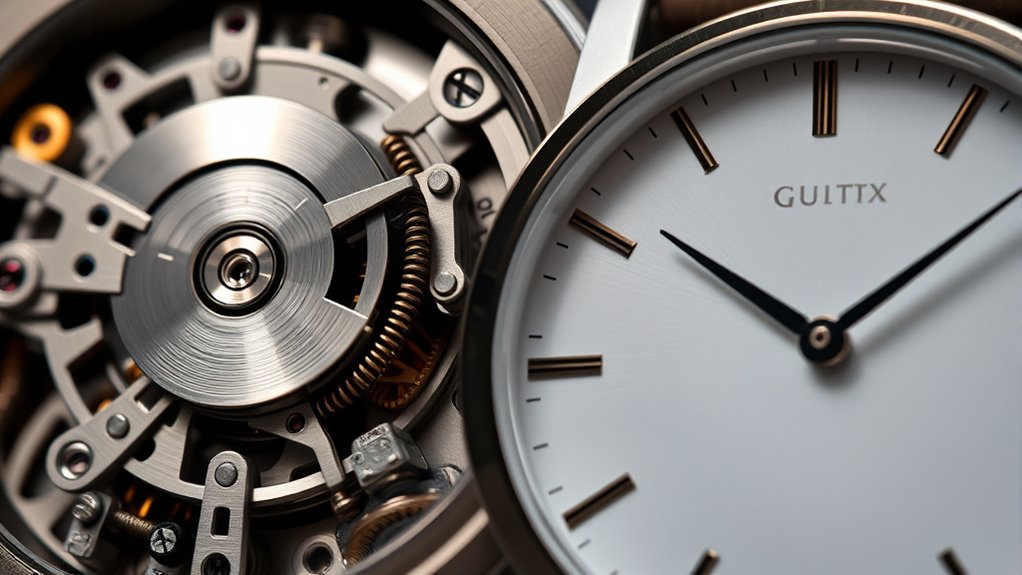

Mechanical watches rely on gears, springs, and manual winding to keep time, offering craftsmanship and tradition but needing regular maintenance. Quartz watches use a battery and a crystal oscillator for highly accurate timekeeping with minimal upkeep and adjustments. Mechanical movements require winding and professional servicing, while quartz models are more convenient with battery replacements. Understanding how each works helps you choose the right type for your lifestyle, and exploring further reveals even more about their unique features and benefits.
Key Takeaways
- Mechanical movements rely on gears and springs, requiring winding and regular servicing, while quartz movements use battery-powered crystals for accurate timekeeping.
- Mechanical watches typically have a power reserve of 40-80 hours, whereas quartz watches have a battery life of several years with minimal maintenance.
- Mechanical watches are valued for craftsmanship and tradition, but need periodic winding and servicing; quartz watches are low-maintenance and highly precise.
- Mechanical movements can be affected by environmental factors and require lubrication, unlike quartz movements which are less sensitive and more reliable daily.
- Choice depends on lifestyle and preference: mechanical for craftsmanship and tradition, quartz for accuracy and convenience.
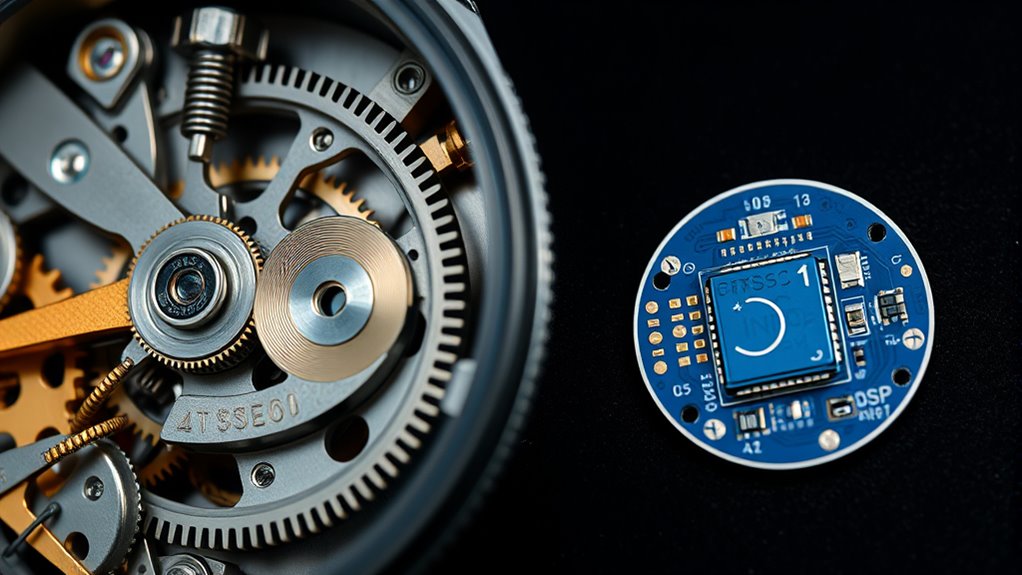
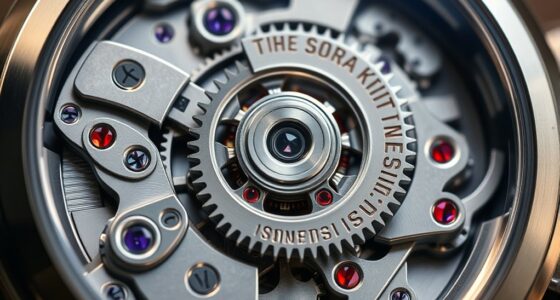
Have you ever wondered how different watch movements keep time? Understanding the mechanics behind your watch can deepen your appreciation for its design and functionality. Mechanical watches rely on intricate gears, springs, and escapements to keep time, and maintaining them requires regular watch maintenance. One essential aspect of a mechanical watch is its power reserve—the amount of time it can run without needing to be rewound or wound again. Typically, mechanical watches have a power reserve ranging from 40 to 80 hours, depending on the model. When you wind your mechanical watch, you’re storing energy in the mainspring, which gradually releases as the gear train moves. Over time, the mainspring unwinds, and the watch stops. That’s why keeping an eye on the power reserve is vital; if it runs out, you’ll need to wind it to restore its accuracy and keep it running smoothly. Ignoring the power reserve can lead to inaccurate timekeeping and, in some cases, potential wear and tear on the movement components. Proper watch maintenance involves not just winding at regular intervals but also periodic servicing by a professional to verify all parts are lubricated and functioning correctly.
In contrast, quartz watches operate through a different mechanism altogether. They use a tiny battery to power a quartz crystal oscillator, which vibrates at a precise frequency—usually 32,768 times per second. This vibration drives an electronic circuit that moves the watch hands with remarkable accuracy. Because of this straightforward operation, quartz watches generally require less maintenance and are more convenient for everyday wear. The battery life can last anywhere from one to several years, and when it runs out, you simply replace it. Unlike mechanical watches, quartz movements don’t rely on winding or power reserve management. They are less sensitive to daily handling and environmental factors, making them highly reliable and low-maintenance.
However, some enthusiasts prefer mechanical watches for their craftsmanship and tradition, despite the need for regular watch maintenance and attention to the power reserve. On the other hand, if you’re looking for precision and minimal upkeep, quartz movements provide an accurate, hassle-free option. Both types have their advantages, but understanding how each keeps time helps you make an informed choice based on your lifestyle and appreciation for watchmaking. Whether you choose a mechanical or quartz watch, knowing the basics of their operation guarantees you get the most out of your timepiece.
Frequently Asked Questions
How Do Mechanical and Quartz Watches Compare in Maintenance Needs?
You’ll find mechanical watches need regular maintenance, like lubrication, to keep the gears running smoothly, which can be costly and time-consuming. Quartz watches, on the other hand, are battery-dependent and require less maintenance—usually just a battery change every couple of years. Mechanical movements demand more attention over time, while quartz watches stay more convenient, making them a better choice if you prefer low-maintenance timepieces.
Which Type of Movement Is More Environmentally Friendly?
You’ll find that solar-powered mechanical watches are more environmentally friendly because they use solar energy to recharge their batteries, reducing the need for disposable batteries. Additionally, both types often incorporate recyclable materials, minimizing waste. By choosing a solar-powered watch with eco-friendly components, you help lower your carbon footprint and support sustainability efforts, making it a smarter, greener choice compared to traditional quartz or mechanical watches that rely on non-renewable resources.
Can Mechanical Watches Be More Accurate Than Quartz?
In the accuracy debate, mechanical watches generally aren’t more precise than quartz ones. Quartz movements excel in precision comparison because their electronic oscillators keep time more consistently, often within a few seconds per month. Mechanical watches, while admired for craftsmanship and tradition, tend to lose or gain a few seconds daily. So, if accuracy is your priority, quartz watches usually outperform mechanical ones.
Are Mechanical Watches More Durable Than Quartz Watches?
You might find it surprising, but mechanical watches often aren’t more durable than quartz ones. Quartz watches usually withstand daily wear better, thanks to their simpler, fewer moving parts. Mechanical watches, however, shine with their aesthetic appeal and intricate craftsmanship, but they’re more sensitive to water resistance and shocks. So, if you need durability, quartz might be your better bet, while mechanical watches excel in elegance and artisanal charm.
What Are the Cost Differences Between Mechanical and Quartz Watches?
You’ll find that quartz watches generally cost less than mechanical ones due to lower manufacturing complexity. Mechanical watches often carry a luxury branding premium because of intricate craftsmanship and higher production costs. If you’re on a budget, quartz offers affordability and accuracy, but if you value artisanal quality and exclusivity, a mechanical watch’s higher price reflects its detailed craftsmanship and prestige.
Conclusion
So, whether you prefer the craftsmanship of mechanical watches or the precision of quartz, understanding the differences helps you make an informed choice. Did you know that quartz movements are about 50 times more accurate than mechanical ones? That means less time adjusting your watch and more confidence in its reliability. Ultimately, it’s about what matters most to you—tradition or convenience. Whichever you choose, you’re getting a timepiece that suits your style and needs perfectly.

Born in Dubai to Pakistani parents, Aisha deeply understands Middle Eastern and South Asian luxury markets. She excels in forging strategic partnerships with top-tier luxury brands worldwide, fostering cross-cultural collaborations that enhance our global presence.