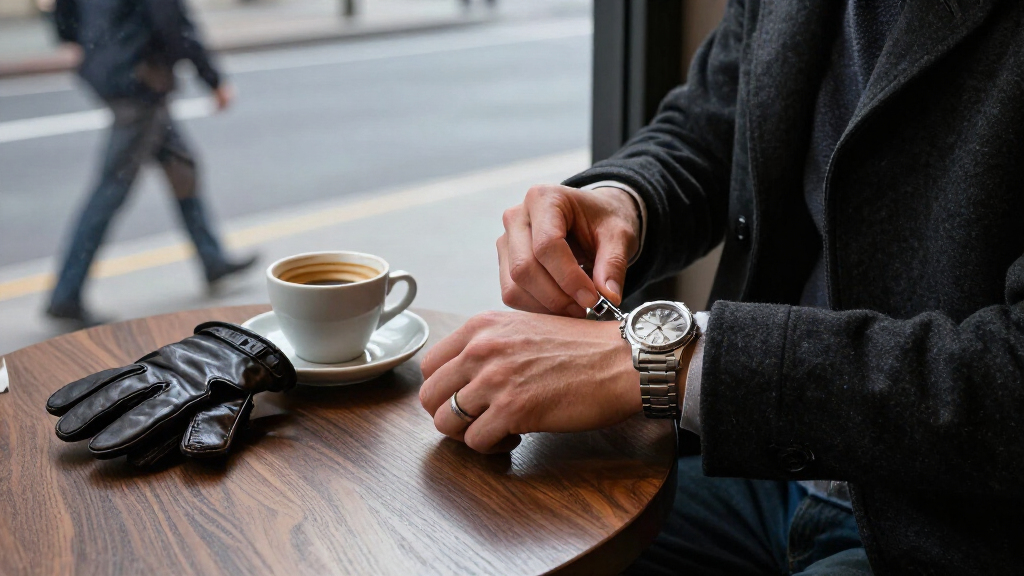

TL;DR
Luxury watches for men bring together design, movement, materials, brand history, and long-term service. Choose by how you plan to wear yours, how it fits, and what it costs to own; a high price alone does not guarantee lasting value.
A luxury watch can look perfect in a photograph and feel like a dinner plate on your wrist. The difference between a watch you admire and one you actually wear often comes down to fit, daily comfort, and purpose.

Get your wardrobe favorites delivered free with Prime
- Fast, free delivery on millions of items
- Prime Video, Amazon Music and more included
- Member-only deals all year
This guide explains what makes a watch feel luxurious, how mechanical, quartz, and light-powered movements compare, and which features suit everyday wear, travel, or formal occasions. You will also get a practical buying checklist for new and pre-owned watches, including the costs and checks that can be easy to overlook.
Think of buying a watch like choosing a well-made pair of shoes: the name and materials matter, but you still need the right fit for your life. A fine watch can be a pleasure without being an investment, and a high price alone does not tell you whether it is the right one for you.
Luxury has no universal price threshold; finishing, construction, design, service support, and movement all contribute.
Choose mechanical, quartz, solar, or Spring Drive based on the ownership experience you want.
Match the style and features to your routine, then check fit beyond case diameter.
For pre-owned watches, verify condition, service history, reference details, return terms, and authenticity.
Treat resale gains as uncertain and budget for tax, insurance, straps, and servicing.
What Makes a Watch Feel Truly Luxurious?
A luxury watch combines thoughtful design, careful construction, reliable quality control, and a brand or model history that people value; there is no universal price line that makes a watch luxury. These qualities matter because a watch is both a precision object and something you interact with repeatedly. Crisp edges, a balanced case, and an easy-to-read dial can make ordinary moments of checking the time feel considered, while a respected name alone cannot fix a watch that is awkward or hard to maintain.
Look closely at how the case catches light. Brushed surfaces diffuse it into a soft, satin-like sheen; polished edges reflect it sharply, revealing the transitions between finishes. Those details take skill and influence the watch’s character, but they also create tradeoffs: polished surfaces show scratches more readily, while a heavily finished case may cost more to repair without changing how accurately it keeps time. Inside, a mechanical movement may show hand-finished components or a complication such as a chronograph. Premium watches can also use quartz or solar technology, which may offer greater convenience and accuracy with less mechanical upkeep. The movement is part of the experience, not a simple ranking of quality.
Imagine comparing two watches at a counter: one has a gold case but feels awkward and offers little service support; the other has a comfortable steel case, clear markers, and a well-supported movement. The second may make a better daily companion because comfort and readability affect every wear, while weak service access can turn a repair into a long, expensive problem. Gold brings a distinctive look and material value, but it is softer and heavier than steel, so it may not suit every routine.
Long-term ownership matters too. Check whether the brand or a qualified watchmaker can service the movement and source parts. Serviceability affects more than repair bills: it determines whether a small fault can be fixed promptly or leaves the watch unused while parts are found. A watch is a small machine with a long life ahead of it; good support helps it keep ticking after the first shine has faded.
Luxury is a mix of craft and experience: precious materials can add appeal, though not always more comfort, utility, or lasting value.
Popular right now

Shark Pet Cordless Stick Vacuum, 40-Minute Runtime, Lightweight, IX141

Sony WH-1000XM6 Wireless Noise-Canceling Headphones, Black

Bose QuietComfort Headphones (2nd Gen), Wireless Over-Ear Noise-Cancelling Headphones, Black
As an affiliate, we earn on qualifying purchases.
Choose a Movement That Matches Your Routine
Luxury watches for men use several movement types, and the best one depends on whether you enjoy winding and mechanical craft or prefer low-maintenance accuracy. A mechanical watch runs on a wound mainspring; quartz uses a battery and quartz oscillator; solar watches collect light; Grand Seiko’s Spring Drive pairs a mechanical power source with an electronic regulator. These differences shape daily ownership: how often you set or wind the watch, how consistently it keeps time, and what sort of service it may eventually need.
An automatic mechanical watch winds as you move your wrist, while a manual watch needs winding by hand. That ritual can be part of the pleasure: you might wind a dress watch each morning before putting on a crisp shirt. It also means a watch left unworn may stop, and an automatic is not maintenance-free simply because it winds itself. Mechanical watches need periodic servicing, and service costs can rise with complexity. The benefit is the tactile, mechanical experience; the tradeoff is that you accept more care and potentially less day-to-day accuracy than with quartz.
Quartz is usually practical and accurate, which suits someone who wants to grab a watch from the dresser and leave. A solar model offers similar convenience while drawing energy from light, though it still has components that may eventually need attention. Think of movement choice like choosing between a manual espresso machine and a good automatic coffee maker: one invites you into the process; the other makes the routine simpler. Neither choice is automatically more luxurious; the right one is the one whose upkeep and feel you will appreciate rather than resent.
More functions do not automatically mean a better watch. A GMT display can help when you call colleagues abroad, and a chronograph can time a train platform sprint, but a tourbillon or perpetual calendar may add complexity you rarely use. Each additional mechanism can make the dial harder to read and service more involved. Choose the feature you will reach for, not the one that sounds most impressive, so the function earns the space and cost it adds.
Match the Watch to the Moments You’ll Wear It
The right watch style follows your routine: a slim dress watch slips beneath a cuff, a diver is built for water-oriented use, and a GMT can help you track another time zone. A chronograph adds stopwatch functions, while a simple everyday watch keeps the dial clear and easy to read. Matching style to use matters because size, thickness, and dial layout affect comfort and legibility long after the novelty of a new complication wears off.
| Style | Where it fits | What to check |
|---|---|---|
| Dress watch | Formal events and office wear | Thin profile, clear dial, comfortable strap |
| Diver | Casual wear and water activities within its rating | Legible markers, bezel, water-resistance guidance |
| GMT | Travel or tracking a second time zone | Readable second-time display and simple setting |
| Chronograph | Timing tasks and sporty everyday wear | Subdial legibility, thickness, pushers |
For example, if you fly between Berlin and New York, a GMT can show local time and home time at a glance. That convenience is useful when you need to coordinate across time zones, but only if the second-time display is readable and setting it feels intuitive. If you mostly wear a jacket and work at a desk, a thick sports watch may catch on your cuff or feel heavy by afternoon. A watch can suit several settings, but carrying every possible feature often adds bulk or visual clutter you notice every day.
Water resistance needs a careful read. A rating is a test specification under stated conditions, not a promise that a watch is ready for every swim or dive; movement, impact, temperature, and aging seals can affect real-world protection. Follow the maker’s guidance, have water resistance checked when appropriate, and avoid operating crowns or pushers underwater unless the instructions allow it. This extra care matters because water damage can be costly and may not be covered by a warranty.
Find a Size That Feels Right on Your Wrist
A comfortable fit depends on more than case diameter: lug-to-lug length, thickness, bracelet shape, weight, and your own preferences all change how a watch wears. Diameter describes the case across its face, but lug-to-lug length determines how far it spans your wrist; thickness and weight influence whether it slides under a cuff or shifts as you move. Two watches with the same stated diameter can feel quite different once their lugs and bracelets meet your wrist.
Try a watch on if you can. Let your arm hang naturally, then bend your wrist and slide your hand under a shirt cuff. A watch that looks balanced in a product photo may feel top-heavy when you type, while a smaller vintage-inspired case may sit neatly and disappear into your day. Pay attention to where the crown lands too: a large or sharply edged crown can press into the back of your hand when you bend your wrist.
Imagine a 40 mm steel watch with long lugs beside a 40 mm watch with a compact case. The first may extend toward the edge of a smaller wrist; the second may sit comfortably within it. The bracelet can change the impression further: a tapered bracelet may feel lighter, while a broad bracelet can make the watch feel more substantial. That is why a single number cannot tell you the whole fit story.
Case sizes have become more varied, including smaller options and vintage-inspired proportions, but there is no one correct size for everyone. Style and sizing vary by brand, so check that brand’s measurements and, when possible, compare several models on your wrist. Your comfort is the useful measure, especially after wearing it for more than a minute in front of a mirror.
Use This Checklist Before You Buy
A good watch purchase starts with your full ownership budget, not just the sticker price. Add tax, insurance, servicing, a possible strap change, and import costs if they apply. These costs affect which watches are genuinely affordable to own: a lower purchase price can be offset by a complicated movement or limited service options, while a simpler watch may leave room for care and wear. A watch with an intricate calendar may be more expensive to maintain than a simpler model, even if both look equally at home with your wardrobe.
- Set a complete budget, including likely ownership costs.
- Name your main use: daily wear, formal occasions, water activities, or travel.
- Check the fit by comparing diameter, lug-to-lug length, thickness, and bracelet shape.
- Read the practical specifications, including legibility, accuracy, power reserve, and service access.
- Try it on if possible, and move your wrist as you would during the day.
- Buy from a reputable seller with clear return terms, documentation, and a written condition description.
For a concrete example, someone buying a first watch for office wear might choose a legible three-hand model, then reserve money for insurance and a fitted strap. That can bring more daily enjoyment than spending the entire budget on a complication they will rarely use. The tradeoff is straightforward: a simpler watch may offer less novelty, but its clarity and comfort can make it more useful across ordinary workdays.
Ask where the watch can be serviced and what the maker recommends. If you plan to wear it in water, check the specific model guidance and the age of its seals. Service and water questions help you estimate the real cost and limits of ownership before you commit. Practical questions do not spoil the romance; they help the watch stay part of your life.
Buy New or Pre-Owned With Your Eyes Open
A new watch offers a known starting condition and a manufacturer or retailer warranty subject to its terms; a pre-owned watch can open the door to discontinued models or a lower purchase price. The main tradeoff is certainty versus choice: buying new usually gives you clearer condition and warranty coverage, while pre-owned can offer models or prices unavailable at retail but requires more effort to establish history and condition. Each route can be sensible if you check what you are getting and what support comes with it.
For a pre-owned watch, request clear photographs, reference and serial details, service history, and a written list of replaced or non-original parts. Box and papers can help establish provenance, but they do not prove authenticity by themselves. A qualified watchmaker’s inspection can be especially helpful before a high-value purchase because it may reveal wear, unauthorized parts, or service needs that photographs cannot show. That inspection adds time and cost, but it can reduce the chance of inheriting an expensive repair.
Try to compare like with like: condition, completeness, service record, and seller return policy all affect the asking price. A polished case may look bright under shop lights yet have softer edges than the original design. A watch with visible wear can still be a good choice if the condition is honestly described and the price reflects it. What matters is understanding whether the marks are cosmetic or point to deeper wear, and whether the price leaves room for any needed service.
Recent years brought wider interest in certified pre-owned watches and more digital tools such as online appointments and digital certificates. Those services can make shopping easier, but their value depends on what the certification actually covers and who stands behind it. An independent inspection still adds value when the watch is costly or its history is unclear. Buy the seller’s evidence as carefully as you buy the watch.
Treat Resale Value as a Bonus, Not a Promise
A high price alone does not predict resale value, and a luxury watch is not a reliable investment by default. Resale depends on future demand and the particular watch’s condition, availability, and reputation; those factors can change while you own it. That uncertainty makes a watch difficult to treat like a predictable financial asset, especially once purchase costs and selling expenses are included.
Some sought-after watches have sold above retail, while many resale prices cooled after sharp rises during parts of the pandemic-era boom. That broad trend does not describe every brand or model. Condition, timing, transaction fees, taxes, insurance, and servicing all affect what a seller might actually keep. A watch that sells for more than its original price can still produce little or no net gain after those costs.
Picture buying a watch because a friend says it is “sure to go up.” If the design does not suit you and the market softens, you may own an expensive object you do not enjoy. If you choose a watch you love wearing and any future resale is strong, that gain is a welcome extra. This is why personal fit and use are practical ways to judge a purchase: they provide value you can experience even if the market moves against you.
Materials such as gold or platinum can influence price, but demand and workmanship also shape appeal. A steel model with a distinctive design may attract more interest than a heavier precious-metal piece. Materials can support a watch’s desirability, but they cannot guarantee that a future buyer will want that model. Choose within a budget you can afford and let personal enjoyment carry the decision.
Frequently Asked Questions
How much should I spend on my first luxury watch?
Set a budget that includes tax, insurance, servicing, and any strap changes, then look for a watch that fits your routine within it. A simple, well-supported model can be a better first choice than stretching your budget for a complicated watch.
Is a mechanical watch better than a quartz watch?
Neither is best for everyone. Mechanical watches offer the appeal of a wound spring and moving parts, while quartz watches are generally accurate and low-maintenance. Choose the experience and upkeep you prefer.
How can I tell whether a pre-owned watch is authentic?
Review the reference and serial details, clear photographs, service history, and written condition information, then buy from a reputable seller with clear return terms. Box and papers can support provenance but do not prove authenticity alone; consider an inspection by a qualified watchmaker for a valuable purchase.
Can I swim with a water-resistant watch?
Check the specific model’s instructions before taking it into water. A water-resistance rating does not guarantee suitability for every swim or dive, and seals can age. Have the rating checked as recommended by the maker.
Are luxury watches good investments?
They are not reliable investments by default. Resale prices vary with demand, condition, supply, timing, and costs such as fees, insurance, taxes, and servicing. Buy a watch you can afford and enjoy, and treat any future gain as uncertain.
Conclusion
Choose the watch you will enjoy wearing, then check that its fit, movement, service needs, and full cost suit your life. Try it on if possible, ask how it will be maintained, and treat resale as a possibility rather than a promise.
A good watch does more than catch the light in a shop window. It keeps time through workdays, dinners, and departures at dawn, gathering small stories with every tick.