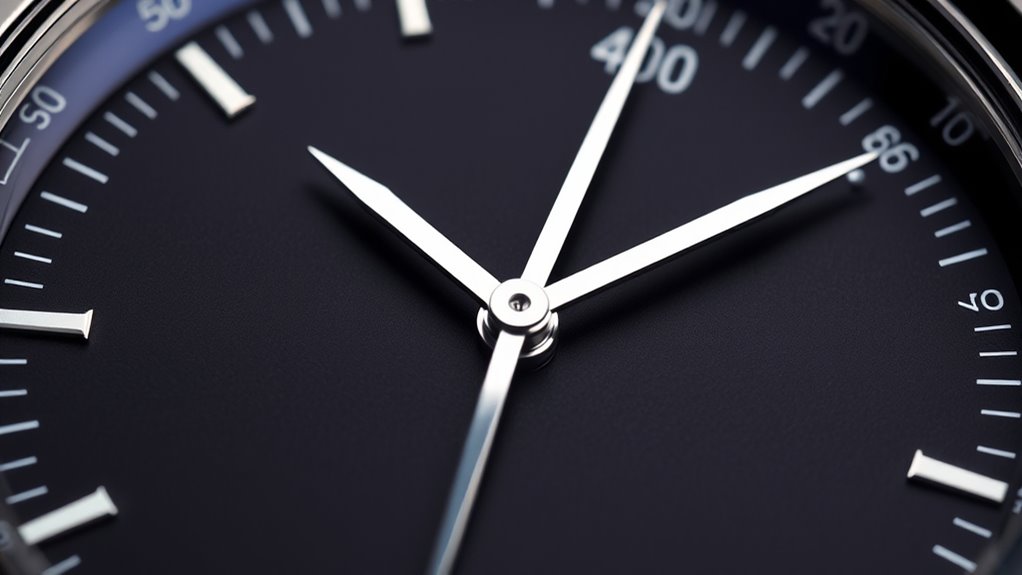

To figure out your speed with a tachymeter, start your chronograph at the beginning of a known distance. When you reach the end, stop the timer and look at where the second hand points on the scale. That number indicates your average speed in units per hour. It’s a quick way to get useful info without doing complex math. Keep exploring to understand the full details behind this handy tool.
Key Takeaways
- Start the chronograph when the vehicle or object passes the starting point.
- Stop the chronograph once it passes the known distance marker.
- Look at the second hand’s position on the tachymeter scale.
- Read the number on the scale where the second hand points; this indicates speed per hour.
- Ensure the tachymeter is properly calibrated for accurate speed measurement.

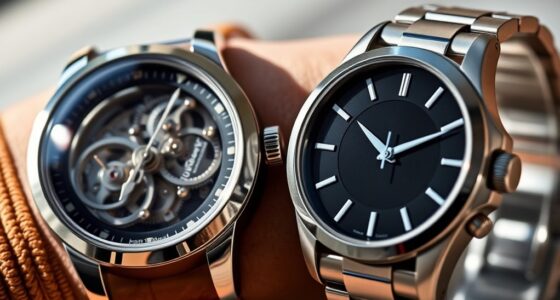
A tachymeter scale, often found on the bezel of a chronograph watch, is a handy tool for measuring speed based on time traveled over a fixed distance. To use it effectively, you start your chronograph when you pass the starting point and stop it once you’ve traveled the known distance, such as a mile or a kilometer. The position of the second hand on the tachymeter scale then indicates your average speed during that segment. But before relying on the scale, you need to verify proper tachymeter calibration. This involves confirming that the scale aligns correctly with your watch’s timing mechanism, so your readings are accurate. Calibration may be necessary if your watch has been subjected to shocks, temperature changes, or if it has been serviced recently. Many watches come with manufacturer instructions for calibration, or you can have it professionally calibrated to guarantee precision. Additionally, understanding the historical development of tachymeters helps you appreciate their design and purpose. Originally, tachymeters were developed in the early 20th century for automotive racing and aviation. Their main function was to quickly determine speed without complex calculations, making them essential tools for pilots and race car drivers. Early tachymeters appeared on mechanical chronographs with fixed bezels engraved with a scale. Over time, advancements in watchmaking allowed for more precise calibration and the introduction of rotating bezels, which added versatility. Today, modern tachymeters often incorporate digital features, but the basic principle remains rooted in their historical use: measuring speed based on elapsed time over a known distance.
You might wonder how the scale actually works. It’s based on the inverse relationship between time and speed. The tachymeter scale is typically calibrated to measure speeds from about 60 to 1,200 units per hour. When you start your chronograph at the beginning of the distance, the second hand moves around the dial as time passes. Once you reach the end, look at where the second hand points on the tachymeter. If it points to 120, for example, you’re traveling at 120 units per hour. The key is knowing the fixed distance, as the scale only provides speed estimates based on that. Keep in mind that the accuracy of your reading depends on proper calibration and the precision of your timing.
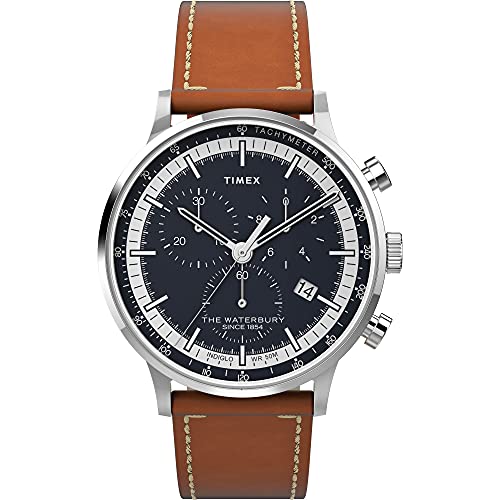
Timex Men's Waterbury Classic Chrono 40mm Stainless Steel Quartz Dress Watch with Leather Strap, Brown, 20 (Model: TW2V30800VQ)
Adjustable brown 20mm genuine leather strap fits up to 8-inch wrist circumference; quick-release spring bars
As an affiliate, we earn on qualifying purchases.
As an affiliate, we earn on qualifying purchases.
Frequently Asked Questions
Can a Tachymeter Be Used for Calculating Distances?
A tachymeter isn’t designed for calculating distances; it’s mainly for measuring speed over a fixed distance. Its limitations lie in its specific scale, which assumes a known distance for accurate readings. For calculating actual distances, you should use alternative measures like GPS, odometers, or map tools. These methods provide more precise results, as tachymeters are better suited for speed calculations rather than distance measurements.
What Is the Ideal Environment for Using a Tachymeter?
Sure, you’re ready to conquer the world with your tachymeter—just don’t forget it’s most at home in perfect weather. Clear skies, steady conditions, and proper calibration make it the superhero tool it’s meant to be. Rain, fog, or shaky hands? Not so much. For ideal use, choose an environment free from weather chaos, line up your calibration, and watch it work wonders—until Mother Nature throws a tantrum.
How Accurate Are Tachymeter Readings?
Tachymeter readings are generally quite accurate if properly calibrated, but keep in mind that calibration accuracy can vary between devices. Environmental factors like temperature, humidity, and lighting can influence your readings, so use your tachymeter in stable conditions for the best results. Regular calibration and careful measurement help guarantee your readings stay precise, allowing you to rely on them for speed or distance calculations.
Can a Tachymeter Be Used for Measuring Speed in Non-Motorized Activities?
Imagine yourself on a scenic trail, using your tachymeter to gauge your pace during outdoor activities. Yes, you can use a tachymeter for measuring speed in non-motorized pursuits like running, cycling, or rowing. It works by timing your activity over a known distance and reading the scale to determine your speed. Whether you’re conquering mountain trails or cycling through city streets, a tachymeter can enhance your athletic pursuits.
What Maintenance Is Required for a Tachymeter?
You need to regularly check your tachymeter’s calibration procedures to guarantee accurate readings, especially if it’s a digital model. Keep the device clean and avoid exposure to extreme temperatures or moisture. For battery maintenance, replace batteries promptly when they run low to prevent malfunction. Also, store your tachymeter properly when not in use. Regular maintenance helps maintain its precision and prolongs its lifespan.

Timex Men’s Expedition Field Chrono 43mm Watch – Black Case & Dial with Black Silicone Strap
Adjustable black 20 millimeter silicone strap fits up to 8-inch wrist circumference
As an affiliate, we earn on qualifying purchases.
As an affiliate, we earn on qualifying purchases.
Conclusion
Mastering a tachymeter scale might seem simple, but it’s your secret weapon to measuring time and speed like a true watch expert. Once you get the hang of it, you’ll feel unstoppable—like you have the power to decode the universe’s fastest secrets with just your wrist. So keep practicing, and remember: the tachymeter isn’t just a tool, it’s your ticket to unraveling the mysteries of speed itself. Your journey to mastery starts now—go conquer time!

Digital Caliper, Adoric 0-6" Calipers Measuring Tool – Electronic Micrometer Caliper with Large LCD Screen, Auto-Off Feature, Inch and Millimeter Conversion
Precise measurement: Measurement range: 0 – 6''/0 – 150 mm; Resolution: 0.01”/0.1 mm; Accuracy: +/- 0.2 mm/0.01”. Perfect…
As an affiliate, we earn on qualifying purchases.
As an affiliate, we earn on qualifying purchases.

SWANSOFT Timegrapher No.1000, Multifunctional Watch Tester, Watch Timing Machine for Watchmaker, Calibration Tool for Mechanical Watches(White)
Ultra-Precision: The No.1000 timegrapher delivers industry-leading ±0.1s/d accuracy (50-sample avg.) for advanced movements and ±999s/d range for antique/faulty…
As an affiliate, we earn on qualifying purchases.
As an affiliate, we earn on qualifying purchases.

Born in Dubai to Pakistani parents, Aisha deeply understands Middle Eastern and South Asian luxury markets. She excels in forging strategic partnerships with top-tier luxury brands worldwide, fostering cross-cultural collaborations that enhance our global presence.