TL;DR
Watches with ECG can record a short, usually single-lead tracing that may flag a pattern consistent with atrial fibrillation, but they do not continuously record every heartbeat or diagnose a heart attack. Before buying, check whether the ECG feature is authorized in your country, works with your phone, and lets you save or share a recording. Treat results as useful context for a clinician, not a substitute for medical care.
A watch can put an electrocardiogram in reach of your wrist, but it cannot give you a hospital heart exam. That distinction matters when you shop for watches with ECG: the feature can save a short rhythm tracing, yet it cannot promise that a normal result means your heart is fine.

Get your wardrobe favorites delivered free with Prime
- Fast, free delivery on millions of items
- Prime Video, Amazon Music and more included
- Member-only deals all year
This guide explains what the recording measures, what a result can mean, and when symptoms matter more than a screen. You’ll also get a practical way to compare ECG availability, phone support, comfort, battery life, and alternative trackers without treating a longer feature list as better heart care.
If you’re replacing a particular watch, such as a Fitbit Sense 2, models with similar battery or water-resistance claims may still have different ECG features—or none at all. You’ll learn how to check the exact model and region before you buy, and how to use a saved tracing as a conversation starter with a clinician.
A watch ECG usually records a single-lead tracing on demand for about 30 seconds; it does not continuously record every heartbeat.
Some authorized models can flag a pattern consistent with AFib, but the result is screening information, not a diagnosis or heart-attack check.
Check regional authorization, exact model instructions, phone compatibility, and recording export before buying.
Battery life, water resistance, and other fitness features do not establish that a watch can record ECG.
Save the tracing and note your symptoms for a clinician; seek urgent care for chest pain, fainting, or severe shortness of breath regardless of the watch resul…
What an ECG Watch Can Actually Record
An ECG watch records a short electrical tracing from your wrist and finger, usually to check for a rhythm that may be consistent with atrial fibrillation. With many models, you open the ECG app, rest a finger from your other hand on an electrode, and keep still for about 30 seconds. The result captures that brief moment, like a snapshot rather than a full-day film.
The electrical signal travels between the watch’s back, which touches your wrist, and the electrode under your finger. The app may label the recording as sinus rhythm, possible AFib, inconclusive, or unreadable. The exact labels depend on the watch, its software, and the feature’s authorization where you live.
That makes an ECG feature different from the green-light sensor many watches use for routine pulse tracking. Optical sensors estimate heart rate from changes in blood flow; ECG electrodes measure electrical activity. A watch might use optical sensing to notice an irregular pulse and prompt you to take an ECG, but those are separate functions.
For example, if you feel a flutter while sitting at your desk, an on-demand recording might give you a tracing to save and show your clinician. If the flutter passes before you start the app, the watch cannot go back and capture it. That limit is why a watch ECG can add context without replacing a medical assessment.
An ECG watch is a recorder for selected moments, not a continuous hospital monitor. Its most useful result may be a saved tracing that helps you describe what happened.
Popular right now

Dyson Cyclone V10 Origin Cordless Vacuum
Ninja Foodi Smart XL 6-in-1 Indoor Grill and Air Fryer, Black/Silver (DG551)

Shark IY143H Cordless Pet Stick Vacuum
As an affiliate, we earn on qualifying purchases.
Why a Watch ECG Is Not a Full Heart Check
A watch ECG can screen a brief recording for certain rhythm patterns, but it cannot rule out a heart problem or diagnose a heart attack. Most watches record on demand, and their algorithms sort results into a limited set of categories. A normal label describes what the device could classify during that recording; it does not certify your overall heart health.
A clinical 12-lead ECG uses multiple electrical views of the heart. A wrist watch generally provides a single-lead tracing, so the information is narrower. The watch’s software may be designed to identify possible AFib, for example, while being unable to reliably classify other rhythms or interpret every person’s recording.
Imagine you take a clear reading in the morning, but an intermittent rhythm episode occurs in the evening. The earlier result cannot rule out the later event. Likewise, movement, weak skin contact, a very fast or slow pulse, or an unfamiliar rhythm can lead to an inconclusive or unreadable result rather than a useful classification.
Symptoms deserve attention on their own. Chest pain, fainting, or severe shortness of breath need urgent medical attention, regardless of whether a watch says “normal.” If you receive an alert or repeatedly get inconclusive readings, follow the manufacturer’s instructions and contact a healthcare professional for advice. Don’t keep taking readings to delay care when you feel seriously unwell.
A normal watch result is not an all-clear. A short recording can miss an intermittent problem, and the watch cannot diagnose a heart attack.
How to Take a Clear Recording and Share It
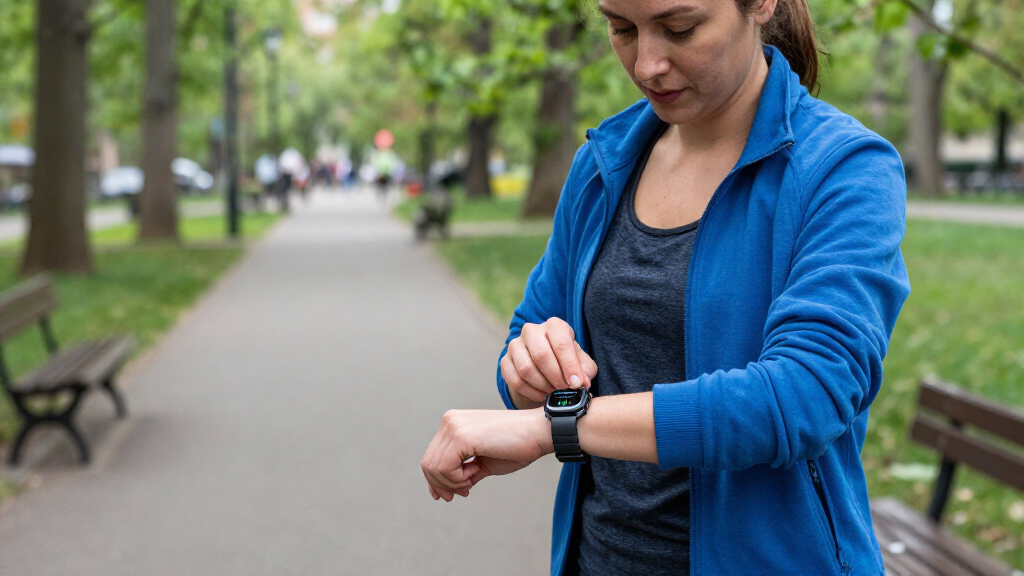
To record a watch ECG, open the device’s ECG app, place the watch snugly on your wrist, rest a finger on its electrode, and stay still for the app’s roughly 30-second measurement. A quiet chair and a dry, comfortable hand can make it easier to hold the contact steadily. The app then displays a classification and, on supported devices, saves a tracing.
- Check the instructions first. Confirm which wrist, finger placement, and posture the manufacturer recommends. A device may require a compatible phone or a particular app setup.
- Sit down and settle. Rest your forearm on a table or your lap. If you just hurried up stairs, pause as the app directs before recording.
- Touch the electrode gently. Keep your finger in place without pressing hard, and avoid talking or moving while the timer runs.
- Save the original tracing. If the watch allows export or sharing, learn how to retrieve the recording before you need it. A clinician may want the tracing, not only the summary label.
- Discuss recurring concerns. Tell a healthcare professional what you felt and when it happened, along with the saved recording. The reading is additional context for their assessment.
For instance, if your hands tremble, keeping an arm supported may help you hold contact more comfortably. Some people may still find the posture difficult because of wrist or finger limitations, skin-contact issues, or tremor. If the watch repeatedly cannot produce a readable tracing, mention that to your clinician instead of assuming the result means nothing is happening.
The app’s labels are clues, not instructions for self-treatment. If it reports possible AFib, follow its guidance and seek appropriate clinical evaluation. If you have sudden or severe symptoms, seek urgent help rather than trying to improve the recording first.
How to Compare ECG Watches Before You Buy
The best ECG watch for you is one whose specific ECG feature works in your region, pairs with your phone, and produces a recording you can comfortably take and share. Start with those practical checks before comparing extras such as maps, calls, sleep tracking, or battery claims. A device can have an impressive health menu while lacking an ECG function that is authorized or usable where you live.
| What to check | Why it matters | Question to ask |
|---|---|---|
| Region and authorization | Features and permitted uses can vary by country, model, and software version. | Is this exact ECG feature available and authorized where I live? |
| Purpose | Some tools record a tracing; others may also offer irregular-pulse notifications. | What rhythm is the app designed to identify? |
| Phone compatibility | Setup, storage, and sharing may depend on a certain phone or operating system. | Will the ECG work with my phone and preferred health apps? |
| Sharing and support | A saved original tracing can be more useful at an appointment than a label alone. | Can I export the tracing, and how long will software support continue? |
| Comfort and routine | A recording requires steady contact; charging and fit affect everyday use. | Can I hold the recommended posture, and does the battery suit my routine? |
Say you’re considering two watches: one has a longer stated battery life, while the other pairs easily with your phone and lets you export a tracing. If sharing a recording is your main reason to buy, the second may fit your needs better even if it has fewer lifestyle extras.
Manufacturers’ descriptions can change as software updates arrive. Read the instructions for the precise model and check the feature’s status in your country before purchasing. If you have a pacemaker, another implanted device, or a diagnosed heart condition, ask your clinician and check the manufacturer’s instructions; some algorithms are not intended for certain users.
What Similar Fitness Trackers Do—and Don’t—Replace
A fitness tracker with similar water-resistance or battery claims is not automatically an ECG replacement. The relevant question is whether its exact model offers an authorized ECG recording feature—not whether its product page lists heart rate, blood pressure, sleep, or stress tools. Those functions may help you track routines, but they do not turn a tracker into a heart-rhythm recorder.
For example, product specifications for a Fitbit Sense Health & Fitness Smartwatch describe ECG alongside a set of other health features, while a MorePro Fitness Tracker description emphasizes heart rate, blood pressure, and sleep monitoring. A general “Smart Watch 1.96" AMOLED Health & Fitness Tracker” listing may highlight an AMOLED screen and activity tools. Those titles alone do not establish that each model offers an ECG feature.
One source comparison lists water resistance of 50 meters and battery life of 6+ days for the Fitbit Sense and Sense 2, with continuous GPS listed at up to 12 hours. It lists the MorePro tracker at IP68, up to seven days in normal use and 15 days on standby; the 1.96-inch watch at four to seven days in normal use and up to 15 days on standby. These are stated specifications, not a guarantee of real-world performance or proof of ECG capability.
A Google Fitbit Air Screenless Activity Tracker is another type of alternative in the supplied product set, with up to seven days of stated battery life, 50-meter water resistance, and GPS via smartphone. Those shared lifestyle specifications do not tell you whether it records ECG. If ECG is the reason you’re replacing a watch that may be discontinued or unavailable, check the current listing and instructions for the exact replacement before you choose.
Battery performance can change with GPS use, notifications, settings, and age of the device. Water-resistance wording also has limits set by the manufacturer. Compare the features you will actually use, then verify the medical function separately rather than inferring it from a familiar brand or a long sensor list.
What an Alert or Inconclusive Result Means for Your Next Step
An ECG alert means the watch detected a pattern its software classified as worth following up; it is not a diagnosis. An inconclusive result means the app could not confidently place that tracing in its available categories. Movement, poor contact, heart rate outside the app’s expected range, or a rhythm the algorithm does not classify can all contribute.
If the watch flags possible AFib, save the recording and follow the device’s instructions for contacting a healthcare professional. A clinician may review the tracing alongside your symptoms and history, then decide whether you need a standard ECG or longer monitoring. The watch’s summary alone cannot confirm AFib.
If a reading is inconclusive, you can try again when you are settled and following the recommended position, provided you feel well and the instructions permit another reading. For example, a loose watch and a cold fingertip may make it harder to keep stable contact. If the same issue keeps happening or you remain concerned, discuss it with a clinician rather than treating repeated retries as medical evaluation.
Accuracy depends on the specific device, recording quality, rhythm, and person using it. A published performance figure for one watch and study group does not automatically apply to another model or to every wearer. That variation is one reason to treat a tracing as context that may help guide a conversation, not as a final answer.
Keep the tracing and the story together. When you speak with a clinician, explain what you felt, when it started, and what the watch recorded.
When an ECG Watch May Fit Your Routine
An ECG watch may suit you if you want an accessible way to capture a brief rhythm recording and understand that the result has limits. It can be especially useful when a clinician has suggested recording symptoms or when you want a saved tracing available for a future appointment. It is less useful as a promise that you can rule out a problem whenever the app displays a reassuring label.
Picture someone who feels occasional palpitations but has no symptoms during a scheduled clinic visit. If an episode happens at home, an on-demand watch recording could provide extra information for that person’s clinician. The tracing may still be unreadable or miss the relevant episode, but it offers a concrete record of one moment instead of relying only on memory.
Comfort matters as much as the feature list. If you have trouble touching the electrode, keeping still, or wearing a watch regularly, you may not get a readable result when you want one. Think through your typical day: can you sit for half a minute, use a compatible phone, charge the device, and find the saved recording later?
Also consider ongoing support and data handling. Confirm how the manufacturer stores, exports, and shares recordings, and whether a subscription or particular phone is needed. If you mainly want step counts, notifications, or sleep tracking, an ECG feature may not be a good reason on its own to choose a more complex device. Match the watch to the job you need it to do.
Frequently Asked Questions
Can watches with ECG detect atrial fibrillation?
Some authorized watches can flag a tracing with a pattern that may be consistent with AFib. That is a screening indication, not a definitive diagnosis. A clinician may confirm it with a medical ECG or another form of monitoring.
Can a watch ECG detect a heart attack?
No. A wrist ECG is not designed to diagnose or rule out a heart attack. Seek emergency care for possible heart-attack symptoms, even if the watch reports a normal result.
Does an ECG watch monitor my heart continuously?
Usually, no. The ECG function generally records on demand for a short period. Separate optical sensors may track pulse periodically or issue an irregular-pulse notification, but that is not continuous ECG recording.
What does an inconclusive watch ECG mean?
It means the app could not confidently classify that recording. Movement, weak skin contact, an unusually fast or slow heart rate, or a rhythm outside the app’s categories can contribute. If this keeps happening or you have concerns, contact a healthcare professional.
Will my doctor accept a watch ECG?
A clinician may review a saved tracing as additional information, but may still recommend a standard ECG or longer-term monitoring. Ask how to share the original recording rather than relying only on the app’s summary label.
Can I use an ECG watch with a pacemaker or known heart condition?
Check the manufacturer’s instructions and ask your clinician before relying on the feature. Some algorithms are not intended for people with certain diagnosed conditions or implanted devices, so the result may not suit your care.
Conclusion
Choose an ECG watch for the recording it can actually provide: a brief rhythm tracing you may be able to share with a clinician. Check regional authorization, phone support, comfort, and export options for the exact model, then keep its limits in view.
Let the watch capture a moment; let a healthcare professional help interpret the story. And if serious symptoms arrive, don’t wait for your wrist to answer.