Among these portable generators for camping, I rank the WEN 2350-Watt Portable Inverter Generator as the best overall for campers who want useful AC power in a relatively compact gas model. The Jackery Explorer 1000 v2 stands out for quiet, fuel-free power, while the WEN 3600-Watt Inverter Generator offers more output for heavier loads. The central tradeoff is straightforward: gas models provide longer-running power for demanding equipment but bring fuel, noise, and exhaust; battery stations run quietly but have finite capacity and need recharging. Small stations suit phones and lights, not every appliance, so matching wattage and capacity to your actual campsite needs matters. Read on for the full breakdown and a guide to choosing the right power source for your trip.

Get your wardrobe favorites delivered free with Prime
- Fast, free delivery on millions of items
- Prime Video, Amazon Music and more included
- Member-only deals all year
Complete the kit


Key Takeaways
- The lineup divides into two distinct kinds of camping power: gas inverter generators offer sustained output, while battery power stations avoid exhaust and are better suited to quiet campsites.
- The WEN 2350 earns the overall role for a more restrained balance of usable output and camping practicality; the larger WEN 3600 and 4000- to 4500-watt gas models make more sense when heavier loads justify added bulk and fuel.
- Solar panels are not a shortcut to unlimited power. The Jackery Explorer 300 bundle and ZeroKor 300W bundle add a way to recharge, but panel wattage and available sunlight affect how quickly a battery station recovers.
- Capacity changes what a battery station can realistically run. The 88Wh MARBERO and HOWEASY models are aimed at small electronics, while the 1000 v2 offers a more capable battery option for campers with broader needs.
- Compactness alone does not make a generator suitable for a campsite. Output, runtime, recharging options, noise expectations, ventilation needs, and the ability to transport fuel all shape the better choice.
| Oxseryn 4400-Watt Gas Inverter Generator |  | Best for Higher-Power Campsites | Fuel type: Gasoline | Starting / running wattage: 4,400 / 3,400 watts | Engine: 208 cc, 4-stroke | VIEW ON AMAZON | See Our Full Breakdown |
| WEN 2350-Watt Portable Inverter Generator with Fuel Shutoff |  | Best Quiet Gas Generator for Small Loads | Surge power: 2,350 watts | Engine: 79 cc, 4-stroke OHV | Noise level: 51 dB at quarter load | VIEW ON AMAZON | See Our Full Breakdown |
| Jackery Explorer 300 Portable Power Station with 40W Solar Panel |  | Best Solar-Ready Battery Pick | Battery capacity: 292 Wh | Battery chemistry: LiFePO4 | Ports: 2 AC outlets, 1 × 100W USB-C PD, 2 USB-A, 1 × 120W car port | VIEW ON AMAZON | See Our Full Breakdown |
| AIVOLT 1600W Portable Inverter Generator |  | Best Lightweight Gas Generator | Starting / running wattage: 1,600 / 1,260 watts | Engine: 60 cc, 4-stroke OHV | Fuel type: Gasoline | VIEW ON AMAZON | See Our Full Breakdown |
| ZeroKor 300W Portable Power Station with 60W Solar Panel | 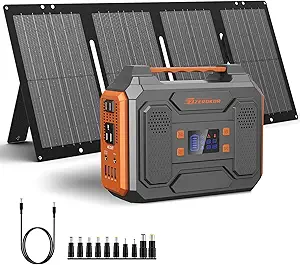 | Best for Basic Solar Charging | Maximum power output: 300 W | Solar panel: 60 W monocrystalline | AC outlets: 2, 300W maximum | VIEW ON AMAZON | See Our Full Breakdown |
| Jackery Explorer 300 Portable Power Station, 292Wh |  | Best Overall Battery Power Station | Battery capacity: 292Wh | Battery chemistry: LiFePO4 | Peak output: 600W | VIEW ON AMAZON | See Our Full Breakdown |
| Pulsar PGD40ISCO 4000W Portable Gas Inverter Generator |  | Best for Quiet, High-Power Campsites | Peak output: 4,000W | Fuel: Gasoline | Tank volume: 1 gallon | VIEW ON AMAZON | See Our Full Breakdown |
| MARBERO M82 Portable Power Station, 88Wh |  | Best for Minimalist, Short-Trip Camping | Capacity: 88Wh | Battery capacity: 24,000mAh | Running output: 80W | VIEW ON AMAZON | See Our Full Breakdown |
| Portable Power Station 300W (600W Surge) Solar Generator 192Wh |  | Best for Fast Recharging and Backup Use | Battery capacity: 192Wh | Battery type: LiFePO4 | Continuous output: 300W | VIEW ON AMAZON | See Our Full Breakdown |
| Oxseryn 2800-Watt Portable Inverter Generator |  | Best Value Gas Inverter for Longer Runs | Peak output: 2,800W | Running output: 2,000W | Engine: 79.8 cc four-stroke OHV | VIEW ON AMAZON | See Our Full Breakdown |
| ERAYAK 4500W Portable Inverter Generator |  | Best for High-Demand Campsites | Fuel type: Gasoline | Peak / running wattage: 4,500W / 3,500W | Engine: 208 cc, 4-stroke | VIEW ON AMAZON | See Our Full Breakdown |
| SIOKIUU 2500W Portable Inverter Generator |  | Best for Lightweight Gas-Powered Camping | Fuel type: Gasoline | Peak / running output: 2,500W / 1,900W | Engine: 80 cc, 4-stroke | VIEW ON AMAZON | See Our Full Breakdown |
| WEN 3600-Watt Portable Inverter Generator (56360i) |  | Best for RV Outlet Compatibility | Surge wattage: 3,600W | Engine: 149 cc | Weight: 46 lbs | VIEW ON AMAZON | See Our Full Breakdown |
| HOWEASY Portable Power Station, 120W (240W Peak), 88Wh |  | Best for Small-Device Charging | Capacity: 88Wh | Running / peak output: 120W / 240W | Weight: 2.3 lbs | VIEW ON AMAZON | See Our Full Breakdown |
| Jackery Explorer 1000 v2 Portable Power Station |  | Best Premium Battery Power Station | Capacity: 1,070Wh | Output / surge peak: 1,500W / 3,000W | Battery type: LFP | VIEW ON AMAZON | See Our Full Breakdown |
| portable generators for camping | Weight | Runtime | Noise level |
|---|---|---|---|
| Oxseryn 4400-Watt Gas Inverter | 56 pounds | Up to 14 hours at 25% load in ECO mode | Under 72 dBA at 23 feet |
| WEN 2350-Watt Portable Inverte | 39 pounds | Over 5.7 hours at half load | 51 dB at quarter load |
| Jackery Explorer 300 Portable | 12.9 pounds | — | — |
| AIVOLT 1600W Portable Inverter | 28 pounds | Up to 8 hours at 25% load; approximately 2 hours at full load | 57 dBA at 23 feet |
| ZeroKor 300W Portable Power St | — | — | — |
| Jackery Explorer 300 Portable | About 7.5 lbs | — | — |
| Pulsar PGD40ISCO 4000W Portabl | 47.3 lbs | About 4 hours at half load | 59 dB |
| MARBERO M82 Portable Power Sta | 3.2 lbs (listed) | — | — |
| Portable Power Station 300W | 8.8 lbs | — | — |
| Oxseryn 2800-Watt Portable Inv | About 40 lbs | Up to 9 hours at 25% load | Under 58 dBA at 23 feet |
| ERAYAK 4500W Portable Inverter | 55.12 lbs | Up to 16 hours | 60.5 dB(A) |
| SIOKIUU 2500W Portable Inverte | 39.46 lbs | Up to 17 hours at 25% load; 8.6 hours at 50% load | Under 59 dBA at 23 feet |
| WEN 3600-Watt Portable Inverte | 46 lbs | Up to 5 hours at half load | 65 dB at quarter load |
| HOWEASY Portable Power Station | 2.3 lbs | — | — |
| Jackery Explorer 1000 v2 Porta | 23.8 lbs | — | — |
More Details on Our Top Picks
Oxseryn 4400-Watt Gas Inverter Generator
The Oxseryn EDOG10 suits campers who need more than device charging: its 3,400 running watts and RV outlet can support a broader mix of campsite or trailer loads than the WEN 2350-Watt inverter. It also offers up to 14 hours at 25% load, so light-use stretches need not mean frequent refueling. The tradeoff is its open-frame build and noise rating of under 72 dBA at 23 feet; that makes it a less considerate neighbor at a quiet campground than the WEN, rated 51 dB at quarter load. At 56 pounds, it is portable for its output, but not a lightweight carry for long walks from the car. I’d choose it for vehicle-accessible sites and skip it for sound-sensitive, walk-in camping.
Pros:- 3,400 running watts provide far more capacity than compact options such as the WEN 2350.
- Up to 14 hours of runtime at 25% load in ECO mode.
- RV, AC, and 12V DC outlets support a range of campsite connections.
- 56-pound weight is manageable for a generator in this output class.
Cons:- Open-frame design and a rating under 72 dBA at 23 feet make it a poor match for noise-sensitive campsites.
- At 56 pounds, it is less convenient to carry than the 39-pound WEN or small battery power stations.
- Gasoline operation requires fuel transport and outdoor operation.
Best for: RV campers and groups at drive-up sites who need substantial 120V power and an RV outlet for multiple campsite loads.
Not ideal for: Walk-in campers and people at quiet campgrounds who prioritize low noise and easy carrying over higher output.
- Fuel type:Gasoline
- Starting / running wattage:4,400 / 3,400 watts
- Engine:208 cc, 4-stroke
- Fuel tank:2 gallons
- Runtime:Up to 14 hours at 25% load in ECO mode
- Noise level:Under 72 dBA at 23 feet
- Outlets:2 × 120V AC, 1 × 12V DC, 1 × RV
- Weight:56 pounds
- Warranty:1 year
Our verdict“Choose the Oxseryn for drive-up camping or RV use when higher output matters more than quiet operation and easy carrying.”
WEN 2350-Watt Portable Inverter Generator with Fuel Shutoff
For campers who want gasoline backup without stepping up to a heavier, louder open-frame unit, the WEN 2350 is the more campsite-friendly choice. Its 51 dB rating at quarter load is well below the Oxseryn 4400’s under-72-dBA rating, while its 39-pound body is easier to move and pack. The 1,900 rated watts can cover modest camping needs, and clean inverter power is suited to sensitive electronics. Fuel shutoff helps reduce fuel left in the carburetor during storage, but the one-gallon tank and runtime of over 5.7 hours at half load mean more refueling than the Oxseryn’s longer light-load runtime. This is a practical fit for small loads, not a way to run a high-demand RV setup. The parallel kit is sold separately.
Pros:- Quiet 51 dB operation at quarter load is better suited to shared campsites than the open-frame Oxseryn 4400.
- 39-pound weight is relatively easy to transport.
- Inverter output is described as clean power for sensitive electronics.
- Fuel shutoff and eco mode support storage maintenance and fuel-conscious operation.
Cons:- The one-gallon tank limits fuel capacity, and runtime is over 5.7 hours at half load.
- Its 1,900 rated watts are well below the Oxseryn 4400’s 3,400 running watts.
- Parallel connection kit is sold separately.
Best for: Campers who drive to their site, need gasoline power for electronics and modest appliances, and value lower noise and manageable weight.
Not ideal for: RV users or groups trying to run several high-draw appliances at once, or campers who want long stretches between refueling.
- Surge power:2,350 watts
- Engine:79 cc, 4-stroke OHV
- Noise level:51 dB at quarter load
- Fuel tank:1 gallon
- Runtime:Over 5.7 hours at half load
- Outlets:2 × 120V AC, 1 × 12V DC, 2 × 5V USB
- Weight:39 pounds
- Warranty:2 years
Our verdict“Pick the WEN if you need a quieter, lighter gasoline generator for modest campsite loads and can accept limited tank capacity.”
Jackery Explorer 300 Portable Power Station with 40W Solar Panel
The Jackery Explorer 300 is a different kind of camping generator: its 292Wh LiFePO4 battery delivers power without gasoline, exhaust, or engine noise at the campsite. Compared with the WEN 2350, it gives up sustained appliance capacity but is simpler for charging phones, cameras, and other small electronics; the included 40W solar panel adds a way to recharge away from a wall outlet. Its 300W rated output and 600W peak limit what it can run, so it is not a substitute for the Oxseryn 4400 when an RV or higher-draw equipment needs power. At 12.9 pounds, it is easier to carry than either gas generator. The panel’s listed charge time to 80% is about 7.5 hours, so solar replenishment can be slow.
Pros:- Battery operation avoids gasoline, engine exhaust, and generator noise at the campsite.
- LiFePO4 chemistry is rated for over 4,000 charge cycles to 70% capacity.
- Includes a 40W solar panel for off-grid recharging.
- At 12.9 pounds, it is easier to carry than the WEN or Oxseryn gas generators.
Cons:- 300W rated output limits it to small devices and is far below the gas generators’ capacity.
- The included 40W panel is listed to take about 7.5 hours to charge the unit to 80%.
- The power station and solar panel may ship separately.
Best for: Campers who want quiet, exhaust-free power for phones, cameras, and other small devices, with solar charging as an option.
Not ideal for: Campers who need to run high-draw appliances, power an RV, or replenish a battery quickly with the included small panel.
- Battery capacity:292 Wh
- Battery chemistry:LiFePO4
- Ports:2 AC outlets, 1 × 100W USB-C PD, 2 USB-A, 1 × 120W car port
- Included solar panel:40 W
- Weight:12.9 pounds
- Warranty:3+2 years
Our verdict“Choose the Jackery for quiet, portable charging of small devices when battery convenience matters more than high wattage.”
AIVOLT 1600W Portable Inverter Generator
The AIVOLT 1600W fills the gap between battery stations and larger gas generators: it offers engine-powered runtime but weighs just 28 pounds. That makes it easier to move around a campsite than the 39-pound WEN 2350, though the AIVOLT produces only 1,260 running watts and is better reserved for a smaller set of loads. Its 57 dBA rating at 23 feet and less-than-3% THD support a quieter, electronics-friendly setup, while CO auto-shutoff, low-oil shutdown, and overload protection add useful safeguards. The compromise is endurance under strain: the listed runtime falls to about two hours at full load. Its stated three-and-a-half-gallon tank is sizeable for this compact class, but doesn’t change that full-load limitation. Parallel capability is available, with the kit not included.
Pros:- 28-pound weight makes it the lightest gasoline generator in this five-product group.
- 57 dBA rating at 23 feet and less than 3% THD suit a quieter setup and sensitive electronics.
- CO auto-shutoff, low-oil shutdown, and overload protection are built in.
- Parallel capability allows expansion with a separate kit.
Cons:- 1,260 running watts limits the number and draw of devices it can power.
- Listed runtime is approximately two hours at full load.
- Parallel kit is not included, and the product is not approved for use in California.
Best for: Campers who need a compact gasoline generator for electronics and modest loads, and who value low carry weight plus built-in safety protections.
Not ideal for: Campers who need extended full-load operation, high running wattage, or a generator approved for use in California.
- Starting / running wattage:1,600 / 1,260 watts
- Engine:60 cc, 4-stroke OHV
- Fuel type:Gasoline
- Runtime:Up to 8 hours at 25% load; approximately 2 hours at full load
- Noise level:57 dBA at 23 feet
- Weight:28 pounds
- Outlets:2 × 120V, 2 USB (Type-A/C)
- Safety features:CO auto-shutoff, low-oil auto-shutdown, overload protection
- Warranty:2 years
Our verdict“Choose the AIVOLT if low weight and gasoline runtime matter more than high output or long full-load operation.”
ZeroKor 300W Portable Power Station with 60W Solar Panel
The ZeroKor 300W is aimed at campers who want a compact battery source for small electronics and appreciate a 60W monocrystalline solar panel in the bundle. Its AC, DC, and USB outputs make it more flexible for device charging than a basic USB battery pack, while the built-in BMS lists protection against overload, overheating, and other electrical faults. Compared with the Jackery Explorer 300, the ZeroKor’s stronger included panel may appeal to buyers focused on solar input, but the available data does not state its battery capacity or charge-cycle rating, making endurance harder to compare. The 300W maximum rules out common high-wattage appliances, and the panel junction box is not waterproof. It also needs regular charging to avoid entering battery protection state.
Pros:- Includes a 60W monocrystalline solar panel, compared with the Jackery Explorer 300’s included 40W panel.
- AC, DC, and multiple USB outputs accommodate a range of small camping devices.
- BMS lists short-circuit, over-current, over-voltage, overload, and overheating protection.
- SOS flashlight and reading mode add basic emergency and campsite lighting functions.
Cons:- 300W output cannot run devices above that limit, including many coffee makers and hair dryers.
- Solar panel junction box is not waterproof, limiting confidence in wet conditions.
- Regular charging is needed to avoid the battery entering protection state; battery capacity is not specified in the supplied data.
Best for: Campers who mainly charge phones and small electronics, want multiple output types, and plan to use a bundled solar panel in fair weather.
Not ideal for: Campers needing high-wattage appliances, dependable solar use in wet conditions, or a clearly specified battery capacity for planning longer trips.
- Maximum power output:300 W
- Solar panel:60 W monocrystalline
- AC outlets:2, 300W maximum
- USB ports:3 × 5V/3A; 1 × Quick Charge (5V/3A, 9V/2A)
- DC port:1 × 9–12.6V/10A maximum
- Recharge methods:AC wall outlet, solar panel, 12V car adapter
- Safety features:BMS protection for short circuit, over-current, over-voltage, overload, and overheating
- Included accessories:AC adapter, cigarette lighter adapter, 12V car cable, 60W solar panel, manuals
Our verdict“Pick the ZeroKor for basic device charging with a bundled solar panel, but skip it if you need high output or a clearly stated battery capacity.”
Jackery Explorer 300 Portable Power Station, 292Wh
For campers who want quiet, fuel-free power for phones, lights, and smaller electronics, the Jackery Explorer 300 offers a useful balance of capacity and carry weight. Its 292Wh LiFePO4 battery and 100W USB-C output suit multi-device charging, while the 300W rated output is more capable than the MARBERO M82’s 80W limit. At about 7.5 pounds, it is also far easier to carry to a campsite than either gas inverter in this group. The tradeoff is appliance power: 300W rules out many cooking and heating devices, and solar charging requires a separately purchased panel. I’d choose it over the smaller MARBERO when longer device runtimes matter, but skip it in favor of the Oxseryn 2800 if your camping setup needs substantial AC power.
Pros:- 292Wh LiFePO4 capacity offers more stored energy than the MARBERO M82’s 88Wh battery
- 100W USB-C and multiple output types support a mix of devices
- Lightweight at about 7.5 pounds for carrying between car and campsite
- Battery is rated for over 4,000 charge cycles to 70% capacity
Cons:- 300W rated output cannot handle many cooking, heating, or other high-draw appliances
- Solar panel is sold separately
- Charging time is listed as four hours, so it is not the fastest-recharging option here
Best for: Tent campers who want quiet charging for phones, cameras, lights, and other modest electronics without carrying gasoline
Not ideal for: Campers planning to run high-wattage appliances or seeking a complete solar setup without buying a panel separately
- Battery capacity:292Wh
- Battery chemistry:LiFePO4
- Peak output:600W
- Ports:2 AC outlets, 1 USB-C PD, 2 USB-A, 1 car port
- USB-C output:100W
- Weight:About 7.5 lbs
- Solar charging:80% in approximately 2.8 hours with a 100W panel; panel not included
- Charge cycles:Over 4,000 to 70% capacity
Our verdict“Choose the Jackery Explorer 300 for quiet, portable power and longer device charging; choose a gas inverter if your campsite needs much more than 300W.”
Pulsar PGD40ISCO 4000W Portable Gas Inverter Generator
The Pulsar PGD40ISCO is the strongest fit here for campers who need generator-level output but want to limit campsite noise. Its 3,200W rated output can support much larger loads than the battery stations, including compatible RV air conditioning up to 13,500 BTU, while inverter technology is suited to sensitive electronics. At 59 dB, it is listed as quiet for a gas generator, though it will still be more noticeable than the silent Jackery Explorer 300. The main compromise is endurance: a one-gallon tank runs about four hours at half load, so longer trips mean refueling. At 47.3 pounds, it is also far heavier than the Oxseryn 2800. I’d favor the Pulsar for higher-demand RV camping, not for minimalist tent trips where quiet and easy carrying matter most.
Pros:- 3,200W rated output handles much larger loads than any battery station in this group
- 59 dB noise rating is relatively low for a gas generator
- Inverter output is suitable for sensitive electronics
- Parallel-ready design allows capacity to be increased with a compatible unit
Cons:- One-gallon tank provides about four hours at half load
- At 47.3 pounds, it is much heavier than the battery power stations and the Oxseryn 2800
- Gas engine noise and exhaust make it less suitable for quiet, close-packed campsites
Best for: RV campers who need substantial AC output, including support for compatible air conditioning, and prefer a quieter inverter generator
Not ideal for: Walk-in or noise-sensitive campers, and anyone who wants long runtimes without carrying fuel or stopping to refuel
- Peak output:4,000W
- Fuel:Gasoline
- Tank volume:1 gallon
- Runtime:About 4 hours at half load
- Noise level:59 dB
- Weight:47.3 lbs
- Engine displacement:145 cc
- Warranty:3-year limited
Our verdict“Pick the Pulsar for quiet-for-its-class power at an RV campsite, but choose a battery station for silent, lightweight device charging.”
MARBERO M82 Portable Power Station, 88Wh
When the campsite power list is mostly a phone, headlamp, and other small electronics, the MARBERO M82 keeps the kit compact at 3.2 pounds and adds a built-in light with SOS mode. Its eight output ports make it flexible for several small devices, but port count should not be confused with power capacity: its 80W running output is much lower than the Jackery Explorer 300’s 300W, and its 88Wh battery stores far less energy. That makes the MARBERO easier to justify for an overnight or emergency charging role than as a shared family power hub. It can recharge through AC, a car, or compatible solar panels, but a panel is not listed as included. I’d choose it over the larger stations only when low weight and basic charging matter more than runtime or appliance capability.
Pros:- Compact 3.2-pound form is easy to pack and carry
- Eight output ports allow several small devices to connect
- Built-in three-level LED light includes an SOS mode
- Supports AC, car, and compatible solar charging
Cons:- 88Wh capacity offers much less stored energy than the Jackery Explorer 300
- 80W running output excludes most appliances
- Compatible solar panel is not listed as included
Best for: Solo or minimalist campers who need a light backup for phones, small electronics, and campsite lighting
Not ideal for: Families, multi-night groups, or campers who need to power appliances beyond its 80W running limit
- Capacity:88Wh
- Battery capacity:24,000mAh
- Running output:80W
- Surge power:120W
- Output ports:8
- Weight:3.2 lbs (listed)
- Dimensions:6.5 × 4.6 × 3.1 inches
- Charging time:0–80% in 2 hours with included adapter
- Charging options:AC, car, and compatible 30W or 60W solar panel
Our verdict“Choose the MARBERO M82 for light, short-trip charging and emergency lighting, not for extended power or appliance use.”
Portable Power Station 300W (600W Surge) Solar Generator 192Wh
This 192Wh power station stands out for campers who value quick recovery between outings or want a compact unit that can also serve as home backup. Its advertised AC or car charging to 80% in one hour is faster than the Jackery Explorer 300’s listed four-hour battery charge time, while its 300W continuous output supports the same broad class of modest electronics and small loads. A built-in UPS with a ≤10ms switch time and emergency light add utility beyond campsite charging. The compromise is capacity: at 192Wh, it stores less energy than the Jackery’s 292Wh, so frequent or longer device use can shorten time between recharges. Solar panels are sold separately, and it cannot run high-wattage appliances. I’d pick it over the Jackery for recharge speed, but take the Jackery for longer off-grid use between charges.
Pros:- Advertised 80% recharge in one hour via AC or car charger
- 300W continuous and 600W surge output suit modest campsite loads
- UPS switches in 10ms or less for connected backup equipment
- Built-in LED offers high, low, strobe, and SOS modes
Cons:- 192Wh capacity is lower than the Jackery Explorer 300’s 292Wh
- Cannot run high-wattage appliances such as hair dryers or coffee makers
- Solar panel is sold separately
Best for: Campers who can recharge often and want a fast-recharging unit that can also provide small-device backup at home
Not ideal for: Campers who need longer runtimes between charging opportunities or power for coffee makers, hair dryers, and other high-wattage appliances
- Battery capacity:192Wh
- Battery type:LiFePO4
- Continuous output:300W
- Surge output:600W
- Outlets:2 AC, 1 USB-C PD 65W, 2 USB-A, 1 car port
- UPS switch time:≤10 ms
- Weight:8.8 lbs
- Dimensions:9.4 × 7.3 × 5.4 inches
- Charge cycles:4,000+
Our verdict“Choose this station if quick recharging and UPS backup matter more than the longer runtimes offered by the Jackery Explorer 300.”
Oxseryn 2800-Watt Portable Inverter Generator
The Oxseryn 2800 makes sense for car campers who want meaningful AC power without stepping up to the Pulsar PGD40ISCO’s heavier, higher-output format. It delivers 2,000W running power, enough for a broader range of campsite equipment than the Jackery Explorer 300 or other battery stations, and its listed runtime reaches up to nine hours at 25% load. At about 40 pounds, it is also lighter than the Pulsar, though still a two-handed lift for many campers. Less than 3% total harmonic distortion is a useful match for sensitive electronics, and the USB-C port adds convenient direct charging. Runtime depends on load, and the 1.1-gallon tank means it still needs fuel management; it is not as quiet as the battery options. I’d choose it for sustained, moderate-power camping, not silent or walk-in trips.
Pros:- 2,000W running output supports substantially larger loads than the battery stations
- Up to nine hours of runtime at 25% load reduces refueling frequency on lighter loads
- Less than 3% THD is suited to sensitive electronics
- USB-C, USB, DC, and two AC outlets provide flexible charging and power options
Cons:- About 40 pounds is much heavier than any battery station in this group
- Gas engine produces noise and exhaust, unlike the Jackery and MARBERO power stations
- Runtime varies with load, and the high-altitude kit is not included
Best for: Car campers who need more than battery-station output and want extended operation for moderate loads without carrying the larger Pulsar
Not ideal for: Walk-in campers and people seeking silent, fuel-free power; also a poor fit for buyers who need the Pulsar’s higher rated output
- Peak output:2,800W
- Running output:2,000W
- Engine:79.8 cc four-stroke OHV
- Fuel tank capacity:1.1 gallons
- Runtime:Up to 9 hours at 25% load
- Noise level:Under 58 dBA at 23 feet
- Weight:About 40 lbs
- Outlets:2 × 120V AC, 1 × 12V DC, 1 × USB, 1 × USB-C
- Total harmonic distortion:Less than 3%
Our verdict“Choose the Oxseryn 2800 for longer, moderate-power car camping; choose the Pulsar when higher output matters more than weight and fuel endurance.”
ERAYAK 4500W Portable Inverter Generator
For campers who need generator-level output for an RV setup or several appliances, the ERAYAK’s 3,500W running capacity gives it a clear advantage over the smaller SIOKIUU 2500W. Its inverter output is described as suitable for sensitive electronics, while Eco Mode can help limit fuel use and noise when demand is light. The 55.12-pound body is portable for this power class, but it is still a two-person or wheeled-transport consideration for many campers. A claimed runtime of up to 16 hours and a 2.25-gallon tank suit longer stays, though actual runtime depends on load. I’d choose it for power needs first, not for quiet, minimalist camping: the parallel kit costs extra, and you must add engine oil before first use.
Pros:- 3,500W running output supports a broader range of campsite and RV loads than the SIOKIUU 2500W
- Inverter output is suited to sensitive electronics
- Eco Mode and a 2.25-gallon tank support longer, lower-demand operation
- Multiple outlet types and parallel capability offer flexible connections and expansion
Cons:- At 55.12 pounds, it is less convenient to move than smaller camping generators
- Parallel kit is sold separately
- Engine oil must be added before first use
Best for: RV campers and groups who need to run multiple higher-draw devices while retaining inverter power for electronics
Not ideal for: Solo campers prioritizing easy carry and a light campsite footprint; at 55.12 pounds, it is much heavier than the SIOKIUU 2500W
- Fuel type:Gasoline
- Peak / running wattage:4,500W / 3,500W
- Engine:208 cc, 4-stroke
- Weight:55.12 lbs
- Noise level:60.5 dB(A)
- Tank capacity:2.25 gallons
- Runtime:Up to 16 hours
- Outlets:30A L5-30R (TT-30R), 2 × 120V AC, 12V 5A, USB-A, USB-C
- Parallel capability:Two units; up to 7,000W rated and 9,000W peak
Our verdict“Choose the ERAYAK if your campsite needs substantial output and RV connections matter more than a very light load to carry.”
SIOKIUU 2500W Portable Inverter Generator
The SIOKIUU is a more manageable choice for campers who want gasoline power without hauling a larger unit: at 39.46 pounds, it is lighter than both the ERAYAK 4500W and WEN 3600W. Its 1,900W running output is better suited to essentials and modest loads than an RV setup with several demanding appliances, so the lower weight comes with a real capacity limit. The less-than-3% THD output is a useful match for sensitive electronics, and the CO sensor’s automatic shutdown adds a safety feature not listed for the WEN 3600W. Its up-to-17-hour runtime applies at only 25% load; at 50% load, the stated figure falls to 8.6 hours. The compact 1.06-gallon tank and four outlets make load planning worthwhile.
Pros:- Lighter than the ERAYAK 4500W and WEN 3600W for easier transport
- Less than 3% THD output suits sensitive electronics
- CO sensor can shut the generator down automatically when levels are too high
- Up to 17 hours of runtime at 25% load
Cons:- 1,900W running output limits the appliances it can support at once
- Small 1.06-gallon tank means runtime varies considerably with load
- Only four outlets are listed
Best for: Campers who can manage a 39-pound generator and want gasoline power for electronics and moderate campsite loads
Not ideal for: RV users or groups running multiple high-draw appliances; 1,900W running output is well below the ERAYAK 4500W
- Fuel type:Gasoline
- Peak / running output:2,500W / 1,900W
- Engine:80 cc, 4-stroke
- Weight:39.46 lbs
- Fuel tank:1.06 gallons
- Runtime:Up to 17 hours at 25% load; 8.6 hours at 50% load
- Noise level:Under 59 dBA at 23 feet
- Total harmonic distortion:Less than 3%
- Features and warranty:ECO mode, parallel capability, CO sensor with automatic shutdown; 3-year warranty
Our verdict“Pick the SIOKIUU if lighter gasoline power and a CO shutdown sensor matter more than the ERAYAK’s higher output.”
WEN 3600-Watt Portable Inverter Generator (56360i)
The WEN 56360i earns its place for campers who need a TT-30R RV receptacle without stepping up to the ERAYAK 4500W’s higher output and weight. Its 3,600W surge rating can help with brief startup demands, while the 46-pound build is lighter than the ERAYAK, though heavier than the SIOKIUU. Clean inverter power and USB ports cover common electronics, and fuel shut-off technology is intended to reduce stale-fuel issues and maintenance needs. The tradeoff is endurance: the listed five-hour runtime is at half load, so longer outings may call for fuel planning more often than the ERAYAK’s stated up-to-16-hour runtime. At 65 dB at quarter load, it is not the quietest figure in this group, either. The parallel kit is sold separately.
Pros:- TT-30R RV receptacle supports a direct RV connection
- Clean inverter output is suitable for sensitive electronics
- At 46 pounds, it is lighter than the ERAYAK 4500W
- Fuel shut-off technology is designed to reduce maintenance concerns
Cons:- Listed runtime is only five hours at half load
- Parallel connection kit is sold separately
- At 65 dB at quarter load, it may be less suited to noise-sensitive campsites than the SIOKIUU
Best for: RV campers who want a TT-30R connection, clean power, and more surge capacity than a compact 2,500W-class generator
Not ideal for: Campers on extended trips who want fewer refueling stops, or those seeking the lightest generator in this lineup
- Surge wattage:3,600W
- Engine:149 cc
- Weight:46 lbs
- Fuel tank:1.6 gallons
- Runtime:Up to 5 hours at half load
- Noise level:65 dB at quarter load
- Outlets:2 × 120V NEMA 5-20R, 1 × TT-30R RV, 1 × 12V DC, 2 × 5V USB
- Voltage:120V
- Warranty:3-year limited
Our verdict“Choose the WEN if an RV receptacle and moderate weight matter more than long runtime or the ERAYAK’s higher running output.”
HOWEASY Portable Power Station, 120W (240W Peak), 88Wh
This HOWEASY is not a gasoline generator like the ERAYAK or WEN; it is a small battery power station for phones, lights, and other low-wattage gear. At just 2.3 pounds, it is far easier to tuck into a camping bag than any of the gas units here, and its eight outputs accommodate several device types. The distinction is capacity: 88Wh and 120W running output are meant for charging small electronics, not powering an electric kettle or other demanding appliance. The Jackery Explorer 1000 v2 offers vastly more stored energy and output, but is also a much larger, heavier choice; this HOWEASY makes more sense when portability is the priority. Recharging from AC, a car socket, or a compatible solar panel adds flexibility, though the panel is not included.
Pros:- Very light at 2.3 pounds and compact enough for a small pack
- Eight outputs cover AC, USB, USB-C, and DC connections
- Can recharge from an AC outlet, car socket, or compatible solar panel
- Built-in LED includes steady, flashing, and SOS modes
Cons:- 120W running output rules out many camping appliances
- 88Wh capacity provides limited stored energy compared with the Jackery Explorer 1000 v2
- Compatible solar panel is not included
Best for: Backpackers and minimalist campers who need a lightweight way to charge phones, small devices, and low-wattage gear
Not ideal for: Campers who need to run appliances, power an RV, or keep several devices running for extended periods; its 88Wh capacity and 120W output are limited
- Capacity:88Wh
- Running / peak output:120W / 240W
- Weight:2.3 lbs
- Dimensions:6.6 × 4 × 3 in
- Output ports:8
- USB-C output:18W
- Recharging methods:AC outlet, compatible 15V–24V solar panel, or 12V/24V car socket
- LED modes:Steady, flash, and SOS
- Warranty:24 months
Our verdict“Choose the HOWEASY for light-duty device charging when easy packing matters more than appliance power or long runtimes.”
Jackery Explorer 1000 v2 Portable Power Station
For campers who want substantial power without a gasoline engine, the Jackery Explorer 1000 v2 is the strongest battery-based option in this batch. Its 1,070Wh capacity and 1,500W output can handle a wider range of devices than the HOWEASY 88Wh station, while avoiding fuel storage and generator exhaust at camp. The LFP battery is rated for over 4,000 charge cycles, and three pure-sine-wave AC outlets plus USB and DC ports make it useful for mixed gear. At 23.8 pounds, it is much easier to move than the ERAYAK, though not a backpacking pick. Fast charging is a feature with a condition: the one-hour figure requires emergency charging in the app; default charging takes 1.7 hours. Solar panels are separate, and solar compatibility is limited to Jackery panels.
Pros:- 1,070Wh capacity and 1,500W output exceed the HOWEASY’s small-device range
- LFP battery is rated for over 4,000 charge cycles
- Three pure sine wave AC outlets and USB/DC ports support varied campsite gear
- App includes emergency, quiet, and energy-saving charging modes
Cons:- At 23.8 pounds, it is heavier than a small-device power bank such as the HOWEASY
- Solar panel is sold separately and compatibility is limited to Jackery panels
- One-hour charging requires emergency mode in the app; default charging takes 1.7 hours
Best for: Car campers who want high-capacity, fuel-free power for electronics and moderate appliances, with app-managed charging
Not ideal for: Backpackers who need a very light power source, or buyers who want flexible third-party solar-panel compatibility
- Capacity:1,070Wh
- Output / surge peak:1,500W / 3,000W
- Battery type:LFP
- Battery lifespan:Over 4,000 charge cycles; over 70% capacity retained
- Weight:23.8 lbs
- AC outlets:3 pure sine wave
- Other ports:2 USB-C, 1 USB-A, 1 DC car port
- Charging time:1 hour with emergency charging enabled; 1.7 hours default
- Solar compatibility:Solar panel not included; compatible only with Jackery solar panels
Our verdict“Choose the Explorer 1000 v2 if you want substantial battery power for car camping and prefer to avoid a gasoline generator.”

How We Picked
I compared the 15 listed models as camping power options, separating gas inverter generators from battery power stations rather than treating them as interchangeable. The main criteria were usable output for common campsite loads, battery capacity or fuel-powered capability, portability, power and recharging options, and how much complexity each choice adds to a trip. I also considered whether the product’s role is clear: small stations serve electronics and lights, while higher-output gas models are aimed at more demanding loads.
The ranking favors options that make sense for a broad range of camping needs, then distinguishes picks for quiet operation, higher output, entry-level use, or compact electronics charging. Models with more output are not automatically ranked higher: their extra capability matters only if a camper needs it, and gas brings exhaust, noise, and fuel handling. Likewise, a battery station’s quiet operation does not compensate for limited stored energy when a trip requires sustained heavy power. The product details provided do not establish comparative runtime, noise measurements, or charging times, so I avoid making unsupported claims about those factors.
Factors to Consider When Choosing Portable Generators For Camping
Before choosing a generator for camping, I would start with the equipment you plan to power and the rules of the campsite—not the largest wattage on the box. These decisions help reveal whether a gas inverter or a battery station is the better match, and what compromises come with each.
List Your Loads Before Comparing Wattage
Write down each device you might use and its running wattage, then check whether any appliance needs extra power when it starts. A refrigerator, cooking appliance, or other motor-driven device can demand more at startup than its normal running figure suggests. Add the loads you might use at the same time rather than assuming you will power everything at once. Many buyers focus on a generator’s headline wattage and miss the difference between continuous and surge output. If your list is mostly phones, lights, and small electronics, a compact battery station may be enough. If you expect higher-demand equipment, a small power station can run out of capability before its portability becomes useful.
Choose Between Fuel and Stored Battery Power
Gas and battery models solve different camping problems, so convenience depends on the trip. A gas inverter can keep supplying power while it has fuel, but it needs careful outdoor placement and brings fuel storage, engine noise, and exhaust into the plan. A battery station produces no exhaust at the campsite and runs quietly, but its stored energy is finite until recharged. For a site with strict quiet expectations or a preference for avoiding fuel, battery power may be the better fit even when capacity is lower. For prolonged or heavier use, gas may be more practical if the campsite rules allow it. Do not plan to run a fuel generator inside a tent, vehicle, or enclosed space.
Treat Battery Capacity and Output as Separate Limits
For battery stations, watt-hours describe stored energy, while watts describe how much power the unit can deliver at a given moment. A station can have enough capacity to charge a phone repeatedly but still lack the output to run a high-wattage appliance. The reverse can also be a problem: sufficient output does not promise long runtime if the battery is small. Estimate energy use over the full trip, including how many hours each device will run and how often it needs charging. A common mistake is to compare models by peak wattage alone and overlook capacity. Choose for both the largest load and the total energy you expect to use.
Check Recharging Plans, Not Just Solar Panel Wattage
A solar panel can help replenish a battery station, but its rated wattage is not a promise of constant charging at that rate. Sun angle, shade, weather, and the charging setup all affect how much energy reaches the battery. A panel bundled with a station can make the kit easier to plan around, yet it does not remove the need to budget power. Think about whether you can recharge from a vehicle or another available source, and whether your camping schedule gives a panel enough time in direct sun. If you need power every night, estimate daily use against realistic opportunities to recharge. Buying a panel without checking that it works with the station is another avoidable mismatch.
Match Portability to the Whole Trip
Portable does not mean effortless to carry: the generator, fuel container, cables, and any panels all take space and add weight. Consider the full route from vehicle to campsite, including uneven ground, stairs, or a walk-in site. A higher-output gas unit can serve more equipment but may be cumbersome for a small tent campsite. Compact battery stations are easier to fit into a camping setup, though their limited capacity can mean more frequent charging or fewer powered devices. Check the product’s dimensions, weight, carrying features, and the space available in your vehicle before deciding. The best choice is the one you can transport and use safely, not simply the smallest or most powerful listing.
Check Campsite Rules and Safe Placement
Rules vary between public campgrounds, private sites, and dispersed camping areas, so confirm whether generators are allowed and whether quiet hours apply. A gas inverter may be a poor fit even if its output is attractive when a site restricts engine use or limits generator hours. Battery stations avoid exhaust at the point of use, but they still need protection from water, heat, and rough handling. Gas models require outdoor operation with ample distance from tents, vehicles, and openings to prevent carbon monoxide exposure. Plan cable routing so it does not create a trip hazard, and keep fuel stored and handled according to the manufacturer’s instructions. A campsite’s rules and layout can narrow the right product choice before wattage does.
Frequently Asked Questions
Can a small 88Wh power station run a camping refrigerator overnight?
Do not assume it can. An 88Wh station has limited stored energy, and an appliance that runs for many hours can drain it quickly, even if the appliance’s wattage seems modest. Refrigerators also cycle on and off, so actual use depends on the model, temperature, ventilation, and how often the lid opens. Check the refrigerator’s energy consumption and compare it with the station’s usable capacity, allowing for conversion losses. The MARBERO and HOWEASY 88Wh models are better approached as small-device options unless the refrigerator maker confirms a suitable power draw and runtime.
Is a solar bundle enough for a weekend camping trip without other charging?
It depends on what you power, how often you use it, and how much direct sun the panel receives. A bundled panel does not guarantee that a station will fully recharge each day; shade, clouds, panel angle, and daylight hours can reduce energy collection. Estimate your daily use in watt-hours, then compare it with the station’s capacity and realistic charging opportunities. If you rely on the Jackery Explorer 300 or ZeroKor bundle, treat solar as a helpful refill source rather than a guarantee of uninterrupted power. For a trip with steady heavy loads, plan a backup charging method or choose a power source suited to that demand.
Should I choose a gas inverter generator if my campsite has quiet hours?
Check the campground’s generator rules before choosing a gas model. Quiet hours can limit when you are allowed to run an engine, and even an inverter generator may not fit a site where engine use is prohibited. A battery power station avoids engine noise during operation, making it a more fitting choice for quiet camping, though its capacity limits how long it can supply power. If you select gas, plan to use it only during permitted hours and in a safe outdoor location. Do not trade campsite compliance or safe placement for additional wattage.
How much generator output do I need to start a camper appliance?
Start with the appliance’s running wattage, then check its label or manual for starting or surge demand. Motors and compressors can briefly require more power at startup than they use once running, so a unit that meets the running figure may still fail to start the load. Add the startup requirement to any other equipment that will run at the same time, while checking the generator’s continuous and surge ratings separately. If you cannot find a reliable startup figure, ask the appliance maker rather than guessing. This calculation can prevent buying a compact unit that looks sufficient on its headline rating but cannot handle the real load.
Can I run a portable generator inside a tent or vehicle if it is raining?
No. A gas generator must not run inside a tent, vehicle, or enclosed or partly enclosed space, because carbon monoxide can build up and become deadly. Rain is not a reason to bring it indoors; follow the manufacturer’s instructions for weather protection and safe outdoor placement. Keep the exhaust directed away from people, tents, vehicles, doors, and windows, and leave generous clearance around the unit. Battery power stations do not produce engine exhaust, but they still need protection from moisture and other conditions outside their rated use. If you cannot place a gas generator safely and legally, do not run it.
Conclusion
For the broadest camping use in this lineup, I recommend the WEN 2350 as the best overall pick, while campers who want quiet, fuel-free operation should look to the Jackery Explorer 1000 v2 as the premium battery option. The best value depends on the job: the WEN 2350 is a practical place to start for gas-powered needs, while a small station such as the Jackery Explorer 300 suits simpler electronics charging. For beginners, I would favor a battery station if quiet operation and straightforward campsite use matter more than running demanding appliances; match capacity to the devices before buying. For specific needs, choose the WEN 3600 or a larger gas inverter when you need more output and can manage fuel and outdoor placement, or an 88Wh station for light loads where compactness matters. My final recommendation is to pick by actual wattage, trip length, campsite rules, and recharge access—not by maximum output alone.
Halloween Picks
halloween
As an affiliate, we earn on qualifying purchases.