Wildlife trail cameras vary most in how they send images, how they handle power, and how much ground each camera can cover. The GardePro A3S is my best overall pick for straightforward, non-cellular monitoring, while the SPYPOINT FLEX-M2 stands out for remote cellular access and the MAXDONE Solar Trail Camera for solar-assisted power and wireless file transfer. Cellular convenience can depend on coverage and service requirements, while Wi-Fi models still call for a visit to retrieve footage. I also compare compact cameras and multi-camera bundles for buyers who need discreet placement or broader coverage. Continue reading for the full breakdown and help choosing the right setup for your property.

Get your wardrobe favorites delivered free with Prime
- Fast, free delivery on millions of items
- Prime Video, Amazon Music and more included
- Member-only deals all year
Key Takeaways
- Remote access and simple local recording are different priorities: SPYPOINT FLEX-M2 and Moultrie EDGE 3 are the cellular choices, while most other picks require retrieving files near the camera.
- Solar power is a convenience, not a guarantee of maintenance-free operation: MAXDONE’s solar models may reduce battery changes, but placement, light, and backup power still matter.
- Two-packs and four-packs can cover more locations, but they also multiply setup and upkeep: MAXDONE, Moultrie, GardePro, and WOSODA bundles suit multi-site monitoring better than a single-camera plan.
- High megapixel claims do not settle image quality: Night illumination, trigger response, camera placement, and the distance to wildlife affect usable evidence as much as headline resolution.
- Compact models trade some flexibility for discreet placement: The KJK mini camera and WOSODA Mini 4-Pack are suited to smaller, less conspicuous setups, while larger models offer a broader feature mix.
| SPYPOINT FLEX-M2 Cellular Trail Camera with Night Vision | 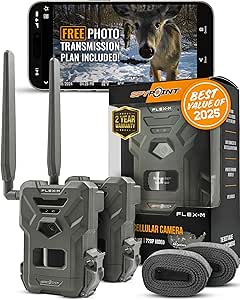 | Best for Remote Monitoring | Photo resolution: 32MP | Video resolution: 1080p with sound | Connectivity: Cellular, dual-SIM | VIEW ON AMAZON | See Our Full Breakdown |
| MAXDONE 2-Pack Solar Trail Camera – 4K Wi‑Fi & Bluetooth Night Vision |  | Best Solar-Powered Camera Pair | Included cameras: 2 | Photo resolution: 64MP | Video resolution: 4K at 30 fps | VIEW ON AMAZON | See Our Full Breakdown |
| KJK Trail Camera 4K 64MP WiFi Bluetooth Game Camera |  | Best for Wide-Angle, Fast-Action Capture | Model: KJK230 | Photo resolution: 64MP | Video resolution: 4K | VIEW ON AMAZON | See Our Full Breakdown |
| GardePro E5S Non-Cellular Trail Camera, 64MP Photos and 1296P HD Video |  | Best for No-Glow Night Monitoring | Photo resolution: 64MP | Video resolution: 1296p HD | Trigger speed: 0.1 seconds | VIEW ON AMAZON | See Our Full Breakdown |
| CEYOMUR Trail Camera 36MP HD with Night Vision |  | Best for Simple Beginner Setup | Photo resolution: 36MP | Video resolution: 2K | Night vision: 850nm infrared, black and white | VIEW ON AMAZON | See Our Full Breakdown |
| Moultrie EDGE 3 Cellular Trail Camera, 2-Pack |  | Best for Remote Monitoring | Pack size: 2 cameras | Photo resolution: 40 MP | Video resolution: 1080p | VIEW ON AMAZON | See Our Full Breakdown |
| KJK Trail Camera 36MP 2.7K Mini Game Camera with Night Vision, 0.1s Trigger Time, 130° Wide-Angle, Waterproof, 2.0″ HD TFT Screen |  | Best for Fast, Wide-Area Coverage | Photo resolution: 36 MP | Video resolution: 2.7K at 30 fps | Trigger speed: 0.1 seconds | VIEW ON AMAZON | See Our Full Breakdown |
| GardePro A3S Non-Cellular Trail Camera, 64MP Photos and 1296P HD Video |  | Best for No-Glow Night Monitoring | Photo resolution: 64 MP | Video resolution: 1296P HD with sound | Night vision: 940nm no-glow infrared, up to 100 feet | VIEW ON AMAZON | See Our Full Breakdown |
| WOSODA Mini Trail Camera 4-Pack, 30MP 1080P HD |  | Best Multi-Camera Starter Kit | Pack size: 4 cameras | Photo resolution: 30 MP | Video resolution: 1080p | VIEW ON AMAZON | See Our Full Breakdown |
| Meidase P70 Trail Camera, 64MP 1296p, No-Glow IR Night Vision, Motion Activated, Waterproof for Wildlife and Hunting |  | Best for On-Site Detail and Night Range | Photo resolution: 64 MP | Video resolution: 1296p HD | Trigger speed: 0.1 seconds | VIEW ON AMAZON | See Our Full Breakdown |
| GardePro E5S 2-Pack Non-Cellular Trail Camera, 64MP Photo & 1296P HD Video |  | Best for Fast, High-Detail Coverage | Quantity: 2 cameras | Photo resolution: 64 MP | Video resolution: 1296p HD | VIEW ON AMAZON | See Our Full Breakdown |
| WOSODA 2-Pack Waterproof Trail Cameras with Night Vision, 48MP Photos, and 1080p Video |  | Best Value Two-Camera Starter Set | Model: G200 | Quantity: 2 cameras | Photo resolution: 48 MP | VIEW ON AMAZON | See Our Full Breakdown |
| MAXDONE Solar Trail Camera, 4K 64MP WiFi Bluetooth Night Vision Game Camera |  | Best for Solar-Powered Local Phone Access | Video resolution: 4K | Photo resolution: 64 MP | Trigger speed: 0.1 seconds | VIEW ON AMAZON | See Our Full Breakdown |
| WOSPORTS 64MP 4K Non-Cellular Trail Camera with No-Glow Night Vision |  | Best for Wide-Area Night Coverage | Photo resolution: Up to 64 MP | Video resolution: Up to 4K (3840 × 2160) | Trigger speed: 0.2 seconds | VIEW ON AMAZON | See Our Full Breakdown |
| wildlife trail camera | Photo resolution | Video resolution | Trigger speed | Night vision |
|---|---|---|---|---|
| SPYPOINT FLEX-M2 Cellular Trai | 32MP | 1080p with sound | — | — |
| MAXDONE 2-Pack Solar Trail Cam | 64MP | 4K at 30 fps | — | 850nm low-glow infrared, up to 65 ft (20 m) |
| KJK Trail Camera 4K 64MP WiFi | 64MP | 4K | 0.1 seconds | — |
| GardePro E5S Non-Cellular Trai | 64MP | 1296p HD | 0.1 seconds | No-glow infrared, up to 100 ft |
| CEYOMUR Trail Camera 36MP HD w | 36MP | 2K | — | 850nm infrared, black and white |
| Moultrie EDGE 3 Cellular Trail | 40 MP | 1080p | 0.5 seconds | Low-glow infrared |
| KJK Trail Camera 36MP 2.7K Min | 36 MP | 2.7K at 30 fps | 0.1 seconds | — |
| GardePro A3S Non-Cellular Trai | 64 MP | 1296P HD with sound | 0.1 seconds | 940nm no-glow infrared, up to 100 feet |
| WOSODA Mini Trail Camera 4-Pac | 30 MP | 1080p | 0.3 seconds | — |
| Meidase P70 Trail Camera | 64 MP | 1296p HD | 0.1 seconds | 940nm no-glow infrared, up to 100 feet |
| GardePro E5S 2-Pack Non-Cellul | 64 MP | 1296p HD | 0.1 seconds | 100 ft no-glow infrared |
| WOSODA 2-Pack Waterproof Trail | 48 MP | 1080p HD | 0.3 seconds | 850 nm low-glow infrared; up to 60 ft |
| MAXDONE Solar Trail Camera | 64 MP | 4K | 0.1 seconds | — |
| WOSPORTS 64MP 4K Non-Cellular | Up to 64 MP | Up to 4K (3840 × 2160) | 0.2 seconds | No-glow infrared, up to 80 ft |
More Details on Our Top Picks
SPYPOINT FLEX-M2 Cellular Trail Camera with Night Vision
The SPYPOINT FLEX-M2 is the clearest fit for buyers who need wildlife images sent to a phone rather than stored for a later site visit. Its cellular connection and app-based management let you check activity and adjust settings remotely, while automatic connection to major carriers can simplify setup where coverage is available. Compared with the GardePro E5S, which keeps footage on an SD card and has no wireless access, the FLEX-M2 saves retrieval trips but depends on a usable cellular signal. It also records 1080p video with sound and 32MP photos, though it offers less stated image resolution than the 64MP MAXDONE and KJK models. The potential 12-month run time requires a separately sold LIT-22 battery pack, so factor that accessory into a long-term remote setup.
Pros:- Sends photos and video to a phone through the SPYPOINT app.
- Remote activation, settings management, updates, and GPS location support off-site monitoring.
- Automatically connects to major cellular carriers.
- Records 1080p video with sound.
Cons:- Cellular service is required for remote image delivery.
- The LIT-22 rechargeable battery pack is sold separately.
- Its 32MP photo resolution is lower than the 64MP figures listed for the MAXDONE and KJK cameras.
Best for: Wildlife observers and property owners who need to check a camera remotely and have cellular coverage at the monitoring site.
Not ideal for: Buyers placing cameras beyond cellular coverage or those seeking the highest stated photo resolution without buying a separate battery pack.
- Photo resolution:32MP
- Video resolution:1080p with sound
- Connectivity:Cellular, dual-SIM
- App:SPYPOINT
- Remote features:Activation, management, updates, GPS locator
- Battery compatibility:LIT-22 rechargeable battery pack, sold separately
- Potential battery life:Up to 12 months with LIT-22
Our verdict“Choose the FLEX-M2 for phone-based wildlife monitoring at a covered site, but skip it if you need a camera that works independently of cellular service.”
MAXDONE 2-Pack Solar Trail Camera – 4K Wi‑Fi & Bluetooth Night Vision
The MAXDONE 2-Pack suits wildlife watchers who want two camera positions and less dependence on routine battery changes. Each camera combines a detachable solar panel with a built-in rechargeable battery, and the included 32GB card gets a setup started without a separate storage purchase. Its 64MP photos and 4K/30fps video offer more stated detail than the SPYPOINT FLEX-M2, but this is not a cellular camera: Wi-Fi and Bluetooth access is limited to roughly 55 feet, so files still require a visit near the unit. A 100° lens covers a broad scene, while 850nm infrared night vision reaches up to 65 feet. Compared with the single-camera KJK, the two-unit bundle adds coverage, but its local-only wireless access makes it less suitable for remote checks.
Pros:- Two cameras let buyers monitor separate locations at once.
- 64MP photos and 4K video provide high stated capture resolution.
- Solar panel and built-in rechargeable battery can reduce routine battery changes.
- Includes a 32GB microSD card and carries an IP66 waterproof rating.
Cons:- Wi-Fi and Bluetooth access is limited to about 55 feet; there is no remote cellular access.
- Night vision is specified up to 65 feet, shorter than the GardePro E5S’s stated 100-foot range.
- The 100° lens is narrower than the KJK camera’s stated 130° detection angle.
Best for: Wildlife observers who want to cover two trails or feeding areas with solar-assisted cameras and can retrieve footage within wireless range.
Not ideal for: Buyers who need remote alerts from a distant site or who cannot visit the cameras to connect over Wi-Fi or Bluetooth.
- Included cameras:2
- Photo resolution:64MP
- Video resolution:4K at 30 fps
- Lens angle:100°
- Night vision:850nm low-glow infrared, up to 65 ft (20 m)
- Connectivity:Wi-Fi 6 (about 55 ft range) and Bluetooth
- Power:Built-in rechargeable battery with detachable solar panel
- Included storage:32GB microSD card
Our verdict“Pick this two-camera set for solar-assisted coverage of nearby wildlife sites, not for checking distant cameras from home.”
KJK Trail Camera 4K 64MP WiFi Bluetooth Game Camera
The KJK pairs a 0.1-second trigger with a stated 130° detection angle, a useful combination for trails where animals cross quickly or approach from the edge of the frame. It also records 64MP photos and 4K video, matching the headline resolution of the MAXDONE while relying on included AA batteries rather than a solar panel and rechargeable system. Wi-Fi and Bluetooth support app-based preview and settings changes, but the camera connects directly to a phone rather than a home router; that means nearby access, not remote monitoring. The IP67 rating offers stronger stated water-and-dust protection than the MAXDONE’s IP66, but buyers must supply a microSD card, which can hold up to 128GB. Choose it over the GardePro E5S for app access and broader detection; choose the GardePro if a stated 100-foot night-vision range matters more.
Pros:- 0.1-second trigger speed is suited to quick-moving wildlife.
- 130° detection angle covers a wider stated area than the MAXDONE’s 100° lens.
- 64MP photos and 4K video provide high stated resolution.
- IP67 rating and included eight AA batteries support a ready-to-power outdoor setup.
Cons:- Wi-Fi and Bluetooth require a nearby direct connection; the camera cannot connect to a home router for remote viewing.
- A microSD card is not included.
- Uses AA batteries and has no solar power option specified.
Best for: Wildlife watchers tracking fast-moving animals across broad trails who want local phone access and are comfortable supplying a memory card.
Not ideal for: Buyers who need cellular remote monitoring, a memory card included, or a solar-powered setup.
- Model:KJK230
- Photo resolution:64MP
- Video resolution:4K
- Trigger speed:0.1 seconds
- Detection angle:130°
- Connectivity:Wi-Fi and Bluetooth
- Power:8 AA batteries included
- Storage support:microSD cards up to 128GB; card not included
Our verdict“Choose the KJK for fast action across a wide detection area, provided local phone access and a separately supplied card meet your needs.”
GardePro E5S Non-Cellular Trail Camera, 64MP Photos and 1296P HD Video
The GardePro E5S favors discreet, straightforward wildlife recording over phone connectivity: its no-glow infrared night vision has a stated 100-foot range, and footage stays on an SD card for retrieval in person. That makes it a simpler fit for sites without cellular coverage than the SPYPOINT FLEX-M2, though it cannot send images to a phone or support remote adjustments. Its 0.1-second trigger speed and 120° field of view are well suited to a fixed trail, while 64MP photos offer a higher stated resolution than the SPYPOINT’s 32MP. The tradeoff is 1296p rather than 4K video, as offered by the KJK and MAXDONE, and the E5S needs eight AA batteries or a separately sold compatible solar panel. It is a practical pick when stealth and simple local capture matter more than connected features.
Pros:- No-glow infrared night vision has a stated range of up to 100 feet.
- 0.1-second trigger speed helps capture animals moving through the frame.
- 64MP photo resolution and a 120° field of view suit trail monitoring.
- IP66 weather-resistant body supports outdoor placement.
Cons:- No cellular or Wi-Fi connectivity; footage must be collected from the SD card.
- Eight AA batteries and an SD card are not included.
- Solar power requires a separately sold compatible GardePro SP350 panel, and video tops out at 1296p.
Best for: Wildlife observers who want no-glow night capture at an isolated site and are willing to retrieve SD-card footage in person.
Not ideal for: Buyers who want phone alerts, remote camera control, included batteries, or 4K video.
- Photo resolution:64MP
- Video resolution:1296p HD
- Trigger speed:0.1 seconds
- Night vision:No-glow infrared, up to 100 ft
- Field of view:120°
- Power:8 AA batteries, not included; compatible with GardePro SP350 solar panel, sold separately
- Connectivity:Wired USB; non-cellular and non-Wi-Fi
- Warranty:1 year
Our verdict“Choose the E5S for discreet, local wildlife recording with long stated night-vision reach, but not for remote viewing or 4K footage.”
CEYOMUR Trail Camera 36MP HD with Night Vision
The CEYOMUR keeps the wildlife-camera experience simple, with an integrated 2-inch front-facing screen and onboard controls for setup at the tree rather than through an app. Its 36MP photos and 2K video provide a step up from basic HD capture, though the KJK and MAXDONE offer higher stated resolutions and phone-based file access. The CEYOMUR’s 850nm infrared night vision records in black and white, so it suits users who value a straightforward night record over color after dark. IP66-rated construction supports outdoor use, but the listing says batteries and an SD card are not included; that adds setup steps compared with the MAXDONE, which includes a 32GB card. Its plastic enclosure may also feel less robust than buyers seeking a more substantial housing expect.
Pros:- Integrated 2-inch screen and controls make field setup accessible to beginners.
- 36MP photos and 2K video provide more detail than basic HD capture.
- 850nm infrared night vision supports nighttime wildlife monitoring.
- IP66 waterproofing is suited to outdoor placement.
Cons:- Eight AA batteries and an SD card are not included.
- Night footage is black and white.
- Its stated resolution is lower than the 64MP and 4K options from KJK and MAXDONE.
- Plastic enclosure may feel less substantial than buyers seeking a more rugged-bodied camera prefer.
Best for: First-time trail-camera buyers who want on-camera controls and a screen for basic field setup without relying on a phone app.
Not ideal for: Wildlife recorders who need 4K video, app-based file access, included storage, or color night footage.
- Photo resolution:36MP
- Video resolution:2K
- Night vision:850nm infrared, black and white
- Screen:2 inches
- Power:8 AA batteries, not included
- Video format:AVI
- Mount type:Tree mount
- Dimensions:5.71 x 4.02 x 7.1 inches
Our verdict“Pick the CEYOMUR for simple screen-based setup and basic wildlife monitoring, but choose a higher-resolution or app-connected model for more demanding capture.”
Moultrie EDGE 3 Cellular Trail Camera, 2-Pack
I’d choose the Moultrie EDGE 3 2-Pack when checking cameras in person would be the main obstacle. Its automatic connection to four major U.S. networks, real-time alerts, and app controls let me monitor two locations remotely; AI buck detection and GPS mapping add useful tools for managing a wildlife or hunting property. The 0.5-second trigger is slower than the KJK Trail Camera’s 0.1-second response, so fast-moving animals may be a harder capture. The pair also records 40MP photos and 1080p video, while the non-cellular GardePro A3S offers 64MP photos without ongoing cellular access costs. I’d pick Moultrie for convenient remote scouting, not for the simplest or least expensive-to-run setup: cellular service requires a plan, and compatible battery packs and solar panels are optional.
Pros:- Two cameras cover separate trails or property zones
- Automatic selection among four major U.S. cellular networks
- App-based alerts, AI buck detection, GPS mapping, and remote controls
- 40MP photos and 1080p video
Cons:- Cellular use requires a service plan
- 0.5-second trigger is slower than the 0.1-second KJK and GardePro options
- Compatible rechargeable battery packs and solar panels are not stated as included
Best for: Hunters and land managers who want alerts and remote access from two camera locations without visiting each site to retrieve cards.
Not ideal for: Buyers who want to avoid cellular plans, prefer the fastest trigger, or need rechargeable battery packs or solar panels included.
- Pack size:2 cameras
- Photo resolution:40 MP
- Video resolution:1080p
- Trigger speed:0.5 seconds
- Detection range:100 feet
- Connectivity:Cellular; automatic connection to four major U.S. networks
- Night vision:Low-glow infrared
- Power options:Batteries; compatible with EDGE Series lithium battery packs and solar panels
- Warranty:2 years from activation
Our verdict“Choose this two-camera set if remote alerts and network flexibility matter more to you than avoiding cellular costs or getting the fastest trigger.”
KJK Trail Camera 36MP 2.7K Mini Game Camera with Night Vision, 0.1s Trigger Time, 130° Wide-Angle, Waterproof, 2.0″ HD TFT Screen
The KJK Trail Camera is the pick I’d favor for a narrow window of action across a broad trail: its 0.1-second trigger and 130° field of view give it a strong chance of recording animals that cross the frame quickly or approach from the sides. The built-in 2-inch color screen also makes on-site setup and footage checks easier than with the phone-free WOSODA Mini 4-Pack, though neither option offers remote viewing. Its 36MP photos and 2.7K video provide more detail than the WOSODA’s 30MP and 1080p output, while the GardePro A3S offers a longer stated night-vision reach at up to 100 feet versus KJK’s 70 feet. The wide view can capture more surroundings, but night range is more limited, and buyers must provide their own SD card.
Pros:- 0.1-second trigger for quick animal movement
- 130° field of view covers a broad area
- Built-in 2-inch color screen for local setup and playback
- IP66 construction and stated operating range from -22°F to 158°F
Cons:- No Wi-Fi or app connection for remote viewing
- 70-foot night-vision range is shorter than the GardePro A3S and Meidase P70
- SD card is not included
Best for: Wildlife watchers who need a quick-trigger camera with a broad view, an on-camera screen, and no cellular service.
Not ideal for: People who need remote phone access, longer-range night coverage, or a camera ready to record without buying an SD card separately.
- Photo resolution:36 MP
- Video resolution:2.7K at 30 fps
- Trigger speed:0.1 seconds
- Field of view:130°
- Night-vision range:70 feet
- Screen:2.0-inch HD TFT
- Weather and temperature:IP66; -22°F to 158°F
- Battery life:Up to 17,000 images
- Dimensions and weight:4.3 x 3 x 1.8 inches; 0.41 kg
Our verdict“Pick the KJK if a fast trigger and broad daytime coverage matter more than remote access or extended night range.”
GardePro A3S Non-Cellular Trail Camera, 64MP Photos and 1296P HD Video
I’d shortlist the GardePro A3S for close-to-home wildlife monitoring where discreet nighttime capture matters more than remote access. Its 940nm no-glow infrared is designed to avoid the visible glow associated with low-glow cameras such as the Moultrie EDGE 3, and its stated night range reaches 100 feet. The 0.1-second trigger also responds faster than Moultrie’s 0.5-second trigger, while the A3S records 64MP photos and 1296P video with sound. Those capabilities come with a hands-on routine: this model has no cellular or Wi-Fi viewing, so I’d need to retrieve its SD card to see footage. Unlike the ready-to-check Moultrie app setup, batteries and storage are not included; an optional solar panel can reduce battery changes but adds a separate purchase.
Pros:- 940nm no-glow infrared with night vision up to 100 feet
- 64MP photos and 1296P video with sound
- 0.1-second trigger and 120° PIR detection angle
- Supports SD cards up to 512GB and an optional solar panel
Cons:- No cellular or Wi-Fi access; footage requires SD-card retrieval
- Batteries, SD card, and solar panel are not included
- High-resolution files can call for more storage management
Best for: Wildlife watchers who want discreet night recording, high-resolution stills, and local SD-card storage at a fixed camera site.
Not ideal for: Buyers who need remote alerts, dislike retrieving memory cards, or want batteries, storage, and solar power supplied in the box.
- Photo resolution:64 MP
- Video resolution:1296P HD with sound
- Night vision:940nm no-glow infrared, up to 100 feet
- Trigger speed:0.1 seconds
- PIR detection angle:120°
- Power:8 AA batteries or optional SP350 solar panel
- SD card support:Up to 512GB
- Screen size:2.31 inches
- Dimensions and weight:3 x 4.4 x 6.1 inches; 350 g
Our verdict“Choose the A3S for discreet, local night monitoring if you’re willing to retrieve cards instead of viewing footage remotely.”
WOSODA Mini Trail Camera 4-Pack, 30MP 1080P HD
For covering several trails, feeding areas, or property edges at once, I’d favor the WOSODA Mini 4-Pack over buying one high-spec camera. It includes four 16GB SD cards and 16 AA batteries, so the set needs fewer separate essentials than the KJK, which doesn’t include an SD card. Each camera captures 30MP photos and 1080p video, with a 0.3-second trigger and night vision up to 65 feet. That speed is respectable, but it trails the 0.1-second KJK and GardePro A3S; the WOSODA’s night range is also shorter. It has no phone connection, so footage still means collecting and checking cards. The included storage tops out at 16GB per card, with support up to 32GB, making this a practical coverage-first set rather than a choice for remote monitoring or extensive high-resolution recording.
Pros:- Four cameras make it possible to monitor multiple locations
- Includes 16 AA batteries and four 16GB SD cards
- 0.3-second trigger with 30MP photos and 1080p video
- Camouflage housing and IP65 waterproof rating
Cons:- No phone connectivity; recordings require SD-card retrieval
- 65-foot night-vision range is shorter than the GardePro A3S and Meidase P70
- Maximum supported storage is 32GB per camera
Best for: First-time wildlife watchers and property owners who want several simple cameras, included starter batteries, and memory cards for multiple locations.
Not ideal for: Buyers who want phone access, long-range night viewing, faster-than-0.3-second capture, or large-capacity storage for extended recording.
- Pack size:4 cameras
- Photo resolution:30 MP
- Video resolution:1080p
- Trigger speed:0.3 seconds
- Night-vision range:Up to 65 feet
- Included power:16 AA batteries
- Included storage:Four 16GB SD cards
- Maximum supported storage:32GB
- Phone connectivity:None
Our verdict“Choose this set to spread basic wildlife coverage across four sites with included starter storage and batteries, not for remote viewing or long-range night work.”
Meidase P70 Trail Camera, 64MP 1296p, No-Glow IR Night Vision, Motion Activated, Waterproof for Wildlife and Hunting
The Meidase P70 suits a fixed wildlife site where I want detailed local playback and discreet nighttime recording. Its 64MP photos, 1296p video, and 2.4-inch color display make it easier to check what the camera captured while I’m at the location; the no-glow 940nm infrared reaches up to 100 feet without a visible flash. Like the GardePro A3S, it has a 0.1-second trigger and accepts storage up to 512GB, but the P70 specifies an IP66 housing and includes a larger display than the A3S’s 2.31-inch screen? Actually, the A3S screen is 2.31 inches, so it is slightly smaller. Neither camera offers remote access. The P70 is solar-ready, but its solar panel is sold separately, and AA batteries are also not included. High-resolution files and a one-year warranty are further tradeoffs for buyers planning long-term deployment.
Pros:- 64MP photos and 1296p HD video
- 940nm no-glow infrared night vision reaches up to 100 feet
- 0.1-second trigger captures fast movement
- IP66 housing, 2.4-inch display, and support for storage up to 512GB
Cons:- AA batteries and the SP350 solar panel are sold separately
- No remote viewing or alerts are specified
- High-resolution files require more storage management, and warranty coverage is one year
Best for: Wildlife observers who visit camera sites and want no-glow night capture, high-resolution stills, and a built-in screen for local review.
Not ideal for: People who need app-based alerts, want included batteries or solar power, or prefer a longer warranty than one year.
- Photo resolution:64 MP
- Video resolution:1296p HD
- Trigger speed:0.1 seconds
- Night vision:940nm no-glow infrared, up to 100 feet
- IR LEDs:36
- Display:2.4-inch color screen
- Power:8 AA batteries or optional SP350 solar panel
- Storage:SD, SDHC, or SDXC; up to 512GB
- Weather resistance and warranty:IP66; 1 year
Our verdict“Pick the P70 for detailed, discreet footage and convenient on-site review if you accept local-only operation and must supply its power source.”
GardePro E5S 2-Pack Non-Cellular Trail Camera, 64MP Photo & 1296P HD Video
I’d choose this two-camera set when quick movement and still-image detail matter more than checking footage remotely. Its 0.1-second trigger and three PIR sensors give it an advantage over the WOSODA G200 set’s 0.3-second trigger, which can mean fewer missed frames when animals pass quickly. The 64MP photos also offer more stated resolution than WOSODA’s 48MP, while 1296p video sits below the 4K options from MAXDONE and WOSPORTS. An IP66 body, time-lapse mode, and optional solar-panel compatibility suit longer outdoor deployments. The tradeoff is a fully local workflow: there’s no Wi-Fi or cellular viewing, batteries aren’t included, and high-resolution footage can fill storage quickly. I’d pick it for paired monitoring points, not remote scouting.
Pros:- Two cameras let you monitor separate locations at once.
- 0.1-second trigger and three PIR sensors suit fast-moving wildlife.
- 64MP photo resolution exceeds the WOSODA G200 set’s stated 48MP.
- IP66 construction and optional solar compatibility support extended outdoor placement.
Cons:- No Wi-Fi or cellular connection for remote viewing.
- Eight AA batteries are not included.
- Large video files can demand substantial card capacity.
Best for: Wildlife watchers who want two fast-trigger cameras for separate trails or feeding areas and are comfortable retrieving memory cards.
Not ideal for: People who need phone-based remote access, or buyers who want included batteries and a ready-to-use storage setup.
- Quantity:2 cameras
- Photo resolution:64 MP
- Video resolution:1296p HD
- Trigger speed:0.1 seconds
- Motion sensors:3 PIR sensors
- Night vision:100 ft no-glow infrared
- Recording modes:Motion Detection, Time-Lapse, Hybrid
- Storage support:SD cards up to 512 GB
- Power:8 AA batteries (not included); optional solar panel
Our verdict“Choose this set for two weather-ready cameras with very fast triggers and detailed stills, provided local card retrieval works for you.”
WOSODA 2-Pack Waterproof Trail Cameras with Night Vision, 48MP Photos, and 1080p Video
The WOSODA G200 set makes sense for buyers who want two cameras with key setup accessories included, rather than paying for the highest resolution in this group. It comes with two 16GB cards, straps, and mounting brackets, so it is more ready for basic field monitoring than the GardePro E5S 2-Pack, whose batteries are not included and whose storage needs may be greater. Its 0.3-second trigger is slower than the E5S’s 0.1 seconds, and the 48MP photos and 1080p video are more modest than the 64MP and 4K alternatives. Still, a 60-foot detection range, low-glow night vision, and IP65 protection cover common backyard and trail use. I’d choose it for straightforward paired monitoring, not demanding fast-action capture or high-detail video.
Pros:- Two cameras include 16GB SD cards and mounting accessories.
- Eight AA batteries are included per camera.
- Low-glow infrared supports nighttime wildlife recording.
- IP65-rated body is suited to outdoor monitoring.
Cons:- 0.3-second trigger is slower than the GardePro E5S 2-Pack’s 0.1-second response.
- 1080p video and 48MP photos trail the higher-resolution options in this roundup.
- Maximum supported card capacity is 256GB.
Best for: First-time wildlife observers who want two cameras with memory cards and mounting hardware for separate, familiar locations.
Not ideal for: Buyers tracking fast-moving animals or seeking maximum image detail, longer detection range, or larger card capacity.
- Model:G200
- Quantity:2 cameras
- Photo resolution:48 MP
- Video resolution:1080p HD
- Trigger speed:0.3 seconds
- Trigger distance:Up to 60 ft
- Night vision:850 nm low-glow infrared; up to 60 ft
- Included storage:Two 16GB SD cards; supports up to 256GB
- Power:8 AA batteries included per camera
Our verdict“Pick the WOSODA set for accessible two-location monitoring with cards and mounts included, rather than for the fastest trigger or sharpest footage.”
MAXDONE Solar Trail Camera, 4K 64MP WiFi Bluetooth Night Vision Game Camera
The MAXDONE stands apart from the non-connected GardePro E5S 2-Pack and WOSPORTS by letting you retrieve footage through a short-range Wi-Fi hotspot and app. That is useful when you’d rather review clips on a phone at the camera than handle its card, but it is not remote monitoring: the camera has no cellular connection, home Wi-Fi access, or real-time motion alerts. Its split solar panel and 6000mAh rechargeable battery reduce reliance on disposable batteries, while 4K video and 64MP photos give it a detail advantage over the GardePro’s 1296p video. The 0.1-second trigger is also among the quickest listed here. In return, the 65-foot night-vision distance is shorter than WOSPORTS’ stated 80 feet, and app access depends on being near the camera.
Pros:- 4K video and 64MP photos provide high stated capture resolution.
- Split solar panel and 6000mAh rechargeable battery reduce dependence on AA batteries.
- 0.1-second trigger speed helps capture quick movement.
- Local Wi-Fi and Bluetooth app access allow nearby phone-based control and file retrieval.
Cons:- Hotspot access requires being near the camera; it cannot provide remote monitoring or live alerts.
- Night vision is specified to 65 ft, shorter than WOSPORTS’ 80 ft.
- Maximum supported storage is 256GB.
Best for: Wildlife observers who want solar-supported power and phone-based footage review while standing near the camera, without a cellular plan.
Not ideal for: Buyers who need live alerts, access from home or away, or longer stated night-vision range than 65 feet.
- Video resolution:4K
- Photo resolution:64 MP
- Trigger speed:0.1 seconds
- Battery:6000mAh rechargeable
- Charging options:Solar, Type-C, or internal charging
- Night-vision distance:65 ft
- Included storage:32GB SD card; supports up to 256GB
- Connectivity:Wi-Fi hotspot and Bluetooth
- App:TrailCamGO
Our verdict“Choose MAXDONE if solar-assisted operation and nearby phone access matter more than remote alerts or longer-range night vision.”
WOSPORTS 64MP 4K Non-Cellular Trail Camera with No-Glow Night Vision
For a fixed trail crossing where animals may approach from different angles, I’d favor the WOSPORTS for its 120-degree detection angle and stated 80-foot no-glow night vision. Those reach figures set it apart from the MAXDONE camera, which adds phone access and solar power but lists a 65-foot night-vision distance. WOSPORTS also records 4K video and up to 64MP photos, and its 2-inch color LCD lets you review footage at the camera without an app. The 0.2-second trigger is quick, though not as fast as the 0.1-second GardePro E5S 2-Pack or MAXDONE. Its 16GB card is included, but power accessories beyond the AA-battery option are sold separately. With no Wi-Fi or cellular link, checking footage still means visiting the camera.
Pros:- 120-degree detection angle suits wider trail coverage.
- No-glow infrared night vision is specified for up to 80 ft.
- 4K video and up to 64MP photos offer detailed capture.
- Included 16GB card and 2-inch color LCD support local setup and playback.
Cons:- No Wi-Fi or cellular connectivity for remote file access.
- Trigger speed of 0.2 seconds is slower than the GardePro E5S 2-Pack and MAXDONE.
- AA batteries, rechargeable battery, and compatible solar panel are not included.
Best for: Wildlife watchers covering a broad trail junction who value no-glow night capture, on-device playback, and high-resolution recording.
Not ideal for: Remote monitors who want phone access, or buyers who need solar or rechargeable power accessories included.
- Photo resolution:Up to 64 MP
- Video resolution:Up to 4K (3840 × 2160)
- Trigger speed:0.2 seconds
- Detection angle:120 degrees
- Night vision:No-glow infrared, up to 80 ft
- IR LEDs:32
- Display:2-inch color LCD
- Water resistance:IP66
- Storage:16GB card included; supports up to 256GB
Our verdict“Choose WOSPORTS for broad, no-glow night coverage and local playback, but skip it if remote access or included alternate power is a priority.”

How We Picked
I ranked these wildlife trail cameras by how well their stated features match real monitoring needs: dependable motion capture, useful night recording, practical power, manageable setup, and a clear path to reviewing footage. I also weighed the difference between cellular transmission, short-range wireless transfer, and local-card recording, since those choices shape both field access and ongoing upkeep. Bundle size mattered when it offered a practical way to cover multiple trails or feeding areas rather than simply adding units.
The ranking favors cameras with a clear role and a useful balance of capability and complexity. Cellular picks rank well for remote checking, but they are less suitable where coverage or service arrangements are a concern. Solar and Wi-Fi features can reduce some chores, yet they do not remove the need to plan for placement and file access. I treated resolution claims cautiously and gave weight to distinctive needs such as compact size, no-glow night vision, and multi-camera coverage. Product claims alone cannot establish field performance, so buyers should check exact specifications, compatibility, and service terms before purchase.
Factors to Consider When Choosing Wildlife Trail Cameras
Choosing a camera starts with the monitoring routine you can sustain, not the biggest number on the box. I would decide how often I can visit the site, whether cellular coverage is available, and whether I need one viewpoint or several before comparing image and video claims.
Choose How You Will Retrieve Images
A camera’s connection type determines whether you can check activity from home or need to visit the site. Cellular models can send images remotely, but service availability, plan terms, and signal strength can affect whether that convenience works at your location. Wi-Fi and Bluetooth models generally support nearby file access rather than long-distance monitoring, so they are most useful when the camera is within reach during regular visits. Local-card cameras avoid dependence on wireless service, but you must collect the storage card or connect directly to review footage. A common mistake is buying cellular hardware before checking reception at the exact mounting spot. If the site is remote and service is weak, a locally recording camera may produce a more dependable record than a connection you cannot maintain.
Plan for Power and Maintenance
Power life depends on more than the battery label: frequent triggers, video recording, cold weather, and wireless transmission can all increase demands. Solar-assisted cameras may reduce battery changes when their panels receive suitable light, but shade, season, and mounting direction can limit that benefit. Treat solar as a way to extend a power plan, not proof that a camera can be left unattended indefinitely. Before choosing a setup, estimate how often animals will cross the detection zone and whether you can return to replace batteries or inspect the unit. Keep a backup power option in mind for long deployments. Buyers often underestimate maintenance because a camera works well during setup, then miss footage after power runs low during a busy period.
Match Night Vision to the Wildlife and Location
Night vision matters most when the animals you want to record are active after dark, but the right choice depends on what you need to learn. No-glow infrared can help keep illumination less visible to people and animals, while other infrared systems may offer a different balance of visibility and image detail. Check the stated detection range and illumination approach against the distance from the camera to the trail; a wide clearing can exceed what a compact camera handles well at night. Avoid aiming directly at reflective leaves, water, or nearby branches, which can interfere with night footage. A high resolution label cannot recover detail that the sensor never captured. For behavior monitoring, consistent framing and enough illumination are often more useful than chasing the highest advertised megapixel count.
Think Beyond Resolution and Trigger Claims
Photo megapixels and video resolution are only part of the evidence a camera can provide. Trigger speed and detection coverage affect whether a fast animal appears in frame, while recovery time influences how quickly the camera can capture another event. A wide-angle field of view can cover more trail, but it may make distant animals look smaller; a narrower view can give a more focused record at a known crossing. Check whether the camera records stills, video, or both in the mode you plan to use, since video can consume more storage and power. Place the unit so animals cross the detection zone rather than approach directly toward it. For identifying species or observing behavior, a properly framed sequence may be more useful than a single large-number specification.
Decide Whether a Bundle Fits Your Sites
Multi-camera bundles make sense when you already have several distinct locations to monitor, such as separate trails, water sources, or property boundaries. More cameras mean wider coverage, but also more mounts, batteries, cards, settings, and time spent checking equipment. A two-pack can be a practical starting point for comparing two routes, while a four-pack is better suited to a planned network than an untested site. Do not buy several cameras simply to compensate for uncertain placement; begin by identifying where tracks, funnels, or repeated sightings make coverage valuable. Mixed models may require separate setup routines and apps, while matched bundles can simplify day-to-day use. For a single focal area, one stronger-positioned camera may provide more useful information than several poorly placed units.
Check Placement, Weather Protection, and Storage
Even a waterproof-rated camera needs careful placement to produce useful footage and avoid unnecessary wear. Mounting height and angle should suit the target animal and trail width, with enough clearance to keep plants from triggering recordings in wind. Check the product’s weather-protection details and storage requirements rather than assuming every model handles prolonged exposure or large cards the same way. A camera pointed toward sunrise or sunset may capture glare, and a location with frequent false triggers can fill storage quickly. Secure mounting can also reduce movement and discourage casual interference. Before leaving the site, confirm the date, recording mode, storage card, and test capture so a setup error does not go unnoticed for weeks.
Frequently Asked Questions
Should I choose a cellular camera or one that stores footage locally?
Choose cellular if remote image checks are worth the added dependence on signal and service arrangements. The SPYPOINT FLEX-M2 and Moultrie EDGE 3 are the cellular options in this roundup, while most other models are better suited to local recording or nearby file transfer. Check coverage at the camera location rather than relying on a map for the general area. Local storage is a sound choice when you can visit the site and prefer not to rely on transmission. If you are unsure, a local camera can help establish whether the location is worth equipping with cellular hardware.
Will a solar trail camera keep running without battery checks?
No solar setup should be treated as maintenance-free. The MAXDONE solar models can suit buyers who want to reduce battery changes, but panel exposure, shade, season, and recording frequency affect how much power is available. Video and frequent motion events can raise energy use, while poor placement can limit solar input. Check what backup power the camera supports and how the panel is positioned relative to the sun. For a remote site, plan occasional inspections even if solar power is part of the setup.
Are multi-camera packs a better choice than buying one camera?
A bundle is useful when you have several locations that answer different questions, such as which of two trails animals use or when activity shifts between a feeding area and a water source. The MAXDONE, Moultrie, GardePro, and WOSODA bundles offer ways to expand coverage, while a single unit is simpler to place and maintain. More cameras also mean more storage, power checks, and settings to manage. If you have not identified reliable animal routes, begin with one camera and use its footage to guide later placement. Choose a pack when you can name the sites each unit will monitor.
Does a 64MP camera necessarily capture better wildlife evidence?
No; the megapixel figure alone does not tell you how clearly an animal will appear. Distance, lighting, trigger timing, camera angle, and night illumination all affect the image you can use. Several models here advertise 64MP photos, so buyers should compare their connection type, power needs, and intended placement rather than treating that shared number as a ranking. For species identification, a clear view at a suitable distance matters more than a large resolution claim. Check sample images or recording details from the manufacturer when available, especially for nighttime use.
What should I prioritize for a camera I cannot visit often?
Start with reliable power, enough storage for the expected activity, weather protection, and a retrieval method that fits the site. Cellular access can reduce unnecessary trips if coverage and service are workable; otherwise, a camera with local storage needs a longer interval between visits and enough capacity for the footage. Solar assistance may help, but it still depends on exposure and should not replace a backup plan. Aim the camera carefully to limit false triggers that fill storage or drain power. For a hard-to-reach location, test the setup nearby before leaving it unattended for an extended period.
Conclusion
For most buyers seeking a capable, straightforward camera without cellular dependence, I would start with the GardePro A3S as my best overall pick. The GardePro E5S is my best value direction for buyers who want non-cellular monitoring, with the E5S two-pack better suited to covering separate sites. For remote checking, choose the SPYPOINT FLEX-M2 or the Moultrie EDGE 3 two-pack, depending on whether you need one camera or a matched pair and have suitable coverage. Beginners who want a simple local setup can start with the CEYOMUR 36MP or a single GardePro model; those prioritizing solar-assisted power should compare the MAXDONE Solar options. For discreet placements, consider the KJK mini or WOSODA Mini 4-Pack, while the WOSPORTS no-glow model fits buyers focused on less visible night illumination. Match the camera to your access, coverage, and maintenance routine before choosing by resolution alone.
Halloween Picks
halloween
As an affiliate, we earn on qualifying purchases.