For most home cinema setups, the Panamax MR4300 is my best overall pick because it pairs surge protection with power conditioning features aimed at audio-video equipment. The Panamax M8-AV is a simpler AV-focused alternative, while the Amazon Basics 12-Outlet Surge Protector suits buyers who mainly need plenty of sockets and a long cord. The main tradeoff is between basic outlet capacity and added home-theater features, with placement, plug spacing, and device connections also shaping the right choice. A surge protector can help defend connected equipment from certain electrical surges, but it is not a substitute for proper wiring or protection against every power problem. Read on for the full comparison and advice on matching a model to your room and gear.

Get your wardrobe favorites delivered free with Prime
- Fast, free delivery on millions of items
- Prime Video, Amazon Music and more included
- Member-only deals all year
Key Takeaways
- The Panamax MR4300 leads for AV-focused features: it is the most specialized pick here, while the M8-AV offers a less feature-rich Panamax option.
- Outlet count alone does not decide the best fit: the TROND has 13 outlets and USB ports, while rotating outlets on the Belkin can help with bulky adapters.
- Flat plugs and cord layout affect installation: the Eaton Tripp Lite TLP1208TELTV and TLP810NET suit tight spaces better than a bulky wall connection.
- Some models add useful connection types: the CyberPower CSP1206UC includes USB charging, while the TLP118DBNET adds network connections for compatible equipment.
- Rugged construction and extra features bring tradeoffs: the metal Tripp Lite HT10DBS and power-conditioning-focused Panamax models may suit dedicated systems better than a basic TV-and-streaming setup.
| Amazon Basics 12-Outlet Surge Protector with 8-Foot Extension Cord |  | Best for High-Device-Count Setups | Outlets: 12 | Surge protection: 4,000 joules | Extension cord: 8 feet | VIEW ON AMAZON | See Our Full Breakdown |
| ECHOGEAR ShockBlocker 8-Outlet Surge Protector |  | Best for a Compact Wall-Mounted Setup | Outlets: 8 | Surge protection: 3,420 joules | Voltage: 120 volts AC | VIEW ON AMAZON | See Our Full Breakdown |
| Panamax MR4300 Power Line Conditioner and Surge Protector |  | Best for Advanced Home Theater Protection | Outlets: 9 protected and filtered | Voltage: 120 V | Maximum current: 15 A | VIEW ON AMAZON | See Our Full Breakdown |
| Panamax M8-AV 8-Outlet Surge Protector |  | Best for Voltage Fluctuation Protection | Model: M8-AV | AC outlets: 8 | Power cord length: 6 feet | VIEW ON AMAZON | See Our Full Breakdown |
| Eaton Tripp Lite TLP1208TELTV 12-Outlet Surge Protector with Flat Plug |  | Best for Flexible Placement and Media-Line Connections | Outlets: 12, including four spaced for bulky transformers | Cord length: 8 feet | Maximum current: 12 A | VIEW ON AMAZON | See Our Full Breakdown |
| CyberPower CSP1206UC Surge Protector |  | Best for Mixed AV and Charging Setups | Grounded outlets: 12 | USB ports: 1 USB-A, 1 USB-C | Surge protection: 3,000 joules | VIEW ON AMAZON | See Our Full Breakdown |
| TROND Surge Protector Power Strip with 13 Outlets and 4 USB Ports | 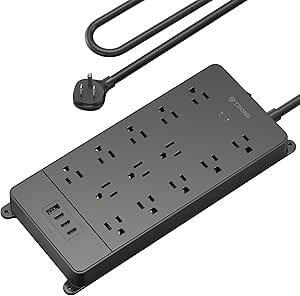 | Best for Maximum Outlet Capacity | AC outlets: 13 | USB ports: 4 | USB output: 17 W total | VIEW ON AMAZON | See Our Full Breakdown |
| CyberPower HT812TC Home Theater Surge Protector |  | Best for Coax and Phone-Line Protection | Outlets: 8 | Surge protection: 4,350 joules | Line protection: RJ11 phone and RG6 coaxial | VIEW ON AMAZON | See Our Full Breakdown |
| Belkin 12-Outlet Surge Protector Power Strip with 8 Rotating Outlets and 8-Foot Cord |  | Best for Flexible Plug Arrangement | Outlets: 12: 8 rotating and 4 stationary | Surge protection: 4,320 joules | Power cord: 8 ft | VIEW ON AMAZON | See Our Full Breakdown |
| Eaton Tripp Lite TLP118DBNET 11-Outlet Surge Protector |  | Best for Networked Home Cinema | Outlets: 11 | Surge protection: 4,200 joules | Power cord: 8 ft braided | VIEW ON AMAZON | See Our Full Breakdown |
| Eaton Tripp Lite TLP810NET 8-Outlet Surge Protector with Flat Plug |  | Best for Mixed-Signal Home Theaters | Outlets: 8 | Maximum current: 15 A | Voltage: 120 V | VIEW ON AMAZON | See Our Full Breakdown |
| Tripp Lite HT10DBS Heavy Duty Isobar Metal Surge Protector – 10 Outlets |  | Best Heavy-Duty Theater Hub | Outlets: 10 NEMA 5-15R | Surge protection: 3,840 joules | Voltage: 120 V | VIEW ON AMAZON | See Our Full Breakdown |
| surge protectors for home cinema | Outlets | Surge protection | Maximum current | Voltage |
|---|---|---|---|---|
| Amazon Basics 12-Outlet Surge | 12 | 4,000 joules | — | — |
| ECHOGEAR ShockBlocker 8-Outlet | 8 | 3,420 joules | — | 120 volts AC |
| Panamax MR4300 Power Line Cond | 9 protected and filtered | — | 15 A | 120 V |
| Panamax M8-AV 8-Outlet Surge P | — | — | — | — |
| Eaton Tripp Lite TLP1208TELTV | 12, including four spaced for bulky transformers | — | 12 A | — |
| CyberPower CSP1206UC Surge Pro | — | 3,000 joules | 15 A | — |
| TROND Surge Protector Power St | — | 4,000 joules | 15 A | — |
| CyberPower HT812TC Home Theate | 8 | 4,350 joules | — | 120 V |
| Belkin 12-Outlet Surge Protect | 12: 8 rotating and 4 stationary | 4,320 joules | 15 A | 125 V listed; product information also says 220 V |
| Eaton Tripp Lite TLP118DBNET 1 | 11 | 4,200 joules | 15 A | 120 V |
| Eaton Tripp Lite TLP810NET 😯 | 8 | — | 15 A | 120 V |
| Tripp Lite HT10DBS Heavy Duty | 10 NEMA 5-15R | 3,840 joules | 12 A | 120 V |
More Details on Our Top Picks
Amazon Basics 12-Outlet Surge Protector with 8-Foot Extension Cord
For a cinema system with a receiver, TV, streaming box, game console, and accessories, the 12 outlets make this a straightforward way to power many devices from one strip. Its 4,000 joules of surge protection is the highest specified figure among these five picks, while the 15-amp breaker adds overload protection. Compared with the ECHOGEAR ShockBlocker, it gives you four more outlets, but lacks the listed signal filtering and connected-equipment warranty. The eight-foot cord and rear keyhole mount help when the wall outlet is not directly behind the equipment, though the cord may still fall short in a distant or awkwardly placed setup. Safety shutters and an on/off switch round out a practical design; there are no listed USB ports or coaxial connections for antenna or cable lines.
Pros:- 12 outlets accommodate a large mix of cinema and gaming devices
- 4,000 joules of stated surge protection
- Eight-foot cord and keyhole mount allow flexible placement
- Safety shutters and a 15-amp circuit breaker add practical protection features
Cons:- No coaxial or telephone-line protection is listed
- No USB ports or signal filtering are listed
- An eight-foot cord may not reach outlets far from the equipment
Best for: Home-cinema owners with many AC-powered components who want a high outlet count and a wall-mount option.
Not ideal for: Buyers who need coaxial or phone-line surge protection, USB charging, or a documented connected-equipment warranty.
- Outlets:12
- Surge protection:4,000 joules
- Extension cord:8 feet
- Circuit breaker:15 amps
- Mounting:Back keyhole wall mount
- Safety features:Safety shutters and on/off switch
- Material:PC flame-retardant material
- Color:Black
Our verdict“Choose this for a crowded home-cinema setup that needs many AC outlets, but look elsewhere for line protection or dedicated signal filtering.”
ECHOGEAR ShockBlocker 8-Outlet Surge Protector
The slim, wall-mountable shape makes the ShockBlocker a tidy fit beside a TV or behind a small equipment cabinet, and its extra spacing helps bulky adapters avoid blocking neighboring sockets. It supplies eight outlets and 3,420 joules of surge protection, fewer outlets than the Amazon Basics 12-outlet model but with a stated signal-filtering feature and a five-year connected-equipment warranty. That makes it a better match for a modest system where placement and plug access matter more than outlet count. Safety covers and a power switch keep the layout simple. Its limits are clear: eight outlets can fill quickly once a receiver, console, and streaming devices are connected, and the product description does not list coaxial or telephone-line protection for connected media cables.
Pros:- 3,420 joules of stated surge protection
- Extra spacing accommodates larger plugs
- Slim design supports wall mounting
- Includes signal filtering and a five-year connected-equipment warranty
Cons:- Eight outlets may be limiting for a receiver, console, and multiple accessories
- Coaxial and telephone-line protection are not listed
- The description does not specify a cord length
Best for: TV owners with a compact set of components who want a slim, mountable protector with room for larger plugs.
Not ideal for: Owners of larger home theaters who need more than eight outlets or protection for coaxial and telephone lines.
- Outlets:8
- Surge protection:3,420 joules
- Voltage:120 volts AC
- Dimensions:11.75 × 3 inches
- Features:Wall mountable, on/off switch, safety covers, signal filtering
- Plug type:Type B
- Connected equipment warranty:5 years, up to $25,000
- Color:Black
Our verdict“Pick the ShockBlocker for a compact, wall-mounted cinema setup where plug spacing and its stated warranty matter more than maximum outlet capacity.”
Panamax MR4300 Power Line Conditioner and Surge Protector
The MR4300 is the most specialized cinema option here: automatic voltage monitoring, Protect or Disconnect technology, and Level 3 noise filtration target power conditions that a basic outlet strip does not address. It also protects LAN, telephone, and coaxial connections, which gives it broader system coverage than the Amazon Basics 12-outlet protector. With nine protected and filtered outlets, it suits a receiver-and-display system better than a setup built around a long list of peripherals. Rack-mount capability and front-panel media lights favor dedicated theater installations, while two USB ports offer a little extra charging convenience. The tradeoff is a heavier, more specialized unit with no remote or app-based control; its listed manufacturer warranty is 90 days, shorter than the ECHOGEAR’s five-year connected-equipment warranty.
Pros:- Automatic voltage monitoring with Protect or Disconnect technology
- Level 3 noise filtration and protection for LAN, telephone, and coaxial lines
- Nine protected and filtered outlets with rack-mount capability
- Front-panel media indicators and two USB charging ports
Cons:- Nine outlets may not cover a large collection of components
- Weighs 6.5 pounds and has no remote or app-based monitoring
- Listed manufacturer warranty is 90 days
Best for: Home-theater owners with a receiver, display, and connected media lines who want voltage monitoring, filtration, and rack-mount capability.
Not ideal for: Buyers who need a high outlet count, remote monitoring, or a longer listed manufacturer warranty.
- Outlets:9 protected and filtered
- Voltage:120 V
- Maximum current:15 A
- USB ports:2
- Filtering:Level 3 noise filtration
- Line protection:LAN, telephone, and coaxial
- Mounting:Rack-mount capability
- Weight:6.5 pounds
- Manufacturer warranty:90 days
Our verdict“Choose the MR4300 for a dedicated theater where voltage monitoring, filtration, and protection across media lines matter more than outlet count or remote control.”
Panamax M8-AV 8-Outlet Surge Protector
The M8-AV focuses on what can matter in an audio-video system beyond the AC outlets: automatic disconnection during unsafe voltage and protection for telephone, cable, satellite, and antenna lines. Its eight outlets and power cleaning make it a more cinema-specific choice than the Amazon Basics strip, which lists more outlets and a higher joule figure but no comparable media-line protection or voltage monitoring. Against the Panamax MR4300, the M8-AV shares a theater-oriented approach, while the MR4300 adds listed LAN protection, USB ports, rack-mount capability, and Level 3 noise filtration. The M8-AV may suit buyers who want voltage safeguards without those extra features. The supplied information does not state its joule rating, warranty, or mounting options, making direct comparison on those points difficult.
Pros:- Eight outlets with filtering and surge protection
- Protects AC, telephone, cable, satellite, and antenna connections
- Disconnects equipment during unsafe overvoltage or undervoltage
- Power cleaning and filtration are designed for audio-video systems
Cons:- No joule rating is provided in the supplied product data
- Eight outlets may be insufficient for a larger theater system
- USB ports, rack mounting, and warranty details are not listed
Best for: Home-cinema owners with cable, satellite, antenna, or telephone connections who want automatic response to unsafe voltage.
Not ideal for: Buyers who need a stated joule rating, USB charging, rack mounting, or a high outlet count.
- Model:M8-AV
- AC outlets:8
- Power cord length:6 feet
- Protected connections:AC power, telephone, cable, satellite, and antenna lines
- Voltage monitoring:Disconnects during unsafe overvoltage or undervoltage and reconnects when power returns to a safe level
- Filtering:Power cleaning and filtration
Our verdict“Choose the M8-AV if automatic voltage response and protection for connected TV signal lines matter more than a published joule rating or extra convenience features.”
Eaton Tripp Lite TLP1208TELTV 12-Outlet Surge Protector with Flat Plug
The TLP1208TELTV combines 12 outlets with coaxial and RJ11 phone-line protection, making it a useful middle ground for a busy TV setup that also needs its signal connections covered. Four outlets are spaced for bulky transformers, and the flat plug and mounting slots help fit the strip behind furniture or onto a wall or desk. Compared with the Amazon Basics 12-outlet model, it adds stated coaxial and phone protection plus diagnostic LEDs, but its listed maximum current is 12 A while its breaker is rated at 15 A. That difference deserves attention when connecting several power-hungry components. The included coaxial and phone cables reduce the need to source those connections separately, though this product’s listed protection is not as broad as the Panamax MR4300’s LAN, telephone, and coaxial coverage.
Pros:- 12 outlets, including four spaced for bulky transformers
- Coaxial and RJ11 phone-line protection
- Flat plug and wall-or-desk mounting slots support flexible placement
- Includes grounding and protection diagnostic LEDs plus connection cables
Cons:- Maximum current is listed as 12 A while the circuit breaker is rated at 15 A
- LAN protection is not listed
- The 8-foot cord may not suit equipment positioned farther from the outlet
Best for: TV and home-cinema owners who need 12 outlets, protection for coaxial and phone connections, and a flat plug for tight placement.
Not ideal for: Buyers with high-current equipment who need clearer current-rating alignment, or systems that also need LAN-line protection.
- Outlets:12, including four spaced for bulky transformers
- Cord length:8 feet
- Maximum current:12 A
- Circuit breaker:15 A
- Line connections:1-in/2-out RJ11 and coaxial
- Included cables:6-foot RJ11 phone line and 6-foot coaxial cable
- Mounting:Wall or desk
- Diagnostic indicators:Grounding and protection LEDs
- Connected equipment insurance:$150,000
Our verdict“Choose this Tripp Lite for a crowded TV setup that needs coaxial and phone-line connections protected, but check the 12 A maximum-current listing against your equipment.”
CyberPower CSP1206UC Surge Protector
For a home cinema that also serves as a device-charging station, the CyberPower CSP1206UC balances 12 grounded outlets with USB-A and USB-C charging. Its six widely spaced outlets can fit bulkier power adapters without giving up every neighboring socket, while keyhole slots make wall or under-desk mounting practical. Compared with the TROND 13-Outlet Surge Protector, it has one fewer AC outlet but lists USB-C alongside USB-A, a useful distinction for newer phones and accessories. The tradeoff is that the product details give no USB output rating, and the one-year limited warranty is shorter than the coverage listed for some competing picks. Its 3,000-joule rating is substantial, though the CyberPower HT812TC and Belkin offer higher listed protection levels.
Pros:- 12 grounded outlets accommodate a sizable collection of home-cinema components
- USB-A and USB-C ports provide built-in charging for mobile devices
- Six widely spaced outlets help fit bulky adapters
- Keyhole slots allow wall or under-desk mounting
Cons:- The one-year limited warranty is short compared with several alternatives
- USB output capacity is not specified, making charging performance harder to judge
- Its 3,000-joule rating is lower than the listed ratings of the HT812TC, Belkin, TROND, and Eaton TLP118DBNET
Best for: Home-cinema owners who need many AV connections plus USB-A and USB-C charging for phones, remotes, or streaming accessories.
Not ideal for: Buyers prioritizing the highest listed joule rating or longer warranty coverage; the HT812TC and Belkin list higher surge ratings, while this model has a one-year limited warranty.
- Grounded outlets:12
- USB ports:1 USB-A, 1 USB-C
- Surge protection:3,000 joules
- Widely spaced outlets:6
- Power cord:6 ft
- Maximum current:15 A
- Mounting:Keyhole slots
- Warranty:One-year limited
Our verdict“Choose the CSP1206UC if your cinema setup needs 12 outlets and both USB-A and USB-C charging more than a longer warranty or a higher listed joule rating.”
TROND Surge Protector Power Strip with 13 Outlets and 4 USB Ports
The TROND Surge Protector is the outlet-capacity pick: its 13 widely spaced AC outlets can serve a receiver, display, consoles, speakers, and other gear while leaving room for bulky plugs. Four USB ports add convenient charging, though their 17 W total output is better suited to low-demand devices than fast charging several devices at once. Compared with the CyberPower CSP1206UC, TROND offers one more AC outlet and two additional USB ports, but it lacks the stated USB-C connection and has a shorter, five-foot cord. Its 4,000-joule rating is higher than the CSP1206UC’s 3,000 joules, while the Belkin and CyberPower HT812TC list higher figures still. Wall-mounting tabs help manage placement, but the cord may limit where the strip can sit in a larger media cabinet.
Pros:- 13 widely spaced AC outlets provide high capacity for a multi-component system
- Four USB ports add convenient charging connections
- 4,000-joule surge rating exceeds the CSP1206UC’s listed 3,000 joules
- Wall-mounting tabs and included screws support fixed placement
Cons:- Four USB ports share only 17 W of total output
- The five-foot cord may not reach outlets behind or beside larger setups
- Its listed surge rating is below the Belkin, CyberPower HT812TC, and Eaton TLP118DBNET
Best for: Home-cinema owners with many components and bulky adapters who want extra outlets and several USB charging connections in one strip.
Not ideal for: Setups far from the wall outlet or buyers needing fast USB charging; the cord is five feet and all four USB ports share 17 W.
- AC outlets:13
- USB ports:4
- USB output:17 W total
- Surge protection:4,000 joules
- Power cord:5 ft
- Maximum power:1,875 W
- Maximum current:15 A
- Certification:ETL listed
- Warranty:18 months
Our verdict“Pick TROND when fitting many AV plugs matters most, and skip it if your installation needs a longer cord or higher-output USB charging.”
CyberPower HT812TC Home Theater Surge Protector
For a cinema system that still connects through coaxial cable or a phone line, the CyberPower HT812TC protects more than the AC outlets: it lists RG6 coaxial and RJ11 phone-line protection, alongside EMI/RFI filtering and automatic shutdown. That makes it a more focused AV choice than the TROND 13-Outlet Surge Protector, which offers more outlets and USB charging but does not list data-line protection. The HT812TC has eight outlets, including four spaced for larger plugs, so it suits a receiver-and-display setup better than a room full of consoles and accessories. Its 4,350-joule rating is the highest among these five picks. One practical detail is unresolved: the description says the cord is 12 feet, while item details say six feet. I would confirm cord length before planning a tight installation.
Pros:- Protects AC connections plus RJ11 phone and RG6 coaxial lines
- 4,350-joule rating is the highest among these five products
- EMI/RFI filtering and automatic shutdown add line-noise filtering and a defined shutdown feature
- Keyhole slots support wall or under-desk mounting
Cons:- Cord length is inconsistent in the supplied details: 12 feet in the description and six feet in item details
- Eight outlets offer less capacity than the 11-, 12-, and 13-outlet alternatives
- The listed Type A, 2-pin plug detail may require verification for the intended grounded home-cinema installation
Best for: Home-cinema owners using coaxial cable or a phone line who want those connections protected along with AV equipment and need EMI/RFI filtering.
Not ideal for: Buyers with many powered components or a fixed cord-length requirement; it has eight outlets and conflicting six- and 12-foot cord details.
- Outlets:8
- Surge protection:4,350 joules
- Line protection:RJ11 phone and RG6 coaxial
- Power cord:12 ft in description; 6 ft in item details
- Voltage:120 V
- Weight:2 lb
- Mounting:Keyhole slots for wall or under-desk installation
- Warranty:Limited lifetime warranty and connected equipment guarantee
Our verdict“Choose the HT812TC for coax and phone-line protection with strong listed surge capacity, but verify its cord length and plug details before buying.”
Belkin 12-Outlet Surge Protector Power Strip with 8 Rotating Outlets and 8-Foot Cord
The Belkin earns its place through eight rotating outlets, which can make a crowded media cabinet easier to wire when power bricks would otherwise block neighboring sockets. It also lists 4,320 joules of protection, phone-line and coaxial connections, LED indicators, and an eight-foot cord. Compared with the CyberPower CSP1206UC, Belkin has no listed USB charging ports, but it gives you more flexibility for bulky AC adapters and adds coaxial protection. Its 12 outlets are one fewer than TROND’s 13, and the fixed four outlets sit alongside the rotating bank. The supplied product information conflicts on voltage, dimensions, and weight, so I would not rely on those figures when checking fit or electrical compatibility. That uncertainty makes the more clearly specified Eaton TLP118DBNET a safer documentation-led alternative.
Pros:- Eight rotating outlets can improve access around bulky adapters
- 4,320-joule surge rating is higher than the TROND and CSP1206UC figures
- Eight-foot cord with an angled plug offers flexible placement
- Includes phone-line and coaxial protection, plus LED indicators
Cons:- No USB charging ports are listed
- Voltage, dimensions, and weight conflict across the supplied product details
- The two-year warranty is shorter than the lifetime limited warranty listed for the Eaton TLP118DBNET
Best for: Home-cinema owners with bulky power adapters who want outlet positions that can be adjusted, plus coaxial or phone-line protection.
Not ideal for: Buyers who need USB charging or clear, consistent electrical and physical specifications; the supplied information conflicts on voltage, dimensions, and weight.
- Outlets:12: 8 rotating and 4 stationary
- Surge protection:4,320 joules
- Power cord:8 ft
- Maximum power:1,875 W
- Maximum current:15 A
- Line protection:RJ11 phone and coaxial
- Voltage:125 V listed; product information also says 220 V
- Warranty:2 years
- Connected equipment warranty:$300,000
Our verdict“Choose the Belkin if rotating outlets are your main need, but favor a better-documented option if exact specifications are central to your setup.”
Eaton Tripp Lite TLP118DBNET 11-Outlet Surge Protector
The Eaton Tripp Lite TLP118DBNET is the strongest fit here for a home cinema with wired networking: it lists RJ11, RJ45, and coaxial protection, plus EMI/RFI filtering and diagnostic LEDs. Its 11 outlets include six spaced for bulky plugs, and an eight-foot braided cord gives more placement flexibility than the five-foot TROND. The key caveat is its Ethernet pass-through, rated up to 100 Mbps; that may constrain faster wired connections, so I would compare that limit against the router and streaming devices in the setup. Unlike the Belkin, its supplied specifications do not conflict on voltage, weight, or dimensions, though the data-line range is different: Eaton adds Ethernet, while Belkin lists phone and coaxial protection. A resettable breaker and mounting slots round out a practical, rather than outlet-maximizing, choice.
Pros:- Protects RJ11, RJ45, and coaxial connections as well as AC-powered devices
- 4,200-joule surge rating is higher than the TROND and CSP1206UC figures
- Six spaced outlets accommodate bulky power adapters
- Eight-foot braided cord, mounting slots, resettable breaker, and diagnostic LEDs support practical installation and monitoring
Cons:- Ethernet pass-through is limited to 100 Mbps
- 11 outlets are fewer than the 12 on the Belkin and CSP1206UC and the 13 on the TROND
- USB charging ports are not listed
Best for: Home-cinema owners with wired Ethernet, coaxial, and phone connections who want those lines protected alongside AV equipment.
Not ideal for: Buyers whose wired network needs speeds above 100 Mbps through the protector, or who need the largest outlet count; TROND offers 13 AC outlets.
- Outlets:11
- Surge protection:4,200 joules
- Power cord:8 ft braided
- Data-line connections:RJ11, RJ45, and coaxial
- Ethernet pass-through:Up to 100 Mbps
- Maximum current:15 A
- Voltage:120 V
- Mounting:Wall or desktop
- Warranty:Lifetime limited manufacturer’s warranty
Our verdict“Pick the TLP118DBNET when protecting wired network and coaxial connections matters more than fast Ethernet pass-through or maximum outlet count.”
Eaton Tripp Lite TLP810NET 8-Outlet Surge Protector with Flat Plug
The TLP810NET suits a home cinema where the signal cables need protection alongside the power cords. Its coaxial, phone, and Ethernet protection covers connections that a basic AC-only strip leaves exposed, while eight outlets include three spaces for bulky adapters. That layout is more accommodating for mixed gear than a compact strip, though it offers fewer outlets than the Tripp Lite HT10DBS, which also has a metal enclosure and isolated filter banks. The TLP810NET instead gives you a 10-foot cord and EMI/RFI filtering, useful when the nearest wall outlet is awkwardly placed or line noise is a concern. Its plastic body is lighter, but less rugged than the HT10DBS’s metal housing. Connected-equipment coverage is listed at $250,000 and applies only in the USA and Canada.
Pros:- Protects AC, coaxial, RJ11 phone, and RJ45 Ethernet connections
- Eight outlets include three spaces for transformer plugs
- 10-foot cord offers more placement flexibility than the HT10DBS’s 8-foot cord
- EMI/RFI filtering, lifetime warranty, and $250,000 connected-equipment coverage
Cons:- Plastic enclosure is less rugged than the HT10DBS’s metal housing
- Eight outlets may be limiting for a larger component stack
- Connected-equipment coverage applies only in the USA and Canada
Best for: Home-cinema owners connecting a TV or projector, receiver, and wired network or coaxial equipment who need a longer cord and room for transformer plugs.
Not ideal for: Buyers with more than eight devices or a preference for a heavy-duty metal enclosure; the HT10DBS provides ten outlets and a metal body.
- Outlets:8
- Maximum current:15 A
- Voltage:120 V
- Cord length:10 ft
- Protected connections:Coaxial, RJ11 phone, RJ45 Ethernet
- Coax bandwidth:2.2 GHz
- Enclosure:Plastic
- Warranty:Lifetime
- Connected-equipment coverage:$250,000
Our verdict“Choose the TLP810NET if your cinema setup needs protection for network or coaxial lines and a long cord more than extra outlets or a metal enclosure.”
Tripp Lite HT10DBS Heavy Duty Isobar Metal Surge Protector – 10 Outlets
For a crowded home theater or combined media-and-work setup, the HT10DBS prioritizes capacity and a rugged build. Its ten outlets give it an advantage over the eight-outlet TLP810NET when a receiver, display, streaming box, and other components all need power. It also protects coaxial, phone/modem, and Ethernet lines, while isolated filter banks help limit interference between connected devices. The metal enclosure and integrated circuit breaker make it a sturdier, more feature-focused hub than the plastic TLP810NET, but the larger housing can be difficult to fit behind shallow furniture. Its 8-foot cord is also shorter than the TLP810NET’s 10-foot lead. With a 12 A maximum current, this is a fit for a properly sized component setup, not a reason to exceed the limits of a circuit or connected equipment.
Pros:- Ten outlets accommodate more components than the TLP810NET
- Metal enclosure provides a heavy-duty alternative to plastic-bodied strips
- Protects coaxial, phone/modem, and Ethernet connections
- Isolated filter banks, diagnostic LEDs, circuit breaker, lifetime limited warranty, and $500,000 insurance coverage
Cons:- Large metal housing can be awkward in tight media cabinets
- 8-foot cord is shorter than the TLP810NET’s 10-foot cord
- 12 A maximum current calls for attention to the combined load
Best for: Home-theater owners with a full rack or media cabinet who need ten outlets, signal-line protection, and a metal enclosure.
Not ideal for: Anyone with a tight space behind a console, a need for a longer reach to the wall, or a setup that may exceed the 12 A maximum current.
- Outlets:10 NEMA 5-15R
- Surge protection:3,840 joules
- Voltage:120 V
- Maximum current:12 A
- Plug type:Type B, North American 3-pin
- Power cord length:8 ft
- Protected connections:Coaxial, phone/modem, Ethernet
- Certification:UL 1449 3rd Edition
- Warranty and insurance:Lifetime limited warranty; $500,000 insurance coverage
Our verdict“Pick the HT10DBS for a larger, fixed home-theater setup that benefits from ten outlets and a metal body, provided its size and 12 A limit suit your installation.”

How We Picked
I compared these 12 models through the needs of a home cinema setup: protecting a mix of televisions, receivers, streamers, consoles, and accessories while keeping cables manageable. I weighed outlet count and spacing, cord and plug design, AV-specific features, additional connections, and construction. I also looked at whether a product seemed suited to a simple media corner or a more involved rack or equipment stack.
The ranking favors useful protection features and practical fit over outlet count alone. Models with clearer home-theater advantages rank ahead of general-purpose strips when those extras may help an AV system, while simple, accessible designs remain strong choices for less demanding setups. I also accounted for tradeoffs: a specialized unit may be unnecessary for a small system, and a crowded outlet layout can matter more than a high socket count. Check each product’s current documentation for its electrical ratings and supported connections before buying.
| surge protectors for home cinema | Mounting |
|---|---|
| Amazon Basics 12-Outlet Surge | Back keyhole wall mount |
| ECHOGEAR ShockBlocker 8-Outlet | — |
| Panamax MR4300 Power Line Cond | Rack-mount capability |
| Panamax M8-AV 8-Outlet Surge P | — |
| Eaton Tripp Lite TLP1208TELTV | Wall or desk |
| CyberPower CSP1206UC Surge Pro | Keyhole slots |
| TROND Surge Protector Power St | — |
| CyberPower HT812TC Home Theate | Keyhole slots for wall or under-desk installation |
| Belkin 12-Outlet Surge Protect | — |
| Eaton Tripp Lite TLP118DBNET 1 | Wall or desktop |
| Eaton Tripp Lite TLP810NET 😯 | — |
| Tripp Lite HT10DBS Heavy Duty | — |
Factors to Consider When Choosing Surge Protectors For Home Cinema
Choosing a surge protector for a cinema setup is less about chasing the biggest number on the box and more about matching the unit to your equipment, room, and wiring. These factors can help narrow the field before comparing individual models.
Match Outlet Layout to Your Actual Equipment
Count the devices that need power, then account for the plugs themselves: large adapters can cover nearby sockets even when the outlet count looks generous. Receivers and powered speakers may use wide plugs, while streamers and consoles often have compact power supplies. A strip with rotating or widely spaced outlets can make a smaller count more usable than a tightly packed row. Leave room for equipment you are likely to add, but avoid buying an oversized unit simply because it has the highest count. Do not plug one surge protector into another to gain outlets, since daisy-chaining can create unsafe loading and messy cabling. Check the manufacturer’s instructions for any limits on connected equipment.
Choose AV Features for a Reason
Power conditioning and other AV-oriented features can make a model more suited to a dedicated home theater, but they are not automatically necessary for every television and streaming box. Start by identifying a specific need, such as supporting a larger stack of components or managing power for a dedicated audio-video system. Compare the feature descriptions and electrical specifications rather than assuming that a “home theater” label guarantees better protection for every device. Basic surge protection may be a more sensible fit for a modest setup with few components. More specialized equipment can add complexity and cost without addressing the main problem in a given room. For persistent picture, sound, or power issues, check the equipment and household wiring rather than expecting a protector to correct every fault.
Plan for Cable, Wall, and Furniture Constraints
Measure the distance from the wall outlet to the equipment before choosing a cord length; a short cord pulled taut can strain connections, while excess cable can bunch behind a cabinet. A flat plug may help furniture sit closer to the wall, though it still needs enough clearance for the cord to bend safely. Check whether the strip will sit on the floor, attach to furniture, or fit inside an equipment cabinet, and confirm its dimensions and mounting options. Keep ventilation in mind around receivers and other heat-producing devices rather than packing a power strip into a cramped space. Cable management also matters: labeling plugs and routing power cords separately from signal cables can make troubleshooting easier. Avoid placing the unit where it can be stepped on, pinched, or exposed to spills.
Decide Whether You Need USB or Signal Connections
USB ports can reduce the need for separate phone or controller chargers, but they are not a replacement for a device’s dedicated power supply when that device needs more power. Check the USB output specifications against the accessories you intend to charge. Some home-theater protectors also provide connections for coaxial or network lines, which may be relevant if those cables enter the system from outside the room. Those connections only help when the correct incoming and outgoing cables pass through them, so confirm compatibility and installation details. Do not assume that every connected line is protected just because the power strip has surge protection. If your system relies on an antenna, cable feed, or wired network, include those paths in your protection plan.
Read the Protection and Warranty Details
Compare each model’s published electrical specifications and protection features, not just its outlet count or product name. Look for clear documentation about indicator lights, grounding requirements, connected-equipment coverage, and what the manufacturer says happens after a protective component reaches its limit. A protection light can show a status condition, but it does not prove that the home’s wiring is correctly grounded. Warranty terms vary and may include conditions, exclusions, or a claims process; read the actual terms rather than treating coverage as a guaranteed reimbursement. Replace a unit if its documentation says it has reached end of life or it shows damage. A surge protector is one layer of protection, not a guarantee against lightning, sustained overvoltage, or every electrical fault.
Frequently Asked Questions
Is the Panamax MR4300 worth choosing over a basic surge strip for a small TV setup?
For a television, streaming device, and one or two accessories, the MR4300’s AV-focused features may be more than you need. A simpler model can meet the practical need for extra outlets if its documented specifications and layout fit your equipment. The MR4300 makes more sense when you have a larger system and specifically want the features described in its product documentation. Compare the devices you own with those features before paying for a more specialized unit. If you are unsure whether a feature addresses a real issue in your room, favor a straightforward setup and check the manufacturer’s guidance.
Should I choose a model with coaxial or network connections for my cinema system?
Those connections are relevant if coaxial or wired network cables form part of your system and you want them to pass through the protector. They add little value when your equipment uses Wi-Fi and has no coaxial connection. Before buying, trace each cable from its source to the television, receiver, or other component and confirm the protector supports the connection type. Read the product instructions for how to connect the cables and what level of protection is specified. Protecting only the power cords may leave other connected signal paths outside the protector.
How many outlets should I plan for behind a home theater cabinet?
List every device that needs power, including the television, receiver, console, streamer, subwoofer, and charging accessories, then add a small amount of room for future equipment. Count bulky adapters as well as devices: a wide plug may block neighboring sockets. Models such as the TROND and the 12-outlet strips provide capacity, but a lower-count unit with better spacing can be easier to use. Avoid filling every socket if that would crowd the cabinet or make plugs hard to reach. Follow the product’s electrical limits and do not connect one strip to another to expand capacity.
Can I place a surge protector behind a wall-mounted television?
It can work only if the product, cord, and outlet fit without pinching or bending the cord sharply behind the screen. A flat-plug design may reduce the space needed at the outlet, but it does not solve poor access or cable strain by itself. Check the strip’s dimensions, cord direction, and mounting instructions before installing it. Keep the protector accessible enough to inspect its status and unplug equipment when needed. For a concealed installation, follow local electrical rules and the television and protector manufacturers’ instructions rather than hiding a power strip inside a wall.
Does a surge protector replace a UPS for a receiver or projector?
No. A surge protector is intended to limit certain voltage surges, while an uninterruptible power supply can provide temporary battery power during an outage, depending on its design and capacity. A projector or receiver that needs time for a controlled shutdown may benefit from a UPS, but the right unit must support the equipment’s power draw. Check the device manuals for guidance, since some equipment may not be suited to a particular UPS output type. You can use surge protection and battery backup as separate parts of a power plan, but follow both manufacturers’ instructions for connections. Neither device protects against every electrical problem.
Conclusion
For a dedicated AV setup, I’d start with the Panamax MR4300 as best overall, while buyers who want AV-focused protection with a simpler feature set can compare the Panamax M8-AV. My best value choice is the Amazon Basics 12-Outlet Surge Protector for households that mainly need accessible sockets and a long cord, and the best premium fit is the Tripp Lite HT10DBS for shoppers who prioritize its heavy-duty metal construction. Beginners with a straightforward TV and streaming setup should favor an easy-to-place, general-purpose option rather than paying for features they will not use. For specific needs, choose the Belkin if rotating outlets suit bulky adapters, the Eaton Tripp Lite TLP1208TELTV or TLP810NET for a flat-plug installation, or a model with USB or signal connections only when your devices need them. Match the product to your equipment, room layout, and documented protection features—not the outlet count alone.
Halloween Picks

Pumpkin Halloween Fog Machine with 12-Color LEDs, Bluetooth Speaker, and Remote

12.5-Foot Lighted Halloween Inflatable Archway

Halloween Inflatable Haunted House Maze – 20×20 ft with Removable Roof and Blower
As an affiliate, we earn on qualifying purchases.