Choosing the right solar phone chargers requires balancing actual solar efficiency with battery capacity, as pure solar charging is often slower than advertised. My analysis highlights the BLAVOR 20,000mAh Solar Power Bank as the best overall pick due to its rare combination of a hand crank, built-in cables, and reliable solar integration. For those needing maximum capacity for extended trips, the YELOMIN 38800mAh offers substantial backup, though it sacrifices portability. The primary tradeoff you face is weight versus runtime: larger banks charge phones many times but become burdensome to carry. Continue reading to see how these options stack up on speed, durability, and real-world utility.

Get your wardrobe favorites delivered free with Prime
- Fast, free delivery on millions of items
- Prime Video, Amazon Music and more included
- Member-only deals all year
Key Takeaways
- Most ‘solar’ chargers are better used as large power banks that occasionally top up via the sun, rather than primary solar harvesters.
- Built-in cables significantly improve convenience but are often the first component to fail due to connector wear.
- Hand cranks serve as a critical emergency backup but generate power at a rate far slower than standard wall charging.
- Capacities above 20,000mAh trigger airline restrictions in many regions, requiring careful planning for travel.
- Wireless charging adds bulk and slows down charging speeds compared to wired connections, making it a secondary feature for most users.
| BLAVOR 20,000mAh Solar Power Bank with Hand Crank and Built-In Cables |  | Best for Emergency Readiness | Battery capacity: 20,000mAh | USB-C charging: Up to 20W PD | Wireless charging: Qi, up to 15W | VIEW ON AMAZON | See Our Full Breakdown |
| Durecopow 20,000mAh Solar Power Bank with Built-In Cables and Dual Flashlight |  | Best for Simple Outdoor Charging | Battery capacity: 20,000mAh | Built-in cables: Type-C, Lightning, Micro USB | Ports: 3 | VIEW ON AMAZON | See Our Full Breakdown |
| YELOMIN 38800mAh Solar Power Bank |  | Best Lightweight High-Capacity Pick | Battery capacity: 38,800mAh | Listed weight: 280g | Ports: 3 | VIEW ON AMAZON | See Our Full Breakdown |
| BLAVOR 20,000mAh Solar Power Bank with Wireless Charging |  | Best for Cable-Free Charging | Battery capacity: 20,000mAh | USB-C fast charging: 20W | Wireless charging: Qi for phones and Apple Watch | VIEW ON AMAZON | See Our Full Breakdown |
| FEELLE 50,000mAh Solar Power Bank with Magnetic Wireless Charging and Hand Crank |  | Best for Group Trips and Maximum Capacity | Battery capacity: 50,000mAh | Battery cell type: Lithium polymer | Wireless charging: Magnetic, up to 15W | VIEW ON AMAZON | See Our Full Breakdown |
| GOODaaa 24,000mAh Solar Power Bank with Built-In Cables | 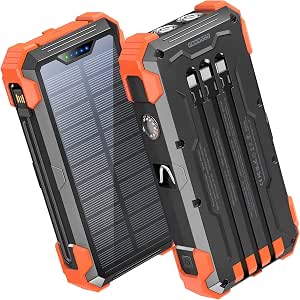 | Best for Charging a Group | Battery capacity: 24,000mAh | Battery type: Lithium polymer | Integrated output cables: iOS and dual USB-C | VIEW ON AMAZON | See Our Full Breakdown |
| 20,000 mAh Solar Power Bank with Built-In Cables, Wireless Charging, and Flashlights |  | Best for Cable-Free Charging | Battery capacity: 20,000mAh | Battery voltage: 3.7V | Charging output: 5V/3A | VIEW ON AMAZON | See Our Full Breakdown |
| MINRISE 40,000mAh Solar Power Bank with 20W PD Fast Charging |  | Best for High Capacity and Wired Speed | Battery capacity: 40,000mAh | USB-C PD output: 20W | Solar panel: 1.8W | VIEW ON AMAZON | See Our Full Breakdown |
| BLASOUL Solar Power Bank, 49800mAh Wireless Portable Phone Charger with 4 Built-in Cables, 22.5W Fast Charging USB-C in/Output External Battery Pack for iPhone, Android, Perfect for Hiking/Camping |  | Best for Wireless Charging and Connector Variety | Battery capacity: 49,800mAh | Wired fast charging: Up to 22.5W; built-in Type-C cable listed at up to 20W when used alone | Wireless charging: Up to 15W | VIEW ON AMAZON | See Our Full Breakdown |
| Luvknit 20,000mAh Solar Power Bank with USB-C and USB-A |  | Best Lightweight Pick | Battery capacity: 20,000mAh | Maximum output power: 15W | Ports: USB-C and USB-A | VIEW ON AMAZON | See Our Full Breakdown |
| 20,000mAh Solar Power Bank with Wireless Charging and Built-In Cables |  | Best for Emergency Versatility | Battery capacity: 20,000mAh | Battery type: Solid-state | Charging power: 15W | VIEW ON AMAZON | See Our Full Breakdown |
| Luvknit 20,000mAh Solar Power Bank with Wireless Charging |  | Best for Cable-Free Convenience | Battery capacity: 20,000mAh | Output: 15W | Output current: 3A | VIEW ON AMAZON | See Our Full Breakdown |
| BLAVOR Solar Power Bank 10,000mAh Portable Wireless Charger for Cell Phones |  | Best Compact Outdoor Pick | Battery capacity: 10,000mAh | USB-C output: Up to 20W | Wireless charging: Qi-compatible | VIEW ON AMAZON | See Our Full Breakdown |
| SOARAISE Solar Power Bank 48000mAh Wireless Portable Charger with 4 Cables |  | Best High-Capacity Solar Backup | Battery capacity: 48,000mAh | Battery type: Lithium polymer | Solar panels: 4 | VIEW ON AMAZON | See Our Full Breakdown |
| solar phone charger | Battery capacity | Wireless charging | Ports | Built-in cables |
|---|---|---|---|---|
| BLAVOR 20,000mAh Solar Power B | 20,000mAh | Qi, up to 15W | 1 USB-C, 2 USB-A | 2 USB-C, 1 iOS, 1 USB-A |
| Durecopow 20,000mAh Solar Powe | 20,000mAh | — | 3 | Type-C, Lightning, Micro USB |
| YELOMIN 38800mAh Solar Power B | 38,800mAh | — | 3 | — |
| BLAVOR 20,000mAh Solar Power B | 20,000mAh | Qi for phones and Apple Watch | — | 2 USB-C, 1 iOS, 1 USB-A |
| FEELLE 50,000mAh Solar Power B | 50,000mAh | Magnetic, up to 15W | 3 | USB-C, Phone Cable, Micro, USB-A |
| GOODaaa 24,000mAh Solar Power | 24,000mAh | — | — | — |
| 20,000 mAh Solar Power Bank wi | 20,000mAh | Qi compatible | — | — |
| MINRISE 40,000mAh Solar Power | 40,000mAh | — | — | — |
| BLASOUL Solar Power Bank | 49,800mAh | Up to 15W | — | iOS, Type-C, Micro USB output; USB-A input |
| Luvknit 20,000mAh Solar Power | 20,000mAh | — | USB-C and USB-A | — |
| 20,000mAh Solar Power Bank wit | 20,000mAh | Qi-compatible devices | 2 USB-A; USB-C input/output | USB-A, Lightning, and USB-C |
| Luvknit 20,000mAh Solar Power | 20,000mAh | Qi | 3 | — |
| BLAVOR Solar Power Bank 10,000 | 10,000mAh | Qi-compatible | — | — |
| SOARAISE Solar Power Bank 4800 | 48,000mAh | Supported | 2 USB-A outputs; 1 USB-C input/output | USB-C, phone, USB-A, and Micro |
More Details on Our Top Picks
BLAVOR 20,000mAh Solar Power Bank with Hand Crank and Built-In Cables
The BLAVOR 20,000mAh is the most emergency-focused option in this group: alongside USB and solar recharging, it adds a hand crank, lights, and survival accessories. Its 20W USB-C charging and built-in cables make it more practical for routine phone top-ups than a crank-only emergency device, while wireless charging offers a cable-free option. Compared with the Durecopow PS35K, it has stronger listed charging features and more emergency tools, but the Durecopow is lighter on extras and sticks to a simpler setup. The tradeoff is bulk: at 1.3 lb, it is a substantial pack, and powering several devices at once divides its available output. I’d treat the solar panel and crank as backup sources, not a replacement for charging from a wall outlet.
Pros:- 20,000mAh capacity with USB-C PD charging up to 20W
- Four built-in cables plus wireless charging reduce the need to pack leads
- Hand crank, flashlight, camping light, compass, and thermometer support emergency use
- Listed as waterproof, shockproof, and dustproof
Cons:- At 1.3 lb, it is heavy for a phone-focused hiking setup
- Charging up to seven devices can divide the available power
- Solar and hand-crank charging performance is not quantified
Best for: Campers and emergency-kit builders who want multiple ways to recharge phones and useful lighting in one rugged unit.
Not ideal for: Ultralight hikers or people who mainly need a slim daily phone charger; its 1.3 lb weight and survival-focused extras add bulk.
- Battery capacity:20,000mAh
- USB-C charging:Up to 20W PD
- Wireless charging:Qi, up to 15W
- Built-in cables:2 USB-C, 1 iOS, 1 USB-A
- Ports:1 USB-C, 2 USB-A
- Maximum simultaneous devices:7
- Weight:1.3 lb
- Protection:Waterproof, shockproof, dustproof
Our verdict“Choose this BLAVOR if emergency features matter more than keeping your pack light.”
Durecopow 20,000mAh Solar Power Bank with Built-In Cables and Dual Flashlight
The Durecopow PS35K keeps the solar-power-bank formula straightforward: a 20,000mAh battery, three built-in output cables, three ports, and dual flashlights with steady, SOS, and strobe modes. Its five indicator lights make it easier to check remaining charge than on models whose listed features focus more on emergency accessories. Compared with the BLAVOR hand-crank model, Durecopow gives up wireless charging, fast USB-C PD, and the crank in favor of a simpler, more conventional backup pack. That makes it a sensible fit for casual camping or keeping in a car, but the listed output is 5V and 2.4A, so I wouldn’t choose it for faster charging. The claim of charging six devices at once is not supported by its three listed ports.
Pros:- 20,000mAh capacity for multiple phone top-ups
- Built-in Type-C, Lightning, and Micro USB output cables
- Dual lights offer steady, SOS, and strobe modes
- Drop-, water-, and dust-resistant design is suited to outdoor carrying
Cons:- Listed output is 5V and 2.4A, with no USB-C PD wattage specified
- Solar charging is best treated as supplemental, and its performance is not quantified
- The advertised six-device claim is not clearly supported by the three listed ports
Best for: Casual campers and drivers who want built-in cables, a large battery, and basic signaling lights without a hand crank.
Not ideal for: Buyers who need fast USB-C PD, wireless charging, or a clearly supported high device count; those features are not listed.
- Battery capacity:20,000mAh
- Built-in cables:Type-C, Lightning, Micro USB
- Ports:3
- Maximum output:2.4A at 5V
- Recharge options:Solar or USB
- Battery type:Lithium-ion
- Lighting modes:Steady, SOS, strobe
- Warranty:12 months
Our verdict“Pick the Durecopow for uncomplicated outdoor backup charging and lights, not for fast charging or elaborate emergency tools.”
YELOMIN 38800mAh Solar Power Bank
The YELOMIN pairs a listed 38,800mAh capacity with a claimed weight of just 280g, making it the capacity-focused choice for backpackers who want to share power without carrying a heavier emergency kit. It has USB-C input/output, two USB-A outputs, sealed port covers, and dual flashlights. Compared with the 20,000mAh Durecopow, it promises substantially more stored capacity and adds USB-C input/output; unlike the BLAVOR hand-crank model, though, it has no crank or wireless charging. The product description sensibly frames solar as a source for emergency top-ups, with wall charging used to fill the bank. I would treat the capacity and weight claims as product-listed specifications, and note that the provided data does not detail USB-C wattage or a charging time.
Pros:- Listed 38,800mAh capacity is higher than the 20,000mAh options in this batch
- Claimed 280g weight keeps the capacity-to-weight proposition appealing
- USB-C input/output and two USB-A outputs allow three simultaneous connections
- Sealed port covers and dual emergency flashlights suit outdoor use
Cons:- USB-C charging wattage and full recharge time are not specified
- Solar charging is described as supplemental rather than a dependable way to refill the bank
- No wireless charging or hand-crank option is listed
Best for: Backpackers or small groups seeking a lightweight, high-capacity backup bank with USB-C and basic weather protection.
Not ideal for: Buyers who need verified fast-charging wattage, wireless charging, or a hand-crank backup; those capabilities are not listed.
- Battery capacity:38,800mAh
- Listed weight:280g
- Ports:3
- Outputs:USB-C and 2 USB-A
- Maximum listed current:2.4A
- Recharge options:Wall adapter or solar
- Lighting:Dual LED flashlights with steady, SOS, and strobe modes
- Warranty:12 months
Our verdict“Choose the YELOMIN if its listed high capacity and low weight matter more than wireless charging or quantified fast-charge performance.”
BLAVOR 20,000mAh Solar Power Bank with Wireless Charging
This BLAVOR is the clearest fit for buyers who want wireless charging alongside built-in cables. Its 20W USB-C charging provides a wired fast-charge option, while Qi charging supports compatible phones and Apple Watch. The product lists capacity for up to six devices at once, though that figure is a maximum connection claim, not a guarantee that every device will charge quickly. Compared with the BLAVOR hand-crank model, this version keeps the same broad outdoor-accessory approach but omits the crank; compared with the Durecopow, it adds wireless charging and a specified 20W USB-C output. The main uncertainty is solar performance: no charging rate is provided, so I’d buy it primarily as a rechargeable power bank with solar as a backup, not as a panel-led charging solution.
Pros:- 20,000mAh capacity with listed 20W USB-C fast charging
- Qi wireless charging supports compatible phones and Apple Watch
- Four built-in cables and multiple connections reduce separate accessories
- Includes a flashlight, camping light, compass, and thermometer
Cons:- Solar charging speed and performance are not specified
- No hand-crank backup is listed, unlike the other BLAVOR model in this batch
- Charging several devices together may limit the power available to each
Best for: Travelers with Qi-compatible phones or an Apple Watch who want wireless charging and built-in cable options in one outdoor-oriented bank.
Not ideal for: Buyers who need a hand crank or dependable solar-only recharging; neither a crank nor a solar charge rate is listed.
- Battery capacity:20,000mAh
- USB-C fast charging:20W
- Wireless charging:Qi for phones and Apple Watch
- Built-in cables:2 USB-C, 1 iOS, 1 USB-A
- Maximum simultaneous devices:6
- Water resistance:IPX5 listed in product title
- Safety protection:Overcharge, over-discharge, over-current, and short-circuit protection
- Outdoor features:Flashlight, camping light, compass, thermometer
Our verdict“Choose this model for flexible wireless and wired charging, but not if a hand crank or proven solar output is a priority.”
FEELLE 50,000mAh Solar Power Bank with Magnetic Wireless Charging and Hand Crank
With a listed 50,000mAh capacity, four solar panels, and charging for up to six devices, the FEELLE is the group-oriented pick here. Its magnetic wireless charging and four built-in cables offer several ways to connect phones, while the hand crank and three-mode flashlight add emergency options. Compared with the YELOMIN, it claims more capacity and adds wireless charging and a crank, but it is a more feature-heavy choice; compared with the 20,000mAh BLAVOR models, its larger capacity is better suited to sharing across a group than carrying as a simple personal backup. The tradeoff is uncertainty: the provided information gives no solar or crank output figures, and magnetic alignment may be less reliable through thick phone cases. Treat the panels and crank as backup sources rather than guaranteed ways to refill its large battery.
Pros:- Listed 50,000mAh capacity suits shared and extended-use charging
- Four built-in cables, three ports, and magnetic wireless charging offer flexible connections
- Four solar panels and a hand crank provide multiple backup recharge methods
- Compass and steady, SOS, and strobe flashlight modes add outdoor utility
Cons:- Solar and hand-crank charging performance is not quantified
- Thick phone cases can weaken magnetic attachment and charging efficiency
- A high-capacity, feature-heavy design may be more than a solo phone user needs
Best for: Groups on extended camping trips who want a high-capacity bank with multiple cable options, magnetic wireless charging, and emergency lighting.
Not ideal for: Solo ultralight hikers or buyers relying on solar or crank charging as their main power source; performance figures for both are absent.
- Battery capacity:50,000mAh
- Battery cell type:Lithium polymer
- Wireless charging:Magnetic, up to 15W
- Ports:3
- Built-in cables:USB-C, Phone Cable, Micro, USB-A
- Maximum simultaneous devices:6
- Solar panels:4
- USB-C output:3A
- Flashlight modes:Steady, SOS, strobe
Our verdict“Pick the FEELLE for group charging and emergency versatility, provided you view its solar panels and crank as backup rather than primary recharging.”
GOODaaa 24,000mAh Solar Power Bank with Built-In Cables
I’d choose the GOODaaa when sharing power matters more than keeping a kit light. Its three integrated output cables and additional ports can serve up to five devices at once, a more group-focused setup than the two-device charging described for the Luvknit 20,000mAh Solar Power Bank. The 24,000mAh capacity offers more reserve than either of those 20,000mAh options, while covered ports and silicone corner bumpers suit rougher outings. Dual flashlights with SOS and strobe modes add useful emergency lighting.
The tradeoff is its 420 g weight and a solar panel whose charging performance is not specified. I would treat the panel as backup rather than a reliable way to refill the bank on a trip. Choose it for shared charging and built-in convenience; skip it if you want the lightest pack or documented solar input performance.
Pros:- Can charge up to five devices simultaneously
- Integrated iOS and dual USB-C output cables reduce loose accessories
- 24,000mAh capacity exceeds the 20,000mAh Luvknit option
- Silicone corner bumpers, covered ports, and dual SOS-capable flashlights suit outdoor use
Cons:- At 420 g, it is a substantial carry for a single-phone kit
- Solar charging speed and performance are not specified
- The listed 5V DC output does not establish support for fast charging
Best for: Small groups or families who want to charge several phones and carry fewer separate cables on outdoor trips.
Not ideal for: Solo hikers prioritizing low pack weight, or buyers who need stated solar charging speed to plan an off-grid setup.
- Battery capacity:24,000mAh
- Battery type:Lithium polymer
- Integrated output cables:iOS and dual USB-C
- Inputs:USB-A cable, USB-C, and iOS
- Maximum simultaneous devices:5
- Output voltage:5V DC
- Flashlight modes:Steady, strobe, SOS
- Dimensions:7 × 3.5 × 1.3 inches
- Battery weight:420 g
Our verdict“Pick the GOODaaa for multi-device group charging and rugged features, but not for lightweight carry or predictable solar recharging.”
20,000 mAh Solar Power Bank with Built-In Cables, Wireless Charging, and Flashlights
This model’s clearest distinction is Qi wireless charging alongside built-in cables, so it can suit a mixed-device group that wants fewer loose accessories. Compared with the GOODaaa 24,000mAh bank, it gives up 4,000mAh of stated capacity and the GOODaaa’s five-device limit, but adds a wireless option for compatible phones. Its rainproof, splashproof design, shock and dust resistance, compass carabiner, and dual SOS-capable LEDs give it a practical outdoor kit feel.
The solar claim needs a realistic reading: the listed 12–15-hour solar charging time makes sunlight a slow refill method, not a dependable daily power source. The listing also gives varied charging and compatibility claims, so I would check connector fit and wired charging needs before relying on it. Choose it for wireless convenience; skip it if capacity or clearly documented charging performance matters more.
Pros:- Qi wireless charging complements its built-in wired cables
- 20,000mAh capacity provides a substantial phone-charging reserve
- Built-in connectors cover Lightning, Micro USB, Mini USB, and USB-C
- Dual LEDs include SOS and strobe modes, with a rainproof and splashproof design
Cons:- Solar charging is listed at 12–15 hours in sunlight
- Charging speed and compatibility claims vary across the listing
- Its 20,000mAh capacity is lower than the GOODaaa and MINRISE options
Best for: Campers with Qi-compatible phones who value wireless top-ups, integrated cables, and basic rain and dust protection.
Not ideal for: Buyers needing the largest reserve, a fast solar refill, or precise and consistent charging compatibility information.
- Battery capacity:20,000mAh
- Battery voltage:3.7V
- Charging output:5V/3A
- Connector types:Lightning, Micro USB, Mini USB, USB Type-C
- Wireless charging:Qi compatible
- Solar charging time:12–15 hours in sunlight
- Number of ports:3
- Water resistance:Rainproof and splashproof
- Flashlight modes:Standard, SOS, and strobe
Our verdict“Choose this bank for Qi convenience and multiple built-in connectors, not for fast solar charging or maximum capacity.”
MINRISE 40,000mAh Solar Power Bank with 20W PD Fast Charging
The MINRISE stands apart for combining a 40,000mAh stated capacity with 20W USB-C PD, making it a better fit for repeated wired top-ups than the 20,000mAh Luvknit bank. Three built-in output cables and a USB-A input cable also cut down on what needs to be packed, while the listed 10 ports give it more connection options than a simpler two-port travel bank. Its water-, dust-, and drop-resistant construction and dual flashlights add useful backup features outdoors.
That capacity comes with a real carrying cost: the unit weighs 1.1 lb, more than twice the listed weight of the Luvknit. The 1.8W solar panel is described as emergency backup, so I would recharge it by other means before a trip rather than count on sunlight to replenish it. Choose MINRISE for stored power and wired speed; skip it for minimal-weight hiking.
Pros:- 40,000mAh capacity offers more stated reserve than the 20,000mAh Luvknit
- 20W USB-C PD supports faster wired charging than basic 5V output
- Three output cables and a USB-A input cable reduce cable packing
- Water-, dust-, and drop-resistant design includes dual LED flashlights
Cons:- At 1.1 lb, it is heavy for a compact phone-charging kit
- The 1.8W solar panel is described as emergency backup, not a practical main refill
- The listed six-hour battery charge time may require advance planning
Best for: Travelers or campers carrying several devices who want a large stored reserve, built-in cables, and 20W wired USB-C charging.
Not ideal for: Ultralight hikers or anyone expecting the solar panel to serve as a practical primary charging source.
- Battery capacity:40,000mAh
- USB-C PD output:20W
- Solar panel:1.8W
- Built-in output cables:Type-C, iOS, Micro USB
- Built-in input cable:USB-A
- Number of ports:10
- Weight:1.1 lb
- Dimensions:6.67 × 3.35 × 1.22 inches
- Protection:Overcharge and short-circuit protection; water-, dust-, and drop-resistant
Our verdict“Pick MINRISE when capacity and wired 20W charging outweigh weight, and treat its solar panel as emergency backup.”
BLASOUL Solar Power Bank, 49800mAh Wireless Portable Phone Charger with 4 Built-in Cables, 22.5W Fast Charging USB-C in/Output External Battery Pack for iPhone, Android, Perfect for Hiking/Camping
The BLASOUL combines a 49,800mAh stated capacity with both wireless charging and four built-in cables, making it the most connector-rich option here. Compared with the MINRISE 40,000mAh bank, it adds 15W wireless charging and more stated capacity, while MINRISE provides a clearly specified 20W USB-C PD output and a defined 1.8W solar panel. BLASOUL lists up to 22.5W wired charging and 20W maximum on its built-in Type-C cable when used alone, plus IP65 protection for water, shock, and dust resistance.
I’d treat its solar feature as supplemental: no solar recharge time or panel output is provided. The listing also gives different figures for charging performance, so buyers should not assume every port or charging method reaches the maximum. At 7 × 3.66 × 1.28 inches, it is a sizable bank; choose it for charging flexibility, not a light or solar-dependent setup.
Pros:- 49,800mAh stated capacity exceeds the MINRISE 40,000mAh option
- Three built-in output cables plus a USB-A input cable limit loose-cable needs
- Wireless charging supports compatible devices
- IP65 rating and a three-mode flashlight suit outdoor and emergency use
Cons:- Solar panel output and solar charging time are not specified
- Charging-speed figures vary by charging method and are not consistent across the listing
- Its 7-inch length makes it a bulky choice for a small daypack
Best for: Campers with a mix of iPhone and Android devices who want wireless charging, several built-in connectors, and a high-capacity reserve.
Not ideal for: Weight-conscious hikers or buyers who need a documented solar input wattage and charging time before going off-grid.
- Battery capacity:49,800mAh
- Wired fast charging:Up to 22.5W; built-in Type-C cable listed at up to 20W when used alone
- Wireless charging:Up to 15W
- Built-in cables:iOS, Type-C, Micro USB output; USB-A input
- Number of ports:3
- Voltage:5V
- Dimensions:7 × 3.66 × 1.28 inches
- Water and dust protection:IP65
- Flashlight modes:Steady, SOS, and strobe
Our verdict“Choose BLASOUL for cable variety, wireless charging, and a large reserve, but not when solar refill performance or compact carry is the priority.”
Luvknit 20,000mAh Solar Power Bank with USB-C and USB-A
At 0.52 lb, the Luvknit is the easiest of these five to justify for a daypack or carry-on. It offers a straightforward 20,000mAh capacity, USB-C and USB-A outputs, and can charge two devices at once—less flexible than the GOODaaa’s five-device setup, but simpler and lighter for a solo traveler. Its listed 15W output and three-mode flashlight cover basic charging and emergency-light needs, while the IP65 rating adds water and dust protection.
The solar panel is explicitly intended for slow emergency trickle charging, and the listed 10-hour charging time makes a wall outlet the sensible way to prepare it before leaving. Unlike the BLASOUL, it has no wireless charging or integrated output cables. I’d pick it for low-weight wired portability, but not for a multi-device group or anyone counting on the sun to refill the bank.
Pros:- At 0.52 lb, it weighs less than the other four products in this batch
- 20,000mAh capacity suits a personal phone-and-device kit
- USB-C and USB-A outputs can charge two devices at once
- IP65 water and dust resistance and a three-mode flashlight support outdoor carry
Cons:- Solar charging is slow and intended only for emergency backup
- The listed charging time is about 10 hours
- No built-in output cables or wireless charging are listed
Best for: Solo travelers and day hikers who want a lighter, carry-on-friendly power bank with wired USB-C and USB-A charging.
Not ideal for: Groups needing several simultaneous connections, or off-grid users expecting solar charging to refill a power bank quickly.
- Battery capacity:20,000mAh
- Maximum output power:15W
- Ports:USB-C and USB-A
- Number of ports:3
- Listed charging time:10 hours
- Weight:0.52 lb (8.32 oz)
- Dimensions:5.63 × 2.91 × 0.85 inches
- Water and dust resistance:IP65
- Flashlight modes:Strong, strobe, SOS
Our verdict“Choose the Luvknit for lighter wired travel charging, and skip it if you need wireless convenience, group charging, or useful solar replenishment.”
20,000mAh Solar Power Bank with Wireless Charging and Built-In Cables
This model earns its place through charging flexibility: it combines a 20,000mAh battery, Qi wireless charging, three built-in cables, and separate ports, so a group can top up several devices without packing a cable bundle. Its SOS flashlights also make it more emergency-oriented than the Luvknit 20,000mAh Solar Power Bank, whose listed flashlight has three modes but whose water and impact protection are unspecified. The main tradeoff is the solar panel: its recharge is described as slow, so I would treat sunlight as a backup rather than a dependable way to refill the bank during a short outing. At 15W, it offers useful everyday charging but is not the fastest wired option in this lineup. Choose it for varied charging needs and emergency lighting, not quick solar replenishment.
Pros:- 20,000mAh capacity provides substantial stored power for phone top-ups.
- Qi charging, three built-in cables, USB-A ports, and USB-C output cover varied devices.
- Can charge up to six devices at once according to the product details.
- Dual flashlights include an SOS mode for emergency signaling.
Cons:- Solar recharging is described as slow, limiting its usefulness as a primary off-grid charging source.
- 15W charging is less powerful than faster wired options in the roundup.
- The product details do not provide dimensions or a water-resistance rating.
Best for: Campers or households who want one backup bank for mixed USB and Qi devices, with built-in cables and an SOS light.
Not ideal for: Hikers prioritizing low pack weight or anyone relying on the panel to rapidly recharge the battery off-grid.
- Battery capacity:20,000mAh
- Battery type:Solid-state
- Charging power:15W
- Wireless charging:Qi-compatible devices
- Ports:2 USB-A; USB-C input/output
- Built-in cables:USB-A, Lightning, and USB-C
- Solar panel:Monocrystalline
- Additional features:Dual flashlights with SOS mode
Our verdict“Choose this bank for multi-device emergency flexibility, but not if fast solar recovery or a clearly rated rugged build is your priority.”
Luvknit 20,000mAh Solar Power Bank with Wireless Charging
The Luvknit is a practical pick for travelers who want wireless charging and built-in leads in one compact-looking package. Its 20,000mAh capacity and three listed ports give it a similar everyday role to the 20,000mAh Solar Power Bank with Wireless Charging and Built-In Cables, but Luvknit specifies a three-mode flashlight and a 12-month warranty. The solar panel adds an outdoor backup option, though the listing gives no solar input rate, so I would not plan a trip around sunlight refilling the battery. Another limitation is the lack of stated waterproof or shockproof ratings: the ABS body may suit routine travel, but it is a less clearly protected choice than the BLAVOR 10,000mAh, which lists IPX5 protection. It suits convenience-first use better than rough-weather expeditions.
Pros:- 20,000mAh capacity pairs with Qi wireless charging for cable-free phone top-ups.
- Built-in Lightning, USB-C, and USB-A cables reduce the accessories to carry.
- Flashlight offers steady, strobe, and SOS modes.
- USB-C input and solar panel provide two ways to replenish the bank.
Cons:- Solar charging speed is not specified, making outdoor recharge expectations hard to judge.
- No waterproof or shockproof rating is provided.
- At 15W output, it does not match the higher stated charging power of some alternatives.
Best for: Travelers who want a 20,000mAh reserve, Qi charging, and common device cables built into a single bank.
Not ideal for: Backpackers expecting verified waterproof or shockproof protection, or campers who need documented solar charging performance.
- Battery capacity:20,000mAh
- Output:15W
- Output current:3A
- Wireless charging:Qi
- Ports:3
- Input:USB-C
- Flashlight modes:Steady, strobe, SOS
- Dimensions:2.87 x 2.48 x 1.14 inches
- Warranty:12 months
Our verdict“Pick the Luvknit for convenient wired and wireless charging on ordinary trips, but choose a rated rugged model for harsh conditions.”
BLAVOR Solar Power Bank 10,000mAh Portable Wireless Charger for Cell Phones
Unlike the 20,000mAh banks elsewhere in this roundup, the BLAVOR prioritizes smaller size and outdoor protection over extended reserves. Its 10,000mAh capacity is a more manageable carry for day hikes, while the listed 20W USB-C output gives it a faster wired-charging ceiling than the 15W 20,000mAh Solar Power Bank with Wireless Charging and Built-In Cables. Qi charging, three-device support, dual flashlights, and a compass carabiner add useful trail features. The tradeoff is straightforward: less stored power means fewer opportunities to recharge multiple phones, and the solar panel should be treated as supplemental rather than a quick refill method. Its IPX5 rating offers a clearer protection claim than the Luvknit, but that does not make it a substitute for a large-capacity emergency bank.
Pros:- Compact 10,000mAh format is easier to carry than the 20,000mAh and larger options.
- USB-C output supports up to 20W wired charging.
- Qi wireless charging and support for up to three devices add connection flexibility.
- IPX5 protection, dual flashlights, and a compass carabiner suit outdoor carry.
Cons:- Half the capacity of the 20,000mAh models, so it offers fewer phone recharges.
- Solar charging is not presented with a rate that would establish it as a reliable rapid refill.
- The compact capacity is a weaker fit for charging several devices over multiple days.
Best for: Day hikers and outdoor commuters who value a lighter 10,000mAh bank, USB-C fast charging, and stated splash protection.
Not ideal for: Multi-day travelers or groups who need a large shared reserve to recharge several phones repeatedly.
- Battery capacity:10,000mAh
- USB-C output:Up to 20W
- Wireless charging:Qi-compatible
- Number of ports:3
- Simultaneous device charging:Up to 3 devices
- Water resistance:IPX5
- Dimensions:5.9 x 3.1 x 0.8 inches
- Weight:9.3 ounces
- Additional features:Dual flashlights and compass carabiner
Our verdict“Choose the BLAVOR for a more portable, outdoor-ready day-trip bank; choose a 20,000mAh or larger model for longer trips and shared charging.”
SOARAISE Solar Power Bank 48000mAh Wireless Portable Charger with 4 Cables
For buyers who put stored power first, the SOARAISE offers the largest stated capacity in this group at 48,000mAh, along with four solar panels, four built-in cables, and Qi charging. That combination is aimed at longer trips or several devices sharing one bank, rather than minimalist day hikes. The maker says its four panels charge up to five times faster than a standard single-panel design, but the listing supplies no measured input rate; I would treat that comparison as a claim, not a guarantee of quick recharging. The 5V/3A output is useful, yet the 15W 20,000mAh models provide similar listed output in a smaller-capacity format. Its larger 6.38 x 3.43 x 1.57-inch body also makes it a bulkier carry than the BLAVOR 10,000mAh.
Pros:- 48,000mAh stated capacity offers a much larger reserve than the 10,000mAh and 20,000mAh alternatives.
- Four solar panels provide more panel area than the single-panel designs in this batch.
- Four built-in cables, three ports, and Qi charging support varied devices.
- Listed features include waterproof, shockproof, and dustproof protection.
Cons:- The larger dimensions make it less convenient for pocket carry or weight-conscious trips.
- The claimed solar speed improvement is not accompanied by a specific charging rate.
- 5V/3A output is not a higher-voltage fast-charging specification.
Best for: Group campers and long-trip travelers who need a large shared battery reserve, multiple built-in cables, and a solar backup panel.
Not ideal for: Ultralight hikers or buyers seeking a clearly documented fast solar recharge rate and a compact power bank.
- Battery capacity:48,000mAh
- Battery type:Lithium polymer
- Solar panels:4
- Ports:2 USB-A outputs; 1 USB-C input/output
- Built-in cables:USB-C, phone, USB-A, and Micro
- Wireless charging:Supported
- Output:5V/3A
- Dimensions:6.38 x 3.43 x 1.57 inches
- Additional features:LED camping flashlights; listed as waterproof, shockproof, and dustproof
Our verdict“Choose the SOARAISE when a large shared reserve matters more than compact carry, while treating its solar panels as supplemental charging.”

How We Picked
I evaluated these devices based on three core metrics: charging efficiency, portability, and utility features. First, I assessed the actual battery capacity against the physical size and weight, prioritizing models that offer a high energy-to-weight ratio. Many solar banks claim high mAh numbers, but I looked for brands with transparent specifications regarding output stability and conversion rates. Second, I considered the practicality of the solar panel itself. I favored models where the solar panel is a supplementary feature rather than the sole charging method, acknowledging that small panels cannot efficiently charge a phone in a reasonable time. Finally, I examined additional features like hand cranks, built-in cables, and durability ratings (IPX ratings or rugged casing). Products that combined these elements without compromising the core battery performance were ranked higher. This approach ensures the recommendations are not just about solar capability, but about reliable emergency power.
Factors to Consider When Choosing Solar Phone Chargers
Understanding the technology behind solar power banks helps you avoid overpaying for features you won’t use. Here are the key factors to weigh before making a purchase.
Realistic Solar Charging Expectations
It is vital to understand that small solar panels on power banks cannot charge a smartphone quickly. A typical 20,000mAh bank might take 30 to 50 hours of direct sunlight to fully recharge via solar, assuming perfect weather and angle. You should view the solar panel as an emergency trickle charger, not a primary power source. If you need to recharge the bank quickly, you must use a wall outlet or car charger. Buyers who expect to charge their phone solely by leaving the device on a backpack during a hike will be disappointed. The solar feature adds weight and cost, so decide if the peace of mind of having a backup recharging method is worth the extra bulk.
Battery Capacity vs. Airline Regulations
When selecting capacity, you must balance the number of phone charges you need against travel restrictions. Most airlines allow power banks up to 100Wh (approximately 27,000mAh) in carry-on luggage without special approval. Banks exceeding this limit, such as 40,000mAh or 50,000mAh models, may be confiscated or require airline permission. For frequent travelers, sticking to the 20,000mAh range is the safest bet. If you are a car camper or do not fly, larger capacities like 38,000mAh provide extended autonomy but come with a significant weight penalty. Always check the specific airline’s policy, as rules can vary by country and carrier.
The Convenience of Built-In Cables
Models with integrated cables eliminate the need to carry separate charging cords, which is a major convenience factor for emergency kits. However, these cables are often fixed-length and limited to USB-C or Lightning. If your device uses a different connector, you will still need an adapter or separate cable. Additionally, the connectors at the end of the built-in cable are prone to wear and tear because they cannot be replaced individually. If a built-in cable breaks, the entire charging method for that port is compromised. Consider if the convenience of tangle-free storage outweighs the risk of irreparable cable damage during a critical outage.
Hand Cranks: Utility vs. Effort
Hand cranks provide a mechanical way to generate power when no sunlight or wall outlets are available. In practice, cranking generates power very slowly, often yielding only a few percent of battery life after several minutes of intense physical effort. It is best suited for emergency SOS situations where you need just enough power to make a short call or send a text message. Do not rely on the crank to charge your phone for regular use. It adds mechanical complexity and potential points of failure to the device. Look for models with ergonomic handles and low-friction gears if the crank is a priority for your emergency kit.
Durability and Environmental Resistance
Outdoor use exposes these devices to dust, moisture, and drops. Look for IP67 or IP68 ratings if you plan to use the charger in rain or near water sources. Many solar banks are only splash-resistant, not waterproof. The solar panel material also matters; monocrystalline panels are generally more efficient and durable than polycrystalline ones in low-light conditions. A rugged casing with rubberized corners protects the internal battery from shock damage. If you are hiking in harsh environments, prioritize build quality over extra features like wireless charging, which can add unnecessary fragility.
Frequently Asked Questions
Do solar phone chargers actually work well?
They work, but not in the way marketing often suggests. The solar panels integrated into these power banks are small, limiting their energy harvest. You cannot realistically charge a fully depleted smartphone using only the solar panel within a single day. The solar function is most useful for slowly topping up the power bank itself over several days while it is attached to a backpack. This extends the time between wall charges, providing a buffer in prolonged off-grid scenarios. For immediate power needs, you must rely on the stored battery capacity.
How many times can a solar power bank charge my phone?
This depends on the bank’s capacity and your phone’s battery size. A 20,000mAh power bank typically provides about 3 to 4 full charges for a standard smartphone, accounting for energy loss during conversion. A 10,000mAh model offers roughly 1.5 to 2 charges, while larger 40,000mAh units can provide 6 to 8 charges. Keep in mind that cold temperatures reduce battery efficiency, so you may get fewer charges in winter conditions. Always check your phone’s specific battery capacity (in mAh) and divide the power bank’s capacity by that number, then multiply by 0.8 to estimate real-world output.
Can I bring a solar power bank on an airplane?
Yes, but with strict limitations. The Federal Aviation Administration (FAA) and most international airlines allow power banks with a capacity of up to 100 watt-hours (Wh) in carry-on luggage. This generally corresponds to batteries under 27,000mAh at 3.7V. Power banks between 100Wh and 160Wh usually require airline approval, and those over 160Wh are prohibited. You must carry these devices in your carry-on bag, never in checked luggage, due to fire risks. Always label your power bank with its capacity clearly visible to avoid security delays.
Is wireless charging worth it on a solar power bank?
For most users, wireless charging is a convenience feature rather than a necessity. It is slower than wired charging and generates more heat, which can reduce battery efficiency and lifespan. Additionally, wireless coils add thickness and weight to the device. If you prioritize speed and efficiency, stick to wired options. However, if you value simplicity and have a newer phone that supports fast wireless charging, it can be a useful secondary option. Consider if the added bulk is worth the ability to drop your phone on the charger without plugging in.
How do I maintain a solar power bank for long-term storage?
Lithium-ion batteries degrade if stored at full charge or completely empty for extended periods. The best practice is to store the device at around 40% to 60% charge. Check the battery level every 3 to 6 months and top it up if it drops below 20%. Keep the device in a cool, dry place away from direct sunlight when not in use. Excessive heat accelerates battery degradation. If you store it for a year or more, the battery may lose capacity permanently, so regular maintenance cycles are key to longevity.
Conclusion
Choosing the right solar phone chargers depends on your specific use case. For the best all-around performance, I recommend the BLAVOR 20,000mAh Solar Power Bank with Hand Crank for its balanced mix of capacity, durability, and emergency features. If you need maximum power and do not fly, the YELOMIN 38800mAh or FEELLE 50,000mAh are superior for long-term off-grid use. Beginners or light travelers should look at the Luvknit 20,000mAh for its straightforward design and portability. Those prioritizing cable convenience will appreciate the Durecopow or GOODaaa models with built-in cords. Ultimately, remember that these devices are primarily large power banks with solar capabilities. Choose based on how much backup power you need, not just the solar panel size.
Halloween Picks

10-Foot Halloween Inflatable Double-Headed Dragon Archway

MGparty 14.5FT Halloween Inflatable Walk-in Pumpkin House with LED Lights

8.5 Foot Halloween Inflatable Haunted House Castle with Skeleton, Ghost & Skulls
As an affiliate, we earn on qualifying purchases.