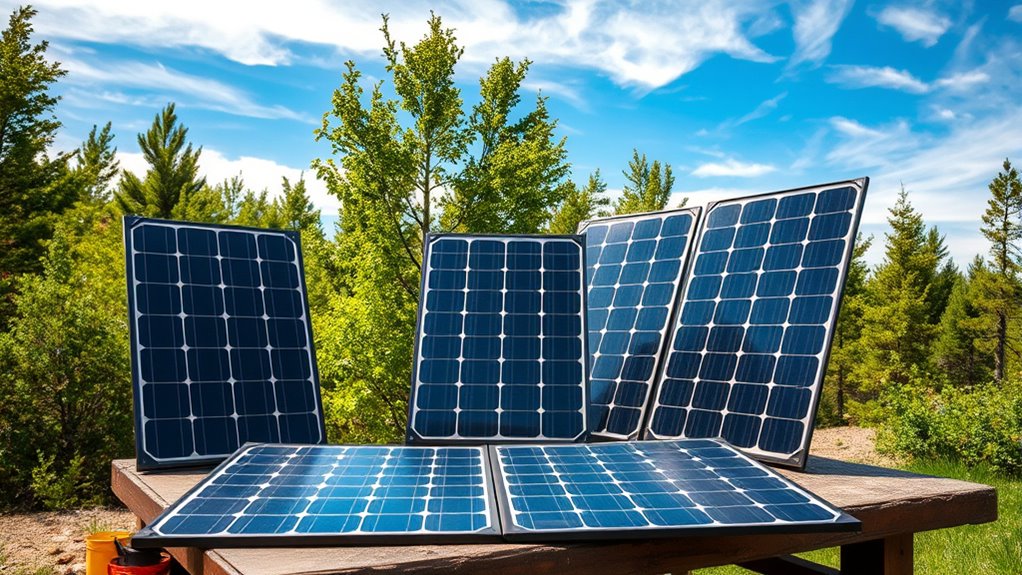

Choosing a portable solar setup for both camping and home backup comes down to whether you need a panel, a battery, or both. I put the DOKIO 300W kit first for buyers charging a compatible 12V battery, while the Twelseavan 200W panel is the simpler pick for direct USB charging and broader power station compatibility. The 2016Wh power station bundle is the most complete option for home backup and longer trips, but it is a heavier system rather than a lightweight panel alone. These products serve different jobs: rated panel output depends on sun and compatible equipment, and neither panel stores energy by itself.

Get your wardrobe favorites delivered free with Prime
- Fast, free delivery on millions of items
- Prime Video, Amazon Music and more included
- Member-only deals all year
My ranking reflects practical fit for the title: usable charging options, setup flexibility, and how clearly each product serves camping and home needs. A high wattage figure does not guarantee that a power station can accept that much solar input. I also weigh the tradeoff between carrying a foldable panel and moving a full battery system.
Key Takeaways
- DOKIO 300W is my panel-kit pick for charging a 12V battery through its included PWM controller, with multiple connection types and a long cable.
- Twelseavan 200W offers direct USB-C charging up to 60W, making it a better fit for phones and compatible devices without a separate battery.
- The 2016Wh bundle includes two 200W panels and a LiFePO4 power station, so it can store energy for later use at camp or during an outage.
- Panel wattage is a maximum rating: sunlight, positioning, and a connected power station’s solar-input limit affect actual charging.
- The DOKIO and Twelseavan panels weigh about 15 pounds each; the bundled station weighs about 24.8kg, so portability varies sharply by setup.
| DOKIO 300W Portable Foldable Solar Panel Kit with Charge Controller |  | Best Panel Kit for 12V Battery Setups | Maximum power: 300W | Maximum voltage: 18V | Amperage capacity: 16.67A | VIEW ON AMAZON | See Our Full Breakdown |
| Twelseavan 200W Portable Foldable Solar Panel with USB-C and QC3.0 |  | Best for Direct Device Charging | Maximum output: 200W | Claimed conversion efficiency: 24% | USB-C output: Up to 60W | VIEW ON AMAZON | See Our Full Breakdown |
| Portable Power Station 2016Wh with Two 200W Solar Panels |  | Best Complete Setup for Home Backup | Battery capacity: 2016Wh | Battery type: LiFePO4 | AC output: 3600W | VIEW ON AMAZON | See Our Full Breakdown |
| portable solar panel for camping and home | Weight | USB-C output |
|---|---|---|
| DOKIO 300W Portable Foldable S | 15.2 lb | — |
| Twelseavan 200W Portable Folda | 15.7 lb | Up to 60W |
| Portable Power Station 2016Wh | — | 2 × 100W USB-C PD |
More Details on Our Top Picks
DOKIO 300W Portable Foldable Solar Panel Kit with Charge Controller
The DOKIO earns my top panel-only spot because it combines a 300W-rated foldable panel with a separate PWM controller, cable, and several adapter types. That controller adds a practical layer between panel and 12V battery, including protections for reverse polarity, overcharging, overload, and short circuits. For a campsite or a home battery setup that already uses compatible 12V equipment, this is a more complete charging kit than the Twelseavan, which focuses on direct USB outputs and power station adapters.
Its 9.85-foot cable gives more room to place the panel in sun while keeping the battery or equipment in shade. The dual USB ports can handle small devices when connected to a 12V battery, but they are not a dependable substitute for the Twelseavan’s specified USB-C output if direct device charging is your priority. And although the 300W rating is highest among the standalone panels here, some power stations accept less solar input, so check the receiving unit before expecting to use the panel’s full rated capacity.
The kit weighs 15.2 pounds, close to the Twelseavan’s 15.7, and folds for transport. That makes it manageable for car camping, but not a natural choice for backpacking. The fabric case also needs more care than an exposed panel rating might suggest: the description advises protection from prolonged heavy rain or strong sun. I would choose it over the Twelseavan for a battery-centered setup, and skip it if I wanted the lightest arrangement or reliable USB charging without a connected battery.
Pros:- 300W maximum rating with a separate PWM controller for 12V battery charging
- Controller includes reverse-polarity, overcharge, overload, and short-circuit protections
- 9.85-foot cable and SAE, XT60, DC, and alligator-clip connections
- Foldable design weighs 15.2 pounds and includes a storage bag
Cons:- Some power stations may accept less than the panel’s rated 300W input
- Fabric case should be protected from prolonged heavy rain or strong sun
- USB output may fluctuate in sunlight and requires a connected battery
Best for: Car campers and home users with a compatible 12V battery who want a foldable panel kit with controller protections and multiple connection options.
Not ideal for: Backpackers, buyers seeking a self-contained battery, or anyone who needs direct USB device charging without a connected battery.
- Maximum power:300W
- Maximum voltage:18V
- Amperage capacity:16.67A
- Output voltage:12V DC
- Cell material:Monocrystalline silicon
- Folded dimensions:19.3 × 37.4 × 1.1 in
- Weight:15.2 lb
- Cable and controller:9.85 ft cable; separate PWM charge controller
- Connectors:SAE, XT60, DC, alligator clips
Our verdict“I would pick the DOKIO for a compatible 12V battery setup, where its controller and connection options matter more than direct USB convenience.”
Twelseavan 200W Portable Foldable Solar Panel with USB-C and QC3.0
The Twelseavan is the clearer choice when camping means charging personal electronics directly from the panel. Its standout detail is USB-C output up to 60W, joined by QC3.0 up to 18W and a standard USB port. That avoids requiring a separate 12V battery just to charge a compatible device, unlike the DOKIO’s described USB ports, which need a connected battery. For phones and other compatible electronics, the port mix gives the Twelseavan a more straightforward role.
It also comes with an MC4 cable and three DC adapters for use with many portable power stations. That makes it adaptable, though compatibility still depends on the specific station and its input limits. The 200W maximum rating is lower than the DOKIO’s 300W, so buyers prioritizing the highest panel rating should look at DOKIO first. In practice, neither rating can be assumed in all conditions: sunlight and panel positioning affect what the connected equipment receives.
Four adjustable kickstands help aim the panel toward the sun, while the IP65 rating offers stated protection against outdoor dust and water exposure. Those features suit a campsite, but this remains a 15.7-pound folded panel, not a backpacking accessory. Compared with the all-in-one power station bundle, it is much easier to transport and does not include stored energy. I would choose it for direct device charging or to pair with a compatible station; buyers needing overnight power or home outage storage need a battery as well.
Pros:- USB-C output up to 60W, plus QC3.0 and standard USB ports
- Includes MC4 cable and three DC adapters for many portable power stations
- Four adjustable kickstands help with panel positioning
- IP65 rating and magnetic handle support outdoor handling
Cons:- 15.7-pound weight may be cumbersome for hiking
- 200W maximum rating is lower than the DOKIO’s 300W
- Actual generation depends on sunlight and compatible receiving equipment
Best for: Campers who want direct USB-C charging and power station compatibility in a foldable panel without carrying a full battery system.
Not ideal for: People who need stored energy for nighttime or outage use, or buyers seeking a lightweight panel for long-distance hiking.
- Maximum output:200W
- Claimed conversion efficiency:24%
- USB-C output:Up to 60W
- QC3.0 output:Up to 18W
- USB output:5V/3A
- Weight:15.7 lb
- Folded size:23 × 22 in
- Included accessories:MC4 cable, three DC adapters, user manual
- Warranty:24 months
Our verdict“I would choose the Twelseavan when direct USB-C charging is more useful than the DOKIO’s higher panel rating and battery-focused controller kit.”
Portable Power Station 2016Wh with Two 200W Solar Panels
This bundle changes the comparison: it is a portable power station with two 200W panels, not a panel alone. Its 2016Wh LiFePO4 battery stores energy for later, which is the feature that makes it more useful for home backup and overnight camping than either standalone panel. The listed 3600W AC output, four AC outlets, and two 100W USB-C PD ports give it a broad range of connection options. By contrast, the DOKIO and Twelseavan need a compatible battery or power station to provide stored power.
For buyers preparing for outages, the bundle supports solar, wall, and car charging, and lists a 10ms UPS function. The station’s listed solar input reaches 1600W, while the included panels total 400W maximum, so the included pair does not by itself match the station’s maximum solar input. That leaves room for a larger compatible solar array, though any added panels must match the unit’s requirements. App monitoring may help keep track of charging and power use, but it does not reduce the physical burden of moving the system.
At approximately 24.8kg and 23 × 13 × 17 inches, the station is far less convenient to carry than either foldable panel. It makes sense for car camping, an RV, or a home backup location where capacity matters more than frequent lifting. The product description also lists different outlet counts in different places, so I would verify the exact configuration before relying on a particular total. I rank it as the strongest complete system for stored energy, but not as the best choice for someone searching for a simple portable panel.
Pros:- 2016Wh LiFePO4 battery stores energy for later use
- Includes two 200W solar panels and supports solar, wall, and car charging
- Lists 3600W AC output, 7200W surge output, and two 100W USB-C PD ports
- App monitoring and a 10ms UPS function are included
Cons:- Station weighs approximately 24.8kg and is bulky to transport
- Included 400W of panels is below the station’s stated 1600W maximum solar input
- Product description and specifications give conflicting outlet counts
Best for: Households and car campers who want a large LiFePO4 battery, included solar panels, and multiple charging methods in one purchase.
Not ideal for: Backpackers, buyers who only need a panel, or anyone who cannot comfortably move a 24.8kg power station.
- Battery capacity:2016Wh
- Battery type:LiFePO4
- AC output:3600W
- Surge output:7200W
- Solar input:Up to 1600W
- UPS switching time:10ms
- USB-C output:2 × 100W USB-C PD
- Included solar panels:2 × 200W
- Weight and dimensions:24.8kg; 23 × 13 × 17 in
Our verdict“I would choose this bundle for stored power at home or car camping, provided its weight and outlet configuration suit the intended setup.”

How We Picked
I compared these three products against the specific needs behind portable solar panel for camping and home: collecting energy outdoors, connecting to useful devices or storage, and fitting the realities of transport and setup. I gave weight to output and connection details, but treated advertised maximum wattage as a ceiling rather than a promise of everyday performance. Sun conditions, panel angle, and the receiving device’s input limits all affect results.
I also separated panels from complete power systems. The Twelseavan has USB outputs and adapters for compatible power stations; the DOKIO kit adds a separate PWM controller for a 12V battery setup. The third product bundles a large battery with two panels, which makes it the strongest ready-made option for storing power, though far less convenient to carry. My ranking favors the DOKIO as a flexible panel kit, the Twelseavan for direct device charging, and the bundle for buyers whose priority is home backup capacity.
Provided specifications and descriptions form the basis of this comparison. I do not treat weather resistance as permission to leave gear exposed indefinitely, and compatibility should be checked against the exact power station or battery before purchase. The DOKIO’s fabric case has stated exposure limits, and the bundled station description lists conflicting outlet counts, so I avoid relying on a single total for that detail.
Factors to Consider When Choosing Portable Solar Panel For Camping And Home
I would start by deciding whether I need to generate energy, store it, or do both. A foldable panel collects power when sunlight is available; a battery lets me use stored energy after the sun goes down or when the panel is packed away.
Panel-only or complete system?
The DOKIO and Twelseavan are foldable panels. The DOKIO includes a separate PWM controller for a compatible 12V battery, while the Twelseavan provides direct USB outputs and adapters for compatible power stations. Neither one includes a battery in the supplied description. The third option bundles two panels with a 2016Wh station, so it can store energy and supply AC power. I would favor the bundle for home outage preparation, and a standalone panel when I already own compatible storage.
Match the connections to your equipment
Before buying, I would check the input requirements for my battery or power station: connector type, voltage range, and maximum solar input. The DOKIO lists SAE, XT60, DC, and alligator-clip connections, and its controller is intended for a 12V battery setup. The Twelseavan includes MC4 and DC adapters and has USB-C, QC3.0, and USB outputs. Included adapters are useful, but they do not guarantee compatibility with every device. Confirm the exact equipment pairing first.
Treat rated watts as a ceiling
The DOKIO’s 300W rating exceeds the Twelseavan’s 200W rating, but the higher figure alone does not tell me what a device will receive. Cloud cover, shade, panel angle, and the receiving unit’s input limit all affect charging. A power station that accepts less than 300W cannot take the DOKIO’s full rated output. The included panels for the power station bundle total 400W, even though the station’s listed solar input can reach 1600W. I would match the panel array to the receiving unit rather than buying by wattage alone.
Think about the trip and the storage location
Both standalone panels weigh about 15 pounds, which is reasonable for car camping but burdensome for carrying far from a vehicle. The Twelseavan folds to 23 × 22 inches and has four kickstands; the DOKIO folds into a longer, narrower form and includes a 9.85-foot cable. The bundled station is approximately 24.8kg and is better suited to a vehicle or a fixed home location. I would account for the battery’s weight as well as the panel’s when planning a camp setup.
Check exposure limits and product details
Outdoor use still calls for sensible care. The Twelseavan lists an IP65 rating, while the DOKIO description says to protect its fabric case from prolonged heavy rain or strong sun. Neither statement means I should leave a setup unattended in harsh conditions. I would also confirm the power station bundle’s outlet layout with the seller because its description and specifications differ on the total count. For any of these options, check warranty terms and included accessories against the current product listing before ordering.
Frequently Asked Questions
Can either foldable panel power a home during an outage by itself?
No. The DOKIO and Twelseavan are panels, so they generate power when sunlight is available but do not store it for later. The DOKIO kit includes a controller for a compatible 12V battery, and the Twelseavan can connect to compatible power stations, but a battery or other suitable receiving device is needed for stored backup power. The third product includes a 2016Wh station as well as two panels, making it the complete option in this group.
Which standalone panel should I choose for camping?
I would choose based on what I plan to charge. The Twelseavan is more convenient for compatible phones and electronics because it lists USB-C up to 60W, QC3.0, and standard USB output. The DOKIO makes more sense when I am charging a compatible 12V battery and want its separate PWM controller, longer cable, and range of connectors. Both weigh around 15 pounds, so they suit car camping better than trips that require carrying gear a long distance.
Does the DOKIO’s 300W rating mean it will charge faster than the Twelseavan?
Not in every setup. The DOKIO has the higher maximum panel rating, but actual output changes with sunlight, shade, and angle. A connected power station may also cap incoming solar power below 300W. The Twelseavan’s lower 200W rating may still suit a smaller station or direct USB device charging. I would compare the panel output with the receiver’s input limits and the charging needs of my equipment.
Is the power station bundle suitable for backpacking?
Its station weighs approximately 24.8kg and measures 23 × 13 × 17 inches, so I would not choose it for backpacking. The battery and included panels are better suited to a vehicle, RV, campsite with easy access, or a home backup location. If I need a panel that is easier to carry, either standalone foldable option is more practical, though each still weighs about 15 pounds and neither provides stored energy on its own.
What should I verify before buying a panel for my power station?
I would confirm the station’s permitted solar voltage range, maximum input wattage, connector requirements, and whether the included adapter matches the panel. I would also check the battery or station’s instructions for safe connection and charging. A panel can have an adapter that physically fits while still being unsuitable for the station’s electrical limits. The product descriptions here list different connectors and output arrangements, so compatibility needs to be checked for the exact pairing.
Conclusion
For a compatible 12V battery system, I recommend the DOKIO 300W kit for its controller, cable length, and connection options. For direct charging of compatible electronics while camping, the Twelseavan 200W panel is the more convenient pick thanks to its USB-C output and adjustable stands. If home backup or stored power for car camping matters most, I would choose the 2016Wh power station bundle, accepting its substantial weight and checking the outlet configuration before purchase. My deciding question is simple: do I need a panel, direct device charging, or a battery system that can keep power available after sunlight fades?