
If you’re dealing with thick walls and need seamless coverage, I recommend mesh systems like the TP-Link Deco X55 or the NETGEAR Orbi 370, which offer wide coverage and advanced Wi-Fi 6/6E technology. Systems with tri-band support, external antennas, and wired backhaul perform best in challenging environments. For outdoor use, consider models like the Deco Outdoor Mesh. Want to find out which setup suits your home best? Keep exploring to discover the top options.
Key Takeaways
- High-coverage mesh systems like TP-Link Deco X55 and NETGEAR Orbi 370 excel in large, thick-walled homes, ensuring seamless coverage.
- Wi-Fi 6 and Wi-Fi 6E models provide stronger signals through walls and support more devices efficiently.
- Mesh systems with Ethernet backhaul and AI-driven optimization enhance stability and performance in challenging environments.
- Outdoor-specific mesh units like TP-Link Deco Outdoor Mesh extend reliable Wi-Fi to yards and external structures.
- Easy setup, smart home integration, and security features make advanced mesh systems user-friendly and secure for thick-walled spaces.
TP-Link Deco X55 AX3000 Mesh WiFi System (3-Pack)


If you’re dealing with thick walls that weaken your Wi-Fi signal, the TP-Link Deco X55 AX3000 Mesh WiFi System (3-Pack) is an excellent choice because it offers seamless coverage up to 6,500 square feet. I love how it replaces traditional routers and extenders, eliminating dead zones and buffering. With Wi-Fi 6 support, it connects up to 150 devices reliably, providing fast speeds and stable connections. The setup is simple via the Deco app, and remote management makes it even easier to control your network. Plus, with built-in security features, you get reliable protection without extra cost.
Best For: households with thick walls or large areas needing seamless Wi-Fi coverage and reliable device connectivity.
Pros:
- Covers up to 6,500 sq. ft. with seamless Wi-Fi 6 coverage
- Supports up to 150 devices simultaneously for stable connections
- Easy setup through the Deco app with remote management features
Cons:
- Requires a modem for most internet service providers, adding to initial setup costs
- Mesh system’s performance depends on proper placement of units
- Premium security features may require subscription upgrades for advanced options
TP-Link Deco XE75 AXE5400 Tri-Band WiFi 6E Mesh System

The TP-Link Deco XE75 AXE5400 Tri-Band WiFi 6E Mesh System stands out as an excellent choice for large homes with thick walls, thanks to its expansive coverage of up to 7,200 square feet. It supports WiFi 6E, adding a new 6 GHz band that reduces interference and can serve as a dedicated backhaul or a high-speed network for compatible devices. With combined speeds up to 5,400 Mbps across three bands, it ensures seamless, high-performance connectivity. The AI-driven mesh technology automatically optimizes your network, supporting up to 200 devices, making it ideal for eliminating dead zones and buffering in even the most challenging environments.
Best For: large households or multi-story homes seeking seamless, high-speed WiFi coverage with minimal interference and reliable device connectivity.
Pros:
- Covers up to 7,200 sq.ft., ideal for large homes with thick walls.
- Supports WiFi 6E with a dedicated 6 GHz band for reduced interference and enhanced performance.
- Smart AI-driven mesh technology automatically optimizes network performance for up to 200 devices.
Cons:
- Requires a modem, which adds to initial setup costs if not already owned.
- Premium pricing may be higher than basic WiFi systems.
- Setup and management, while user-friendly, may still be complex for non-technical users unfamiliar with mesh networking.
NETGEAR Orbi 370 Series WiFi 7 Mesh Network System

For homeowners dealing with thick walls that impede Wi-Fi signals, the NETGEAR Orbi 370 Series WiFi 7 Mesh Network System stands out with its strong coverage and reliable performance. It offers dual-band connectivity with speeds up to 5 Gbps, supporting multiple devices and seamless streaming. Covering up to 6,000 sq.ft., it’s ideal for large homes, and its high-performance antennas ensure 360° coverage. The system includes a router and two extenders, with a fast 2.5 Gigabit Ethernet port for wired connections. Easy to set up via the app and compatible with any internet provider, it’s a solid choice for thick-walled homes needing dependable Wi-Fi.
Best For: homeowners with large or thick-walled homes seeking fast, reliable Wi-Fi coverage for multiple devices and high-bandwidth activities.
Pros:
- Supports ultra-fast WiFi 7 speeds up to 5 Gbps and seamless connectivity for around 70 devices.
- Covers up to 6,000 sq.ft. with high-performance antennas providing 360° coverage.
- Easy setup and management via the Orbi app, compatible with any internet provider.
Cons:
- Higher price point compared to basic WiFi systems, reflecting advanced features.
- Slightly bulky units with dimensions of approximately 8.02 x 4.72 x 2.95 inches.
- Limited detailed information on extended security features beyond the initial 30-day Armor trial.
TP-Link Deco Outdoor Mesh WiFi (Deco X50-Outdoor)

When dealing with thick walls and outdoor environments, reliable Wi-Fi coverage requires a robust solution like the TP-Link Deco Outdoor Mesh WiFi (Deco X50-Outdoor). This weatherproof, dustproof device extends Wi-Fi 6 performance outdoors, covering yards, patios, or guest houses. It’s compatible with all Deco Mesh systems and easy to set up via the Deco app, offering seamless management. With dual Gigabit PoE ports, it supports flexible, cable-efficient installation using Ethernet or PoE+ power. Its durable design withstands harsh weather, ensuring stable, long-lasting connectivity. Plus, with built-in security features like TP-Link HomeShield, it keeps your outdoor network safe and protected.
Best For: homeowners and outdoor enthusiasts seeking reliable, high-performance Wi-Fi coverage across large outdoor areas like yards, patios, or guest houses.
Pros:
- Weatherproof and dustproof design ensures durability in harsh outdoor conditions
- Supports dual-band Wi-Fi 6 for fast, seamless outdoor connectivity
- Flexible installation options with PoE+ and Ethernet ports reduce cable clutter
Cons:
- Requires PoE power source or AC adapter, which may need additional setup
- May be more expensive compared to indoor Wi-Fi solutions
- Setup and management are dependent on the Deco app, which may have a learning curve for some users
TP-Link Deco BE25 Mesh Wi-Fi System (3-Pack)

If you need reliable Wi-Fi coverage through thick walls, the TP-Link Deco BE25 Mesh Wi-Fi System (3-Pack) is an excellent choice, especially since it supports WiFi 7 with dual-band, 4-stream technology delivering up to 5 Gbps combined speeds. It uses Multi-Link Operation (MLO), 4K-QAM, and Multi-RUs for enhanced performance, making it ideal for the latest devices like gaming consoles and smartphones. Covering up to 6,600 sq. ft., it supports over 150 devices simultaneously. Each unit includes two 2.5 Gbps ports for wired connections, ensuring fast, stable performance both wireless and wired. Its AI-driven roaming guarantees seamless coverage across your home.
Best For: households requiring high-speed, reliable Wi-Fi coverage across large areas with multiple devices and smart home integration.
Pros:
- Supports WiFi 7 with up to 5 Gbps combined speeds for fast, seamless connectivity
- Covers up to 6,600 sq. ft. and supports over 150 devices simultaneously
- Includes two 2.5 Gbps wired ports per unit for high-performance wired connections
Cons:
- Requires a modem for internet connection, which may add to setup complexity
- Higher cost compared to basic Wi-Fi systems due to advanced features
- May be overkill for small households or those with minimal internet needs
MeshForce M3 Dot WiFi Extender

The MeshForce M3 Dot WiFi Extender is an ideal choice for those already using a MeshForce Wi-Fi system who want to expand their coverage seamlessly. Designed exclusively for M1 and M3 models, it can’t work as a standalone device or with other brands. Each M3 Dot adds about 1-2 rooms or up to 1,000 square feet of coverage, and you can add up to six dots for a total coverage of 10,000 square feet. Setup is simple—just scan the QR code with the My Mesh app. You can easily manage your network, monitor connected devices, and create guest zones, making it a smart addition for thick-walled homes.
Best For: Homeowners with existing MeshForce Wi-Fi systems seeking to expand coverage seamlessly in a thick-walled or large house.
Pros:
- Easy setup via QR code scan with the My Mesh app.
- Expands Wi-Fi coverage by up to 10,000 sq ft with up to six dots.
- Manages network, connected devices, and guest zones conveniently through mobile app.
Cons:
- Only compatible with MeshForce M1 and M3 systems; not suitable for other brands.
- Cannot operate as a standalone extender or mesh point.
- Limited to a maximum of six dots per system, which may not suit extremely large properties.
Amazon eero 6 Mesh WiFi System (3-Pack)
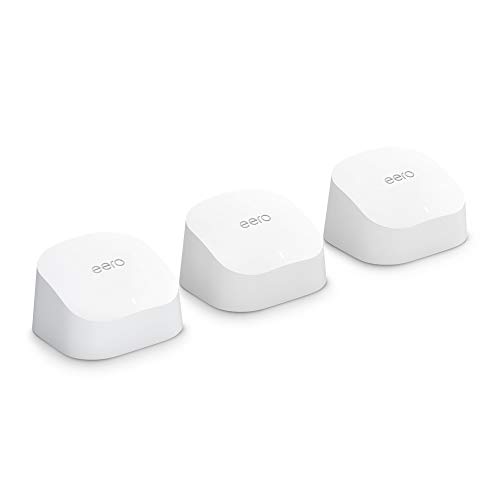
The Amazon eero 6 Mesh WiFi System (3-Pack) excels at providing reliable, whole-home coverage, making it an ideal choice for homes with thick walls that often hinder traditional Wi-Fi signals. Supporting internet plans up to 500 Mbps, it covers up to 4,500 sq ft with one router and two extenders. This Wi-Fi 6 system handles multiple devices seamlessly, perfect for streaming, gaming, and video calls. It also functions as a Zigbee smart home hub, integrates easily with Alexa, and offers a straightforward setup through the eero app. With robust security features and automatic updates, it guarantees a secure, stable connection across even challenging environments.
Best For: households seeking reliable, extensive Wi-Fi coverage with smart home integration and support for multiple devices, especially in environments with thick walls or challenging layouts.
Pros:
- Supports whole-home coverage up to 4,500 sq ft with a 3-pack, ideal for large or complex spaces.
- Seamless Wi-Fi 6 performance with support for over 75 connected devices, reducing buffering and lag.
- Functions as a Zigbee smart home hub, easily integrates with Alexa, and offers straightforward setup via the eero app.
Cons:
- Maximum internet speed support is up to 500 Mbps, which may not suit higher-tier plans.
- Performance can vary depending on building materials, interference, and device placement.
- Limited to a 1-year warranty with optional paid subscription for additional features (eero Plus).
Linksys Velop Whole Home WiFi Mesh System (Renewed)
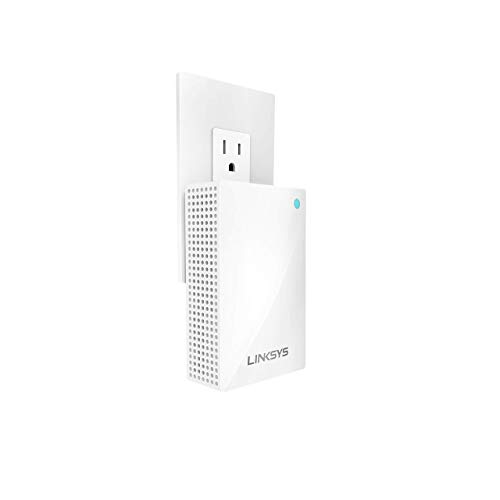
For homeowners struggling with thick walls that weaken Wi-Fi signals, the Linksys Velop Whole Home WiFi Mesh System (Renewed) offers an effective solution. These wall plug-in nodes extend coverage without cables, fitting easily into any environment. Compatible exclusively with the Velop system, they work seamlessly to improve device connectivity in previously hard-to-reach areas. Setup is quick via the Linksys app, so you can be online in minutes. With open-source support and a compact design, these nodes blend into your home while boosting Wi-Fi speed and range. Customers rate this renewed system highly, making it a reliable, scalable choice for seamless coverage.
Best For: homeowners with thick walls or challenging layouts seeking an easy-to-install, seamless Wi-Fi coverage solution.
Pros:
- Easy quick setup via the Linksys app for instant connectivity
- Compact, plug-in design fits discreetly into any environment
- Enhances Wi-Fi range and speed, especially in hard-to-reach areas
Cons:
- Compatible exclusively with the Velop system, limiting flexibility with other brands
- Renewed product may have some wear, though thoroughly tested for reliability
- Open-source features may require some technical knowledge to fully utilize
Bangcheer Wall Mount for TP-Link WiFi Mesh Routers

If you’re looking to maximize your TP-Link Deco X20, X60, X50, or X55 mesh system’s performance in spaces with thick walls, the Bangcheer Wall Mount is a smart choice. Designed specifically for these models, it helps optimize placement for better coverage and reception. Made from sturdy metal and plastic, it’s lightweight yet durable. The stylish, space-saving design fits seamlessly into homes or offices, while the ventilated bottom ensures proper heat dissipation. Easy to install with included accessories, it keeps your router secure, organized, and accessible. With this mount, you can improve your WiFi signal and reduce dead zones effortlessly.
Best For: homeowners and office users seeking to improve WiFi coverage and performance for TP-Link Deco X20, X60, X50, or X55 mesh systems through easy wall mounting.
Pros:
- Easy and quick installation with included accessories
- Durable, stylish, and space-saving design suitable for various environments
- Ventilated bottom promotes heat dissipation, extending device lifespan
Cons:
- Compatible only with specific TP-Link Deco models (router not included)
- May require wall drilling or additional tools for installation
- Limited to wall mounting, not suitable for other mounting options
NETGEAR AX1800 Dual-band WiFi 6 Mesh Extender

When you need a reliable way to extend Wi-Fi coverage through thick walls, the NETGEAR AX1800 Dual-band WiFi 6 Mesh Extender stands out with its seamless mesh networking and compatibility. It can cover up to 1,500 sq. ft. and supports over 20 devices, including smartphones, laptops, and IoT gadgets. With WiFi 6 technology, it delivers speeds up to 1.8Gbps across dual bands, ensuring fast, efficient connections. Easy to set up via the app or WPS button, it also includes a Gigabit Ethernet port for wired devices. Its smart roaming keeps your network stable as you move around, making it ideal for challenging environments.
Best For: homeowners and small office users seeking reliable, seamless Wi-Fi coverage in challenging environments with multiple devices.
Pros:
- Extends WiFi coverage up to 1,500 sq. ft. supporting over 20 devices
- Supports WiFi 6 technology for faster, more efficient speeds up to 1.8Gbps
- Easy setup via app or WPS button with seamless smart roaming
Cons:
- Requires compatible WiFi 6 router for optimal performance
- May be less effective in extremely thick walls or large properties beyond 1,500 sq. ft.
- Refurbished models might have limited warranty compared to new units
Wall Mount for TP-Link Deco Mesh Wi-Fi System (3-Pack)

The Wall Mount for TP-Link Deco Mesh Wi-Fi System (3-Pack) is an excellent choice for anyone looking to maximize signal strength and maintain a tidy setup, especially in homes with thick walls that can hinder Wi-Fi coverage. Designed specifically for TP-Link Deco BE Series models, it securely mounts routers on walls to improve reception and save space. Made from high-quality aluminum alloy with a white powder coating, it offers durability and good ventilation to prevent overheating. The built-in cable management rack keeps wires organized and out of sight. Easy to install and stylish, this mount enhances both functionality and home decor.
Best For: homeowners and tech enthusiasts seeking to enhance Wi-Fi coverage and maintain an organized, stylish router setup in their living spaces.
Pros:
- Compatible specifically with TP-Link Deco BE Series Mesh Wi-Fi 7 systems for a secure fit.
- Made from durable aluminum alloy with good ventilation to prevent overheating.
- Features a built-in cable management rack for a tidy and clutter-free environment.
Cons:
- Limited to TP-Link Deco BE Series models, not universal for other routers.
- Installation requires wall mounting, which may not be suitable for all surfaces.
- Slightly more expensive compared to basic or generic wall mounts.
TP-Link Deco BE23 Dual-Band Wi-Fi 7 Mesh System (3-Pack)

Looking to extend reliable Wi-Fi coverage through thick walls without sacrificing speed? The TP-Link Deco BE23 Dual-Band Wi-Fi 7 Mesh System (3-Pack) is a top choice. It leverages the latest Wi-Fi 7 tech, offering full speeds up to 3.6 Gbps and supporting over 150 devices simultaneously. With four high-gain antennas per node and wired multi-gig backhaul, it ensures strong, stable signals across up to 6,500 square feet. Plus, its advanced security, intuitive app management, and AI-driven seamless roaming make it a future-proof solution for large homes with thick walls. Perfect for streaming, gaming, and remote work.
Best For: households and small offices seeking ultra-fast, reliable Wi-Fi coverage across large areas with thick walls, supporting multiple devices for streaming, gaming, and remote work.
Pros:
- Utilizes the latest Wi-Fi 7 technology for speeds up to 3.6 Gbps and future-proof performance.
- Covers up to 6,500 sq. ft. with seamless connectivity and strong signals via high-gain antennas and wired backhaul.
- Offers advanced security features, app-based management, and AI-driven seamless roaming for easy, secure network control.
Cons:
- Higher price point compared to older Wi-Fi systems due to advanced features.
- Requires compatible Wi-Fi 7 devices to maximize full speed benefits.
- Setup may be more complex for users unfamiliar with mesh networking or advanced configurations.
Outlet Wall Mount for eero 6 & eero 6+ Mesh Wi-Fi System

If you’re using the eero 6 or eero 6+ mesh Wi-Fi system and want a tidy, space-saving setup, the Outlet Wall Mount is a great choice. It’s specifically designed for these models, offering a sleek, wall-hanging solution that hides wires in a groove behind the bracket for a neat appearance. Installation is quick and tool-free, making it perfect for beginners. The mount supports even network coverage, reduces clutter, and enhances your home or office’s aesthetics. Made of high-quality materials, it ensures stability and long-term use, all while allowing easy movement of your router between rooms.
Best For: users with eero 6 or eero 6+ mesh Wi-Fi systems seeking a simple, space-saving wall mount solution for neat network setup.
Pros:
- Easy, tool-free installation suitable for beginners.
- Hides wires in a groove for a clean, organized appearance.
- Made of high-quality materials ensuring stability and long-term durability.
Cons:
- Only compatible with eero 6 and eero 6+ models, not other eero versions.
- Does not include the eero router, plug, or cord in the package.
- Limited to wall mounting, which may not suit all space configurations.
Wall Mount for TP-Link Deco X68/XE75/AXE5300 Mesh Wi-Fi System

For homeowners and office managers seeking a sleek, secure way to optimize Wi-Fi coverage, the wall mount for TP-Link Deco X68/XE75/AXE5300 Mesh Wi-Fi System offers an ideal solution. It’s compatible with several TP-Link models and improves device placement, maintaining strong signals and coverage. Its cord groove simplifies cable management, while the wall-mounted design protects devices from spills, pets, and children. Installation is quick and straightforward with just a screwdriver, screws, and expansion bolts. The sleek, modern look blends seamlessly with any decor, and vented bottoms ensure proper airflow. Made from durable materials, this mount keeps your Wi-Fi system protected, organized, and aesthetically pleasing.
Best For: homeowners and office managers looking to optimize Wi-Fi coverage with a sleek, secure, and space-saving wall mount solution.
Pros:
- Compatible with multiple TP-Link Deco models, ensuring versatile use
- Easy 3-step installation with included screws and expansion bolts, no special tools needed
- Vented bottom promotes effective airflow, helping to dissipate heat and maintain device performance
Cons:
- Wall mounting may require drilling, which could be inconvenient for renters or those avoiding wall damage
- Size and design may not suit very large or unusually shaped Wi-Fi devices
- Limited to specific TP-Link models, not compatible with other brand systems
TP-Link Deco XE70 Pro WiFi 6E Mesh System (3-Pack)

The TP-Link Deco XE70 Pro WiFi 6E Mesh System (3-Pack) is an excellent choice for homes with thick walls because it delivers robust, congestion-free coverage using the latest Wi-Fi 6E technology. Its tri-band setup supports lightning-fast speeds up to 4.9 Gbps across 6 streams, with the added benefit of Wi-Fi 7 support for future-proofing. With coverage of up to 2,900 sq. ft. per unit and seamless AI-roaming, it keeps all devices connected smoothly. Plus, the system supports up to 200 devices simultaneously, ensuring reliable performance for smart homes, streaming, gaming, and more. Setup is quick via the Deco app, and security is premium with advanced protections.
Best For: households seeking high-speed, reliable, and future-proof Wi-Fi coverage capable of supporting numerous devices and demanding activities like streaming, gaming, and smart home integration.
Pros:
- Supports Wi-Fi 6E and Wi-Fi 7 for cutting-edge, congestion-free connectivity.
- Covers up to 2,900 sq. ft. per unit with seamless AI-roaming for smooth device switching.
- Handles up to 200 devices simultaneously, ideal for busy smart homes and entertainment setups.
Cons:
- May be more expensive than traditional Wi-Fi systems due to advanced features.
- Requires the Deco app for setup and management, which might be a learning curve for some users.
- The full performance potential depends on compatible devices and internet plan, limiting benefits if connected devices are outdated.
Factors to Consider When Choosing a Mesh Wi-Fi System for Thick Walls

When selecting a mesh Wi-Fi system for thick walls, I look at signal penetration capabilities and how well the system can pass through barriers. I also consider mesh technology compatibility and whether wired backhaul options are available to improve performance. Additionally, I check device capacity limits and if outdoor use is weatherproof, ensuring the system fits my specific environment.
Signal Penetration Capabilities
Choosing a mesh Wi-Fi system capable of penetrating thick walls requires attention to specific features that enhance signal strength and stability. Systems with higher power output and advanced beamforming concentrate signals directly where needed, improving penetration. Devices supporting WiFi 6 or WiFi 6E also deliver stronger, more reliable coverage in challenging environments. Tri-band systems are particularly effective, as they dedicate a separate backhaul channel, reducing interference and boosting stability. External and high-gain antennas can further improve signal penetration through dense barriers. Additionally, strategic placement of nodes—closer to thick walls—can make a significant difference. By focusing on these capabilities, you’ll ensure your mesh system delivers robust, seamless coverage even in homes with challenging, thick-walled layouts.
Mesh Technology Compatibility
Selecting a mesh Wi-Fi system that works well with thick walls means paying attention to its compatibility features. Tri-band systems with a dedicated 6 GHz band help reduce interference and congestion, guaranteeing more reliable connections through barriers. Wi-Fi 6 and Wi-Fi 6E standards support adaptive routing and self-healing capabilities, making them ideal for challenging environments. Compatibility with Ethernet backhaul allows nodes to connect via wired links, considerably boosting stability across thick walls. Additionally, AI-driven mesh learning optimizes signal paths dynamically, enhancing coverage and performance. Using standardized protocols like 802.11ax or 802.11be also guarantees better interoperability among devices. All these compatibility factors work together to maintain strong, seamless coverage in homes with dense barriers.
Wired Backhaul Options
Wired backhaul offers a reliable solution for maintaining strong, consistent Wi-Fi signals in homes with thick walls, especially when wireless signals struggle to penetrate dense materials. By using Ethernet cables to connect mesh nodes, it creates a dedicated high-speed link that reduces wireless congestion and interference. This setup considerably enhances network stability and speed, ensuring that each node with Ethernet ports maintains ideal bandwidth distribution. Wired backhaul also minimizes latency and packet loss, resulting in smoother streaming, gaming, and video calls. While installing Ethernet cabling may require extra effort, it provides superior performance in challenging layouts. When choosing a mesh system for thick walls, consider models with multiple Ethernet ports and easy wiring options to maximize the benefits of wired backhaul.
Device Capacity Limits
When dealing with thick walls, it’s essential to take into account how many devices you’ll connect to your mesh Wi-Fi system, as this directly impacts network performance. Mesh systems vary widely in their capacity, supporting anywhere from 50 to over 200 devices simultaneously. Choosing a system with a higher device capacity guarantees your network remains stable and responsive, even when multiple users and smart gadgets operate at once. Advanced AI-driven mesh technology can help optimize performance and manage device limits more efficiently. To prevent network congestion, verify each mesh node’s maximum device support, especially if you have a large household or office. Making sure your system can handle your device load is key to maintaining seamless connectivity through thick walls and busy networks.
Weatherproof Outdoor Use
To guarantee your mesh Wi-Fi system performs well outdoors, weatherproof units are a smart choice, especially when dealing with thick walls that limit indoor coverage. These units are built with durable, water-resistant materials that can withstand rain, snow, and dust, ensuring reliable performance outside. Outdoor-rated devices typically feature sealed enclosures and corrosion-resistant components, making them suitable for long-term use in harsh weather conditions. Proper placement of weatherproof nodes can extend your Wi-Fi coverage into yards, patios, and open spaces, bypassing barriers posed by thick walls. Additionally, outdoor mesh units with good ventilation and heat dissipation help maintain excellent operation in varying temperatures, ensuring seamless connectivity without interruptions or signal degradation.
Easy Installation Methods
Choosing a mesh Wi-Fi system that’s easy to install can save you time and frustration, especially when dealing with thick walls that complicate coverage. I recommend looking for systems that offer straightforward setup through mobile apps with visual guides, which make installation simple. Opt for nodes that are wall-mountable or plug-in, so placement becomes hassle-free without extensive wiring. Clear, step-by-step instructions and minimal tools needed can considerably reduce technical barriers. Additionally, self-configuring or auto-optimizing features help streamline the process, ensuring the system adapts to your environment effortlessly. Flexible placement options, like wall mounts or compact designs, are especially helpful for thick walls, allowing you to position nodes strategically for ideal coverage without complications.
Frequently Asked Questions
How Do Mesh Systems Perform in Extremely Thick or Concrete Walls?
Mesh systems can struggle with extremely thick or concrete walls, as these materials block Wi-Fi signals. I’ve found that deploying more nodes closer to the problematic areas helps improve coverage. Using mesh systems with high-powered antennas or dual-band capabilities also boosts performance. While they don’t completely eliminate dead spots, with careful placement and some upgrades, you can get pretty reliable coverage even through tough walls.
Are There Specific Mesh Features That Enhance Coverage Through Thick Walls?
Think of mesh Wi-Fi systems as a relay race, passing the signal smoothly through thick walls. Features like dedicated backhaul channels act as dedicated lanes, ensuring the signal doesn’t get lost or slowed down. Advanced beamforming focuses the Wi-Fi directly to your devices, like a spotlight illuminating a stage. These features work together to enhance coverage, making even the thickest walls less of a barrier and more of a passing baton.
Can Mesh Units Be Customized for Better Penetration in Dense Building Materials?
Yes, mesh units can be customized for better penetration in dense building materials. I recommend placing nodes strategically, such as near thick walls, and using units with adjustable antennas to boost signals. Upgrading firmware and choosing systems with advanced features like beamforming can also enhance coverage. By optimizing placement and selecting the right hardware, I’ve found that you can considerably improve Wi-Fi performance in challenging environments.
Do Mesh Wi-Fi Systems Require Special Installation for Optimal Thick Wall Coverage?
Back in the day, setting up a Wi-Fi was straightforward, but today, mesh systems for thick walls do need some finesse. I recommend installing the primary node centrally and placing additional units strategically to maximize coverage. No special tools are necessary, but careful placement matters. Experiment with positions to find the sweet spot where signals pass through dense materials most effectively, ensuring seamless, strong coverage throughout your space.
How Does Wall Material Affect the Choice of Mesh Wi-Fi System?
Wall material greatly impacts my choice of mesh Wi-Fi system. Thick concrete or brick walls tend to block signals more than drywall, so I look for systems with powerful, high-gain antennas and multiple nodes to bounce signals around obstacles. I also consider systems with dedicated backhaul channels, which help maintain fast speeds even through dense materials. Fundamentally, the tougher the walls, the more robust and adaptable my mesh system needs to be.
Conclusion
In my quest for seamless, strong Wi-Fi through stubborn walls, selecting the right system truly transforms your space. By balancing bandwidth, coverage, and durability, you can beat barriers and boost your connection. Whether it’s a tri-band titan or outdoor warrior, the perfect mesh system makes all the difference. Don’t settle for spotty signals—stand strong, stay connected, and enjoy uninterrupted internet with a system that’s built to break through walls.