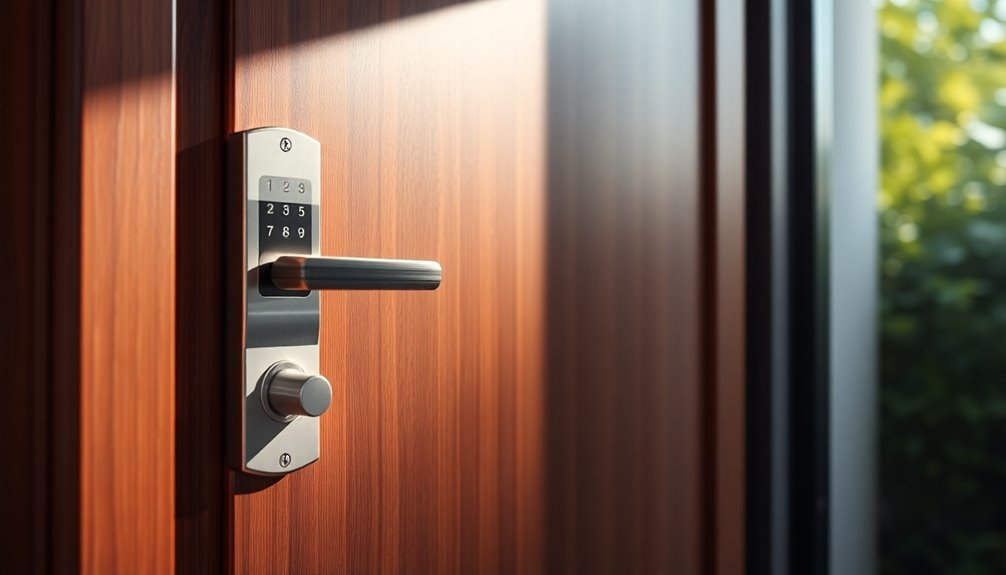
Keyless door locks trade a traditional key routine for keypad codes, fingerprints, or phone-based access, but the right choice depends on how much convenience and connectivity you need. My best overall pick is the Philips Wi-Fi Smart Deadbolt for shoppers who want app access alongside keyless entry; the TEEHO TE001 is a simpler keypad-focused alternative, while the Ulecoce U68 adds fingerprint entry. The main tradeoffs are connected features versus setup and upkeep, and a deadbolt-only replacement versus a full handle set. Read on for how all eight options compare and which fits your door and household.

Get your wardrobe favorites delivered free with Prime
- Fast, free delivery on millions of items
- Prime Video, Amazon Music and more included
- Member-only deals all year
Key Takeaways
- Philips Wi-Fi Smart Deadbolt is the lead pick for buyers who want Wi-Fi access; the keypad-focused TEEHO TE001 suits those who prefer a simpler setup.
- The two TEEHO TE001 finishes represent the same keypad deadbolt model, so the choice between them is primarily a finish match rather than a feature upgrade.
- Veise VE027-L and Philips 4200 Series include handle sets, which can make them better fits when replacing more than the deadbolt.
- Ulecoce U68 adds fingerprint entry to keypad access, trading a broader entry choice for a feature set buyers may not need.
- The lineup spans deadbolts, knob or handle sets, and Wi-Fi-connected models, so door compatibility and desired access method matter more than the shared keyless label.
| TEEHO TE001 Keyless Entry Deadbolt with Keypad, Matte Black |  | Best Overall | Model: TE001 | Finish: Matte black | Access codes: Up to 20, plus a temporary single-use code | VIEW ON AMAZON | See Our Full Breakdown |
| Veise VE027-L Wi-Fi Smart Lock and Handle Set, Satin Nickel |  | Best for Connected Access | Model: VE027-L | Finish: Satin nickel | Connectivity: 2.4 GHz Wi-Fi; no hub required | VIEW ON AMAZON | See Our Full Breakdown |
| Yamiry Keyless Entry Smart Door Knob Lock with Keypad and Handle |  | Best for Simple Keypad Upgrades | Material: Aluminum alloy | Weather resistance: IP54 | Keypad: Backlit | VIEW ON AMAZON | See Our Full Breakdown |
| TEEHO TE001 Keyless Entry Deadbolt with Keypad, Satin Nickel |  | Best for Traditional Finishes | Model: TE001 | Finish: Satin nickel | Access codes: 20 household codes and a single-use guest code | VIEW ON AMAZON | See Our Full Breakdown |
| Ulecoce U68 Fingerprint Keypad Deadbolt with Knob Set, Matte Black | 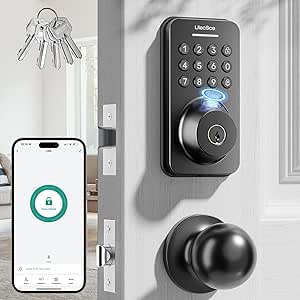 | Best for High-Capacity Biometric Access | Model: U68 | Color: Matte black | Unlocking methods: Fingerprint, keypad, app, one-touch, and physical key | VIEW ON AMAZON | See Our Full Breakdown |
| Philips Wi-Fi Smart Deadbolt Lock with Keyless Entry |  | Best for High-Security Key Control | Unlock methods: App, passcode, fingerprint, physical key, Alexa, or Google Assistant | Connectivity: Built-in 2.4 GHz Wi-Fi; no hub required | Passcodes: Up to 100 custom codes; one-time and scheduled codes supported | VIEW ON AMAZON | See Our Full Breakdown |
| Veise KS01C Keyless Entry Deadbolt with Knobs, Matte Black |  | Best Weather-Ready Keypad Set | Unlock methods: Up to 20 user codes, one master code, two backup keys, and unlimited one-time passwords | Auto-lock delay: 10–99 seconds | Incorrect code protection: Three-minute lockout after 10 consecutive incorrect attempts | VIEW ON AMAZON | See Our Full Breakdown |
| Philips 4200 Series Wi-Fi Keypad Deadbolt with Handle |  | Best Integrated Handle Set | Wi-Fi: 2.4 GHz; no hub required | Entry methods: Fingerprint, PIN code, app, voice assistant, and keyless deadbolt | Fingerprint unlock speed: 0.3 seconds | VIEW ON AMAZON | See Our Full Breakdown |
| keyless door lock | Model | Power | Weather resistance |
|---|---|---|---|
| TEEHO TE001 Keyless Entry Dead | TE001 | 4 AA batteries, not included | IP54 |
| Veise VE027-L Wi-Fi Smart Lock | VE027-L | 8 AA batteries, not included | — |
| Yamiry Keyless Entry Smart Doo | — | — | IP54 |
| TEEHO TE001 Keyless Entry Dead | TE001 | 4 AA batteries, not included | IP54 |
| Ulecoce U68 Fingerprint Keypad | U68 | — | — |
| Philips Wi-Fi Smart Deadbolt L | — | — | — |
| Veise KS01C Keyless Entry Dead | — | Four AA batteries; stated use over one year | IP54 |
| Philips 4200 Series Wi-Fi Keyp | — | — | — |
More Details on Our Top Picks
TEEHO TE001 Keyless Entry Deadbolt with Keypad, Matte Black
The TEEHO TE001 is my lead pick for households that want dependable keypad entry without app setup or a smart home hub. Its 20 family codes and single-use guest code cover everyday sharing, while adjustable auto-lock adds a safeguard for people who forget to turn the bolt. Compared with the satin nickel TE001, the hardware and access features are the same; the choice is mainly a finish match. The Veise VE027-L adds Wi-Fi, fingerprint entry, and access logs, but also calls for eight AA batteries and more connected features to manage. TEEHO keeps things simpler, with up to 365 days of claimed battery life and two backup keys. Check the door first: this model requires a 54 mm hole, and batteries are not included.
Pros:- Stores up to 20 household codes plus a single-use guest code
- Adjustable auto-lock delay can be set from 10 to 99 seconds
- Four AA batteries are specified for up to 365 days of use
- Includes two physical backup keys
Cons:- Fits 54 mm door holes and is not compatible with 38 mm holes
- Four AA batteries are not included
- Requires a reset before first use
Best for: Households seeking a straightforward keypad deadbolt with separate family and guest codes, especially where a matte black finish suits the door.
Not ideal for: Owners whose door has a 38 mm bore hole or buyers who want app control, fingerprint entry, or remote access logs.
- Model:TE001
- Finish:Matte black
- Access codes:Up to 20, plus a temporary single-use code
- Auto-lock delay:10–99 seconds; off by default
- Power:4 AA batteries, not included
- Claimed battery life:Up to 365 days
- Weather resistance:IP54
- Compatible door hole:2-1/8 in (54 mm); not compatible with 38 mm holes
- Warranty:2 years
Our verdict“Choose this matte black TEEHO for practical coded household access and auto-lock without smart connectivity, provided your door has the required 54 mm hole.”
Veise VE027-L Wi-Fi Smart Lock and Handle Set, Satin Nickel
The Veise VE027-L is the most versatile entry system here for buyers who want to manage access through several methods. It combines fingerprint, passcode, app, voice assistant, IC card, and physical key entry, with logs and alerts that can help track who is coming and going. Unlike the TEEHO TE001, it supports 2.4 GHz Wi-Fi without a separate hub, so app control does not stop at the door. That added reach comes with more setup and power demand: it uses eight AA batteries, compared with four in the TEEHO, and supports only 2.4 GHz Wi-Fi. Its IP65-rated metal handle set also offers greater stated water resistance than the IP54 TEEHO and Yamiry models. Buyers should measure door thickness and handle-to-lock spacing before choosing this broader, connected package.
Pros:- Offers app, fingerprint, passcode, voice assistant, IC card, and physical-key entry
- Connects directly to 2.4 GHz Wi-Fi without a hub
- Provides access logs, alerts, and adjustable auto-lock
- IP65-rated metal handle set
Cons:- Requires eight AA batteries, which are not included
- Wi-Fi connectivity is limited to 2.4 GHz
- Door thickness and handle-to-lock hole spacing must match its fit requirements
Best for: Households that want fingerprint entry and app-based access logs, alerts, and code sharing over 2.4 GHz Wi-Fi without adding a hub.
Not ideal for: Buyers who prefer a simple keypad-only lock, use a Wi-Fi network without 2.4 GHz, or want to minimize battery changes.
- Model:VE027-L
- Finish:Satin nickel
- Connectivity:2.4 GHz Wi-Fi; no hub required
- Unlock methods:App, fingerprint, passcode, voice assistant, IC card, physical key, user authorization, and code sharing
- Fingerprint capacity:Up to 20 fingerprints
- Auto-lock:Adjustable from 0 to 180 seconds
- Power:8 AA batteries, not included
- Door thickness compatibility:1-3/8 to 2 inches (35–50 mm)
- Water resistance:IP65
Our verdict“Pick the Veise VE027-L if connected access logs and multiple entry methods matter more to you than the simpler, lower-battery-demand TEEHO TE001.”
Yamiry Keyless Entry Smart Door Knob Lock with Keypad and Handle
The Yamiry keypad knob suits buyers who want to add coded entry at a door without stepping up to a connected deadbolt like the Veise VE027-L. Its backlit keypad is easier to use in low light, and it supports up to 20 user codes plus a one-time guest code. Auto-lock timing ranges from 5 to 99 seconds, with the option to disable it—more flexibility at the short-delay end than either TEEHO TE001 model, whose settings start at 10 seconds. The tradeoff is that the keypad does not replace every key-based fallback: the supplied backup key is described as duplicable. Its IP54 rating is also below Veise’s IP65 rating. This is a more basic fit for users who want local keypad access and a knob format, rather than app control or a deadbolt.
Pros:- Stores up to 20 user codes and a one-time guest code
- Backlit keypad and low-battery indicator aid everyday use
- Auto-lock can be set from 5 to 99 seconds or disabled
- Designed for screwdriver installation in under 15 minutes
Cons:- Backup access relies on a physical key described as duplicable
- IP54 rating is below the Veise VE027-L’s IP65 rating
- Does not list app or Wi-Fi control
Best for: Renters or homeowners seeking a keypad knob with individual user codes, one-time guest access, and adjustable auto-lock.
Not ideal for: Buyers who specifically need a deadbolt, Wi-Fi or app access, or stronger stated water resistance than IP54.
- Material:Aluminum alloy
- Weather resistance:IP54
- Keypad:Backlit
- User codes:Up to 20
- Code length:4–8 digits
- Guest access:One-time code
- Auto-lock time:5–99 seconds or disabled
- Installation:Under 15 minutes with a screwdriver
- Warranty and support:30-day money-back guarantee, 1-year product coverage, lifetime after-sales support
Our verdict“Choose the Yamiry if a keypad knob with flexible auto-lock is your priority and you do not need the deadbolt format or connectivity offered by Veise.”
TEEHO TE001 Keyless Entry Deadbolt with Keypad, Satin Nickel
This satin nickel TEEHO TE001 offers the same practical keypad setup as the matte black version: 20 household codes, a single-use guest code, adjustable auto-lock, and two-year warranty coverage. I give it a distinct role for buyers matching existing satin nickel hardware; there is no stated access or security feature that separates it from its matte black sibling. Both use four AA batteries and fit a 54 mm door hole, while the Yamiry offers a shorter minimum auto-lock delay and a knob format instead of a deadbolt. Compared with the Veise VE027-L, this TEEHO skips app access, fingerprints, and activity logs, which keeps daily operation simpler. The fit limitation matters, and the lock must be reset before first use to detect door direction.
Pros:- Provides 20 household codes and a single-use guest code
- Adjustable auto-lock from 10 to 99 seconds, with one-touch auto-lock
- Includes a low-battery indicator and claims up to 365 days of battery life
- Designed for screwdriver installation
Cons:- Only fits 54 mm door holes and is not compatible with 38 mm holes
- Four AA batteries are not included
- Requires a reset before first use to detect door direction
Best for: Homeowners replacing a satin nickel deadbolt who want family and guest codes without app-based controls.
Not ideal for: Buyers with 38 mm door holes or those seeking fingerprint unlocking, Wi-Fi access, or monitoring logs.
- Model:TE001
- Finish:Satin nickel
- Access codes:20 household codes and a single-use guest code
- Auto-lock:Adjustable from 10 to 99 seconds; off by default
- Power:4 AA batteries, not included
- Claimed battery life:Up to 365 days
- Weather resistance:IP54
- Compatible door hole:2-1/8 in (54 mm); not compatible with 38 mm holes
- Warranty:2 years
Our verdict“Choose this satin nickel TEEHO when matching traditional hardware and simple coded deadbolt access matter more than the Veise’s connected features.”
Ulecoce U68 Fingerprint Keypad Deadbolt with Knob Set, Matte Black
The Ulecoce U68 is my choice for a busy household that wants fingerprint entry alongside keypad and app options. Its stated capacity of up to 512 fingerprint and passcode sets far exceeds the 20-fingerprint capacity listed for the Veise VE027-L, which makes Ulecoce better suited to a larger group of users or frequent code changes. Five backup keys provide another fallback, and a three-year warranty is longer than the coverage listed for either TEEHO TE001. App features include temporary codes and access logs, but remote and voice control need a separately sold gateway; the Veise connects to Wi-Fi directly. The U68 also lists a short app range of five meters, so buyers should not assume broad remote access without that gateway. Its feature range comes with a more involved setup than a standalone keypad deadbolt.
Pros:- Stores up to 512 fingerprint and passcode sets
- Supports fingerprint, keypad, app, one-touch, and physical-key unlocking
- App includes temporary codes and access logs
- Includes five backup keys and a three-year warranty
Cons:- Remote and voice control require a separately sold gateway
- Listed app range is five meters
- More access features may involve more setup than a basic keypad deadbolt
Best for: Large households or shared properties that need many fingerprint and passcode slots, app logs, and multiple local unlocking methods.
Not ideal for: Buyers who want remote or voice control out of the box, or who prefer the simpler setup of a keypad-only TEEHO deadbolt.
- Model:U68
- Color:Matte black
- Unlocking methods:Fingerprint, keypad, app, one-touch, and physical key
- Fingerprint and passcode capacity:Up to 512 sets
- Fingerprint recognition time:As little as 0.3 seconds
- Auto-lock interval:5 to 60 seconds
- Door handing:Left- or right-hand
- Included keys:5 backup keys
- Warranty:3 years
Our verdict“Pick the Ulecoce U68 for high-capacity biometric access and multiple local unlock methods, provided you accept a separate gateway for remote or voice control.”
Philips Wi-Fi Smart Deadbolt Lock with Keyless Entry
The Philips Wi-Fi Smart Deadbolt is the strongest fit here for households that need to manage many people’s access remotely. Its 100 custom passcodes, scheduled and one-time codes, and entry history make it easier to give a cleaner, visitor, or family member limited access without sharing a permanent code. Built-in Wi-Fi also provides remote control without a hub, while fingerprint entry and a physical key give household members alternatives to a phone or PIN. Compared with the Veise KS01C, it offers app-based remote management and more code capacity, but the Veise includes knobs and rated weather resistance. This Philips lock is not a certified high-security lock, and it lacks a door sensor; its feature set supports access management, not a claim of superior forced-entry protection. Buyers also need 2.4 GHz Wi-Fi and separate AA batteries.
Pros:- Supports up to 100 custom passcodes, including scheduled and one-time codes
- Built-in Wi-Fi enables remote control without a hub
- Fingerprint, app, passcode, physical key, and voice assistant entry options
- Access notifications, history, auto-lock, and Away Mode support access management
Cons:- Only supports 2.4 GHz Wi-Fi
- AA alkaline batteries are sold separately
- No door sensor is included
Best for: Households, hosts, or property managers who need remote access and many individually managed codes, and who have compatible 2.4 GHz Wi-Fi
Not ideal for: Buyers seeking a certified high-security lock, a door sensor, or a simple keypad deadbolt without Wi-Fi setup
- Unlock methods:App, passcode, fingerprint, physical key, Alexa, or Google Assistant
- Connectivity:Built-in 2.4 GHz Wi-Fi; no hub required
- Passcodes:Up to 100 custom codes; one-time and scheduled codes supported
- Auto-lock timer:10–180 seconds
- Door thickness:1⅜–2 inches (38–50 mm)
- Batteries:AA alkaline (LR6), not included
- Door sensor:Not included
Our verdict“Choose this Philips if remote access management and a high capacity for individual codes matter more than a door sensor or weather-rated construction.”
Veise KS01C Keyless Entry Deadbolt with Knobs, Matte Black
The Veise KS01C suits buyers who want a straightforward keypad deadbolt with matching knobs and physical keys, without adding app or Wi-Fi management. Its IP54 weather resistance and stated operating range make it a more fitting option for exposed entries than the Philips Wi-Fi models, while vacation, passage, and silent modes give it useful flexibility around the home. One-time passwords and up to 20 user codes help separate regular household access from temporary visits. Compared with the Philips Wi-Fi Smart Deadbolt, the KS01C gives up remote app control, fingerprint entry, and the larger code capacity, but it includes knobs and two backup keys. Its ANSI/BHMA Grade 3 certification identifies its grade; buyers seeking a higher certified security grade should look elsewhere. Installation also depends on a compatible standard door, and the warranty is limited unless registered for an extension.
Pros:- Includes two knobs and two backup keys
- Supports up to 20 user codes and unlimited one-time passwords
- IP54 weather resistance and a stated operating range of -31°F to 158°F
- Offers vacation, passage, and silent modes with automatic locking
Cons:- No Wi-Fi or remote app access is listed
- ANSI/BHMA Grade 3 may not suit buyers seeking a higher certified grade
- Uses four AA batteries, and the warranty is limited to one year unless extended through registration
Best for: Homeowners who want a keypad deadbolt with included knobs, backup keys, temporary codes, and weather resistance for an outdoor entry
Not ideal for: Buyers who need remote app control, fingerprint access, a higher ANSI/BHMA grade, or a lock for a nonstandard door
- Unlock methods:Up to 20 user codes, one master code, two backup keys, and unlimited one-time passwords
- Auto-lock delay:10–99 seconds
- Incorrect code protection:Three-minute lockout after 10 consecutive incorrect attempts
- Modes:Vacation, passage, and silent
- Certification:ANSI/BHMA Grade 3
- Weather resistance:IP54
- Door compatibility:1⅜–2 inches thick; 2⅛-inch hole diameter
- Power:Four AA batteries; stated use over one year
Our verdict“Pick the KS01C for a weather-resistant keypad-and-knob set with backup keys, provided remote access and a higher security grade are not priorities.”
Philips 4200 Series Wi-Fi Keypad Deadbolt with Handle
The Philips 4200 Series is a practical choice when replacing a deadbolt and handle together: its matching handle set gives the entry a coordinated look without selecting separate hardware. It retains the smart-access basics, with fingerprint, PIN, app, and voice assistant entry over built-in 2.4 GHz Wi-Fi. Permanent, one-time, periodic, and recurring PINs make it more adaptable for changing access needs than the Veise KS01C, which has no listed remote app features. The tradeoff against the other Philips deadbolt in this group is capacity: the 4200 Series lists flexible PIN types but not a 100-code limit. Its auto-lock is off by default, so buyers must activate it, and the stated battery life is up to six months. Check the door thickness and router distance before choosing it.
Pros:- Includes a matching handle set for a coordinated replacement
- Supports fingerprint, PIN, app, and voice assistant entry
- Offers permanent, one-time, periodic, and recurring PIN codes
- Built-in Wi-Fi supports remote status checks and access history without a hub
Cons:- Auto-lock is off by default and must be enabled manually
- Battery life is stated as up to six months, and batteries are not included
- Wi-Fi connection can be affected by distance or obstacles; recommended router distance is within 33 feet
Best for: Homeowners replacing both a deadbolt and handle who want fingerprint entry, remote status checks, and multiple PIN schedules
Not ideal for: Buyers whose doors exceed 1¾ inches thick, whose router is more than 33 feet away, or who prioritize long battery life and ready-enabled auto-lock
- Wi-Fi:2.4 GHz; no hub required
- Entry methods:Fingerprint, PIN code, app, voice assistant, and keyless deadbolt
- Fingerprint unlock speed:0.3 seconds
- PIN code types:Permanent, one-time, periodic, and recurring
- Auto-lock:Adjustable from 0–180 seconds; off by default
- Battery life:Up to six months
- Door thickness:1⅜–1¾ inches (38–50 mm)
- Included hardware:Matching handle set
- Router distance:Keep within 33 ft (10 m)
Our verdict“Choose the 4200 Series when you want a coordinated deadbolt-and-handle replacement with flexible smart entry and can accommodate its Wi-Fi and battery limits.”

How We Picked
I compared these locks by the buyer decisions that separate them: entry methods, Wi-Fi connectivity, whether the package replaces a deadbolt alone or includes a handle set, and how directly the listed features serve everyday access. I gave more weight to a useful fit for a clear buyer type than to feature count alone. A connected lock can make remote access possible, while a keypad-only model can be a better match for someone who wants codes without app-based management.
The ranking gives the lead position to a Wi-Fi deadbolt for its broader access options, then distinguishes simpler keypad choices, fingerprint entry, and handle-set packages. Similar models are not treated as separate feature upgrades: the two TEEHO TE001 finishes share the same model identity, so they rank as finish alternatives. Product details provided do not establish security certifications, installation dimensions, battery life, or smart-home compatibility; buyers should confirm those against the manufacturer’s current specifications before choosing.
Factors to Consider When Choosing Keyless Door Locks
Before choosing a keyless lock, match the hardware and access method to your door and household routines. A familiar feature name does not tell you whether a lock fits your existing prep or whether its connected functions suit the way you manage access.
Decide Whether You Need a Deadbolt or a Full Handle Set
Start by checking whether you are replacing only the deadbolt or also the knob or lever below it. A deadbolt-only package can be the tidier choice when existing handles are staying, while a handle set can give the entry a coordinated replacement. Buying a full set when you only need a deadbolt may add hardware and installation work without solving a real problem. Replacing just the deadbolt can also leave a mismatch in finish or style. Measure your door and check the lock’s installation requirements before ordering. That simple check matters more than choosing a finish from a product photo.
Choose an Entry Method People Will Actually Use
Keypads work well when household members need separate or shared codes, and they do not require a phone at the door. Fingerprint access can speed up entry for a person who regularly arrives with full hands, though users should check how enrollment and backup entry work. App access can help when you need to manage entry remotely, but it brings setup and account considerations. More entry methods can help a varied household, yet unused features add little value. Think about guests, children, caregivers, and anyone who may not want to use a smartphone. Select the method that fits the least tech-comfortable regular user as well as the primary owner.
Treat Wi-Fi as a Feature With Setup and Upkeep
A Wi-Fi lock can support remote access and app-based control, which is useful when you need to respond while away from home. That convenience depends on a reliable network, app setup, and the product’s supported integrations. Do not assume every Wi-Fi model works with a particular voice assistant or smart-home platform; check the maker’s compatibility list. If you mainly want a code for family members, a connected lock may add complexity without changing your routine. Consider who will manage accounts and what happens if the network or phone is unavailable. Confirm the lock’s backup entry method before relying on connected access.
Check Door Fit Before Comparing Features
Keyless locks still need to match the door’s thickness, bore hole, backset, and existing hardware layout. A model that looks right online may not fit an older door or a nonstandard installation. Read the manufacturer’s fit requirements and compare them with measurements from your door before removing the current lock. Handle-set packages deserve an extra check because they involve more mounting points than a deadbolt alone. If the listing leaves fit details unclear, ask the manufacturer or installer before purchase. This prevents a feature-rich lock from becoming an avoidable return.
Plan for Batteries and Backup Access
Electronic entry shifts some upkeep from carrying a key to maintaining batteries and knowing the lock’s backup procedure. Check the product documentation for battery type, low-power alerts, and the steps available if power runs down. Do not assume every model offers the same physical key option or emergency power method. Keep the backup instructions accessible to the people who may need them. If you manage access for guests or relatives, explain what to do before a problem occurs. A lock’s everyday convenience depends on having a workable fallback.
Pay More Only for Features That Solve a Real Need
Connected access, fingerprint recognition, and included handle hardware each solve different problems; none is automatically an upgrade for every home. Remote control makes sense when you regularly grant access from elsewhere, while a fingerprint reader helps when quick hands-free entry is a priority. A full handle set is useful during a broader hardware replacement, but less compelling if the existing handle is staying. Decide which one or two benefits would change your routine, then compare models around those needs. Also check whether the maker documents security certifications and smart-home support if either affects your decision. This keeps feature comparisons grounded in a practical reason to choose one lock over another.
Frequently Asked Questions
Should I choose a Wi-Fi lock or a keypad-only lock?
Choose Wi-Fi when remote access or app-based management is part of your regular routine. If you only need household members to enter with codes, a keypad model may be easier to manage and less dependent on network setup. Check whether remote functions require a hub, an account, or specific network conditions. Also verify the fallback method for entry if your internet connection is down. The better choice is the one whose extra capabilities you will use.
Is a fingerprint lock worth choosing over a keypad?
A fingerprint reader can be convenient for people who want to enter without recalling or entering a code. A keypad may be more flexible for temporary visitors because codes can be shared without enrolling each person’s fingerprint. Before choosing biometric entry, read how the lock handles fingerprint enrollment, recognition problems, and backup access. Consider whether everyone in the household is comfortable using it. If not, make sure another entry method covers those users.
Can I replace my existing deadbolt without replacing the door handle?
Often, a deadbolt-only lock is intended to replace the deadbolt while leaving the existing knob or lever in place, but fit depends on the door and product dimensions. Check the lock’s measurements against the door’s thickness, bore hole, and backset. A handle-set model may be a better match if you are already replacing both pieces of hardware. Compare the package contents carefully so you do not buy a second handle you do not need. When measurements are unclear, confirm compatibility before installation.
What should I check if my door or current lock is an unusual size?
Measure the door thickness, backset, and bore hole, then compare those figures with the manufacturer’s installation requirements. Look for details about the existing latch and mounting pattern as well, especially if the product includes a handle set. Do not rely on the lock’s general label or appearance to confirm fit. If you cannot identify a measurement, a locksmith or hardware professional can help before you order. A model that fits correctly is a better starting point than one chosen for features alone.
What happens if the batteries run down or the Wi-Fi stops working?
The answer varies by model, so check the manual for low-battery alerts and the stated backup entry procedure before you depend on a lock. A Wi-Fi outage may affect remote features while leaving local keypad operation available, but confirm that behavior for the specific model. Find out whether there is a physical key, emergency power option, or another approved fallback. Keep the instructions somewhere household members can find them. Planning for these cases makes keyless access more dependable day to day.
Conclusion
For most buyers seeking broader access options, my best overall is the Philips Wi-Fi Smart Deadbolt. The best value in simplicity is the TEEHO TE001 if a keypad and a matching finish are the main priorities; its two listed finishes share the same model. For best premium-style feature choice, consider the Ulecoce U68 if fingerprint entry addresses a real need, and compare its specifications and fit before buying. The Veise VE027-L and Philips 4200 Series make more sense for buyers replacing a handle set alongside the lock, while the Yamiry and Veise KS01C offer other keypad-and-handle configurations. For beginners, I would start with the TEEHO TE001’s straightforward keypad format; for remote access, choose a Wi-Fi model only after confirming network and app compatibility. The available product details do not establish that any pick suits a high-security key manufacturer requirement, so verify documented security certifications and key-control specifications directly with the maker if that is your priority.
Halloween Picks
halloween
As an affiliate, we earn on qualifying purchases.