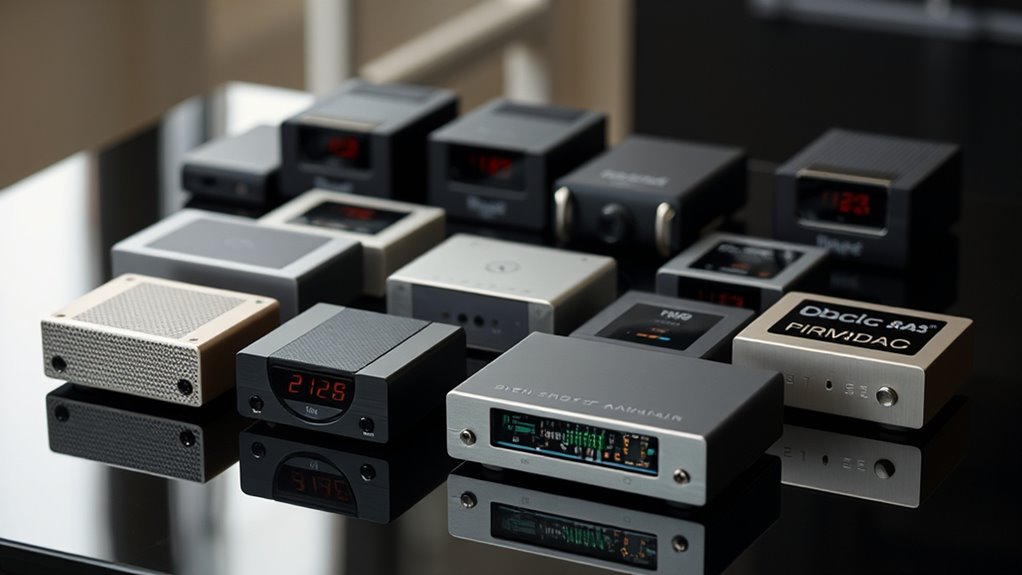
High-end portable DACs range from tiny USB-C dongles to Bluetooth receivers and larger battery-powered headphone amps, so the right pick depends on how you listen as much as on audio specifications. I’d put the FiiO BTR17 forward as the best overall balance of wireless and USB use, dual DACs, equalization, and both 3.5mm and 4.4mm outputs. The Qudelix-5K stands out for detailed wireless control, while the iFi hip-dac3 suits listeners who prefer a dedicated battery-powered design. The main tradeoffs are pocket space, battery needs, wired versus wireless convenience, and whether your headphones need extra output power. Read on for how the 15 options differ and which compromises make sense for your setup.

Get your wardrobe favorites delivered free with Prime
- Fast, free delivery on millions of items
- Prime Video, Amazon Music and more included
- Member-only deals all year
Complete the kit


Key Takeaways
- The FiiO BTR17 is the most balanced all-rounder: Bluetooth and USB use, 10-band PEQ, and two output sizes make it more adaptable than a single-purpose dongle.
- Wireless control is a distinct strength, not a universal upgrade: the Qudelix-5K and BTR17 offer Bluetooth flexibility, while compact wired picks avoid receiver charging and pairing.
- Output power and connector choice should match the headphones: balanced outputs appear on several models, but they matter only when the headphones can use them and benefit from additional drive.
- Portable does not always mean dongle-small: the FiiO QX13, iFi hip-dac3, and larger Bluetooth units prioritize capabilities or battery operation over the least possible carry burden.
- The lineup spans very different budgets and use cases: the Kiwi Ears Allegro Mini and Fosi DS2 keep the setup simple, while the Questyle, CrinEar, and MUSEHiFi options focus on more specialized feature sets.
| Questyle Sigma Portable Bluetooth 5.4 DAC and Headphone Amplifier |  | Best for High-Power Wireless Listening | DAC chip: AKM AK4493 | Bluetooth: Version 5.4 | Supported codecs: LDAC, aptX Adaptive, aptX HD, LE Audio | VIEW ON AMAZON | See Our Full Breakdown |
| FiiO BTR17 Bluetooth 5.4 USB DAC and Amplifier |  | Best for Flexible EQ and Multi-Mode Use | DACs: Dual ESS ES9069Q | Bluetooth: Version 5.4 | Listed codecs: LDAC, aptX Adaptive, aptX Lossless | VIEW ON AMAZON | See Our Full Breakdown |
| FiiO BTR7 High-Resolution Portable Bluetooth DAC and Headphone Amplifier (Titanium) |  | Best for a Durable Bluetooth Receiver | DAC: ES9219C | Bluetooth: Version 5.1 | Supported Bluetooth formats: LDAC, aptX HD, AAC, SBC | VIEW ON AMAZON | See Our Full Breakdown |
| Crinacle JCALLY AP6 Portable DAC-Amplifier with Dual Output and High Power |  | Best for a Powerful Wired USB-C Setup | DAC: Conexant CX31993 | Operational amplifiers: Dual SG Micro SGM8262 | Power output: 540mW at 16Ω | VIEW ON AMAZON | See Our Full Breakdown |
| Fosi Audio DS2 USB-C to AUX Headphone Amp DAC Dongle |  | Best Compact Wired Value | DAC chips: Dual Cirrus Logic CS43131 | Supported formats: DSD256, PCM 32-bit/384kHz | Output power: 170mW per channel at 32Ω | VIEW ON AMAZON | See Our Full Breakdown |
| MUSEHiFi M3 Ultra Portable Tube DAC and Headphone Amp |  | Best for Tube-Style Sound | DAC chip: ES9028Q2M | Tube: JAN6418 pentode, triode-strapped | Amplifier design: Hybrid tube and op-amp | VIEW ON AMAZON | See Our Full Breakdown |
| FiiO QX13 Portable DAC and Headphone Amplifier, Titanium Gold |  | Best for Power and On-Device Control | DAC: ESS ES9027PRO, 8-channel | Output power: 900 mW × 2 | Display: 1.99-inch color touchscreen with Corning Gorilla Glass 3 | VIEW ON AMAZON | See Our Full Breakdown |
| Questyle M18i Max Headphone Amplifier Bluetooth 5.4 Receiver Portable USB DAC with High-Resolution Support |  | Best for Modern Bluetooth Flexibility | DAC chip: ESS ES9219Q | Bluetooth: Version 5.4 | Supported codecs: AAC, SBC, aptX, aptX HD, aptX Adaptive, LE AUDIO, LDAC | VIEW ON AMAZON | See Our Full Breakdown |
| MOONDROP Dawn Pro 2 Portable USB DAC/Headphone Amplifier |  | Best for App-Based Equalizer Control | DAC chips: Dual Cirrus Logic CS43198 | Outputs: 3.5 mm and 4.4 mm | Audio support: Up to 32-bit/384 kHz and DSD256 | VIEW ON AMAZON | See Our Full Breakdown |
| Qudelix-5K Bluetooth USB DAC AMP with LDAC, aptX Adaptive, aptX HD, AAC |  | Best Compact Bluetooth Pick | DAC: Dual ES9219 | Bluetooth chipset: Qualcomm QCC5124 | Bluetooth codecs: LDAC, aptX Adaptive, aptX HD, AAC | VIEW ON AMAZON | See Our Full Breakdown |
| Questyle M15i Electro Purple Headphone Amplifier MFi Certified USB C DAC with 4.4mm/3.5mm Outputs |  | Best for iPhone Compatibility | DAC chip: ESS ES9281AC | Supported formats: PCM up to 768 kHz; DSD512 | Outputs: 3.5 mm and 4.4 mm | VIEW ON AMAZON | See Our Full Breakdown |
| EPZ TP35 PRO Portable USB-C DAC and Headphone Amplifier |  | Best for Built-In Sound Tuning | DAC chips: Dual Cirrus Logic CS43198 | Audio formats: PCM up to 32-bit/384 kHz; DSD256 | Outputs: 3.5 mm single-ended; 4.4 mm balanced | VIEW ON AMAZON | See Our Full Breakdown |
| CrinEar Protocol Max Portable DAC-Amplifier with 10-Band PEQ, Dual Cirrus Logic CS43198 + Dual SG Micro SGM8262-2, 600 mW High Power Amplification |  | Best for Power and Parametric EQ | Model: DK55 | DAC chips: Dual Cirrus Logic CS43198 | Operational amplifiers: Dual SG Micro SGM8262-2 | VIEW ON AMAZON | See Our Full Breakdown |
| iFi hip-dac3 – Portable Hi-Res DAC/Headphone Amp with Balanced Circuit and Up to 12hrs Playtime |  | Best for Battery-Powered Listening | Output power: 400 mW into 32 ohms | Supported formats: PCM up to 384 kHz; DSD256; MQA | Battery life: 7–10 hours | VIEW ON AMAZON | See Our Full Breakdown |
| Linsoul Kiwi Ears Allegro Mini Portable IEM DAC |  | Best Compact Pick for IEMs | Connectivity: USB Type-C | Outputs: 3.5 mm single-ended; 4.4 mm balanced | Resolution support: PCM up to 32-bit/384 kHz; DSD128 | VIEW ON AMAZON | See Our Full Breakdown |
| high end portable dac | Outputs |
|---|---|
| Questyle Sigma Portable Blueto | 3.5mm and 4.4mm balanced |
| FiiO BTR17 Bluetooth 5.4 USB D | 3.5mm unbalanced and 4.4mm balanced |
| FiiO BTR7 High-Resolution Port | 3.5mm and 4.4mm balanced |
| Crinacle JCALLY AP6 Portable D | 4.4mm balanced and 3.5mm single-ended |
| Fosi Audio DS2 USB-C to AUX He | 3.5mm single-ended and 4.4mm balanced |
| MUSEHiFi M3 Ultra Portable Tub | — |
| FiiO QX13 Portable DAC and Hea | — |
| Questyle M18i Max Headphone Am | 3.5 mm unbalanced and 4.4 mm balanced |
| MOONDROP Dawn Pro 2 Portable U | 3.5 mm and 4.4 mm |
| Qudelix-5K Bluetooth USB DAC A | 3.5 mm unbalanced and 2.5 mm balanced |
| Questyle M15i Electro Purple H | 3.5 mm and 4.4 mm |
| EPZ TP35 PRO Portable USB-C DA | 3.5 mm single-ended; 4.4 mm balanced |
| CrinEar Protocol Max Portable | 4.4 mm balanced; 3.5 mm single-ended |
| iFi hip-dac3 | — |
| Linsoul Kiwi Ears Allegro Mini | 3.5 mm single-ended; 4.4 mm balanced |
More Details on Our Top Picks
Questyle Sigma Portable Bluetooth 5.4 DAC and Headphone Amplifier
The Questyle Sigma is the strongest fit here for buyers who want one portable unit to handle both Bluetooth listening and demanding headphones. Its Bluetooth 5.4 support for LDAC and aptX Adaptive gives it more wireless flexibility than the USB-only Fosi Audio DS2, while its stated peak output above 5W is aimed at headphones that need more drive than the DS2’s 170mW-per-channel rating. That headroom is the draw, not a promise that every headphone will sound better. The tradeoff is a plastic housing, which feels less premium on paper than the aluminum JCALLY AP6 or metal Fosi. Its high power also makes less sense for sensitive IEMs or casual users. Choose Sigma for wireless freedom and headroom; skip it if compact, simple USB audio is enough.
Pros:- Bluetooth 5.4 with LDAC and aptX Adaptive support
- USB-C and Bluetooth connectivity across iOS, Android, and computers
- 3.5mm single-ended and 4.4mm balanced outputs
- High stated peak power for more demanding headphones
Cons:- Plastic construction is less premium than the metal-bodied JCALLY AP6 and Fosi DS2
- Its high output is unnecessary for many efficient earphones
- The supplied details do not specify battery capacity or runtime
Best for: Listeners who switch between phone, computer, and Bluetooth use and own full-size headphones that benefit from substantial amplifier headroom.
Not ideal for: Sensitive-IEM owners seeking a small, uncomplicated USB dongle, or buyers who prioritize a metal-bodied finish.
- DAC chip:AKM AK4493
- Bluetooth:Version 5.4
- Supported codecs:LDAC, aptX Adaptive, aptX HD, LE Audio
- Maximum audio resolution:PCM 768kHz, DSD512
- Outputs:3.5mm and 4.4mm balanced
- Peak power:More than 5W
- Interface:USB-C and Bluetooth
- Housing material:Plastic
Our verdict“Choose the Sigma if you want high-output headphone drive plus modern Bluetooth in one portable DAC, and pass if a simple USB dongle better fits your listening.”
FiiO BTR17 Bluetooth 5.4 USB DAC and Amplifier
The FiiO BTR17 earns its place for listeners who want a portable DAC they can tailor, not just connect. Its 10-band parametric EQ, accessible through app or web controls, gives it a practical advantage over the FiiO BTR7, whose supplied details do not list comparable customization. Three operating modes also let the BTR17 shift between PC, Bluetooth, and phone use without limiting it to one role. The dual ESS DACs, LDAC support, and balanced output make it a feature-rich alternative to the simpler wired Fosi Audio DS2. There are caveats: its listed output reaches 650mW, well below the Sigma’s stated peak above 5W, and desktop mode requires a dedicated power input and adapter. The supplied Bluetooth feature details also contain some ambiguity, so buyers should verify the specific codec support they need.
Pros:- 10-band parametric EQ adjustable through app or web controls
- PC, Bluetooth, and phone operating modes
- Dual ESS ES9069Q DACs with 3.5mm and 4.4mm outputs
- USB decoding up to 768kHz/32-bit and DSD512 hardware decoding
Cons:- 650mW maximum output is lower than the Questyle Sigma’s stated peak output
- Desktop mode requires a dedicated power input and adapter
- The supplied Bluetooth capability details are not fully clear
Best for: Phone and computer listeners who want Bluetooth, wired USB operation, and adjustable parametric EQ in one device.
Not ideal for: Buyers seeking the highest stated output for especially demanding headphones, or those who want a straightforward dongle without mode and power setup.
- DACs:Dual ESS ES9069Q
- Bluetooth:Version 5.4
- Listed codecs:LDAC, aptX Adaptive, aptX Lossless
- Maximum USB decoding:768kHz/32-bit
- DSD support:DSD512 hardware decoding
- Outputs:3.5mm unbalanced and 4.4mm balanced
- Equalizer:10-band PEQ, up to 192kHz sampling rate
- Output power:Up to 650mW
- Operating modes:PC, Bluetooth, phone
Our verdict“Pick the BTR17 if flexible EQ and multiple connection modes matter more than maximum amplifier output or a minimal setup.”
FiiO BTR7 High-Resolution Portable Bluetooth DAC and Headphone Amplifier (Titanium)
The FiiO BTR7 is the more straightforward choice for buyers who want a portable Bluetooth receiver with a titanium build and both single-ended and balanced headphone connections. It supports LDAC and aptX HD, plus MQA and DSD256, making it a capable match for phone-based listening. Compared with the newer BTR17, the BTR7 has an older Bluetooth 5.1 specification and no listed PEQ or three-mode control, so it gives up some of that model’s flexibility. Its more focused feature set may suit listeners who do not need extensive EQ, but the supplied information is thin on battery life, charging, and customization. Unlike the USB-powered Fosi DS2, the BTR7’s Bluetooth receiver role adds wireless convenience; buyers should weigh that against the need for clearer operating details.
Pros:- Titanium housing for a durable portable form
- 3.5mm and 4.4mm balanced outputs
- Bluetooth support for LDAC and aptX HD
- Supports MQA, PCM up to 384kHz, and DSD256
Cons:- Bluetooth 5.1 is an older specification than the 5.4 listed for the BTR17 and Sigma
- Battery life and charging details are not provided
- No app control or EQ customization is listed
Best for: Listeners who want a compact Bluetooth receiver with balanced output and a more durable stated housing material than plastic-bodied alternatives.
Not ideal for: Buyers who need documented battery runtime, detailed EQ controls, or the newer Bluetooth and multi-mode features listed for the BTR17.
- DAC:ES9219C
- Bluetooth:Version 5.1
- Supported Bluetooth formats:LDAC, aptX HD, AAC, SBC
- Maximum PCM sample rate:384kHz
- Maximum DSD:DSD256
- Additional format support:MQA
- Outputs:3.5mm and 4.4mm balanced
- Housing material:Titanium
Our verdict“Choose the BTR7 for a titanium-bodied Bluetooth receiver with balanced output, but favor the BTR17 if EQ and newer listed wireless specifications matter more.”
Crinacle JCALLY AP6 Portable DAC-Amplifier with Dual Output and High Power
The Crinacle JCALLY AP6 is the wired pick for listeners who want substantial output without adding a battery-powered Bluetooth receiver to their setup. Its 540mW at 16Ω rating and 4.4mm balanced connection give it a stronger stated power focus than the Fosi DS2, which is rated at 170mW per channel at 32Ω. That does not make the AP6 the better fit for every headphone, but it gives buyers with more demanding models a reason to choose it. The aluminum housing also offers a more substantial material choice than the Sigma’s plastic shell. The tradeoff is direct: AP6 draws power from its USB-C source, so it cannot operate independently like a battery-powered portable receiver. Its listed chip and power details are useful, while broader format and control information is limited.
Pros:- Rated output of 540mW at 16Ω
- 4.4mm balanced and 3.5mm single-ended outputs
- Aluminum housing
- USB-C plug-and-play connection without a separate battery to charge
Cons:- No internal battery, so it relies on the connected device for power
- No Bluetooth connectivity is listed, unlike the Questyle Sigma and FiiO BTR17
- Detailed format support and additional controls are not specified
Best for: Wired listeners who want a compact aluminum DAC amp with a high stated output rating for headphones that need more drive.
Not ideal for: People who want wireless playback, independent battery operation, or a portable DAC that does not draw power from the connected device.
- DAC:Conexant CX31993
- Operational amplifiers:Dual SG Micro SGM8262
- Power output:540mW at 16Ω
- Outputs:4.4mm balanced and 3.5mm single-ended
- Power source:USB-C
- Housing material:Aluminum
Our verdict“Choose the AP6 for a high-output, aluminum-bodied wired setup, and skip it if Bluetooth or battery-powered operation is part of your portable routine.”
Fosi Audio DS2 USB-C to AUX Headphone Amp DAC Dongle
The Fosi Audio DS2 is the leanest choice in this group: a metal-bodied USB-C dongle with dual Cirrus Logic DAC chips, independent volume control, and both 3.5mm and 4.4mm outputs. Its 170mW per channel at 32Ω is suited to many portable headphones and earphones, though it has less stated headroom than the JCALLY AP6 and is not the pick for buyers who need the most amplifier power. Unlike the Bluetooth-equipped BTR17, the DS2 is strictly a wired option; in return, its operating setup stays simple and it avoids the extra modes and wireless controls. It supports PCM up to 32-bit/384kHz and DSD256, but it draws power from the connected device and requires USB-C. That makes it a sensible compact DAC, not a self-contained portable player.
Pros:- Dual Cirrus Logic CS43131 DAC chips
- 3.5mm single-ended and 4.4mm balanced outputs
- Solid CNC-machined metal construction
- Independent volume control with memory function
Cons:- No internal battery, so it draws power from the connected device
- Requires a USB-C connection
- 170mW per channel at 32Ω offers less stated output than the JCALLY AP6
Best for: USB-C phone and laptop users who want a compact metal DAC with balanced output and independent volume control for everyday wired headphones.
Not ideal for: Listeners who need Bluetooth, an internal battery, legacy ports, or more output headroom for demanding full-size headphones.
- DAC chips:Dual Cirrus Logic CS43131
- Supported formats:DSD256, PCM 32-bit/384kHz
- Output power:170mW per channel at 32Ω
- Outputs:3.5mm single-ended and 4.4mm balanced
- Noise floor:1μV
- THD:0.0001%
- SNR:130dB
- Housing:Solid CNC-machined metal
Our verdict“Pick the DS2 for a compact, wired metal dongle with balanced output, but choose the AP6 for higher stated power or the BTR17 for Bluetooth and EQ.”
MUSEHiFi M3 Ultra Portable Tube DAC and Headphone Amp
The MUSEHiFi M3 Ultra is the distinctive pick here for listeners who want tube character in a portable DAC, rather than a strictly neutral presentation. Its JAN6418 tube and op-amp hybrid design is intended to add warmth while retaining detail and control; the FiiO QX13 takes a more feature-focused route, with a touchscreen and substantially higher stated output power. The M3 Ultra still offers both 3.5 mm and 4.4 mm outputs, plus PCM up to 32-bit/384 kHz and DSD256, so it can serve different headphones and high-resolution sources. Noise-reduction and shock-absorption measures address a particular tube drawback, but they cannot make a tube-based device immune to movement noise. Choose it for its sound-design approach, not as the most powerful or fuss-free option in this group.
Pros:- Hybrid JAN6418 tube and op-amp design offers an alternative to more conventional portable DAC presentations.
- Provides both 3.5 mm single-ended and 4.4 mm balanced headphone outputs.
- Supports PCM up to 32-bit/384 kHz and DSD256.
- Noise-reduction and physical shock-absorption measures target tube microphonics.
Cons:- Movement can still trigger tube microphonics despite the noise-reduction measures.
- The listed output and distortion figures depend on their stated output or test conditions.
- Its tube-focused design is less suited to listeners who prioritize simple, movement-proof operation.
Best for: Listeners who want a portable DAC with tube-inspired warmth, use both single-ended and balanced headphones, and usually listen while stationary.
Not ideal for: Commuters who move around while listening or buyers seeking the strongest documented headphone drive; tube microphonics remain a possible nuisance, and the QX13 lists higher output power.
- DAC chip:ES9028Q2M
- Tube:JAN6418 pentode, triode-strapped
- Amplifier design:Hybrid tube and op-amp
- Single-ended output:3.5 mm, up to 460 mW
- Balanced output:4.4 mm, up to 480 mW
- Audio formats:PCM up to 32-bit/384 kHz; DSD256
- Distortion:THD+N as low as 0.0003% through 4.4 mm under specified test conditions
- Noise reduction:Circuit optimization, microphonics suppression, and physical shock absorption
Our verdict“Choose the M3 Ultra if tube-style warmth and dual headphone outputs matter more to you than the QX13’s higher listed power and screen-based controls.”
FiiO QX13 Portable DAC and Headphone Amplifier, Titanium Gold
The FiiO QX13 suits buyers who want a portable DAC to do more than convert audio: its color touchscreen, customizable interface, and 10-band EQ put key adjustments on the device. Its stated output of 900 mW × 2 also makes it the strongest documented power option among these five, a useful distinction for owners of demanding headphones. Compared with the MUSEHiFi M3 Ultra, the QX13 favors control and drive over tube-based sound character; compared with the Qudelix-5K, it is a heavier, more substantial unit with a display rather than an ultra-light clip-on form. The 8.48-ounce weight may be noticeable in a pocket, and the optional E-Stick power bank is sold separately. It makes most sense for users willing to carry a larger setup for its controls and power.
Pros:- Stated 900 mW × 2 output is suited to headphones that need more drive.
- 1.99-inch color touchscreen and customizable interface provide direct control.
- 10-band EQ enables sound adjustments without relying solely on source-device settings.
- Magnetic case supports pairing with the separately sold E-Stick power bank.
Cons:- At 8.48 ounces, it is substantially heavier than the Qudelix-5K for pocket carry.
- The E-Stick power bank is sold separately.
- The combination case may be needed for the intended desktop-style setup.
Best for: Portable listening enthusiasts who use harder-to-drive headphones and want on-device EQ and interface controls without relying on a phone app.
Not ideal for: Minimalists who want a light, pocket-friendly Bluetooth receiver like the Qudelix-5K, or buyers who expect the optional E-Stick power bank to be included.
- DAC:ESS ES9027PRO, 8-channel
- Output power:900 mW × 2
- Display:1.99-inch color touchscreen with Corning Gorilla Glass 3
- Equalizer:10-band EQ
- Amplifier components:4 × INA1620 and 2 × OPA1692 op-amps
- Weight:8.48 ounces
- Color:Titanium Gold
- Warranty:1 year
Our verdict“Pick the QX13 if you want substantial listed output power and touchscreen controls in a portable unit and can accept its weight and add-on power setup.”
Questyle M18i Max Headphone Amplifier Bluetooth 5.4 Receiver Portable USB DAC with High-Resolution Support
The Questyle M18i Max is the versatile choice for someone who moves between wireless playback and wired headphones. Its Bluetooth 5.4 receiver supports codecs including LDAC, aptX HD, and aptX Adaptive, while USB DAC use and PCM 384 kHz/DSD256 support give it a wired high-resolution path too. The 3.5 mm and 4.4 mm outputs accommodate different headphone cables, and manual gain control lets owners adjust drive to their setup. Compared with the Qudelix-5K, the M18i Max offers newer Bluetooth connectivity and a 4.4 mm balanced output, while the Qudelix is notably compact and has stated battery-life figures. The M18i Max’s battery capacity and runtime are not specified, so buyers planning long sessions away from power have less to go on. Its many features may also be more than casual listeners need.
Pros:- Bluetooth 5.4 supports a broad codec range, including LDAC and aptX Adaptive.
- USB DAC functionality complements its wireless receiver use.
- 3.5 mm unbalanced and 4.4 mm balanced outputs suit different headphone cables.
- Manual gain control allows adjustment for different listening setups.
Cons:- Battery capacity and battery life are not specified.
- Its broad feature set may be unnecessarily complex for casual Bluetooth listening.
- The listed distortion figure does not by itself describe performance across every output and use condition.
Best for: Listeners who want one compact device for Bluetooth reception and USB DAC use, with modern codecs and both 3.5 mm and 4.4 mm headphone connections.
Not ideal for: Buyers who need a clearly documented battery runtime or a very simple receiver; the Qudelix-5K provides stated battery-life figures and a smaller, lighter form.
- DAC chip:ESS ES9219Q
- Bluetooth:Version 5.4
- Supported codecs:AAC, SBC, aptX, aptX HD, aptX Adaptive, LE AUDIO, LDAC
- Outputs:3.5 mm unbalanced and 4.4 mm balanced
- High-resolution support:PCM 384 kHz and DSD256
- Distortion:0.0002%
- Microphone:Infineon flagship, 2-meter range
Our verdict“Choose the M18i Max if you want current Bluetooth codec support alongside USB DAC use, but favor the Qudelix-5K if documented battery runtime is a priority.”
MOONDROP Dawn Pro 2 Portable USB DAC/Headphone Amplifier
The MOONDROP Dawn Pro 2 is a wired USB DAC for listeners who want to shape sound rather than add Bluetooth features. Its dual CS43198 DAC chips, 100-step volume control, and app-based parametric EQ provide fine-grained adjustment, while 3.5 mm and 4.4 mm outputs keep it compatible with a range of headphone cables. Against the FiiO QX13, the Dawn Pro 2 is the simpler, smaller-format direction: it lacks a touchscreen and the QX13’s much higher stated power, but its app EQ and separate DAC volume control offer useful tuning flexibility. The listed maximum output power is 124 mW, which narrows its appeal for power-hungry headphones. EQ customization also depends on the MOONDROP app, so it is less appealing to buyers who prefer controls entirely on the device.
Pros:- Dual CS43198 DAC chips support high-resolution PCM and DSD playback.
- App-based parametric EQ allows adjustment of filter, frequency, gain, and Q.
- 100-step volume control offers finer adjustment than coarse volume increments.
- Aluminum alloy housing includes vents intended to help dissipate heat.
Cons:- Listed maximum output power is 124 mW, limiting suitability for demanding headphones.
- EQ customization requires the MOONDROP app.
- The included components list specifies a USB cable, with no other accessories listed.
Best for: Wired headphone listeners who want app-based parametric EQ, precise volume steps, and both common single-ended and balanced outputs.
Not ideal for: Owners of power-hungry headphones or buyers who want Bluetooth and on-device controls; the QX13 lists substantially more output power and has a touchscreen.
- DAC chips:Dual Cirrus Logic CS43198
- Outputs:3.5 mm and 4.4 mm
- Audio support:Up to 32-bit/384 kHz and DSD256
- Maximum output voltage:4 Vrms
- Maximum output power:124 mW
- Volume control:100-step
- Material:Aluminum alloy
- Included components:USB cable
Our verdict“Choose the Dawn Pro 2 for wired listening with flexible app EQ, but look to the QX13 if your headphones need the higher listed output power.”
Qudelix-5K Bluetooth USB DAC AMP with LDAC, aptX Adaptive, aptX HD, AAC
The Qudelix-5K is the carry-friendly option in this group: at 25 g, it clips easily into a portable setup and works as a Bluetooth receiver or USB DAC/amp for wired headphones. Its dual ES9219 DACs and support for LDAC, aptX Adaptive, aptX HD, and AAC cover common high-quality wireless listening needs, while the stated battery life of 6 to 20 hours gives buyers a useful runtime range. Compared with the Questyle M18i Max, it is lighter and has documented battery figures, but its balanced output is 2.5 mm rather than 4.4 mm. The QX13 is the stronger fit for buyers seeking high stated output power and a screen; the Qudelix prioritizes portability instead. Its plastic body feels less premium, and it cannot transmit Bluetooth audio to wireless headphones.
Pros:- Very light 25 g body and included aluminum clip suit portable use.
- Supports LDAC, aptX Adaptive, aptX HD, and AAC Bluetooth codecs.
- Stated battery life ranges from 6 to 20 hours.
- Offers both 3.5 mm unbalanced and 2.5 mm balanced outputs.
Cons:- Bluetooth works as a receiver, not a transmitter for wireless headphones.
- Balanced output uses 2.5 mm rather than the 4.4 mm connection on the M18i Max and several other options.
- Plastic body may feel less premium than the aluminum QX13.
Best for: Commuters and travelers who want a lightweight Bluetooth receiver with a clip, a stated long-runtime range, and wired headphone connections.
Not ideal for: Listeners seeking Bluetooth transmission to wireless headphones, a 4.4 mm balanced output, or a premium-feeling metal body.
- DAC:Dual ES9219
- Bluetooth chipset:Qualcomm QCC5124
- Bluetooth codecs:LDAC, aptX Adaptive, aptX HD, AAC
- Outputs:3.5 mm unbalanced and 2.5 mm balanced
- Battery:500 mA Li-Po
- Battery life:6 to 20 hours
- Weight:25 g
- Dimensions:52.8 × 26.7 × 15.6 mm
Our verdict“Pick the Qudelix-5K if light weight, a clip, and stated battery runtime matter more than a 4.4 mm output or premium materials.”
Questyle M15i Electro Purple Headphone Amplifier MFi Certified USB C DAC with 4.4mm/3.5mm Outputs
The Questyle M15i is a compact wired pick for listeners who want both balanced and single-ended connections without giving up straightforward iPhone support. Its MFi certification gives it a clearer compatibility case for iOS users than the EPZ TP35 PRO, whose listed compatibility centers on USB-C devices. The M15i also supports PCM up to 768 kHz and DSD512, alongside Questyle’s current-mode amplifier and a stated 8–600-ohm range. Those specs make it a flexible partner for a range of headphones, but they don’t replace checking how much power a particular demanding model needs. The tradeoff is a thinner documented feature set: unlike the CrinEar Protocol Max, it has no specified parametric EQ or output-power figure here. Choose it for portable, direct device compatibility, not extensive sound customization.
Pros:- MFi certification provides a defined iOS compatibility advantage.
- Offers both 3.5 mm single-ended and 4.4 mm balanced outputs.
- Supports PCM 768 kHz and DSD512 playback.
- Specified impedance range spans 8 to 600 ohms.
Cons:- No output-power figure is provided, making headphone-driving comparisons harder.
- No EQ or saved sound-profile feature is listed.
- Some device compatibility may require checking before purchase.
Best for: iPhone listeners who want a small wired DAC with MFi certification, plus 3.5 mm and 4.4 mm headphone options.
Not ideal for: Buyers who need published output-power figures or built-in parametric EQ to match demanding headphones or tune sound.
- DAC chip:ESS ES9281AC
- Supported formats:PCM up to 768 kHz; DSD512
- Outputs:3.5 mm and 4.4 mm
- Impedance range:8–600 ohms
- Compatibility:iOS, Android 5.1+, Windows 10+, Mac
- Amplifier design:Patented Current Mode Amplifier
Our verdict“Choose the M15i if iPhone-friendly wired use and broad format support matter more to you than onboard EQ or clearly stated output power.”
EPZ TP35 PRO Portable USB-C DAC and Headphone Amplifier
The EPZ TP35 PRO earns its place for buyers who want portable DAC hardware with practical sound controls, rather than just high-resolution format support. Its app-based EQ with saved settings and five digital filters give it a useful tuning advantage over the Questyle M15i, which lists no comparable EQ feature. Dual CS43198 chips and both 3.5 mm and 4.4 mm outputs round out a capable wired setup; the stated balanced output is 262 mW at 32 ohms, compared with 112 mW through the single-ended output. That distinction helps buyers match the connection to their headphones. The CNC-machined aluminum body suits carry-around use, though this is still a USB-C DAC rather than a wireless receiver. Some tuning may require a driver download, and the listed compatibility is limited to USB-C devices.
Pros:- App-based EQ supports saved settings for repeatable sound adjustments.
- Five digital filters provide additional playback choices.
- Balanced 4.4 mm output is rated at 262 mW into 32 ohms.
- CNC-machined aluminum construction and dual headphone outputs suit portable use.
Cons:- Tuning may require a driver download.
- Compatibility is specified for USB-C devices, which excludes some older connections.
- No Bluetooth functionality is listed.
Best for: USB-C phone, tablet, and computer users who want saved EQ profiles, filter choices, and both balanced and single-ended outputs.
Not ideal for: Listeners with devices lacking USB-C or buyers who want Bluetooth listening instead of a wired DAC connection.
- DAC chips:Dual Cirrus Logic CS43198
- Audio formats:PCM up to 32-bit/384 kHz; DSD256
- Outputs:3.5 mm single-ended; 4.4 mm balanced
- Output power:112 mW at 32 ohms (3.5 mm); 262 mW at 32 ohms (4.4 mm)
- Equalizer and filters:App-based EQ with saved settings; five digital filters
- Material:CNC-machined aluminum alloy
- Compatibility:USB-C devices running macOS, iPadOS, iOS, Android, or Windows
Our verdict“Pick the TP35 PRO if saved EQ and clearly stated output figures matter more than the M15i’s MFi positioning or wireless convenience.”
CrinEar Protocol Max Portable DAC-Amplifier with 10-Band PEQ, Dual Cirrus Logic CS43198 + Dual SG Micro SGM8262-2, 600 mW High Power Amplification
The CrinEar Protocol Max is the lineup’s most explicitly feature-rich wired option for buyers pairing a portable DAC with demanding headphones or hands-on sound shaping. Its stated 600 mW maximum output and Eco and Boost modes give it a stronger power-focused pitch than the EPZ TP35 PRO, whose listed balanced output is 262 mW at 32 ohms. The browser-based 10-band parametric EQ is another meaningful differentiator: it allows detailed adjustments and saved presets, but setup is less convenient than the EPZ’s app-based approach because a PC browser is required. Dual CS43198 DACs, dual SGM8262-2 op-amps, and 3.5 mm and 4.4 mm outputs complete the package. At 110 g, it is less featherweight than a simple dongle, and the aluminum enclosure can warm during prolonged high-output use.
Pros:- Maximum output is specified at 600 mW.
- 10-band parametric EQ supports saved presets.
- Eco and Boost modes offer a choice between lower power use and maximum output.
- Includes 3.5 mm and 4.4 mm outputs with USB-C and USB-A connectivity.
Cons:- EQ setup requires a PC browser rather than a dedicated mobile app.
- The 110 g aluminum unit is heavier than a basic USB-C dongle.
- The housing can become warm during prolonged high-output use.
Best for: Headphone owners who want substantial stated output, balanced connectivity, and detailed EQ presets they can configure from a PC browser.
Not ideal for: Buyers who need quick EQ changes from a phone or a very light, low-profile dongle for sensitive IEMs.
- Model:DK55
- DAC chips:Dual Cirrus Logic CS43198
- Operational amplifiers:Dual SG Micro SGM8262-2
- Maximum output power:600 mW
- Outputs:4.4 mm balanced; 3.5 mm single-ended
- Connectivity:USB-C and USB-A
- EQ and power modes:Browser-based 10-band parametric EQ with saved presets; Eco and Boost
- Weight and enclosure:110 g; aluminum
Our verdict“Choose the Protocol Max over the EPZ TP35 PRO if higher stated output and deeper EQ control outweigh lighter carry and phone-first tuning.”
iFi hip-dac3 – Portable Hi-Res DAC/Headphone Amp with Balanced Circuit and Up to 12hrs Playtime
The iFi hip-dac3 stands apart from the USB-powered dongles in this group because it pairs a portable DAC and headphone amp with a built-in battery. Its claimed 7–10 hours of playback and separate USB-C connectivity give it a more self-contained listening setup than the EPZ TP35 PRO or Questyle M15i. The true balanced circuit, 4.4 mm connection, and stated 400 mW into 32 ohms make it a strong fit for listeners who want a portable unit with a clearer power specification. It also supports PCM 384 kHz, DSD256, and MQA. In exchange, the hip-dac3 is a larger, battery-dependent choice rather than the simplest phone dongle; its advantage matters less if your headphones use only a basic single-ended connection. The supplied data also does not list a 3.5 mm output.
Pros:- Built-in battery is rated for 7–10 hours of playback.
- True balanced circuit and a 4.4 mm balanced connection are specified.
- Output power is listed at 400 mW into 32 ohms.
- Supports PCM 384 kHz, DSD256, and MQA.
Cons:- Battery runtime means the unit needs charging separately from a simple host-powered dongle.
- No 3.5 mm output is listed in the supplied product data.
- Balanced output benefits depend on having compatible headphones or a suitable cable.
Best for: Mobile listeners who want a battery-powered DAC/amp, balanced circuitry, and longer unplugged sessions with compatible headphones.
Not ideal for: Buyers seeking the smallest plug-in dongle, or those whose headphones require a 3.5 mm output that is not specified here.
- Output power:400 mW into 32 ohms
- Supported formats:PCM up to 384 kHz; DSD256; MQA
- Battery life:7–10 hours
- Connectivity:Dual USB-C ports
- Circuit design:True balanced circuit
- Material and finish:Aluminum; Titanium Shadow
Our verdict“Choose the hip-dac3 if battery-powered portability and balanced output suit your headphones better than the lighter USB-only approach of the M15i or TP35 PRO.”
Linsoul Kiwi Ears Allegro Mini Portable IEM DAC
The Kiwi Ears Allegro Mini is the most straightforward choice here for listeners who want a compact USB-C DAC to carry with in-ear monitors. Its aluminum body, 3.5 mm and 4.4 mm outputs, and support for PCM up to 32-bit/384 kHz and DSD128 cover the main needs of a wired portable setup. Compared with the CrinEar Protocol Max, it avoids a more elaborate feature set such as a 10-band parametric EQ and Eco/Boost modes; that makes the Allegro Mini simpler, but leaves fewer controls for tailoring sound or powering demanding full-size headphones. Its listed THD+N is 0.004% at 32 ohms, while no output-power figure is provided. Buyers should also note the product description’s stated USB-C requirement and its emphasis on IEM use.
Pros:- Compact all-aluminum construction is suited to portable use.
- Provides both 3.5 mm single-ended and 4.4 mm balanced outputs.
- Supports PCM up to 32-bit/384 kHz and DSD128.
- USB-C connectivity supports phone and PC use with compatible devices.
Cons:- No output-power figure is provided for comparing headphone-driving capability.
- No EQ or sound-profile controls are listed.
- USB-C compatibility is required.
Best for: IEM users who want a small aluminum USB-C DAC with both single-ended and balanced connection options.
Not ideal for: Owners of power-hungry full-size headphones who need a published output-power rating or onboard EQ controls.
- Connectivity:USB Type-C
- Outputs:3.5 mm single-ended; 4.4 mm balanced
- Resolution support:PCM up to 32-bit/384 kHz; DSD128
- Material:All-aluminum alloy
- THD+N:0.004% at 32 ohms
- Intended headphone type:In-ear monitors
Our verdict“Pick the Allegro Mini for a compact IEM-focused USB-C setup, but choose the Protocol Max if you need specified high output and extensive EQ.”

How We Picked
I ranked these high-end portable DACs by how well their design fits real portable listening, not by headline specifications alone. I weighed connection options, output formats, power-oriented features, control and equalization tools, battery arrangements, and how easily each device can fit into a phone-and-headphone setup. I also looked at the likely friction points: dongle cables and phone power draw, Bluetooth pairing and charging, larger enclosures, and whether added features serve a clear listening need.
The ranking favors versatility and day-to-day usability, which puts the BTR17 first as a broadly capable wired-and-wireless option. Models with more specialized strengths rank well for their intended buyers: the Qudelix-5K for adjustable wireless use, the iFi hip-dac3 for a dedicated battery-powered format, and compact USB DACs for uncomplicated wired listening. No single connector, DAC-chip count, or power figure makes a device the best fit for everyone; a buyer whose headphones, phone, and listening habits do not use a feature should not pay a portability or complexity cost for it.
Factors to Consider When Choosing High End Portable Dacs
Before choosing among these models, I’d start with the listening setup rather than the spec sheet. The differences that matter most are how the DAC connects, what it must drive, how much equipment you want to carry, and whether you’ll actually use its adjustment tools.
Choose wired, wireless, or both
A USB DAC is a direct path from phone or computer to headphones, with fewer pairing steps and no separate Bluetooth receiver battery to manage. A Bluetooth model gives you freedom to leave the phone in a pocket or bag, but adds charging, codec compatibility, and occasional connection management. Hybrid devices can cover both situations, though their extra controls and battery are only useful if you switch between them. Check the source device’s supported Bluetooth codecs before treating LDAC or aptX support as a benefit; the transmitter and receiver need a compatible option in common. A common mistake is choosing wireless features for a setup that is almost always wired, or buying a dongle when the cable tether is the problem. Match the connection to your routine, not to the longest feature list.
Match output and connectors to your headphones
Start with the headphones’ plug and how much output they need at your preferred listening level. A 4.4mm balanced jack can be useful if your cable already has that connector and the device’s output suits your headphones, but it is not automatically better for every listener. If your earphones use a standard 3.5mm plug, a balanced socket may add no value and can create a need for a different cable. Hard-to-drive headphones may benefit more from a capable amplifier stage than from a particular DAC-chip label. Check manufacturer output specifications alongside headphone sensitivity and impedance rather than assuming that “high power” guarantees a fit. This avoids paying for an output you cannot use or choosing a small unit that does not meet your headphone’s needs.
Account for the full carry setup
Portability includes the device, its cables, and any battery or adapter needed to use it—not just the body dimensions. A tiny dongle can be easy to pocket, but its short cable may put strain on a phone’s port or make a stacked setup awkward. A larger unit may be easier to handle and can offer independent power, yet take up more room and add weight. Bluetooth receivers reduce the phone-to-headphone cable run, although you still need to carry and charge the receiver. Think through where the unit will sit during a commute, workout, or desk session and how often you’ll need to unplug it. The most portable choice is the one that works smoothly with the rest of your gear.
Decide whether equalization and controls matter
Equalization can tailor headphones to your preference or help address a sound balance you find fatiguing, but it adds setup choices and may require an app or companion software. A model with parametric or multiband controls makes more sense if you expect to adjust profiles for different headphones; for plug-and-play listening, those controls may go unused. Check whether your preferred settings can be saved and whether the device can access them across the sources you use. Physical buttons and clear status indicators can matter more than advanced software when adjusting volume on the move. Avoid buying on the number of EQ bands alone: usability and compatibility determine whether the feature becomes part of your listening routine.
Understand battery and source-device tradeoffs
USB-powered DACs draw power from the connected phone or computer, which keeps the device simple but can shorten phone battery life during long sessions. A self-powered model shifts that energy demand to its own battery, adding another device to charge while reducing reliance on the source. Bluetooth receivers also need regular charging, even when used without a wired USB connection. Check whether you expect long listening sessions, frequent travel, or use near a power source; each pattern changes which tradeoff feels smaller. Do not compare a stated playtime directly across different operating modes or listening levels unless the manufacturer defines the conditions. For travel, charging convenience and the ability to keep using the DAC while it charges may matter more than a headline battery figure.
Pay for features you will actually use
Higher-end portable DACs can add wireless codecs, more output options, EQ, display controls, or a more substantial amplifier, but extra capability can mean more bulk and setup complexity. Choose a premium model when it solves a real limitation—such as needing Bluetooth and USB in one unit, more convenient headphone control, or an output suited to demanding headphones. If your current earphones connect over 3.5mm and your main goal is a clean wired path, a compact dongle may be a more sensible match than a larger feature-rich device. Do not treat chip counts or resolution support as a shortcut for judging whether a DAC will improve your particular setup. Write down the two features you will use most, then reject options whose main advantages do not serve those needs.
Frequently Asked Questions
Is a Bluetooth DAC like the FiiO BTR17 or Qudelix-5K better than a USB-C dongle?
Neither format is better for every setup. A Bluetooth receiver is more convenient when you want to keep the phone away from your headphones or switch between wired USB use and wireless listening, but it needs charging and depends on codec support across both devices. A USB-C dongle is simpler for direct listening and avoids a separate receiver battery, though the cable can be inconvenient and the phone supplies its power. If you listen mostly at a desk or on a commute with your phone nearby, a dongle may be enough. Choose Bluetooth when cutting the phone-to-headphone tether solves a problem you actually have.
Do I need a 4.4mm balanced output for high-end headphones?
No; a balanced output is useful only when it matches your cable and listening needs. Your headphones must have a suitable balanced cable, and the DAC’s output performance must fit the headphones. Many listeners can use a 3.5mm connection without needing a cable change or a balanced jack. Before buying, check the headphone plug and the DAC’s output specifications rather than assuming that balanced automatically means better sound. If you do not own compatible headphones or cables, that feature should not decide the purchase.
Will a portable DAC make my headphones sound better?
A DAC can offer useful improvements when your current source has noise, limited output, poor connectivity, or controls that do not meet your needs. The effect varies with the headphones, source, and listening conditions, so a more expensive DAC does not guarantee a change you will notice. Features such as EQ may alter the sound more directly than a change in DAC hardware. First identify a specific issue—such as insufficient volume, unwanted tonal balance, or a need for Bluetooth—then choose a device that addresses it. If your current setup already works well, upgrading may bring convenience rather than a clear audible difference.
Should I worry about my phone battery when using a USB DAC?
Yes, if you often listen for long stretches away from a charger. A USB-powered DAC draws energy from the phone, and the amount depends on the device, headphones, volume, and listening format. A Bluetooth receiver shifts much of the playback work to its own battery, while a self-powered DAC such as the iFi hip-dac3 is designed around an onboard battery. That convenience adds another device to charge and carry. For short sessions, a dongle may be simpler; for extended travel, compare battery arrangements and charging routines before choosing.
Is a more powerful portable DAC necessary for IEMs?
Usually, sensitive in-ear monitors do not need the same output capability as demanding full-size headphones. A powerful unit can still be useful if you also own harder-to-drive headphones, but excess output may make volume adjustment less comfortable with very sensitive earphones. Check for low-volume control and listen for unwanted hiss if your IEMs are especially sensitive. The CrinEar Protocol Max and other high-output designs make more sense when your headphone collection benefits from their drive capability. For IEM-only use, prioritize quiet operation, convenient controls, and a suitable output over maximum power.
Conclusion
For the broadest mix of wired and wireless listening, I’d choose the FiiO BTR17 as best overall; its range of connections and adjustment options make it a flexible center for a portable setup. The best value for straightforward wired listening is the Fosi Audio DS2, while the Qudelix-5K is a strong fit for listeners who want wireless codecs and detailed EQ controls. For a premium, battery-powered format, the iFi hip-dac3 is the standout choice, and beginners who want an easy wired starting point can look to the MOONDROP Dawn Pro 2 or Kiwi Ears Allegro Mini. If you need a specialized feature set, compare the Questyle models, FiiO QX13, CrinEar Protocol Max, or MUSEHiFi M3 Ultra against your headphones and carry habits before choosing. The right pick is the one whose extra capability solves a real need without making your daily setup less convenient.