For dependable gear for power outages, I’d start with the Consciot 1000-Lumen Battery-Powered LED Camping Lantern as the best overall lighting pick, then add the FosPower NOAA Emergency Weather Radio for alerts and backup charging. The MARBERO M82 Portable Power Station stands out when keeping small electronics powered matters more than having another light. The main tradeoff is between simple, long-lasting battery lighting and multipurpose gear that adds charging or weather information but needs more planning. I compare all 10 options by what they can realistically do during an outage, where each falls short, and who should choose it.

Get your wardrobe favorites delivered free with Prime
- Fast, free delivery on millions of items
- Prime Video, Amazon Music and more included
- Member-only deals all year
Key Takeaways
- The Consciot lantern is the most straightforward central light: its 1000-lumen output prioritizes room illumination, while compact lantern multipacks are better for spreading light across several rooms.
- Radio features distinguish the emergency tools: the Eoxsmile, FosPower, and Leaton combine weather-radio functions with hand-crank or solar charging, but differ in battery capacity and charging flexibility.
- The MARBERO M82 fills a different need than the lights and radios: its 88Wh capacity is for compatible small electronics, not a substitute for a home generator or an all-night high-power appliance supply.
- Multipacks favor coverage over simplicity: the XTAUTO, Etekcity, Energizer, and MalloMe packs can distribute gear or provide spares, while a single powerful lantern may be easier to manage as a main light.
- Glow sticks are a no-battery backup, not a replacement for a lantern: their 12-hour glow can mark locations or provide basic visibility, but they cannot be switched off and reused like powered lights.
| Consciot 1000-Lumen Battery-Powered LED Camping Lantern | 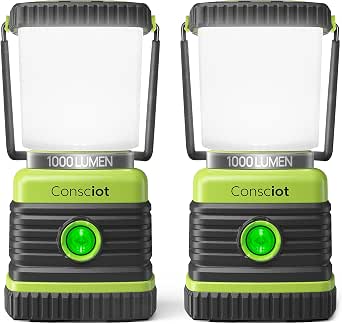 | Best for Bright, Adjustable Room Lighting | Maximum light output: 1000 lumens | Beam angle: 360 degrees | Lighting modes: Cool white, warm white, combined white, and strobe | VIEW ON AMAZON | See Our Full Breakdown |
| Collapsible Portable LED Camping Lantern XTAUTO Lightweight Waterproof Solar USB Rechargeable LED Flashlight Survival Kits for Indoor Outdoor Home Emergency Light Power Outages Hiking Hurricane 4-Pack |  | Best Solar-Rechargeable Multi-Light Set | Set quantity: 4 lanterns | Light coverage: 360 degrees | Charging methods: USB and solar | VIEW ON AMAZON | See Our Full Breakdown |
| Etekcity LED Camping Lanterns, Battery Included, 4 Pack |  | Best for Simple, Ready-to-Store Coverage | Set quantity: 4 lanterns | Maximum light output: 154 lumens | Light source: 30 LEDs per lantern | VIEW ON AMAZON | See Our Full Breakdown |
| Glow Mind Emergency Glow Sticks, 12 Pack, Green, 12-Hour |  | Best No-Battery Backup Light | Quantity: 12 glow sticks | Color: Green | Light duration: Up to 12 hours | VIEW ON AMAZON | See Our Full Breakdown |
| Eoxsmile Emergency Radio with NOAA Weather Alerts, Solar Charging, and Hand Crank |  | Best for Weather Updates and Backup Charging | Battery capacity: 5000 mAh | Power sources: Solar, hand crank, USB, rechargeable battery, or 3 AAA batteries | Radio bands: AM 520–1710 kHz; FM 88–108 MHz; SW 7–19 MHz; 7 NOAA weather bands | VIEW ON AMAZON | See Our Full Breakdown |
| Energizer Weatheready Rechargeable Emergency Flashlights, 3-Pack |  | Best for Automatic Room Lighting | Quantity: 3 flashlights | Light source: LED | Maximum light output: 40 lumens | VIEW ON AMAZON | See Our Full Breakdown |
| FosPower NOAA Emergency Weather Radio A1 7400mWh Solar Hand Crank (Orange) |  | Best for Weather Updates and Basic Backup Power | Power bank capacity: 7400mWh (2000mAh) | Radio bands: AM, FM, and NOAA weather band | Power sources: Solar, hand crank, and 4 AAA batteries | VIEW ON AMAZON | See Our Full Breakdown |
| MARBERO M82 Portable Power Station, 88Wh |  | Best Compact Power Station | Capacity: 88Wh | Battery capacity: 24,000mAh | Output: 80W | VIEW ON AMAZON | See Our Full Breakdown |
| MalloMe 2-Pack Collapsible LED Camping Lanterns |  | Best Simple Area Lighting | Quantity: 2 lanterns | Light source: COB LED | Maximum output: 300 lumens | VIEW ON AMAZON | See Our Full Breakdown |
| Leaton Hand Crank Emergency Radio, NOAA Weather Radio AM/FM, 10000mAh |  | Best Radio for Longer Device Backup | Battery capacity: 10,000mAh | USB output: 5V/1A | Radio bands: AM, FM, and NOAA | VIEW ON AMAZON | See Our Full Breakdown |
| gear for power outage | Water resistance | Dimensions |
|---|---|---|
| Consciot 1000-Lumen Battery-Po | IPX4 | 3.54 × 3.86 × 7.28 in |
| Collapsible Portable LED Campi | — | — |
| Etekcity LED Camping Lanterns | — | 3.46 × 3.46 × 4.86 in |
| Glow Mind Emergency Glow Stick | — | — |
| Eoxsmile Emergency Radio with | — | 6.77 × 3.7 × 2.91 in |
| Energizer Weatheready Recharge | Not water resistant | — |
| FosPower NOAA Emergency Weathe | Water resistant | — |
| MARBERO M82 Portable Power Sta | — | 6.5 x 4.6 x 3.1 inches |
| MalloMe 2-Pack Collapsible LED | Water resistant | — |
| Leaton Hand Crank Emergency Ra | IPX6; protected against water spray and splashes | Approximately 6.3 x 3.5 x 3.1 inches |
More Details on Our Top Picks
Consciot 1000-Lumen Battery-Powered LED Camping Lantern
For a power outage where one lantern needs to light a shared room, the Consciot’s 1000-lumen output and 360-degree coverage give it an advantage over the lower-output Etekcity lanterns. Its cool, warm, and combined white modes, plus stepless dimming, make it easier to choose between broad task lighting and softer light for the evening. A handle, hanging hook, and removable diffuser add useful placement options when table space is limited. The tradeoff is its dependence on three D-cell batteries, which are not included; the Etekcity set comes with AA batteries and provides four lights for spreading through a home. The Consciot is rated for up to 12 hours and has IPX4 splash resistance, so it suits indoor outages and covered outdoor use, not submersion or a long outage without spare cells.
Pros:- Up to 1000 lumens with 360-degree coverage for lighting a shared space
- Three white-light options and stepless dimming allow finer control than the Etekcity lanterns
- Handle, bottom hook, and removable diffuser support different placements
- Rated for up to 12 hours of battery life
Cons:- Requires three D-cell batteries, which are not included
- IPX4 protection covers splashes, not immersion
- At 0.99 kg, it is heavier than a compact collapsible lantern
Best for: Households that want one bright, dimmable lantern for a main room and keep D-cell batteries in their emergency supplies.
Not ideal for: Buyers who want an included-battery setup, multiple lights to distribute around the house, or protection from immersion.
- Maximum light output:1000 lumens
- Beam angle:360 degrees
- Lighting modes:Cool white, warm white, combined white, and strobe
- Dimming:Stepless
- Power source:3 D-cell batteries, not included
- Water resistance:IPX4
- Dimensions:3.54 × 3.86 × 7.28 in
- Included components:2 LED lanterns and 1 user manual
Our verdict“Choose the Consciot if you want powerful, adjustable room light and are prepared to stock D-cell batteries.”
Collapsible Portable LED Camping Lantern XTAUTO Lightweight Waterproof Solar USB Rechargeable LED Flashlight Survival Kits for Indoor Outdoor Home Emergency Light Power Outages Hiking Hurricane 4-Pack
The XTAUTO set is aimed at households that want four compact lights and a way to recharge them without relying only on disposable batteries. Each lantern combines USB and solar charging, and its pull-up body adjusts the light while collapsing to a small form for storage. That makes it easier to place lights in several rooms than relying on the single Consciot lantern’s higher output. The listing states up to 25 hours of lighting, but does not provide a lumen figure, so I would not choose these over the Consciot for a clearly specified bright, central light. Solar charging also depends on available sunlight, while USB is the more predictable way to top up before a storm. This is a practical distributed-lighting option, but buyers should check the charge state of all four units before an outage.
Pros:- Four lanterns make it possible to distribute light across multiple rooms
- USB and solar charging provide alternatives to disposable batteries
- Collapsible design and folding handle make storage and hanging straightforward
- Listing states up to 25 hours of lighting
Cons:- No maximum lumen output is provided, unlike the Consciot and Etekcity lanterns
- Solar charging depends on sunlight and may be a poor fit during extended cloudy weather
- Rechargeable batteries require advance charging and cannot be quickly replaced with common cells
Best for: Families who want several small rechargeable lanterns for bedrooms, hallways, and a car emergency kit.
Not ideal for: Buyers who need a documented high lumen output, dependable charging without sunlight, or a lantern powered by replaceable household batteries.
- Set quantity:4 lanterns
- Light coverage:360 degrees
- Charging methods:USB and solar
- Built-in battery capacity:1600 mAh
- Stated battery life:More than 25 hours
- Material:ABS
- Color temperature:6000 K
Our verdict“Pick the XTAUTO set when room-by-room coverage and rechargeable convenience matter more than a specified brightness level.”
Etekcity LED Camping Lanterns, Battery Included, 4 Pack
The Etekcity four-pack is a straightforward choice for preparing several rooms: each lantern uses three included AA batteries, so there is no charging routine to maintain before an outage. At up to 154 lumens, these are not as bright as the Consciot, but four separate lights can be more useful than one powerful lantern when people need to move around the house. The collapsible body controls brightness by changing how far it is extended, keeping operation simple when the lights go out. The listing gives up to 50 hours of runtime, though that figure does not make these a substitute for a brighter task light. Their water resistance is described without a specific rating, so I would choose the Glow Mind glow sticks for a no-battery option in wet conditions.
Pros:- Four lanterns and 12 included AA batteries offer a ready-to-store household setup
- Up to 154 lumens with 360-degree illumination
- Collapsible design adjusts light output and packs down for storage
- Listing states up to 50 hours of battery life
Cons:- Maximum output is much lower than the Consciot’s 1000 lumens
- Uses disposable AA batteries rather than USB or solar charging
- Water resistance is stated, but no protection rating is supplied
Best for: Households that want a simple, battery-ready set of four lanterns for bedrooms, hallways, and emergency kits.
Not ideal for: Buyers who need high-output room lighting, rechargeable operation, or a clearly specified water-resistance rating.
- Set quantity:4 lanterns
- Maximum light output:154 lumens
- Light source:30 LEDs per lantern
- Beam angle:360 degrees
- Power source:3 AA batteries per lantern
- Included batteries:12 AA batteries
- Stated battery life:Up to 50 hours
- Weight:0.67 lb
- Dimensions:3.46 × 3.46 × 4.86 in
Our verdict“Choose the Etekcity pack for uncomplicated, battery-ready lights spread around the home, not for illuminating a large room with one lantern.”
Glow Mind Emergency Glow Sticks, 12 Pack, Green, 12-Hour
Glow sticks fill a different outage role from the rechargeable and battery-powered lanterns: they provide immediate light without batteries, a charger, or a working outlet. Each stick is individually wrapped and activated by bending, snapping, and shaking, so a household can reserve them for a dead flashlight, a wet area, or a situation where handling an open flame is a concern. Unlike the Consciot or Etekcity lanterns, they cannot be switched off, dimmed, or reused; activation starts a single-use light period of up to 12 hours. Their 360-degree glow is useful for marking a route or giving each person a basic light source, but it is not a replacement for a brighter lantern when reading or doing detailed work. This pack makes most sense as a backup layer in an outage kit.
Pros:- Works without batteries, charging, or an electrical supply
- Individually wrapped sticks can be kept in an emergency kit until needed
- Waterproof and non-flammable, according to the product data
- Provides 360-degree light for up to 12 hours
Cons:- Single-use and cannot be switched off once activated
- Brightness cannot be adjusted and is not suited to detailed tasks
- Activation requires bending, snapping, and shaking each stick
Best for: People building an outage kit who want a shelf-stable, battery-free light source for household members or wet conditions.
Not ideal for: Buyers who need reusable lighting, adjustable brightness, or enough output for detailed tasks and room-wide illumination.
- Quantity:12 glow sticks
- Color:Green
- Light duration:Up to 12 hours
- Illumination:360 degrees
- Stated visibility:Up to 1 mile
- Waterproof:Yes
- Flammability:Non-flammable
- Packaging:Individually foil-wrapped
- Part number:GM-06-12
Our verdict“Keep the Glow Mind sticks as a battery-free backup, while relying on a lantern for sustained, brighter household lighting.”
Eoxsmile Emergency Radio with NOAA Weather Alerts, Solar Charging, and Hand Crank
Light matters during an outage, but staying informed can matter just as much when severe weather is involved. The Eoxsmile combines seven NOAA weather bands and alert signals with AM, FM, and shortwave reception, then adds a flashlight, reading lamp, and USB phone-charging output. Compared with the Glow Mind sticks, it offers reusable functions and information; compared with the Consciot lantern, it gives less emphasis to bright, wide-area lighting. Its multiple power options—solar, hand crank, USB, internal rechargeable battery, or three AAA batteries—provide several ways to keep the radio available, though the stated 13-hour runtime applies to FM playback on a full charge, not every feature together. I would treat phone charging as emergency backup rather than a substitute for a dedicated power station.
Pros:- Receives seven NOAA weather bands and can signal alerts with an alarm and flashing red light
- Solar, hand-crank, USB, rechargeable-battery, and AAA power options
- Built-in flashlight, two-level reading lamp, and USB phone-charging output
- Compact format includes AM, FM, and shortwave reception
Cons:- AAA batteries and a 5 V/2 A power plug are not included
- The stated 13-hour runtime applies to FM playback on a full charge
- USB phone charging is a backup feature, not a replacement for a dedicated power station
Best for: Households in storm-prone areas that want NOAA alerts, a small flashlight, and several backup power methods in one device.
Not ideal for: Buyers whose priority is bright room-wide illumination or substantial phone charging during a long outage.
- Battery capacity:5000 mAh
- Power sources:Solar, hand crank, USB, rechargeable battery, or 3 AAA batteries
- Radio bands:AM 520–1710 kHz; FM 88–108 MHz; SW 7–19 MHz; 7 NOAA weather bands
- FM runtime:Up to 13 hours on a full charge
- Flashlight:3 W LED; stated beam distance of 80 m
- Reading lamp:2.5 W with 2 brightness levels
- USB output:Cell phone charging
- Dimensions:6.77 × 3.7 × 2.91 in
- Weight:14.88 oz
Our verdict“Choose the Eoxsmile if weather alerts and several ways to power a radio are as important to your outage kit as basic light.”
Energizer Weatheready Rechargeable Emergency Flashlights, 3-Pack
I’d choose this three-pack when the priority is having lights ready without searching for them after the power cuts out. Plug each flashlight into a standard outlet and leave its switch on while charging; it turns on automatically during an outage. That hands-off response is a useful distinction from the MalloMe lanterns, which need to be pulled up and rely on separately supplied AAA batteries.
The tradeoff is modest illumination: 40 lumens per light suits a hallway, bedside, or short indoor trip, but it won’t light a whole room like the 300-lumen MalloMe pair. Runtime is limited to up to three hours, and these lights are not water resistant. I’d treat them as convenient indoor backup, not as the only lighting plan for a long outage or wet outdoor conditions.
Pros:- Turns on automatically during an outage when left switched on while charging
- Three rechargeable lights can be placed at different outlets
- Plugs into a standard outlet to stay ready between outages
- Impact resistant up to 1 meter
Cons:- Up to 40 lumens per light is limited for room-wide illumination
- Runtime is up to three hours
- Not water resistant
Best for: Households that want several indoor lights to come on automatically in bedrooms, hallways, or near outlets during a blackout.
Not ideal for: People who need bright area lighting, extended runtime, or a flashlight that can be used outdoors in wet weather.
- Quantity:3 flashlights
- Light source:LED
- Maximum light output:40 lumens
- Illumination distance:Up to 30 meters
- Runtime:Up to 3 hours
- Power source:Corded electric with rechargeable lithium-ion battery
- Water resistance:Not water resistant
- Impact resistance:Up to 1 meter
Our verdict“Choose this set for automatic, outlet-based indoor backup lighting; pick a brighter lantern for lighting a room or outdoor area.”
FosPower NOAA Emergency Weather Radio A1 7400mWh Solar Hand Crank (Orange)
When outage preparation means staying informed as well as having a light, I’d favor the FosPower A1 over a standalone lantern such as the Consciot 1000-Lumen Camping Lantern. It receives NOAA, AM, and FM broadcasts, and its crank, solar panel, and AAA batteries offer several ways to keep the radio and lights going when outlets are unavailable. A 1W flashlight and four-LED reading light add practical close-range illumination.
Its 2000mAh power bank can provide an emergency boost to a phone or small tablet, but it is not a substitute for a larger power station. Compared with the Leaton radio in this roundup, the FosPower lists a smaller battery capacity, while its stated details don’t specify NOAA automatic alerts. The radio is water resistant, but AAA batteries are required and not included in the provided product details, so plan your battery supply ahead.
Pros:- Receives NOAA weather, AM, and FM broadcasts
- Crank, solar, and AAA battery power options help reduce reliance on wall outlets
- Includes a flashlight, four-LED reading light, and SOS alarm
- Water-resistant design suits basic outdoor emergency use
Cons:- The 2000mAh power bank offers limited capacity for device charging
- Four AAA batteries are required and are not included in the supplied details
- The provided product information does not state automatic NOAA alert capability
Best for: People who want one compact outage kit item for NOAA and broadcast radio, basic lighting, and occasional phone top-ups.
Not ideal for: Households needing substantial phone-charging capacity, automatic weather alerts, or a primary source of bright room lighting.
- Power bank capacity:7400mWh (2000mAh)
- Radio bands:AM, FM, and NOAA weather band
- Power sources:Solar, hand crank, and 4 AAA batteries
- Flashlight:1W
- Reading light:4 LEDs
- Speaker maximum output:2 watts
- Water resistance:Water resistant
- Connectivity:USB
Our verdict“Pick the FosPower A1 if weather-radio access and multiple backup power methods matter more than high-capacity phone charging.”
MARBERO M82 Portable Power Station, 88Wh
For an outage kit that needs to keep small electronics going, I’d put the MARBERO M82 ahead of radio-first options like the FosPower A1. Its 88Wh capacity and eight output ports, including AC, USB, USB-C PD, and car DC, give it more ways to serve phones and compatible small devices from one compact unit. At 3.2 pounds, it is easier to move between rooms or pack in a vehicle than a larger backup battery.
The limit is output, not portability: 80W continuous output and 120W surge mean it is not intended for high-draw appliances. Unlike the Leaton radio, it does not provide NOAA broadcasts or hand-crank charging, and solar charging requires a compatible panel. I’d select it for device charging and modest loads, while keeping separate lighting and weather information in the outage plan.
Pros:- 88Wh capacity supports charging small devices without a wall outlet
- Eight ports include AC, USB, USB-C PD, and car DC
- Compact 3.2-pound body is easy to carry and store
- Built-in three-level LED light includes SOS mode
Cons:- 80W output limits the appliances it can power
- Solar charging requires a compatible 30W or 60W panel
- Does not replace a weather radio or high-capacity home backup system
Best for: Apartment residents, commuters, and small-device users who want a portable battery with several connection types for short outages.
Not ideal for: People who need to run refrigerators, heaters, or other high-wattage appliances, or want built-in radio and crank charging.
- Capacity:88Wh
- Battery capacity:24,000mAh
- Output:80W
- Surge power:120W
- Output ports:8
- Dimensions:6.5 x 4.6 x 3.1 inches
- Weight:3.2 lbs
- Charging methods:AC, battery, or compatible 30W or 60W solar panel
Our verdict“Choose the M82 for portable charging of phones and other modest loads, but not for running major household appliances.”
MalloMe 2-Pack Collapsible LED Camping Lanterns
The MalloMe pair makes the most sense when I want wide, hands-free light without adding a power station or rechargeable setup to the plan. Each lantern spreads up to 300 lumens across a 360-degree area, a better fit for a kitchen table or shared room than the Energizer Weatheready flashlights, which provide only 40 lumens each and are aimed more at directional, automatic backup lighting.
Operation is straightforward: pull the lantern up to turn it on, then collapse it to 3.7 inches for storage. That simplicity comes with a preparedness catch: each unit needs three AAA batteries, and none are included. Its water-resistant construction adds flexibility for damp conditions, though it is not described as waterproof. I’d choose these for portable area lighting, but not if I wanted a rechargeable light that stays plugged in and ready by itself.
Pros:- Up to 300 lumens with 360-degree illumination
- Two lanterns provide light in separate rooms or locations
- Collapses to 3.7 inches for compact storage
- Pull-up operation avoids complicated controls
Cons:- Each lantern requires 3 AAA batteries, which are not included
- Water resistant but not specified as waterproof
- Battery readiness depends on keeping spare cells available
Best for: Families who want two compact lanterns for illuminating a table, room, or emergency kit and are willing to store spare AAA batteries.
Not ideal for: Buyers seeking rechargeable or automatic outage lighting, or anyone who needs a light confirmed as waterproof.
- Quantity:2 lanterns
- Light source:COB LED
- Maximum output:300 lumens
- Beam angle:360 degrees
- Power:3 AAA batteries per lantern; batteries not included
- Collapsed height:3.7 inches
- Water resistance:Water resistant
- Warranty:1 year
Our verdict“Pick the MalloMe pair for easy, broad-area lighting if you can keep six AAA batteries on hand.”
Leaton Hand Crank Emergency Radio, NOAA Weather Radio AM/FM, 10000mAh
I’d choose the Leaton over the FosPower A1 when phone backup matters more: its 10,000mAh battery is substantially larger than the FosPower’s stated 2000mAh bank, and it adds USB-C input, solar charging, and a hand crank. It also combines NOAA, AM, and FM reception with a flashlight, reading lamp, compass, and SOS alarm, so one portable unit covers several outage-kit jobs.
There are clear limits. Phone charging is 5V/1A and intended for emergency use, not fast charging or powering multiple devices at once. NOAA reception requires manual tuning; this radio does not have SAME technology or automatic alerts, unlike a model specifically equipped with alert features such as the Eoxsmile radio in this roundup. Its IPX6 rating is for spray and splashes, not immersion or heavy rain. Keep it charged before an outage and recharge it every few months in storage.
Pros:- 10,000mAh internal battery provides more backup capacity than the FosPower A1
- USB-C, solar, and hand-crank charging offer multiple ways to replenish power
- Combines NOAA/AM/FM radio, flashlight, reading lamp, compass, and SOS alarm
- IPX6 splash resistance and compact 1.1-pound design suit go-bags and vehicle kits
Cons:- NOAA stations must be tuned manually; no SAME or automatic alerts
- 5V/1A USB output is limited and cannot charge multiple devices at once
- Splash resistance does not mean it can be immersed or used in heavy rain
Best for: Households and campers who want a larger emergency radio battery, manual NOAA access, and basic phone charging in a splash-resistant portable unit.
Not ideal for: People who need automatic NOAA alerts, fast or simultaneous device charging, or a radio suited to immersion or prolonged heavy rain.
- Battery capacity:10,000mAh
- USB output:5V/1A
- Radio bands:AM, FM, and NOAA
- Charging methods:USB-C, solar, and hand crank
- Water resistance:IPX6; protected against water spray and splashes
- Dimensions:Approximately 6.3 x 3.5 x 3.1 inches
- Weight:Approximately 1.1 lbs (500g)
- Lighting:3-mode flashlight and 1.3W reading lamp
- NOAA alerts:Manual tuning; no SAME or automatic alerts
Our verdict“Choose the Leaton for a portable radio with a comparatively large battery and several charging methods, but not for automatic alerts or fast phone charging.”

How We Picked
I ranked these picks by how well each one addresses a distinct outage need: usable light, access to weather information, backup charging, or simple emergency visibility. For lights, I weighed output and portability against how many items are included and whether the product depends on replaceable batteries, rechargeable power, or sunlight. For radios and the power station, I focused on the functions buyers may need when the grid is down, including alert access, more than one charging method, and the limits implied by battery capacity.
The order favors practical coverage across common household outage needs rather than treating every product as a substitute for the others. The Consciot leads as a clear primary-light choice; the FosPower ranks highly for combining radio information with multiple charging methods; and the MARBERO earns a distinct place for powering compatible electronics. Compact multi-packs, basic flashlights, and glow sticks rank lower as stand-alone solutions, but can make sense as room-by-room backups or specialized additions. I also considered ease of use and the tradeoff between versatility and the extra planning that rechargeable or multi-function gear can require.
| gear for power outage | Water resistance |
|---|---|
| Consciot 1000-Lumen Battery-Po | IPX4 |
| Collapsible Portable LED Campi | — |
| Etekcity LED Camping Lanterns | — |
| Glow Mind Emergency Glow Stick | — |
| Eoxsmile Emergency Radio with | — |
| Energizer Weatheready Recharge | Not water resistant |
| FosPower NOAA Emergency Weathe | Water resistant |
| MARBERO M82 Portable Power Sta | — |
| MalloMe 2-Pack Collapsible LED | Water resistant |
| Leaton Hand Crank Emergency Ra | IPX6; protected against water spray and splashes |
Factors to Consider When Choosing Gear For Power Outages
Choosing outage gear is less about finding one item that does everything and more about building a small, compatible set. These factors can help you avoid buying several products that depend on the same power source or leave a key household need uncovered.
Plan Lighting by Room, Not Just by Lumen Rating
A bright lantern can illuminate a central area, but it may not help someone walking down a hallway or checking a separate bedroom. Think through where people will gather, where they will sleep, and which paths need safe visibility. One high-output light and several lower-output lights serve different roles, so compare coverage before choosing between a single lantern and a multipack. A common mistake is counting every included light as a spare while forgetting that multiple rooms may need illumination at the same time. Keep at least one light easy to reach without crossing a dark room.
Match Power Sources to How Long You May Be Without Electricity
Battery-powered, rechargeable, solar, and hand-crank gear all handle outages differently. Replaceable batteries can be simple to store, but only help if they are fresh and the right type; rechargeable devices need a charging plan before the outage begins. Solar charging can add flexibility, but indoor placement or poor weather may limit how much energy it collects. Hand cranking can provide a fallback, though it takes effort and should not be treated as effortless continuous power. For a more resilient kit, avoid having every essential device rely on one charging method.
Separate Weather Updates From Device Charging
A weather radio and a power station solve different problems, even when both advertise charging features. A radio helps you receive alerts and updates; a power station stores energy for compatible devices, subject to its capacity and output limits. Decide whether timely local information, phone charging, or both would make the bigger difference for your household. Do not assume a radio’s charging capability can replace a dedicated battery pack or station for frequent phone use. Check which charging inputs and device connections you actually need before selecting multi-function gear.
Choose Portable Capacity for Specific Devices
Portable power is most useful when you know what you plan to connect and roughly how often you will use it. A small station can support compatible electronics, but its stored energy is finite and will not run household appliances indefinitely. List essential devices, their charging requirements, and whether they need to operate while connected. Buyers often overestimate runtime by focusing on a capacity figure without accounting for device consumption and conversion losses. If the goal is only occasional phone charging, a lighter charging solution may be easier to manage; if you need multiple compatible connections, a station can offer more flexibility.
Use Multipacks to Fill Coverage Gaps, Not to Duplicate Gear
Several compact lights can be more useful than one powerful lantern when family members occupy different rooms. The reverse is true if you need a dependable central light and do not want to keep track of multiple small units. Before choosing a multipack, assign each item a likely location and purpose, such as a bedside backup or a hallway light. A bundle does not automatically provide better outage coverage if all pieces use the same charging method or have similar limitations. Pair different kinds of gear when possible, so one drained battery does not remove every option.
Keep Non-Rechargeable Backups Simple and Accessible
Glow sticks and battery flashlights can provide useful redundancy when a rechargeable device is depleted or misplaced. Glow sticks need no charging, but they provide limited illumination and cannot be turned off for later use. Battery flashlights are more controllable, though their usefulness depends on having working cells available. Store backup items where household members can find them quickly, and explain which light is intended for each person or location. Check stored batteries and emergency supplies periodically rather than discovering a dead backup during an outage.
Frequently Asked Questions
Should I buy a lantern, flashlights, or both for a power outage?
I’d choose both if your household needs to move between rooms during an outage. A lantern is better suited to lighting a shared space, while flashlights direct light where someone is walking or working. If you can only start with one, choose based on the most likely immediate need: a central gathering area favors a lantern, and safe movement around the home favors handheld lights. The Etekcity and Energizer multipacks can help distribute lights, while the Consciot offers a higher-output central-light option. Avoid storing all your lighting in one room.
Is a hand-crank emergency radio enough to keep my phone charged?
Not necessarily. Hand-crank radios are primarily useful for receiving broadcasts and providing a backup charging option, not as a guaranteed way to keep a phone topped up through extended use. The energy available depends on the device and the amount of cranking, and phone charging needs vary. If communication is a priority, conserve phone power and consider a dedicated power source alongside a radio. The Leaton’s stated 10000mAh capacity and the FosPower’s 7400mWh rating describe different battery measures, so compare manufacturer details rather than assuming the numbers are directly interchangeable.
Is an 88Wh portable power station enough for my outage plan?
It may suit a plan centered on charging compatible small electronics, but whether it is enough depends on what you connect and how often. An 88Wh rating is stored energy, not a promise that every device can run for a fixed number of hours. Check device requirements and the station’s supported outputs, then leave room for energy lost during conversion. It is not a practical replacement for a generator when the goal is to run larger household appliances. If your main need is lighting, battery lanterns may be a simpler way to reserve station capacity for electronics.
Are solar-rechargeable outage lights reliable if the power is already out?
They can be helpful as one part of a kit, but solar charging depends on access to adequate sunlight and time to collect energy. Indoor windows, cloudy conditions, and the timing of an outage can limit that option. Treat solar as a supplementary charging method rather than the only way to keep essential lights ready. A product such as the XTAUTO lantern set may appeal if you want rechargeable lighting options, but keep another charged or battery-powered light available. Before an outage, check how the product can be charged and how much advance charging it needs.
What should I buy first if I am building an outage kit from scratch?
Start with dependable lighting for the rooms people will use, then add a way to receive local weather information if severe weather is a concern. After those basics, decide whether phone charging is a separate need and choose a power source suited to your devices. For a simple starting point, the Consciot lantern addresses central lighting, while a radio such as the FosPower adds alert access and alternate charging methods. Keep a small backup light accessible rather than spending the whole kit budget on one multifunction device. Add specialized gear only after you know which household need remains uncovered.
Conclusion
Best overall: I’d choose the Consciot 1000-Lumen Battery-Powered LED Camping Lantern as the clearest main-light pick. Best value: the Etekcity LED Camping Lanterns 4-pack makes sense for households that want several lights to place in different rooms. Best premium: the MARBERO M82 is the choice for buyers who need a dedicated source of power for compatible small electronics, not just illumination. Best for beginners: the Energizer Weatheready Rechargeable Flashlights offer a familiar, easy-to-distribute lighting format. Best for specific needs: choose the FosPower for weather alerts and multiple charging methods, the Leaton if its larger stated battery capacity fits your radio-and-charging priorities, or Glow Mind sticks for simple no-battery backup visibility. I’d build around one primary light, then add a radio or power source based on the gap your household still has.
Halloween Picks

11.2-Foot Halloween Inflatable Pumpkin with LED Lights

MGparty 14.5FT Halloween Inflatable Walk-in Pumpkin House with LED Lights

27FT Giant Inflatable Pumpkin Lighted Outdoor Halloween Decor
As an affiliate, we earn on qualifying purchases.