
When I compare the quietest whole-house generator options here, the first distinction is whether you want a permanently installed standby unit or a portable generator connected for backup. The Westinghouse 5000-Watt inverter is the clearest noise-focused choice, with a stated 52 dBA rating, while the Generac 14 kW standby is the most direct fit for automatic, permanently installed residential backup. For greater portable output and fuel flexibility, the Westinghouse WGen11500TFc can run on three fuels, but its listed specifications do not give a noise rating.

Get your wardrobe favorites delivered free with Prime
- Fast, free delivery on millions of items
- Prime Video, Amazon Music and more included
- Member-only deals all year
Those choices involve different compromises: quieter inverter operation usually comes with less capacity, while high-output open-frame portables can be loud enough to disrupt nearby outdoor spaces. A standby generator offers automatic operation, but it needs professional installation and its noise figures are not provided here. I rank these models by how clearly their stated design and noise information support a quieter home-backup decision—not by wattage alone.
Complete the kit


Key Takeaways
- The Westinghouse 5000 inverter is the only model in this lineup with a stated noise rating as low as 52 dBA, but its 3,900 rated watts are not equivalent to whole-home standby capacity.
- The Generac 14 kW is the only listed permanently installed standby model and starts automatically during an outage; the supplied information does not state its operating noise level.
- The Oxseryn supplies 9,000 running watts and inverter-style pure sine wave output, but its stated 77 dB at 23 feet makes it a poor pick when low noise is the main goal.
- The Westinghouse WGen11500TFc runs on gasoline, propane, or natural gas and provides 11,500 running watts, but it remains a portable generator and an automatic transfer switch is separate.
- The DuroMax XP13000HX offers gasoline-or-propane flexibility and a 50A transfer-switch-ready outlet, though its open portable format and substantial weight make quiet placement and handling harder.
| Westinghouse 5000 Peak Watt Super Quiet Portable Inverter Generator with Remote Start |  | Best for quieter portable backup | Peak output: 5,000 watts | Fuel tank: 3.4 gallons | Claimed runtime: Up to 18 hours | VIEW ON AMAZON | See Our Full Breakdown |
| Generac 14 kW Whole-Home Standby Generator with Cellular Monitoring |  | Best for automatic standby backup | Power output: 14,000 watts | Fuel: Natural gas or propane | Voltage: 240 volts | VIEW ON AMAZON | See Our Full Breakdown |
| Westinghouse WGen11500TFc Tri-Fuel Portable Generator with Remote Electric Start |  | Best for portable power and fuel choice | Peak output: 14,500 watts | Running output: 11,500 watts | Fuel types: Gasoline, propane, natural gas | VIEW ON AMAZON | See Our Full Breakdown |
| DuroMax XP13000HX 13,000-Watt Dual-Fuel Portable Generator |  | Best for dual-fuel high-output backup | Listed output: 13,000 watts | Fuel: Gasoline or propane | Engine: 500cc OHV, 4-stroke | VIEW ON AMAZON | See Our Full Breakdown |
| Oxseryn 12,000W Open-Frame Inverter Generator |  | Best for inverter output with substantial portable capacity | Starting output: 12,000 watts | Running output: 9,000 watts | Noise level: 77 dB at 23 feet | VIEW ON AMAZON | See Our Full Breakdown |
| whole house generator quietest model | Fuel tank | Claimed runtime | Outlets | Fuel |
|---|---|---|---|---|
| Westinghouse 5000 Peak Watt Su | 3.4 gallons | Up to 18 hours | 120V duplex, RV-ready TT-30R, USB | — |
| Generac 14 kW Whole-Home Stand | — | — | — | Natural gas or propane |
| Westinghouse WGen11500TFc Tri- | 9.5 gallons | Up to 19 hours at 25% load | L14-30R 30A and 14-50R 50A | — |
| DuroMax XP13000HX 13,000-Watt | — | — | 120V GFCI, 120V 30A, 120/240V 30A, 120/240V 50A | Gasoline or propane |
| Oxseryn 12,000W Open-Frame Inv | 6.6 gallons | Up to 10 hours at 50% load | — | Gasoline |
More Details on Our Top Picks
Westinghouse 5000 Peak Watt Super Quiet Portable Inverter Generator with Remote Start
The 52 dBA stated noise level makes this the most defensible pick for a buyer who puts sound ahead of maximum output. Its inverter format, remote electric start, and claimed runtime of up to 18 hours give it a practical role during shorter outages, camping, or powering a limited selection of household essentials. It is the quietness leader in this group because the other listed noise figure is 77 dB for the Oxseryn, while the remaining products have no supplied noise rating.
Capacity is the tradeoff: this unit provides 3,900 rated watts, far less than the DuroMax, Oxseryn, or WGen11500TFc. I would not treat it as a whole-house solution without a careful load plan; it is better suited to selected circuits or essential appliances. Its listed outlets include a 120V duplex, RV-ready TT-30R, and USB ports, so buyers should check that their intended home connection is supported rather than assuming it has the higher-capacity 240V connections offered by other models.
Compared with the Generac standby, it cannot automatically take over a home’s power through a permanent installation, but it has a clear stated sound advantage. It is still described as heavy, and the available specifications do not provide a weight figure, so portability should not be mistaken for effortless lifting. I would choose it for sound-conscious, limited-load backup—not for someone who expects one machine to run a broad set of household circuits.
Pros:- Stated 52 dBA noise level is the lowest documented in this lineup.
- Remote and electric start make operation more convenient.
- Up to 18 hours of runtime is claimed, depending on load and conditions.
- Inverter format and USB outlets suit a mix of small electronics and portable use.
Cons:- 3,900 rated watts limit how many household loads it can support.
- Heavy for a portable model, and the supplied details do not state its weight.
- Listed outlet selection is more limited than the 240V, 50A options on larger generators.
Best for: Buyers who need quieter portable power for a limited number of essentials, RV use, or a carefully planned partial-home backup.
Not ideal for: Households seeking automatic whole-home standby service or enough stated output for a large collection of household loads.
- Peak output:5,000 watts
- Fuel tank:3.4 gallons
- Claimed runtime:Up to 18 hours
- Outlets:120V duplex, RV-ready TT-30R, USB
- Starting:Remote, electric, and recoil
- Warranty:3-year limited
Our verdict“I rank it first for documented quietness, provided you accept portable, partial-home power rather than automatic whole-house backup.”
Generac 14 kW Whole-Home Standby Generator with Cellular Monitoring
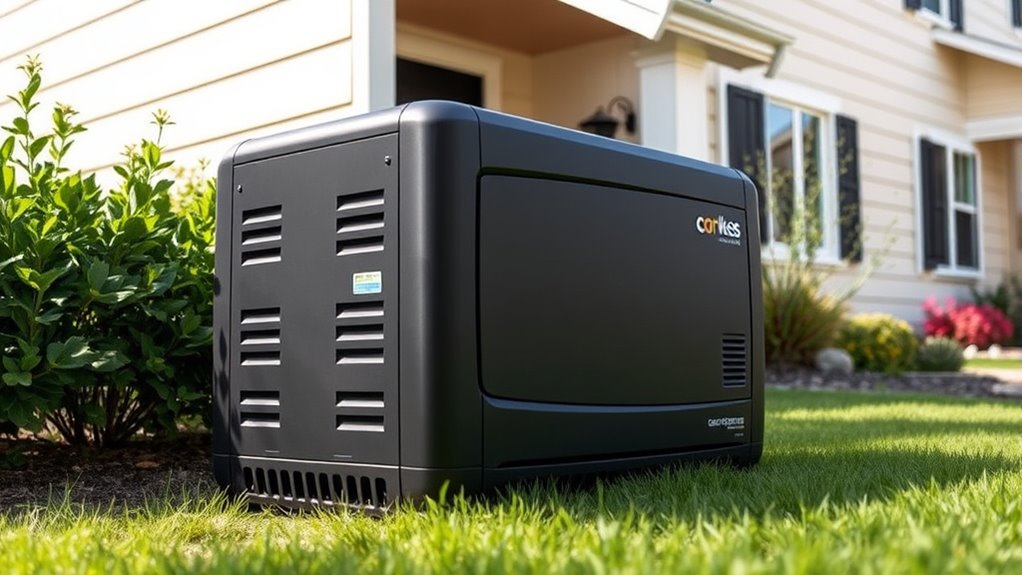
If the aim is to have backup power arrive without wheeling out equipment, the Generac 14 kW standby is the clearest whole-home-oriented option here. It detects an outage and supplies power through a permanent standby setup, running on natural gas or propane. Its automatic operation is a more direct match for household continuity than any portable model in this lineup, including the higher-output WGen11500TFc, which still requires a portable-generator connection and manual planning.
For a quietness roundup, however, I cannot rank it first on acoustic evidence: the supplied specifications include no operating noise figure. A fully enclosed stainless-steel design may be relevant to siting and weather exposure, but it is not a substitute for a published sound rating. Buyers focused specifically on low noise should ask an installer for the model’s sound data at relevant distances and loads, then compare local setback rules and placement options before choosing.
The built-in cellular connection supports remote monitoring and control through Mobile Link, but real-time updates and maintenance alerts require a premium subscription. Oil-level sensing and cold-start improvements support readiness, though they do not remove the need for regular maintenance or professional installation. At 391 pounds, it is not a casual DIY move. Compared with the Westinghouse 5000, this is the more capable automatic-backup concept; compared with the stated-52-dBA inverter, it lacks a noise figure that can settle the quietness question.
Pros:- Automatically detects outages and supplies residential backup power when properly installed.
- Runs on natural gas or propane.
- Built-in cellular monitoring and control are available through the Mobile Link app.
- Oil-level sensors and cold-start improvements support readiness.
Cons:- No operating noise figure is supplied for comparing quietness.
- Premium subscription is required for real-time app updates and maintenance alerts.
- At 391 pounds, it requires careful handling and professional installation.
Best for: Homeowners seeking permanently installed automatic backup on natural gas or propane, with professional installation and monitoring features.
Not ideal for: Buyers who need a documented low-noise rating, portable power, or a setup that avoids installation and subscription costs.
- Power output:14,000 watts
- Fuel:Natural gas or propane
- Voltage:240 volts
- Connectivity:Built-in cellular
- Weight:391 pounds
- Dimensions:46.4 × 26.3 × 30.7 inches
- Enclosure:Fully enclosed stainless steel
- Starting behavior:Automatically detects outages
Our verdict“I recommend this as the lineup’s strongest automatic standby choice, but not as the proven quietest model without a published noise rating.”
Westinghouse WGen11500TFc Tri-Fuel Portable Generator with Remote Electric Start
The WGen11500TFc makes the most sense when a household values substantial portable output and fuel flexibility more than a confirmed low-noise rating. It supplies 11,500 running watts and can use gasoline, propane, or natural gas. That three-fuel choice can help owners plan around what is available during a disruption, while remote and push-button electric start reduce the effort of getting it running compared with a recoil-only machine.
Its 30A and 50A outlets are transfer-switch-ready, but the automatic transfer switch is sold separately. That means it does not offer the hands-off outage response of the Generac standby, and it is not a plug-in replacement for a professionally designed home connection. The stated up-to-19-hour runtime applies at 25% load; heavier use will change fuel consumption. Although the product information gives total harmonic distortion below 5%, it does not give a noise level, so I cannot place it above the Westinghouse 5000 for quietness.
Compared with the DuroMax XP13000HX, this Westinghouse trades a little listed running output for tri-fuel operation and remote start. Compared with the Oxseryn, it offers more running watts and a wider fuel menu, but the Oxseryn at least provides a specific noise figure—one that is high at 77 dB. The WGen11500TFc is a capable portable backup candidate, yet buyers with close neighbors should request its sound data before deciding where it can run.
Pros:- Runs on gasoline, propane, or natural gas.
- Provides 11,500 running watts with 30A and 50A transfer-switch-ready outlets.
- Remote and push-button electric starting are included.
- CO sensor and automatic low-oil shutdown add protective features.
Cons:- No noise rating is supplied, making quietness difficult to compare.
- Automatic transfer switch is sold separately.
- Heavy-duty portable construction can be difficult to move.
Best for: Households that want high portable output, three fuel options, remote start, and a planned transfer-switch connection.
Not ideal for: Noise-sensitive buyers who need a documented sound rating or anyone expecting automatic standby operation without separate equipment.
- Peak output:14,500 watts
- Running output:11,500 watts
- Fuel types:Gasoline, propane, natural gas
- Fuel tank:9.5 gallons
- Claimed runtime:Up to 19 hours at 25% load
- Outlets:L14-30R 30A and 14-50R 50A
- Starting:Push-button electric and remote
- Total harmonic distortion:Less than 5%
Our verdict“I would choose it for fuel flexibility and substantial portable output, not on the assumption that it is one of the quietest models.”
DuroMax XP13000HX 13,000-Watt Dual-Fuel Portable Generator
The DuroMax XP13000HX suits buyers who want a large portable generator with gasoline-or-propane operation and a 50A outlet ready for a compatible transfer setup. Its listed 13,000 watts, electric start, and four GFCI household outlets give it a broad range of backup uses. The CO Alert feature is a practical safety addition, but it does not make indoor or enclosed-space operation safe; portable generators must be used outdoors and away from openings according to the manual and local safety guidance.
Quietness is the weak point in the comparison: the supplied product information gives no noise rating, and its open portable format does not provide the same kind of enclosed standby arrangement as the Generac. It also weighs 245 pounds and measures 30 × 29 × 26 inches, so moving it and finding a suitable operating location take planning. Buyers should confirm the exact outlet and transfer-switch arrangement with an electrician rather than assume that a 50A connection can serve every home load.
Against the Westinghouse WGen11500TFc, the DuroMax offers dual-fuel rather than tri-fuel operation and has no supplied remote-start detail. The Westinghouse 5000 is the more compelling option for documented quietness, though it provides far less output. I see the DuroMax as a power-first portable pick for buyers who accept the noise uncertainty, not a strong match for someone choosing chiefly to limit generator sound.
Pros:- Runs on gasoline or propane.
- Offers electric start and a 50A transfer-switch-ready outlet.
- CO Alert and a digital display are included.
- Multiple household and 240V outlet options support varied backup plans.
Cons:- No noise rating is supplied for quietness comparisons.
- At 245 pounds, it is difficult to move without help or suitable equipment.
- Its 30 × 29 × 26-inch footprint needs dedicated storage and operating space.
Best for: Buyers who want a high-output portable generator with gasoline-or-propane flexibility and a transfer-switch-ready 50A outlet.
Not ideal for: People prioritizing a documented quiet operating level, easy movement, or automatic standby service.
- Listed output:13,000 watts
- Fuel:Gasoline or propane
- Engine:500cc OHV, 4-stroke
- Runtime:Up to 17 hours
- Weight:245 pounds
- Dimensions:30 × 29 × 26 inches
- Outlets:120V GFCI, 120V 30A, 120/240V 30A, 120/240V 50A
- Safety feature:CO Alert
Our verdict“I recommend it for dual-fuel portable capacity, while buyers focused on quiet operation should favor a model with clearer sound information.”
Oxseryn 12,000W Open-Frame Inverter Generator
The Oxseryn pairs 9,000 running watts with pure sine wave output, a 50A GFCI outlet, electric start, and a digital meter. That combination can appeal to buyers who want more portable output than the Westinghouse 5000 while still paying attention to power quality for sensitive electronics. ECO mode and a 6.6-gallon tank support a stated runtime of up to 10 hours at 50% load, though actual runtime will vary with demand.
Its key limitation for this roundup is unusually clear: the listed noise level is 77 dB at 23 feet. That figure makes it difficult to recommend for close neighbors, quiet outdoor areas, or anyone seeking to minimize sound around the home. It is an open-frame design rather than a permanently installed standby unit, so it needs a safe outdoor location and a proper connection plan. The wheels and folding handle help with movement, but both require assembly, and the 150-pound weight still makes it a substantial machine to reposition.
Compared with the DuroMax, the Oxseryn has a stated noise figure and inverter output, but its 77 dB figure is not a quietness advantage. Compared with the Westinghouse 5000, it offers far more running capacity and a 120/240V 50A outlet, yet is much less suitable when noise leads the buying decision. I rank it last for this particular title—not because it lacks useful power features, but because its documented sound level runs counter to the main goal.
Pros:- 9,000 running watts and a 120/240V 50A GFCI outlet support larger portable backup plans.
- Pure sine wave output is designed for sensitive electronics.
- Digital meter and fuel gauge make operating information easier to check.
- Wheels and folding handle support storage and repositioning after assembly.
Cons:- Stated 77 dB at 23 feet is the highest and only clearly documented loudness concern here.
- Weighs 150 pounds despite its wheels and handle.
- Wheels and folding handle require assembly.
Best for: Buyers who need substantial portable inverter output, a 50A connection, and pure sine wave power, with room to operate it well away from living areas.
Not ideal for: Noise-sensitive households, close-set properties, or buyers seeking an automatically starting whole-home standby generator.
- Starting output:12,000 watts
- Running output:9,000 watts
- Noise level:77 dB at 23 feet
- Fuel:Gasoline
- Fuel tank:6.6 gallons
- Claimed runtime:Up to 10 hours at 50% load
- Output:120/240V, up to 50A
- Weight:150 pounds
- Power quality:Pure sine wave output
Our verdict“I would choose the Oxseryn for portable inverter capacity, but its stated 77 dB level makes it the weakest match for a quietness-first purchase.”

How We Picked
I ranked these five models around the promise of quieter whole-home backup, while separating actual whole-house standby equipment from portable generators that can support selected home circuits. I gave the most weight to a stated noise figure, the generator’s operating format, and whether its output and connections plausibly suit residential backup. That is why the Westinghouse 5000 inverter leads on documented quiet operation, even though it is not the strongest whole-home option.
Where a product description did not provide a noise measurement, I did not guess or treat it as quiet. The Generac, DuroMax, and Westinghouse tri-fuel generator have useful backup features, but their supplied specifications do not establish how loud they are. The Oxseryn does list a figure—77 dB at 23 feet—which gives a meaningful caution for noise-sensitive buyers. I also considered fuel choices, runtime claims, starting method, transfer-switch connections, and portability because a generator’s sound is only one part of whether it will work well at home.
This is a comparison of the supplied specifications, not a claim of independent acoustic testing. Manufacturer noise figures may depend on load, distance, and operating conditions, so I treat them as reference points rather than direct laboratory comparisons. I also distinguish a generator that starts automatically through a standby installation from a portable unit that requires setup and a suitable transfer connection. For whole-house use, a qualified electrician should confirm the home’s load requirements, permitted connection method, and installation plan.
| whole house generator quietest model | Claimed runtime | Fuel |
|---|---|---|
| Westinghouse 5000 Peak Watt Su | Up to 18 hours | — |
| Generac 14 kW Whole-Home Stand | — | Natural gas or propane |
| Westinghouse WGen11500TFc Tri- | Up to 19 hours at 25% load | — |
| DuroMax XP13000HX 13,000-Watt | — | Gasoline or propane |
| Oxseryn 12,000W Open-Frame Inv | Up to 10 hours at 50% load | Gasoline |
Factors to Consider When Choosing Whole House Generator Quietest Models
Quietness is only useful if the generator can support the loads you need and can be installed or connected safely. I would start by separating automatic standby service from portable backup, then compare documented noise figures only among options with relevant measurements.
Standby versus portable: choose the operating style first
A permanently installed standby unit, such as the Generac, is designed to detect an outage and start through a professionally planned installation. That convenience is different from portability: portable models need a suitable outdoor operating spot, fuel, and a safe connection to the home’s circuits. The Westinghouse 5000 is the strongest documented quietness pick, but its 3,900 rated watts point to selected loads rather than a broad whole-house plan. I would not equate a high portable wattage with automatic whole-home backup.
Treat sound figures as comparison points, not promises
Only two listed products provide a noise figure: the Westinghouse 5000 at 52 dBA and the Oxseryn at 77 dB at 23 feet. These numbers make the Westinghouse the clearest quietness choice and the Oxseryn a poor fit for noise-sensitive sites, but they may reflect different measurement conditions. The other products cannot be ranked acoustically from the supplied details. Ask the manufacturer or installer for sound levels at specified distances and loads, and check local rules on generator placement and operating hours.
Match output to essential circuits
Make a list of the loads you expect to run at the same time, including appliances with startup surges. The Westinghouse 5000’s rated output is much lower than the larger portable options, so it is better suited to a limited backup plan. The DuroMax, Oxseryn, and WGen11500TFc provide more listed output and 240V or 50A connection options, but those features do not establish which circuits a home can safely power. Have an electrician size the generator and connection around the actual load plan.
Fuel options and runtime depend on the outage plan
Fuel flexibility can matter as much as tank size. The Generac uses natural gas or propane; the DuroMax runs on gasoline or propane; and the WGen11500TFc accepts gasoline, propane, or natural gas. Gasoline tank runtime claims are tied to specific loads, such as the Westinghouse tri-fuel unit’s up-to-19-hour figure at 25% load. Do not assume that maximum runtime applies at full output. Review fuel storage, local supply, connection requirements, and safe refueling procedures before choosing.
Plan for installation, placement, and safe connection
A transfer-switch-ready outlet does not mean a generator can be connected directly to household wiring without the proper equipment. The WGen11500TFc’s automatic transfer switch is separate, and the DuroMax’s 50A outlet still needs a compatible, professionally designed connection. Standby installation also requires site planning, fuel connections, and code compliance. Every portable generator in this comparison must operate outdoors in a well-ventilated location, away from doors, windows, and other openings, following its manual and applicable safety requirements.
Account for monitoring and ownership demands
The Generac’s cellular monitoring may help owners track readiness, but its premium subscription is needed for real-time updates and maintenance alerts. Portable models avoid that subscription detail but require owners to manage setup, fuel, storage, and periodic maintenance. Weight matters too: the Generac is listed at 391 pounds, the DuroMax at 245 pounds, and the Oxseryn at 150 pounds. Wheels or a permanent installation change how a machine is handled, but they do not remove the need for a suitable location and support.
Frequently Asked Questions
Which generator in this comparison has the lowest stated noise level?
The Westinghouse 5000 portable inverter has the lowest supplied figure at 52 dBA. The Oxseryn is listed at 77 dB at 23 feet, while the other three products have no noise figure in the provided specifications. Because the measurement conditions may differ, I would use these numbers as reference points and request comparable manufacturer data before making a final choice.
Is the quietest model here suitable for powering an entire house?
The Westinghouse 5000 is described as a portable generator with 3,900 rated watts, so I would treat it as a limited-load or partial-home option rather than assume it can run an entire home. The number and type of circuits it can support depend on the home’s loads and the permitted connection method. An electrician can help determine whether it fits a selected-circuit plan.
Which option provides automatic backup when the power fails?
The Generac 14 kW standby model is the listed option designed to detect an outage and supply residential backup automatically when installed as intended. The portable models require setup and a suitable connection plan, even if they offer remote or electric start. Automatic generator starting should not be confused with automatic connection to every home circuit.
Does a transfer-switch-ready outlet mean the portable generator includes a transfer switch?
No. A transfer-switch-ready outlet indicates a compatible connection option, but the home still needs properly selected transfer equipment and professional installation. The Westinghouse WGen11500TFc description specifically says its automatic transfer switch is sold separately. Buyers should have an electrician verify compatibility and prevent unsafe backfeeding.
How should I use noise ratings when choosing a home generator?
Compare ratings only when the distance, load, and measurement method are similar, since generator sound changes with operating conditions. Here, the Westinghouse 5000 is listed at 52 dBA and the Oxseryn at 77 dB at 23 feet, but the supplied data does not establish identical test conditions. For products without a stated figure, request manufacturer sound information and check local placement and operating rules before purchase.
Conclusion
For a buyer whose first priority is documented lower noise and who can work with partial-home capacity, I would start with the Westinghouse 5000 inverter. If you want automatic, permanently installed backup, the Generac is the clearest fit, but I would ask an installer for its sound data before choosing it on quietness. For households that need higher portable output and multiple fuel choices, the WGen11500TFc is the more flexible option, while the DuroMax suits buyers who specifically want gasoline-or-propane operation and a 50A outlet.
I would skip the Oxseryn if low sound is the deciding factor, since its listed 77 dB at 23 feet works against that goal, even though its inverter output and capacity may suit other needs. Across all five models, I would size power from a real circuit plan, verify noise under comparable conditions, and arrange safe placement and connection before buying. That approach keeps a quietness-first decision grounded in both sound evidence and the backup the household actually needs.