When searching for the best astronomy telescopes, you face a range of options that balance performance, ease of use, and price. The Celestron NexStar 8SE stands out as the best overall choice for its powerful Schmidt-Cassegrain design and user-friendly features. For beginners, the Gskyer 70mm offers a manageable size and straightforward setup at an affordable price. Meanwhile, the Dwarflab Dwarf 3 excels for those interested in astrophotography with its app-controlled camera. These choices reflect the core tradeoffs: higher performance versus simplicity, and premium features versus entry-level affordability. Keep reading for a detailed breakdown to find the perfect fit for your stargazing ambitions.

Get your wardrobe favorites delivered free with Prime
- Fast, free delivery on millions of items
- Prime Video, Amazon Music and more included
- Member-only deals all year
Key Takeaways
- The best telescopes balance aperture size with portability, ensuring clear views without excessive bulk.
- Smartphone-guided models simplify setup and targeting for beginners, but may sacrifice some precision and power.
- Entry-level telescopes often prioritize ease of use and affordability, but can limit deep-sky observation capabilities.
- Premium models like the NexStar 8SE offer advanced features that appeal to serious hobbyists and astrophotographers.
- Choosing the right telescope depends heavily on intended use: casual viewing, astrophotography, or advanced astronomy.
| 80mm Aperture Refractor Telescope for Adults and Beginners, Portable Travel Telescopio with Backpack |  | Best for Beginners and Kids on the Go | Aperture: 80mm | Focal Length: 600mm | Eyepieces: K20mm and K9mm | VIEW ON AMAZON | See Our Full Breakdown |
| Celestron StarSense Explorer LT 114AZ Newtonian Smartphone Guided Telescope |  | Best for Beginners Who Want Tech Assistance | Aperture: 114mm | Type: Newtonian reflector | Mount: Manual altazimuth | VIEW ON AMAZON | See Our Full Breakdown |
| Celestron NexStar 102SLT Computerized Refractor Telescope |  | Best for Portable, Quick-Setup Viewing | Aperture: 102mm | Optical Design: Refractor | Technology: SkyAlign | VIEW ON AMAZON | See Our Full Breakdown |
| Celestron NexStar 8SE Computerized Telescope – Schmidt-Cassegrain |  | Best for Serious Moon and Deep-Sky Observation | Aperture: 8 inches | Optics: Schmidt-Cassegrain | Mount: Computerized GoTo | VIEW ON AMAZON | See Our Full Breakdown |
| Celticbird 80mm Aperture Refractor Telescope with Backpack, Phone Adapter, and Moon Filter |  | Best for Versatile, Field-Ready Astronomy | Aperture: 80mm | Focal Length: 600mm | Focal Ratio: f/6.7 | VIEW ON AMAZON | See Our Full Breakdown |
| MEEZAA 150EQ Newtonian Reflector Telescope for Adults and Beginners |  | Best Overall for Serious Beginners and Enthusiasts | Aperture: 150mm | Focal Length: 650mm | Eyepieces: 25mm & 10mm | VIEW ON AMAZON | See Our Full Breakdown |
| Celestron StarSense Explorer DX 130AZ Smartphone Guided Newtonian Telescope |  | Best for Beginners Who Want Easy Smartphone Guidance | Telescope Type: Newtonian reflector | Aperture: 130mm | Mount Type: Altazimuth | VIEW ON AMAZON | See Our Full Breakdown |
| Gskyer 70mm Aperture 400mm AZ Mount Astronomical Refracting Telescope for Kids and Beginners | 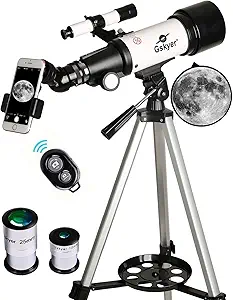 | Best for Kids and Entry-Level Observers | Aperture: 70mm | Focal Length: 400mm | Finder Scope: 5×24 with cross-hair | VIEW ON AMAZON | See Our Full Breakdown |
| Dwarflab Dwarf 3 Smart Telescope, App-Controlled Astrophotography Camera |  | Best for Portable Astrophotography and Outdoor Use | Weight: 3 lb / 1.35 kg | Lens System: Dual lenses (telephoto and wide-angle) | Auto-Tracking: Yes | VIEW ON AMAZON | See Our Full Breakdown |
| MEEZAA 90mm Aperture Refractor Telescope for Adults | 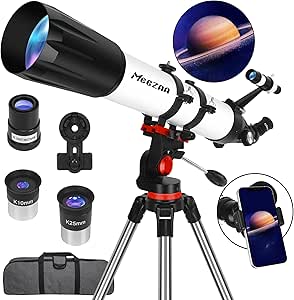 | Best for Beginners Seeking a High-Quality Refractor | Aperture: 90mm | Focal Length: 800mm | Magnification: 32X-240X | VIEW ON AMAZON | See Our Full Breakdown |
| astronomy telescope | Aperture | Focal Length |
|---|---|---|
| 80mm Aperture Refractor Telesc | 80mm | 600mm |
| Celestron StarSense Explorer L | 114mm | — |
| Celestron NexStar 102SLT Compu | 102mm | — |
| Celestron NexStar 8SE Computer | 8 inches | — |
| Celticbird 80mm Aperture Refra | 80mm | 600mm |
| MEEZAA 150EQ Newtonian Reflect | 150mm | 650mm |
| Celestron StarSense Explorer D | 130mm | — |
| Gskyer 70mm Aperture 400mm AZ | 70mm | 400mm |
| Dwarflab Dwarf 3 Smart Telesco | — | — |
| MEEZAA 90mm Aperture Refractor | 90mm | 800mm |
More Details on Our Top Picks
80mm Aperture Refractor Telescope for Adults and Beginners, Portable Travel Telescopio with Backpack
This 80mm refractor stands out for its simplicity and portability, making it ideal for newcomers to astronomy or families wanting a lightweight option. Compared with the Celticbird 80mm, it offers a similar aperture but includes a backpack for easier transport, enhancing its travel-friendly appeal. However, its basic build quality and limited magnification mean it’s not suited for serious star-gazers aiming for detailed planetary or deep-sky views. The manual adjustment and lower optical sophistication are tradeoffs for ease of use and portability.
This pick makes the most sense for casual users, kids, or travelers seeking a straightforward introduction to the night sky.
Pros:- Easy to assemble and suitable for beginners and kids
- Portable with a backpack for travel and outdoor use
- Includes multiple eyepieces and accessories for versatile viewing
Cons:- Limited magnification range for detailed astronomy
- Build quality may be basic for serious users
- Requires manual adjustment for precise targeting
Best for: Beginners, kids, and outdoor enthusiasts who value portability and ease of setup
Not ideal for: Experienced astronomers or those seeking high-magnification views or astrophotography capabilities
- Aperture:80mm
- Focal Length:600mm
- Eyepieces:K20mm and K9mm
- Magnification:30x-66x
- Finder Scope:5×24 with crosshair
- Accessories:Mobile phone adapter, carrying backpack, adjustable tripod
Our verdict“A practical, beginner-friendly telescope perfect for casual stargazing and travel, but not for advanced astronomy pursuits.”
Celestron StarSense Explorer LT 114AZ Newtonian Smartphone Guided Telescope
This 114mm Newtonian reflector uses smartphone technology to guide users in locating celestial objects, making it a clear choice for newcomers intimidated by star charts. Its smartphone app-guided system simplifies setup compared to the manual operation of the Celestron NexStar 102SLT. However, the manual mount offers limited tracking precision, and light pollution can hinder performance in city skies. Its straightforward operation and vivid views make it a solid first step into astronomy, but it lacks motorized tracking for extended observation sessions.
This pick makes the most sense for beginners wanting guided, easy-to-use equipment with decent planetary and deep-sky views.
Pros:- Easy to use with smartphone guidance and app-based sky recognition
- Sharp, vivid views of planets, Moon, and deep-sky objects
- Simple setup with manual tracking for beginners
Cons:- Manual mount may require steady hands for precise tracking
- Limited to basic altazimuth movement without motorized tracking
- Performance affected by light pollution in urban settings
Best for: Novice astronomers interested in guided sky exploration without complex systems
Not ideal for: Advanced users or those seeking astrophotography, as it lacks motorized tracking
- Aperture:114mm
- Type:Newtonian reflector
- Mount:Manual altazimuth
- Connectivity:Smartphone app guided
Our verdict“A beginner-friendly telescope that leverages smartphone tech for easy star-hopping but doesn’t support long, automated viewing sessions.”
Celestron NexStar 102SLT Computerized Refractor Telescope
The NexStar 102SLT offers a portable, computerized solution for users wanting quick access to celestial objects. Its 102mm aperture provides bright images of planets and the Moon, comparable to the 80mm Refractor for Beginners, but adds the convenience of SkyAlign technology that speeds up setup. While it’s easier to use than more complex mounts, it’s not designed for high-level astrophotography or deep-sky imaging. Some assembly and alignment are required, and its optical quality is geared toward amateur viewing, not professional detail.
This telescope balances portability with automation, but it’s best suited for those who want quick, guided views without investing in larger, more complex setups.
This pick makes the most sense for amateur astronomers who prioritize ease of setup and portability over advanced imaging.
Pros:- Portable and easy to transport
- Quick setup with SkyAlign technology
- Includes free astronomy software for sky simulation
Cons:- Limited to amateur-level viewing
- Not suitable for advanced astrophotography
- Requires some assembly and alignment
Best for: Casual astronomers seeking quick, guided vistas of the night sky
Not ideal for: Experienced astrophotographers or users requiring high-precision optics
- Aperture:102mm
- Optical Design:Refractor
- Technology:SkyAlign
- Included Software:Starry Night
- Warranty:2 years
Our verdict“A convenient, user-friendly telescope ideal for quick sky observations and learning, but not for detailed imaging or professional use.”
Celestron NexStar 8SE Computerized Telescope – Schmidt-Cassegrain
The NexStar 8SE stands out for its substantial 8-inch aperture, offering detailed views of lunar craters, planetary detail, and deep-sky objects. Its fully computerized GoTo mount with SkyAlign technology makes locating objects straightforward, even for those new to astronomy. Compared with the smaller 102mm Refractor, the 8SE provides a significant boost in light-gathering power, but its size and initial setup complexity can be daunting for absolute beginners. The system’s extensive object database makes it well-suited for users who want to explore the universe in depth, but the higher price and learning curve are tradeoffs.
This pick makes the most sense for amateur astronomers ready to invest in a larger, more capable telescope for serious lunar and planetary observation.
Pros:- Large 8-inch aperture for detailed lunar and deep-sky views
- Fully automated GoTo with extensive object database
- Portable for its size and easy to set up
Cons:- Requires initial setup and alignment
- Higher price point for advanced features
- Some users may find the computerized system complex at first
Best for: Intermediate to advanced amateur astronomers seeking detailed, versatile viewing
Not ideal for: Beginners or those seeking a lightweight, portable scope for quick outings
- Aperture:8 inches
- Optics:Schmidt-Cassegrain
- Mount:Computerized GoTo
- Object Database:40,000+ objects
- Warranty:2 years
Our verdict“A powerful, automated telescope suited for dedicated amateurs ready to explore the universe’s finer details, with some setup effort involved.”
Celticbird 80mm Aperture Refractor Telescope with Backpack, Phone Adapter, and Moon Filter
This 80mm Celticbird refractor combines quality optics with a suite of accessories, making it a flexible choice for both beginners and more experienced hobbyists. Its high-quality fully coated lenses produce bright, sharp images comparable to the 80mm Aperture Refractor for Beginners, but adds a phone adapter and moon filter for astrophotography and detailed lunar viewing. Its portability, thanks to the included backpack and adjustable tripod, makes it suitable for outdoor excursions. However, the maximum magnification of 66X limits detailed planetary views, and the lack of motorized tracking means long observing sessions are more challenging.
This telescope balances optical quality and portability but requires some assembly and manual operation.
This pick makes the most sense for enthusiasts who want a portable, high-quality optical instrument with astrophotography potential, but without the complexity of motorized systems.
Pros:- High-quality, fully coated optics for bright, clear images
- Portable with a backpack and adjustable tripod
- Includes phone adapter and moon filter for astrophotography and lunar viewing
Cons:- Limited maximum magnification for planetary details
- Requires assembly which might be tricky for very young children
- No motorized tracking for extended observations
Best for: Intermediate users or hobbyists seeking portable optics with basic astrophotography features
Not ideal for: Professional astrophotographers or users needing high-magnification planetary details
- Aperture:80mm
- Focal Length:600mm
- Focal Ratio:f/6.7
- Eyepieces:20mm and 9mm
- Magnification:30X and 66X
- Included Accessories:Backpack, Phone Adapter, Moon Filter
Our verdict“A well-rounded, portable telescope that offers good optical performance and astrophotography options for hobbyists, with some limitations on magnification and tracking.”
MEEZAA 150EQ Newtonian Reflector Telescope for Adults and Beginners
The MEEZAA 150EQ stands out for its large 150mm aperture, delivering bright, detailed views of the Moon, planets, and deep-sky objects. Compared to the Gskyer 70mm, this model offers significantly better light-gathering power and resolution, making it ideal for those ready to move beyond basic telescopes. The stable German equatorial mount allows for smoother tracking, though manual operation can challenge newer users. Assembly may take some time, and its manual tracking isn’t as beginner-friendly as smartphone-guided options like the Celestron StarSense Explorer DX 130AZ. It excels for amateur astronomers seeking detailed planetary and deep-space views but isn’t suited for casual stargazing or professional astrophotography. The included accessories, such as multiple eyepieces and a moon filter, add value for serious observation. However, the size and manual operation mean it’s less portable and requires some learning curve.Pros:- Large 150mm aperture for bright, detailed images
- Includes multiple eyepieces and accessories for versatile observing
- Stable German equatorial mount with smooth tracking
Cons:- Assembly can be time-consuming and complex for beginners
- Manual tracking may be challenging for novice users
Best for: Amateur astronomers wanting detailed deep-sky and planetary viewing with room to grow.
Not ideal for: Casual stargazers or those preferring quick, automated setups without manual adjustments.
- Aperture:150mm
- Focal Length:650mm
- Eyepieces:25mm & 10mm
- Magnification:26X to 130X
- Mount:German Equatorial
- Tripod Material:Stainless steel
Our verdict“This telescope is ideal for dedicated beginners or hobbyists aiming for detailed celestial observations and willing to handle some setup complexity.”
Celestron StarSense Explorer DX 130AZ Smartphone Guided Newtonian Telescope
The Celestron StarSense Explorer DX 130AZ offers a straightforward way to locate celestial objects using smartphone technology. Compared to the Gskyer 70mm, this 130mm aperture provides sharper, more detailed views of planets and nebulae, making it better suited for those eager to explore more than just the Moon. Its smartphone app with sky recognition simplifies setup and reduces initial frustration, though manual tracking remains a challenge for absolute beginners. While it lacks advanced motorized tracking, its dual-axis controls help keep objects in view, making it an excellent entry-level choice for casual astronomy. It’s particularly appealing for users who want quick results with minimal fuss, but those seeking high-precision astrophotography may find it limiting. Overall, it balances ease of use with solid optical performance for amateur stargazers.Pros:- Smartphone-guided setup with sky recognition technology
- Sharp, vivid views of planets, nebulae, and galaxies
- Includes a 2-year US warranty and support
Cons:- Manual tracking can require adjustment and patience
- Limited to amateur observation levels
Best for: Beginners who want an easy, guided introduction to celestial observation with smartphone integration.
Not ideal for: Experienced astronomers or those seeking fully automated, high-precision tracking for astrophotography.
- Telescope Type:Newtonian reflector
- Aperture:130mm
- Mount Type:Altazimuth
- Tracking:Manual with dual-axis
- Connectivity:Smartphone app
Our verdict“This telescope makes a strong choice for beginners wanting guided, high-quality views without complex setup.”
Gskyer 70mm Aperture 400mm AZ Mount Astronomical Refracting Telescope for Kids and Beginners
The Gskyer 70mm refractor offers a beginner-friendly experience with its manageable size and straightforward setup. Compared to larger telescopes like the MEEZAA 150EQ, it’s less powerful but perfect for young explorers or casual viewers. Its fully coated optics and included accessories, such as the phone adapter and wireless remote, make celestial imaging accessible, especially for those just starting out. The adjustable aluminum tripod provides portability, but its basic stability may limit detailed observations, especially at higher magnifications. Its limited aperture and simple mount mean it’s best suited for lunar and planetary views rather than deep-space objects. For families or new amateurs, it offers a fun, easy introduction, though more serious enthusiasts should consider larger, more stable options.Pros:- Suitable for beginners and kids to explore astronomy
- Includes phone adapter and wireless remote for imaging
- Portable with adjustable tripod and carry bag
Cons:- Magnification depends on eyepieces and Barlow lens, limiting high-power views
- Basic tripod may restrict stability for detailed observation
Best for: Kids and beginners seeking a portable, easy-to-use telescope for lunar and planetary viewing.
Not ideal for: Advanced astronomers wanting detailed deep-sky imaging or high-magnification planetary observations.
- Aperture:70mm
- Focal Length:400mm
- Finder Scope:5×24 with cross-hair
- Includes:Phone adapter, wireless remote, carry bag
- Tripod:Adjustable aluminum alloy
Our verdict“This telescope provides a simple, portable way for newcomers and children to enjoy basic astronomy activities.”
Dwarflab Dwarf 3 Smart Telescope, App-Controlled Astrophotography Camera
The Dwarflab Dwarf 3 redefines portability with its lightweight design and dual lenses for day and night imaging. Compared to traditional telescopes like the MEEZAA 150EQ, it prioritizes travel and quick setup over deep-space viewing, making it ideal for outdoor adventures. Its smart auto-tracking and 4K image clarity significantly improve astrophotography experiences for beginners and experts alike. However, reliance on a smartphone app and limited battery information could pose usability issues on longer outings. This pick is perfect for those who want a versatile, compact device that can handle daytime photography as well as celestial imaging, but it lacks the high-sensitivity features of larger, more advanced astrophotography setups. Overall, it’s a fun, innovative option for spontaneous astrophotography on the go.Pros:- Highly portable and lightweight for travel
- Dual lens system for day and night imaging
- Smart auto-tracking with 4K clarity enhances photo quality
Cons:- Full functionality depends on smartphone app
- Limited details on battery life and power options
Best for: Travelers and outdoor enthusiasts interested in portable, app-controlled astrophotography with versatile day/night imaging.
Not ideal for: Dedicated astrophotographers requiring high-end, high-precision imaging equipment for deep-space photography.
- Weight:3 lb / 1.35 kg
- Lens System:Dual lenses (telephoto and wide-angle)
- Auto-Tracking:Yes
- Resolution:4K
- Connectivity:USB-C
Our verdict“This smart telescope excels for portable astrophotography and outdoor adventures, especially for casual users wanting quick results.”
MEEZAA 90mm Aperture Refractor Telescope for Adults
The MEEZAA 90mm refractor combines a solid aperture with a straightforward design, making it a strong choice for burgeoning enthusiasts. Compared with the Gskyer 70mm, it offers increased light-gathering power and higher potential magnification, which translates into brighter, more detailed images of the Moon and planets. Its 800mm focal length allows for versatile viewing, and the included accessories, like the phone adapter and carry bag, enhance portability. While it lacks advanced features like computerized tracking, it compensates with ease of use and good optical quality. The adjustable tripod supports users of different heights, though its maximum height may not suit all needs. This telescope hits a sweet spot for beginners who want to grow their skills without the complexity of high-end models.Pros:- Large 90mm aperture for brighter, clearer images
- Versatile magnification with included eyepieces and Barlow lens
- Easy assembly and quick setup with manual
Cons:- Magnification may be limited for very detailed planetary work
- Tripod height adjustment might not suit all users
Best for: Beginners and hobbyists wanting a high-quality, easy-to-use refractor for lunar and planetary observation.
Not ideal for: Advanced astronomers seeking specialized astrophotography features or high-magnification planetary imaging.
- Aperture:90mm
- Focal Length:800mm
- Magnification:32X-240X
- Eyepieces:10mm & 25mm
- Barlow Lens:3X
- Tripod Height:28 to 46 inches
Our verdict“This refractor provides a balanced entry point for beginners eager to explore planetary and lunar details with optical clarity.”

How We Picked
The products in this roundup were selected based on a combination of performance metrics, user reviews, build quality, ease of setup, and value for money. We prioritized telescopes that cater to a broad range of users, from beginners to experienced amateurs. Each model was evaluated for its optical quality, motorized capabilities, and portability. The ranking reflects a balance between budget-friendliness and advanced features, highlighting options that excel in real-world viewing conditions and usability. Our goal was to identify telescopes that offer reliable performance and good longevity, making the choices meaningful for different types of stargazers.Factors to Consider When Choosing Astronomy Telescopes
Selecting the right astronomy telescope involves understanding several key factors beyond just specs. The following considerations will help you navigate common pitfalls and make an informed decision tailored to your interests and skill level.Aperture Size and Optical Quality
The aperture determines how much light the telescope can gather, directly impacting the clarity and brightness of observed objects. Larger apertures provide sharper images of planets and deep-sky objects, but also tend to be heavier and more expensive. Optical quality, including lens and mirror craftsmanship, affects image clarity and contrast. For serious astronomy, prioritize at least 80mm of aperture, but for casual viewing or portability, smaller models can still deliver satisfying results.
Mount Type and Ease of Use
The mount supports the telescope and influences stability and tracking. Equatorial mounts are ideal for astrophotography and precise tracking, but they require more setup and learning. Altazimuth mounts are simpler and more intuitive, making them suitable for beginners. Motorized or computerized mounts can automatically locate objects, saving time and frustration but often come at a higher cost. Consider your comfort with setup and your goals—manual mounts are more affordable and straightforward, while computerized models offer convenience for frequent stargazing.
Portability and Size
If you plan to travel or hike to dark sky sites, weight and size become key factors. Compact telescopes are easier to carry and store, but may sacrifice some aperture and optical quality. Larger telescopes provide better views but can be cumbersome and require sturdy support. Think about where you’ll use the telescope most often, and balance portability with the need for detailed viewing. A lightweight, durable design can make the difference between consistent use and neglect due to inconvenience.
Ease of Setup and Operation
Beginners benefit from models that are quick to assemble and simple to operate. Many modern telescopes feature quick-release mounts, intuitive controls, and smartphone apps that help locate objects. Avoid overly complex systems if you’re just starting, as frustration can diminish enjoyment. However, if you’re interested in learning more about astronomy, investing in a slightly more sophisticated model can be rewarding. Always consider how much time you’re willing to dedicate to setup and how user-friendly the controls are.
Budget and Long-Term Value
Your budget influences nearly every aspect of your telescope choice. While entry-level models are affordable and great for beginners, they often lack the power for deep-sky exploration. Investing in a mid-range or premium telescope can provide richer views and better durability, but at a higher cost. Evaluate the features you need most and consider whether the investment aligns with your long-term interest. Remember, a more expensive telescope with advanced features can also mean higher maintenance and complexity, so choose wisely based on your ambitions.
Frequently Asked Questions
What is the best telescope for beginner astronomers?
The Gskyer 70mm refractor is a popular choice for beginners due to its simple setup, affordability, and decent optical quality. It offers a good balance of ease of use and performance for casual stargazing and beginner learning. Its lightweight design makes it portable, and the straightforward operation helps new users quickly enjoy the night sky. Keep in mind, though, that very small telescopes may have limited deep-sky capabilities, so manage expectations accordingly.
Should I buy a computerized telescope or a manual one?
Computerized telescopes simplify object locating and tracking, making them ideal for those who want quick access to celestial targets without extensive star-hopping. They are particularly helpful in light-polluted areas or for beginners who lack experience. However, they tend to be more expensive, heavier, and require batteries or power sources. Manual telescopes, while requiring more effort to find objects, are often lighter, less costly, and provide a more hands-on learning experience, which can deepen your understanding of the night sky.
How important is aperture size when choosing a telescope?
Aperture size is arguably the most critical factor because it directly impacts image brightness and detail. Larger apertures gather more light, revealing fainter objects like nebulae and distant galaxies. However, bigger telescopes are also heavier, more expensive, and less portable. For casual observations or beginner setups, an aperture of around 80-90mm strikes a good balance, while more serious astronomers often opt for 130mm or larger models for advanced viewing and astrophotography.
Can I use a telescope for astrophotography?
Yes, but not all telescopes are equally suited for astrophotography. For long-exposure imaging, you’ll need a telescope with a sturdy, motorized mount and precise tracking capabilities. Refractors and Schmidt-Cassegrain models like the NexStar 8SE are popular for astrophotography due to their stability and optical quality. Entry-level telescopes tend to lack these features, making them less ideal for capturing detailed images. Investing in a dedicated astrophotography setup involves additional accessories, but it can significantly expand your astrophotography potential.
What maintenance do telescopes require?
Most telescopes require minimal maintenance beyond keeping them clean and stored properly. Regularly check and clean the lenses or mirrors with proper tools, and protect your telescope from dust and moisture. For mechanical parts like mounts, occasional lubrication and calibration may be necessary to maintain smooth operation. Electronic components, especially in computerized models, should be checked for firmware updates and battery health. Proper storage in a dry, dust-free environment extends the life of your telescope and ensures consistent performance.
Conclusion
For beginners just starting out, the Gskyer 70mm offers a straightforward, budget-friendly introduction to astronomy. Serious amateurs and those interested in astrophotography should consider the Celestron NexStar 8SE for its advanced features and robust build. If portability is your priority, a compact refractor like the MEEZAA 90mm strikes a good balance. For those seeking the best overall performance and versatility, the Celestron NexStar 102SLT provides a reliable and user-friendly experience. Ultimately, your choice depends on your specific goals, budget, and willingness to learn—matching the right telescope to your needs will make your stargazing journey more rewarding.