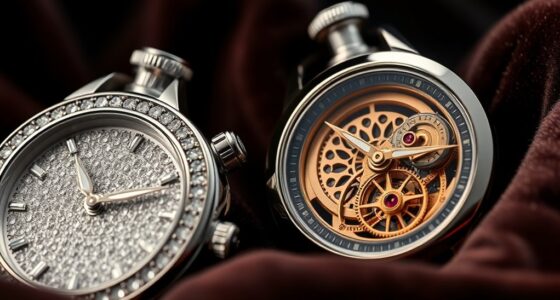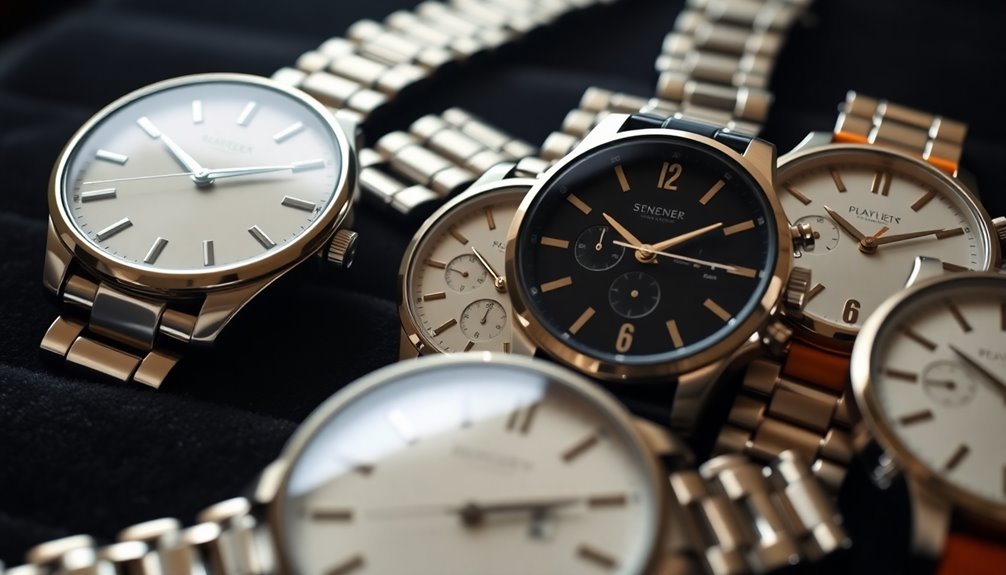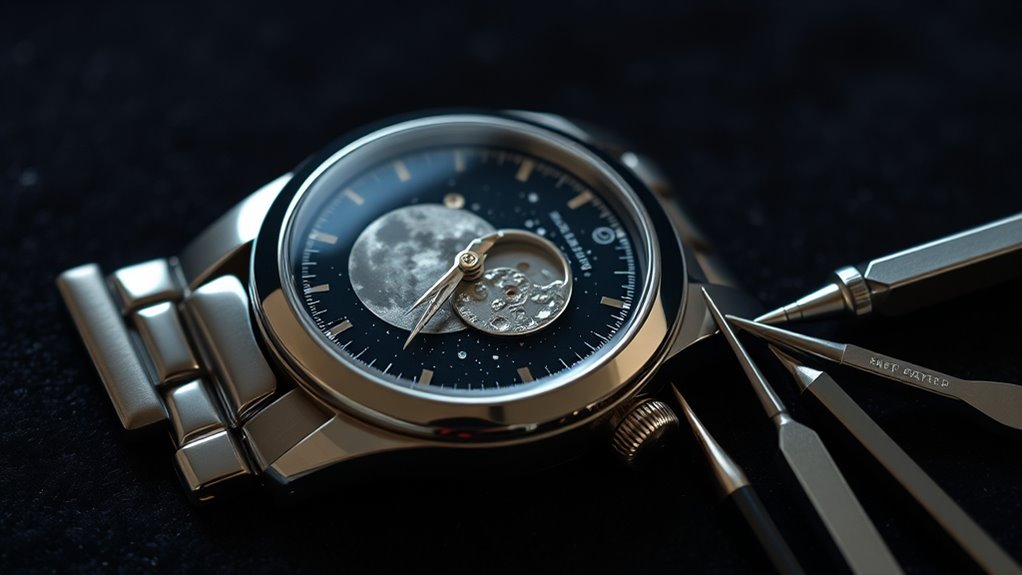

To set your moonphase correctly, first confirm the current lunar phase using a trusted lunar calendar or by observing the night sky. Make sure your watch is fully wound and running accurately. Use the crown or pusher designated for moonphase adjustments to carefully move the display in small increments until it matches the actual moon phase. Patience is key, and proper calibration helps keep your moonphase accurate over time, so keep exploring for more detailed tips.
Key Takeaways
- Confirm the current lunar phase using a lunar calendar or night sky observation before adjustment.
- Fully wind and ensure your watch is running accurately prior to setting the moonphase.
- Use the dedicated pusher or crown to carefully advance the moonphase in small increments.
- Match the watch’s moonphase display precisely with the actual lunar phase for optimal accuracy.
- Regularly verify and recalibrate the moonphase to maintain long-term synchronization.
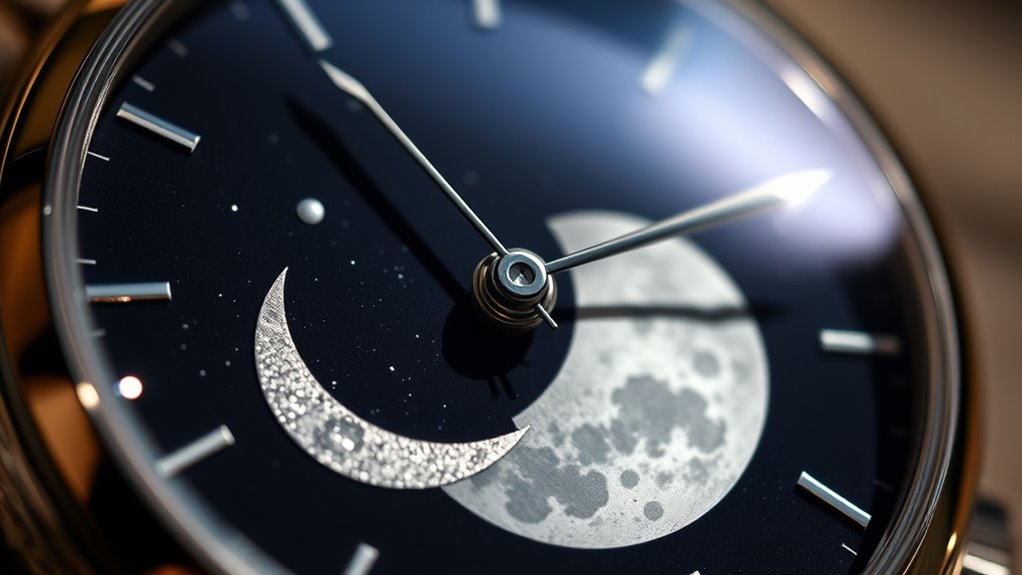
Have you ever wondered how to accurately set a moonphase on your watch or clock? It’s a fascinating feature that adds elegance and functionality, but understanding how to get it right requires a bit of knowledge about the lunar cycle. The lunar cycle spans approximately 29.5 days, marking the time it takes for the moon to complete its phases—from new moon to full moon and back again. When setting your watch’s moonphase, you’re fundamentally aligning the display with this natural cycle. Proper watch maintenance is crucial here; if your watch isn’t well-maintained, the moonphase complication might drift out of sync, leading to inaccuracies. Regular servicing ensures the movement stays precise, making it easier to set and maintain the moonphase correctly.
Setting a moonphase requires understanding the lunar cycle and regular watch maintenance for accuracy.
To start, identify the current moon phase, which you can do by checking a trusted lunar calendar or observing the night sky. Once you know whether it’s a new moon, first quarter, full moon, or last quarter, you can begin setting your watch accordingly. Many watches have a dedicated pusher or crown position to adjust the moonphase. Before you proceed, confirm your watch is fully wound and running accurately, as mechanical watches can lose or gain time, impacting the moonphase setting. If your watch has a quick-set feature for the moonphase, use it carefully—usually, turning the crown or pressing a pusher will advance the display in small increments.
When setting the moonphase, you’ll want to align the display with the current phase you’ve identified. For example, if it’s a full moon, set the moonphase to show the full moon icon. If your watch allows for precise adjustment, you might need to advance it through several cycles to get an accurate match—this is especially helpful if your watch’s moonphase has drifted over time. Remember, patience is key. Don’t rush the process; double-check your lunar calendar and compare to your watch’s display until they match perfectly. Additionally, since the moonphase is linked to the natural lunar cycle, it’s important to keep your watch calibrated to maintain accuracy over time.
Once set, keep an eye on your watch and its moonphase display over the coming weeks. If you notice discrepancies, it could be time for a watch maintenance session, where a professional can recalibrate the movement and ensure the moonphase stays aligned with the lunar cycle. By doing so, you preserve the beauty and accuracy of this complication, ensuring it remains a reliable and charming feature of your timepiece. Properly setting and maintaining the moonphase enhances your appreciation of your watch’s craftsmanship and keeps it functioning beautifully for years to come.

Aeaocvo 5 Pcs Watch Hands Repair Tool Kit, Stainless Steel Watch Hand Setting Tool, Pusher Set, Pointer Adjustment Tool
Watch Hands Installation: This watch tools repair kit includes 3 hand pressure tools and 2 watch hands removers…
As an affiliate, we earn on qualifying purchases.
As an affiliate, we earn on qualifying purchases.
Frequently Asked Questions
Can I Set the Moonphase on Any Watch Model?
You can’t set the moonphase on any watch model, as it depends on the watch’s design and calibration features. While some watches, especially mechanical ones, allow you to calibrate the moonphase, others lack this function. Knowing the moonphase history helps you understand its importance in watchmaking. Always refer to your watch’s manual or consult a professional to verify proper watch calibration, especially for models with complex moonphase complications.
How Often Should I Adjust the Moonphase Display?
Think of moonphase maintenance as a gentle dance with your watch. You typically only need to adjust the moonphase display once a month or when you notice it’s out of sync, usually after a full moon or a long period of non-wear. Regular adjustment frequency isn’t necessary unless your watch experiences shocks or temperature changes. Keep an eye on it, and your moonphase will stay beautifully aligned with the lunar cycle.
Does Setting the Moonphase Affect Watch Accuracy?
Setting the moonphase doesn’t directly affect your watch’s accuracy, but improper moonphase calibration can cause slight timing issues. When you adjust the moonphase, you might accidentally disrupt the movement’s precision if you don’t follow proper procedures. To maintain ideal watch accuracy, verify you calibrate the moonphase correctly, especially after battery changes or impacts. Proper moonphase setting preserves both the aesthetic and functional integrity of your watch without compromising its timekeeping.
What Tools Are Needed to Set a Moonphase Watch?
To embark on moonphase calibration, you’ll need a few simple tools like a fine-tipped screwdriver and a loupe for close inspection. These help you make precise adjustments during watch maintenance, ensuring the moonphase displays accurately. Some watches may also require a specialized crown or pusher. With these tools, you’ll keep your timepiece aligned with celestial cycles, maintaining its elegance and accuracy effortlessly.
Can I Set the Moonphase Manually Without the Date?
Yes, you can perform moonphase calibration manually without adjusting the date. Use the manual adjustment techniques provided in your watch’s manual, usually involving the crown or a dedicated pusher. Carefully turn the crown to set the moonphase disc to match the current moon phase, ensuring precise moonphase calibration. This process helps keep your watch accurate without changing other settings like the date, making it straightforward to maintain correct moonphase display.
Aeaocvo 5 Pcs Watch Hands Repair Tool Kit, Stainless Steel Watch Hand Setting Tool, Pusher Set, Pointer Adjustment Tool
Watch Hands Installation: This watch tools repair kit includes 3 hand pressure tools and 2 watch hands removers…
As an affiliate, we earn on qualifying purchases.
As an affiliate, we earn on qualifying purchases.
Conclusion
Now that you’ve learned how to set your moonphase correctly, you’re like a master navigator guiding your timepiece through the night sky. With a gentle touch, you’ll keep your watch’s lunar story in perfect harmony with the moon’s silent dance overhead. Every glance at your watch will feel like catching a glimpse of the universe’s secret rhythm, turning timekeeping into a poetic ballet of celestial precision. Your watch is now a small universe in itself.

JOREST Watch Link Removal Kit, Resizing Tool for Bracelet Adjustment & Replacement, Pin Remover for Sizing Strap, Watch Adjuster, Hammer for Watch Repair, Adjust Band, with User Manual, Punches
【Liftable platform】The liftable platform is designed for better alignment of the punch pin and the watch link pin…
As an affiliate, we earn on qualifying purchases.
As an affiliate, we earn on qualifying purchases.

MOZSLY Watch Winder for Automatic Watches with Quiet Motor 12 Rotation Mode Setting Black Leather
Fashion design: MOZSLY watch winders selected black PU leather and clear acrylic glass give this deluxe watch winder…
As an affiliate, we earn on qualifying purchases.
As an affiliate, we earn on qualifying purchases.

Born in Dubai to Pakistani parents, Aisha deeply understands Middle Eastern and South Asian luxury markets. She excels in forging strategic partnerships with top-tier luxury brands worldwide, fostering cross-cultural collaborations that enhance our global presence.