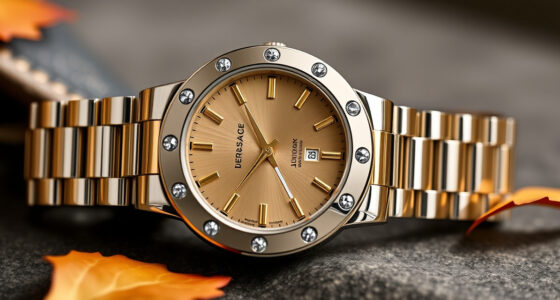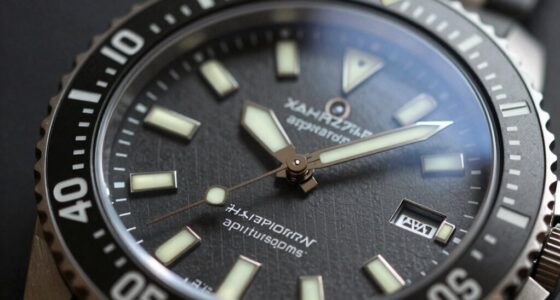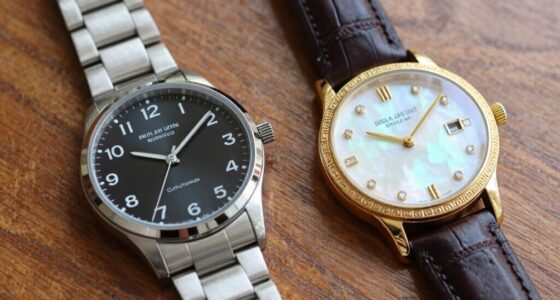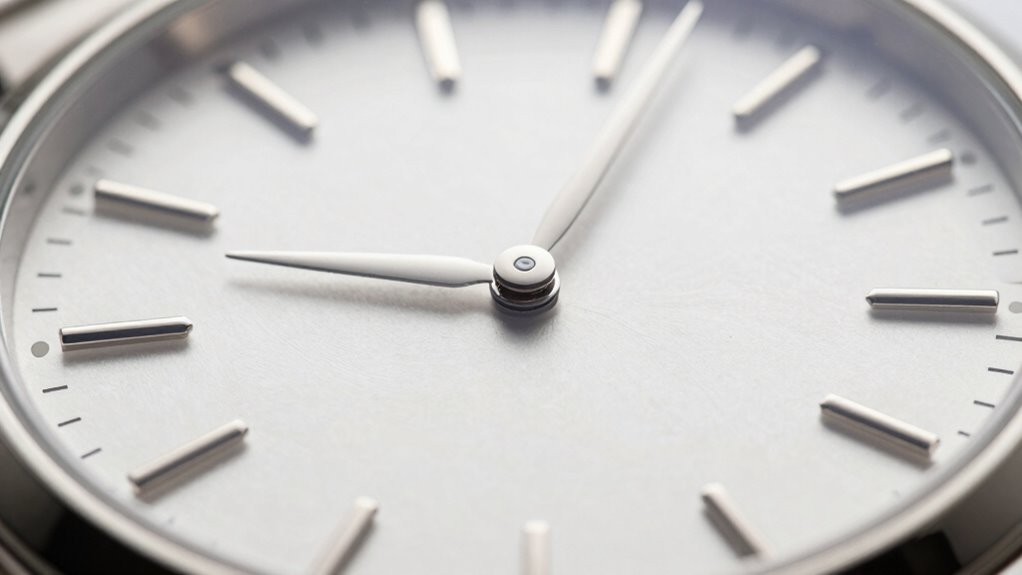

To understand a watch dial beyond the brand name, start by noting the layout of hour markers, numerals, and color choices, which guide your eyes and help you see the time quickly. Check for complications like date windows, moon phases, or sub-dials, and observe their placement to understand added features. Luminous elements reveal if the watch is designed for darkness, while color and style choices show its overall aesthetic. Keep exploring, and you’ll discover how these design cues tell the full story.

Get your wardrobe favorites delivered free with Prime
- Fast, free delivery on millions of items
- Prime Video, Amazon Music and more included
- Member-only deals all year
Key Takeaways
- Identify the hour markers, numerals, and their style to determine the primary time-telling cues.
- Observe the position and design of sub-dials or apertures indicating additional functions like date or chronograph.
- Note luminous elements on hands and markers for readability in darkness.
- Recognize the placement of complications to understand extra features without cluttering the main dial.
- Analyze color contrasts and marker prominence to quickly interpret the watch’s full range of functions.
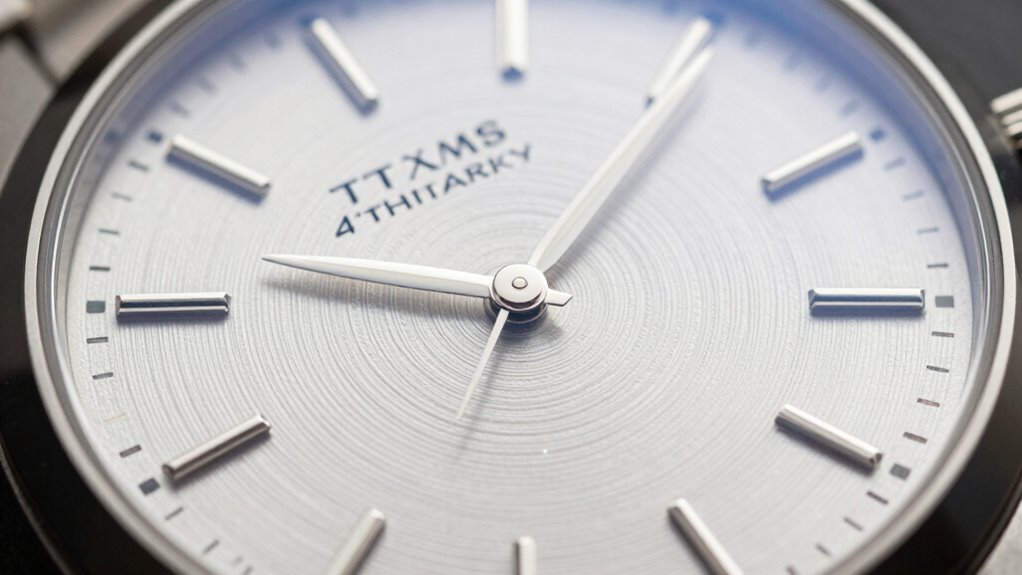
Ever wondered how to quickly tell the time just by glancing at a watch dial? It’s more than just reading the position of the hands; understanding the dial’s design elements and watch complications can give you a lot more information at a glance. A watch isn’t merely a timekeeper—it’s a miniature display with layers of details that reveal its complexity. So, when you look at a watch dial, you’re deciphering a carefully crafted map of functions and aesthetics.
First, pay attention to the dial design elements. The layout, colors, and markers aren’t random. They’re specifically chosen to enhance readability and style. For example, some dials feature bold hour markers, while others use subtle indices. The use of luminous materials allows you to read the time in darkness, often signaled by glowing hands and markers. The placement of numerals, whether Roman, Arabic, or minimalist lines, influences how quickly you can identify the hour. The overall design guides your eye, making it easier to interpret the time swiftly.
Dial design elements like markers, colors, and numerals enhance readability and style, guiding your eye to tell time quickly.
Beyond the basic hour and minute hands, watch complications add layers of functionality. These are extra features or sub-dials that serve different purposes. Common complications include date windows, chronographs, moon phases, or power reserve indicators. Each complication is displayed with its own dial design elements—tiny sub-dials, apertures, or specialized hands. Recognizing these helps you understand what additional information the watch offers and how to interpret it. For instance, a small seconds sub-dial usually sits at the 6 o’clock position, indicating the passing seconds separately from the main hands. A chronograph’s sub-dials measure elapsed minutes and hours, turning the watch into a precise stopwatch. Additionally, understanding the placement of complications can help you quickly identify their functions without confusion. Having knowledge of watch design principles further enhances your ability to read and appreciate the watch’s layout.
Understanding watch complications also involves knowing their placement. They’re often positioned symmetrically or at specific points on the dial for clarity. The design ensures that these features don’t clutter the main time-telling function. Instead, they complement the overall aesthetic while providing useful data. When you look at a watch, paying attention to these elements helps you grasp the full scope of what the watch can do. It’s like reading a visual language that communicates both the time and additional functions.
Popular right now

Vitamix Propel Series 750 Professional-Grade Blender, 4 Programs, Black

LG 85-inch QNED75B Mini LED Smart TV Bundle with HDMI and CPS Protection Plan

Ninja Foodi DZ201 8-Quart DualZone 6-in-1 Air Fryer
As an affiliate, we earn on qualifying purchases.
Frequently Asked Questions
What Materials Are Commonly Used for Watch Dials?
You’ll find watch dials made from materials like brass, stainless steel, and sometimes even ceramic or enamel. These materials affect watch dial textures and thickness, giving each piece a unique feel. Brass dials are common and easy to customize, while ceramic offers durability and a sleek look. The watch dial thickness varies depending on the material and design, influencing how the watch sits on your wrist and its overall aesthetic.
How Do Different Watch Dial Colors Affect Readability?
Different watch dial colors considerably impact readability through color contrast and aesthetic appeal. Bright, contrasting colors like white or light backgrounds with dark hands make it easier to read the time quickly. Darker shades like black or navy can add elegance but might reduce clarity if not paired with high-contrast markers. Ultimately, choosing a dial color balances your style preferences with practical readability, enhancing your overall watch experience.
Are There Specific Watch Dial Designs for Different Professions?
Yes, there are specific watch dial designs tailored to different professions. For example, pilots prefer large, high-contrast dials for quick readability, emphasizing professional aesthetics and functional design symbolism. Medical professionals often choose watches with clear, simple dials to avoid distractions. Similarly, divers opt for water-resistant, luminous dials that highlight safety features. These design choices reflect both the profession’s needs and the symbolic values of practical, specialized craftsmanship.
How Do Luminescent Markings Work on Watch Dials?
Luminescent markings work through luminescent coatings made from phosphorescent materials that absorb light and glow in the dark. These coatings, often applied to hands and indices, store energy when exposed to light and then release it slowly, providing visibility in low-light conditions. You’ll find these markings especially useful during nighttime or in dark environments, ensuring you can read your watch easily without external light sources.
Can Watch Dials Be Customized or Engraved?
Yes, you can customize watch dials through watch dial customization options, including engraved watch dials. Engraving allows you to add personal touches like initials, special dates, or designs, making your watch unique. Many jewelers and watchmakers offer these services, enabling you to create a one-of-a-kind piece. Keep in mind, engraved watch dials may require professional craftsmanship to guarantee durability and aesthetic quality.
Conclusion
Now that you know how to read a watch dial beyond just the brand name, you’re ready to master the art of time-telling with confidence. Whether you’re deciphering a vintage pocket watch or a modern chronograph, understanding these details adds depth to your appreciation. Think of it as decoding a tiny, intricate map—like a secret society’s cipher from a bygone era. With this knowledge, you’ll never look at a watch the same way again.