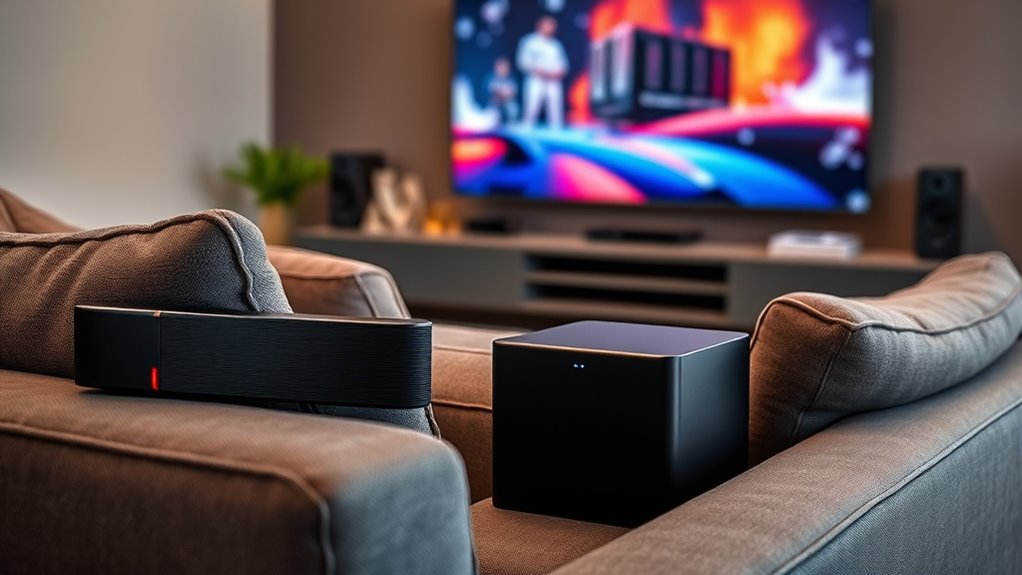

Wireless subwoofer soundbar combos add fuller bass and clearer TV audio without requiring a traditional receiver-and-speaker setup. My best overall pick is the Hisense AX3120Q, which pairs a 3.1.2 layout with up-firing speakers and support for Dolby Atmos and DTS:X; the Polk Signa S4 is a strong alternative for Atmos-focused TV viewing, while the LG S40TR stands out for including rear speakers. The main tradeoff is between a simpler 2.1 setup, a clearer dialogue-focused 3.1 bar, and a larger system that can create more surround immersion but needs more space and setup. TV connections, room shape, and whether you want actual rear speakers matter as much as headline channel counts. Read on for the full breakdown and help matching a system to your room and listening habits.

Get your wardrobe favorites delivered free with Prime
- Fast, free delivery on millions of items
- Prime Video, Amazon Music and more included
- Member-only deals all year
Key Takeaways
- The Hisense AX3120Q leads on format and channel flexibility: its 3.1.2 layout, up-firing speakers, Dolby Atmos, and DTS:X support give it a more ambitious setup than the simpler 2.1 models.
- Atmos support does not mean every system has the same surround effect: the Polk Signa S4 and TCL S55H use compact bar-based approaches, while the LG S40TR adds physical rear speakers for a different kind of immersion.
- Dialogue-focused 3.1 systems fill a useful middle ground: the Samsung HW-B630F and LG S60T add a center channel without requiring a full rear-speaker layout.
- Most of the lineup keeps setup straightforward, but connection options still matter: HDMI eARC or ARC can simplify TV control and audio handoff, while a wireless subwoofer only removes the audio cable—not the power cord.
- There is no single best fit for every room: compact 2.1 picks such as the Sony HT-S400 and Hisense HS2100 suit simpler setups, while systems with surround speakers need space and placement flexibility.


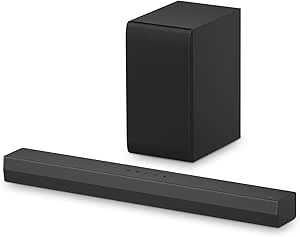


| wireless subwoofer soundbar combo | Channels | Subwoofer |
|---|---|---|
| Samsung B-Series Soundbar HW-B | 3.1 | Wireless |
| LG S60T 3.1 ch. Soundbar with | 3.1 | Wireless |
| TCL S65K 5.1-Channel Soundbar | 5.1 | — |
| LG S40T 2.1-Channel Soundbar w | 2.1 | Wireless |
| Polk Audio Signa S2 Ultra-Slim | — | Wireless |
| Ultimea Poseidon M60 5.1 Chann | 5.1 | — |
| Hisense AX3120Q 3.1.2ch Soundb | 3.1.2 | Wireless, 6.5-inch |
| ULTIMEA Sound Bar with Wireles | 2.1 | Wireless, 18 mm high-excursion driver |
| LG S40TR 4.1-Channel Soundbar | 4.1 | — |
| Polk Audio Signa S4 Dolby Atmo | — | Wireless, 5.9-inch |
| Hisense HS2100 2.1-Channel Sou | 2.1 | — |
| TCL S55H 2.1 Sound Bar with Wi | 2.1 | — |
| Philips B7305 2.1 Channel 300 | 2.1 | Wireless |
| Sony HT-S400 2.1-Channel Sound | 2.1 | Wireless; 160 mm speaker unit |
More Details on Our Top Picks
Samsung B-Series Soundbar HW-B630F 3.1 Channel DTS Virtual:X Soundbar with Subwoofer, One Remote Control, Voice Enhance Mode, Adaptive Sound
The Samsung HW-B630F is a strong fit for mixed TV viewing because its dedicated center channel gives voices their own place in the sound mix, while the wireless subwoofer adds bass without a cable running back to the bar. DTS Virtual:X aims to widen the presentation without separate rear speakers, making this a simpler setup than the more expansive TCL S65K system. Adaptive Sound and Voice Enhance Mode also suit households that move between dialogue-heavy shows and action scenes. The tradeoff is less scope for tailoring: unlike the LG S60T, it has no dedicated app for advanced sound customization. Its mobile connection is unavailable while linked to a TV, too. I’d choose it for clear, flexible everyday listening, not for shoppers seeking extensive app controls or actual rear speakers.
Pros:- Dedicated center channel helps keep dialogue distinct from effects
- Wireless subwoofer adds bass without a cable between it and the soundbar
- DTS Virtual:X creates a broader soundstage without rear speakers
- Bluetooth supports two connected devices for easier source switching
Cons:- No dedicated app for detailed sound customization
- Mobile connection is unavailable while the soundbar is linked to a TV
Best for: TV households that prioritize clear dialogue, a wireless bass module, and a straightforward setup without rear speakers
Not ideal for: Listeners who want app-based equalizer controls or a physical surround-speaker setup
- Channels:3.1
- Maximum output power:370 watts
- Audio technology:DTS Virtual:X
- Subwoofer:Wireless
- Bluetooth:Dual-device connectivity
- Sound modes and features:Adaptive Sound, Voice Enhance Mode
- Soundbar width:33.86 inches
- Mounting:Wall mount
Our verdict“Choose the Samsung HW-B630F for dialogue-focused TV sound and virtual surround in a simpler setup than the TCL S65K.”
LG S60T 3.1 ch. Soundbar with Wireless Subwoofer, Dolby Audio, TV Synergy, Wow Interface, AI Sound Pro – Black
The LG S60T makes the strongest case when paired with a compatible LG TV: WOW Orchestra can combine the TV and soundbar output, and the WOW Interface lets owners control both with one remote. Its 3.1-channel layout includes a center channel for clearer voices, while the wireless subwoofer supplies bass without a wired link to the bar. AI Sound Pro adapts the presentation across content, and the app adds three-band EQ adjustment—a useful level of control that the Samsung HW-B630F lacks. The LG is less compelling outside that TV ecosystem, since its standout integration features depend on select LG models. Compared with the TCL S65K, it also keeps the setup simpler but does not include wireless surround speakers or the listed Dolby Atmos and DTS:X support.
Pros:- Dedicated center channel supports clearer dialogue
- Wireless subwoofer adds bass without a wired connection to the soundbar
- WOW Orchestra can expand the soundstage with select LG TVs
- App offers three-band equalizer adjustments
Cons:- WOW Orchestra and related TV integration depend on compatible LG models
- Does not include wireless rear surround speakers like the TCL S65K
- Listed format support is narrower than the TCL S65K’s Dolby Atmos and DTS:X options
Best for: Owners of compatible LG TVs who want shared sound output, one-remote control, and app-based EQ adjustments
Not ideal for: Shoppers without a compatible LG TV who want included surround speakers or Dolby Atmos and DTS:X playback
- Channels:3.1
- Audio format:Dolby Audio
- Subwoofer:Wireless
- Sound processing:AI Sound Pro
- TV integration:WOW Orchestra on select compatible LG TVs
- App equalizer:Three-band EQ adjustment
- Dimensions:3.5 x 33.5 x 2.5 inches
- Bluetooth range:10 meters
Our verdict“Pick the LG S60T if you own a compatible LG TV and value ecosystem controls more than separate surround speakers.”
TCL S65K 5.1-Channel Soundbar System with Dolby Atmos and Wireless Surround Speakers
The TCL S65K is the most theater-oriented choice in this group: it pairs a wireless subwoofer with wireless surround speakers, adding physical rear-channel effects that the Samsung HW-B630F’s virtual surround processing cannot reproduce in the same way. Dolby Atmos and DTS:X support, plus a center channel and tweeter, give it a broader feature set for films and dialogue-heavy content. AI Sonic room calibration is intended to tune the sound to the listening space, while Bluetooth, USB, Wi-Fi, and HDMI provide several connection routes. That larger system also asks more of the room than the compact LG S40T, and the speakers still need power cords even though their audio connection is wireless. ChoruSound compatibility is limited to compatible TCL TVs, so its ecosystem feature is not universal.
Pros:- Includes wireless subwoofer and wireless surround speakers
- Supports Dolby Atmos and DTS:X
- AI Sonic calibration is designed to adapt sound to the room
- Center channel and tweeter support dialogue clarity
Cons:- Surround speakers need power cords despite their wireless audio connection
- ChoruSound feature works only with compatible TCL TVs
- More components require more placement space than the LG S40T
Best for: Movie fans with room for rear speakers who want physical surround channels and Dolby Atmos or DTS:X support
Not ideal for: Small-room listeners seeking a minimal setup, or buyers who expect every speaker to operate without power cables
- Channels:5.1
- Maximum output power:630 watts
- Audio technologies:Dolby Atmos, DTS:X, DTS Virtual:X
- Subwoofer driver:6.5 inches
- Surround speakers:Wireless
- Connectivity:Bluetooth, USB, Wi-Fi, HDMI
- Room tuning:AI Sonic room calibration
- Power source:Corded electric
Our verdict“Choose the TCL S65K for a fuller physical surround setup, provided you have room and outlets for its rear speakers.”
LG S40T 2.1-Channel Soundbar with Wireless Subwoofer, Black
The LG S40T keeps the system straightforward: two soundbar channels handle the main program, and a wireless subwoofer supplies added low-end impact without a cable between the units. Dolby Audio, Dolby Digital, and DTS Digital support familiar formats, while Clear Voice Plus targets dialogue that gets lost in TV speakers. Its app-based three-band EQ gives it more adjustment than a bare-bones 2.1 system, and the WOW Interface can simplify control with an LG TV. Compared with the 3.1-channel LG S60T, though, the S40T lacks a dedicated center channel, so it is the less convincing choice for dialogue-first viewing. It also cannot match the TCL S65K’s separate rear speakers for surround immersion. This is an uncomplicated upgrade, not a small home-theater system.
Pros:- Wireless subwoofer adds bass without a cable linking it to the soundbar
- Supports Dolby Audio, Dolby Digital, and DTS Digital
- Clear Voice Plus is designed to improve speech intelligibility
- Three-band EQ can be adjusted in the LG Soundbar app
Cons:- Two-channel soundbar lacks the dedicated center channel found in the LG S60T
- WOW Interface remote integration is described for use with an LG TV
- No rear speakers for the physical surround effect offered by the TCL S65K
Best for: LG TV owners who want an easy-to-control 2.1 upgrade with a wireless subwoofer and basic EQ customization
Not ideal for: Dialogue-focused viewers who want a dedicated center channel, or movie fans seeking rear surround speakers
- Channels:2.1
- Subwoofer:Wireless
- Audio compatibility:Dolby Audio, Dolby Digital, DTS Digital
- Voice enhancement:Clear Voice Plus
- Equalizer:Customizable three-band EQ via LG Soundbar app
- TV control integration:WOW Interface with LG TV
- Color:Black
Our verdict“The LG S40T suits LG TV owners seeking a simple bass upgrade, but dialogue-focused buyers should step up to the S60T.”
Polk Audio Signa S2 Ultra-Slim Sound Bar for Smart TV with Subwoofer
The Polk Audio Signa S2 is the space-conscious pick: its two-inch profile is easier to fit below a low-set TV than the taller-looking alternatives, and it can also be wall-mounted. The wireless subwoofer adds bass without requiring a cable back to the soundbar, while VoiceAdjust gives listeners a way to tune dialogue clarity. Dolby Digital decoding, Bluetooth, and HDMI, optical, and AUX inputs make it flexible for older and newer TV setups. Compared with the Samsung HW-B630F, the Signa S2 gives up a dedicated center channel and DTS Virtual:X; it is a better match for tight furniture than for a wider virtual-surround presentation. Its plastic construction feels less premium on paper than the metal-enclosure LG S60T, and the stated Bluetooth range is limited to about 10 meters.
Pros:- Two-inch profile fits under TVs with limited clearance
- Wireless subwoofer adds bass without a cable to the soundbar
- VoiceAdjust is designed to improve dialogue clarity
- HDMI, optical, AUX, and Bluetooth support varied connections
Cons:- No dedicated center channel, unlike the Samsung HW-B630F
- Plastic construction may feel less premium than the LG S60T’s metal enclosure
- Bluetooth range is listed at about 10 meters
Best for: Apartment dwellers and TV owners with low-clearance stands who need a slim bar, flexible wired inputs, and a separate subwoofer
Not ideal for: Listeners prioritizing a dedicated center channel, virtual surround processing, or a more premium enclosure
- Soundbar profile:2 inches
- Subwoofer:Wireless
- Dialogue feature:VoiceAdjust
- Audio decoding:Dolby Digital
- Wireless technology:Bluetooth
- Bluetooth range:10 meters
- Wired inputs:HDMI, optical, AUX
- Mounting:Bar mount or TV soundbar placement
Our verdict“Choose the Polk Signa S2 when clearance and connection flexibility matter more than a dedicated center channel or virtual surround.”
Ultimea Poseidon M60 5.1 Channel Surround Sound Bar System with Dolby Atmos
The Poseidon M60 is the pick here for buyers who want Dolby Atmos and a 5.1-channel layout without adding separate rear speakers. Its five built-in drivers, including side-firing units, aim to spread effects more widely than the 2.1-channel ULTIMEA wireless-subwoofer model, while the 10-band EQ and 121 presets offer unusually detailed sound shaping. The 300 W peak output and wooden subwoofer give it more stated headroom than that simpler ULTIMEA system, and VoiceMX is intended to keep speech clear amid effects.
The tradeoff is the subwoofer’s wired connection, which restricts placement compared with the wireless Hisense AX3120Q and Polk Signa S4. It also relies on side-firing drivers rather than dedicated rear speakers, so buyers seeking sound physically behind them should look at the LG S40TR instead. There’s no built-in Wi-Fi, either.
Pros:- Dolby Atmos and five built-in drivers provide a more spatial presentation than a basic 2.1 setup.
- 10-band EQ, 121 presets, and 13 surround levels allow detailed app-based tuning.
- 300 W peak output and a wooden subwoofer support a high-output home theater setup.
- VoiceMX is designed to improve dialogue clarity.
Cons:- The wired subwoofer offers less placement flexibility than the wireless units in the Hisense AX3120Q and Polk Signa S4.
- Side-firing drivers simulate surround without the separate rear speakers included with the LG S40TR.
- No built-in Wi-Fi connectivity.
Best for: Movie and gaming viewers who want Dolby Atmos, detailed app equalization, and a surround-style setup without placing rear speakers around the room.
Not ideal for: Buyers who need a freely positioned subwoofer, dedicated rear-speaker placement, or Wi-Fi streaming.
- Channels:5.1
- Peak power output:300 W
- Drivers:Five full-range drivers and wired wooden subwoofer
- Frequency response:45 Hz–18 kHz
- Maximum SPL:99 dB
- HDMI:eARC, up to 37 Mbps
- Bluetooth:Version 5.4
- App sound controls:10-band EQ, 121 presets, 13 surround levels
Our verdict“Choose the Poseidon M60 if you value app-based sound control and a virtualized 5.1 Atmos presentation more than wireless subwoofer placement or dedicated rear speakers.”
Hisense AX3120Q 3.1.2ch Soundbar with Wireless Subwoofer, Up-Firing Speakers, Dolby Atmos, DTS:X, Bluetooth 5.3, HDMI eARC, Roku TV Ready, App Control & Remote Control, 7 EQ Modes, Hi-Concerto
The Hisense AX3120Q pairs Dolby Atmos and DTS:X with two up-firing speakers and a wireless 6.5-inch subwoofer, giving buyers height effects without a wired bass unit or separate rear speakers. Compared with the Ultimea Poseidon M60, its wireless subwoofer is easier to place, and its listed bass extension reaches 40 Hz rather than the M60’s 45 Hz. The 3.1.2 layout also puts the emphasis on height-channel effects, while HDMI eARC and 4K HDR pass-through fit neatly into a modern TV setup.
Its seven EQ modes are easier to switch between than the M60’s extensive app tuning, but offer less fine control than that model’s 10-band EQ and 121 presets. The AX3120Q also lacks dedicated rear speakers, unlike the LG S40TR, and its surround presentation depends on the soundbar’s speaker array. Choose it for convenient wireless placement and height effects, not a room-filling system of speakers behind the listener.
Pros:- 3.1.2-channel layout combines up-firing speakers with Dolby Atmos and DTS:X.
- Wireless 6.5-inch subwoofer allows more flexible placement than the Poseidon M60’s wired subwoofer.
- HDMI eARC and 4K HDR pass-through suit a one-cable TV connection.
- Seven EQ modes provide quick settings for different content.
Cons:- No dedicated rear speakers, unlike the LG S40TR.
- Seven presets provide less detailed sound adjustment than the Poseidon M60’s 10-band EQ and 121 presets.
- The soundbar’s 40-inch width may be a poor fit for especially narrow TV stands.
Best for: TV owners who want Atmos height effects, a wireless subwoofer, and straightforward EQ presets without installing separate rear speakers.
Not ideal for: Listeners who want dedicated rear-channel speakers or extensive manual EQ control comparable to the Ultimea Poseidon M60.
- Channels:3.1.2
- Speaker array:Eight speakers, including five front-firing and two up-firing speakers
- Subwoofer:Wireless, 6.5-inch
- Audio formats:Dolby Atmos and DTS:X
- Maximum output power:440 W
- Bass response:Down to 40 Hz
- HDMI:eARC with 4K HDR pass-through
- Bluetooth:Version 5.3
- Soundbar dimensions:40 × 4.25 × 2.24 in (W × H × D)
Our verdict“Pick the AX3120Q for an uncomplicated Atmos setup with a wire-free subwoofer, but choose the LG S40TR if actual rear speakers matter more than height effects.”
ULTIMEA Sound Bar with Wireless Subwoofer, App Control for Home Theater
This ULTIMEA is the straightforward choice for buyers who want wireless bass without a surround-speaker setup. Its 2.1 channels keep installation simpler than the Hisense AX3120Q’s 3.1.2 arrangement or the LG S40TR’s system with rear speakers, while the wireless subwoofer can be placed away from the soundbar. The 10-band EQ and 121 presets are a strong fit for listeners who like to tune dialogue, movies, or music through an app; Bluetooth 6.0 also supports direct wireless streaming.
At 240 W peak, it has less stated output than the 300 W Poseidon M60 and 440 W Hisense AX3120Q. More importantly, 2.1 channels do not provide dedicated height or rear channels, so it is a poor substitute for those systems if cinematic spatial effects are the priority. VoiceMX and BassMX add useful adjustment, but the feature set is aimed at refining a compact stereo-plus-subwoofer setup, not recreating a multichannel theater.
Pros:- Wireless subwoofer allows flexible placement without running a cable from the soundbar.
- 10-band app EQ and 121 presets provide extensive sound customization.
- VoiceMX and BassMX offer separate dialogue and bass-focused adjustments.
- Bluetooth 6.0 supports wireless music and podcast streaming.
Cons:- 2.1-channel configuration lacks dedicated rear and height speakers.
- 240 W peak output is lower than the listed output of the Poseidon M60 and Hisense AX3120Q.
- No supplied information confirms HDMI eARC or Dolby Atmos support.
Best for: Apartment or living-room viewers who want a wireless subwoofer, app-based EQ, and a simple upgrade from TV speakers without rear or height speakers.
Not ideal for: Buyers seeking Dolby Atmos, DTS:X, or a multichannel surround layout like the Hisense AX3120Q or LG S40TR.
- Channels:2.1
- Peak power output:240 W
- Frequency response:45 Hz–18 kHz
- Maximum SPL:95 dB
- Subwoofer:Wireless, 18 mm high-excursion driver
- BassMX range:45–150 Hz
- Bluetooth:Version 6.0
- App EQ:10 bands and 121 presets
Our verdict“Choose this ULTIMEA if flexible subwoofer placement and app tuning matter more than multichannel surround formats.”
LG S40TR 4.1-Channel Soundbar with Wireless Subwoofer and Rear Speakers
The LG S40TR stands apart by including rear surround speakers as well as a wireless subwoofer. That physical rear placement gives it a different kind of immersion from the Hisense AX3120Q and Polk Signa S4, which use up-firing speakers for Atmos height effects rather than separate rear speakers. Its 4.1-channel configuration, Dolby Digital and DTS Digital support, and Smart Up-Mixer make it a practical choice for viewers who want sound effects behind them without moving to a larger speaker package.
The tradeoff is setup: the rear speakers need AC power and a wired connection to each other, so the subwoofer is wireless but the system is not cable-free. It also does not list Dolby Atmos, unlike the AX3120Q or Signa S4, and its 28.4-inch soundbar is more compact than the Hisense’s 40-inch bar. Clear Voice Plus and LG TV remote compatibility help with everyday use, but buyers seeking height effects should choose an Atmos option.
Pros:- Includes rear surround speakers and a wireless subwoofer.
- Physical rear speakers can create more direct behind-the-listener effects than a front-bar-only design.
- Clear Voice Plus is designed to improve dialogue clarity.
- Compatible LG TVs can be controlled with an LG TV remote.
Cons:- Rear speakers require AC power and a wired connection to each other.
- Dolby Atmos is not listed among the supported formats.
- Optical and USB are listed as additional connections, but HDMI eARC is not specified in the supplied product data.
Best for: Viewers who can place and power rear speakers and want physical surround effects rather than relying on virtual or up-firing sound.
Not ideal for: People who need a cable-light installation or prioritize Dolby Atmos height effects, as offered by the Hisense AX3120Q and Polk Signa S4.
- Channels:4.1
- Included components:Soundbar, wireless subwoofer, and rear surround speakers
- Audio formats:Dolby Digital and DTS Digital
- Sound features:WOW Orchestra, Clear Voice Plus, Smart Up-Mixer
- Soundbar dimensions:28.4 × 2.5 × 3.4 in (W × H × D)
- Subwoofer dimensions:6.7 × 12.6 × 9.9 in (W × H × D)
- Additional connections:Optical input and USB
- Mounting:Tabletop
Our verdict“Choose the S40TR if you can accommodate powered, connected rear speakers and value physical surround over Atmos height effects.”
Polk Audio Signa S4 Dolby Atmos 3.1.2 Soundbar with Wireless Subwoofer
The Polk Signa S4 makes sense for buyers who want Atmos height effects in a slim soundbar package with a wireless subwoofer. Its 3.1.2 configuration and up-firing speakers offer a more height-focused presentation than the LG S40TR’s 4.1 system, which instead supplies separate rear speakers. VoiceAdjust and BassAdjust also let listeners tune speech and low-end levels directly, without the deeper app-based preset library found on the Ultimea Poseidon M60.
The wireless 5.9-inch subwoofer offers more placement freedom than the M60’s wired unit, though the Signa S4 does not include dedicated rear speakers like the LG. Its 41.2-inch width may also be harder to fit beneath a compact TV than the smaller S40TR bar. The product data lists Dolby Atmos and Bluetooth, but not DTS:X, and describes stereo audio output mode; buyers who need more explicit format or channel flexibility may prefer the Hisense AX3120Q.
Pros:- 3.1.2 configuration and up-firing speakers support Dolby Atmos height effects.
- Wireless subwoofer allows more flexible placement than the Poseidon M60’s wired subwoofer.
- VoiceAdjust and BassAdjust provide direct dialogue and bass tuning.
- Slim design supports wall or shelf placement.
Cons:- No dedicated rear speakers, unlike the LG S40TR.
- At 41.2 inches wide, it may not suit compact TV stands.
- DTS:X support is not listed, unlike the Hisense AX3120Q.
Best for: TV owners who want a slim, wall-mountable Atmos soundbar with a wireless subwoofer and simple dialogue and bass controls.
Not ideal for: Buyers who need separate rear speakers, DTS:X support, or a narrower soundbar for a small TV stand.
- Audio configuration:3.1.2
- Audio format:Dolby Atmos
- Subwoofer:Wireless, 5.9-inch
- Height speakers:Up-firing
- Connectivity:HDMI eARC and Bluetooth
- Dimensions:41.2 × 2.4 × 3.7 in (W × H × D)
- Weight:19 lb
- Mounting:Wall mount
Our verdict“Choose the Signa S4 for a slim Atmos setup with adjustable dialogue and wireless bass, but choose the LG S40TR if physical rear speakers are your priority.”
Hisense HS2100 2.1-Channel Soundbar with Wireless Subwoofer
The Hisense HS2100 makes sense for buyers who want a straightforward jump from TV speakers to a wireless-subwoofer setup, without adding a complicated speaker system. Its 240W output, HDMI ARC, and Bluetooth 5.3 cover everyday TV viewing and music streaming, while six EQ presets let you adjust the sound for different content. Compared with the TCL S55H, it offers fewer advanced immersion and room-calibration features, but its simpler feature set may suit someone who wants familiar controls and an uncomplicated connection. The tradeoff is a conventional 2.1-channel layout: DTS Virtual:X can add a sense of space, but it does not provide separate surround speakers. Its 5.25-inch subwoofer is also a modest match for buyers seeking powerful bass in a large room.
Pros:- Wireless subwoofer adds bass without a cable running from the bar
- HDMI ARC simplifies connection and TV-remote volume control
- Six preset EQ modes offer quick sound adjustments for different content
- Bluetooth 5.3 supports wireless music streaming
Cons:- 2.1-channel design does not provide separate rear surround speakers
- The 5.25-inch subwoofer may not satisfy buyers looking for forceful bass in a large room
- Lacks the TCL S55H’s AI room calibration and Dolby Atmos support
Best for: TV owners who want a simple HDMI ARC setup, wireless bass, and preset sound modes for everyday viewing
Not ideal for: Buyers seeking room-calibrated sound, advanced immersive formats, or surround speakers for a large home theater
- Channels:2.1
- Maximum output power:240W
- Audio formats:Dolby Audio, Dolby Digital Plus
- Surround technology:DTS Virtual:X
- Connectivity:HDMI ARC, Bluetooth 5.3
- EQ modes:6
- Subwoofer diameter:5.25 inches
- Soundbar dimensions:3.5 × 31.5 × 2.4 inches
Our verdict“Choose the HS2100 for a straightforward TV-and-music upgrade with wireless bass, not for advanced surround effects or room-filling theater sound.”
TCL S55H 2.1 Sound Bar with Wireless Subwoofer – Dolby Atmos, DTS:X, AI Sonic Auto Room Calibration, 220W, Bluetooth, App & Remote Control
The TCL S55H stands apart from basic 2.1 combos by pairing a wireless subwoofer with Dolby Atmos, DTS:X, and AI Sonic room calibration. That calibration is its most distinctive feature: it is designed to tailor playback to the room, which can help when furniture or placement makes a standard setup less predictable. Against the Hisense HS2100, the TCL offers more ambitious audio processing and broader listed connections, including HDMI eARC/ARC, optical, AUX, and Bluetooth. The compromise is that it remains a 2.1-channel system, not a package with discrete rear speakers, so virtual surround should not be mistaken for sound coming from behind you. Its stated small-to-medium-room focus also makes it a less convincing fit for large spaces or buyers who want a high-output system.
Pros:- AI Sonic calibration is designed to adapt playback to room layout
- Supports Dolby Atmos and DTS:X processing
- HDMI eARC/ARC, optical, Bluetooth, and AUX provide flexible connections
- Wireless subwoofer adds bass without a wired connection to the bar
Cons:- 2.1-channel configuration does not include separate rear speakers
- Designed for small-to-medium rooms and may feel underpowered in a large space
- Bluetooth range is listed at about 10 meters
Best for: TV owners in small or medium rooms who want immersive-format processing, automatic room calibration, and several connection choices
Not ideal for: Buyers outfitting a large room or seeking discrete rear speakers and stronger evidence of true multichannel surround
- Channels:2.1
- Maximum output power:220W
- Audio modes:Dolby Atmos, DTS Virtual:X, Surround Sound
- Room calibration:AI Sonic
- Connectivity:HDMI eARC/ARC, optical, Bluetooth 5.2, AUX
- Woofer diameter:5.5 inches
- Bluetooth range:10 meters
- Soundbar dimensions:3.86 × 31.89 × 2.36 inches
Our verdict“Pick the S55H if room calibration and immersive-format processing matter more than discrete surround speakers or large-room output.”
Philips B7305 2.1 Channel 300 Watts Dolby Audio Performance Soundbar Speaker with Wireless Subwoofer, HDMI ARC (TAB7305)
The Philips B7305 is the output-focused choice in this group, with a stated 300W maximum, a wireless subwoofer, and a driver arrangement that includes two midrange drivers and two tweeters. That combination targets fuller movie sound and clearer dialogue than a TV’s built-in speakers, while HDMI ARC lets compatible TVs share volume control through their remote. Compared with the Hisense HS2100, Philips lists more maximum power and a larger 6.5-inch subwoofer, but it does not offer the TCL S55H’s Dolby Atmos and DTS:X features or automatic room calibration. Its Dolby Audio support and 2.1 layout keep the setup relatively simple; they also mean this is not a discrete surround system. The supplied information gives less detail on wireless connections and sound modes than some alternatives, so buyers wanting extensive setup options may prefer another pick.
Pros:- 300W stated maximum output is the highest listed among these four picks
- Wireless subwoofer with a 6.5-inch driver adds low-frequency support
- Two midrange drivers and two tweeters are intended to balance dialogue and effects
- HDMI ARC supports control through a compatible TV remote
Cons:- 2.1-channel layout does not include separate rear surround speakers
- Does not list Dolby Atmos, DTS:X, or room-calibration features found on the TCL S55H
- Available product details provide less information about connectivity and sound modes than the Hisense HS2100
Best for: Movie and TV viewers who prioritize higher listed output, a larger subwoofer driver, and HDMI ARC control
Not ideal for: Buyers who want Dolby Atmos or DTS:X, automatic room calibration, or a detailed selection of sound modes
- Channels:2.1
- Maximum output power:300W
- Audio format:Dolby Audio, Dolby Digital Plus
- Connectivity:HDMI ARC, Bluetooth
- Subwoofer:Wireless
- Subwoofer diameter:6.5 inches
- Mounting:Wall mountable
- USB ports:1 USB 2.0 port
Our verdict“Choose the Philips B7305 if its higher stated output and larger subwoofer matter more to you than immersive-format processing and room calibration.”
Sony HT-S400 2.1-Channel Soundbar with Wireless Subwoofer
The Sony HT-S400 is a sensible fit for buyers who want a familiar, restrained 2.1 system with a wireless subwoofer and straightforward TV connections. S-Force PRO Front Surround and Dolby Digital provide virtual surround processing, while HDMI ARC and optical cover common TV setups. Its OLED display adds a useful on-bar readout, and wall mounting gives more placement flexibility than a system intended only for a shelf. Compared with the TCL S55H, the Sony has fewer listed immersive formats and no room-calibration feature; its appeal is a simpler feature set, particularly for compatible BRAVIA owners. Sony specifies wireless TV connection for compatible BRAVIA TVs, so buyers should not assume that feature works with every television. At 16.1 pounds, it is also heavier than the Hisense HS2100, and its listed dimensions call for checking available space before purchase.
Pros:- Wireless subwoofer provides bass without a cable linking it to the soundbar
- S-Force PRO Front Surround and Dolby Digital support virtual surround playback
- HDMI ARC and optical provide common TV connection options
- OLED display and wall-mountable design add setup and placement flexibility
Cons:- Wireless TV connection is specified for compatible BRAVIA TVs
- Does not list Dolby Atmos, DTS:X, or room calibration offered by the TCL S55H
- At 16.1 pounds, it is heavier than the Hisense HS2100
Best for: Sony BRAVIA owners who want a wall-mountable 2.1 soundbar with a wireless subwoofer, HDMI ARC, or optical TV connection
Not ideal for: Buyers with non-BRAVIA TVs who expect Sony’s wireless TV connection, or shoppers seeking Atmos, room calibration, or rear speakers
- Channels:2.1
- Surround technology:S-Force PRO Front Surround
- Audio format:Dolby Digital
- Subwoofer:Wireless; 160 mm speaker unit
- Connectivity:Bluetooth, HDMI ARC, optical
- Display:OLED
- Mounting:Wall mountable
- Bluetooth range:10 meters
Our verdict“Choose the HT-S400 for a simple, wall-mountable Sony-centered setup, but check BRAVIA compatibility if wireless TV connection is a priority.”

How We Picked
I compared these 14 soundbar-and-wireless-subwoofer systems by the outcomes buyers are most likely to notice: dialogue clarity, bass support, surround presentation, connection options, and how demanding each setup is to place and operate. I also looked at channel layout and audio-format support as practical clues, not guarantees of identical performance; room acoustics, content, and speaker placement affect what a listener hears. A wireless subwoofer makes placement more flexible, but it still needs a nearby power outlet.
The ranking favors balanced performance and useful flexibility over a long feature list alone. Systems with a center channel, credible height or surround features, and practical TV connections rise when those additions serve a clear purpose. Straightforward 2.1 options remain worthwhile for smaller rooms and uncomplicated setups, but they rank lower when they offer fewer ways to separate dialogue or create an enveloping sound field. I also weigh tradeoffs: a system with rear speakers can improve surround presence, yet requires more room and setup than a single-bar package.
| wireless subwoofer soundbar combo | Subwoofer |
|---|---|
| Samsung B-Series Soundbar HW-B | Wireless |
| LG S60T 3.1 ch. Soundbar with | Wireless |
| TCL S65K 5.1-Channel Soundbar | — |
| LG S40T 2.1-Channel Soundbar w | Wireless |
| Polk Audio Signa S2 Ultra-Slim | Wireless |
| Ultimea Poseidon M60 5.1 Chann | — |
| Hisense AX3120Q 3.1.2ch Soundb | Wireless, 6.5-inch |
| ULTIMEA Sound Bar with Wireles | Wireless, 18 mm high-excursion driver |
| LG S40TR 4.1-Channel Soundbar | — |
| Polk Audio Signa S4 Dolby Atmo | Wireless, 5.9-inch |
| Hisense HS2100 2.1-Channel Sou | — |
| TCL S55H 2.1 Sound Bar with Wi | — |
| Philips B7305 2.1 Channel 300 | Wireless |
| Sony HT-S400 2.1-Channel Sound | Wireless; 160 mm speaker unit |
Factors to Consider When Choosing Wireless Subwoofer Soundbar Combos
Before choosing a wireless subwoofer soundbar combo, match the system to your room, TV connections, and listening priorities. Specs can narrow the field, but the right layout depends on how you watch and how much equipment you want around the room.
Choose the channel layout for the sound you want
A 2.1 system combines a soundbar and subwoofer, making it a sensible starting point when you mainly want more body and volume than TV speakers provide. A 3.1 setup adds a center channel that can give dialogue its own place in the mix, which is useful for films and busy soundtracks. A 3.1.2 system adds height channels intended to create a more overhead impression, while a system with rear speakers can place effects behind the listening position. These layouts are not interchangeable, and a higher channel count does not automatically mean a better match for your room. Decide whether your priority is clearer speech, bass, or surround placement before paying for extra channels.
Check your TV’s audio connections before choosing
Look at the ports on the TV, not just the soundbar listing, before deciding which features you can use. HDMI eARC or ARC generally makes connecting and controlling a compatible soundbar simpler, while optical audio can suit older TVs but may limit supported audio formats and control features. A soundbar’s Dolby Atmos or DTS:X support only helps when the connection, TV, and source content can pass the relevant audio signal. Also check whether the TV remote can control volume through the connection you plan to use. A quick port check can prevent paying for a feature your current setup cannot send to the bar.
Treat wireless subwoofer placement as flexible, not cord-free
Wireless describes the audio link between the bar and subwoofer; the subwoofer still needs power. That gives you more freedom to find a convenient spot, but the unit still has to sit near an outlet and within a reliable connection range. A corner can make bass feel stronger, though it may also sound boomy depending on the room. If possible, leave some flexibility to reposition the subwoofer after setup rather than assuming its first location will sound best. Buyers who need a completely cable-free room should remember that the power connection remains part of the setup.
Do not confuse virtual surround with rear speakers
Sound processing can make a front-facing bar seem wider or more spacious, but it does not place a speaker physically behind you. Systems that include rear speakers can create a more direct sense of sounds coming from the back, at the cost of extra placement and power arrangements. Virtual effects are often a better fit when the sofa is close to a wall, the room is narrow, or you want fewer components. Real rear speakers make more sense when you have space to position them around the seating area. Choose based on your room and tolerance for setup, not on the word “surround” alone.
Match the soundbar’s size and controls to daily use
A bar that is too tall can block the TV’s lower edge or remote sensor, so measure the space below the screen before buying. A compact 2.1 model may suit a bedroom or small living room, while a larger setup can be a better visual and audio match for a wide screen. Consider whether you want app control, a physical remote, TV-remote integration, or simple controls you can use without opening an app. Extra EQ modes are useful only if they make common tasks—such as hearing speech at low volume—easier. Favor a system you can operate comfortably every day over features you are unlikely to adjust.
Pay for features your room and content can use
Spending more makes sense when it adds a capability you will use, such as physical rear speakers, height channels, or a center channel for dialogue. It makes less sense to choose a feature-rich model solely for a format name if most of your viewing is regular TV in a small room. Check which streaming services, discs, and devices you use actually provide the surround formats you want. A simple system can be the better buy when ease of use and clearer everyday TV sound matter more than cinematic effects. Prioritize the upgrade that fixes your current limitation rather than adding specifications for their own sake.
Frequently Asked Questions
Will a wireless subwoofer connect to any soundbar?
No. The subwoofer is generally designed to pair with the soundbar it comes with, or with compatible models from the same system family. Wireless connection does not mean it can act as a universal speaker for another brand’s bar. If you already own a soundbar and want to add a subwoofer, check the manufacturer’s compatibility list before buying one separately. For a new setup, choosing the matched bundle avoids uncertainty about pairing and controls.
Do I need HDMI eARC to get Dolby Atmos from a soundbar?
Not in every setup, but the connection can affect which audio formats pass from the TV to the soundbar. HDMI eARC offers broader support for high-bandwidth audio than a basic optical connection, while standard ARC may handle some Atmos sources depending on the TV, format, and app. The TV, soundbar, and playback source all need to support the same signal path. Check the manuals for your specific devices rather than assuming that an Atmos label guarantees Atmos playback. If your TV lacks eARC, confirm which Atmos formats it can send before choosing a system around that feature.
Should I choose a 3.1 soundbar or a 2.1 system for dialogue?
A 3.1 system includes a dedicated center channel, which can help keep voices distinct from effects and music. A 2.1 model can still make TV sound fuller, but it does not have that separate center channel. The difference may matter most for films, dialogue-heavy programs, or viewers who often lower the volume to follow speech. Room acoustics and sound modes still affect results, so channel count is not a promise that every voice will sound clear. If speech intelligibility is your main concern, a 3.1 option is a sensible place to start.
Are rear speakers worth the extra setup?
Rear speakers are worth considering if you want effects to come from behind the seating area and have places to position them. They can make surround sound feel more physical than processing from a soundbar in front of the TV. The tradeoff is extra equipment to place, power, and live with; wireless rear-speaker connections may still need nearby outlets. If your seating is against a wall or the room is cramped, a simpler bar-based system may be easier to use. Choose rear speakers for a real surround goal, not just because the channel count looks larger.
Will a soundbar with a wireless subwoofer work well in a small apartment?
It can, especially if the main goal is clearer TV sound without installing a full speaker system. A wireless subwoofer still occupies floor space and needs power, and strong bass can carry through shared walls. Look for control over bass level or a night mode if you often watch at low volume, and keep the subwoofer away from shared walls when practical. A compact 2.1 system may be easier to place than a package with rear speakers. The best fit depends on whether your neighbors, room layout, or desire for surround sound sets the main limit.
Conclusion
For the best overall balance, I recommend the Hisense AX3120Q for buyers who want height channels, modern surround formats, and a wireless subwoofer in one package. For value and straightforward TV upgrades, compare the simpler 2.1 choices, including the Sony HT-S400 and Hisense HS2100; pick based on the connections and controls your setup needs. For a premium-style feature set, the Polk Signa S4 is a strong option for buyers focused on Atmos, while the LG S40TR suits listeners who specifically want rear speakers. For beginners, the LG S40T or Samsung HW-B630F offers a less complicated route to fuller sound, with the Samsung adding a center channel. For a specific need—rear-channel effects, choose the LG S40TR; for a compact room, start with a 2.1 model; for dialogue, favor a 3.1 layout. Match the system to your TV ports and room before making the final choice.
Halloween Picks

10.5 ft Lighted Pumpkin and Ghost Halloween Inflatable Archway

Halloween Inflatable Haunted House Maze – 20×20 ft with Removable Roof and Blower

Spirit Halloween 54-Inch Sitting Scarecrow Animatronic
As an affiliate, we earn on qualifying purchases.