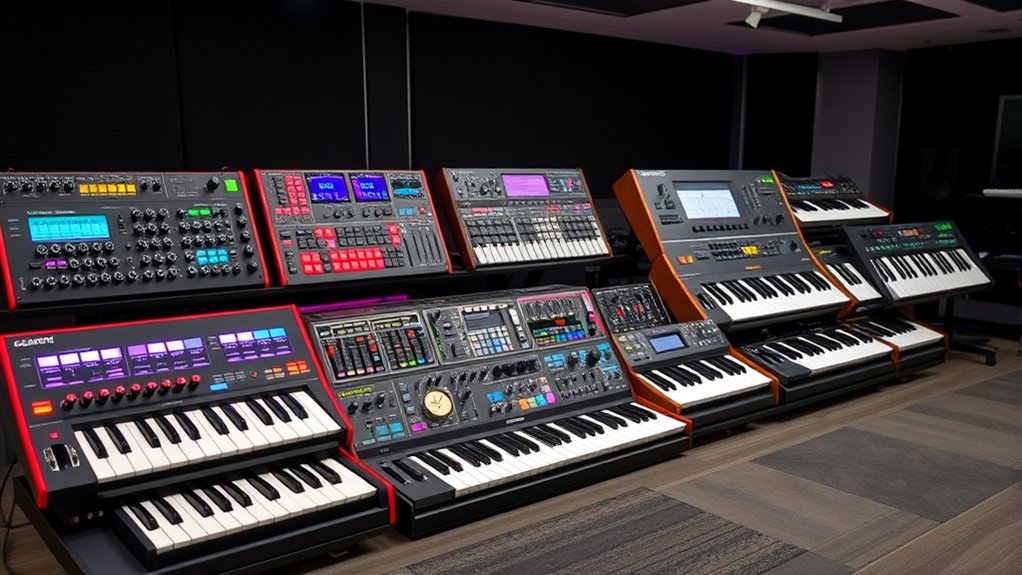

When searching for synthesizers, the key is balancing sound quality, versatility, and ease of use. The Yamaha MODX M8 stands out as the best overall for its powerful sound engine and extensive features, while the Arturia MicroFreak offers incredible value with its hybrid design and flexible oscillators. For those seeking portability and analog character, options like the Korg Volca Bass and the Stylophone GENX-2 provide compact yet capable solutions. The main tradeoffs involve choosing between complexity and simplicity, portability and expandability, or digital versus analog sound. Continue reading to get detailed insights into each option and find the best fit for your needs.
Open a free Amazon Business account
Business pricing, bulk buying and tax-exempt orders.
Create a free accountAs an affiliate, we earn on qualifying purchases.
Key Takeaways
- The top synthesizers balance sound versatility with user-friendly interfaces, appealing to both beginners and professionals.
- Portability varies widely; some models like the Stylophone GENX-2 excel for on-the-go use, while others are better suited for studio setups.
- Analog sound character remains a key preference, but digital synths often provide more features and easier integration.
- Budget and feature tradeoffs are inevitable; high-end models offer advanced controls but come with a higher price tag.
- Understanding whether you need a hybrid, analog, or digital synth helps narrow down the best options for your style.
| Yamaha 88-Key Music Synthesizer MODX M8 |  | Best Overall Synthesizer for Versatile Performance and Realistic Piano Feel | Number of Keys: 88 | Action: Graded Hammer | Sound Engines: 3 (analog synths, FM synths, realistic instruments) | VIEW ON AMAZON | See Our Full Breakdown |
| Arturia MicroFreak Synthesizer Keyboard – 25-Key Hybrid Synth with PCB Keyboard, Wavetable & Digital Oscillators, Analog Filters |  | Best for Experimental Sound Design and Creative Modulation | Number of Keys: 25 | Keyboard Type: Capacitive touch PCB | Oscillator Modes: 17 | VIEW ON AMAZON | See Our Full Breakdown |
| Stylophone The Original Pocket Electronic Synthesizer |  | Best Compact Retro Synth for On-the-Go Fun | Octaves: 3 | Power: 3 x AA batteries | Connectivity: 3.5mm stereo input | VIEW ON AMAZON | See Our Full Breakdown |
| MOOG Messenger Monophonic Analog Synthesizer with 32 Keys, Sequencer, and Presets |  | Best for Classic Moog Sound with Modern Sequencing and Presets | Number of Keys: 32 | Sequencer Steps: 64 | Presets: 256 | VIEW ON AMAZON | See Our Full Breakdown |
| How Synthesizers Work: A Simple Guide |  | Best Educational Resource for Beginners | VIEW ON AMAZON | See Our Full Breakdown | |||
| Korg Volca Bass Analog Synthesizer |  | Best for Bassists and Live Performers Seeking Compact Analog Power | Oscillators: 3 | Sequencer: 16-step | Power: Battery-powered | VIEW ON AMAZON | See Our Full Breakdown |
| Stylophone Theremin – Portable Touch-Sensitive Synthesizer with Retro Analog Sound, Built-In Speaker, Delay & Vibrato Effects |  | Best for Experimentalists and Vintage Sound Enthusiasts on the Go | Type: Theremin synthesizer | Power: Battery-powered | Built-in speaker: Yes | VIEW ON AMAZON | See Our Full Breakdown |
| Stylophone GENX-2 Portable Analogue Synthesizer with Built-in Speaker, LFO, Filter, Delay, and CV/Gate Output |  | Best for Sound Designers and Modular Enthusiasts Who Need Versatile, Portable Synthesis | Power: Battery operated | Built-in speaker: Yes | Outputs: Headphone, audio, CV, Gate | VIEW ON AMAZON | See Our Full Breakdown |
| synthesizer | Connectivity | Power |
|---|---|---|
| Yamaha 88-Key Music Synthesize | Stage and studio integration via Softsynth Plugin | — |
| Arturia MicroFreak Synthesizer | CV outputs, USB, MIDI | — |
| Stylophone The Original Pocket | 3.5mm stereo input | 3 x AA batteries |
| MOOG Messenger Monophonic Anal | 6 CV patch points, MIDI, USB-C | — |
| How Synthesizers Work: A Simpl | — | — |
| Korg Volca Bass Analog Synthes | SYNC jack, MIDI IN | Battery-powered |
| Stylophone Theremin | — | Battery-powered |
| Stylophone GENX-2 Portable Ana | — | Battery operated |
More Details on Our Top Picks
Yamaha 88-Key Music Synthesizer MODX M8
The Yamaha MODX M8 stands out for its authentic graded-hammer key action, making it an excellent choice for pianists looking for a realistic feel. Its versatile sound engines, including analog synths, FM synthesis, and realistic instrument samples, allow for a broad musical palette. Compared with the Arturia MicroFreak, which excels in experimental sound design but lacks weighted keys, the MODX offers a more traditional playing experience. Its intuitive controls, including physical faders and a color touch screen, streamline workflow, but the lightweight build may impact durability over time. The absence of built-in speakers means you’ll need external amplification for performances. Overall, this model is ideal for performers seeking a hybrid keyboard that balances piano realism with synth versatility, with a slight tradeoff in portability and complexity.
Pros:- Authentic graded-hammer key action for expressive piano playing
- Multiple sound engines for expansive tone options
- Intuitive physical controls and a color touch screen
Cons:- Lightweight design could impact long-term durability
- Complex feature set may require time to master
- Lacks built-in speakers, requiring external gear
Best for: Pianists and keyboard players who need a versatile synth with authentic weighted keys for performance and studio work
Not ideal for: Travelers or casual hobbyists who prefer portable, lightweight options or don’t require realistic piano feel
- Number of Keys:88
- Action:Graded Hammer
- Sound Engines:3 (analog synths, FM synths, realistic instruments)
- Performance Controls:8 faders, Super Knob
- Display:Color touch screen, 6 display knobs
- Connectivity:Stage and studio integration via Softsynth Plugin
Our verdict“This synthesizer suits serious performers and studio musicians who value realistic keys and versatile sound engines, accepting some complexity and portability tradeoffs.”
Arturia MicroFreak Synthesizer Keyboard – 25-Key Hybrid Synth with PCB Keyboard, Wavetable & Digital Oscillators, Analog Filters
The Arturia MicroFreak offers a compact, highly flexible hybrid synthesis platform with 25 touch-sensitive keys that include polyphonic aftertouch. Its 17 oscillator modes, from wavetable to digital engines, provide an array of sound design options unmatched in this small form factor. Compared with the Yamaha MODX M8, which emphasizes performance realism, the MicroFreak caters to experimentalists and sound explorers, though its limited keys restrict live performance versatility. Its innovative touch keyboard and extensive modulation matrix make it ideal for creating evolving textures, but the absence of traditional moving keys might challenge players used to standard keyboards. Connectivity options like CV outputs and MIDI expand its integration into modular setups or DAWs. This pick is perfect for artists seeking deep sonic experimentation within a portable, feature-rich device, with the tradeoff of a steeper learning curve.
Pros:- Versatile hybrid synthesis with multiple oscillator modes
- Innovative capacitive touch keyboard with polyphonic aftertouch
- Rich modulation options and extensive connectivity
Cons:- Lacks traditional moving keys, which may feel less familiar
- Complex interface can be intimidating for beginners
- Limited keys for live performance or melodic playing
Best for: Sound designers, experimental musicians, and producers wanting a compact, highly modifiable synth
Not ideal for: Performers needing a full-sized keyboard or straightforward interface for traditional playing
- Number of Keys:25
- Keyboard Type:Capacitive touch PCB
- Oscillator Modes:17
- Polyphony:Paraphonic
- Filters:Analog resonant filter
- Connectivity:CV outputs, USB, MIDI
Our verdict“This synthesizer is perfect for experimental artists and sound designers who prioritize deep modulation and innovative interfaces over traditional playability.”
Stylophone The Original Pocket Electronic Synthesizer
The Stylophone remains a beloved pocket-sized synthesizer, famous for its distinctive vintage sound and simple playability. Its compact size, less than 12cm wide, makes it ideal for quick sketches or playful experimentation, especially for those fond of its retro aesthetic. Compared to the modern Arturia MicroFreak, which offers a broad range of oscillator modes and modulation capabilities, the Stylophone is straightforward, focusing on classic analog tones and ease of use. Its touch-sensitive metal surface is intuitive for beginners, but the limited 3-octave range might restrict more melodic or complex compositions. Battery-powered with a built-in speaker, it’s perfect for spontaneous music sessions anywhere, though its vintage sound might not suit those seeking modern digital clarity. This device is best for nostalgic musicians or beginners exploring basic synthesis, with limited scope for serious performance or advanced sound design.
Pros:- Extremely portable and pocket-sized design
- Iconic vintage sound loved by famous artists
- Simple touch-sensitive interface for quick play
Cons:- Limited to 3 octaves, restricting range
- Requires batteries, no rechargeable option
- Vintage sound may not suit all music styles
Best for: Beginners, students, and retro enthusiasts seeking a portable, easy-to-use synth with iconic sound
Not ideal for: Advanced performers or studio users needing extensive control and keyboard range
- Octaves:3
- Power:3 x AA batteries
- Connectivity:3.5mm stereo input
- Size:Less than 12cm wide
- Sound:Analog, retro
Our verdict“This synth is ideal for nostalgic players and beginners wanting a fun, portable way to explore classic analog sounds with minimal complexity.”
MOOG Messenger Monophonic Analog Synthesizer with 32 Keys, Sequencer, and Presets
The MOOG Messenger delivers the rich, warm tones associated with Moog’s legacy, combined with modern features like a 64-step sequencer and 256 presets. Its 32 semi-weighted keys offer a more expressive playing experience than smaller models like the MicroFreak, though it remains monophonic, unlike the Yamaha MODX M8’s polyphony. Compared to the MicroFreak’s digital oscillators, the Messenger’s analog wavefolding oscillators produce a thicker, more organic sound. The interface, with extensive modulation options and patch points, offers deep sound-shaping, but it may pose a learning curve for beginners. Its portability makes it suitable for performers who value classic Moog sound in a compact form, with some limitations on polyphony and a steeper setup learning process.
Pros:- Rich, authentic Moog analog sound
- Built-in 64-step sequencer and extensive presets
- Expressive controls with patch points and modulation options
Cons:- Limited to monophonic play, unsuitable for chords
- Complex interface may require familiarity with synthesis concepts
- No polyphony limits performance versatility
Best for: Synth enthusiasts and performers seeking authentic Moog analog tones with sequencing capabilities in a portable format
Not ideal for: Beginners or those needing polyphonic synths for complex arrangements or live band use
- Number of Keys:32
- Sequencer Steps:64
- Presets:256
- Oscillators:Two wavefolding VCOs
- Filter Types:4- or 2-pole low-pass, band-pass, high-pass
- Connectivity:6 CV patch points, MIDI, USB-C
Our verdict“This synthesizer is perfect for monophonic players and sound purists who want classic Moog tones with modern sequencing and preset features, accepting its learning curve and monophony limitations.”
How Synthesizers Work: A Simple Guide
This book offers clear, straightforward explanations of the fundamentals behind synthesizers, making complex concepts accessible for newcomers and hobbyists. While it doesn’t provide hands-on sound creation or technical schematics like dedicated software tutorials, it fills an important gap by demystifying synthesis theory in simple language. Compared to technical manuals, this guide is less intimidating, but it lacks in-depth depth and visual aids that more advanced readers might desire. It’s ideal for those just starting out or curious about how synthesizers operate, but not suitable for experienced users seeking detailed schematics or advanced techniques. Overall, this resource makes the world of synthesis approachable without overwhelming.
Pros:- Clear and accessible explanations
- Good for beginners learning synthesis basics
- Provides a solid conceptual overview
Cons:- Lacks in-depth technical details
- No visuals or diagrams included
Best for: Beginners and enthusiasts seeking a foundational understanding of synthesizer principles
Not ideal for: Advanced users or professionals looking for detailed technical manuals or specific sound design techniques
Our verdict“This book is an excellent starting point for newcomers wanting to grasp how synthesizers work without prior technical knowledge.”
Korg Volca Bass Analog Synthesizer
The Korg Volca Bass stands out for delivering rich, punchy analog bass sounds with its three oscillators, making it an excellent choice for producers focused on bass-heavy tracks or live electronic sets. Its built-in 16-step sequencer allows for creating intricate bass lines without external gear, providing a hands-on experience that’s intuitive once you get used to the controls. Compared to the Stylophone GENX-2, which offers more modulation options, the Volca excels in straightforward bass synthesis but is limited outside that niche. Its compact size and battery power make it ideal for performers who need portability but come with the tradeoff of lacking full-range synthesis or effects. It’s best suited for users who prioritize bass creation and live performance flexibility over complex sound design or full-spectrum synthesis.
Pros:- Rich, punchy analog bass sounds with multiple oscillators
- Built-in sequencer for creating complex bass lines quickly
- Compact design with battery operation for portability
Cons:- Limited to bass sound creation, not suitable for full-spectrum synthesis
- Basic interface may require some learning curve
- No built-in effects or extensive modulation options
Best for: Bass-focused producers and live performers needing a portable, dedicated bass synth
Not ideal for: Music creators seeking a versatile synth for full-range sounds or complex modulation, as this is primarily a bass machine
- Oscillators:3
- Sequencer:16-step
- Power:Battery-powered
- Connectivity:SYNC jack, MIDI IN
- Built-in speaker:Yes
- Tuning:Self-tuning function
Our verdict“This synth makes the most sense for bassists and performers who want a portable, dedicated analog bass engine.”
Stylophone Theremin – Portable Touch-Sensitive Synthesizer with Retro Analog Sound, Built-In Speaker, Delay & Vibrato Effects
The Stylophone Theremin offers a unique playing experience through its touch slider, allowing for precise, expressive note control that appeals to experimental musicians. Its built-in delay and vibrato effects add depth and character to the simple analog tone, making it suitable for spontaneous performances or sound design experiments. Compared to the Stylophone GENX-2, which provides more modulation options, the Theremin’s standout feature is its vintage-inspired, intuitive control interface. Its portable size and battery power make it ideal for musicians who want to explore theremin-style sounds anywhere, but the learning curve can be steep, and it’s limited to analog synthesis without digital features. This device is best for users interested in expressive, vintage-style sound manipulation in a portable format.
Pros:- Portable and battery-powered for use anywhere
- Touch slider provides smooth, expressive note control
- Built-in effects like delay and vibrato add sonic depth
Cons:- Limited to analog sound, lacks modern digital features
- Steep learning curve for new users unfamiliar with theremin-style controls
- No included accessories or preset library
Best for: Experimentalists and vintage sound lovers seeking a portable, expressive analog synthesizer
Not ideal for: Beginners or digital sound designers who prefer modern interfaces and extensive preset options, as this device emphasizes manual control and analog tone
- Type:Theremin synthesizer
- Power:Battery-powered
- Built-in speaker:Yes
- Effects:Delay, Vibrato
- Control:Slider
- Outputs:Headphone, Audio
Our verdict“This pick is perfect for performers and sound explorers who want an intuitive, vintage-inspired analog synth with expressive control.”
Stylophone GENX-2 Portable Analogue Synthesizer with Built-in Speaker, LFO, Filter, Delay, and CV/Gate Output
Best for Sound Designers and Modular Enthusiasts Who Need Versatile, Portable Synthesis
View on AmazonThe Stylophone GENX-2 offers a broad palette of sound-shaping tools, including an LFO, resonant low-pass filter, and analogue delay, making it ideal for users who want deep control over their sound on the move. Its built-in speaker and stylus-powered keyboard with an expression strip enable expressive performances, but the device’s complexity can be daunting for beginners, especially compared to simpler options like the Stylophone Theremin. Unlike the Volca Bass, which is specialized for bass, the GENX-2 provides a more comprehensive synthesis experience, suitable for sound designers and modular fans. Its connectivity to external gear (CV/Gate outputs) opens possibilities for integration with other synths, though this makes it less straightforward for casual users. This synth makes sense for those who desire detailed sound design capabilities in a portable format.
Pros:- Rich sound design options with multiple modulation and filtering controls
- Seamless connectivity with external gear and modular synths
- Built-in analogue delay adds depth and character
Cons:- Limited to analog synthesis, lacking digital features
- Stylus keyboard may not appeal to all players
- Steep learning curve for full feature utilization
Best for: Sound designers, modular enthusiasts, and experienced musicians seeking versatile, portable synthesis with external connectivity
Not ideal for: Beginners or users preferring straightforward, plug-and-play instruments, as its feature set can be overwhelming
- Power:Battery operated
- Built-in speaker:Yes
- Outputs:Headphone, audio, CV, Gate
- LFO waves:Square, triangle
- Filter:Resonant low-pass
- Delay:Analogue delay
- Sub-octave switches:Dual
- Keyboard:Stylus-powered with expression strip
Our verdict“This synth is best for experienced sound designers and modular fans who need portable, detailed control over their synthesis process.”

How We Picked
Our evaluation process focused on performance, build quality, usability, and value for money. We considered the sound engine capabilities, connectivity options, and expandability, especially how each synthesizer suits different skill levels and music styles. Portability and interface design also played roles, as intuitive controls can make a significant difference in creative flow. We ranked products based on how well they strike a balance between features and accessibility, ensuring that each offers a clear advantage in its category while considering tradeoffs such as complexity or cost.Factors to Consider When Choosing Synthesizers
Choosing the right synthesizer depends on several key factors that go beyond basic features. Your decision should consider how you plan to use the synth—whether for live performance, studio work, or experimentation. Budget constraints and preferred sound character—digital versus analog—also influence the best fit. Understanding these broader considerations helps avoid common mistakes, such as overpaying for features you won’t use or selecting a model that’s too complex for your skill level.Sound Quality and Character
The core of any synthesizer is its sound. Digital models often provide a wide range of tones and effects, while analog and hybrid synths excel in warmth and depth. Consider whether you prefer classic analog sounds or modern digital versatility, and choose accordingly. Remember, a more complex synth isn’t always better if it overwhelms your workflow or learning curve.
Ease of Use and Interface
Intuitive controls can make a big difference, especially for beginners. Some synths feature extensive menus and small knobs, which can slow down creativity, while others offer clear layouts and tactile controls. Think about your experience level and whether you need a straightforward interface or are ready to explore advanced features.
Portability and Size
If you plan to perform or produce on the go, size and weight matter. Compact options like the Stylophone GENX-2 are easy to carry but might lack advanced features. Larger, keyboard-based synths are more versatile but less portable. Match the form factor to your use case and space constraints.
Connectivity and Expandability
Check for MIDI, CV/Gate, USB, and audio outputs to ensure your synth integrates smoothly with other equipment. Expandability through additional modules or software can extend the instrument’s lifespan and versatility. Consider your current setup and future plans to avoid buying a model too limited or overly complex for your needs.
Budget and Value
Prices vary widely, and higher cost often correlates with more features and better sound quality. However, budget models can still be highly capable, especially for beginners or hobbyists. Weigh what features are essential for your music and avoid paying extra for options you won’t use, but be willing to invest more if you need professional-grade sound and performance.
Frequently Asked Questions
Is it better to choose a digital or analog synthesizer for beginners?
For beginners, digital synthesizers often provide a more straightforward interface and a wide variety of sounds without the complexity of analog circuitry. They’re typically more affordable and easier to integrate with modern equipment. However, if you’re interested in exploring classic synth sounds and tactile controls, an analog or hybrid model could be more inspiring, though it might come with a steeper learning curve and higher cost.
Can I upgrade or expand my synthesizer later?
Many modern synthesizers support expansion through MIDI, CV/Gate, or software updates, allowing you to add features or connect with other gear. Hardware modules and software plugins can also extend capabilities. When choosing a synth, consider how open its architecture is to future upgrades, especially if you plan to grow your setup or experiment with different sound sources.
What should I prioritize if I want a synth for live performances?
For live use, focus on portability, reliable build quality, and quick access to essential controls. Features like live modulation, performance presets, and sturdy connections matter. A synth with an intuitive interface and minimal setup time will allow you to focus on your performance rather than fiddling with settings, so look for models that balance versatility with straightforward operation.
How important is it to choose a synthesizer with a keyboard?
The importance depends on your playing style and setup. If you perform or want to play melodies and chords, a built-in keyboard enhances expressiveness and immediacy. For studio use or sound design, a module or controller might suffice. Consider your workflow, space, and whether you’ll need velocity-sensitive keys or aftertouch, as these features impact playability and musical expression.
Are hybrid synthesizers a good choice for beginners?
Hybrid synths combine digital oscillators with analog filters, offering a balance of versatility and warmth. They can be excellent for beginners who want a flexible instrument that’s relatively straightforward to use but still capable of producing rich sounds. However, they may also introduce some complexity, so it’s worth spending time with tutorials and understanding their features to maximize your investment.
Conclusion
For those seeking the best overall experience, the Yamaha MODX M8 offers a powerful combination of sound quality and features suitable for professionals. Budget-conscious users or beginners will appreciate the Arturia MicroFreak for its versatility and value. If portability is a priority, the Korg Volca Bass and Stylophone GENX-2 provide compact options that don’t compromise on sound. Advanced users looking for premium hardware may prefer the MOOG Messenger for its authentic analog sound. Match your choice to your skill level, intended use, and budget to find the perfect synthesizer for 2026.
As an affiliate, we earn on qualifying purchases.Flea & tick season Picks
flea and tick prevention