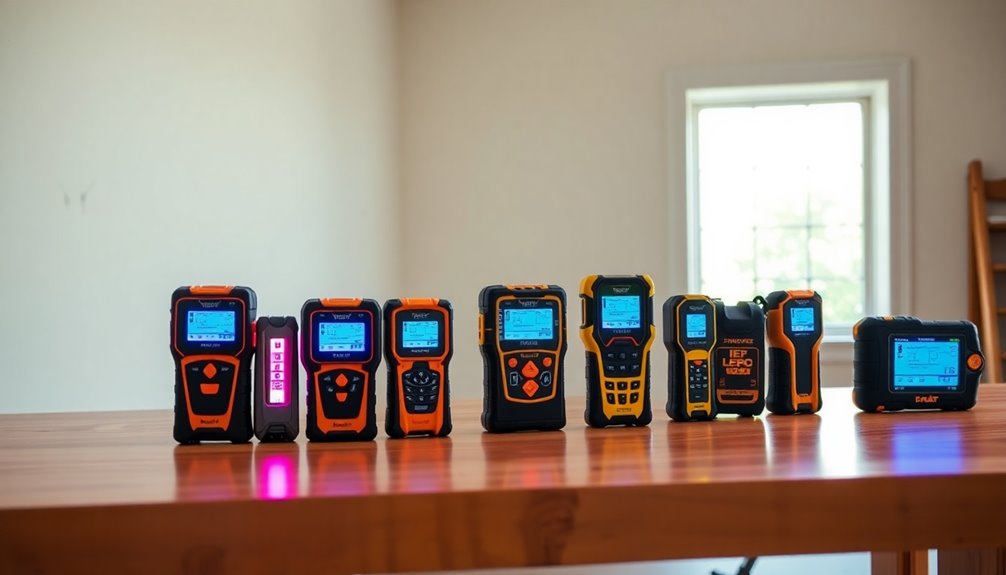

Stud finders range from simple center-finding tools to wall scanners that also flag metal and live wires. For the broadest mix of coverage and safety features, I’d start with the Franklin Sensors ProSensor M210; the DEWALT DW0100 offers a simpler center-finding approach, while the Franklin Sensors ProSensor M150 keeps operation straightforward with multiple sensors. The main tradeoff is between a clear stud-location readout and extra detection modes that can help identify obstacles but may take more interpretation. Wall material and mounting depth also affect which tool makes sense. Read on for how these 15 options compare and which type of buyer each best serves.

Get your wardrobe favorites delivered free with Prime
- Fast, free delivery on millions of items
- Prime Video, Amazon Music and more included
- Member-only deals all year
Key Takeaways
- The Franklin Sensors ProSensor M210 combines a 13-sensor array with live-wire detection, giving it a broader feature set than the simpler M90 and M150.
- The DEWALT DW0100 centers its appeal on center-finding, a focused choice for buyers who want a direct stud-location task rather than a multi-mode scanner.
- The Franklin Sensors ProSensor MAX is the depth-focused pick, with stated detection up to 2.5 inches for buyers dealing with thicker wall coverings.
- Multi-mode scanners such as the Zircon A200, VETOUCH, LSENLTY, and Mecurate add metal or wire detection, but extra modes mean more readings to interpret.
- Rechargeable models with laser levels, including PREXISO and GOTMEET, combine layout help with scanning, though buyers should weigh charging and added functions against a dedicated scanner’s simpler use.
| CRAFTSMAN Stud Finder, 3/4-Inch Depth (CMHT77633) |  | Best for Wallpapered Walls | Model: CMHT77633 | Detection: Stud edge detection | Detection depth: Up to 3/4 inch through drywall | VIEW ON AMAZON | See Our Full Breakdown |
| LSENLTY 6-in-1 Stud Finder Wall Scanner |  | Best for Multi-Target Scanning | Model: TXW-T60 | Scanning modes: 6 | Scanning depths: 1/2 in, 1 in, and 1-1/2 in | VIEW ON AMAZON | See Our Full Breakdown |
| VETOUCH 7-in-1 Wall Scanner and Stud Finder with Metal and AC Wire Detection |  | Best for Accurate Mounting Guidance | Detection modes: Wood, metal, screws, and live AC wires | Depth modes: 1/2 in, 1 in, and 1-1/2 in for wood and metal; 60 mm for ferrous metal | AC wire detection depth: Up to 2 in | VIEW ON AMAZON | See Our Full Breakdown |
| DEWALT Stud Finder with Center-Find Technology (DW0100) |  | Best for Finding Stud Centers | Model: DW0100 | Power source: Battery powered | Battery type: AAA | VIEW ON AMAZON | See Our Full Breakdown |
| Zircon MultiScanner A200 Stud Finder with Metal and Live Wire Detection |  | Best for Deeper Stud Scans | Power source: Battery powered | Battery: 9V alkaline | Scanning modes: StudScan, DeepScan, Metal Scan | VIEW ON AMAZON | See Our Full Breakdown |
| 5-in-1 Stud Finder Wall Scanner with LCD Display |  | Best for Multi-Material Scanning | Scan modes: Stud, deep, and metal | Detects: Wood studs, metal, pipes, and live AC wires | Display: Backlit LCD | VIEW ON AMAZON | See Our Full Breakdown |
| POROMETISTO DSF05 All-in-One Stud Finder and Wall Scanner |  | Best for Depth Readouts | Wood detection: 1.5 in deep mode; 0.78 in exact mode | Ferrous metal depth: 1.5 in (38 mm) | Non-ferrous metal depth: 0.78 in (20 mm) | VIEW ON AMAZON | See Our Full Breakdown |
| PREXISO 2-in-1 Rechargeable Stud Finder with Laser Level |  | Best for Marking and Alignment | Functions: Stud finder and manual-leveling laser level | Stud detection depth: Up to 3/4 in through drywall | AC wire detection depth: Up to 1-1/2 in | VIEW ON AMAZON | See Our Full Breakdown |
| Mecurate 5-in-1 Stud Finder and Wall Scanner |  | Best for Mode-Specific Depths | Standard mode: 3/4 in | Deep mode: 1-1/2 in | Metal mode: 2-3/8 in | VIEW ON AMAZON | See Our Full Breakdown |
| Franklin Sensors ProSensor M150 Stud Finder with AC Wire Warning |  | Best for Calibration-Free Stud Finding | Sensors: 9 | Maximum detection depth: 1.5 in | Stud types: Wood and metal | VIEW ON AMAZON | See Our Full Breakdown |
| GOTMEET Rechargeable Stud Finder Wall Scanner |  | Best Rechargeable Multi-Material Scanner | Brand: GOTMEET | Model: NF-G5102 | Wood stud or pipe depth: Up to 1.18 in | VIEW ON AMAZON | See Our Full Breakdown |
| 5-in-1 Stud Finder Wall Scanner with Smart Chip and LCD Display |  | Best for Low-Light Scanning | Scan modes: Stud scan, deep scan, and metal scan | Display: Backlit LCD | Alerts: Audio alerts and beeps | VIEW ON AMAZON | See Our Full Breakdown |
| Franklin Sensors ProSensor M90 9-Sensor Stud Finder |  | Best for Clear Stud Width Readings | Sensor count: 9 | Sensing distance: Up to 1.5 in | Stud types: Wood and metal | VIEW ON AMAZON | See Our Full Breakdown |
| Franklin Sensors ProSensor M210 13-Sensor Stud Finder with Live Wire Detection |  | Best Stud Finder with Built-In Level | Sensor count: 13 | Detection depth: Up to 1.7 in | Stud types: Wood and metal | VIEW ON AMAZON | See Our Full Breakdown |
| Franklin Sensors ProSensor MAX 13-Sensor Stud Finder, 2.5-in Deep Detection |  | Best for Deep Scanning | Sensor count: 13 | Maximum detection depth: 2.5 in | Detection modes: 2: standard and deep | VIEW ON AMAZON | See Our Full Breakdown |
More Details on Our Top Picks
CRAFTSMAN Stud Finder, 3/4-Inch Depth (CMHT77633)
Wallpaper and fabric-covered drywall compatibility gives this CRAFTSMAN a focused advantage when a basic stud finder needs to work through a wall covering. It detects the edges of wood and metal studs up to 3/4 inch deep, so you can map a stud boundary before choosing a mounting point. Unlike the DEWALT DW0100, which identifies stud centers and live wires, this model is limited to edge detection and has no listed wire alert. The tradeoff is straightforward: CRAFTSMAN covers common covered drywall, while the DEWALT offers more guidance for pinpointing a center. Its shock-resistant, water-resistant plastic body adds durability, but the shallow stated depth makes it a less fitting choice for thicker wall materials.
Pros:- Detects wood and metal stud edges
- Works through wallpaper and fabric-covered drywall
- Shock-resistant and water-resistant body
Cons:- Indicates stud edges rather than center points
- Specified detection depth is limited to 3/4 inch
- No live-wire or pipe detection is listed
Best for: DIYers locating wood or metal stud edges through wallpaper or fabric-covered drywall
Not ideal for: People who need center-finding, live-wire alerts, or detection beyond 3/4 inch
- Model:CMHT77633
- Detection:Stud edge detection
- Detection depth:Up to 3/4 inch through drywall
- Compatible stud materials:Wood and metal
- Compatible surfaces:Wallpaper and fabric-covered drywall
- Material:Plastic
- Pack quantity:1
Our verdict“Choose the CRAFTSMAN for basic stud-edge locating through covered drywall, but pick the DEWALT if center guidance and wire detection matter.”
LSENLTY 6-in-1 Stud Finder Wall Scanner
Six scanning modes make the LSENLTY the broadest stated target finder among these five picks: it covers wood and metal studs, magnetic fasteners, PVC pipes, and live AC wiring. Its three selectable depths let buyers adapt the scan to different wall conditions, while the LCD and audio and visual alerts make the result easier to follow than a tool that relies on a single signal. Compared with the VETOUCH 7-in-1, it lists PVC pipe detection and a deeper metal detection range of up to 2.36 inches; VETOUCH instead adds center and edge detection plus a built-in bubble level. The tradeoff is that LSENLTY’s stated depths vary by target, so its settings do not imply equal reach for every material.
Pros:- Detects studs, magnetic fasteners, PVC pipes, and live AC wiring
- Offers three selectable scanning depths
- LCD, visual, and audio alerts communicate scan results
- Batteries are included and the warranty is listed as five years
Cons:- Detection depth varies by target type
- Does not list center-and-edge stud guidance
- Auto shutoff after three minutes may interrupt longer pauses during a scan
Best for: Homeowners who want one scanner for studs, fasteners, PVC pipes, and live AC wiring
Not ideal for: Buyers who prioritize center-and-edge stud guidance or need one uniform detection depth across targets
- Model:TXW-T60
- Scanning modes:6
- Scanning depths:1/2 in, 1 in, and 1-1/2 in
- Metal detection depth:Up to 2.36 in
- Live AC wire detection depth:Up to 2 in
- Alerts:LCD, visual, and audio
- Power:Batteries included
- Auto shutoff:After 3 minutes of inactivity
- Warranty:5 years
Our verdict“Pick the LSENLTY when target variety matters more than center-finding aids or a consistent depth across materials.”
VETOUCH 7-in-1 Wall Scanner and Stud Finder with Metal and AC Wire Detection
The VETOUCH pairs center and edge detection with wood, metal, screw, and unshielded live-wire scanning, giving a mounting job more guidance than the CRAFTSMAN’s edge-only approach. An LCD, audio alarm, and LED indicators make it easier to follow a scan, and the built-in bubble level can help with a quick alignment check. Compared with the LSENLTY, VETOUCH offers explicit center-and-edge locating and a level, while LSENLTY adds PVC pipe detection and lists greater metal detection depth. VETOUCH’s tradeoffs are its unshielded-wire limitation and the need for a 9V battery; its stated 20-hour battery life and included spare-ready pouch make it a practical kit for repeated household jobs.
Pros:- Center and edge detection help locate stud boundaries and mounting points
- Detects wood, metal, screws, and unshielded live AC wires
- Built-in bubble level and one-button calibration aid setup
- Includes a 9V battery and storage pouch
Cons:- Live-wire detection is specified for unshielded wires
- Requires a 9V battery
- Does not list PVC pipe detection
Best for: DIYers hanging shelves or fixtures who want stud center and edge cues plus a built-in level
Not ideal for: Buyers who need PVC pipe scanning, shielded-wire detection, or a tool that uses a different battery format
- Detection modes:Wood, metal, screws, and live AC wires
- Depth modes:1/2 in, 1 in, and 1-1/2 in for wood and metal; 60 mm for ferrous metal
- AC wire detection depth:Up to 2 in
- Display and alerts:LCD, audio alarm, and LED indicators
- Power source:9V battery included
- Battery life:20 hours
- Auto shutoff:After 3 minutes of inactivity
- Weight:4.32 oz (124 g)
- Dimensions:7.28 × 2.83 × 1.1 in
Our verdict“Choose VETOUCH for mounting guidance and alignment aids, while the LSENLTY is a better fit when PVC pipe detection is a priority.”
DEWALT Stud Finder with Center-Find Technology (DW0100)
Center-Find Technology makes the DEWALT a clear choice for buyers who want a direct mounting reference rather than only a stud edge. It locates wood and metal studs to 3/4 inch, then uses directional LED arrows, an audible alert, and a center marking channel to guide the mark. Compared with the CRAFTSMAN, it provides a center point and live-wire detection; compared with the Zircon A200, it has fewer scanning modes and no listed deeper stud scan. Automatic calibration helps simplify startup, though the listed surface limits exclude concrete, brick, plaster, and tile, and it is not designed for plastic or non-ferrous objects such as pipes. This is a focused stud tool, not a broad wall-material scanner.
Pros:- Finds stud centers rather than only edges
- Detects wood and metal studs up to 3/4 inch
- Live-wire detection adds a warning during wall scans
- Directional LED arrows, audible alert, and center marking channel guide marking
Cons:- Not designed to locate plastic or non-ferrous objects such as pipes
- Listed surface exclusions include concrete, brick, plaster, and tile
- Does not offer the Zircon A200’s multiple scan modes or deeper stud scan
Best for: Homeowners who want a clear stud center and marking channel for mounting on drywall
Not ideal for: People scanning concrete, brick, plaster, tile, or searching for pipes and other non-ferrous objects
- Model:DW0100
- Power source:Battery powered
- Battery type:AAA
- Detection depth:3/4 in
- Detection:Wood and metal studs; AC and live wires
- Display:LED
- Marking feature:Center marking channel
- Dimensions:5.88 × 1.3 × 9 in
Our verdict“Choose the DEWALT for center-focused stud locating on drywall, and the Zircon A200 if deeper scanning modes are more useful.”
Zircon MultiScanner A200 Stud Finder with Metal and Live Wire Detection
The Zircon A200 is the strongest fit here when a standard shallow scan may not be enough: its DeepScan mode reaches up to 1 1/2 inches, compared with the 3/4-inch limits listed for both the DEWALT and CRAFTSMAN. It also scans for metal objects and live AC wires, while SpotLite, an LCD, and an audio tone help indicate where to mark. The three modes—StudScan, DeepScan, and Metal Scan—give it more flexibility than the DEWALT’s focused center-finding approach, though the DEWALT explicitly marks the stud center. The A200’s setup has a learning curve: it must be held still against the wall during calibration, and it uses a 9V alkaline battery. That makes it better suited to deliberate scanning than quick, repeated repositioning.
Pros:- DeepScan locates studs up to 1 1/2 inches
- Three modes cover stud, deeper stud, and metal scans
- Detects wood and metal studs, metal objects, and live AC wires
- LCD, audio tone, and SpotLite pointer support locating and marking
Cons:- Requires a 9V alkaline battery
- Must be held still against the wall during calibration
- Does not list the DEWALT’s dedicated center marking channel
Best for: DIYers who need selectable stud and metal scans, including a deeper stud mode for thicker drywall
Not ideal for: Buyers who want a center-marking channel or prefer a scanner that does not require stillness during calibration
- Power source:Battery powered
- Battery:9V alkaline
- Scanning modes:StudScan, DeepScan, Metal Scan
- StudScan depth:Up to 3/4 in
- DeepScan depth:Up to 1 1/2 in
- Detection:Wood and metal studs, metal objects, and live AC wires
- Display and alerts:Digital display, audio tone, and SpotLite pointer
- Weight:0.37 kg
- Dimensions:1.8 × 3.23 × 7.72 in
Our verdict“Choose the A200 for its deeper stud mode and multiple scan types, while the DEWALT is the simpler pick for center marking.”
5-in-1 Stud Finder Wall Scanner with LCD Display
This scanner earns its place for buyers who want one tool to check for wood studs, metal, pipes, and live AC wires. Its stud, deep, and metal modes give more control over what the scanner is looking for, while the backlit LCD and audio alerts make signals easier to follow in dim rooms. Compared with the Mecurate 5-in-1 Stud Finder and Wall Scanner, this model lists broad material detection but gives no detection-depth figures, so it is harder to judge how it will perform on thicker surfaces. That missing detail is its main tradeoff: the feature list is versatile, but buyers have less information for planning a specific job. Choose it for general wall checks; skip it if stated depth limits are a priority.
Pros:- Detects wood studs, metal, pipes, and live AC wires
- Offers stud, deep, and metal scan modes
- Backlit LCD and audio alerts aid scanning in low light
- Compact listed dimensions of 7.8 × 3.23 × 1.81 inches
Cons:- No detection-depth figures are provided
- No accuracy-testing information is provided
Best for: DIYers who want a single scanner for routine stud checks and alerts for metal, pipes, and live wires
Not ideal for: Buyers who need published detection depths or accuracy details before drilling
- Scan modes:Stud, deep, and metal
- Detects:Wood studs, metal, pipes, and live AC wires
- Display:Backlit LCD
- Alerts:Audio alerts and beeps
- Power:Alkaline battery powered
- Weight:8.1 ounces
- Model:TH410
Our verdict“Pick this scanner for broad material alerts and clear on-tool feedback, provided you can work without published depth specifications.”
POROMETISTO DSF05 All-in-One Stud Finder and Wall Scanner
The DSF05 is the clearest choice here for shoppers who want specific depth figures alongside material alerts. Its deep and exact modes cover wood detection at different stated depths, and the LCD reports material and depth signals. Published limits include up to 1.5 inches for deep wood scanning, ferrous metal, and live AC wires, with shallower figures for exact wood mode and non-ferrous metal. Compared with the 5-in-1 Stud Finder Wall Scanner with LCD Display, that detail makes its capabilities easier to evaluate before a job. The tradeoff is that the instructions call for slow movement, so rushed scanning can undermine the readout; it also comes with only one battery. This suits careful users more than anyone seeking a quick pass across a wall.
Pros:- Lists detection depths for wood, ferrous and non-ferrous metals, and live AC wires
- Deep and exact modes let users tailor wood scans
- LCD shows material and depth signals
- Includes a 9V battery and storage bag
Cons:- Scanning accuracy depends on moving the tool slowly
- Only one battery is included
Best for: DIYers who want stated detection depths and material readouts while scanning drywall, ceilings, or floors
Not ideal for: People who tend to scan quickly or need spare batteries included for extended work
- Wood detection:1.5 in deep mode; 0.78 in exact mode
- Ferrous metal depth:1.5 in (38 mm)
- Non-ferrous metal depth:0.78 in (20 mm)
- Live AC wire depth:1.5 in (38 mm)
- Modes:Deep and exact
- Display:LCD with material and depth signals
- Included components:Stud finder, user manual, 9V battery, and storage bag
Our verdict“Choose the DSF05 if stated depth limits and an LCD readout matter more than fast scanning.”
PREXISO 2-in-1 Rechargeable Stud Finder with Laser Level
PREXISO pairs stud finding with a manual-leveling cross-line laser, making it the most task-specific pick for someone locating studs and then marking a straight line for a shelf or frame. It detects wood and metal studs through drywall up to 3/4 inch and live AC wires up to 1-1/2 inches. Its visual and audible alerts help identify stud edges, while the laser projects an alignment line indoors. By comparison, the Franklin Sensors ProSensor M150 focuses on finding stud width and center without calibration; PREXISO adds layout help but requires calibration for detection. It is also limited to drywall and wood walls, and the laser does not self-level. Choose it when marking is part of the same job, not for lath and plaster or users who want automatic leveling.
Pros:- Combines stud detection with a cross-line laser for marking
- Detects studs through drywall up to 3/4 inch
- Detects live AC wires up to 1-1/2 inches
- Rechargeable by Type-C and includes a wall mount and storage bag
Cons:- Requires calibration before stud detection
- Laser is manual-leveling rather than self-leveling
- Not designed for lath and plaster walls
Best for: Home improvers who need to find studs and align wall-mounted items on drywall or wood walls
Not ideal for: People working on lath and plaster, or buyers who need a self-leveling laser
- Functions:Stud finder and manual-leveling laser level
- Stud detection depth:Up to 3/4 in through drywall
- AC wire detection depth:Up to 1-1/2 in
- Laser working range:Up to 10 m (30 ft) indoors
- Laser class:Class II, output under 1 mW
- Power:Rechargeable, Type-C charging
- Wall compatibility:Drywall and wood walls; not designed for lath and plaster
Our verdict“Pick PREXISO when you want stud locating and straight-line marking in one rechargeable tool for drywall jobs.”
Mecurate 5-in-1 Stud Finder and Wall Scanner
Mecurate stands out for buyers who want separate depth settings with stated limits for different scan targets: standard, deep, metal, and AC. The LCD graphics and audio alerts provide two ways to follow a scan, and the included battery and pouch mean it is ready to carry and store. Compared with the POROMETISTO DSF05, Mecurate lists greater depths for metal and AC modes, while the DSF05 provides explicit figures for ferrous and non-ferrous metals separately. Mecurate’s main constraint is its recommended surface: it works best on single-layer drywall and is not recommended for concrete, brick, or tile. Calibration is also required before use. It makes sense for standard drywall projects where mode-specific ranges are useful, but not for masonry or layered walls.
Pros:- Provides standard, deep, metal, and AC detection modes
- Lists a detection depth for each mode
- LCD graphics and audio alerts support scan interpretation
- Includes a battery and carrying pouch
Cons:- Works best on single-layer drywall
- Not recommended for concrete, brick, or tile
- Requires calibration before use
Best for: DIYers scanning single-layer drywall who want distinct depth modes for studs, metal, and live AC wires
Not ideal for: Buyers working on concrete, brick, tile, or walls outside the recommended single-layer drywall use
- Standard mode:3/4 in
- Deep mode:1-1/2 in
- Metal mode:2-3/8 in
- AC mode:2 in
- Display:LCD screen with detection graphics
- Alerts:Audio alerts, including live-wire warning
- Recommended surface:Single-layer drywall
- Included accessories:Battery, carrying pouch, and user manual
Our verdict“Choose Mecurate for mode-specific depth ranges on single-layer drywall, and look elsewhere for masonry work.”
Franklin Sensors ProSensor M150 Stud Finder with AC Wire Warning
The ProSensor M150 is the most focused option in this group for locating a stud’s full width and center. Its nine sensors read across the stud, and it requires no calibration, which removes a setup step before marking a drilling point. Deep scan reaches up to 1.5 inches for wood and metal studs, with live-wire warning as an added safety signal. Compared with the multi-material POROMETISTO DSF05, the M150 puts more emphasis on stud shape and straightforward operation than on displaying material and depth signals. Its tradeoffs are practical: two AAA batteries are required but not included, and rechargeable batteries are incompatible. Choose it for frequent stud-location tasks; skip it if you need pipe or metal-object scanning modes or want a rechargeable power option.
Pros:- Nine sensors detect the full width and center of studs
- Does not require calibration
- Detects wood and metal studs up to 1.5 inches deep
- Includes live AC wire warning
Cons:- Two AAA batteries are not included
- Does not support rechargeable batteries
Best for: Homeowners and installers who regularly locate wood or metal stud centers and want to skip calibration
Not ideal for: Buyers who need pipe detection, multi-material scan modes, or rechargeable battery support
- Sensors:9
- Maximum detection depth:1.5 in
- Stud types:Wood and metal
- Wire detection:Live AC wire warning
- Calibration:Not required
- Power:2 AAA batteries, not included
- Rechargeable battery compatibility:Not compatible
Our verdict“Choose the M150 for direct, calibration-free stud locating, provided you have compatible AAA batteries and do not need broader material scanning.”
GOTMEET Rechargeable Stud Finder Wall Scanner
The GOTMEET stands out for combining rechargeable power with detection for wood studs, metal, pipes, and live AC wires. Its LCD reports depth and center position, while audio alerts can help when your eyes are on the wall. Compared with the Franklin Sensors ProSensor M90, which focuses on finding stud width and center without calibration, the GOTMEET covers more hazard and material types and avoids disposable batteries. That wider feature set comes with a tradeoff: wood stud detection is specified only up to 1.18 inches, and the listed maximum depth applies to magnetic metal, not every material. Choose it for varied scanning jobs and USB-C charging; skip it if your main priority is deeper wood stud detection or clearly documented accuracy.
Pros:- Detects wood, metal, pipes, and live AC wires
- LCD indicates depth and center position
- Built-in battery charges through USB-C
- Audio alerts and automatic calibration support scanning
Cons:- Wood stud and pipe detection is limited to 1.18 inches
- Depth varies by material, with no single maximum applying to every scan
- The description does not provide accuracy measurements
Best for: DIYers who want one rechargeable tool for locating studs, pipes, metal, and live AC wires around the home
Not ideal for: Buyers scanning thick walls for wood studs, since the stated wood detection depth is up to 1.18 inches
- Brand:GOTMEET
- Model:NF-G5102
- Wood stud or pipe depth:Up to 1.18 in
- Magnetic metal depth:Up to 3.94 in
- Non-magnetic metal depth:Up to 3.15 in
- Live AC wire depth:Up to 1.97 in
- Battery and charging:Built-in 390 mAh rechargeable battery; USB-C
- Weight:5.44 oz
Our verdict“Choose the GOTMEET if USB-C charging and broad material detection matter more than deeper wood stud reach.”
5-in-1 Stud Finder Wall Scanner with Smart Chip and LCD Display
This scanner is a straightforward pick for buyers who want several scan modes and a backlit screen for dim rooms. It detects wood studs, metal, pipes, joists, and live AC wires, with audio alerts as another cue while moving across a wall. The GOTMEET Rechargeable Stud Finder gives buyers more concrete information about depth, battery, and charging; this model’s description leaves those details unspecified. The Franklin Sensors ProSensor M90, by contrast, publishes a 1.5-inch sensing distance and uses nine sensors to show stud width and center. This 5-in-1 may suit general home projects where a lit display and broad detection claims matter, but buyers who need to plan around wall thickness or battery runtime have less information to work with.
Pros:- Detects studs, metal, pipes, joists, and live AC wires
- Stud, deep, and metal scan modes
- Backlit LCD is easier to read in low light
- Audio alerts provide another scanning cue
Cons:- No detection depth or accuracy measurements are provided
- Battery type and runtime are unspecified
Best for: Homeowners scanning walls in dim rooms who want a backlit readout and several detection modes
Not ideal for: Buyers who need known detection depths or battery runtime before choosing a scanner
- Scan modes:Stud scan, deep scan, and metal scan
- Display:Backlit LCD
- Alerts:Audio alerts and beeps
- Detects:Wood studs, metal, pipes, joists, and live AC wires
- Color:Cherry
- Battery:Type and runtime not provided
Our verdict“Choose this model for a backlit display and multiple scan modes if the missing depth and battery details are acceptable.”
Franklin Sensors ProSensor M90 9-Sensor Stud Finder
The ProSensor M90 earns its place for making stud width and center the focus: nine sensors read across a wider area, and its LED display indicates width and double studs. Since it requires no calibration, it also avoids a setup step before scanning. Compared with the Franklin Sensors ProSensor M210, the M90 is the simpler stud-finding choice: the M210 adds live wire detection, a bubble level, and a pencil caddy, while the M90 is specified for a sensing distance of up to 1.5 inches. That reach is less than the M210’s 1.7 inches and the ProSensor MAX’s 2.5 inches, so this model is best suited to ordinary wall work rather than deeper materials. It also takes two AAA batteries, and rechargeable cells are not compatible.
Pros:- Nine sensors detect the full width and center of studs
- LED display indicates stud width and double studs
- No calibration required
- Detects wood and metal studs up to 1.5 inches deep
Cons:- Two AAA batteries are required and not included
- Rechargeable batteries are not compatible
- Less depth than the ProSensor M210 and ProSensor MAX
Best for: DIYers who want a no-calibration scanner that shows stud width and double studs on standard walls
Not ideal for: People scanning deeper wall materials or seeking built-in live wire detection and added leveling features
- Sensor count:9
- Sensing distance:Up to 1.5 in
- Stud types:Wood and metal
- Display:LED; indicates stud width and double studs
- Dimensions:5.38 x 2.75 x 2 in
- Weight:5.12 oz
- Batteries:Two AAA batteries required, not included
- Rechargeable battery compatibility:Not compatible
Our verdict“Choose the M90 for clear stud width readings and simple no-calibration use on walls within its 1.5-inch sensing range.”
Franklin Sensors ProSensor M210 13-Sensor Stud Finder with Live Wire Detection
The M210 makes sense for buyers who want full-width stud readings plus a few useful extras in the same tool. Its 13 sensors locate wood and metal studs up to 1.7 inches deep without calibration, and the LED display shows width and center. A built-in bubble level can help with placement, while live wire detection adds a check before drilling. Against the ProSensor M90, the M210 offers greater stated depth and those added features; the ProSensor MAX reaches farther at 2.5 inches and supports deeper scanning through several materials. The M210 is the more modest choice for typical wall jobs, but its 1.7-inch limit may not suit thick assemblies. Two AA batteries are required and not included.
Pros:- Thirteen sensors show stud width and center
- Detects wood and metal studs up to 1.7 inches deep
- No calibration required
- Built-in bubble level and live wire detection
Cons:- Two AA batteries are required and not included
- 1.7-inch maximum depth may not reach studs in thick walls
- Does not match the ProSensor MAX’s stated 2.5-inch depth
Best for: DIYers who want stud width and center readings, live wire detection, and a built-in level for routine wall projects
Not ideal for: People scanning thick walls or layered materials beyond the stated 1.7-inch detection depth
- Sensor count:13
- Detection depth:Up to 1.7 in
- Stud types:Wood and metal
- Display:LED showing full width and center
- Calibration:Not required
- Power:Two AA batteries, not included
- Additional features:Bubble level, live wire detection, and pencil caddy
Our verdict“Choose the M210 for a no-calibration stud finder with live wire detection and leveling features for ordinary wall thicknesses.”
Franklin Sensors ProSensor MAX 13-Sensor Stud Finder, 2.5-in Deep Detection
The ProSensor MAX is the strongest fit here for thick or layered walls, with a stated 2.5-inch reach through drywall, plaster, OSB, plywood, MDF, and large tile. Its 13 sensors show full stud width and center, and no calibration is required. The ProSensor M210 shares the 13-sensor approach but tops out at 1.7 inches; it adds live wire detection, a bubble level, and a pencil caddy, so it may be more useful for typical walls with extra convenience needs. The MAX instead prioritizes deeper scanning, with two modes for standard and deep work. Its depth still has a ceiling, and the product data does not specify its power source. Pick it when wall material and reach are the main concerns, not when extra built-in tools are the priority.
Pros:- Stated detection depth reaches 2.5 inches
- Works through several listed materials, including plaster, plywood, and large tile
- Thirteen sensors show full stud width and center
- Two scan modes and no calibration required
Cons:- Detection depth is limited to 2.5 inches
- Power source is not specified in the provided product data
- Does not list the M210’s live wire detection or built-in level
Best for: Renovators and DIYers scanning studs through plaster, plywood, MDF, or other layered wall materials
Not ideal for: Buyers who want a specified live wire detector, built-in level, or a stated battery type
- Sensor count:13
- Maximum detection depth:2.5 in
- Detection modes:2: standard and deep
- Materials:Drywall, plaster, OSB, plywood, MDF, and large tile
- Stud display:Full width and center with precision LED indicator
- Calibration:Not required
Our verdict“Choose the ProSensor MAX when deeper reach through layered wall materials matters more than added leveling or wire detection features.”

How We Picked
I ranked these stud finders around the decisions a buyer faces at the wall: how directly the tool locates a stud, whether it helps identify live wires or metal, how much detection depth it claims, and how easy its feedback is to act on. I gave more weight to clear, useful stud-location functions than to a long list of modes, since the main job is finding a reliable mounting point. Multi-sensor designs and center-finding features stood out when they offered a distinct path to locating a stud; additional scanning modes mattered most when they added relevant safety or material information.
The order also reflects fit across common jobs. The M210 ranks first for its combination of a 13-sensor array and live-wire detection, while the M150 and M90 trade some functions for a more focused approach. The MAX ranks well for greater stated depth, and the DEWALT is a strong choice for buyers who prioritize center finding. Compact, rechargeable, and broad-mode scanners remain useful for specific needs, but I place them lower when their added functions create more setup or interpretation without a clear advantage for basic stud location. Product names alone do not establish performance on every wall, so I treat claimed modes and depth as selection factors rather than guarantees.
Factors to Consider When Choosing Stud Finders
Before choosing a stud finder, match its detection approach to the wall and the job. A tool with more modes may be useful, but it cannot remove uncertainty caused by wall construction, surface materials, or nearby wiring. These factors can help narrow the field before you compare individual models.
Match Detection Depth to the Wall
Detection depth matters most when the wall has thick plaster, tile, paneling, or several layers of material. A tool’s stated maximum is a limit under particular conditions, not a promise that every stud will register at that depth. If your walls are standard drywall, a deep-range model may add little to everyday mounting. Buyers working with unusual or layered surfaces should check the maker’s stated conditions and plan to confirm a reading before drilling. A common mistake is choosing by the biggest depth figure alone while overlooking whether the device is designed for the wall material at hand. When the wall type is uncertain, allow time for repeated scans and a second confirmation method.
Choose the Readout You Can Interpret
Stud finders communicate with lights, screens, beeps, sensor arrays, or combinations of these cues. A simple center indicator can make it easier to mark a single point, while a display with several modes can provide more context about what lies behind the surface. More information helps only if you can tell which reading corresponds to a stud, metal, or a wire warning. Before buying, consider whether you prefer a direct signal or are comfortable switching modes and interpreting a screen. If more than one person will use the tool, a clear, repeatable display can reduce mistakes. Treat any reading as a guide to verify, especially near electrical outlets or switches.
Treat Wire Detection as a Warning Aid
Live-wire detection can add a useful warning when scanning before drilling, but it is not a substitute for safe work practices. Detection may depend on the wire being energized, its position, shielding, and the wall construction. A quiet reading does not prove that an area is free of electrical hazards. Buyers who regularly mount objects near outlets, switches, or likely cable routes may value this feature more than someone hanging items in a known clear area. Follow the tool’s instructions, scan from multiple directions, and keep appropriate clearance around electrical fixtures. Do not choose a scanner on the assumption that its warning function can map every wire behind a wall.
Decide Whether Metal Detection Helps Your Projects
Metal detection can help identify metal studs, pipes, or other objects that affect where and how you mount something. It can also produce signals from items that are not framing, so interpreting a metal alert takes context. In newer interiors with metal framing, this mode may be more relevant than a wood-stud-only approach. For a typical drywall mounting job, a metal feature may be secondary to locating the stud’s edges or center. Think about the buildings you work in and whether you need to distinguish material types. If the answer is rarely, a simpler tool may be easier to use and maintain.
Weigh Added Tools Against Setup
A laser level or rechargeable battery can make a combined device handy for layout and repeated work, but it also adds charging, controls, and features to manage. Those extras make more sense when you already need alignment help or scan often enough to appreciate a rechargeable tool. For occasional picture hanging, a straightforward scanner may be ready to use with less preparation. Check how the device is powered and whether its display and controls remain usable in the spaces where you work. Think about storage as well: a larger all-in-one tool may be less convenient to keep in a small household kit. Buy the extra functions for tasks you expect to do, rather than for a feature list alone.
Plan to Verify Before Drilling
Even a well-suited stud finder can give misleading readings if it is used incorrectly or moved too quickly. Calibration steps and scanning technique vary, so follow the instructions for the specific model instead of assuming every scanner works the same way. A practical habit is to scan across the target area more than once and mark the edges before deciding where to drill. Nearby corners, outlets, and wall seams can affect where framing is likely to run, but they do not confirm its exact position. If a reading shifts between passes, pause and rescan rather than choosing the most convenient mark. This extra care matters more for heavy or safety-critical loads than for a small decorative hook.
Frequently Asked Questions
Is a multi-mode wall scanner a better choice than a basic stud finder?
It depends on what you need to identify behind the wall. A multi-mode scanner can add metal or live-wire warnings, which may help when wall contents are less predictable. Those features also require you to select the right mode and interpret more signals. If your main task is locating framing for routine hanging, a focused stud finder may be easier to use. Choose added detection when it addresses a real feature of your home or project, and verify warnings before drilling.
Can I trust a stud finder to locate a safe drilling spot by itself?
No single reading should be treated as proof that a spot is clear. A scanner can miss or misread objects because of wall material, calibration, wire conditions, or the way it is moved. Repeat the scan, mark the likely stud edges, and use the tool’s wire-warning function according to its instructions. Take extra care near outlets, switches, plumbing fixtures, and other likely routes for services. For a heavy load, confirm that your mounting plan suits both the wall and the fastener.
Do I need a deep-detection model for ordinary drywall?
Most buyers working with standard drywall can prioritize ease of use and a clear stud location over maximum stated depth. A deeper range becomes more relevant with thicker finishes, layered walls, or other surfaces that separate the scanner from framing. Depth claims depend on conditions, so they do not guarantee the same result in every home. If you are unsure about the wall, check the model’s guidance and test several passes in the intended area. Paying for extra reach makes sense when your projects regularly need it.
Should I choose a rechargeable stud finder with a laser level?
A combined tool is useful when alignment and repeated scanning are both part of your projects. The laser can help lay out a level line, while rechargeable power avoids disposable batteries. Those benefits come with charging and extra controls, so the combination may be unnecessary for occasional one-point mounting. Consider whether you would use the alignment function often enough to keep the device charged and ready. If you mainly need to locate a stud, a dedicated scanner keeps the task simpler.
Which feature should I prioritize for mounting a heavy object?
Start with a clear way to locate the stud and its usable width, then choose hardware suited to the object, wall, and framing. A center-finding feature or multi-sensor readout can help establish where the framing lies, while depth can matter if the wall finish is thick. Wire warnings may be useful during placement, but they do not confirm that a location is safe by themselves. Follow the scanner and fastener instructions, and distribute the load across framing where the mounting plan calls for it. For especially heavy or safety-sensitive objects, a stud finder is only one part of a secure installation.
Conclusion
For the broadest feature mix in this lineup, I’d choose the Franklin Sensors ProSensor M210 as best overall, thanks to its 13-sensor array and live-wire detection. The DEWALT DW0100 is my focused pick for buyers who want center finding without a long list of scanning modes, while the Franklin Sensors ProSensor M150 suits beginners who want a straightforward multi-sensor approach. For greater stated depth, look at the Franklin Sensors ProSensor MAX; for metal and wire scanning, compare the Zircon A200 and VETOUCH 7-in-1. Buyers who want layout help built in can consider the PREXISO 2-in-1. Match the tool to your wall and working habits, then confirm readings before drilling.
Fall Picks
fall essentials
As an affiliate, we earn on qualifying purchases.