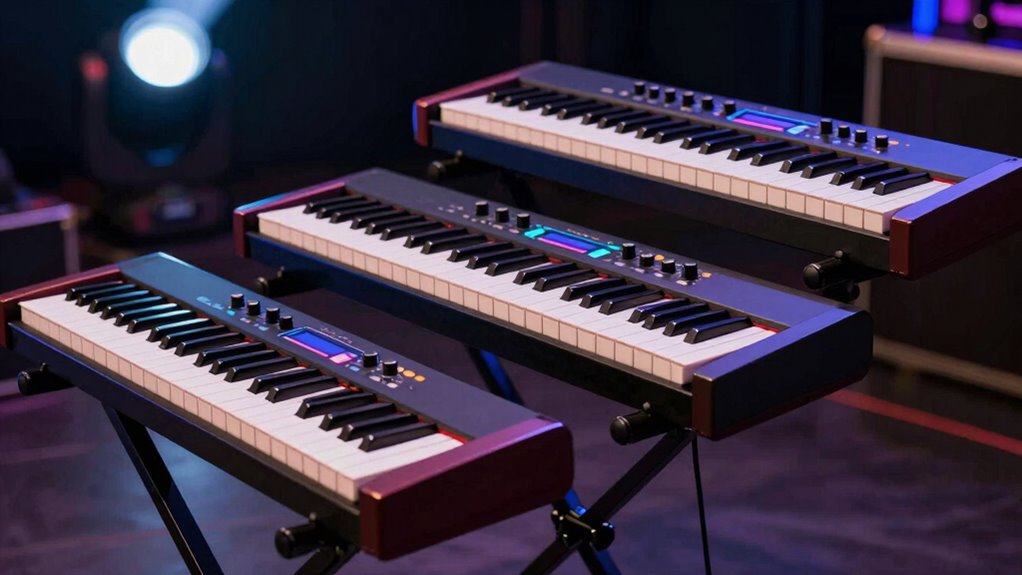

A stage keyboard for live performance needs to do more than sound good: it should be easy to control under pressure, suit your playing style, and fit the way you travel and set up. My best overall pick is the Roland V-STAGE 88, which offers a performance-focused full-size format; the Nord Stage 4 Compact is a standout for players who want a lighter 73-key instrument, while the Yamaha CK88 adds built-in speakers for flexible rehearsals and smaller gigs. The main tradeoffs are key feel versus portability, deep sound-shaping versus fast operation, and pro-level performance features versus beginner-friendly bundles. The RockJam sets serve a different role from the dedicated stage instruments, while the Nord, Roland, Yamaha, and Arturia options target more demanding live setups. Read on for the full breakdown and help matching a keyboard to your stage needs.

Get your wardrobe favorites delivered free with Prime
- Fast, free delivery on millions of items
- Prime Video, Amazon Music and more included
- Member-only deals all year
Key Takeaways
- Roland V-STAGE 88 leads as the all-around pro choice because its full-size format and performance-first design suit players who want one main stage instrument.
- Nord Stage 4 models offer the most choice in key feel and size: the Compact favors portability and semi-weighted action, while the 73- and 88-key versions better suit players who prioritize piano-style playing.
- Yamaha CK88 is the practical pick when built-in speakers matter, though players focused on a more specialized pro rig may prefer the Roland or Nord options.
- Arturia AstroLab stands apart for sound selection and electronic performance workflows, making it a better match for players who value a broad palette over a traditional piano-centered layout.
- The two RockJam bundles are beginner-oriented, not direct rivals to pro stage boards; their included accessories and lessons may help newcomers, but touring players should prioritize live controls, key action, and stage connectivity.
| Roland V-STAGE 88 Weighted Digital Keyboard |  | Best Overall for Piano-Centered Live Sets | Number of keys: 88 | Key type: Weighted | Sound engines: Acoustic piano, electric piano, organ, and ZEN-Core synthesizer | VIEW ON AMAZON | See Our Full Breakdown |
| RockJam 61-Key Keyboard Piano Stand with Pitch Bend Kit, Bench, Headphones, Simply Piano App & Keynote Stickers |  | Best Starter Bundle for Casual Performers | Number of keys: 61 full-size keys | Power source: Mains or batteries | Rhythms: 200 | VIEW ON AMAZON | See Our Full Breakdown |
| Nord Stage 4 Compact 73-Key Semi-Weighted Keyboard |  | Best Compact Board for Fast Stage Playing | Number of keys: 73 | Keybed: Semi-weighted waterfall triple sensor | Sound capabilities: Stage piano and synth sounds | VIEW ON AMAZON | See Our Full Breakdown |
| RockJam RJ761 61-Key Digital Piano Keyboard Set with Bench, Headphones, Sustain Pedal & Lessons |  | Best for Beginners Building a First Live Setup | Number of keys: 61 full-size keys | Power source: AC or batteries | Included accessories: Keyboard stand, adjustable stool, headphones, and sustain pedal | VIEW ON AMAZON | See Our Full Breakdown |
| Yamaha 61-Key Arranger Keyboard with Multiple Styles and Voices PSRSX720+ |  | Best Arranger for Solo and Song-Led Performance | Number of keys: 61 | Voices: 1,300 | Accompaniment styles: 450 | VIEW ON AMAZON | See Our Full Breakdown |
| Arturia AstroLab Stage Keyboard (61 Key) |  | Best for Preset-Driven Synth Variety | Keys: 61 | Supported software: Analog Lab Pro, V Collection | Preset library: More than 1,800 presets across 44 instruments | VIEW ON AMAZON | See Our Full Breakdown |
| Nord Stage 4 73-Key Fully-Weighted Keyboard |  | Best for Weighted 73-Key Performance | Keys: 73 | Key type: Fully weighted | Instrument type: Stage piano | VIEW ON AMAZON | See Our Full Breakdown |
| Yamaha CK Series 88-Key Stage Keyboard with Built-In Speakers, Black (CK88) |  | Best for Self-Contained Full-Range Playing | Keys: 88 | Sounds: Piano, organ, strings, brass, and synth | Special features: Built-in speakers, digital display, digital effects | VIEW ON AMAZON | See Our Full Breakdown |
| Nord Stage 4 88-Key Digital Stage Piano Bundle |  | Best Premium Layered Stage Rig | Keys: 88 | Keybed: Triple-sensor weighted hammer action | Sound layers: Up to 7: 2 piano, 2 organ, 3 synth | VIEW ON AMAZON | See Our Full Breakdown |
| stage keyboard for live performance | Number of keys |
|---|---|
| Roland V-STAGE 88 Weighted Dig | 88 |
| RockJam 61-Key Keyboard Piano | 61 full-size keys |
| Nord Stage 4 Compact 73-Key Se | 73 |
| RockJam RJ761 61-Key Digital P | 61 full-size keys |
| Yamaha 61-Key Arranger Keyboar | 61 |
| Arturia AstroLab Stage Keyboar | — |
| Nord Stage 4 73-Key Fully-Weig | — |
| Yamaha CK Series 88-Key Stage | — |
| Nord Stage 4 88-Key Digital St | — |
More Details on Our Top Picks
Roland V-STAGE 88 Weighted Digital Keyboard
I’d put the Roland V-STAGE 88 at the top for players who want one instrument to cover piano, organ, and synth parts without giving up a full weighted keyboard. Its four independent sound engines make it more adaptable across a set than the more focused Nord Stage 4 Compact, while 512 scenes and 128 scene chains give players room to organize sounds for changing songs and setlists. Balanced XLR and 1/4-inch outputs, plus a microphone input and stereo line inputs, suit a more involved stage setup. The tradeoff is physical: at 48.1 pounds and 57 inches long, it asks more of a player’s transport and stage space than a 73-key board. I’d skip it if portability matters more than a broad, ready-to-organize live rig.
Pros:- Four sound engines cover acoustic piano, electric piano, organ, and ZEN-Core synth duties.
- Weighted 88-key layout supports piano-style playing across a full keyboard range.
- 512 scenes and 128 scene chains help organize sounds for a varied live set.
- Balanced main and sub outputs, mic input, and stereo line inputs support flexible stage routing.
Cons:- At 48.1 pounds, it is a substantial load for frequent transport.
- Its 57-inch length takes considerable stand and storage space.
- Its broad sound and scene-management system may take time to configure for players who want a simple setup.
Best for: Gigging keyboardists who play piano-led sets but also need organ and synth sounds, extensive setlist storage, and pro-stage audio connections.
Not ideal for: Players who load in alone, have limited vehicle or stage space, or primarily need a compact board for synth parts.
- Number of keys:88
- Key type:Weighted
- Sound engines:Acoustic piano, electric piano, organ, and ZEN-Core synthesizer
- Scenes:512
- Scene chains:128
- Audio outputs:Balanced XLR and 1/4-inch main stereo outputs; two balanced sub outputs
- Weight:48.1 pounds
- Dimensions:57 x 21 x 11 inches
Our verdict“Choose the V-STAGE 88 if you need a full-range, multi-engine live keyboard and can accommodate its size and weight.”
RockJam 61-Key Keyboard Piano Stand with Pitch Bend Kit, Bench, Headphones, Simply Piano App & Keynote Stickers
The RockJam 61-Key Super Kit is the accessible, all-in-one choice for a new player who wants to practice at home and take a lightweight keyboard to informal performances. Its 61 full-size keys, 200 tones, and 200 rhythms offer more variety than a basic piano-only setup, and the included stand, padded seat, and headphones reduce the need to source essentials separately. Compared with the professional Roland V-STAGE 88, though, this is a learning-oriented instrument rather than a stage rig: it has fewer keys and the listed connections do not include balanced outputs or MIDI. Battery operation can help when an outlet is unavailable, but the keyboard still needs a power source. I’d choose it for lessons, rehearsals, and casual gigs, not for a player who needs a full-range piano action or dependable pro-level routing.
Pros:- Includes an adjustable stand, padded seat, and headphones for a ready-to-play setup.
- Offers 200 tones and 200 rhythms for practice and varied casual performance parts.
- Can run from mains power or batteries, giving some flexibility away from an outlet.
- Record and playback, demo songs, and an LED display support basic learning and practice.
Cons:- The 61-key keyboard is not a full-range substitute for an 88-key piano.
- The listed specifications do not include balanced stage outputs or MIDI connectivity.
- Teaching features may be too basic for players seeking advanced performance tools.
Best for: Beginning players and casual performers who want a portable 61-key keyboard with a stand, seat, headphones, and practice features in one package.
Not ideal for: Gigging pianists who need weighted full-range keys, balanced stage outputs, or dedicated professional performance controls.
- Number of keys:61 full-size keys
- Power source:Mains or batteries
- Rhythms:200
- Tones:200
- Demo songs:30
- Functions:Record and playback
- Display:LED
- Included accessories:Adjustable stand, padded seat, and headphones
Our verdict“Pick the RockJam Super Kit for learning and informal playing with included accessories, but choose a stage-focused keyboard for demanding live work.”
Nord Stage 4 Compact 73-Key Semi-Weighted Keyboard
The Nord Stage 4 Compact is the lineup’s better fit for players who value agile movement around the keys and a smaller stage footprint over a full piano range. Its 73-key semi-weighted waterfall keybed suits organ and synth technique more naturally than the weighted Roland V-STAGE 88, while still offering piano and synth sounds for a mixed set. Dynamic compression and MIDI control add performance and rig-integration options, making this a more stage-directed choice than the beginner-oriented RockJam keyboards. The main compromise is the key range: pianists who rely on the lowest and highest octaves may prefer an 88-key model. Its feature set can also take time to learn, and the product data does not specify outputs or onboard sound counts. I’d shortlist it for a mobile player whose set leans toward organ, synth, and compact piano parts.
Pros:- Semi-weighted waterfall triple-sensor keybed suits quick organ and synth playing.
- Combines stage piano and synth sounds for mixed live parts.
- Dynamic compression provides an onboard performance feature for shaping sound.
- MIDI control supports integration with other performance equipment.
Cons:- The 73-key range may limit players who use the full piano register.
- Semi-weighted action is less suited to players who want a weighted piano feel.
- The feature set may require a learning period, and the listed product data leaves some connection details unspecified.
Best for: Gigging organ and synth players who want a semi-weighted 73-key instrument with piano sounds, MIDI control, and a more manageable footprint than an 88-key board.
Not ideal for: Pianists who need a full 88-key range or players who prefer weighted piano action for most of their set.
- Number of keys:73
- Keybed:Semi-weighted waterfall triple sensor
- Sound capabilities:Stage piano and synth sounds
- Dynamic compression:Included
- MIDI control:Included
- Product category:Stage keyboard
Our verdict“Choose the Nord Stage 4 Compact if responsive semi-weighted keys and a reduced footprint matter more than full-range weighted piano action.”
RockJam RJ761 61-Key Digital Piano Keyboard Set with Bench, Headphones, Sustain Pedal & Lessons
The RockJam RJ761 makes the most sense for a player learning songs at home who wants to bring the same keyboard to rehearsals or a small informal performance. Its stand, adjustable stool, headphones, and sustain pedal provide a more complete starter setup than the RockJam Super Kit’s listed accessories, while MIDI output offers a connection option absent from that model’s supplied specs. The 200 sounds and rhythms, recording, and learn function are useful for practice, though they do not make it a professional stage instrument. Against the Yamaha PSR-SX720+, the RJ761 is more focused on an entry-level bundled setup; Yamaha offers far broader voice and accompaniment selections and performance controls. With only 61 keys and no listed balanced audio outputs, the RJ761 is best for getting started, not for a demanding touring rig.
Pros:- Includes a stand, adjustable stool, headphones, and sustain pedal.
- MIDI output supports connection to compatible equipment.
- Learn function, recording, and playback provide useful practice tools.
- Offers 200 sounds, 200 rhythms, and 30 demo songs.
Cons:- 61 keys limit the range available for piano-heavy performance.
- The listed specifications do not include balanced audio outputs.
- Its bundled learning and accompaniment features are less suited to advanced stage work than the Yamaha PSR-SX720+.
Best for: Beginners who want a 61-key keyboard, sustain pedal, stand, stool, and headphones for lessons, home practice, and occasional small performances.
Not ideal for: Working performers who need a full-range keyboard, balanced stage connections, or advanced sound and setlist management.
- Number of keys:61 full-size keys
- Power source:AC or batteries
- Included accessories:Keyboard stand, adjustable stool, headphones, and sustain pedal
- Connectivity:MIDI output
- Sounds:200
- Rhythms:200
- Demo songs:30
- Built-in functions:Learn function, recording, and playback
Our verdict“Choose the RJ761 as a practical first keyboard setup for learning and occasional informal playing, not as a long-term professional stage board.”
Yamaha 61-Key Arranger Keyboard with Multiple Styles and Voices PSRSX720+
The Yamaha PSR-SX720+ is the strongest choice here for a performer who builds a show around accompaniment rather than switching between piano, organ, and synth parts alone. Its 450 accompaniment styles and 1,300 voices support a wide range of song arrangements, while the chord looper can help sustain or develop backing patterns during performance. Assignable knobs, a joystick, and a touchscreen give the player hands-on ways to shape parts; that’s a different kind of live flexibility from the Roland V-STAGE 88, whose strengths center on four sound engines, setlist organization, and stage routing. The Yamaha’s 61-key range is a real constraint for piano-led material, and the supplied data does not mention built-in speakers or audio connections. I’d favor it for solo entertainers and arrangers, not for someone seeking a weighted 88-key piano replacement.
Pros:- 1,300 voices offer extensive options for changing instrument parts across a set.
- 450 accompaniment styles support song-led and solo performances across genres.
- Chord looper adds flexibility for developing or sustaining accompaniment.
- Assignable knobs, joystick, and touchscreen provide hands-on control.
Cons:- The 61-key range is restrictive for full-range piano performance.
- The listed package includes a power adapter but does not specify built-in speakers.
- Its arranger features may be more involved than needed for players who mainly want piano, organ, or synth sounds.
Best for: Solo performers and song leaders who want extensive backing styles, varied instrument voices, and controls for shaping accompaniment live.
Not ideal for: Piano-focused players who need weighted 88-key action, or performers who require confirmed onboard speakers or specific stage output connections.
- Number of keys:61
- Voices:1,300
- Accompaniment styles:450
- Performance controls:Assignable knobs, joystick, and touchscreen
- Voice feature:Super Articulation+ voices
- Accompaniment feature:Chord looper
- Included:Keyboard, music rest, and power adapter
Our verdict“Pick the PSR-SX720+ if live accompaniment and broad voice selection are central to your act; choose a weighted stage piano for piano-first playing.”
Arturia AstroLab Stage Keyboard (61 Key)
The AstroLab is the strongest fit here for players who want a wide range of electronic sounds without building every live patch from scratch. Its more than 1,800 presets across 44 instruments offer quick options for changing songs or set-list moods, while touch-sensitive controls make onstage adjustments more direct than relying on a computer interface. Compared with the Yamaha CK88, it trades full-size piano range and built-in speakers for a 61-key synthesis-focused setup and integration with Analog Lab Pro and V Collection. That software link suits players who also shape sounds in a studio, but the keyboard’s 13.22 kg weight is substantial for a 61-key instrument, and its USB connection is wired rather than wireless. I’d choose it for synth-led sets, not for players prioritizing acoustic-piano feel or the lightest load-in.
Pros:- Large library of more than 1,800 presets across 44 instruments supports fast sound changes.
- Touch-sensitive controls allow hands-on adjustments during performance.
- Compatibility with Analog Lab Pro and V Collection links live playing with software-based sound design.
- 61-key format is shorter than the full-size Yamaha CK88 and Nord Stage 4 88-Key.
Cons:- At 13.22 kg, it is relatively heavy for a 61-key keyboard.
- USB is the listed connection, with no wireless option specified.
- The 61-key range is less suited to two-handed piano parts than the 88-key Yamaha CK88 or Nord Stage 4 bundle.
Best for: Keyboardists playing synth-heavy live sets who want a large preset library and use Analog Lab Pro or V Collection in their sound-design workflow.
Not ideal for: Pianists who need 88 weighted keys, performers who want built-in speakers, or gigging players seeking a particularly light 61-key instrument.
- Keys:61
- Supported software:Analog Lab Pro, V Collection
- Preset library:More than 1,800 presets across 44 instruments
- Connectivity:USB
- Control:Touch
- Weight:13.22 kg
- Dimensions:36.81 x 3.89 x 12.99 in
Our verdict“Choose the AstroLab for broad, software-linked synth sounds and hands-on control, but skip it if weighted piano feel or a lighter load matters more.”
Nord Stage 4 73-Key Fully-Weighted Keyboard
The Nord Stage 4 73 is the middle ground for players who want a weighted playing surface but do not need the full span of an 88-key instrument. Its 73 fully weighted keys point toward piano-centered parts and a more piano-like touch than the semi-weighted Nord Stage 4 Compact 73-Key, while taking up less keybed space than the Nord Stage 4 88-Key bundle. That makes this model a plausible match for players moving between piano passages and other stage sounds who want a narrower instrument onstage. The supplied information, though, is sparse: it does not detail sound engines, connections, weight, or onboard controls, so I can’t rank its live workflow as confidently as the Arturia AstroLab or Yamaha CK88. Its main tradeoff is clear: weighted keys add a piano-oriented feel, but casual players may find a professional stage instrument more than they need.
Pros:- Fully weighted keys provide a piano-oriented playing feel.
- 73 keys offer more range than a 61-key instrument while using less keybed space than an 88-key model.
- Designed for professional stage performance.
- The key count and weighting distinguish it from the semi-weighted Nord Stage 4 Compact 73-Key.
Cons:- The available product information does not specify connectivity or output options.
- Sound options and performance controls are not described in detail.
- A professional stage keyboard may be more instrument than casual players need.
Best for: Pianists and working keyboardists who want a weighted 73-key instrument for live sets but prefer a shorter keybed than a full 88-key model.
Not ideal for: Players who need confirmed details about outputs, sounds, or weight before planning a stage setup, and beginners looking for a simpler or lighter instrument.
- Keys:73
- Key type:Fully weighted
- Instrument type:Stage piano
- Intended use:Professional performance
- Sound options:Versatile sound options; further details not provided
- Connectivity:Not specified
Our verdict“Pick the Nord Stage 4 73 if weighted keys and a more compact alternative to 88 keys are your priorities, but verify its live connections and features before buying.”
Yamaha CK Series 88-Key Stage Keyboard with Built-In Speakers, Black (CK88)
The CK88 is the lineup’s most self-contained choice for performers who want a full keyboard range without depending on a separate amplifier at every stop. Its 88 keys, built-in speakers, and battery power suit rehearsals, small performances, and locations where mains power or external amplification may be inconvenient. That differs from the Nord Stage 4 88-Key bundle, which offers more detailed layering and output flexibility but is heavier and is described with a separate accessory package rather than built-in speakers. Yamaha’s piano, organ, strings, brass, and synth sounds, plus dedicated organ and synth controls, give players a broad palette for live adjustments. The compromise is transport weight: at 28.9 pounds, it is no lightweight. Its listed USB connectivity also offers less documented routing detail than the Nord bundle’s four assignable outputs and USB MIDI.
Pros:- Built-in speakers allow playing without a separate monitor or amplifier in suitable settings.
- Battery and corded power options support more flexible placement.
- 88 keys accommodate full-range piano parts.
- Piano, organ, strings, brass, and synth sounds pair with dedicated organ and synth controls.
Cons:- At 28.9 pounds, it is a substantial carry for a portable keyboard.
- The listed connectivity centers on USB, with no extensive audio-output details provided.
- Its 88-key dimensions require more stage and transport space than the Arturia AstroLab.
Best for: Intermediate to professional players who need 88 keys, onboard speakers, and battery operation for rehearsals, portable performances, or venues with a simple setup.
Not ideal for: Frequent giggers who need the lightest full-size keyboard, or performers who require clearly specified multi-output routing and extensive listed connections.
- Keys:88
- Sounds:Piano, organ, strings, brass, and synth
- Special features:Built-in speakers, digital display, digital effects
- Power:Battery powered or corded electric
- Connectivity:USB; auxiliary connectivity listed
- Headphone jack:6.35 mm
- Weight:28.9 lb
- Dimensions:43.3 x 16.1 x 10.2 in
Our verdict“Choose the CK88 if built-in speakers and battery operation make your full-size live setup simpler, but look elsewhere if low carrying weight or detailed output routing is the priority.”
Nord Stage 4 88-Key Digital Stage Piano Bundle
This bundle is the most fully specified live-performance rig in this group, pairing a triple-sensor weighted hammer-action keybed with piano, organ, and synth engines. Up to seven sound layers and 512 stored programs make it suited to players who need layered parts and prepared sounds ready for a set. Compared with the Yamaha CK88, it provides more explicit routing options through four assignable outputs and USB MIDI, but it lacks the Yamaha’s listed built-in speakers and battery operation. The included stand, bench, sustain pedal, and headphones help assemble a playing station, though they do not make the instrument easier to transport: at 43.2 pounds and 50.5 inches long, it demands room and a considered load-in. I’d put it ahead of the Nord Stage 4 73 for full-range parts and detailed specs, not for compactness.
Pros:- Triple-sensor weighted hammer-action keys support expressive piano playing.
- Piano, organ, and synth engines allow up to seven sound layers.
- Four assignable outputs and USB MIDI provide specified live and studio connections.
- Bundle includes an adjustable stand, padded bench, sustain pedal, headphones, and instrument cable.
Cons:- At 43.2 pounds, it is heavier than the Yamaha CK88 and the other listed keyboards with specified weights.
- Its 50.5-inch length requires substantial transport and setup space.
- No built-in speakers or battery power are listed.
Best for: Professional keyboardists who need 88 weighted keys, layered piano/organ/synth sounds, flexible outputs, and a bundle of basic playing accessories.
Not ideal for: Players who regularly carry gear alone, have limited stage or storage space, or need built-in speakers and battery-powered operation.
- Keys:88
- Keybed:Triple-sensor weighted hammer action
- Sound layers:Up to 7: 2 piano, 2 organ, 3 synth
- Program memory:512 programs
- Piano and sample memory:2 GB Nord Piano Library; 1 GB Nord Sample Library
- Outputs and connectivity:4 assignable outputs; USB-B, MIDI, auxiliary
- Weight and dimensions:43.2 lb; 50.5 x 13.7 x 4.7 in
- Included accessories:Adjustable stand, padded bench, sustain pedal, headphones, instrument cable, polishing cloth
Our verdict“Choose the Nord Stage 4 bundle for a full-range, layered performance rig with flexible outputs and included accessories, provided its weight and footprint fit your setup.”

How We Picked
I ranked these keyboards around the demands of live playing: responsive controls, usable sounds, key action, stage practicality, and setup flexibility. A full-size weighted board can suit piano-led sets, while a shorter or lighter instrument may be a better choice for frequent load-ins or players who rely on synth and organ parts. I also looked at whether a model’s design supports quick changes between sounds and playing roles, rather than treating a long feature list as a substitute for live usability.
The ranking reflects each product’s fit for performance, not a claim that every option serves the same buyer. The Roland V-STAGE 88 ranks first for broad live use; the Nord Stage 4 range follows as strong, distinct choices for players who can select the action and size that fit their set. Yamaha CK88 and Arturia AstroLab bring different strengths, while the RockJam kits rank lower because their bundled learning accessories point more toward home practice and entry-level use than demanding gig work. I also weighed practical tradeoffs such as speaker needs, portability, and how much extra gear a player may need to bring.
Factors to Consider When Choosing Stage Keyboard For Live Performance
Choosing a live keyboard starts with the job it must do in your set, not the number of sounds on its spec sheet. These factors can help you rule out a poor fit before comparing models.
Match Key Action to Your Playing
Weighted keys can make piano parts feel more familiar and controlled, but they add heft and may feel slower for rapid synth lines. Semi-weighted or lighter actions can suit organ, pad, and lead parts, especially when one hand often plays fast passages. Think about the parts you actually perform rather than choosing by key count alone. A pianist covering a wide repertoire may value a heavier action, while a multi-instrumentalist may prefer a board that responds easily to different techniques. If you play both styles, consider whether the instrument will be your only keyboard or one layer in a two-board rig.
Choose a Keyboard Length for Your Set and Your Vehicle
An 88-key instrument gives room for full piano arrangements, but it can be awkward on a small stage and harder to move alone. A 73-key model often preserves much of the piano range while trimming some bulk; a 61-key board can be easier to carry and may cover synth-focused sets well. Before buying, check the keyboard’s actual dimensions and weight against your stand, case, transport, and storage space. Players sometimes choose a compact board and later find that split parts or wide piano passages exceed its range. Others bring a full-size keyboard to every gig despite rarely using the upper or lower keys.
Prioritize Fast Onstage Control Over Huge Sound Counts
A large sound library helps only if you can reach the right sound and adjust it quickly while performing. Look at how the keyboard handles patch changes, layers, splits, effects, and volume balancing, especially if your set moves between very different arrangements. A clear front panel can matter more on a dark stage than an extra bank of sounds. Check whether saved setups can keep your parts and levels organized from song to song. A common mistake is choosing a board for its advertised variety without checking whether its controls match the way you work live.
Plan Your Stage Connections and Monitoring
List the outputs and connections your venue or band setup requires before settling on a keyboard. You may need to connect to a sound system, headphones, sustain pedal, MIDI gear, or a computer, and the right combination depends on your rig. Built-in speakers can be useful for practice, quick rehearsals, or small rooms, but they do not replace a suitable connection to a venue sound system for many performances. Also check how easily you can mute speakers or adjust your monitoring without disrupting the main output. Buying on features while overlooking cables, pedals, or a proper case can leave a capable instrument inconvenient to use.
Decide How Much Setup Complexity You Want
A performance keyboard with extensive sound editing can reward players who build custom patches, but it can take time to organize before a gig. A simpler board may be a better choice if you want to select a sound, set a level, and start playing. Consider whether you enjoy programming at home or would rather keep changes minimal once the set begins. Beginners may benefit from a bundle that includes learning accessories, but those extras do not automatically make it more ready for live work. Choose the amount of control you will use, not the most elaborate interface you can find.
Budget for the Whole Rig, Not Just the Keyboard
The instrument is only one part of a reliable stage setup. A stable stand, a case suited to regular transport, the right pedals, cables, and a monitoring plan can affect your experience as much as a sound feature. Bundle accessories may lower the number of separate items a new player needs to source, though gigging musicians should check whether each included item suits repeated setup and teardown. Paying more makes sense when a keyboard’s action, live controls, or sound workflow directly serves your set. If those benefits do not match your needs, a simpler instrument plus dependable support gear may be a better use of your budget.
Frequently Asked Questions
Should I choose an 88-key stage keyboard if I mainly play piano parts?
An 88-key board is a strong fit if your set includes wide piano arrangements, low notes, or parts that use the full range. It can also offer the weighted action many piano players prefer. The tradeoff is added size and weight, which can matter if you load in alone or play venues with tight stages. If your songs rarely use the full range, a 73-key option may cover your repertoire with easier transport. Check your most demanding set pieces before deciding.
Is a 61-key keyboard enough for a live band?
It can be enough when your parts focus on synth leads, organ, pads, or compact splits and you do not need a broad piano range. A 61-key board is often easier to transport and can free up stage space. The limitation becomes more apparent in piano-heavy music or when you need to keep two widely separated parts on the same keyboard. Review the lowest and highest notes in your set, including any split arrangements. If those parts exceed the range, a longer keyboard may prevent awkward compromises.
Are the RockJam keyboard bundles suitable for gigging?
The RockJam bundles are most appealing to newcomers who want a keyboard and practice accessories in one package. Their included items can help with learning and home setup, but that does not make them equivalent to the dedicated performance instruments in this roundup. For regular gigs, pay close attention to the control layout, key response, connections, and how well the setup handles fast sound changes. A player starting with occasional informal performances may find a bundle adequate, while a working performer is more likely to need a stage-focused model. Choose based on the demands of the venues and set, not the accessory count.
When should I pick the Nord Stage 4 Compact over a 73- or 88-key model?
The Compact is the clearest match when portability and a semi-weighted feel suit your playing better than a full piano-style action. It can be attractive to players whose live parts lean toward organ, synth, and mixed keyboard roles. A 73- or 88-key version may be a better fit if piano technique, key range, or weighted action takes priority. Also consider whether you will use a second keyboard to cover parts outside the Compact’s range. The best choice depends on what you play most often, not on the assumption that a longer board is always better.
Do built-in speakers matter on a stage keyboard?
Built-in speakers can make a keyboard handy for practice, rehearsals, or smaller settings where a separate monitor is unnecessary. They can also help you check a part quickly without setting up the rest of your rig. For larger or louder performances, you will generally still need a suitable connection to the venue’s sound system or stage monitoring. If you already carry a monitor, speakers may matter less than key action, controls, or portability. The Yamaha CK88 is the roundup’s standout for buyers who value this added flexibility.
Conclusion
For a single keyboard aimed at broad live use, I’d start with the Roland V-STAGE 88 as my best overall pick. The Nord Stage 4 Compact is my choice for players who need a more portable semi-weighted option, while the Nord 73- and 88-key models suit buyers who want to select between compact range and a fuller weighted playing surface. For best value, I’d look first at the Yamaha CK88 if built-in speakers and a full-size format fit your needs; the RockJam bundles make more sense as beginner packages than as serious gigging investments. My best premium choices are the Nord Stage 4 models for players who want a dedicated performance instrument and can match its format to their style. For beginners, the RockJam kits offer useful learning extras; for electronic players seeking a distinctive sound-centered workflow, consider the Arturia AstroLab. Choose by action, range, and stage workflow first, then narrow the field by portability and the gear you already own.