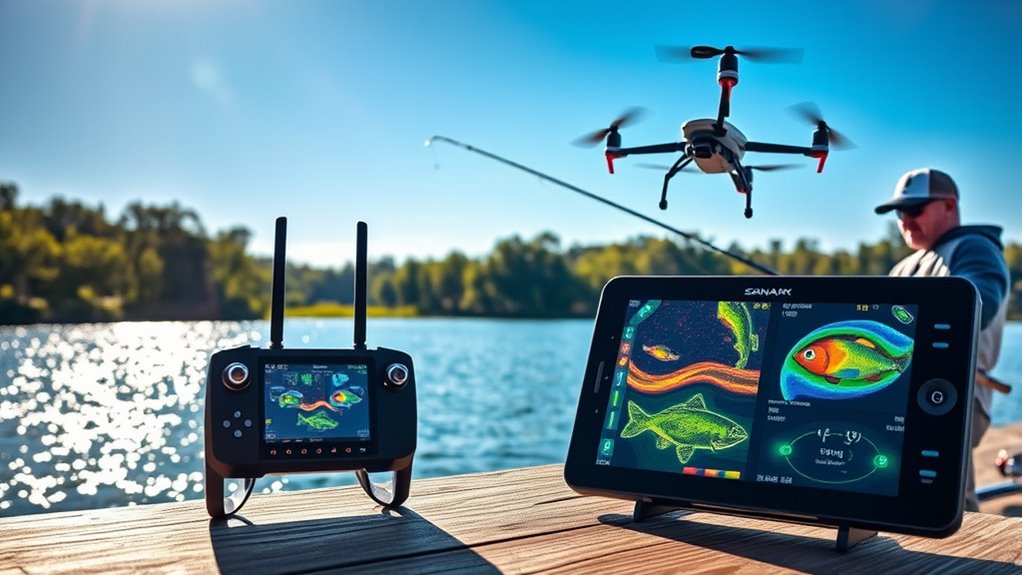

The best smart remote fishing gear for most anglers is the GDIFLS RC Fishing Bait Boat, which pairs GPS navigation with automatic return for controlled bait delivery. For a less boat-focused setup, the Yoocylii XF-08 stands out as a portable sonar fish finder, while the Deep Freeze BlueTipz adds a focused alert system for ice fishing tip-ups. The main choice is between remotely placing bait, reading underwater conditions, and receiving alerts when a line gets action. Bait boats offer reach and control but need more space and upkeep; portable sonar is easier to carry but does not deliver bait. Read on for a comparison of all eight picks and guidance on matching their features to your fishing routine.

Get your wardrobe favorites delivered free with Prime
- Fast, free delivery on millions of items
- Prime Video, Amazon Music and more included
- Member-only deals all year
Key Takeaways
- GPS and automatic return give the GDIFLS bait boat a strong all-around role for anglers who need controlled bait placement and a way to bring the boat back.
- The three bait-boat options serve different priorities: the RIAHNEAH adds dual motors and triple bait bins, while the separate 4.4 lb-capacity model makes payload its clearest point of comparison.
- Portable sonar is a different kind of remote help. The Yoocylii XF-08 has a 3.5-inch LCD, while the LUCKY YMT-202 and handheld LUCKY model suit buyers comparing compact fish-finding tools rather than bait delivery.
- The iBobber and BlueTipz address narrower tasks: wireless sonar scouting and ice tip-up alerts, respectively, rather than the broader range of jobs handled by a bait boat.
- Choosing by fishing method matters more than feature count: boats prioritize range, payload, and return control; fish finders prioritize portability and readable sonar; the ice alarm prioritizes timely bite alerts.
| LUCKY Portable Handheld Fish Finder and Depth Finder |  | Best for Straightforward Sonar Readings | Brand: LUCKY | Model: 1108CP | Display: 2-inch LCD | VIEW ON AMAZON | See Our Full Breakdown |
| GDIFLS RC Fishing Bait Boat with GPS and Automatic Return |  | Best for GPS-Guided Bait Placement | Brand: GDIFLS | GPS positioning points: 16 | Remote control range: 1,968.5 feet | VIEW ON AMAZON | See Our Full Breakdown |
| Yoocylii XF-08 Portable Fish Finder with Sonar Transducer and 3.5-Inch LCD |  | Best for a Larger Dedicated Display | Brand: Yoocylii | Model: XF-08 | Sonar frequency: 125 kHz | VIEW ON AMAZON | See Our Full Breakdown |
| Deep Freeze BlueTipz Bluetooth Ice Fishing Tip-Up Alarm with LED |  | Best for Ice-Fishing Strike Alerts | Brand: Deep Freeze | Model: BTT-222MAX | Package size: 2 transmitters | VIEW ON AMAZON | See Our Full Breakdown |
| ReelSonar iBobber Wireless Bluetooth Fish Finder |  | Best for App-Based Mapping and Trip Logs | Brand: ReelSonar | Model: Classic | Depth range: 135 feet | VIEW ON AMAZON | See Our Full Breakdown |
| RIAHNEAH GPS Fishing Bait Boat with Dual Motors and Triple Bait Bins |  | Best for Organized Multi-Spot Baiting | Control range: 1,968 ft | Navigation features: GPS, auto return, low-battery alert | Bait capacity: 3.3 lbs | VIEW ON AMAZON | See Our Full Breakdown |
| GPS Remote-Controlled Fishing Bait Boat with Dual Motors, 4.4 lb Capacity |  | Best for Long GPS-Guided Sessions | Control range: Up to 1,968.5 ft (600 m) | GPS navigation: Up to 16 waypoints; automatic return on low battery or signal loss | Bait capacity: 4.4 lbs (2 kg) | VIEW ON AMAZON | See Our Full Breakdown |
| LUCKY YMT-202 Portable Wireless Fish Finder |  | Best Portable Sonar for Shore and Kayak Anglers | Display: 3.5-inch LCD | Operation distance: 853 ft | Depth range: 3–147 ft | VIEW ON AMAZON | See Our Full Breakdown |
| smart remote fishing gear | Brand | Model |
|---|---|---|
| LUCKY Portable Handheld Fish F | LUCKY | 1108CP |
| GDIFLS RC Fishing Bait Boat wi | GDIFLS | — |
| Yoocylii XF-08 Portable Fish F | Yoocylii | XF-08 |
| Deep Freeze BlueTipz Bluetooth | Deep Freeze | BTT-222MAX |
| ReelSonar iBobber Wireless Blu | ReelSonar | Classic |
| RIAHNEAH GPS Fishing Bait Boat | — | — |
| GPS Remote-Controlled Fishing | — | — |
| LUCKY YMT-202 Portable Wireles | — | — |
More Details on Our Top Picks
LUCKY Portable Handheld Fish Finder and Depth Finder
I’d choose the LUCKY 1108CP when I want basic sonar information without relying on a phone app. Its handheld display shows approximate fish locations, depth, and bottom features, while the fish alarms can help me notice activity without watching the screen constantly. Compared with the ReelSonar iBobber, it keeps the readings on a dedicated device rather than a smartphone, but gives up the iBobber’s water mapping and trip logging. The 2-inch backlit LCD is compact, not spacious, and its stated 4–5-hour battery runtime makes it a less natural choice for long outings than the iBobber’s rechargeable battery life. Fish locations are approximate, so I’d use the display as a guide rather than a precise target.
Pros:- Shows approximate fish locations, depth, and bottom features on the device
- Backlit display and selectable feet or meters support use in varied conditions
- Adjustable sensitivity and fish alarms help flag possible activity
- Portable handheld design includes a neck strap
Cons:- Stated runtime is at least 4–5 hours with a new battery, so longer trips may need a power plan
- Fish locations are approximate rather than exact
- The 2-inch screen offers less viewing space than the Yoocylii XF-08’s 3.5-inch display
Best for: Kayak and small-boat anglers who want basic depth and fish alerts on a dedicated handheld screen instead of a smartphone.
Not ideal for: Anglers who need app-based mapping, a larger display, or sonar for a full day without planning around battery runtime.
- Brand:LUCKY
- Model:1108CP
- Display:2-inch LCD
- Maximum measuring depth:328 feet (100 meters)
- Minimum measuring depth:3 feet (1 meter)
- Battery life:At least 4–5 hours with a new battery
- Sensitivity settings:5 levels
- Dimensions:2.68 × 1.18 × 4.8 inches
Our verdict“I’d pick this for simple, phone-free sonar readings from a kayak or boat, but not for app-based mapping or extended sessions.”
GDIFLS RC Fishing Bait Boat with GPS and Automatic Return
The GDIFLS bait boat is the pick I’d make when the main job is carrying bait to repeatable spots, not reading sonar from the water. It stores up to 16 GPS positioning points for automatic cruising and return, which can reduce repeated manual steering compared with a castable finder such as the ReelSonar iBobber. Its stated control range of 1,968.5 feet and roughly four-hour runtime suit anglers covering distant or recurring locations; the 4.4-pound load capacity sets a practical limit on how much bait it can carry. Unlike the fish finders in this lineup, it doesn’t provide depth or fish-location readings. I’d also factor in the Chinese-language manual: setup may take extra effort for buyers who don’t read Chinese.
Pros:- GPS supports up to 16 positioning points and automatic cruising and return
- Stated remote control range is 1,968.5 feet
- 5,200 mAh battery is rated for about four hours of operation
- Includes a carrying bag and propeller covers
Cons:- Included manual is in Chinese, which may make setup harder for some buyers
- 4.4-pound load capacity limits bait and payload
- Unlike the Yoocylii XF-08 and LUCKY 1108CP, it does not provide sonar or fish-finding readings
Best for: Carp and lake anglers who want to deliver bait to saved GPS spots and bring the boat back automatically.
Not ideal for: Buyers seeking sonar readings, a simple setup with an English manual, or capacity beyond the stated 4.4-pound load limit.
- Brand:GDIFLS
- GPS positioning points:16
- Remote control range:1,968.5 feet
- Battery:5,200 mAh lithium
- Runtime:About 4 hours
- Maximum speed:3.28 feet per second
- Load capacity:4.4 pounds
- Included components:Fishing bait boat, carrying bag, USB cable, remote control, charger, Chinese manual
Our verdict“I’d choose this for GPS-guided bait delivery across a lake, provided its payload suits my rig and the manual is workable for me.”
Yoocylii XF-08 Portable Fish Finder with Sonar Transducer and 3.5-Inch LCD
I’d favor the Yoocylii XF-08 when a larger screen and extra water data matter more than a simple handheld readout. Its 3.5-inch color LCD can show fish indicators, temperature, depth, and bottom contours, giving me more context than the LUCKY 1108CP’s 2-inch monochrome display. The wireless probe’s stated range is 328–656 feet, while the ReelSonar iBobber connects over Bluetooth up to 100 feet and adds mapping and trip logging. The XF-08 instead offers a probe and accessories suited to different fishing setups. There’s a specification conflict worth noting: product details list a 164-foot maximum depth, while another specification says 328 feet. I’d confirm the depth claim before buying, and account for the four AAA batteries, which are not included.
Pros:- 3.5-inch color display shows fish indicators, temperature, depth, and bottom contours
- Wireless probe is listed with a 328–656-foot range
- Accessories support varied setups, including a float, side-scan adapter, and mounting hardware
- Adjustable brightness, measurement units, and depth or fish alerts
Cons:- Maximum depth is listed as 164 feet in product details and 328 feet in specification text
- Four AAA batteries are not included
- Does not offer the ReelSonar iBobber’s listed water mapping and trip logging
Best for: Anglers who fish from shore, a kayak, a boat, or through ice and want a larger color display with temperature and bottom information.
Not ideal for: Buyers who need a clearly stated maximum depth, don’t want to supply AAA batteries, or prefer mapping and trip records in a phone app.
- Brand:Yoocylii
- Model:XF-08
- Sonar frequency:125 kHz
- Maximum depth:164 feet in product details; 328 feet in specification text
- Wireless range:328–656 feet (100–200 meters)
- Display:3.5-inch color LCD, 480 × 320 resolution
- Power:4 AAA batteries, not included
- Included accessories:Sonar probe with 25-foot cable, float, side-scan adapter, mounting hardware, neck strap, and power cables
Our verdict“I’d choose the XF-08 for a larger, more information-rich sonar screen across different fishing setups, after checking which depth specification applies.”
Deep Freeze BlueTipz Bluetooth Ice Fishing Tip-Up Alarm with LED
The Deep Freeze BlueTipz solves a different problem from the sonar units here: it alerts me when a tip-up is struck rather than searching for fish or measuring depth. That makes it a more focused ice-fishing tool than the LUCKY 1108CP or the app-connected ReelSonar iBobber, both of which provide sonar readings. BlueTipz sends alerts to an iOS or Android device over Bluetooth, and its app lets me assign transmitter names and LED colors so I can tell which line needs attention. The stated range reaches 600 feet, but I’d treat that as a limit to check against my setup, not a promise across every condition. Phone-free use needs a separate BlueTipz receiver, and some tip-ups or automatic hook setters may need adapters.
Pros:- Sends strike alerts to compatible iOS and Android devices or a BlueTipz receiver
- App supports transmitter names and customizable LED colors
- Works with tip-ups, tip-downs, and automatic hook setters
- Includes one AAA battery and comes as a two-transmitter package
Cons:- Phone alerts require a compatible smartphone or tablet; phone-free operation needs a separate receiver
- Stated maximum range is 600 feet and may not suit every layout
- Adapters may be required for some fishing devices
Best for: Ice anglers watching several tip-ups who want named phone alerts or color-coded LED signals when a line is triggered.
Not ideal for: Anglers looking for sonar, depth readings, or phone-free alerts without buying the separate receiver.
- Brand:Deep Freeze
- Model:BTT-222MAX
- Package size:2 transmitters
- Compatibility:iOS and Android smartphones and tablets; BlueTipz receiver
- Maximum range:600 feet
- Power source:Battery powered; 1 AAA battery included
- Mounting type:Surface mount
- Item weight:1.5 ounces
Our verdict“I’d choose BlueTipz to monitor multiple ice-fishing lines remotely, not as a substitute for a fish finder.”
ReelSonar iBobber Wireless Bluetooth Fish Finder
The ReelSonar iBobber makes the most sense when I want a compact sonar device that sends readings to a phone and keeps a record of where I’ve fished. Its castable design, fish and strike alerts, water mapping, and trip logging give it a more app-centered role than the screen-equipped LUCKY 1108CP, which shows readings directly on the device. The iBobber lists sonar readings to 135 feet and Bluetooth range up to 100 feet, so the phone needs to stay relatively close while the bobber is in use. Its stated battery life of over 10 hours is longer than the LUCKY’s stated 4–5 hours, but the requirement for a compatible phone or tablet is a meaningful tradeoff. I’d also choose the Yoocylii XF-08 instead if I wanted a larger dedicated color display.
Pros:- Compact, castable design works in freshwater and saltwater
- Displays fish by size and depth and includes fish and strike alerts
- App supports water mapping and trip logging
- Stated battery life is over 10 hours
Cons:- Requires a compatible smartphone or tablet to view app-connected readings
- Bluetooth range is listed as up to 100 feet
- Its 135-foot depth range is shorter than the LUCKY 1108CP’s stated 328-foot maximum
Best for: Shore and small-boat anglers who want castable sonar, phone alerts, and app-based water mapping and trip logs.
Not ideal for: Anglers who don’t want to use a compatible smartphone or tablet, or who need a longer wireless link than 100 feet.
- Brand:ReelSonar
- Model:Classic
- Depth range:135 feet
- Wireless range:Up to 100 feet
- Battery life:Over 10 hours
- Connectivity:Bluetooth Smart
- Compatibility:iOS and Android
- Water use:Freshwater and saltwater
Our verdict“I’d pick the iBobber for portable, app-based sonar and mapping, but not if I want a dedicated screen or a longer wireless range.”
RIAHNEAH GPS Fishing Bait Boat with Dual Motors and Triple Bait Bins
The RIAHNEAH makes the most sense for anglers who want GPS-assisted bait delivery and the flexibility to carry several bait portions in one run. Its triple bins can hold 3.3 pounds altogether, letting you separate or distribute bait without returning to shore between every drop. Compared with the GPS Remote-Controlled Fishing Bait Boat, it has less stated capacity, but includes two batteries and lists up to 90 minutes of runtime per battery. That gives buyers a clear spare-battery option, though charging and changing batteries add effort. GPS, auto return, and low-battery alerts help reduce the risk of losing track of the boat at range; the 1,968-foot control range supports distant drops. The tradeoff is that its stated speed and per-battery runtime are more modest than the other bait boat’s advertised four-hour run.
Pros:- GPS, auto return, and low-battery alerts support more confident bait delivery at a distance.
- Triple bins allow up to 3.3 pounds of bait to be divided among separate drops.
- Two 5200 mAh batteries provide a spare for sessions beyond one battery’s stated runtime.
- Includes a carrying bag, propeller guard, and front and rear lights.
Cons:- Runtime is listed as up to 90 minutes per battery, shorter than the other GPS bait boat’s stated four hours.
- Its 3.3-pound bait capacity is lower than the other GPS bait boat’s 4.4-pound capacity.
- At 5.91 ft/s, its stated speed is not as conservative as a slower cruising speed for anglers prioritizing controlled placement.
Best for: Anglers who want to deliver different bait portions to several spots and value GPS return features plus a spare battery.
Not ideal for: Anglers who need the highest stated bait capacity or a single long session without swapping batteries; the other GPS bait boat lists 4.4 pounds of capacity and up to four hours of runtime.
- Control range:1,968 ft
- Navigation features:GPS, auto return, low-battery alert
- Bait capacity:3.3 lbs
- Bait bins:Triple
- Motors:Dual 390 motors, 52 W
- Batteries:2 × 5200 mAh Li-ion
- Runtime:Up to 90 minutes per battery
- Hull and weight:ABS; 4.4 lbs
Our verdict“Choose the RIAHNEAH if divided bait loads, GPS return, and a second battery matter more than maximum capacity or the longest stated single-battery runtime.”
GPS Remote-Controlled Fishing Bait Boat with Dual Motors, 4.4 lb Capacity
This bait boat stands out for combining 4.4-pound bait capacity with GPS routing for up to 16 waypoints. That pairing suits anglers who want to plan several drops and carry more bait per trip, rather than divide smaller loads as with the RIAHNEAH’s triple-bin setup. Its stated up-to-four-hour runtime is also longer than the RIAHNEAH’s 90 minutes per battery, though the claim is paired with an eight-hour charge time and only one listed 5200 mAh battery. Automatic return when the battery is low or signal is lost adds a useful safeguard, while the remote screen reports navigation and battery information. The slower cruising speed of about 3.28 ft/s may suit deliberate placement, but buyers should account for the long recharge and the included manual being in Chinese.
Pros:- Supports up to 16 GPS waypoints and automatic cruising for planned bait drops.
- Lists up to four hours of runtime, longer than the RIAHNEAH’s stated runtime per battery.
- Carries up to 4.4 pounds, more than the RIAHNEAH’s 3.3-pound capacity.
- Remote screen displays navigation and battery information; night lights and propeller covers are included.
Cons:- The listed eight-hour charging time can leave little room for a quick recharge between outings.
- The package includes a Chinese manual, which may make setup harder for English-speaking buyers.
- Only one 5200 mAh battery is listed, unlike the RIAHNEAH package with two batteries.
Best for: Anglers planning repeated GPS waypoint runs who want a larger bait load and a long stated runtime between charges.
Not ideal for: Buyers who need quick turnaround between sessions, clear English setup instructions, or the flexibility of a second included battery.
- Control range:Up to 1,968.5 ft (600 m)
- GPS navigation:Up to 16 waypoints; automatic return on low battery or signal loss
- Bait capacity:4.4 lbs (2 kg)
- Motors:Dual pure copper motors
- Cruising speed:About 3.28 ft/s (1 m/s)
- Battery:5200 mAh
- Runtime and charging:Up to 4 hours; about 8 hours to charge
- Hull and included items:ABS; remote, charger, USB cable, carrying bag
Our verdict“Pick this model for waypoint-based fishing and a larger bait load, provided its long charge time and Chinese manual fit your routine.”
LUCKY YMT-202 Portable Wireless Fish Finder
Unlike the RIAHNEAH and the other bait boat, the LUCKY YMT-202 is for finding fish and reading depth, not carrying bait to a GPS waypoint. Its castable sonar sensor works without a fixed mount or boat wiring, making it the more flexible pick for anglers moving between shore, kayak, boat, and ice. The 853-foot wireless range gives room to scan away from the display, while the 3.5-inch LCD presents fish icons and depth markers in a format intended to be easy to read. The tradeoff is a maximum listed depth of 147 feet, well short of a deep-water tool, and the sensor must be cast and tethered manually. Compared with the ReelSonar iBobber, this model pairs its wireless sensor with a dedicated LCD rather than relying on a phone-based display.
Pros:- Castable wireless sensor works without mounting hardware or complex wiring.
- 853-foot operation distance gives anglers room to scan away from the display.
- Dedicated 3.5-inch LCD shows fish icons and depth markers without requiring a phone display.
- Portable design suits shore, kayak, boat, and ice fishing.
Cons:- The listed depth range tops out at 147 feet, limiting use in deeper water.
- The sensor must be cast and tethered manually rather than following an automated route.
- Unlike the bait boats in this roundup, it does not carry or release bait.
Best for: Shore, kayak, and ice anglers who want portable sonar with a dedicated screen and no permanent installation.
Not ideal for: Anglers targeting water deeper than 147 feet or anyone who wants automatic boat-based bait delivery instead of manually casting a sonar sensor.
- Display:3.5-inch LCD
- Operation distance:853 ft
- Depth range:3–147 ft
- Beam angle:90°
- Mounting type:Portable and castable
- Power source:Rechargeable battery
- Weight:0.7 kg
- Warranty:One year
Our verdict“Choose the YMT-202 if you want portable, screen-based sonar across different fishing locations, and skip it for deep-water scanning or automated bait delivery.”

How We Picked
I ranked these options by how directly they help with remote fishing tasks: locating fish, delivering bait, or alerting an angler to a strike. I gave greater weight to practical control and clear use-case fit than to the number of listed features. That puts the GDIFLS first for combining GPS and automatic return with bait delivery, while the Yoocylii earns a high place for a screen-based portable sonar option. I treated the ice-specific BlueTipz and the wireless iBobber as focused tools rather than substitutes for a bait boat.
I also compared portability, operating complexity, payload or display details where supplied, and the likely upkeep of each gear type. The RIAHNEAH and 4.4 lb-capacity boat remain distinct alternatives because bins and stated capacity answer different buyer needs. The LUCKY fish finders rank as simpler sonar-focused choices, though the available feature details offer less basis for separating them. Since specifications do not settle questions such as real-world range, battery endurance, or compatibility with every phone, I avoid treating those as proven advantages.
| smart remote fishing gear | Brand |
|---|---|
| LUCKY Portable Handheld Fish F | LUCKY |
| GDIFLS RC Fishing Bait Boat wi | GDIFLS |
| Yoocylii XF-08 Portable Fish F | Yoocylii |
| Deep Freeze BlueTipz Bluetooth | Deep Freeze |
| ReelSonar iBobber Wireless Blu | ReelSonar |
| RIAHNEAH GPS Fishing Bait Boat | — |
| GPS Remote-Controlled Fishing | — |
| LUCKY YMT-202 Portable Wireles | — |
Factors to Consider When Choosing Smart Remote Fishing Gear
Before choosing, decide which part of fishing you want to control remotely. Gear that delivers bait cannot replace sonar, and a fish finder will not move a rig across water for you. I would start with the job, then compare operating conditions, portability, and the effort required to maintain the device.
Choose the Remote Task Before Comparing Features
Make a short list of what you want the device to do: scout underwater activity, carry bait, or alert you to a bite. These tasks are not interchangeable, even when products all use wireless controls or connectivity. A bait boat may help reach a chosen spot, but it does not automatically tell you whether fish are there. A sonar unit can provide underwater readings, but it cannot place bait at a distance. Buying for the wrong task is a common source of disappointment, so let your fishing method set the category first.
Match the Device to Your Water and Fishing Setup
Think about where you fish, how far you need to reach, and whether the shore or boat leaves room to operate the gear. Open water may make a bait boat useful, while ice fishing calls for equipment suited to tip-ups and cold-weather handling. Sonar tools also depend on how you plan to position the transducer and interpret readings. Check the product documentation for operating limits and compatible setups instead of assuming a device works on every water type. A feature that is useful on a large pond may add little on a small, sheltered spot.
Treat GPS, Return Control, and Manual Handling as Separate Benefits
GPS can help with navigation, while automatic return addresses the practical problem of bringing a remote boat back. Neither feature tells you how the boat behaves around obstacles or in changing conditions, so check the stated operating guidance before relying on automation. A manual-control model may suit a smaller area or a buyer who prefers direct steering. For a first remote boat, return functionality can reduce the effort involved in recovery, but it should not replace attention to the boat while it is moving. Compare the control functions individually rather than treating a GPS label as proof of complete autonomy.
Size Payload Against the Bait You Actually Carry
For bait boats, capacity affects the number and type of rigs or bait loads you can take on a trip. A stated 4.4 lb capacity is useful only if it matches your intended payload and leaves room for the way you fish. Multiple bins can support separate drops or bait choices, but extra compartments do not automatically mean greater total capacity. Check whether the maker describes payload as a maximum and whether that figure includes any attached tackle. Choosing a boat larger than your routine requires can add bulk without improving your results.
Plan for Power, Charging, and Care
Remote gear depends on batteries, and a fishing session can be interrupted if charging needs do not match your outing. Look for the maker’s stated runtime, charging method, and battery replacement guidance; do not infer endurance from the product category. Boats also need attention to their motors, hull, and moving parts, while sonar units and wireless alarms require care around their sensors and connections. Rinse or dry equipment as directed, especially after use in wet or cold conditions. A simpler device may be the better choice if you want fewer parts to prepare and maintain.
Check the Phone, Screen, and Alert Experience
Bluetooth gear can depend on a compatible phone and an app, while a fish finder with its own LCD offers a dedicated display. Confirm supported operating systems, pairing requirements, and whether core functions remain available if a phone connection drops. A larger or separate screen may be easier to read outdoors, but it can add bulk to a portable setup. For bite alarms, think about where you will be standing or sitting and whether a light or phone notification is the more useful cue. Decide how you want to receive information before choosing based on connectivity alone.
Frequently Asked Questions
Should I buy a bait boat or a portable fish finder first?
Start with the limitation you encounter most often. If you can already identify promising water but cannot place bait where you want it, a bait boat addresses that gap. If you can cast to likely areas but lack information about depth or fish activity, a portable sonar option may be the more useful first purchase. Neither category replaces the other, so buying both makes sense only when each solves a distinct problem in your routine. The GDIFLS represents the remote-delivery path, while the Yoocylii XF-08 represents the screen-based sonar path.
Is automatic return worth prioritizing on a GPS bait boat?
Automatic return can make recovery easier, especially when you send a boat away from the bank or want a straightforward route back. It does not remove the need to monitor the boat, check its operating limits, or account for obstacles and conditions. Look for clear instructions on what triggers return and how the function behaves if the GPS signal or power is interrupted. If you fish close to shore in a small area, dependable manual control may matter more than automation. For longer bait runs, return control is a meaningful feature to compare.
Will a Bluetooth fish finder work without a phone signal?
Bluetooth communication between a device and a nearby phone does not necessarily require cellular service, but the app and its features can vary by product. Check the maker’s requirements for initial setup, map access, software updates, and live use before heading to a remote location. Also confirm that your phone supports the required operating system and Bluetooth version. A dedicated-screen unit, such as the Yoocylii XF-08, may appeal if you prefer not to rely on a phone display. Do not assume every app function works offline without checking its documentation.
What should I prioritize for ice fishing: sonar or a tip-up alarm?
Choose according to whether you need underwater information or a signal that a tip-up has been triggered. A sonar unit helps with locating or reading activity, while the Deep Freeze BlueTipz is purpose-built to alert you to an ice-fishing tip-up event. These tools solve different problems and can complement each other, but one does not replace the other. Before buying an alarm, check how it attaches to your tip-up and what alert method it uses. For a first purchase, prioritize the tool that addresses the task you currently manage by hand.
How do I choose between bait bins and a higher payload rating?
Bins help organize or separate bait drops, while a payload rating describes how much the boat is specified to carry. Think through the rigs and bait you use on a typical outing, then compare that load with the manufacturer’s stated capacity and bin layout. The RIAHNEAH’s triple bins make compartment arrangement its clear point of difference; the 4.4 lb-capacity model gives buyers a stated weight figure to compare. Neither detail alone tells you which boat is better for every angler. Confirm how the maker defines capacity and choose the layout that suits your actual bait plan.
Conclusion
For the best overall balance of remote delivery and recovery features, I would start with the GDIFLS RC Fishing Bait Boat. The best value-style fit for a buyer focused on portable sonar is the LUCKY YMT-202, while the best premium-oriented choice for anglers prioritizing GPS navigation, multiple bait compartments, and dual motors is the RIAHNEAH. For beginners who want a dedicated display rather than boat controls, the Yoocylii XF-08 is the clearest starting point; ice anglers should look at the Deep Freeze BlueTipz for tip-up alerts. Choose the iBobber or either LUCKY finder when wireless or handheld sonar better fits your routine, and pick the 4.4 lb-capacity boat if payload is your main comparison point.
Halloween Picks

Pumpkin Halloween Fog Machine with 12-Color LEDs, Bluetooth Speaker, and Remote

12.5-Foot Lighted Halloween Inflatable Archway

10-Foot Halloween Inflatable Double-Headed Dragon Archway
As an affiliate, we earn on qualifying purchases.