
Get your wardrobe favorites delivered free with Prime
- Fast, free delivery on millions of items
- Prime Video, Amazon Music and more included
- Member-only deals all year
Key Takeaways
- Premium models like the Philips SmartSleep rely on hardware-based light calibration, which often produces a more natural color temperature shift than budget apps.
- App-controlled clocks offer superior scheduling flexibility, but they introduce a dependency on Wi-Fi stability and smartphone battery life that hardware-only clocks avoid.
- White noise integration is common, but the quality of the speaker varies wildly; Bluetooth connectivity does not always mean better audio quality for sleep sounds.
- Light therapy intensity is often overstated in marketing; most standard sunrise clocks do not reach the 10,000 lux threshold needed for Seasonal Affective Disorder treatment.
- Design aesthetics have shifted from clinical white plastics to wood grains and fabric covers, allowing these devices to blend into bedroom decor more seamlessly.
| Ecozy 3-in-1 Sunrise Alarm Clock and White Noise Machine with Smart App Control |  | Best App-Controlled All-in-One | Model: AC-SCE50S | Connectivity: 2.4GHz Wi-Fi; Bluetooth audio | Sleep sounds: 26 | VIEW ON AMAZON | See Our Full Breakdown |
| Philips SmartSleep Wake-Up Light with Sunrise and Sunset Simulation |  | Best for a Simple Sunrise Routine | Model: HF3520/60 | Wake-up sounds: 5 natural sounds | Brightness settings: 20 | VIEW ON AMAZON | See Our Full Breakdown |
| ecozy Lumo Ultra Smart Sunrise Alarm Clock with Pixel Art and White Noise |  | Best for Customizable Display Art | Display: Digital with customizable pixel art and GIFs | Connectivity: 2.4GHz Wi-Fi only | Power source: Corded electric | VIEW ON AMAZON | See Our Full Breakdown |
| ANJANK Smart Sunrise Alarm Clock and Sound Machine |  | Best for Multiple Household Schedules | Connectivity: Wi-Fi | Customizable alarms: Up to 15 | Sunrise modes: 5 | VIEW ON AMAZON | See Our Full Breakdown |
| JALL Full-Screen Sunrise Alarm Clock with White Noise and Bluetooth Speaker |  | Best for Audio Without App-First Controls | Sunrise duration: 10–60 minutes | Alarms: Dual alarms | Snooze: 5–20 minutes | VIEW ON AMAZON | See Our Full Breakdown |
| REACHER Smart Sunrise Alarm Clock with App Control and White Noise |  | Best for Wi-Fi Integration | Sunrise Duration: 5–60 minutes | Sunrise Colors: 8 options | Connectivity: 2.4 GHz Wi-Fi | VIEW ON AMAZON | See Our Full Breakdown |
| Glocusent Sunrise Alarm Clock and Sound Machine |  | Best for Reliability and Backup Power | Sunrise Simulation: 5 minutes | Alarms: Dual alarms | Sounds: 10 alarm, 30 soothing | VIEW ON AMAZON | See Our Full Breakdown |
| 12,000 Lux Light Therapy Lamp and Sunrise Alarm Clock with App Control | 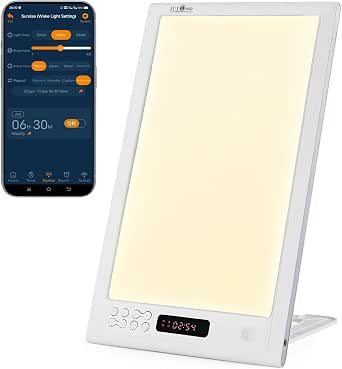 | Best for Light Therapy | Max Illumination: 12,000 lux | LED Source: 132 full-spectrum LEDs | Color Temperatures: 3000K, 4500K, 6000K | VIEW ON AMAZON | See Our Full Breakdown |
| Odokee Sunrise Alarm Clock and White Noise Machine |  | Best for Simplicity and Ease of Use | Sunrise Simulation: 5 to 60 minutes | Wake-up Modes: 3 modes | Sleep Sounds: 25 options | VIEW ON AMAZON | See Our Full Breakdown |
| Hatch Restore 3 Sleep Audio and Circadian Lighting (Greige) |  | Best Premium Ecosystem | Sleep Sounds: 80+ options | Lighting: Customizable circadian | Alarm Type: Sunrise simulation | VIEW ON AMAZON | See Our Full Breakdown |
| REACHER Wood Grain Sunrise Alarm Clock with Sound Machine and Nightlight |  | Best Aesthetic Integration | Material: Wood | Sunrise Simulation: 1% to 100% over 5–60 minutes | Sleep Sounds: 26 | VIEW ON AMAZON | See Our Full Breakdown |
| JALL K6 Sunrise Alarm Clock and White Noise Machine with Bluetooth Speaker |  | Best Feature Density | Connectivity: Bluetooth | Light Modes: 17 | Sunrise Duration: 10–60 minutes | VIEW ON AMAZON | See Our Full Breakdown |
| Dekala Sunrise Alarm Clock with Dual Alarms, Sleep Sounds, FM Radio, and Night Light |  | Best for Couples | Alarms: Dual | Sunset Simulation: Yes, 100% to 0% | Sleep Sounds: 8 | VIEW ON AMAZON | See Our Full Breakdown |
| Smart Sunrise Alarm Clock with App Control, Wake-Up Light, Sound Machine, FM Radio, and Wireless Speaker |  | Best for Smart Home Integration | Control Method: App and Device | Max Alarms: 4 via App | Light Colors: 11 | VIEW ON AMAZON | See Our Full Breakdown |
More Details on Our Top Picks
Ecozy 3-in-1 Sunrise Alarm Clock and White Noise Machine with Smart App Control
I’d choose the Ecozy 3-in-1 for a bedside routine built around one app-controlled device: its sunrise alarm, 26 sleep sounds, and ambient lighting can be managed alongside alarms and timers. That makes it more flexible for people who want sound and light to work together, rather than adding separate gadgets. Compared with the Philips SmartSleep Wake-Up Light, Ecozy offers app-based routines and Bluetooth audio, while Philips has FM radio and a more focused sunrise-and-sunset setup. The tradeoff is the Ecozy’s reliance on 2.4GHz Wi-Fi for app connectivity; homes using only 5GHz Wi-Fi may not be able to use those smart controls as intended. Its many lighting effects are useful for ambient color, but may be more than buyers who want a simple wake-up lamp need.
Pros:- Combines sunrise alarm, sound machine, and ambient light
- Offers 26 sleep sounds and app-managed alarms, timers, and routines
- 360° RGB lighting includes multiple effects and solid colors
- Bluetooth audio adds another way to play sound
Cons:- App connectivity supports 2.4GHz Wi-Fi only
- The range of app and lighting options may feel unnecessary to buyers who want a simple alarm
Best for: People who want app-managed alarms, sleep sounds, and customizable bedside lighting in a single device
Not ideal for: Households with only 5GHz Wi-Fi or buyers who want a straightforward sunrise lamp without app setup and extra lighting features
- Model:AC-SCE50S
- Connectivity:2.4GHz Wi-Fi; Bluetooth audio
- Sleep sounds:26
- Alarm sounds:7
- Lighting:360° RGB surround lighting; 9 effects and 8 solid colors
- Display:Digital
- Mounting:Tabletop
- Weight:14.11 oz
Our verdict“Choose the Ecozy 3-in-1 if you want a sunrise alarm with app-managed sound and lighting routines and have compatible 2.4GHz Wi-Fi.”
Philips SmartSleep Wake-Up Light with Sunrise and Sunset Simulation
The Philips SmartSleep Wake-Up Light is the most straightforward pick here for buyers who want sunrise light without app-controlled routines. Its sunrise and sunset simulation pair a gradual morning wake-up with a light-led wind-down, while 20 brightness settings let the lamp serve as a reading light. Compared with the app-focused Ecozy 3-in-1, Philips gives up customizable RGB lighting and app scheduling but keeps its core controls on the device and adds FM radio. Five natural wake-up sounds and tap snooze cover the basics without an extensive sound library. The tradeoffs are its corded power and plastic construction, along with fewer smart features than connected alternatives. I’d favor it for a simpler bedside routine, not for shoppers who want app control or lots of ambient-light customization.
Pros:- Simulates both sunrise and sunset for morning and bedtime routines
- 20 brightness settings support use as a reading lamp
- FM radio and five natural wake-up sounds provide straightforward audio choices
- Tap snooze and automatic display dimming support bedside use
Cons:- Requires corded electric power
- Plastic construction lacks the more distinctive materials or finishes some buyers may want
- Offers fewer app and lighting customization features than the Ecozy 3-in-1
Best for: Buyers who want sunrise and sunset lighting, basic wake-up sounds, and a reading lamp without relying on a phone app
Not ideal for: People seeking app-controlled schedules, Bluetooth audio, or a broad range of sleep sounds and color effects
- Model:HF3520/60
- Wake-up sounds:5 natural sounds
- Brightness settings:20
- Lighting features:Sunrise and sunset simulation
- Audio:FM radio
- Display:Automatically dimming
- Power source:Corded electric
- Weight:1113 g
Our verdict“Pick the Philips SmartSleep if you want a dedicated, easy-to-operate sunrise-and-sunset light rather than an app-centered smart clock.”
ecozy Lumo Ultra Smart Sunrise Alarm Clock with Pixel Art and White Noise
The ecozy Lumo Ultra makes the most sense for buyers who want their clock display to be part of the room’s personality, not just a time readout. Its customizable pixel art and GIFs give it a distinct visual role, while the sunrise alarm, sleep routines, and 35 stereo sounds cover the practical bedtime and wake-up needs. Compared with the Ecozy 3-in-1, the Lumo adds dual speakers and animated display art, but the 3-in-1 highlights broader RGB surround lighting and more sleep sounds. The Lumo also offers control through both its app and device buttons, so basic adjustments need not always involve a phone. Its 2.4GHz-only Wi-Fi and corded power limit placement and connectivity flexibility, and its animated features may distract buyers who prefer a dark, minimal bedside clock.
Pros:- Customizable pixel art and GIFs make the display visually distinctive
- Sunrise alarm and sleep routines support both morning and bedtime use
- 35 stereo sounds and dual speakers provide varied audio options
- App and device-button controls offer more than one way to adjust routines
Cons:- Wi-Fi connectivity supports 2.4GHz only
- Corded electric power restricts placement
- Animated display features may not suit buyers seeking a subdued clock
Best for: People who want a sunrise alarm with customizable pixel art, animated GIFs, and onboard controls as well as app routines
Not ideal for: Buyers who prefer a minimal display, need wireless placement, or rely on a 5GHz-only Wi-Fi network
- Display:Digital with customizable pixel art and GIFs
- Connectivity:2.4GHz Wi-Fi only
- Power source:Corded electric
- Sounds:35 stereo sounds
- Speakers:Dual speakers
- Dimensions:7.05 in W × 6.89 in H
- Weight:1.2 lb
- Warranty:1 year
Our verdict“Choose the Lumo Ultra if pixel-art customization matters as much as a gradual sunrise and you have a suitable place near power and 2.4GHz Wi-Fi.”
ANJANK Smart Sunrise Alarm Clock and Sound Machine
For households juggling different wake-up times, the ANJANK Smart Sunrise Alarm Clock stands out with up to 15 customizable alarms and schedules for different days. Its five sunrise modes, adjustable sunrise duration, and broad sound and color selections let each alarm be tailored rather than forcing everyone into one routine. Compared with the JALL Full-Screen Sunrise Alarm Clock, ANJANK offers far more alarm slots and app-managed settings, while JALL provides a 5W Bluetooth speaker and FM radio. The ANJANK’s versatility comes with a setup cost: the many options can take time to configure, and the product description says alarm and light controls depend on Wi-Fi and the app. I’d skip it if you want reliable, simple onboard operation without app dependence.
Pros:- Supports up to 15 customizable alarms for varied schedules
- Five sunrise modes and a 0–30-minute sunrise duration offer wake-up flexibility
- Includes 25 soothing sounds and extensive night-light color options
- Display brightness can be adjusted and scheduled to dim
Cons:- Alarm and light controls depend on Wi-Fi and the app
- The extensive customization may take time to set up
- Does not list Bluetooth audio or FM radio, unlike the JALL Full-Screen model
Best for: Families, couples, or shift workers who need several individually scheduled alarms and adjustable sunrise settings
Not ideal for: Buyers who want a simple clock with dependable controls that do not rely on Wi-Fi or an app
- Connectivity:Wi-Fi
- Customizable alarms:Up to 15
- Sunrise modes:5
- Sunrise duration:0–30 minutes
- Sound options:25 soothing sounds
- Alarm sounds:10
- Night-light colors:256, including 9 presets and rainbow mode
- Display brightness:0–100%, with scheduled dimming
Our verdict“Choose ANJANK if several people need separate alarm schedules and you are comfortable managing settings through its app.”
JALL Full-Screen Sunrise Alarm Clock with White Noise and Bluetooth Speaker
The JALL Full-Screen Sunrise Alarm Clock is a strong fit for buyers who want more than a wake-up lamp but do not need app-led routines. Its sunrise duration adjusts from 10 to 60 minutes, and dual alarms with separate daily, weekday, or weekend schedules help accommodate different routines. The 25 sleep sounds, FM radio, and 5W Bluetooth speaker give it a broader audio role than the Philips SmartSleep, which focuses more on sunrise and sunset simulation with FM radio and basic wake-up sounds. JALL also lets you black out the display, a useful option for people sensitive to light at night. The key compromise is time setup: Bluetooth synchronization requires a phone, so it is not entirely phone-independent. Its many light and audio features may also be unnecessary for buyers seeking a basic sunrise clock.
Pros:- Sunrise duration adjusts from 10 to 60 minutes
- Dual alarms support separate daily, weekday, and weekend schedules
- Offers 25 sleep sounds, FM radio, and a 5W Bluetooth speaker
- L0 screen blackout mode can keep the display dark overnight
Cons:- Bluetooth time synchronization requires a phone
- Multiple audio and lighting features may be unnecessary for buyers seeking a simple sunrise alarm
- Bluetooth speaker power may not suit buyers who want a dedicated room-filling speaker
Best for: People who want dual schedules, adjustable sunrise timing, and several audio options, plus the ability to turn the display off
Not ideal for: Buyers who want a very simple clock or expect time synchronization without using a phone
- Sunrise duration:10–60 minutes
- Alarms:Dual alarms
- Snooze:5–20 minutes
- Sleep sounds:25
- Sleep timer:10–480 minutes
- FM radio frequency:76–108 MHz
- Lighting effects:17: 8 solid colors and 9 dynamic RGB effects
- Speaker power:5W
- Display blackout:L0 screen blackout mode
Our verdict“Pick the JALL if you want flexible dual alarms, adjustable sunrise timing, and varied audio, and do not mind using a phone to sync the clock.”
REACHER Smart Sunrise Alarm Clock with App Control and White Noise
This model stands out for its 2.4 GHz Wi-Fi connectivity, allowing remote adjustments via app rather than relying on physical buttons. Compared to the Odokee, which uses manual dials, the REACHER offers greater convenience for users who prefer setting routines from their phone. The sunrise simulation stretches from 5 to 60 minutes, providing a highly customizable wake-up window. However, the reliance on Wi-Fi means setup can be finicky if your home network is congested or uses newer frequencies. It lacks a battery backup, unlike the Glocusent, so power outages will reset your settings. This option is best for tech-comfortable users who value remote control over standalone simplicity.
Pros:- Adjustable sunrise duration from 5 to 60 minutes
- Wi-Fi app control for remote customization
- No monthly subscription fees required
- Includes white noise and nature sounds
Cons:- Requires 2.4 GHz Wi-Fi for connectivity
- No battery backup for power outages
- Setup is dependent on app configuration
Best for: Tech-savvy users who want to adjust alarm settings and lighting remotely via smartphone without touching the device.
Not ideal for: Users with unstable Wi-Fi networks or those who prefer simple, button-operated devices without app dependencies.
- Sunrise Duration:5–60 minutes
- Sunrise Colors:8 options
- Connectivity:2.4 GHz Wi-Fi
- Audio Options:White noise, fan, nature
- Control Method:App and built-in controls
- Monthly Fees:None
Our verdict“Choose this if you want remote control flexibility and have a stable 2.4 GHz Wi-Fi network.”
Glocusent Sunrise Alarm Clock and Sound Machine
The Glocusent differentiates itself with a 1000mAh built-in battery, ensuring the alarm continues during temporary power interruptions. This is a significant advantage over the REACHER, which will lose settings if the power goes out. It features dual alarms, making it practical for households with different schedules. The sunrise simulation is fixed at 5 minutes, which is shorter than the customizable options in the Hatch Restore 3 or Odokee, but the gradual volume increase helps ease you awake. With 30 soothing sounds and a 5W Bluetooth speaker, it doubles as a solid audio hub. The tradeoff is that the battery is for backup only, not cordless use, and the sunrise window is less flexible than premium competitors.
Pros:- Battery backup maintains alarm during power outages
- Dual alarms support different user schedules
- 30 soothing sounds and 5W Bluetooth speaker
- Physical buttons and app control options
Cons:- Fixed 5-minute sunrise duration is short
- Battery is for backup, not cordless operation
- Battery life duration is not specified
Best for: Households with varying wake-up times who need reliable alarm functionality during occasional power fluctuations.
Not ideal for: Users seeking a long, gradual sunrise simulation (e.g., 30+ minutes) or a cordless design for travel.
- Sunrise Simulation:5 minutes
- Alarms:Dual alarms
- Sounds:10 alarm, 30 soothing
- Speaker Power:5W
- Battery:1000mAh backup
- Lighting Modes:12 modes, 20 levels
- Control Methods:Buttons and app
Our verdict“Ideal for those who prioritize alarm reliability and dual scheduling over extended sunrise customization.”
12,000 Lux Light Therapy Lamp and Sunrise Alarm Clock with App Control
This device is unique in the lineup because it prioritizes 12,000 lux illumination, making it a genuine light therapy lamp first and an alarm clock second. While the Philips SmartSleep is a known wake-up light, this model offers higher lux output suitable for combating seasonal affective disorder. The UV-free full-spectrum LEDs provide a brighter wake-up experience than the standard LEDs in the Odokee. However, it is a corded unit with a large footprint (10.8 inches wide), requiring significant bedside table space. The sunrise simulation is programmable via app, but users note potential inconsistency in app connectivity. It is a specialized tool for light therapy rather than a compact sleep aid.
Pros:- High-intensity 12,000 lux light output
- UV-free full-spectrum lighting (CRI >95)
- Programmable sunrise and sunset timers
- Three color temperature options
Cons:- Large physical footprint requires space
- App connectivity can be inconsistent
- Corded power only, no portability
Best for: Individuals seeking high-intensity light therapy for mood or Seasonal Affective Disorder who also want alarm functions.
Not ideal for: Users with small bedside tables or those looking for a compact, discreet sleep aid.
- Max Illumination:12,000 lux
- LED Source:132 full-spectrum LEDs
- Color Temperatures:3000K, 4500K, 6000K
- Built-in Sounds:10 nature sounds
- Dimensions:0.7 × 6.3 × 10.8 inches
- Power Source:Corded electric (18W)
- LED Lifespan:Over 50,000 hours
Our verdict“Select this if you need clinical-grade light therapy brightness alongside basic alarm features.”
Odokee Sunrise Alarm Clock and White Noise Machine
The Odokee stands out for its no-app requirement, relying entirely on physical buttons and dials for control. This contrasts sharply with the REACHER, which needs Wi-Fi and an app for full customization. For users who find smart device setup frustrating, this is a relief. It offers a customizable sunrise simulation (5 to 60 minutes) and 25 sleep sounds via a 5W Bluetooth speaker. The dimmable display and 12-color night light add versatility without complexity. However, the lack of app control means you cannot adjust settings remotely or view usage data. It is a robust, standalone device that prioritizes immediate usability over connectivity, making it ideal for guest rooms or tech-averse users.
Pros:- Physical buttons and dials require no app
- Customizable sunrise duration (5–60 minutes)
- 5W Bluetooth speaker with 25 sounds
- Dimmable display and 12-color night light
Cons:- No remote app control or customization
- No battery backup for power outages
- Limited smart home integration
Best for: Users who prefer physical controls and want to avoid app setup or Wi-Fi connectivity issues.
Not ideal for: Tech enthusiasts who want remote control, data tracking, or integration with smart home ecosystems.
- Sunrise Simulation:5 to 60 minutes
- Wake-up Modes:3 modes
- Sleep Sounds:25 options
- Speaker:5W stereo Bluetooth
- Display:0–100% dimmable
- Night Light:12 color options
- Controls:Physical buttons and dials
Our verdict“Perfect for those who want a simple, reliable alarm clock without the hassle of app configuration.”
Hatch Restore 3 Sleep Audio and Circadian Lighting (Greige)
The Hatch Restore 3 is the most polished option here, offering over 80 sleep sounds and deep customization through its app. Unlike the REACHER or Glocusent, which offer basic app control, Hatch provides a comprehensive sleep tracking and routine-building platform. The circadian lighting adjusts color temperature to support natural rhythms, a feature absent in the Odokee. However, the premium experience comes with a caveat: many advanced features and the full sound library are locked behind the Hatch+ subscription after a 30-day trial. This recurring cost sets it apart from the one-time purchase models in this list. It is designed for users deeply invested in sleep optimization and willing to pay for a cohesive ecosystem.
Pros:- Extensive library of 80+ sleep sounds
- Advanced circadian lighting customization
- High-quality app for routine building
- Sleek, premium design aesthetics
Cons:- Requires subscription for full features
- Higher long-term cost due to fees
- Dependent on app for most functions
Best for: Sleep optimization enthusiasts who want detailed tracking, vast audio libraries, and are willing to pay for a subscription.
Not ideal for: Budget-conscious buyers or those who dislike recurring monthly fees for hardware features.
- Sleep Sounds:80+ options
- Lighting:Customizable circadian
- Alarm Type:Sunrise simulation
- Subscription:Hatch+ required for full features
- Trial Period:30 days for new users
- Control Method:App-centric
- Color Option:Greige
Our verdict“Choose this if you want the most feature-rich sleep ecosystem and don’t mind a subscription cost.”
REACHER Wood Grain Sunrise Alarm Clock with Sound Machine and Nightlight
This model stands out for its wood grain finish, a rare material choice in a category dominated by plastic. While the JALL K6 offers more tech features like Bluetooth, the REACHER prioritizes visual warmth, making it less likely to clash with traditional bedroom decor. The 26 sleep sounds provide a wider variety than the Dekala’s eight options, catering to users who need specific audio textures for sleep. However, it lacks the app connectivity found in the BIB_WJ model, meaning all adjustments must be made physically on the device. This tradeoff favors simplicity over smart home integration, appealing to those who want a clock that feels like furniture rather than a gadget.
Pros:- Wood grain material offers a warmer, more premium look than standard plastic models
- 26 built-in sleep sounds provide more variety than most competitors
- Built-in battery preserves alarm settings during power outages
Cons:- No Bluetooth or app control for remote adjustments
- Requires a constant corded power connection for full functionality
Best for: Design-conscious users who want a clock that blends into wooden furniture or bohemian-style bedrooms.
Not ideal for: Tech enthusiasts who prefer adjusting settings via smartphone apps or need smart home integration.
- Material:Wood
- Sunrise Simulation:1% to 100% over 5–60 minutes
- Sleep Sounds:26
- Nightlight Colors:8
- Power Source:Corded electric
- Dimensions:6.7 x 2.7 x 6 inches
- Backup Battery:Yes, preserves settings
Our verdict“Choose this if you prioritize bedroom aesthetics and sound variety over smart connectivity.”
JALL K6 Sunrise Alarm Clock and White Noise Machine with Bluetooth Speaker
The JALL K6 is the most versatile option here, combining a sunrise alarm, white noise machine, and Bluetooth speaker in one unit. Unlike the REACHER, which relies on internal sounds, this model lets you stream your own playlists or podcasts for sleep assistance. The 17 mood light modes offer more customization than the Dekala’s seven-color ambient light. However, the device is physically larger than the compact BIB_WJ, requiring more bedside table space. It also relies on a USB-C cable rather than a traditional power brick, which might require a separate adapter if you don’t have one handy, adding a layer of setup complexity.
Pros:- Bluetooth connectivity allows streaming of custom audio sources
- 17 mood light modes provide extensive ambient lighting options
- Display can be completely turned off for total darkness
Cons:- Larger footprint compared to compact models like the BIB_WJ
- Requires a USB power source, not a direct wall plug adapter
Best for: Users who want to stream their own audio content via Bluetooth while using the sunrise feature.
Not ideal for: Those with very small nightstands or who prefer dedicated, non-multi-function devices.
- Connectivity:Bluetooth
- Light Modes:17
- Sunrise Duration:10–60 minutes
- Power Connector:USB Type-C
- Dimensions:7.5 x 3.5 x 7.5 inches
- Weight:10.24 ounces
- Display Control:Fully dimmable/off
Our verdict“This is the best choice for users who want a multi-functional audio and lighting hub.”
Dekala Sunrise Alarm Clock with Dual Alarms, Sleep Sounds, FM Radio, and Night Light
The Dekala distinguishes itself with dual alarms, a critical feature for partners with different wake-up times that many single-alarm competitors lack. It also includes a sunset simulation that gradually dims the light, helping wind down before sleep, a feature missing from the JALL K6. While the BIB_WJ offers app control, the Dekala’s physical interface is straightforward for those who dislike managing apps. The inclusion of an FM radio adds utility for traditional radio listeners, though the sound quality is basic. The rechargeable battery is a nice touch for portability, but the lack of detailed runtime specs makes it hard to judge how long it lasts away from a charger.
Pros:- Dual alarms allow two different wake-up times on one device
- Sunset simulation helps with winding down before sleep
- Includes FM radio for traditional broadcast listening
Cons:- Only 8 sleep sounds, which is fewer than the REACHER or JALL
- Rechargeable battery runtime is not specified
Best for: Couples or households with varying sleep schedules who need independent alarm times.
Not ideal for: Solo sleepers who don’t need dual alarms and prefer a more minimalist design.
- Alarms:Dual
- Sunset Simulation:Yes, 100% to 0%
- Sleep Sounds:8
- FM Radio:76–108 MHz
- Power Source:Rechargeable battery
- Display Brightness:4 levels
- Dimensions:6.5 x 6.5 inches
Our verdict“Ideal for households needing flexible scheduling and wind-down lighting without app complexity.”
Smart Sunrise Alarm Clock with App Control, Wake-Up Light, Sound Machine, FM Radio, and Wireless Speaker
This BIB_WJ model is the only one in this batch offering app control, allowing users to set up to four alarms and adjust settings remotely without fumbling in the dark. Compared to the Dekala, which requires manual button presses, the app interface is cleaner and more flexible for complex schedules. It also supports wireless music playback, similar to the JALL K6, but with a more compact vertical design that saves horizontal space. The tradeoff is its narrow form factor, which might feel less stable on crowded surfaces. Additionally, the requirement for a specific power adapter can be a hassle if you lose the included cable, unlike the universal USB-C found on the JALL.
Pros:- App control enables easy scheduling of up to four alarms
- Compact vertical design saves bedside table space
- Supports wireless music playback and FM radio
Cons:- Requires a specific power adapter rather than universal USB
- Only two alarms can be set directly on the device without the app
Best for: Tech-savvy users who want to manage alarms and settings via a smartphone app.
Not ideal for: Users who prefer physical buttons and dislike managing separate companion apps.
- Control Method:App and Device
- Max Alarms:4 via App
- Light Colors:11
- Sound Modes:7 natural sounds
- Dimensions:2.5 x 6.5 inches
- Power:Adapter required
- Warranty:1 year
Our verdict“The best option for users who value remote control and flexible scheduling via a smartphone.”

How We Picked
I evaluated these fourteen devices based on their ability to simulate a natural sunrise, the quality of their accompanying audio features, and the usability of their control interfaces. I prioritized models that offer a gradual light increase over at least 20 to 30 minutes, as abrupt changes can cause sleep inertia. I also examined the user interface, distinguishing between those requiring a dedicated smartphone app and those with intuitive physical buttons or touch controls. Build quality and material durability were considered to ensure the devices feel like long-term bedroom staples rather than temporary gadgets. Finally, I weighed the value proposition of each model, looking for those that deliver core wake-up functionality without unnecessary bloat.Factors to Consider When Choosing Smart Alarm Clocks With Sunrise Light
Selecting the right smart alarm clock involves more than just picking the brightest light. You need to consider how the device interacts with your sleep hygiene and morning routine. Here are the critical factors to weigh before making a purchase.Light Simulation Quality And Color Temperature
The effectiveness of a sunrise alarm clock depends heavily on how accurately it mimics the gradual shift from darkness to daylight. Color temperature control is a key differentiator here, as warmer red and orange hues initially help stimulate melatonin suppression without shocking the system. Cheaper models often jump directly to bright white light, which can feel jarring and less natural. Look for devices that offer a slow ramp-up over 20 to 30 minutes, allowing your body to ease into wakefulness. If you suffer from seasonal affective disorder, verify if the clock actually meets therapeutic lux levels, as many standard wake-up lights do not.
App Connectivity Versus Standalone Functionality
Decide whether you prefer a device that relies on a smartphone app or one that operates independently. App-controlled clocks allow for complex scheduling, such as different wake-up profiles for weekdays and weekends, and provide access to extensive sound libraries. However, this convenience comes with a reliance on stable Wi-Fi connections and regular app updates. Standalone units with physical buttons are less prone to connectivity issues and are often easier to use if you dislike managing digital accounts. Consider your comfort level with technology when choosing between these two control philosophies.
Audio Quality And Sound Source Options
While the light is the primary feature, the accompanying audio plays a significant role in the waking experience. Built-in white noise machines integrated into these clocks vary greatly in fidelity; some produce harsh digital artifacts that can be irritating. Higher-end models often feature better speakers capable of playing music or nature sounds with clarity. If you plan to stream your own audio, check for Bluetooth functionality, but note that Bluetooth pairing can sometimes disconnect during the night. For consistent sleep aid, dedicated onboard sound files are often more reliable than streaming connections.
Display Visibility And Nighttime Distraction
A glowing digital clock face can disrupt sleep if it is too bright, even if the screen dims automatically. Dimmable displays are a mandatory feature for any bedroom device, allowing you to reduce light output to a barely perceptible level. Some models offer a complete display off option, which is ideal for light-sensitive sleepers. Pay attention to whether the time display uses large, easy-to-read numerals or a minimalist design that blends into the background. The goal is to check the time without fully waking up or disrupting your circadian rhythm.
Power Requirements And Backup Reliability
Most smart alarm clocks require a constant power source, but power outages can reset settings and leave you without an alarm. Battery backup capabilities are a critical but often overlooked feature, ensuring your alarm still sounds if the electricity fails. Some devices use a small internal capacitor to retain time settings, while others require disposable batteries. If you live in an area with frequent power interruptions, prioritize models with robust backup systems. Additionally, consider the placement of the device; it needs to be within reach of an outlet, which may limit bedside table positioning.