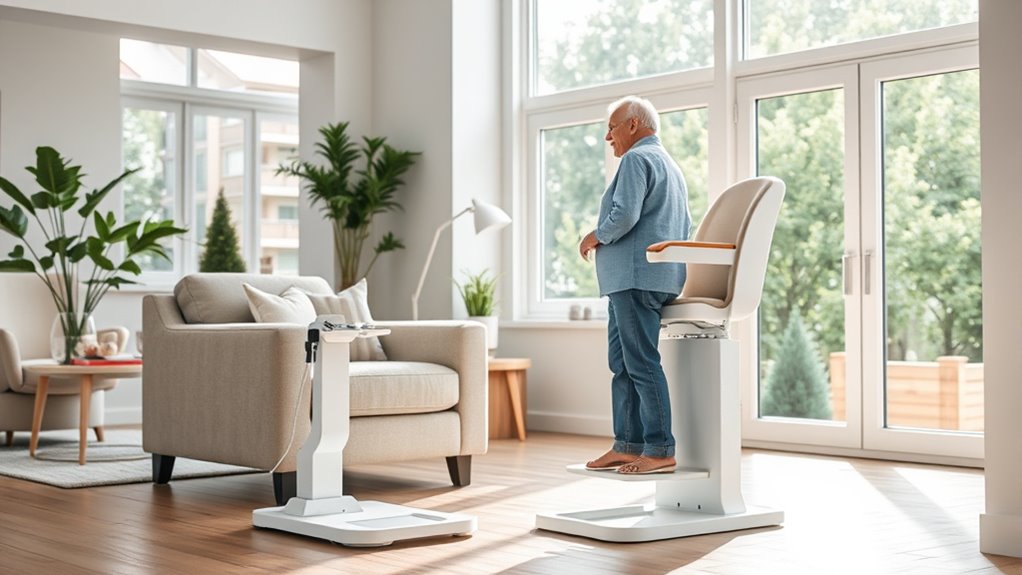

For seniors who can bear some weight but need help rising and moving, the VOCIC Sit to Stand Assist Lift with All-Terrain Wheels and Widened Base is my best overall pick for its focus on stability and maneuverability. The AireMed Full Electric Sit-to-Stand Lift stands out for buyers who want powered assistance, while the ArjoHuntleigh Sara Stedy offers a manual option for care settings that value a simple transfer workflow. The main tradeoffs are how much effort the user and caregiver must supply, how the lift fits through the home, and how much support the user needs to stand. I compare those differences across all 13 options below. Read on to find the lift that best matches the senior’s mobility, caregiver support, and living space.

Get your wardrobe favorites delivered free with Prime
- Fast, free delivery on millions of items
- Prime Video, Amazon Music and more included
- Member-only deals all year
Key Takeaways
The VOCIC all-terrain model leads this lineup for shoppers prioritizing a widened base and wheel mobility, but buyers still need to check doorways and turning space.
The AireMed is the powered standout; electric operation may reduce caregiver effort, while adding a different power and maintenance consideration than manual lifts.
The Sara Stedy represents the manual approach, which can suit users able to participate in standing and transfers but does not provide powered lifting.
Several picks share a wheeled stand-assist format, so differences in fit, adjustability, support accessories, and operating effort matter more than similar-sounding names.
Choosing by the senior’s remaining standing ability comes first: a stand-assist device is not a substitute for a full-body lift when the user cannot reliably bear weight.
| VOCIC Sit to Stand Assist Lift for Seniors with All-Terrain Wheels and Widened Base |  | Best for Toilet Transfers | Widened Front Wheelbase: Yes | Low Profile Height: Approx. 4.1 inches | Seat Design: Split cushioned seat pad | VIEW ON AMAZON | See Our Full Breakdown |
| VOCIC Sit to Stand Patient Lift with Wheels |  | Best Overall for Strength and Capacity | Weight Capacity: 400 lbs | Frame Material: High-grade steel | Knee Pad Adjustment: 2 levels (51–56 cm) | VIEW ON AMAZON | See Our Full Breakdown |
| Sit to Stand Lift for Elderly with Wheels, Standing Trainer, Patient Transfer Chair, Home Care Aid |  | Best Fit Range for Varying Heights | Weight Capacity: 400 lbs | Height Adjustment: Five levels | User Height Range: 5’1″ to 6’6″ | VIEW ON AMAZON | See Our Full Breakdown |
| Mobility Sit-to-Stand Patient Lift for Home Care and Assistance |  | Best for Tight Indoor Spaces | Weight Capacity: 420 lbs | Wheel Type: Silent casters with brakes | Number of Casters: 4 | VIEW ON AMAZON | See Our Full Breakdown |
| Lumex LF1600 Stand Assist Sit-to-Stand Patient Lift for Elderly Seniors |  | Best Established Brand Pick | Product Dimensions: 33.5 x 25 x 42.5 inches | Item Weight: 61 lbs | Maximum User Weight: 400 lbs | VIEW ON AMAZON | See Our Full Breakdown |
| Sit to Stand Lift for Elderly, Adjustable Height, Patient Transfer Stand Assist Aid |  | Best for Higher Weight Capacity | Weight capacity: 400 lbs | Adjustable height levels: 5 | User height range: 5’1″ to 6’3″ | VIEW ON AMAZON | See Our Full Breakdown |
| ELENKER Sit to Stand Patient Lift |  | Best for Adjustable Room Fit | Clearance: 4.7 inches | Leg support height: 20.8–25.1 inches | Base width: 23.2–38.1 inches | VIEW ON AMAZON | See Our Full Breakdown |
| AireMed Full Electric Sit-to-Stand Lift with Large Torso Sling and Buttock Strap |  | Best Powered Option | Weight capacity: 450 lbs | Patient weight range: 250–375 lbs | Battery: Rechargeable 24V | VIEW ON AMAZON | See Our Full Breakdown |
| WHLICKS Upgraded Sit to Stand Patient Lift, One-Step Stand Assist Lift for Elderly, with Wheels, Home Care Transfer Device for Seniors, Adults & Disabled |  | Best for Narrow Doorways | Capacity: 400 lbs | Height adjustment: Five levels | User height range: 5’1″ to 6’6″ | VIEW ON AMAZON | See Our Full Breakdown |
| Perlecare Sit-to-Stand Lift for Elderly with Safety Belt and Casters |  | Best for Simple Height Adjustments | Adjustable seat height: 3 options | Adjustable knee-pad height: 2 options | Width: 26.5 inches | VIEW ON AMAZON | See Our Full Breakdown |
| ArjoHuntleigh Sara Stedy Sit-to-Stand Manual Patient Lift Aid |  | Best for Broad Height Fit | Type: Manual sit-to-stand lift aid | Material: Aluminum | Weight capacity: 400 lbs | VIEW ON AMAZON | See Our Full Breakdown |
| WHLICKS Upgraded Sit-to-Stand Patient Lift for Elderly and Disabled |  | Best for Adjustable Fit | Capacity: 400 lbs | Height adjustment: Five levels | User height range: 5’1″–6’6″ | VIEW ON AMAZON | See Our Full Breakdown |
| Vive Mobility Sit to Stand Patient Lift for Handicapped |  | Best for Transfer Safety Features | Weight capacity: 400 lbs | Base width: 26 inches | Frame material: Steel | VIEW ON AMAZON | See Our Full Breakdown |
| sit to stand lifts for senior | Weight Capacity | Frame Material |
|---|---|---|
| VOCIC Sit to Stand Assist Lift | — | Heavy-duty steel |
| VOCIC Sit to Stand Patient Lif | 400 lbs | High-grade steel |
| Sit to Stand Lift for Elderly | 400 lbs | High-tensile steel |
| Mobility Sit-to-Stand Patient | 420 lbs | — |
| Lumex LF1600 Stand Assist Sit- | — | — |
| Sit to Stand Lift for Elderly | 400 lbs | High-tensile steel |
| ELENKER Sit to Stand Patient L | — | — |
| AireMed Full Electric Sit-to-S | 450 lbs | Steel |
| WHLICKS Upgraded Sit to Stand | — | — |
| Perlecare Sit-to-Stand Lift fo | Not specified in supplied product data | — |
| ArjoHuntleigh Sara Stedy Sit-t | 400 lbs | — |
| WHLICKS Upgraded Sit-to-Stand | — | High-tensile steel |
| Vive Mobility Sit to Stand Pat | 400 lbs | Steel |
More Details on Our Top Picks
VOCIC Sit to Stand Assist Lift for Seniors with All-Terrain Wheels and Widened Base
What sets this VOCIC apart from the rest of the lineup is its widened front wheelbase with a split cushioned seat — a design detail that matters enormously if bathroom transfers are the main reason you’re shopping. Most sit-to-stand lifts, including the Lumex LF1600, treat the toilet as an afterthought; this one builds the whole frame around it. The low 4.1-inch profile also lets it slide under beds, something bulkier units like the generic Standing Trainer (Product 3) can’t manage. Compared with the VOCIC Sit to Stand Patient Lift with Wheels, this model trades some lifting structure for maneuverability and access. The tradeoffs are real, though: it asks more of the user’s own strength, and the lack of a published weight capacity means heavier users should verify limits with the seller before buying.
Pros:- Split seat and widened base make toilet transfers genuinely practical
- All-terrain casters roll smoothly over carpet and thresholds
- Low-profile frame slides under beds for positioning
- Dual foot-pedal wheel locks keep it planted during use
Cons:- Requires meaningful lower-body strength from the user
- No published maximum weight capacity
- Can feel heavy when repositioning between rooms
Best for: Seniors and caregivers whose hardest daily transfers happen at the toilet or bed, especially on carpeted floors
Not ideal for: Users who cannot bear weight on their legs or support themselves — this is an assist aid, not a hoist
- Widened Front Wheelbase:Yes
- Low Profile Height:Approx. 4.1 inches
- Seat Design:Split cushioned seat pad
- Knee Pads:Soft, contoured
- Handle Material:Foam-wrapped
- Frame Material:Heavy-duty steel
- Locking Wheels:Dual foot-pedal locks
Our verdict“This pick makes the most sense for households where bathroom access is the daily bottleneck and the user still has leg strength to contribute.”
VOCIC Sit to Stand Patient Lift with Wheels
This model earns the top spot because it balances the three things that matter most in a sit-to-stand lift: a confirmed 400-lb capacity, a high-grade steel frame, and thoughtful comfort details like padded handgrips and a two-position knee pad. Compared with the Mobility Sit-to-Stand Patient Lift, the knee adjustment here offers fewer levels, but the padding quality and caster arrangement (4-inch front, 3-inch rear) make for steadier steering in doorways. Unlike its sibling — the VOCIC with all-terrain wheels — this one prioritizes structural support over toilet access, so choose based on where your transfers happen. The honest limitation is the same one that applies to every manual stand-assist: the user must support their own upper body, and the absence of an included safety belt means you’ll likely want to add one separately for peace of mind.
Pros:- Confirmed 400-lb weight capacity on a high-grade steel frame
- Padded handgrips and cushioned knee pads keep transfers comfortable
- Dual-lock casters hold the unit still during use
- Adjustable knee pad accommodates different user heights
Cons:- No safety belt restraint included in the box
- User must be able to support their own upper body
- Fewer knee pad adjustment levels than some rivals
Best for: Caregivers assisting a weight-bearing senior who needs a durable, high-capacity daily transfer aid at home
Not ideal for: Families caring for someone fully immobile or paralyzed — a powered hoist-style lift is the safer choice
- Weight Capacity:400 lbs
- Frame Material:High-grade steel
- Knee Pad Adjustment:2 levels (51–56 cm)
- Caster Size:3-inch rear, 4-inch front
- Base Height:6 cm
Our verdict“The most well-rounded choice here for seniors with upper-body strength who need dependable daily standing support.”
Sit to Stand Lift for Elderly with Wheels, Standing Trainer, Patient Transfer Chair, Home Care Aid
The standout feature here is the five-level height adjustment covering users from 5’1″ to 6’6″ — the most flexible fit range in this batch. That matters if one lift needs to serve multiple family members or a taller senior who feels cramped on the fixed-geometry Lumex LF1600. Like the VOCIC Patient Lift with Wheels, it carries a 400-lb rating on steel, but the PE silent wheels give it an edge for overnight care, where a squeaky frame can wake the whole house. The catch is size: this is one of the bulkiest units here, and it needs a minimum 24-inch doorway to pass through comfortably, so measure your hallways first. Assembly also takes patience — the instructions demand careful attention rather than a quick ten-minute job.
Pros:- Five-level height adjustment fits users from 5’1″ to 6’6″
- 400-lb capacity on high-tensile steel
- Silent wheels suit overnight and shared-living care
- Ergonomic layout reduces fatigue for both user and caregiver
Cons:- Assembly requires careful work with the instructions
- Bulky frame is hard to store in small homes
- Doorway clearance of at least 24 inches needed
Best for: Taller seniors or multi-user households who need one adjustable lift to fit several body heights
Not ideal for: Homes with narrow doorways under 24 inches or minimal storage space — its footprint will dominate the room
- Weight Capacity:400 lbs
- Height Adjustment:Five levels
- User Height Range:5’1″ to 6’6″
- Frame Material:High-tensile steel
- Wheel Type:PE silent wheels
- Doorway Width:Minimum 24 inches
Our verdict“The right pick when one lift must comfortably fit a range of heights, as long as your doorways and storage can handle the size.”
Mobility Sit-to-Stand Patient Lift for Home Care and Assistance
If your home has narrow hallways, small bathrooms, or furniture-lined walkways, this is the model I’d point you toward. Its compact, narrow profile slips through spaces where the larger Standing Trainer (Product 3) simply won’t fit, and it carries the highest capacity in this batch at 420 lbs — 20 lbs more than the VOCIC or Lumex options. The three-level knee adjustment also beats the VOCIC Patient Lift’s two positions, giving a more precise fit. Silent braked casters make it a considerate choice for apartments or shared living. Two caveats temper the appeal: assembly takes genuine effort even with tools included, and it’s built strictly for indoor use — the casters won’t handle patio or driveway surfaces the way the all-terrain VOCIC can.
Pros:- 420-lb weight capacity is the highest in this lineup
- Narrow profile maneuvers easily in tight indoor spaces
- Three-level knee pad adjustment for a precise fit
- Silent braked casters keep operation quiet and stable
Cons:- Assembly requires real effort despite included tools
- Indoor-only design with no outdoor capability
Best for: Caregivers in apartments or homes with tight hallways who need maximum capacity in a narrow frame
Not ideal for: Anyone planning transfers to outdoor spaces or over rough terrain — the casters are indoor-only
- Weight Capacity:420 lbs
- Wheel Type:Silent casters with brakes
- Number of Casters:4
- Adjustable Knee Support:3 levels (51–56 cm)
- Base Height:6 cm
- Material:Steel
Our verdict“A smart choice for cramped indoor layouts and heavier users, provided everything stays on smooth floors.”
Lumex LF1600 Stand Assist Sit-to-Stand Patient Lift for Elderly Seniors
Lumex is a long-standing medical equipment name, and that track record shows in the LF1600’s fit and finish — ergonomic handbars and cushioned knee pads that feel purpose-built rather than retrofitted. It matches the VOCIC Patient Lift at 400 lbs of user capacity and shares the same 5’1″ to 6’6″ height range as the Standing Trainer, but its 25-inch width is designed specifically to clear standard doorways and circle furniture without the careful measuring the bulkier Trainer demands. The tradeoff is weight: at 61 lbs, it’s the heaviest lift here, so a single caregiver may struggle to reposition it between rooms — the lighter Mobility lift is easier to shuttle around. Like most in this category, it’s an indoor tool, so don’t plan on driveway or yard transfers.
Pros:- Established medical equipment brand with consistent build quality
- Ergonomic handbars and cushioned knee pads
- Compact footprint clears standard doorways and furniture
- Reduces strain and injury risk for caregivers
Cons:- 61-lb unit weight makes it awkward for one person to move
- Indoor-only design with limited outdoor suitability
Best for: Buyers who prioritize a proven medical brand and predictable build quality for daily in-home transfers
Not ideal for: Solo caregivers who frequently move the lift between rooms — 61 lbs gets tiring fast
- Product Dimensions:33.5 x 25 x 42.5 inches
- Item Weight:61 lbs
- Maximum User Weight:400 lbs
- Suitable User Height:5’1″ to 6’6″
Our verdict“The dependable brand-name choice for weight-bearing seniors, best suited to homes where the lift mostly stays in one place.”
Sit to Stand Lift for Elderly, Adjustable Height, Patient Transfer Stand Assist Aid
For households that need a manual lift with a stated 400 lb capacity, this steel-frame model offers a clear fit, provided the user can bear 60–70% of their weight. Its five height settings and stated user range of 5’1″ to 6’3″ help caregivers match the lift to different bodies and transfer surfaces. Compared with the WHLICKS Upgraded Sit to Stand Patient Lift, it has a narrower stated height range, while WHLICKS specifies a minimum doorway width; check this model’s dimensions before relying on it in tight rooms. Swivel casters with dual locking brakes support positioning and stability, but assembly and a heavy frame may make setup harder for one caregiver. It is not suited to people who cannot contribute substantial weight-bearing effort.
Pros:- Stated 400 lb capacity with a high-tensile steel frame.
- Five height levels help tailor the fit to the user.
- Dual-locking swivel casters aid positioning and help hold the lift in place.
- Padded handrails and cushions add contact comfort.
Cons:- Only supports users who can bear at least 60% of their weight.
- Assembly is required, and the frame may be heavy to lift.
- Its stated user height range ends at 6’3″.
Best for: Caregivers seeking a manual transfer aid for a user under 400 lb who can bear most of their weight and fits the stated height range.
Not ideal for: People needing a fully powered lift, users unable to bear at least 60% of their weight, or caregivers who need to carry equipment frequently.
- Weight capacity:400 lbs
- Adjustable height levels:5
- User height range:5’1″ to 6’3″
- Frame material:High-tensile steel
- Caster type:Swivel casters with dual locking brakes
- Weight-bearing requirement:User can bear 60–70% of their weight
Our verdict“Choose this manual model when a 400 lb capacity and adjustable fit matter more than powered lifting or easy portability.”
ELENKER Sit to Stand Patient Lift
The ELENKER is the most adaptable choice here for caregivers who need to fit the lift around different chairs or transfer spaces. Its base width adjusts from 23.2 to 38.1 inches, while its height spans 38.9 to 70.4 inches; that flexibility can help with varied setups, but the wide base setting may be unwieldy in narrow rooms. A foldable base aids storage, and locking casters help secure the device during a transfer. Compared with the Perlecare Sit-to-Stand Lift, ELENKER supplies more detailed dimensions and adjustable width, while Perlecare lists seat and knee-pad settings instead. Assembly and caregiver familiarization take time, and this is still a partial-weight-bearing aid rather than a solution for users who cannot assist with standing.
Pros:- Adjustable base width accommodates different transfer spaces.
- Foldable base makes storage easier when the lift is not in use.
- Locking casters help keep the device positioned during transfers.
- Foam armrests and multiple hook points support user setup.
Cons:- The 38.1-inch maximum base width may not suit tight rooms.
- Assembly and familiarization are required.
- Partial weight-bearing ability is required from the user.
Best for: Home caregivers who move between different chairs or transfer locations and need a base that can widen or fold for storage.
Not ideal for: Users unable to bear some weight, or households with narrow routes where the base’s maximum width would be difficult to maneuver.
- Clearance:4.7 inches
- Leg support height:20.8–25.1 inches
- Base width:23.2–38.1 inches
- Height:38.9–70.4 inches
- Caster type:Locking casters
- Base:Foldable
Our verdict“Pick ELENKER if adjustable width and a foldable base matter more than a simple, narrow footprint.”
AireMed Full Electric Sit-to-Stand Lift with Large Torso Sling and Buttock Strap
Among these five, AireMed is the only clearly full-electric lift, making it the strongest fit for caregivers who want powered assistance during repeated transfers. Its rechargeable 24V battery is listed for 100–150 lifts per charge, and the included large torso sling with optional buttock strap provides a different support approach from manual models such as the WHLICKS Upgraded Sit to Stand Patient Lift. The stated 450 lb capacity is the highest listed in this batch, though the product also gives a patient weight range of 250–375 lb, so buyers should confirm fit with the supplier rather than assume the figures mean the same thing. It is bulkier for small rooms and requires caregiver upper-body strength for safe operation; it also costs more to maintain over time, given separate frame and electronics warranty periods.
Pros:- Electric operation can reduce effort during repeated lifts.
- Rechargeable battery is listed for 100–150 lifts per charge.
- Large torso sling and optional buttock strap provide substantial contact support.
- Stated 450 lb capacity exceeds the capacities listed for the manual models in this batch.
Cons:- Bulk may make it difficult to use in smaller spaces.
- The patient weight range is narrower than the listed maximum capacity suggests.
- Electronics warranty is shorter than the frame warranty.
Best for: Caregivers who make frequent transfers for a patient within the stated weight range and want battery-powered lifting with sling support.
Not ideal for: Homes with cramped transfer routes, users outside the stated weight range, or caregivers seeking a lightweight manual device.
- Weight capacity:450 lbs
- Patient weight range:250–375 lbs
- Battery:Rechargeable 24V
- Battery life:100–150 lifts per charge
- Frame material:Steel
- Height range:Up to 6’4″
- Caster size:Front 3 inches; rear 4 inches
- Frame warranty:3 years
- Electronics warranty:1 year
Our verdict“Choose AireMed for powered, sling-supported transfers when its size and stated patient weight range fit your home and user.”
WHLICKS Upgraded Sit to Stand Patient Lift, One-Step Stand Assist Lift for Elderly, with Wheels, Home Care Transfer Device for Seniors, Adults & Disabled
WHLICKS is the most specific pick here for homes where doorway clearance determines whether a lift can reach the transfer point: it lists a minimum doorway width of 24 inches. Its five height levels and user range up to 6’6″ give it more stated height coverage than the Sit to Stand Lift for Elderly, Adjustable Height, Patient Transfer Stand Assist Aid, whose range ends at 6’3″. The single-action swivel system, compact base, and wheel locks are aimed at maneuvering and positioning, while foam-wrapped handrails and cushioned contact points add comfort. That convenience comes with a meaningful limit: the user needs enough upper- and lower-body strength to take part. The doorway figure also does not guarantee turning clearance inside a room, so caregivers should measure the full route.
Pros:- Stated 400 lb capacity and high-tensile steel construction.
- Five height settings and a user range up to 6’6″.
- Compact base and one-step swivel design support maneuvering.
- Wheel locks and cushioned handrails aid stability and comfort.
Cons:- Requires adequate upper- and lower-body strength from the user.
- Doorways must be at least 24 inches wide, with additional turning room potentially needed.
- Not a substitute for a powered lift when the user cannot assist.
Best for: Caregivers managing transfers in homes with doorways at least 24 inches wide and users who can actively help stand.
Not ideal for: Users with very limited strength or mobility, or homes with doorways narrower than 24 inches or tight turning spaces.
- Capacity:400 lbs
- Height adjustment:Five levels
- User height range:5’1″ to 6’6″
- Material:High-tensile steel
- Wheel lock:Yes
- Doorway width requirement:At least 24 inches
Our verdict“Choose WHLICKS when doorway access and a taller stated user range matter, provided the user can actively assist with standing.”
Perlecare Sit-to-Stand Lift for Elderly with Safety Belt and Casters
Perlecare keeps its fit adjustments straightforward: caregivers can choose among three seat heights and two knee-pad positions, then secure the lift with four lockable casters. That simpler adjustment set may suit a household that wants a basic manual transfer aid without ELENKER’s wide adjustable base. Compared with the ELENKER Sit to Stand Patient Lift, however, Perlecare gives less information about overall height, clearance, and base dimensions, so it is harder to judge whether it will fit a particular user or room. The missing weight capacity is the main buying limitation; the provided details are not enough to match the lift confidently to a user’s needs. It also requires physical effort, and no battery or power details are supplied. Ask the seller for the capacity and full dimensions before choosing it.
Pros:- Three seat-height options allow some adjustment to the transfer setup.
- Two knee-pad height settings help customize leg support.
- Four lockable casters support positioning stability.
- Portable design is described as easy to transport and set up.
Cons:- No weight capacity is provided in the supplied product data.
- Physical strength is needed to operate the lift.
- Power source and key fit dimensions are not specified.
Best for: Caregivers seeking a manually operated lift with a few seat and knee-pad adjustments for a known transfer setup.
Not ideal for: Buyers who need a verified weight limit, detailed fit measurements, or powered assistance before choosing a lift.
- Adjustable seat height:3 options
- Adjustable knee-pad height:2 options
- Width:26.5 inches
- Casters:4 lockable casters
- Safety belt:Included in product title
- Weight capacity:Not specified in supplied product data
Our verdict“Consider Perlecare only after confirming its capacity and dimensions for your user and transfer space.”
ArjoHuntleigh Sara Stedy Sit-to-Stand Manual Patient Lift Aid
The ArjoHuntleigh Sara Stedy stands out for accommodating users from 4’11” to 6’6″, a broader stated height range than the WHLICKS Upgraded Sit-to-Stand Patient Lift, which starts at 5’1″. Its 400-pound capacity and fully assembled delivery may suit households or care settings that want a manual aid ready to use without an assembly step. Because it is manually operated, caregivers must be able to manage the effort involved, and the person transferring must bear some weight. That makes it a poor match for someone who cannot participate in standing. Compared with the Vive Mobility Sit to Stand Patient Lift, the Sara Stedy has no stated base-width measurement or listed brake details here, so check fit and safety features with the seller before choosing it.
Pros:- Accommodates users from 4’11” to 6’6″
- Supports users up to 400 pounds
- Arrives fully assembled for immediate use
- Manual sit-to-stand design assists with standing and transfers
Cons:- Manual operation may demand strength and effort from the caregiver
- Not suitable for users unable to bear partial weight
- No doorway-width or base-dimension data is provided in the listed specs
Best for: Caregivers seeking a ready-to-use manual lift for users across a wide range of heights who can bear partial weight
Not ideal for: People who cannot support partial body weight, or caregivers who need powered assistance to reduce manual effort
- Type:Manual sit-to-stand lift aid
- Material:Aluminum
- Weight capacity:400 lbs
- User height range:4’11″–6’6″
- Assembly:Fully assembled
- Intended use:Standing assistance and transfers
Our verdict“Choose the Sara Stedy for a broad stated height range and ready-to-use manual assistance when both caregiver and user can manage a standing transfer.”
WHLICKS Upgraded Sit-to-Stand Patient Lift for Elderly and Disabled
The WHLICKS Upgraded Sit-to-Stand Patient Lift is the most fit-adjustable choice in this group: its five height levels and adjustable leg supports let caregivers tailor the setup, while the Sara Stedy’s listed specs give a broad user-height range but no adjustment levels. A one-step swivel system, locking wheel, and foam-wrapped handrails are intended to help with repositioning and grip during transfers. Its 400-pound capacity matches the Sara Stedy and Vive Mobility model, so capacity alone does not separate these options. The WHLICKS has a stated 24-inch minimum doorway width; measure the route, since a narrow doorway can rule it out. It also requires the user to contribute lower-body strength, and its adjustment and transfer setup may take familiarity.
Pros:- Five height levels and adjustable leg supports allow fit adjustments
- One-step swivel system supports repositioning
- Locking wheel and foam-wrapped handrails provide stated transfer-support features
- Supports users up to 400 lbs
Cons:- Requires doorways at least 24 inches wide
- User needs sufficient lower-body strength to participate
- Transfer setup may feel complex to people unfamiliar with assistive devices
Best for: Caregivers who want multiple height settings and adjustable leg supports for users who can contribute lower-body strength
Not ideal for: Households with doorways under 24 inches or users who cannot assist with standing transfers
- Capacity:400 lbs
- Height adjustment:Five levels
- User height range:5’1″–6’6″
- Frame material:High-tensile steel
- Wheel lock:Yes
- Minimum doorway width:24 inches
- Repositioning:One-step swivel system
Our verdict“Pick the WHLICKS when adjustable fit and repositioning matter and your doorways meet its 24-inch minimum.”
Vive Mobility Sit to Stand Patient Lift for Handicapped
The Vive Mobility Sit to Stand Patient Lift makes the clearest case for buyers prioritizing specified transfer-safety features: it lists dual locking brakes and side support hooks, alongside cushioned handrails and a seat. Its stated user requirement—supporting 60–70% of body weight—gives caregivers a more concrete guide to the strength needed than the WHLICKS description, which says lower-body strength is required without a percentage. The tradeoff is footprint: Vive lists a 26-inch base width, and its product information warns that it may not pass through narrow doorways. Compared with the fully assembled Sara Stedy, Vive may also need assembly. Choose it when the listed brakes and hooks fit your transfer needs, and confirm the route and maneuvering space first.
Pros:- Dual locking brakes and side support hooks are listed safety features
- Cushioned seat and foam handrails support comfort during transfers
- Supports users up to 400 lbs
- Swivel casters aid maneuvering
Cons:- The 26-inch base may not fit through narrow doorways
- Needs maneuvering space around the transfer area
- Assembly may be required
Best for: Caregivers who want listed locking brakes and support hooks for transfers with users able to support most of their body weight
Not ideal for: Homes with narrow doorways or limited turning space, or users unable to support 60–70% of their body weight
- Weight capacity:400 lbs
- Base width:26 inches
- Frame material:Steel
- Caster type:Swivel casters
- Safety features:Dual locking brakes and side support hooks
- User strength requirement:Able to support 60–70% of body weight
- Guarantee:2 years
Our verdict“Choose Vive if its specified brakes and support hooks suit your transfers and your doorways and maneuvering space can accommodate the 26-inch base.”

How We Picked
I compared these 13 products as aids for seniors who need support moving from sitting to standing, giving priority to the factors that shape safe, practical home use: the stated support design, whether operation is manual or electric, adjustability, wheels and base layout, and included straps or sling components. I also considered how those features may affect caregiver effort, room-to-room movement, storage, and the ability to fit around a chair or toilet. Product names and descriptions do not establish clinical suitability, so I avoid treating any model as appropriate for every user.
The order reflects how clearly each option addresses common sit-to-stand needs and how useful its stated features appear for the intended buyer. The VOCIC model with all-terrain wheels and a widened base ranks first for its combination of mobility and a stability-oriented design; the AireMed earns a distinct place for powered assistance, and the Sara Stedy for a manual transfer approach. Other wheeled models follow, with their relative appeal depending on details such as height adjustment, belts, and user fit. Before choosing, caregivers should confirm the manufacturer’s capacity and fit limits and consult a qualified clinician about the senior’s ability to bear weight and participate.
| sit to stand lifts for senior | Frame Material |
|---|---|
| VOCIC Sit to Stand Assist Lift | Heavy-duty steel |
| VOCIC Sit to Stand Patient Lif | High-grade steel |
| Sit to Stand Lift for Elderly | High-tensile steel |
| Mobility Sit-to-Stand Patient | — |
| Lumex LF1600 Stand Assist Sit- | — |
| Sit to Stand Lift for Elderly | High-tensile steel |
| ELENKER Sit to Stand Patient L | — |
| AireMed Full Electric Sit-to-S | Steel |
| WHLICKS Upgraded Sit to Stand | — |
| Perlecare Sit-to-Stand Lift fo | — |
| ArjoHuntleigh Sara Stedy Sit-t | — |
| WHLICKS Upgraded Sit-to-Stand | High-tensile steel |
| Vive Mobility Sit to Stand Pat | Steel |
Factors to Consider When Choosing Sit To Stand Lifts For Seniors
My product comparisons show why a familiar label like “sit-to-stand lift” is not enough to select a device. Start with the senior’s actual transfer ability and the home’s layout, then weigh caregiver effort and upkeep. These checks can rule out a poor fit before brand differences matter.
Match the device to the senior’s standing ability
A sit-to-stand aid generally depends on the user being able to bear some weight and take an active part in rising. Ask a clinician to assess strength, balance, pain, and ability to follow transfer instructions before shopping. A person who cannot reliably support their own weight may need a full-body lift or another transfer method instead. Do not assume that adding a torso sling or belt makes a stand-assist device suitable for someone unable to stand. Recheck the plan if the senior’s condition changes, since a device that once fit may no longer provide appropriate support.
Measure the full transfer route
Measure door clearances, hallway turns, the space beside the bed, and the approach to the toilet or favorite chair. Check the base width and turning footprint, not only whether the lift can pass through a doorway straight on. Rugs, thresholds, and uneven flooring can affect how smoothly wheels move and whether a caregiver can position the device. A widened base may appeal for stability but can be harder to maneuver in a small bathroom. If possible, compare measurements with the exact model’s specifications and the furniture arrangement where transfers will happen.
Plan for caregiver effort and operation
Manual devices require the caregiver to position the lift and support the transfer through its operating mechanism. Electric models can reduce some physical effort, but they introduce charging, power availability, and equipment-care needs. Think through who will operate the device, how often transfers occur, and whether that person can manage its controls and movement. A feature that reduces effort during a transfer only helps if the caregiver can position the lift correctly. Ask a clinician or equipment provider to demonstrate the intended technique before relying on any model at home.
Check fit, capacity, and support points
Compare the manufacturer’s stated weight capacity and user dimensions with the senior’s needs; never estimate these from product photos. Look at where the device supports the body, how its belt or sling is adjusted, and whether the user can comfortably hold the grips or rest their feet as intended. Torso support and a buttock strap serve different purposes, so confirm what each included component is designed to do. Clothing, footwear, and chair height can change how easily a person gets into position. Get a fitting or demonstration when possible, especially if the senior has pain, limited range of motion, or difficulty following instructions.
Account for upkeep, storage, and backup plans
Before purchase, check what the manufacturer says about cleaning, inspecting straps, servicing moving parts, and replacing components. Electric models also call for a plan to keep the battery charged and to know what to do if power is unavailable. Consider where the lift will be stored between transfers and whether it can be moved without creating a trip hazard. Ask about delivery, assembly, training, and service access, since those affect day-to-day usability. A backup transfer plan matters if the lift is out of service or the user cannot participate on a particular day.
Frequently Asked Questions
Can a sit-to-stand lift work if a senior cannot bear weight?
These devices usually rely on the user bearing some weight and taking part in standing, so inability to do either may make a sit-to-stand lift unsuitable. A belt or sling does not automatically turn it into a full-body lift. Ask a clinician to assess transfer ability and recommend the correct equipment type. If the senior’s strength varies, discuss what to do on days when standing is not safe. Choose based on the person’s current ability, not a hoped-for improvement.
How do I know whether a lift will fit through my home?
Measure the narrowest doorway, hallway turns, and the usable space around beds, chairs, and toilets. Compare these with the product’s base width and turning dimensions, including any protruding wheels or handles. A straight doorway measurement alone can miss the difficulty of turning into a small room. Check thresholds and floor surfaces, since they may affect movement even when the lift fits on paper. If measurements are close, ask the seller or equipment provider about an in-home fit check.
Should I choose a manual or electric sit-to-stand lift?
Consider the caregiver’s physical capacity, how frequently transfers happen, and whether the senior can actively assist. A manual model avoids reliance on charging but still takes effort to position and operate. An electric option may reduce some lifting effort, while adding battery and service needs. The mechanism alone does not determine safe use: correct fit and training matter for both types. Ask a clinician or supplier to demonstrate each approach with the intended user.
Can one sit-to-stand lift be used with different chairs and toilets?
Possibly, but chair height, armrests, seat shape, and available clearance can affect whether a transfer works. Check the device’s adjustment range and base access against each location where it will be used. A lift that works beside a roomy chair may not fit around a toilet or under a low bed. Confirm the manufacturer’s instructions for the surfaces and transfer positions you plan to use. A practical demonstration at home can reveal fit problems before regular use.
What should I do if the senior’s mobility gets worse after buying a lift?
Pause use if the senior can no longer participate safely or bear the weight the device requires. Contact the clinician who advises on transfers and ask for a reassessment of equipment and technique. Do not try to compensate by tightening a belt or changing the setup beyond the manufacturer’s directions. A change in strength, balance, pain, or alertness can alter what support is appropriate. Keep a backup transfer plan and ask the equipment provider about service or replacement options.
Conclusion
For the broadest mix of wheeled mobility and a stability-oriented base, I’d start with the VOCIC All-Terrain model as best overall. The VOCIC Sit to Stand Patient Lift with Wheels is my value-oriented option for shoppers comparing a simpler wheeled format, while the AireMed electric lift is the premium-style choice for households prioritizing powered assistance. For a first purchase, I’d favor a model whose fit and operation can be demonstrated by a clinician or equipment provider; the Perlecare with safety belt and casters is one option to assess for that kind of guided setup. The Sara Stedy is a distinct manual pick for users who can actively participate, while buyers needing broader support should discuss a full-body lift with a clinician. Match the device to the senior’s standing ability, the caregiver’s capacity, and the actual transfer spaces before deciding.
Fall Picks
fall essentials
As an affiliate, we earn on qualifying purchases.