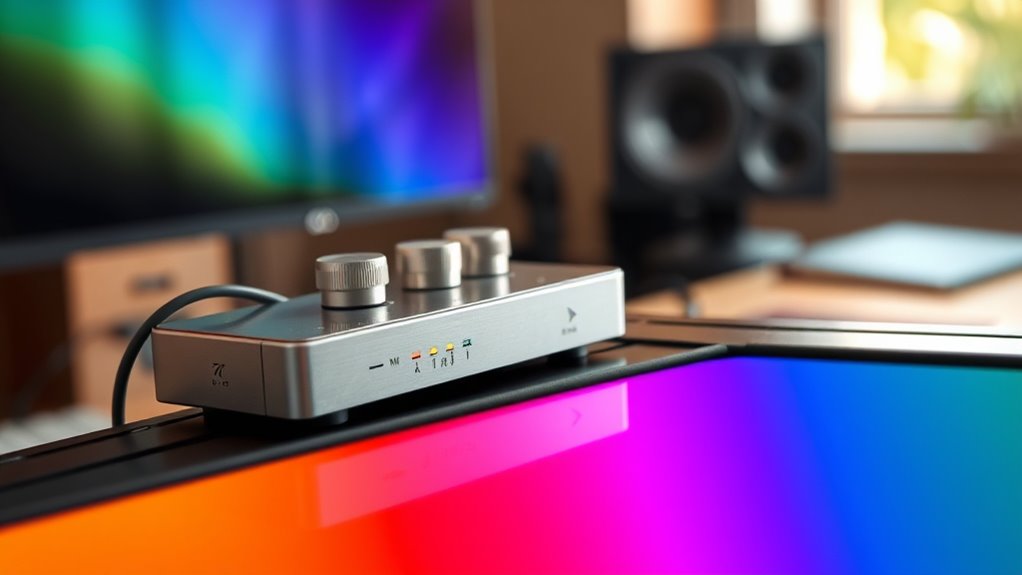

When selecting premium monitor calibration tools, clarity, accuracy, and ease of use are key. The X-Rite i1Display Studio stands out for its user-friendly interface and reliable results, making it ideal for professionals seeking precise color. The Datacolor SpyderX Elite offers advanced features for those who need ultimate customization, though it comes at a higher price. Buyers face tradeoffs between cost, complexity, and calibration accuracy. Continue reading to find a detailed comparison that helps you choose the best fit for your needs.

Get your wardrobe favorites delivered free — and shop member deals
- Fast, free delivery on millions of items
- Access to Prime Big Deal Days deals on October 6–7
- Prime Video, Amazon Music and more included
Key Takeaways
- Top calibrators balance ease of use with high precision, as seen in the X-Rite i1Display Studio and SpyderX Elite.
- Higher-priced options tend to offer more advanced features and broader device compatibility, but may be overkill for casual users.
- Color accuracy for professional work is best served by tools that support multiple color spaces and display types, like OLED and Mini LED.
- Calibration speed and software usability are decisive factors for workflows that demand quick, reliable results.
- Build quality and ongoing support influence long-term value, especially for professional environments.
| Wacom Color Manager with USB-C for Monitor Calibration |  | Best for Advanced Color Profiling and Mobile Integration | Connectivity: USB-C | Compatibility: Wacom devices, X-Rite Color TRUE mobile app, iOS, Android | Features: White point control, luminance, contrast ratio, gamma, intelligent iterative profiling | VIEW ON AMAZON | See Our Full Breakdown |
| X-Rite i1Display Studio |  | Best for User-Friendly, Reliable Color Calibration | Compatibility: Monitors and projectors | Software: Wizard-driven calibration | Features: Multiple monitor profiling, flare correction, profile validation | VIEW ON AMAZON | See Our Full Breakdown |
| Datacolor Spyder X Pro Monitor Calibrator |  | Best for Quick, Accurate Calibration of Multiple Displays | Color accuracy: High precision with lens-based engine | Calibration targets: 12 predefined | Compatibility: Multiple monitors and laptops | VIEW ON AMAZON | See Our Full Breakdown |
| Calibrite Display Pro HL Monitor Calibration Colorimeter |  | Best for Bright, Modern Display Calibration | Measurement Range: up to 3000 nits | Display Compatibility: LCD, Mini LED, OLED, Apple XDR, projectors | Software: Calibrite PROFILER for Mac and Windows | VIEW ON AMAZON | See Our Full Breakdown |
| Datacolor SpyderExpress Monitor Calibrator & Screen Color Calibrator |  | Best for Fast, Basic Calibration of High-End Displays | Compatibility: Liquid Retina XDR, MacBook M4 mini-LED, monitors | Calibration Speed: 90 seconds | Display Support: Supports up to 3 displays | VIEW ON AMAZON | See Our Full Breakdown |
| Datacolor SpyderPro Monitor Calibrator & Screen Color Calibration Tool |  | Best Overall for Professional Color Accuracy | Compatibility: Windows 10/11, macOS 10.14 to 14 | Supported Devices: Unlimited displays, USB-C connectivity | Features: Gamma, whitepoint, brightness adjustments, projector calibration, display analysis, automatic room light switching | VIEW ON AMAZON | See Our Full Breakdown |
| Calibrite Display 123 Monitor Calibration Colorimeter for Photo Editing and Color Accurate Viewing |  | Best for Quick, Easy Color Calibration of Two Monitors | Connection: USB C | Height: 34mm | Diameter: 37mm | VIEW ON AMAZON | See Our Full Breakdown |
| X-Rite ColorChecker Classic (MSCCC) |  | Best for Versatile Color and Projector Calibration | Device Type: Color Calibration Tool | Compatibility: Display, projector, mobile devices | Measurement Speed: 5X faster than previous devices | VIEW ON AMAZON | See Our Full Breakdown |
| Calibrite Creator Kit with Display 123 Colorimeter and ColorChecker Passport Video 2 |  | Best for Video and Photography Workflow Integration | Includes: Display 123 colorimeter, ColorChecker Passport Video 2 | Purpose: Monitor calibration, exposure, white balance, color workflow | Designed for: Photography and videography workflows | VIEW ON AMAZON | See Our Full Breakdown |
| Calibrite Photo Kit with Display Pro HL Monitor Calibration Colorimeter and ColorChecker Passport Photo 2 |  | Best for High-End Photography and RAW Workflow Calibration | Includes: Display Pro HL colorimeter, ColorChecker Passport Photo 2, Calibrite PROFILER software | Supports: Custom camera profiles, monitor calibration for mini LED, OLED, Apple XDR | Features: White balance, exposure reference, customizable targets | VIEW ON AMAZON | See Our Full Breakdown |
| Datacolor Spyder4Pro Colorimeter for Display Calibration |  | Best for Enthusiasts Prioritizing Long-Term Stability | Type: Colorimeter | Sensor: Full-spectrum color sensor | Calibration: Automated color and brightness calibration | VIEW ON AMAZON | See Our Full Breakdown |
| Datacolor SpyderX Elite Monitor Calibration Tool |  | Best for Professionals Needing Speed and Precision | Calibration Speed: Just a few minutes | Color Accuracy: High precision with lens-based color engine | Display Compatibility: Multiple monitors and projectors | VIEW ON AMAZON | See Our Full Breakdown |
| Calibrite ColorChecker Display Pro (CCDIS3) |  | Best for Versatile, Professional-Grade Calibration Across Devices | Model: CCDIS3 | Compatibility: ccProfiler, i1Profiler | Features: High repeatability, rotatable diffuser arm, tripod mount, ambient light measurement | VIEW ON AMAZON | See Our Full Breakdown |
| premium monitor calibration tool | Features | Compatibility |
|---|---|---|
| Wacom Color Manager with USB-C | White point control, luminance, contrast ratio, gamma, intelligent iterative profiling | Wacom devices, X-Rite Color TRUE mobile app, iOS, Android |
| X-Rite i1Display Studio | Multiple monitor profiling, flare correction, profile validation | Monitors and projectors |
| Datacolor Spyder X Pro Monitor | Room-light monitoring, quick calibration | Multiple monitors and laptops |
| Calibrite Display Pro HL Monit | — | — |
| Datacolor SpyderExpress Monito | — | Liquid Retina XDR, MacBook M4 mini-LED, monitors |
| Datacolor SpyderPro Monitor Ca | Gamma, whitepoint, brightness adjustments, projector calibration, display analysis, automatic room light switching | Windows 10/11, macOS 10.14 to 14 |
| Calibrite Display 123 Monitor | — | — |
| X-Rite ColorChecker Classic | Ambient light measurement, monitor and projector profiling, PANTONE Spot Color | Display, projector, mobile devices |
| Calibrite Creator Kit with Dis | — | — |
| Calibrite Photo Kit with Displ | White balance, exposure reference, customizable targets | — |
| Datacolor Spyder4Pro Colorimet | ReCAL re-calibration, improved accuracy and stability | Multiple displays |
| Datacolor SpyderX Elite Monito | Room-light monitoring, automatic profile changing, SpyderProof evaluation | — |
| Calibrite ColorChecker Display | High repeatability, rotatable diffuser arm, tripod mount, ambient light measurement | ccProfiler, i1Profiler |
More Details on Our Top Picks
Wacom Color Manager with USB-C for Monitor Calibration
The Wacom Color Manager stands out for its ability to deliver precise calibration across multiple devices and platforms, thanks to its compatibility with Wacom hardware, iOS, and Android apps. Unlike the X-Rite i1Display Studio, which emphasizes ease of use and quick setup, the Wacom offers advanced profiling features like white point control and iterative profiling, making it ideal for workflows demanding meticulous color accuracy. However, it involves more complex hardware and software setup, which may deter casual users. This pick makes the most sense for professionals who need integrated calibration with mobile workflows and are comfortable with a steeper learning curve.
Pros:- Ensures highly accurate color calibration across devices
- Compatible with multiple platforms and mobile apps
- Advanced profiling features for precision color management
Cons:- Requires additional hardware and software setup
- Complex interface may be overwhelming for beginners
Best for: Creative professionals requiring detailed, device-agnostic calibration and mobile app integration
Not ideal for: Casual users or those seeking a straightforward, plug-and-play calibration solution
- Connectivity:USB-C
- Compatibility:Wacom devices, X-Rite Color TRUE mobile app, iOS, Android
- Features:White point control, luminance, contrast ratio, gamma, intelligent iterative profiling
Our verdict“This is best suited for users who need deep customization and multi-device calibration capabilities.”
X-Rite i1Display Studio
The X-Rite i1Display Studio offers a straightforward calibration experience that balances ease of use with reliable color accuracy. Compared with the Datacolor Spyder X Pro, which emphasizes quick setup and room-light monitoring, this model’s software wizard-driven approach makes it accessible for beginners while still delivering professional-grade results. Its support for multiple monitors and glossy screens is a significant advantage, but it’s not compatible with some third-party software like Dell or Eizo, which could limit integration. This device makes the most sense for users who want dependable calibration without the complexity of advanced features.
Pros:- Intuitive calibration software with guided process
- Ensures consistent, accurate color profiles
- Supports multiple monitors and glossy screens
Cons:- Limited compatibility with third-party monitor brands
- Less advanced profiling features compared to higher-end tools
Best for: Photographers and designers seeking consistent, accurate colors with minimal fuss
Not ideal for: Power users needing advanced profiling tools or third-party software support
- Compatibility:Monitors and projectors
- Software:Wizard-driven calibration
- Features:Multiple monitor profiling, flare correction, profile validation
Our verdict“Ideal for users who prioritize simplicity and reliable color accuracy in everyday workflows.”
Datacolor Spyder X Pro Monitor Calibrator
The Datacolor Spyder X Pro makes a strong case for creative workflows needing fast, precise calibration. Its lens-based color engine offers high accuracy, comparable to the Calibrite Display Pro HL but with a more straightforward setup. Features like room-light monitoring and before-and-after comparison help ensure your calibration is effective. However, some users might find it overkill if they only need casual calibration, and it requires some initial setup for optimal results. This makes it a solid choice for photographers and designers who need quick, reliable results across several displays without fuss.
Pros:- High-precision lens-based color engine
- Supports multiple monitors and quick calibration
- Includes before-and-after display comparison
Cons:- May be overly sophisticated for casual users
- Requires some setup for best accuracy
Best for: Photographers and creative professionals managing multiple displays needing rapid calibration
Not ideal for: Casual users or those with very limited calibration needs
- Color accuracy:High precision with lens-based engine
- Calibration targets:12 predefined
- Compatibility:Multiple monitors and laptops
- Features:Room-light monitoring, quick calibration
Our verdict“Best suited for professionals who need fast, reliable calibration across several displays with minimal hassle.”
Calibrite Display Pro HL Monitor Calibration Colorimeter
The Calibrite Display Pro HL is tailored for high-luminance modern displays like LCD, Mini LED, and OLED, including Apple XDR screens. Its advanced measurement range up to 3000 nits sets it apart from less capable tools like the SpyderX Elite, especially for professionals working with HDR content. The device’s support for multiple display profiles and validation tools ensures consistent color across setups, but it demands software installation and a higher investment, making it less suitable for casual or entry-level users. This tool is perfect for those working in high-end display environments where luminance and color accuracy are critical.
Pros:- High luminance measurement up to 3000 nits
- Supports a wide range of modern displays
- Includes advanced validation and uniformity tools
Cons:- Requires software setup and calibration knowledge
- Higher cost may be prohibitive for hobbyists
Best for: HDR content creators and professionals working with high-brightness displays
Not ideal for: Casual users or those with standard SDR monitors
- Measurement Range:up to 3000 nits
- Display Compatibility:LCD, Mini LED, OLED, Apple XDR, projectors
- Software:Calibrite PROFILER for Mac and Windows
- Connection:USB-C with USB A adapter
- Mounting:1/4″ mount thread
- Included Accessories:Travel storage pouch
Our verdict“Ideal for professionals needing precise calibration of high-brightness, modern screens with advanced measurement capabilities.”
Datacolor SpyderExpress Monitor Calibrator & Screen Color Calibrator
The Datacolor SpyderExpress offers a quick, user-friendly calibration process, making it appealing for creators who want accurate colors without fuss. Its support for the latest Liquid Retina XDR and mini-LED screens means it can handle high-end displays, and the 90-second calibration time is a strong selling point. While it’s easy to set up, the software supports only up to three monitors and lacks hardware upgrade options, which could be limiting for expanding workflows. Compared to the Spyder X Pro, it emphasizes speed over extensive customization, making it ideal for those who prioritize rapid calibration over detailed profiling.
Pros:- Supports high-end, modern displays like Liquid Retina XDR
- Fast calibration process (90 seconds)
- Simple setup and operation
Cons:- Limited to three connected displays
- No hardware upgrades available
Best for: Content creators needing fast calibration for premium displays with minimal complexity
Not ideal for: Power users requiring advanced, multi-layer profiling and customization
- Compatibility:Liquid Retina XDR, MacBook M4 mini-LED, monitors
- Calibration Speed:90 seconds
- Display Support:Supports up to 3 displays
- Software Upgrades:Ambient light adjustment, multi-display profiling, DevicePreview
Our verdict“Best suited for creators who need quick, reliable calibration of high-end displays with straightforward setup.”
Datacolor SpyderPro Monitor Calibrator & Screen Color Calibration Tool
The Datacolor SpyderPro stands out for its extensive support for various backlight types and its user-friendly interface, making it ideal for professionals who demand precise color calibration across multiple displays. Compared to the X-Rite ColorChecker Classic, it offers more detailed control over gamma, whitepoint, and brightness adjustments, and supports projector calibration. However, its higher price and the need for some technical knowledge can be a barrier for casual users. This tool excels in environments where accurate color reproduction is critical, such as photography, video editing, and design projects.
Pros:- Supports a wide range of backlight types and multiple devices
- Provides comprehensive adjustments including gamma, whitepoint, and brightness
- User-friendly software with multi-language support
Cons:- Expensive compared to entry-level calibration tools
- Requires some technical knowledge for optimal setup
Best for: Professional photographers, videographers, and designers needing reliable, multi-display calibration.
Not ideal for: Casual users or hobbyists with limited technical experience or small budgets, due to complexity and cost.
- Compatibility:Windows 10/11, macOS 10.14 to 14
- Supported Devices:Unlimited displays, USB-C connectivity
- Features:Gamma, whitepoint, brightness adjustments, projector calibration, display analysis, automatic room light switching
Our verdict“This is the best choice for professionals who need robust, versatile calibration with detailed control, accepting a higher price and complexity.”
Calibrite Display 123 Monitor Calibration Colorimeter for Photo Editing and Color Accurate Viewing
The Calibrite Display 123 is tailored for photographers and creators seeking a straightforward calibration process. Its simple 1-2-3 software workflow ensures quick, consistent results, especially for those managing up to two displays. Unlike the more complex SpyderPro, it prioritizes ease of use with guided steps and built-in before-and-after comparisons. Its compact size and USB C connection make it portable, but this may also lead to handling concerns. While limited to two screens, it offers accurate calibration suitable for individual creators or small studios.
Pros:- Simple guided workflow that minimizes user error
- Supports calibration of up to two monitors for consistent viewing
- Built-in comparison feature for quick verification
Cons:- Limited to two displays, not suitable for multi-monitor setups
- Requires USB C connection, which may not be compatible with all systems
- Small form factor demands careful handling
Best for: Photographers and hobbyists who need fast, reliable calibration for a small number of screens.
Not ideal for: Large-scale workflows or users needing to calibrate more than two displays, due to its capacity limit.
- Connection:USB C
- Height:34mm
- Diameter:37mm
- Supports:2 displays
- Brightness target options:Native, Photo
Our verdict“This device makes sense for creators who want fast, accurate calibration of a couple of screens without fuss.”
X-Rite ColorChecker Classic (MSCCC)
The X-Rite ColorChecker Classic offers fast, high-accuracy measurements for both displays and projectors, making it a flexible choice. Its spectrally calibrated technology provides quick assessments—five times faster than older models—ideal for professional workflows requiring rapid profiling. Compared with the Calibrite Display 123, it supports a broader range of display types and includes ambient light measurement, but it leans on software for full functionality, which may require additional investment. Its compatibility with mobile devices expands its versatility, yet detailed specs are somewhat limited in the product description, suggesting the need for supplementary software for advanced features.
Pros:- Rapid, accurate measurement speeds
- Compatible with mobile devices via app
- Supports a wide range of display and projector types
Cons:- Limited detailed specifications in the description
- Requires additional software for full features
- No extensive control over calibration parameters
Best for: Professionals needing fast, accurate calibration across multiple display and projection setups, including mobile integration.
Not ideal for: Casual users or those requiring detailed technical control without additional software, due to limited built-in features.
- Device Type:Color Calibration Tool
- Compatibility:Display, projector, mobile devices
- Measurement Speed:5X faster than previous devices
- Features:Ambient light measurement, monitor and projector profiling, PANTONE Spot Color
Our verdict“Ideal for professionals needing quick, reliable color profiling across multiple device types, especially when speed is essential.”
Calibrite Creator Kit with Display 123 Colorimeter and ColorChecker Passport Video 2
The Calibrite Creator Kit combines the reliable Display 123 for monitor calibration with the ColorChecker Passport Video 2, making it well-suited for photographers and videographers aiming for consistent color across their entire workflow. It simplifies matching multiple cameras and verifying exposure, reducing guesswork in editing and filming. While it offers comprehensive features, it may demand some familiarity with calibration processes, and the overall cost could be high for casual users. Compared to standalone tools like the Calibrite Photo Kit, this kit targets more integrated video and photo tasks, ideal for professionals who need comprehensive color consistency.
Pros:- Ensures accurate monitor calibration for consistent on-screen color
- Helps match multiple cameras and verify exposure
- Reduces trial-and-error corrections, streamlining workflow
Cons:- Requires some technical knowledge for effective use
- Price may be prohibitive for casual users
- Limited to specific workflows focused on photography and videography
Best for: Photographers and videographers who want integrated calibration and color verification tools for consistent production quality.
Not ideal for: Enthusiasts or casual users with limited technical background or those on a tight budget.
- Includes:Display 123 colorimeter, ColorChecker Passport Video 2
- Purpose:Monitor calibration, exposure, white balance, color workflow
- Designed for:Photography and videography workflows
Our verdict“This kit is ideal for professionals seeking a comprehensive, integrated approach to color accuracy in both photography and videography.”
Calibrite Photo Kit with Display Pro HL Monitor Calibration Colorimeter and ColorChecker Passport Photo 2
The Calibrite Photo Kit features the high luminance Display Pro HL and the ColorChecker Passport Photo 2, making it a strong choice for photographers working with RAW files and high-end displays like Apple XDR or OLED screens. Its software supports custom camera profiles and precise white balance adjustments, which can significantly improve editing accuracy. Compared with the Calibrite Creator Kit, it is more tailored for photographers focused on camera profiling and high luminance calibration. However, its complexity means a steeper learning curve, and the higher price might be intimidating for casual users.
Pros:- Supports accurate calibration of modern, high-luminance displays
- Allows creation of custom camera profiles for RAW workflows
- Includes software with customizable calibration targets
Cons:- Requires familiarity with calibration and profiling processes
- Higher price may be a barrier for casual users
- Complex setup might be overwhelming for newcomers
Best for: Professional photographers and advanced hobbyists working with RAW workflows and high-end displays.
Not ideal for: Beginners or casual users who prefer plug-and-play solutions, due to its technical requirements and cost.
- Includes:Display Pro HL colorimeter, ColorChecker Passport Photo 2, Calibrite PROFILER software
- Supports:Custom camera profiles, monitor calibration for mini LED, OLED, Apple XDR
- Features:White balance, exposure reference, customizable targets
Our verdict“This kit suits advanced users who need precise calibration for high-end displays and professional camera workflows.”
Datacolor Spyder4Pro Colorimeter for Display Calibration
The Datacolor Spyder4Pro stands out for its full-spectrum sensor and advanced ReCAL feature, making it a solid choice for users who want consistent color calibration over time. Compared with the SpyderX Elite, it offers less speed but emphasizes stability and accuracy, which is ideal for those who prefer steady results rather than rapid updates. Its automated calibration process simplifies setup, but some technical knowledge enhances optimal use, especially when fine-tuning settings. While the price isn’t specified here, it typically sits below the premium range of the SpyderX, making it a practical middle ground. This model is best suited for enthusiasts or professionals who value calibration consistency and are comfortable with a bit of technical involvement. It may not be the best pick for beginners or those seeking ultra-fast calibration. Pros: Accurate and stable calibration, ReCAL re-calibration, improved long-term consistency, suitable for multiple displays.
Cons: Requires some technical knowledge, price not specified, less fast than newer models.
Verdict: A dependable choice for users who prioritize calibration stability and accuracy over speed or cutting-edge features.Pros:- Provides accurate and stable display calibration
- Quick and easy re-calibration with ReCAL feature
- Improved long-term stability and consistency
Cons:- Requires some technical knowledge for optimal use
- Price not specified in the data
Best for: Advanced hobbyists or professionals seeking stable, long-term calibration results
Not ideal for: Beginners or users needing rapid calibration without technical setup
- Type:Colorimeter
- Sensor:Full-spectrum color sensor
- Calibration:Automated color and brightness calibration
- Compatibility:Multiple displays
- Features:ReCAL re-calibration, improved accuracy and stability
Our verdict“Ideal for users who need reliable, long-lasting calibration with a focus on stability over speed.”
Datacolor SpyderX Elite Monitor Calibration Tool
The SpyderX Elite makes a compelling case for professionals who require fast, high-precision calibration, especially in demanding workflows like photography or motion graphics. Its quick calibration process—typically completed in just a few minutes—outperforms older models like the Spyder4Pro in speed. The lens-based color engine delivers high accuracy, making it suitable for color-critical tasks, and its room-light monitoring feature ensures consistent results in varying lighting conditions. While the interface is intuitive, the advanced features and premium price may be overwhelming for beginners without prior calibration experience. Compared to the Calibrite ColorChecker Display Pro, the SpyderX Elite emphasizes speed and ease of use but might lack some of the versatility in ambient light measurement that professionals need. Best suited for: Professional photographers, videographers, or motion designers who need rapid, precise calibration. Not ideal for: Casual users or those on a tight budget, due to its higher cost and complexity. Pros: Fast calibration, high color accuracy, user-friendly interface, supports latest display tech.
Cons: May be complex for beginners, premium price, less versatile for ambient light measurement.
Verdict: Perfect for professionals who prioritize speed, accuracy, and ease of use in a high-performance calibration tool.Pros:- Fast calibration process
- High color accuracy suitable for professionals
- User-friendly interface with step-by-step guidance
- Supports latest display technologies
Cons:- May be complex for beginners without prior calibration experience
- Premium price point for professional use
Best for: Photographers, videographers, or motion graphics professionals needing rapid, accurate calibration
Not ideal for: Beginners or budget-conscious users seeking simple, straightforward tools
- Calibration Speed:Just a few minutes
- Color Accuracy:High precision with lens-based color engine
- Display Compatibility:Multiple monitors and projectors
- Features:Room-light monitoring, automatic profile changing, SpyderProof evaluation
- Sensor Type:Lens-based color engine
Our verdict“Designed for professionals who need quick, precise calibration with minimal fuss and maximum accuracy.”
Calibrite ColorChecker Display Pro (CCDIS3)
The Calibrite ColorChecker Display Pro offers high repeatability and versatility, making it ideal for users needing consistent results across multiple display types, including projectors and ambient light conditions. Its compatibility with ccProfiler and i1Profiler software adds a professional edge, enabling detailed color profiling and calibration workflows. Compared with the SpyderX Elite, this device emphasizes repeatability and flexibility, especially for complex setups involving different display technologies. Its rotatable diffuser arm and tripod mount support diverse calibration environments, but full functionality depends on compatible software, which could be a barrier for casual users. While it may be pricier than basic calibration tools, its broad capabilities justify the investment for advanced users. Best suited for: Professional colorists, videographers, or studios managing multiple display types and requiring high consistency. Not ideal for: Hobbyists or casual users who need simple, plug-and-play calibration. Pros: High repeatability, versatile with projector and ambient light measurement, professional software compatibility, adjustable diffuser arm.
Cons: Requires compatible software, higher cost for casual use, potentially overkill for basic calibration needs.
Verdict: A top choice for professionals demanding consistent, high-quality calibration across various devices and environments.Pros:- Easy to use with professional software
- High repeatability for consistent results
- Versatile use with projectors and ambient light measurement
- Includes adjustable diffuser arm and tripod mount
Cons:- Requires compatible software for full functionality
- May be expensive for casual or hobbyist users
- Overkill for simple monitor calibration needs
Best for: Professional colorists and studios managing diverse display setups requiring high accuracy
Not ideal for: Casual users or those without compatible calibration software
- Model:CCDIS3
- Compatibility:ccProfiler, i1Profiler
- Features:High repeatability, rotatable diffuser arm, tripod mount, ambient light measurement
- Use Case:Multiple displays, projectors, ambient light
- Calibration Type:Color profiling and calibration
Our verdict“A flexible, professional-grade calibration device best suited for users needing repeatable, accurate results across multiple display types.”

How We Picked
These products were selected based on a combination of performance, build quality, ease of use, software reliability, and value for money. Priority was given to calibration accuracy, compatibility with various display types, and user interface simplicity. The ranking reflects how well each tool balances professional-grade results with practical usability for a range of users—from serious creatives to demanding professionals. We also considered customer reviews and brand reputation to ensure long-term support and durability. The goal was to identify tools that consistently deliver precise, repeatable calibration results in real-world scenarios.Factors to Consider When Choosing Premium Monitor Calibration Tools
Choosing the right premium monitor calibration tool involves evaluating several factors that impact your workflow and output quality. It’s important to balance features with your specific needs, whether you’re a professional photographer, graphic designer, or a serious hobbyist. A good calibration device should offer reliable performance, ease of use, and broad compatibility without overwhelming you with unnecessary complexity. Below are key aspects to consider to ensure you select a tool that truly adds value to your color management process.Calibration Accuracy and Color Fidelity
At the core of any premium calibration tool is its ability to deliver high-precision color matching. Look for devices that support multiple color spaces such as sRGB, Adobe RGB, and DCI-P3, especially if you work across different media. Accurate calibration reduces color discrepancies, which is vital for professional print or digital work. Be aware that some lower-cost tools might sacrifice precision for simplicity, so prioritize accuracy if your work demands it.
Display Compatibility and Versatility
Modern displays vary widely—from LCDs to OLEDs and Mini LEDs. The best tools support calibration across this spectrum, including newer panel types. Consider whether the calibration device can handle high dynamic range (HDR) displays if that’s part of your workflow. Compatibility issues can lead to inconsistent results or require additional equipment, so choose a tool designed to adapt to your specific display setup.
Ease of Use and Software Interface
Even the most accurate device can fall short if its software is cumbersome. Look for calibrated tools with intuitive interfaces, clear instructions, and reliable calibration routines. Quick setup, straightforward workflows, and helpful support materials make a big difference, especially during regular, on-the-fly adjustments. Complex software can introduce user error, so prioritize tools that streamline the calibration process without sacrificing accuracy.
Build Quality and Long-Term Support
Premium calibration tools should feel durable and well-made, with sturdy hardware that withstands frequent use. Check for reputable brands that offer ongoing software updates and customer support, which are essential for maintaining calibration accuracy over time. Investing in a high-quality device reduces the risk of calibration drift or hardware failure, providing peace of mind for professional environments.
Price and Value Proposition
While budget constraints matter, premium tools are an investment in your color accuracy. More expensive options often include advanced features like multi-display calibration, ambient light measurement, and more comprehensive software. However, evaluate whether these extras align with your needs. For casual users or hobbyists, a mid-range device might deliver excellent results without the premium price tag, but professionals should consider the long-term benefits of higher-end equipment.
Frequently Asked Questions
Do I need a calibration tool if I already use color management software?
Yes. Calibration tools provide the hardware measurements necessary for your software to generate accurate profiles. Without a reliable calibration device, software alone cannot accurately determine your display’s true color output. Even advanced software cannot correct hardware inaccuracies without proper calibration hardware to gather precise data, making a dedicated device essential for consistent results.
Can I calibrate multiple displays with one device?
Most premium calibration tools support multiple display profiles, but not all are equally efficient at doing so. Some devices can calibrate several screens quickly, while others may require separate profiles or more manual setup. If managing multiple displays, look for a device with multi-screen support and compatible software that simplifies switching between profiles to maintain color consistency across your workspace.
How often should I recalibrate my monitor with a premium tool?
For professional work where color accuracy is critical, recalibrating every 2-4 weeks is advisable, especially if your environment’s lighting changes or your display’s performance shifts. Casual users might find quarterly recalibration sufficient. Regular calibration ensures your monitor maintains consistent color fidelity, preventing drift over time that can compromise your results.
Are features like ambient light measurement necessary in a calibration tool?
Ambient light measurement can enhance calibration accuracy by adjusting display settings based on your environment’s lighting conditions. For color-critical work, this feature can be valuable, but it’s not strictly necessary for all users. If your workspace has variable lighting or you need precise color matching under different conditions, choosing a device with ambient light sensors makes sense. Otherwise, simpler tools without this feature still deliver excellent calibration results.
Is it worth paying extra for a professional-grade calibration device?
Investing in a higher-end device often results in greater accuracy, broader display compatibility, and more advanced features like multi-profile support. For professionals whose work depends on precise color reproduction, this extra investment can be justified by the improved consistency and confidence in their output. Casual users or hobbyists may find mid-range options sufficient, as the incremental benefits may not justify the higher cost in less demanding scenarios.
Conclusion
If you need the best overall performance, the X-Rite i1Display Studio offers a reliable balance of accuracy and ease of use. For those seeking the best value, mid-tier options like the Calibrite Display 123 provide professional results without the premium price. The top-tier premium choice is the Datacolor SpyderX Elite, with advanced features for demanding workflows. Beginners or casual users should consider simpler, more affordable models, while professionals working with multiple displays or HDR content should prioritize devices with extensive compatibility and features. Each of these picks aligns with different priorities, helping you make an informed decision based on your specific needs.
Halloween Picks
halloween
As an affiliate, we earn on qualifying purchases.