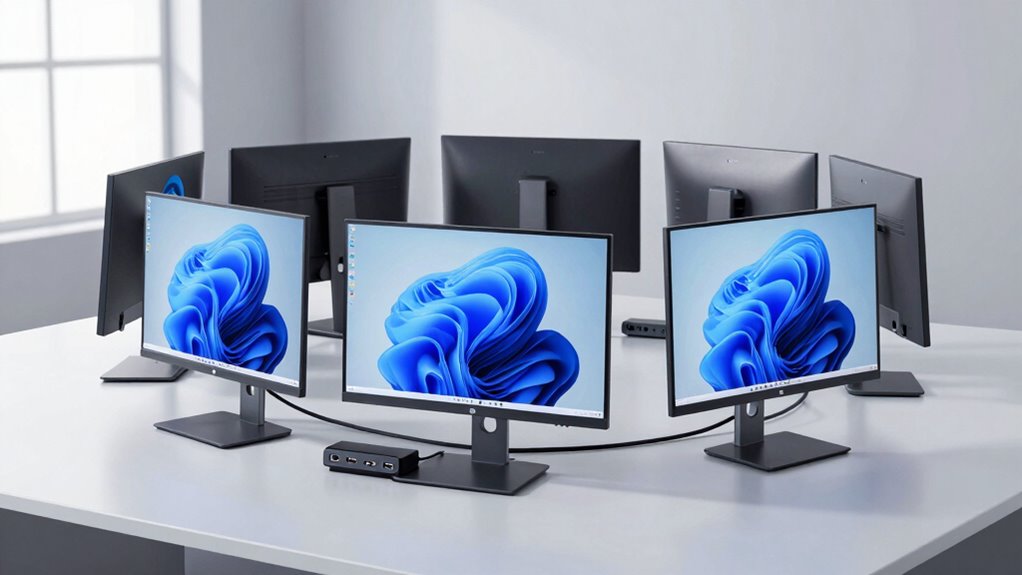

Monitors with built-in docking can connect a laptop to a larger display and compatible peripherals through a single USB-C cable, reducing desk clutter. My best overall pick is the ASUS BE249CGN, a purpose-built 24-inch docking monitor for a practical workstation. For more screen space, the Philips 34E1C5600HE adds an ultrawide display, webcam, and USB-C docking, while the Samsung 49-inch curved monitor suits buyers who want a much larger multi-window station. The main tradeoffs are screen size and resolution versus desk space, and USB-C convenience versus the monitor’s specific charging and port capabilities. Read on for the full comparison and advice on choosing a monitor that fits your laptop, peripherals, and workspace.

Get your wardrobe favorites delivered free with Prime
- Fast, free delivery on millions of items
- Prime Video, Amazon Music and more included
- Member-only deals all year
Key Takeaways
- Dedicated docking features separate the shortlist: the ASUS BE249CGN, ASUS VA27ECPSN, ViewSonic VG2458, Philips 34E1C5600HE, and ASUS VA24ECPSN are explicitly identified as docking monitors, unlike several general USB-C or conventional display models.
- A USB-C port does not automatically mean a complete laptop dock: check for video, data, and enough power delivery for your laptop, plus the downstream ports you need.
- The ASUS BE249CGN leads for a compact work station: its 24-inch format is easier to place than the large curved alternatives, while its docking positioning is more direct than that of general-purpose displays.
- The Philips 34E1C5600HE combines two desk-saving tools: its ultrawide screen, integrated webcam, and USB-C docking can reduce the need for separate display and video-call equipment, though it takes more desk space than 24-inch choices.
- The Samsung 49-inch model is a specialist, not a default pick: its Dual QHD ultrawide format and 120Hz refresh rate suit expansive multitasking, but the footprint and workspace demands make it less suitable for compact desks or simple laptop setups.


| monitors with built in docking | Resolution | Refresh rate | Screen size | Panel type |
|---|---|---|---|---|
| Sceptre 24-inch Prime Monitor | 1080p | Up to 100Hz | — | — |
| ASUS 24” USB-C Docking Monitor | 1920 x 1080 | 120Hz | 23.8 inches | IPS |
| Dell S2722DC Monitor | 2560×1440 (WQHD) | 75Hz | — | — |
| ASUS VA27ECPSN 27-Inch Full HD | 1920 x 1080 (Full HD) | Up to 75Hz | 27 inches | IPS |
| ViewSonic VG2458 24-Inch 1080p | 1920 × 1080 (Full HD) | 100Hz | 24 inches | IPS LED |
| ASUS VA24DQSB 24-Inch Full HD | 1920 × 1080 (Full HD) | Up to 75 Hz | 24 inches | IPS |
| Philips 34 Inch Curved Compute | 3440 × 1440 | 100Hz | 34 inches | VA |
| Samsung 49” Business Curved Ul | Dual QHD | 120Hz | 49 inches | — |
| Philips 34E1C5600HE 34-Inch Cu | 3440 × 1440 | 100Hz | 34 inches | — |
| ASUS VA24ECPSN 23.8-Inch Full | 1920 × 1080 (Full HD) | 75Hz | 23.8 inches | IPS |
More Details on Our Top Picks
Sceptre 24-inch Prime Monitor – 1080p LED, 99% sRGB, 2x HDMI, VGA, Built-in Speakers
The Sceptre is the clear budget-style outlier in a roundup about monitors with built-in docking: its listed connections are two HDMI ports and VGA, with no USB-C, USB hub, or Ethernet. That makes it a poor fit for a laptop station, but a straightforward choice if you need a basic screen for a desktop that already has its own ports. Its 99% sRGB coverage, built-in speakers, and refresh rate up to 100Hz give it more versatility for everyday media and casual gaming than its simple connectivity suggests. Compared with the ASUS BE249CGN, it lacks one-cable laptop charging and network connectivity; compared with the Dell S2722DC, it also has lower resolution. Choose it for a simple, separate-display setup, not for desk docking.
Pros:- 99% sRGB color coverage
- Two HDMI inputs plus VGA
- Built-in speakers avoid needing separate speakers for basic audio
- Refresh rate up to 100Hz with FPS and RTS modes
Cons:- No listed USB-C, USB hub, or Ethernet for docking
- 1080p resolution offers less workspace detail than the Dell S2722DC’s WQHD panel
- No adjustable-stand details are provided
Best for: Desktop users who want a 24-inch 1080p screen with built-in speakers and do not need laptop docking, USB ports, or Ethernet.
Not ideal for: Laptop users building a one-cable station, since the listed connections do not include USB-C docking, a USB hub, or RJ45.
- Display size:24 inches
- Resolution:1080p
- Color gamut:99% sRGB
- Refresh rate:Up to 100Hz
- Ports:2x HDMI, 1x VGA
- Audio:Built-in speakers
- Gaming modes:FPS, RTS
- Mounting pattern:100mm x 100mm
Our verdict“Choose the Sceptre for a simple desktop display, but skip it if built-in docking is the reason you are shopping.”
ASUS 24” USB-C Docking Monitor (BE249CGN)
The ASUS BE249CGN makes the most sense for a compact, wired workstation, especially when a laptop needs both USB-C and a direct Ethernet connection at the desk. Its USB-C docking, USB hub, and RJ45 LAN port give it a more station-ready feature set than the Dell S2722DC, whose supplied details list USB-C power delivery and USB-A but no Ethernet. The ASUS also has a 120Hz IPS display and a highly adjustable stand, so it can serve for smoother everyday motion and flexible placement as well as office work. The tradeoff is Full HD on a 23.8-inch screen, while the Dell offers more pixel detail at 27 inches. The ASUS has no built-in speakers, and its many connections may still mean managing more than one cable depending on your setup.
Pros:- USB-C docking plus RJ45 LAN and a USB hub
- 120Hz refresh rate for smoother onscreen motion
- Height, pivot, swivel, and tilt adjustments support flexible positioning
- Flicker-free and low blue light features
Cons:- Full HD provides less screen detail than the Dell S2722DC’s WQHD resolution
- No built-in speakers
- Full use of the connection options may involve managing multiple cables
Best for: Laptop workers who want USB-C docking, wired Ethernet, a USB hub, and a compact monitor with extensive stand adjustment.
Not ideal for: Buyers who want a higher-resolution 27-inch workspace or built-in speakers; this model is Full HD and lists no speakers.
- Screen size:23.8 inches
- Resolution:1920 x 1080
- Panel type:IPS
- Refresh rate:120Hz
- Connectivity:HDMI, USB-C, DisplayPort, DisplayPort out, earphone jack, USB hub, RJ45 LAN
- Stand adjustments:150mm height, ±180° swivel, ±90° pivot, +35° to -5° tilt
- Eye care:Flicker-free and low blue light
- Warranty:3 years
Our verdict“Pick the ASUS BE249CGN for a compact laptop station that needs wired Ethernet and broad connectivity more than extra resolution or built-in audio.”
Dell S2722DC Monitor – 27-inch WQHD (2560×1440), 75Hz, 4ms, AMD FreeSync, Built-in Speakers, USB-C, Adjustable Stand
The Dell S2722DC is the better fit when screen detail and a larger workspace matter more than having a full docking station built into the display. Its 27-inch WQHD panel gives documents and windows more room and definition than the Full HD ASUS BE249CGN or ASUS VA27ECPSN. USB-C with 65W power delivery can simplify a compatible laptop connection, and the adjustable stand plus built-in speakers help keep a home-office setup tidy. But its listed connectivity is narrower than the ASUS BE249CGN’s: the Dell has no specified RJ45 port or DisplayPort, and its 75Hz refresh rate is lower. This is a useful USB-C monitor, not the most complete station in the group. Choose it if the extra resolution is worth giving up Ethernet docking.
Pros:- 27-inch WQHD resolution offers more workspace detail than the Full HD docking options
- USB-C provides up to 65W power delivery
- Height, pivot, swivel, and tilt adjustments
- Built-in speakers and AMD FreeSync
Cons:- Listed connections do not include RJ45 or DisplayPort, unlike the ASUS BE249CGN
- 75Hz refresh rate is modest for high-refresh gaming
- No HDR support is specified in the supplied product details
Best for: Home-office laptop users who want a 27-inch WQHD screen, 65W USB-C charging, an adjustable stand, and built-in speakers.
Not ideal for: People who need RJ45 Ethernet or a broad dock built into the monitor, or gamers seeking a high-refresh display.
- Display size:27 inches
- Resolution:2560×1440 (WQHD)
- Refresh rate:75Hz
- Response time:4ms
- USB-C power delivery:65W
- USB connectivity:USB 3.2 Gen 1 Type-A
- Stand adjustments:Height, pivot, swivel, tilt
- Additional features:AMD FreeSync, built-in speakers
Our verdict“Choose the Dell S2722DC if a sharper 27-inch display matters more than Ethernet and the broader docking connections offered by ASUS’s BE249CGN.”
ASUS VA27ECPSN 27-Inch Full HD IPS Docking Monitor
The ASUS VA27ECPSN suits buyers who want a 27-inch screen and a built-in wired station without stepping up to a higher-resolution panel. USB-C carries video and data while supplying up to 65W of laptop power; RJ45, three USB-A ports, HDMI, and DisplayPort make this more dock-like than the Dell S2722DC, whose listed connections do not include Ethernet. Its adjustable stand also offers height, pivot, swivel, and tilt, giving it practical flexibility for a fixed desk setup. The main compromise is Full HD stretched across 27 inches: text and fine details will look less crisp than on the Dell’s 27-inch WQHD display. The 75Hz ceiling also favors office work over high-refresh gaming. This is a station-first pick, not a resolution-first one.
Pros:- USB-C carries video and data and provides up to 65W charging
- RJ45 and three USB-A ports support a more complete desk station
- Height, pivot, swivel, and tilt adjustments
- IPS panel with 178-degree viewing angles and Adaptive-Sync
Cons:- Full HD is less detailed at 27 inches than the Dell S2722DC’s WQHD panel
- 75Hz maximum refresh rate is limited for high-refresh gaming
- No built-in speakers are listed in the supplied specifications
Best for: Office workers with a compatible laptop who need a 27-inch display, wired Ethernet, USB-A accessories, and up to 65W USB-C charging at a desk station.
Not ideal for: Buyers who prioritize crisp text and fine detail on a 27-inch screen, or who want refresh rates above 75Hz.
- Screen size:27 inches
- Resolution:1920 x 1080 (Full HD)
- Panel type:IPS
- Refresh rate:Up to 75Hz
- Connectivity:HDMI, DisplayPort 1.2, USB-C, 3x USB 3.2 Gen 1 Type-A, RJ45, earphone jack
- USB-C power delivery:Up to 65W
- Stand adjustments:Tilt, swivel, pivot, height
- Viewing angle:178 degrees
Our verdict“Choose the ASUS VA27ECPSN for a 27-inch office station with Ethernet and USB-C charging, provided Full HD detail is enough for your work.”
ViewSonic VG2458 24-Inch 1080p USB-C Docking Monitor
The ViewSonic VG2458 stands out for a 24-inch station that can deliver up to 100W over USB-C, more charging headroom than the 65W Dell S2722DC and ASUS VA27ECPSN. Its RJ45 port, seven total USB ports, and DisplayPort daisy chaining give it a strong office-docking role: it can connect a laptop, wired network, and desk accessories without relying on a separate hub. The 100Hz IPS panel and fully adjustable stand round out a practical work display. The tradeoff is its 1080p resolution, which is less detailed than the Dell’s WQHD screen. It also has a 5ms response time, and the supplied power-consumption figure is 138W. Choose it for charging and station connectivity, not maximum pixel density.
Pros:- USB-C supports up to 100W power delivery
- RJ45, seven total USB ports, and DisplayPort daisy chaining support a capable desk station
- 100Hz IPS display for smoother everyday motion
- Stand adjusts for height, tilt, swivel, and rotation
Cons:- Full HD resolution is less detailed than the Dell S2722DC’s WQHD panel
- Listed power consumption is 138W
- 5ms response time is less suited to buyers focused on fast-response gaming
Best for: Laptop users building a compact office station who need up to 100W USB-C charging, wired Ethernet, multiple USB connections, and daisy chaining.
Not ideal for: People who want a sharper 27-inch workspace like the Dell S2722DC, or who prefer to avoid a monitor with a listed 138W power consumption.
- Screen size:24 inches
- Resolution:1920 × 1080 (Full HD)
- Panel type:IPS LED
- Refresh rate:100Hz
- USB-C power delivery:Up to 100W
- Ports:HDMI, DisplayPort, USB-A, USB-C, RJ45 Ethernet
- USB ports:7 total
- Stand adjustments:Tilt, swivel, rotate, height adjustment
- Power consumption:138 watts
Our verdict“Pick the ViewSonic VG2458 if your laptop station needs 100W charging and broad connectivity more than a higher-resolution screen.”
ASUS VA24DQSB 24-Inch Full HD IPS Monitor
The VA24DQSB is the most flexible choice here for arranging a compact desk setup, with height, tilt, swivel, and pivot adjustments that the Philips 34E2CUAE’s listed specs don’t match. Its IPS panel and 178-degree viewing angles suit shared viewing, while HDMI, DisplayPort, VGA, and USB cover a range of computers and accessories. But this is not a full docking monitor: the listed USB connectivity does not include USB-C laptop charging or an RJ45 port. Compared with the ASUS VA24ECPSN, it gives up one-cable charging and network docking in exchange for a capable basic display and varied legacy connections. The 75Hz refresh rate and Adaptive-Sync are useful extras, but Full HD across 24 inches offers less workspace detail than the ultrawide Philips models.
Pros:- Height, tilt, swivel, and pivot adjustments help fit varied desk and portrait setups
- IPS panel with 178-degree viewing angles supports off-center viewing
- HDMI, DisplayPort, VGA, and USB offer flexible device connections
- 75Hz refresh rate, Adaptive-Sync, and built-in speakers add everyday versatility
Cons:- No USB-C laptop charging or listed RJ45 Ethernet port, limiting its docking usefulness
- Full HD resolution provides less desktop detail than the 34-inch and 49-inch ultrawides
- USB connectivity is less clearly specified than the docking ports on the VA24ECPSN
Best for: Buyers who need an adjustable 24-inch monitor for a mixed-device desk and do not need laptop charging or Ethernet through the display
Not ideal for: Laptop users seeking a one-cable station with USB-C charging and wired network; the VA24ECPSN is a closer fit
- Screen size:24 inches
- Resolution:1920 × 1080 (Full HD)
- Panel type:IPS
- Refresh rate:Up to 75 Hz
- Connectivity:HDMI, DisplayPort, VGA, USB
- Stand adjustments:130 mm height, tilt, swivel, and pivot
- Audio:Built-in speakers
- Eye care:Flicker-free and low blue light
Our verdict“Choose this for ergonomic flexibility and varied standard inputs, but pick the ASUS VA24ECPSN if you want a genuine USB-C docking station.”
Philips 34 Inch Curved Computer Monitor UWQHD 100Hz USB-C PD VA, 346E2CUAE
The Philips 346E2CUAE makes the most sense for buyers who want a wide UWQHD canvas and USB-C power and data in a single display. Its 34-inch, 3440 × 1440 curved screen gives side-by-side work more room than the Full HD ASUS VA24ECPSN, while 100Hz and Adaptive Sync make scrolling and supported games look smoother. The tradeoff is a less complete station than the product name might suggest: the supplied data confirms USB-C, but does not state its charging wattage or list an Ethernet port. For a work-from-home desk centered on a laptop, the Philips 34E1C5600HE adds a webcam, call audio, and a stated USB hub, making it better equipped for meetings. This model instead favors screen area and a clean single-cable connection, with a 1500R curve that may not suit every desk or content workflow.
Pros:- 3440 × 1440 resolution provides substantial room for side-by-side windows
- USB-C supports power and data through a single laptop connection
- 100Hz refresh rate and Adaptive Sync support smoother motion
- 1500R curvature and wide color-gamut figures suit immersive work and entertainment
Cons:- USB-C charging wattage and a detailed port list are not supplied
- No built-in webcam or microphone is listed, unlike the Philips 34E1C5600HE
- The 34-inch curved screen needs more desk space than the 24-inch ASUS options
Best for: Laptop users who want an ultrawide workspace and USB-C video and data through one monitor connection, without needing an integrated webcam
Not ideal for: Buyers who need a clearly specified high-wattage laptop charger, Ethernet, or built-in video-call equipment
- Screen size:34 inches
- Resolution:3440 × 1440
- Panel type:VA
- Curvature:1500R
- Refresh rate:100Hz
- Response time:1ms MPRT
- Connectivity:USB-C with Power Delivery
- Color gamut:121.3% sRGB, 99.5% NTSC
Our verdict“Pick this Philips for an expansive USB-C ultrawide desk, but choose the 34E1C5600HE if webcam and meeting hardware matter more.”
Samsung 49” Business Curved Ultrawide Dual QHD Computer Monitor with USB-C, DisplayPort, HDMI, 120Hz, VESA DisplayHDR 400, Built-in Speakers, Height Adjustable Stand, Eye Care, LS49C954UANXZA, 2024
The Samsung LS49C954UANXZA is the lineup’s largest productivity station: its 49-inch, 32:9 Dual QHD screen can keep multiple work areas visible without arranging separate monitors. USB-C supplies up to 90W laptop charging, and DisplayPort, HDMI, and USB add connection options; built-in speakers also help keep a desk less crowded. Against the Philips 34E1C5600HE, this Samsung offers far more horizontal space and a higher 120Hz refresh rate, but it lacks that Philips model’s listed webcam and microphone. Its 1000R curve may help bring the wide panel into view, yet this size demands substantial desk width and can be awkward for users who need a conventional screen shape. It is the strongest station-style pick for multitasking, not the practical choice for a small workstation.
Pros:- 49-inch Dual QHD, 32:9 workspace accommodates multiple windows side by side
- USB-C provides up to 90W charging alongside DisplayPort, HDMI, and USB
- 120Hz refresh rate supports smoother scrolling and motion
- Built-in speakers and height-adjustable stand simplify a workstation setup
Cons:- The 49-inch width requires a large desk and careful placement
- The 1000R curve may not suit every workspace or viewing preference
- Unlike the Philips 34E1C5600HE, it has no listed built-in webcam or microphone
Best for: Power users who keep several documents, timelines, or application windows open and want 90W laptop charging from one large display
Not ideal for: Small-desk users, frequent screen sharers, or video-call-focused buyers who want an integrated webcam and microphone
- Screen size:49 inches
- Resolution:Dual QHD
- Aspect ratio:32:9
- Curvature:1000R
- Refresh rate:120Hz
- USB-C charging:Up to 90W
- Connectivity:USB-C, USB, DisplayPort, HDMI
- HDR:VESA DisplayHDR 400
Our verdict“Choose the Samsung if you want maximum panoramic workspace and 90W USB-C charging, provided your desk can accommodate its scale.”
Philips 34E1C5600HE 34-Inch Curved UltraWide QHD Monitor with Webcam, USB-C Docking, and 100Hz Refresh Rate
For a laptop station that doubles as a meeting setup, the Philips 34E1C5600HE is the most complete fit in this group. Its USB-C docking, 5MP Windows Hello webcam, noise-canceling microphone, and stereo speakers reduce the number of separate devices on a desk, while the 34-inch 3440 × 1440 display leaves room for a call beside work documents. Compared with the 346E2CUAE, it adds the built-in conferencing kit and a listed four-port USB hub; compared with the much larger Samsung, it is easier to place in a typical home office. One specification needs checking before purchase: USB-C power delivery appears as both 65W and 90W in the supplied details. Its 1500R curve and 21:9 shape also make it less suited to buyers who prefer a standard flat display.
Pros:- USB-C docking combines laptop connectivity and charging
- Built-in 5MP Windows Hello webcam, noise-canceling microphone, and speakers support video calls
- 34-inch 3440 × 1440 screen provides room for parallel work
- 100Hz refresh rate and a four-port USB listing add everyday flexibility
Cons:- USB-C power delivery is inconsistently listed as up to 65W and up to 90W
- The 1500R curve and 21:9 format may not suit every desk or workflow
- Smaller workspace than the Samsung 49-inch Dual QHD monitor
Best for: Remote workers who want a single monitor for laptop docking, video meetings, and side-by-side applications
Not ideal for: Laptop owners who need confirmed charging above 65W or shoppers who prefer a flat, standard-aspect display
- Screen size:34 inches
- Resolution:3440 × 1440
- Aspect ratio:21:9
- Panel and curvature:VA LCD, 1500R
- Refresh rate:100Hz
- Webcam:Built-in 5MP with Windows Hello
- Audio:Noise-canceling microphone and stereo speakers
- USB-C power delivery:Listed as up to 65W and up to 90W
- Ports:1 HDMI port, 4 USB ports
Our verdict“Choose this Philips for a meeting-ready laptop station with an ultrawide screen, but confirm its USB-C charging output suits your laptop.”
ASUS VA24ECPSN 23.8-Inch Full HD IPS Docking Monitor
The VA24ECPSN is the clearest choice for a compact laptop docking station that still offers practical desk adjustments. Its USB-C connection carries video and data and supplies up to 65W charging; an RJ45 port adds wired network access, while the USB hub helps connect peripherals without reaching for a separate dock. Compared with the VA24DQSB, this model is much better suited to a laptop-centered station, even though both are compact Full HD IPS screens with ergonomic stands. It cannot match the Philips ultrawides for workspace width, and 1920 × 1080 is a modest resolution for detailed multitasking. The supplied brightness value uses an unusual unit, so I would not use it to compare brightness with other displays. For buyers prioritizing docking over screen area, its port mix is the differentiator.
Pros:- USB-C supports video, data, and up to 65W laptop charging
- RJ45 LAN and a USB hub add practical docking connections
- Tilt, swivel, pivot, and height adjustments allow flexible positioning
- IPS panel, Adaptive-Sync, and flicker-free and low blue light features support everyday viewing
Cons:- Full HD resolution provides less detail and desktop space than either Philips 34-inch model
- No built-in webcam or speakers are listed in the supplied details
- Brightness is reported in an unusual unit, making the figure difficult to compare
Best for: Laptop users setting up a compact home or office station who need USB-C charging, wired Ethernet, and a height-adjustable screen
Not ideal for: Buyers who want high-resolution multitasking space, a widescreen format, or a built-in webcam for meetings
- Screen size:23.8 inches
- Resolution:1920 × 1080 (Full HD)
- Panel type:IPS
- Refresh rate:75Hz
- USB-C charging:Up to 65W
- Connectivity:HDMI, USB-C, DisplayPort, USB hub, RJ45 LAN, earphone jack
- Stand adjustments:Tilt, swivel, pivot, and height
- Response time:5 ms
Our verdict“Choose the VA24ECPSN for a compact laptop station with Ethernet and 65W USB-C charging, not for expansive screen space.”

How We Picked
I ranked these monitors by how well they answer the specific need for a built-in laptop docking station, not just by screen size or resolution. I gave more weight to models explicitly described as docking monitors, then considered how their listed USB-C connectivity, display format, ergonomics, and extra features could support a practical work setup. A USB-C label alone does not establish charging wattage or the full range of dock functions, so I avoid treating unspecified capabilities as confirmed.
The order also reflects who is likely to benefit from each display and what they give up. Compact docking monitors rise for everyday desk use; ultrawide models earn their place when a broad workspace, webcam, or more screen area changes the setup meaningfully. General-purpose displays, including models without stated docking features, rank lower for this search because their suitability as a one-cable station is less clear. Every option has a tradeoff, whether that is limited resolution, a larger footprint, or uncertainty about docking details.
| monitors with built in docking | Panel type | Connectivity |
|---|---|---|
| Sceptre 24-inch Prime Monitor | — | — |
| ASUS 24” USB-C Docking Monitor | IPS | HDMI, USB-C, DisplayPort, DisplayPort out, earphone jack, USB hub, RJ45 LAN |
| Dell S2722DC Monitor | — | — |
| ASUS VA27ECPSN 27-Inch Full HD | IPS | HDMI, DisplayPort 1.2, USB-C, 3x USB 3.2 Gen 1 Type-A, RJ45, earphone jack |
| ViewSonic VG2458 24-Inch 1080p | IPS LED | — |
| ASUS VA24DQSB 24-Inch Full HD | IPS | HDMI, DisplayPort, VGA, USB |
| Philips 34 Inch Curved Compute | VA | USB-C with Power Delivery |
| Samsung 49” Business Curved Ul | — | USB-C, USB, DisplayPort, HDMI |
| Philips 34E1C5600HE 34-Inch Cu | — | — |
| ASUS VA24ECPSN 23.8-Inch Full | IPS | HDMI, USB-C, DisplayPort, USB hub, RJ45 LAN, earphone jack |
Factors to Consider When Choosing Monitors With Built In Docking
Choosing a dock-equipped display starts with the laptop and accessories you need to connect, not the screen diagonal. I’d check the connection path, desk layout, and daily work before paying for extra screen area or refresh rate.
Confirm What the USB-C Connection Actually Does
USB-C describes the connector, not a guaranteed set of functions. For a true one-cable setup, the monitor needs to carry video and data, and it must supply enough power for your laptop if you expect it to charge through the same cable. Check the monitor’s documentation for power-delivery wattage and the exact downstream ports rather than assuming a USB-C port handles everything. A laptop with a high-power adapter may still need its own charger even when connected to a dock-equipped monitor. Also verify that your laptop supports video output over USB-C; some ports handle data and charging only. This check can prevent buying a screen that looks like a docking solution but leaves your keyboard, mouse, or power brick connected separately.
Match Screen Area to the Work You Do
More screen space can reduce window switching, but it only helps when your work benefits from keeping multiple apps visible. A 24-inch display is easier to fit into a compact home office or shared desk, while a 27-inch QHD screen gives documents and side-by-side windows more room. A 34-inch ultrawide can replace a dual-monitor arrangement for many workflows, but curved width takes up more desk space and may not suit every application. The 49-inch Samsung is a substantial station rather than a simple monitor upgrade, so measure the desk and viewing distance before choosing it. Think about window layout and desk depth, not just the diagonal measurement.
Choose Resolution for Text and Workspace
Resolution affects how much content fits on screen and how sharp text appears at a given size. Full HD can be a sensible match for compact 24-inch work displays, especially for routine office tasks, but it offers less desktop space than QHD. At 27 inches, QHD can make small text and detailed spreadsheets look more defined while giving you more room for open windows. Ultrawide QHD and Dual QHD displays broaden the workspace, though laptop graphics and application support can affect how smoothly you use that resolution. Avoid choosing a large screen on size alone: a resolution mismatch can leave text less crisp than expected or force more scaling than you prefer.
Treat Ergonomics as Part of the Docking Setup
A monitor can simplify cables yet still make a poor daily station if the screen cannot be positioned comfortably. Check whether the stand adjusts for height and tilt, and whether the monitor supports a VESA mount if you use an arm. Raising the screen to a suitable eye level can matter more over a full workday than an extra feature used occasionally. Curved ultrawide models also need enough distance and desk depth for comfortable viewing across the panel. If the built-in stand does not suit your desk, include the cost and space of a separate mount in your decision. A tidy connection setup should support a comfortable working posture as well.
Count the Ports You Will Keep Using
A docking monitor only reduces clutter if it can connect the devices you actually use. List your regular accessories—such as a keyboard receiver, webcam, storage drive, or wired network adapter—and compare that list with the monitor’s documented ports. Some models may offer USB-C video but few downstream connections, while others are designed more directly as docking displays. Check whether ports remain accessible when the monitor is against a wall or on an arm. If you rely on a separate hub today, confirm that the display can replace its functions rather than adding another device to the chain. When port details are unclear, treat the monitor as a display with USB-C until the manufacturer confirms more.
Pay for Extra Features Only When They Replace Something
Features such as an integrated webcam, speakers, higher refresh rate, or a broad curved panel can make a setup more convenient, but they do not automatically improve its docking function. The Philips 34E1C5600HE’s webcam may reduce separate equipment for frequent video calls, while a large ultrawide may be useful for users who regularly keep several work windows open. For basic documents and email, a simpler docking display may leave more desk space and offer a better fit. Higher refresh rates matter more for motion-heavy use than for ordinary office work. Compare each extra with the device it might replace, and skip features that do not solve a recurring problem.
Frequently Asked Questions
Does every monitor with USB-C work as a laptop docking station?
No. USB-C may provide video, data, charging, or only some of those functions, depending on the monitor and laptop. Check the monitor specifications for video input, downstream USB ports, and power-delivery wattage, then confirm your laptop supports display output over its USB-C port. If any of those details are missing, do not assume the monitor will replace your current dock. The ASUS BE249CGN and models explicitly named as docking monitors are clearer starting points for this need than general displays with USB-C.
Can a built-in docking monitor charge a powerful laptop?
That depends on the monitor’s stated power-delivery output and the laptop’s charging requirements. A USB-C connection can carry power without supplying enough wattage for every laptop, especially under heavy workloads. Compare the monitor’s documented output with your laptop’s recommended adapter, and check whether charging is supported while the display and USB accessories are in use. If the monitor falls short, you may still need a separate charger. The product list does not provide wattage for every USB-C model, so verify this detail before buying.
Is a 34-inch ultrawide better than two monitors for a work station?
It can be a cleaner option if you want one continuous desktop and fewer display cables, but it is not automatically a better fit. A 34-inch ultrawide such as the Philips models offers broad workspace in one panel, while two monitors can provide more flexibility in positioning separate screens. Check whether your software handles window arrangement well and whether your desk has enough width and depth. If you use a webcam, the Philips 34E1C5600HE’s integrated camera may also simplify the station. Choose the layout that suits your workflow rather than relying on diagonal size alone.
Should I choose a docking monitor if I already own a USB-C hub?
It depends on whether the monitor can replace the hub’s functions and whether you value fewer devices on the desk. Compare the hub’s ports and power delivery with the monitor’s documented connections before retiring it. If the display lacks a port you use or provides less charging power, keeping the hub may still be necessary. A monitor with built-in docking can simplify cable changes when you regularly connect and disconnect a laptop, but it may add little if your existing hub already works well. Treat compatibility and port count as the deciding factors, not the docking label alone.
Which type of monitor makes the most sense for a small desk?
A 24-inch model is generally easier to place than a 34- or 49-inch curved display, but check the stand depth and available adjustment as well as the panel size. Among this roundup’s more compact options, the ASUS BE249CGN, ViewSonic VG2458, and ASUS VA24ECPSN are explicitly positioned as docking monitors. The Sceptre and ASUS VA24DQSB are conventional display options in the supplied specifications, so do not assume they provide the same docking setup. Measure your usable desk area and confirm cable access before choosing. A compact screen that connects the right peripherals can make a more useful station than a larger display that crowds the workspace.
Conclusion
For a compact everyday work station, I’d start with the ASUS BE249CGN as the best overall fit because it is explicitly a 24-inch USB-C docking monitor. The ASUS VA24ECPSN is my best-value-style compact alternative for buyers who want a straightforward docking display, while the Philips 34E1C5600HE is the stronger premium-style choice for people who want ultrawide space and an integrated webcam. Beginners who want a less imposing screen should compare the ASUS and ViewSonic 24-inch docking options, then verify charging and ports for their laptop. For a broad multi-window station, the Samsung 49-inch is the specialist pick, provided the desk can accommodate it. Skip the large curved models if space is limited, and check the exact USB-C power and hub specifications before treating any monitor as a full laptop dock.
Columbus Day / Indigenous Peoples' Day Picks
long weekend sales
As an affiliate, we earn on qualifying purchases.