

For most programmers, I would start with the Keychron V6 8K: its full-size layout, programmable knob, and wired connection suit long coding sessions and frequent shortcuts. The Keychron Q8 stands out for programmers who want an ergonomic Alice layout, while the AULA F75 Pro offers a smaller wireless, hot-swappable alternative. The main tradeoffs are layout size, wired reliability versus wireless flexibility, and whether features such as hot-swappable switches or macros justify added complexity. A compact board frees desk space but may make navigation keys less convenient, especially if you use them often. Read on for the full breakdown of all 14 mechanical keyboards for programmers and guidance on choosing the right fit.

Get your wardrobe favorites delivered free with Prime
- Fast, free delivery on millions of items
- Prime Video, Amazon Music and more included
- Member-only deals all year
Key Takeaways
- The Keychron V6 8K is the clearest all-rounder in this lineup for programmers who want a full-size layout, wired connection, programmable knob, and Brown switches.
- Layout choice separates the picks more than flashy extras: the V6 and full-size boards retain dedicated navigation keys, while the F75 Pro and Q8 trade some conventional key placement for desk space or an ergonomic layout.
- Wireless and hot-swappable features point to flexibility, not automatically better typing. Models such as the AULA F75 Pro and F99 suit people who value connection options or switch changes, but wired boards remain simpler for a fixed workstation.
- The Keychron Q8 is the most specialized ergonomic option. Its Alice layout may suit programmers seeking a different hand position, but it asks users to adapt rather than offering a familiar standard layout.
- Several boards serve distinct nonstandard needs: the VSD K1 Pro adds an integrated streaming deck, the SOLAKAKA A99 Pro adds an LCD and knob, and the CHERRY KC 200 MX keeps its appeal focused on a conventional wired typing setup.
| RK Royal Kludge R98 Pro 98-Key Wired Mechanical Keyboard |  | Best Overall for a Wired Programmer Setup | Layout: 98-key QWERTY | Connectivity: Wired USB-C | Switches: Pre-lubed linear; hot-swappable 3-pin and 5-pin | VIEW ON AMAZON | See Our Full Breakdown |
| Logitech Alto Keys K98M Wireless Mechanical Keyboard, Graphite |  | Best for Multi-Device Workstations | Layout: 98-key compact 1800-style with numpad | Switches: Hot-swappable Marble mechanical switches | Connectivity: Bluetooth Low Energy and Logi Bolt USB receiver | VIEW ON AMAZON | See Our Full Breakdown |
| SOLAKAKA A99 Pro 96% Wireless Mechanical Keyboard with LCD Screen and Metal Knob |  | Best for Programmers Who Want Wireless Customization | Layout: 96%, 97 keys | Connectivity: Bluetooth 5.0, 2.4 GHz wireless, and USB-C wired | Multi-device support: Up to five devices | VIEW ON AMAZON | See Our Full Breakdown |
| VSD K1 Pro 87-Key Macro Mechanical Keyboard with Integrated Streaming Deck |  | Best for Shortcut-Heavy Coding Workflows | Layout: 87-key QWERTY | Switches: Linear Red; hot-swappable 3-pin and 5-pin | Connectivity: Corded USB-C | VIEW ON AMAZON | See Our Full Breakdown |
| Keychron K4 Version 2 96% Wireless Mechanical Keyboard with Brown Switches and White Backlight |  | Best for Mac-and-Windows Switching | Layout: 96%, 100 keys | Switches: Tactile brown | Connectivity: Bluetooth 5.1 and USB-C | VIEW ON AMAZON | See Our Full Breakdown |
| Keychron Q8 65% Alice Layout Wired Mechanical Keyboard with Knob |  | Best for Ergonomic Customization | Layout: 65% Alice, QWERTY | Connection: Wired USB-C | Body: CNC-machined aluminum | VIEW ON AMAZON | See Our Full Breakdown |
| Keychron C2 Full-Size Wired Mechanical Keyboard with Brown Switches |  | Best for Beginners | Layout: 104-key full-size QWERTY | Switch type: Tactile Brown | Connection: Wired USB-C | VIEW ON AMAZON | See Our Full Breakdown |
| Redragon K580 Wired RGB Mechanical Gaming Keyboard |  | Best for Onboard Macros | Layout: 104-key QWERTY | Switch type: Clicky Outemu Blue | Connection: Wired USB-C | VIEW ON AMAZON | See Our Full Breakdown |
| AULA F75 Pro 75% Wireless Hot-Swappable Mechanical Keyboard |  | Best for Multi-Device Setups | Layout: 75%, 81 keys | Keyboard layout: QWERTZ | Connectivity: Bluetooth 5.0, 2.4 GHz wireless, and USB-C | VIEW ON AMAZON | See Our Full Breakdown |
| Redragon K556 Wired RGB Mechanical Gaming Keyboard, 104-Key Aluminum |  | Best Value for Switch Customization | Layout: 104 keys | Connection: Wired | Frame: Brushed aluminum | VIEW ON AMAZON | See Our Full Breakdown |
| Keychron V6 8K Full-Size Wired Mechanical Keyboard with Programmable Knob and Brown Switches |  | Best for Programmable Full-Size Workflows | Layout: Full-size QWERTY, 104 keys | Connection: Wired USB-C | Polling rate: 8,000 Hz | VIEW ON AMAZON | See Our Full Breakdown |
| Logitech G413 SE Full-Size Mechanical Gaming Keyboard |  | Best for a Straightforward, Durable Setup | Layout: Full-size QWERTY, 108 keys | Connection: Wired USB 2.0 | Switches: Tactile mechanical | VIEW ON AMAZON | See Our Full Breakdown |
| AULA F99 Tri-Mode Wireless Mechanical Keyboard | 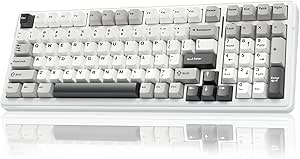 | Best for Multi-Device Wireless Coding | Layout: 99 keys, 96% layout; AZERTY | Connectivity: Bluetooth 5.0, 2.4GHz wireless, USB-C | Device pairing: Up to 5 devices | VIEW ON AMAZON | See Our Full Breakdown |
| CHERRY KC 200 MX Wired Mechanical Keyboard with MX2A Brown Switches |  | Best for Long-Life Tactile Typing | Layout: Full-size QWERTY, 108 keys | Connection: Wired USB-A | Switches: CHERRY MX2A Brown, tactile and non-clicky | VIEW ON AMAZON | See Our Full Breakdown |
| mechanical keyboards for programmer | Layout | Switches | Backlighting | Compatibility |
|---|---|---|---|---|
| RK Royal Kludge R98 Pro 98-Key | 98-key QWERTY | Pre-lubed linear; hot-swappable 3-pin and 5-pin | RGB with 20+ modes | Windows and macOS |
| Logitech Alto Keys K98M Wirele | 98-key compact 1800-style with numpad | Hot-swappable Marble mechanical switches | White, single color | Windows and macOS |
| SOLAKAKA A99 Pro 96% Wireless | 96%, 97 keys | LEOBOG Star Vector; hot-swappable 3-pin and 5-pin | — | Windows, iOS, Mac, and Android |
| VSD K1 Pro 87-Key Macro Mechan | 87-key QWERTY | Linear Red; hot-swappable 3-pin and 5-pin | RGB | Windows 10 or later; macOS 11 Big Sur or later |
| Keychron K4 Version 2 96% Wire | 96%, 100 keys | Tactile brown | White LED | Mac and Windows |
| Keychron Q8 65% Alice Layout W | 65% Alice, QWERTY | Hot-swappable Gateron G Pro; supplied switch color is inconsistently described | RGB, south-facing LEDs | — |
| Keychron C2 Full-Size Wired Me | 104-key full-size QWERTY | — | None | macOS and Windows |
| Redragon K580 Wired RGB Mechan | 104-key QWERTY | — | RGB | Linux, macOS, Windows, and gaming consoles |
| AULA F75 Pro 75% Wireless Hot- | 75%, 81 keys | Linear, hot-swappable 3-pin or 5-pin | RGB, 16.8 million colors | — |
| Redragon K556 Wired RGB Mechan | 104 keys | — | — | Windows and Mac |
| Keychron V6 8K Full-Size Wired | Full-size QWERTY, 104 keys | Tactile brown, hot-swappable | Per-key RGB with 22+ effects | — |
| Logitech G413 SE Full-Size Mec | Full-size QWERTY, 108 keys | Tactile mechanical | Single-color white LED | — |
| AULA F99 Tri-Mode Wireless Mec | 99 keys, 96% layout; AZERTY | Pre-lubed linear, hot-swappable | RGB with 16 lighting effects | — |
| CHERRY KC 200 MX Wired Mechani | Full-size QWERTY, 108 keys | CHERRY MX2A Brown, tactile and non-clicky | — | — |
More Details on Our Top Picks
RK Royal Kludge R98 Pro 98-Key Wired Mechanical Keyboard
The R98 Pro is my strongest all-round pick for programmers who want a compact footprint without giving up the number pad, arrow keys, or room to customize the typing feel. Its 98-key layout keeps navigation and numeric entry close together, while the hot-swappable linear switches let owners try compatible 3-pin or 5-pin alternatives without soldering. Five layers of sound-absorbing foam and a gasket mount are a useful counterpoint to the brighter, more feature-heavy SOLAKAKA A99 Pro: the R98 Pro keeps its setup wired and its controls more straightforward. Double-shot PBT caps and an aluminum volume knob round out a practical desk tool. The tradeoff is USB-C wired-only connectivity; programmers who regularly switch between computers will find the Logitech Alto Keys K98M more convenient. The unusually listed 16-inch height also deserves checking before planning a tight desk fit.
Pros:- Compact 98-key layout retains a number pad and arrow keys
- Hot-swappable sockets support 3-pin and 5-pin switches
- Gasket mount and five sound-absorbing layers help soften typing noise
- Double-shot PBT keycaps and detachable aluminum volume knob
Cons:- Wired USB-C connection only
- Listed 16-inch height appears unusually large and should be verified for desk-fit planning
Best for: Programmers who want a compact keyboard with a number pad, customizable switches, and a permanent wired workstation.
Not ideal for: People who switch between several computers or need a tidy cable-free desk, since this model has no wireless connection.
- Layout:98-key QWERTY
- Connectivity:Wired USB-C
- Switches:Pre-lubed linear; hot-swappable 3-pin and 5-pin
- Mount:Gasket mount with five layers of sound-absorbing foam
- Keycaps:Double-shot PBT, MDA profile
- Backlighting:RGB with 20+ modes
- Compatibility:Windows and macOS
- Dimensions:15.3 × 5.5 × 16 in (as listed)
Our verdict“Choose the R98 Pro for a customizable wired programming setup that preserves the number pad without taking up a full-size layout.”
Logitech Alto Keys K98M Wireless Mechanical Keyboard, Graphite
The Alto Keys K98M suits programmers who move between a work computer and a personal machine but still want a compact layout with a number pad. Bluetooth and Logi Bolt connectivity make that routine more practical than with the wired RK Royal Kludge R98 Pro, and the stated battery life of up to 12 months reduces charging interruptions. Its gasket mount is designed to absorb typing vibrations, while hot-swappable Marble switches offer some scope to change the feel. The programmable Action Keys add quick access to recurring tasks, though some advertised functions depend on the Logi Options+ app. This is a more restrained choice than the RGB-lit SOLAKAKA A99 Pro: the Alto uses white backlighting only and an enclosure made from recycled plastic. Pick it for wireless convenience, not extensive lighting customization or a fully app-independent setup.
Pros:- Bluetooth Low Energy and Logi Bolt support wireless workstation flexibility
- Compact 98-key layout keeps a number pad
- Hot-swappable Marble switches and gasket mount
- Programmable Action Keys and stated battery life of up to 12 months
Cons:- White backlighting only, without RGB customization
- Some advertised features require the Logi Options+ app
- Recycled-plastic enclosure may not suit buyers seeking a metal-bodied board
Best for: Programmers who share a compact numpad keyboard across Windows and macOS computers and want Bluetooth or Logi Bolt connection options.
Not ideal for: Buyers who want RGB effects, minimal software dependence, or an entirely wired setup with fewer wireless components.
- Layout:98-key compact 1800-style with numpad
- Switches:Hot-swappable Marble mechanical switches
- Connectivity:Bluetooth Low Energy and Logi Bolt USB receiver
- Backlighting:White, single color
- Battery life:Up to 12 months
- Charging:USB-C
- Compatibility:Windows and macOS
- Enclosure:Recycled plastic
Our verdict“Choose the Alto Keys K98M if wireless multi-computer use matters more than RGB lighting or app-free customization.”
SOLAKAKA A99 Pro 96% Wireless Mechanical Keyboard with LCD Screen and Metal Knob
The A99 Pro is the most connectivity-focused option in this group: it can connect over Bluetooth, 2.4 GHz wireless, or USB-C, and supports up to five devices. That flexibility makes it a better fit for a desk shared by several machines than the wired-only RK Royal Kludge R98 Pro, while its 96% layout retains a compact cluster of keys for everyday coding and numeric entry. A multifunction metal knob and LCD screen put common controls within reach, and the web driver adds programmable options. The driver’s wired-connection requirement limits the convenience of customizing a wireless setup, though. Its 8000 mAh battery has stated runtimes of approximately 61 hours with backlighting and 170 without, so lighting use affects charging cadence. Buyers accustomed to a standard full-size layout may also need time to adjust.
Pros:- Bluetooth, 2.4 GHz, and USB-C connection options
- Supports up to five devices
- Hot-swappable 3-pin and 5-pin switches
- LCD screen, multifunction metal knob, and large rechargeable battery
Cons:- Web driver requires a wired connection
- 96% layout may take adjustment for users accustomed to standard layouts
- Stated battery life is shorter with backlighting enabled
Best for: Programmers who alternate among several devices and want wireless modes, programmable controls, and a compact layout with a near-full key set.
Not ideal for: People who want a familiar standard layout or expect to configure every setting wirelessly, since the web driver requires a wired connection.
- Layout:96%, 97 keys
- Connectivity:Bluetooth 5.0, 2.4 GHz wireless, and USB-C wired
- Multi-device support:Up to five devices
- Switches:LEOBOG Star Vector; hot-swappable 3-pin and 5-pin
- Keycaps:Double-shot PBT, OEM profile
- Battery:8000 mAh; approximately 61 hours with backlighting and 170 hours without
- Lighting:RGB with 16 main modes and five side-light modes
- Compatibility:Windows, iOS, Mac, and Android
Our verdict“Pick the A99 Pro if multi-device wireless flexibility and programmable controls matter more than a conventional layout or wireless-only configuration.”
VSD K1 Pro 87-Key Macro Mechanical Keyboard with Integrated Streaming Deck
The K1 Pro is a specialized pick for programmers who want macros and app controls directly on the keyboard, rather than a numpad or wireless flexibility. Its six customizable LCD keys and three knobs per software page can put recurring commands within easy reach, making it more task-focused than the standard compact layouts of the Keychron K4 and RK Royal Kludge R98 Pro. The 87-key format also leaves more desk room than a keyboard with a number pad, though that makes it less suited to frequent numeric entry. Hot-swappable 3-pin and 5-pin support gives owners a way to change switches, while the gasket mount and five-layer dampening structure address typing sound. The tradeoffs are a USB-C wired-only connection and reliance on software and a wired connection for display setup and time calibration. It is not water resistant, either.
Pros:- Six customizable LCD keys and three knobs per software page
- Hot-swappable sockets support 3-pin and 5-pin switches
- Gasket mount with five-layer sound dampening
- RGB lighting and adjustable stands
Cons:- USB-C wired connection only
- Display image and date/time setup require software and a wired connection
- Not water resistant
Best for: Programmers who use repeatable macros, application shortcuts, or control knobs and prefer dedicating keyboard space to those tools.
Not ideal for: Users who need a number pad, wireless operation, water resistance, or a simple keyboard without software-dependent display controls.
- Layout:87-key QWERTY
- Switches:Linear Red; hot-swappable 3-pin and 5-pin
- Connectivity:Corded USB-C
- Display and controls:Built-in TFT color display, six LCD keys, and three knobs per page
- Mount:Gasket mount with five-layer sound-dampening structure
- Backlighting:RGB
- Compatibility:Windows 10 or later; macOS 11 Big Sur or later
- Water resistance:Not water resistant
Our verdict“Choose the K1 Pro if programmable macros and on-keyboard controls are more useful to your coding workflow than a numpad or wireless freedom.”
Keychron K4 Version 2 96% Wireless Mechanical Keyboard with Brown Switches and White Backlight
The Keychron K4 Version 2 is a sensible fit for programmers who want one compact keyboard for both Mac and Windows, with a number pad and the option to connect wirelessly or by cable. Its tactile brown switches offer a defined bump for typists who prefer feedback without choosing a linear switch like the one supplied with the RK Royal Kludge R98 Pro. Bluetooth pairing supports up to three devices, while USB-C provides a wired alternative. The stated up to 240 hours of battery life applies with the backlight disabled, so that figure suits people willing to work without illumination. Compared with the wireless Logitech Alto Keys K98M, the K4 offers white lighting and a specified battery capacity but fewer paired devices. Wireless mode is limited to 6-key rollover, unlike wired NKRO, and the board is not water resistant.
Pros:- Compact 96% layout includes a number pad
- Bluetooth 5.1 supports pairing with up to three devices, with USB-C as an alternative
- Mac and Windows compatibility with extra keycaps included
- Stated battery life of up to 240 hours with the backlight disabled
Cons:- Wireless mode supports 6-key rollover rather than NKRO
- The 240-hour battery figure applies with the backlight disabled
- Not water resistant
Best for: Mac-and-Windows programmers who want a compact number-pad layout, tactile switches, and the ability to pair with up to three devices.
Not ideal for: Users who need wireless NKRO, water resistance, or long battery runtimes while keeping the backlight on.
- Layout:96%, 100 keys
- Switches:Tactile brown
- Connectivity:Bluetooth 5.1 and USB-C
- Device pairing:Up to three devices
- Backlighting:White LED
- Battery:4000 mAh; up to 240 hours with backlight disabled
- Rollover:NKRO wired; 6KRO wireless
- Compatibility:Mac and Windows
Our verdict“Choose the K4 Version 2 if you want tactile feedback and Mac-Windows flexibility, provided 6-key wireless rollover meets your needs.”
Keychron Q8 65% Alice Layout Wired Mechanical Keyboard with Knob
The Q8 is the most distinctive programming pick here: its Alice split layout angles the key groups to offer an alternative to a conventional straight keyboard, while QMK/VIA remapping lets me tailor shortcuts and layers to a coding workflow. The programmable knob adds quick control for tasks such as volume adjustment. Compared with the full-size Keychron C2, the Q8 gives up the number pad and conventional layout for a more specialized shape and far more customization. Its aluminum body, double-gasket construction, and hot-swappable switches suit buyers interested in tuning feel and sound without soldering. The tradeoffs are substantial: it is wired only, not water resistant, and the supplied description conflicts on whether the switches are Blue or Red, so the exact switch feel is unclear.
Pros:- Alice layout offers a split, angled alternative to a standard keyboard
- QMK/VIA support enables extensive remapping and custom layers
- Hot-swappable MX-style switches allow changes without soldering
- Aluminum body and double-gasket construction support a substantial, damped feel
Cons:- Wired USB-C connection limits flexible desk or device setups
- The product description conflicts on whether the included switches are Blue or Red
- Not water resistant, and its 65% layout omits a number pad
Best for: Programmers who want an Alice ergonomic layout, programmable layers, and switch customization, and who are comfortable adapting to a less conventional keyboard.
Not ideal for: Programmers who rely on a number pad, need wireless use, or want a clearly specified switch type before buying.
- Layout:65% Alice, QWERTY
- Connection:Wired USB-C
- Body:CNC-machined aluminum
- Switches:Hot-swappable Gateron G Pro; supplied switch color is inconsistently described
- Switch compatibility:MX-style 3-pin and 5-pin
- Programmability:QMK and VIA
- Backlighting:RGB, south-facing LEDs
- Key rollover and polling:NKRO; 1000 Hz
Our verdict“Choose the Q8 if ergonomic layout experimentation and deep remapping matter more than wireless convenience or a familiar full-size layout.”
Keychron C2 Full-Size Wired Mechanical Keyboard with Brown Switches
The C2 is a straightforward starting point for programmers who want familiar full-size typing rather than a compact layout to learn. Its 104-key arrangement and number pad keep navigation and numeric entry close at hand, while tactile Brown switches provide feedback without the specified click of the Redragon K580’s Blue switches. The included Mac and Windows keycaps make it easier to match the legends to a mixed-device setup. Compared with the customization-focused Keychron Q8, the C2 is simpler and more conventional, but it does not offer the Q8’s stated QMK/VIA support, knob, or hot-swappable switches. Its USB-C wired connection is dependable for a fixed desk, though the lack of backlighting can make keys harder to see in dim rooms. It is also not water resistant.
Pros:- Full-size layout includes a number pad and familiar navigation keys
- Tactile Brown switches suit users who want feedback without specified clicky Blue switches
- Includes extra keycaps for Mac and Windows
- Adjustable feet provide two typing angles
Cons:- No backlighting for low-light work
- Wired-only connection is less flexible for multi-device setups
- Not water resistant and does not offer the stated hot-swap customization of the Q8
Best for: New mechanical-keyboard buyers who program at a fixed desk, use the number pad, and want a familiar layout with tactile switches and Mac/Windows keycaps.
Not ideal for: Programmers who need wireless mobility, backlighting, compact desk space, or switch customization.
- Layout:104-key full-size QWERTY
- Switch type:Tactile Brown
- Connection:Wired USB-C
- Backlighting:None
- Keycaps:ABS; extra Mac and Windows keycaps included
- Compatibility:macOS and Windows
- Dimensions:17.1 × 5.1 × 1.5 in
- Switch lifespan:Up to 50 million keystrokes
Our verdict“Pick the C2 for an uncomplicated full-size first mechanical keyboard, especially if you value a number pad over lighting and customization.”
Redragon K580 Wired RGB Mechanical Gaming Keyboard
The K580’s strongest programming angle is its five onboard macro keys, which can be programmed without software. That makes it a practical fit for users who want dedicated shortcuts for repeated commands or app actions without relying on a companion program. It also keeps a full-size layout, adds dedicated media controls and a volume roller, and supports hot-swappable switches. Compared with the Brown-switch Redragon K556, the K580’s Outemu Blue switches are explicitly clicky, a sound profile that may suit a private office but can distract nearby coworkers. Advanced RGB effects and macro profiles require optional software, so the no-software advantage applies mainly to the onboard keys. For programming, the bright feature set does not outweigh the acoustic tradeoff for every shared workspace.
Pros:- Five onboard macro keys can be programmed without software
- Full-size layout includes dedicated media controls and a volume roller
- Hot-swappable switches allow hardware customization
- Anti-ghosting and double-shot keycaps support frequent key use
Cons:- Clicky Outemu Blue switches can be disruptive in shared workspaces
- Advanced RGB effects and macro profiles require optional software
- Wired-only connection offers no wireless setup
Best for: Programmers who want a full-size keyboard with dedicated, software-free onboard macro keys and work in a space where clicky typing is acceptable.
Not ideal for: People sharing a quiet office, users who prefer tactile or linear switches, or buyers who want advanced macro profiles without software.
- Layout:104-key QWERTY
- Switch type:Clicky Outemu Blue
- Connection:Wired USB-C
- Backlighting:RGB
- Macro controls:Five onboard macro keys
- Media controls:Dedicated controls and volume roller
- Compatibility:Linux, macOS, Windows, and gaming consoles
- Keycaps:Double-shot, rated for 50 million keystrokes
Our verdict“Choose the K580 for accessible onboard macros and media controls, but skip it if loud switches are a problem where you work.”
AULA F75 Pro 75% Wireless Hot-Swappable Mechanical Keyboard
For programmers who move between a work computer and personal devices, the F75 Pro offers the lineup’s most flexible connection mix: Bluetooth, 2.4 GHz wireless, and USB-C, with support for up to five devices. Its 75% layout keeps the arrow keys while reducing the footprint compared with the full-size C2 and K580. Linear hot-swappable switches, programmable keys, and a multifunction knob give it more room for personal setup than the C2, while layered sound-dampening construction is aimed at a more controlled typing sound. The catch is the listed QWERTZ layout, which may not match programmers accustomed to QWERTY and can affect key placement and legends. Water resistance is described only as water-repellent, not waterproof, so spills still call for care.
Pros:- Bluetooth, 2.4 GHz, and USB-C support flexible device connections
- Can connect with up to five devices
- Compact 75% layout retains arrow keys
- Hot-swappable switches and programmable controls allow customization
Cons:- Listed QWERTZ layout may not suit QWERTY users
- Water-repellent description does not mean waterproof
- Compact layout omits the full-size number pad found on the C2 and K580
Best for: Programmers switching among several computers or mobile devices who want wireless options, arrow keys, and a compact layout.
Not ideal for: QWERTY typists who do not want to adapt to QWERTZ, or anyone who needs confirmed waterproof protection.
- Layout:75%, 81 keys
- Keyboard layout:QWERTZ
- Connectivity:Bluetooth 5.0, 2.4 GHz wireless, and USB-C
- Multi-device support:Up to five devices
- Switches:Linear, hot-swappable 3-pin or 5-pin
- Keycaps:Side-printed PBT
- Battery:Rechargeable, 4000 mAh
- Backlighting:RGB, 16.8 million colors
Our verdict“Pick the F75 Pro if multi-device wireless use and a compact arrow-key layout matter more than a standard QWERTY arrangement.”
Redragon K556 Wired RGB Mechanical Gaming Keyboard, 104-Key Aluminum
The K556 is a good fit for programmers who want a sturdy full-size board they can modify over time. Its hot-swappable 3-pin and 5-pin sockets make changing switch feel possible without soldering, while the brushed aluminum frame gives it a more substantial construction than the ABS-enclosure K580. Brown tactile switches offer a quieter-feeling alternative to the K580’s clicky Blue switches, though the available details do not specify sound levels. The K556 also provides full anti-ghosting and preset RGB modes, with companion software for custom lighting and macros. Compared with the Keychron Q8, it keeps the familiar number pad and has broad switch compatibility, but it is a conventional full-size wired keyboard rather than an ergonomic Alice board with stated QMK/VIA support. Custom effects and macros depend on software.
Pros:- Brushed aluminum frame provides a rigid full-size build
- Hot-swappable sockets support most 3-pin and 5-pin switches
- Brown tactile switches avoid the specified clicky Blue switch type of the K580
- Full anti-ghosting and preset RGB modes
Cons:- Wired connection limits placement and multi-device flexibility
- Custom lighting and macros require companion software
- Full-size footprint takes more desk space than the AULA F75 Pro
Best for: Programmers who want a full-size wired keyboard with tactile switches, an aluminum frame, and the option to change switches without soldering.
Not ideal for: Buyers who need wireless connectivity, software-free custom macros, or the ergonomic layout and QMK/VIA support listed for the Keychron Q8.
- Layout:104 keys
- Connection:Wired
- Frame:Brushed aluminum
- Switch type:Brown tactile
- Switch compatibility:Hot-swappable 3-pin and 5-pin switches
- Lighting:20 preset RGB modes
- Anti-ghosting:Full
- Compatibility:Windows and Mac
Our verdict“Choose the K556 if you want a full-size, tactile keyboard whose switches can be changed later, and do not mind a wired connection or software-dependent customization.”
Keychron V6 8K Full-Size Wired Mechanical Keyboard with Programmable Knob and Brown Switches
The V6 is the most customization-focused full-size pick here: QMK and Keychron Launcher support let programmers remap keys and configure the knob around their tools, while hot-swappable switches make later changes possible without soldering. Its tactile brown switches offer feedback without a clicky switch’s sharper noise, and the full-size layout keeps a number pad close for data entry. Compared with the Logitech G413 SE, the V6 gives up the simpler, more restrained lighting setup for per-key RGB and deeper remapping options. The 8,000 Hz polling rate is a headline spec, but it is less likely to matter for ordinary coding than the programmable controls. The tradeoff is a wired-only connection and a wide footprint; choose it for customization, not a tidy or portable desk.
Pros:- QMK and Keychron Launcher support enable extensive key and control customization.
- Hot-swappable switches support most 3-pin and 5-pin MX-style switches.
- Full-size layout pairs a number pad with tactile brown switches.
- Per-key RGB lighting offers more control than the Logitech G413 SE’s white-only lighting.
Cons:- Wired USB-C connection limits placement flexibility.
- Full-size layout takes substantial desk space.
- The 8,000 Hz polling rate may offer little practical benefit for typical programming tasks.
Best for: Programmers who want a number pad, tactile switches, and the ability to remap keys or tune controls for their editor and operating system.
Not ideal for: People who need a wireless or compact keyboard, or whose coding workflow will not make use of programmable keys and the knob.
- Layout:Full-size QWERTY, 104 keys
- Connection:Wired USB-C
- Polling rate:8,000 Hz
- Switches:Tactile brown, hot-swappable
- Keycaps:Double-shot PBT
- Backlighting:Per-key RGB with 22+ effects
- Operating systems:macOS, Windows, Linux
- Warranty:1 year
Our verdict“Choose the V6 if you want a customizable full-size coding board; skip it if wireless convenience or desk space matters more.”
Logitech G413 SE Full-Size Mechanical Gaming Keyboard
The G413 SE suits programmers who want a sturdy full-size board without making switch or lighting customization part of the decision. Its tactile mechanical switches provide feedback during long typing sessions, while the PBT keycaps are built to resist wear. The aluminum-magnesium alloy top case gives it a more substantial frame than the AULA F99’s feature-rich wireless approach, but the Logitech keeps the setup simpler: it is wired, has one white backlight color, and supplies function-row media controls. Those limits matter if you want per-key lighting, wireless device switching, or programmable layouts; the Keychron V6 offers much more configuration. For programmers who favor a conventional full-size layout and durable materials over customization, the G413 SE is the more restrained choice.
Pros:- PBT keycaps are designed to resist wear and heat.
- Tactile switches provide a noticeable response while typing.
- Aluminum-magnesium alloy top case adds rigidity.
- Twelve function-key media controls keep common playback adjustments within reach.
Cons:- Wired USB 2.0 connection limits placement flexibility.
- Single-color white backlighting lacks per-key customization.
- Six-key rollover is less suited to users who need full N-key rollover.
Best for: Programmers who want a conventional full-size keyboard with tactile switches, durable PBT keycaps, and a sturdy top case.
Not ideal for: People who need wireless connectivity, per-key RGB, extensive remapping, or a compact layout for a crowded desk.
- Layout:Full-size QWERTY, 108 keys
- Connection:Wired USB 2.0
- Switches:Tactile mechanical
- Key rollover:6-key anti-ghosting
- Keycaps:PBT
- Backlighting:Single-color white LED
- Top case:Aluminum-magnesium alloy
- Dimensions:17.13 × 1.97 × 1.43 in
Our verdict“Pick the G413 SE for a sturdy, no-fuss full-size typing setup, not for wireless use or extensive keyboard customization.”
AULA F99 Tri-Mode Wireless Mechanical Keyboard
The F99 stands out for programmers who move between a computer and other devices: it supports Bluetooth, 2.4GHz, and USB-C, with pairing for up to five devices. Its 99-key layout retains many full-size functions while taking less room than a standard full-size board, though it is not as compact as a smaller layout. The pre-lubed linear switches feel different from the tactile browns in the Keychron V6 and CHERRY KC 200 MX, so buyers who rely on tactile feedback should compare those first. Hot-swap support and programmable keys allow customization, and the large battery supports cordless use. The main snag for many English-language programmers is the listed AZERTY layout, alongside Windows-focused compatibility information. Check both before choosing it for a primary coding machine.
Pros:- Bluetooth, 2.4GHz wireless, and USB-C support varied desk setups.
- Can pair with up to five devices.
- Hot-swap support works with 3-pin and 5-pin switches.
- 8000mAh battery and double-shot PBT keycaps support cordless daily use.
Cons:- Listed AZERTY layout may not suit programmers accustomed to QWERTY.
- Linear switches lack the tactile feedback offered by the Keychron V6 and CHERRY KC 200 MX.
- The 99-key layout remains relatively wide compared with compact keyboards.
Best for: Programmers who switch among several devices and want wireless options, a near-full-size layout, and replaceable switches.
Not ideal for: Users who require a QWERTY layout or clearly specified support beyond Windows, or who prefer tactile switches to linear ones.
- Layout:99 keys, 96% layout; AZERTY
- Connectivity:Bluetooth 5.0, 2.4GHz wireless, USB-C
- Device pairing:Up to 5 devices
- Switches:Pre-lubed linear, hot-swappable
- Switch compatibility:3-pin and 5-pin
- Backlighting:RGB with 16 lighting effects
- Battery:8000mAh rechargeable
- Operating system:Windows
Our verdict“Choose the F99 if multi-device wireless use is your priority and its AZERTY layout suits your typing habits.”
CHERRY KC 200 MX Wired Mechanical Keyboard with MX2A Brown Switches
The KC 200 MX is a straightforward full-size option for programmers who want tactile feedback and a conventional wired setup rather than extensive customization. Its CHERRY MX2A Brown switches are tactile without being clicky, a useful middle ground for shared workspaces, and are rated for more than 100 million actuations per key. The aluminum plate and abrasion-resistant keycaps support a durable, work-oriented build. Compared with the Keychron V6, the CHERRY offers less flexibility: there is no listed hot-swap support, QMK programming, or per-key RGB. It does bring full N-key rollover and practical calculator and volume shortcuts. The USB-A connection and Windows-focused compatibility details may be inconvenient for some setups, so check your computer’s ports and operating system before choosing it.
Pros:- MX2A Brown switches provide tactile feedback without a clicky sound.
- Switches are rated for more than 100 million actuations per key.
- Full N-key rollover and anti-ghosting support simultaneous key presses.
- Aluminum plate and abrasion-resistant keycaps suit regular desk use.
Cons:- Wired USB-A connection restricts placement and may need an adapter on some computers.
- Windows-focused compatibility information leaves other operating systems less clearly specified.
- Offers less customization than the hot-swappable, QMK-capable Keychron V6.
Best for: Programmers who prefer non-clicky tactile switches, full N-key rollover, and a durable full-size keyboard for a Windows workstation.
Not ideal for: People who need wireless connectivity, switch swapping, deep key remapping, or clearly specified support for macOS and Linux.
- Layout:Full-size QWERTY, 108 keys
- Connection:Wired USB-A
- Switches:CHERRY MX2A Brown, tactile and non-clicky
- Rollover:Full N-key rollover and anti-ghosting
- Plate:Aluminum
- Dimensions:16.93 × 4.76 × 1.54 in
- Warranty:1 year
Our verdict“Choose the KC 200 MX for durable, non-clicky tactile typing on a Windows desk, but look elsewhere for wireless use or extensive customization.”

How We Picked
I ranked these keyboards around the needs that shape daily programming work: a useful layout for coding and navigation, a connection that fits the user’s setup, practical programmability, and features that can support long typing sessions. I gave stronger placement to boards that combine broadly useful traits without tying the buyer to a highly specialized layout or extra control system. Full-size and near-full-size choices can be more convenient for programmers who rely on dedicated navigation keys or a number pad; compact models earn their place when desk space and customization matter more.
I also weighed the tradeoffs behind each feature. Hot-swappable switches can make later changes easier, wireless modes add placement flexibility, and macro controls can help with repeated tasks, but none is a substitute for choosing a layout that suits the work. The ranking reflects that balance: the V6 8K leads as a practical wired all-rounder, while specialized options such as the Q8 and VSD K1 Pro rank for narrower needs. I treated gaming-oriented lighting and extra screens as secondary unless they support a clear programming workflow.
| mechanical keyboards for programmer | Connection |
|---|---|
| RK Royal Kludge R98 Pro 98-Key | — |
| Logitech Alto Keys K98M Wirele | — |
| SOLAKAKA A99 Pro 96% Wireless | — |
| VSD K1 Pro 87-Key Macro Mechan | — |
| Keychron K4 Version 2 96% Wire | — |
| Keychron Q8 65% Alice Layout W | Wired USB-C |
| Keychron C2 Full-Size Wired Me | Wired USB-C |
| Redragon K580 Wired RGB Mechan | Wired USB-C |
| AULA F75 Pro 75% Wireless Hot- | — |
| Redragon K556 Wired RGB Mechan | Wired |
| Keychron V6 8K Full-Size Wired | Wired USB-C |
| Logitech G413 SE Full-Size Mec | Wired USB 2.0 |
| AULA F99 Tri-Mode Wireless Mec | — |
| CHERRY KC 200 MX Wired Mechani | Wired USB-A |
Factors to Consider When Choosing Mechanical Keyboards For Programmers
Before choosing a board, I would map it to the way I actually write and edit code, rather than treating every extra feature as an upgrade. These broader choices can matter more than the model name: a layout mismatch can slow familiar shortcuts, and a flexible board may add setup work you do not need.
Choose a layout around your daily navigation habits
Start by noticing how often you use the arrow keys, Home, End, Page Up, Page Down, and a number pad. If those keys are part of routine code navigation or data entry, a full-size or near-full-size layout can preserve familiar reach and reduce reliance on layers. Compact boards save desk room, but their missing or relocated keys may require remapping or extra key combinations. That adjustment can be worthwhile if you rarely use the omitted keys or want more mouse space. Do not choose a compact layout only because it looks tidy; check its key map and decide whether you can live with the arrangement every workday.
Pick a switch feel that fits both your hands and workspace
Switch labels are a starting point, not a guarantee that a keyboard will feel right: typing sound and resistance depend on the whole board, keycaps, and desk environment. Tactile switches such as Brown types provide a noticeable bump without the same click emphasis as clicky switches, which can be a reasonable shared-office compromise. If you work near other people or take calls, account for sound before focusing on switch preference alone. A hot-swappable board can let you change switches later, but it does not make the first choice irrelevant, and replacement parts add cost and setup effort. When possible, compare switch feel on a tester before committing to a layout you otherwise like.
Treat programmability as a workflow tool, not a feature count
Macros and remapping can help with repeated commands, application shortcuts, or a preferred navigation layer, but they only pay off when you will use them consistently. Before buying a board with extensive controls, list the actions you want to assign and check how its configuration software handles them. A knob may be handy for volume or scrolling, yet it is not inherently useful for coding. Extra displays and integrated control decks may appeal to people who stream or manage many applications, but can be distractions for a keyboard used mainly for text and code. Favor clear, maintainable customization over a long list of controls you are unlikely to configure.
Decide whether wired simplicity or wireless flexibility suits your desk
A wired board is a straightforward fit for a fixed workstation: it avoids battery upkeep and keeps the connection simple. Wireless models can make a shared desk easier to rearrange or allow one keyboard to move between devices, though you should check which connection modes the specific model supports. Do not assume that a wireless label means seamless switching among every computer, tablet, or operating system. Also account for charging habits and whether you prefer a cable-free desktop enough to manage them. If your keyboard rarely leaves one desk, a dependable wired connection may be more useful than added connectivity options.
Pay for repairability and build features you will keep using
Hot-swap support, programmable firmware, and a sturdy frame can extend a keyboard’s useful life, but their value depends on whether you plan to change switches, keymaps, or components. A heavier or more elaborate board may feel like a substantial desk fixture, yet it is less convenient to move. Backlighting can help in a dim workspace, while elaborate RGB effects do little for code entry if you work in a bright room. Check the key layout, software support, and replacement-part availability before treating a board as upgradeable. I would spend more for a feature that solves a recurring problem, not simply for a longer specification list.
Frequently Asked Questions
Is a full-size keyboard better for programming than a compact one?
Neither layout is automatically better; the right choice depends on how often you use dedicated navigation keys and a number pad. Full-size options such as the Keychron V6 8K and CHERRY KC 200 MX keep familiar key placement, which can help if you move frequently through code or enter numeric data. Compact choices reclaim desk space but may relocate keys or require layers for functions you expect to reach directly. Before choosing, compare the actual key map with your current habits and decide which adjustments you are willing to make. Familiarity can matter more to daily speed than a smaller footprint.
Should I choose a wireless keyboard for a programming workstation?
Wireless makes the most sense if you move between devices, share a desk, or value a cleaner cable setup. If the keyboard stays connected to one desktop all day, a wired model avoids battery management and keeps the setup uncomplicated. Check the exact connection modes and device-switching behavior rather than assuming all wireless boards work the same way. Also think about whether your work setup allows a receiver or Bluetooth connection you can use reliably. The choice is mostly about desk habits, not programming performance alone.
Are hot-swappable switches worth choosing if I have never changed keyboard switches?
Hot-swap support is useful if you expect to experiment with switch feel or replace a faulty switch without soldering. It is less compelling if you already like the supplied switch type and do not plan to modify the board. Switch changes still require compatible parts, some care during removal, and time to settle on a feel you prefer. For a first mechanical keyboard, I would prioritize a comfortable layout and suitable stock switches before paying extra attention to upgrade options. Treat hot-swap as room to adjust later, not a reason to overlook the basics.
Would an Alice layout help with long coding sessions?
An Alice layout changes the angle and spacing of the key areas, which some typists may find more comfortable, but it is not a guaranteed ergonomic fix. It can also mean a learning period because the layout differs from a conventional keyboard. The Keychron Q8 is the specialist pick here for someone willing to adapt in pursuit of a different hand position. If you rely on standard key placement across multiple workstations, that adjustment may outweigh the potential benefit. Try an Alice-style layout if possible before making it your primary coding keyboard.
Which features should I prioritize if this is my first mechanical keyboard?
I would begin with a familiar layout, a switch feel suited to your workspace, and a connection type you can maintain easily. Dedicated navigation keys can make a first board easier to use if you are accustomed to a full-size keyboard, while an unusual layout or extensive macro system adds a learning curve. The Keychron C2 and CHERRY KC 200 MX offer straightforward wired approaches, while the Keychron V6 8K adds programmability for someone who wants room to customize. Extra screens, knobs, and lighting are secondary unless you already know how they will support your routine. A board that feels natural to use is a stronger first choice than one with the longest feature list.
Conclusion
For the best overall fit, choose the Keychron V6 8K if you want a full-size wired keyboard with a programmable knob and familiar Brown switches. For value, look at the Keychron C2 if a straightforward full-size wired layout is enough and you do not need the V6’s added controls. For a premium, specialized ergonomic setup, choose the Keychron Q8 if you are comfortable learning an Alice layout. For beginners, the CHERRY KC 200 MX is a sensible option for a conventional wired typing experience, while the AULA F75 Pro suits someone who wants a compact wireless board with hot-swap flexibility. For streaming controls, the VSD K1 Pro has the more specific feature set; for a number pad and multiple connection options, consider the AULA F99. I would make the final choice by matching layout and workflow first, then treating wireless, customization, and extra controls as deciding factors.
Halloween Picks
halloween
As an affiliate, we earn on qualifying purchases.