

LTE and 5G home internet routers use a SIM or carrier service to bring cellular internet into a home, cabin, or RV, but they vary widely in speed potential, portability, and network compatibility. My best overall pick is the GL.iNet GL-X3000 Spitz AX, which pairs 5G with Wi-Fi 6 for a strong fixed-home option; the GL-XE3000 Puli AX adds a battery for mobile use, while the T-Mobile 5G Gateway kit is a simpler route for buyers on a compatible T-Mobile plan. The main tradeoff is between newer 5G hardware and more affordable LTE models, alongside the choice between a stationary gateway and a portable router. Carrier bands, SIM restrictions, and coverage can matter more than the router’s headline wireless speed. Read on for the full breakdown and a guide to matching a router to your location and service.

Get your wardrobe favorites delivered free with Prime
- Fast, free delivery on millions of items
- Prime Video, Amazon Music and more included
- Member-only deals all year
Key Takeaways
- The GL-X3000 Spitz AX leads for a fixed 5G setup because it combines 5G cellular connectivity with Wi-Fi 6; buyers who need battery-powered use should compare it with the Puli AX instead.
- The Puli AX is the clearest portable 5G choice in this lineup, thanks to its built-in 6400mAh battery and dual-SIM design, though its battery adds weight and does not replace checking local carrier support.
- LTE models serve a different value proposition than 5G models: the GL-X2000 offers Cat 12 LTE, dual SIM, and Wi-Fi 6, while the C910 and ZBT AC1200 are more basic choices that call for careful scrutiny of bands and software support.
- The T-Mobile G5AR-1 is the carrier-specific simplicity pick with Wi-Fi 7, but it is a less flexible choice than unlocked routers if you want to switch networks or bring your own SIM.
- Portable-router listings need extra verification. The generic 300 Mbps 4G/5G model and the TravlFi XTR Pro are aimed at mobile connectivity, but advertised Wi-Fi speed alone does not establish cellular performance or compatibility.
| GL.iNet GL-X2000 Spitz Plus 4G LTE Cat 12 Wi-Fi 6 Dual-SIM Router |  | Best for Flexible Home Networks | Cellular: 4G LTE Cat 12 | Wi-Fi: Dual-band Wi-Fi 6 | Maximum Wi-Fi data rate: 574 Mbps at 2.4 GHz + 2402 Mbps at 5 GHz | VIEW ON AMAZON | See Our Full Breakdown |
| TravlFi XTR Pro 5G RV Router |  | Best for RV and Multi-Network Travel | Connectivity: 5G and 4G LTE fallback | Maximum data transfer rate: 3600 Mbps | Maximum upstream transfer rate: 200 Mbps | VIEW ON AMAZON | See Our Full Breakdown |
| C910 4G LTE Wireless Router with SIM Card Slot |  | Best Basic LTE SIM Router | Cellular network: 4G LTE FDD bands B2/B4/B5/B12/B13/B17/B18/B25/B26 | Wireless standard: 802.11b/g/n, 2.4 GHz Wi-Fi 4 | Wireless data rate: Up to 300 Mbps | VIEW ON AMAZON | See Our Full Breakdown |
| Portable 4G/5G Mobile Wi-Fi Router, 300 Mbps |  | Best Compact Battery-Powered Option | Network compatibility: 4G/5G and LTE | Maximum data transfer rate: Up to 300 Mbps | Wi-Fi: Wi-Fi 6 listed; 802.11b/g/n also specified | VIEW ON AMAZON | See Our Full Breakdown |
| T-Mobile 5G Gateway & Wi-Fi Router Modem Kit (G5AR-1), Dual-Band WiFi-7 |  | Best Fixed-Home 5G Gateway | Cellular connectivity: 5G | Wi-Fi generation: Wi-Fi 7 | Wi-Fi band: Dual-band | VIEW ON AMAZON | See Our Full Breakdown |
| GL.iNet GL-XE3000 Puli AX 5G Wi-Fi 6 Router with Dual SIM and 6400mAh Battery | 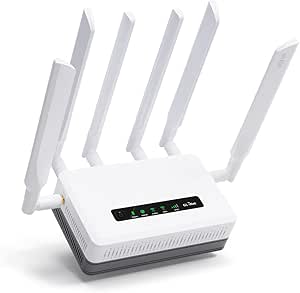 | Best for Backup Power and Connection Failover | Cellular connectivity: 5G NSA/SA and 4G LTE | Wi-Fi: Dual-band Wi-Fi 6 (802.11ax) | Maximum Wi-Fi data rate: 3000 Mbps | VIEW ON AMAZON | See Our Full Breakdown |
| GL.iNet GL-X3000 Spitz AX 5G Cellular Wi-Fi 6 Router |  | Best for Antenna Flexibility and Fixed 5G Setups | Cellular connectivity: 5G NR, LTE, and 3G | Wi-Fi: Dual-band Wi-Fi 6 | Maximum advertised Wi-Fi data rate: Up to 3000 Mbps | VIEW ON AMAZON | See Our Full Breakdown |
| ZBT AC1200 4G LTE Router with SIM Card Slot, Unlocked Dual Band WiFi, Gigabit Ethernet, USB Storage, OpenWrt Support |  | Best for Budget-Minded LTE Home Networks | LTE modem: Quectel EC25AFXDGA | Listed cellular speeds: Up to 150 Mbps download and 50 Mbps upload | Wi-Fi bands and speeds: 2.4 GHz at 300 Mbps; 5 GHz at 867 Mbps | VIEW ON AMAZON | See Our Full Breakdown |
| lte 5g home internet router | Wi-Fi |
|---|---|
| GL.iNet GL-X2000 Spitz Plus 4G | Dual-band Wi-Fi 6 |
| TravlFi XTR Pro 5G RV Router | — |
| C910 4G LTE Wireless Router wi | — |
| Portable 4G/5G Mobile Wi-Fi Ro | Wi-Fi 6 listed; 802.11b/g/n also specified |
| T-Mobile 5G Gateway & Wi-Fi Ro | — |
| GL.iNet GL-XE3000 Puli AX 5G W | Dual-band Wi-Fi 6 (802.11ax) |
| GL.iNet GL-X3000 Spitz AX 5G C | Dual-band Wi-Fi 6 |
| ZBT AC1200 4G LTE Router with | — |
More Details on Our Top Picks
GL.iNet GL-X2000 Spitz Plus 4G LTE Cat 12 Wi-Fi 6 Dual-SIM Router
The GL-X2000 Spitz Plus is a strong fit when a home internet setup needs more than one way to get online. Its Cat 12 LTE, dual-SIM failover, and multi-WAN support can keep a connection available by switching among cellular, Ethernet, repeater, or tethered internet. Compared with the C910, it has newer Wi-Fi 6 and more connection-management options, but it costs the simplicity of a basic SIM router: network setup and routing choices may take more work. Four SMA connectors also make it more adaptable to external antennas where indoor reception is weak. The tradeoff is that it is 4G LTE, not 5G, and its VPN throughput is limited to 30 Mbps on OpenVPN or 190 Mbps on WireGuard. I’d choose it for flexibility, not for the highest cellular speed.
Pros:- Dual-SIM failover and multi-WAN support provide multiple ways to keep internet access available.
- Wi-Fi 6 offers newer local wireless connectivity than the C910’s Wi-Fi 4.
- Four SMA antenna connectors allow external antenna setups for challenging cellular reception.
- Supports OpenVPN and WireGuard alongside Linux-based routing features.
Cons:- Uses 4G LTE rather than 5G, limiting its appeal where faster cellular service is available.
- VPN throughput is limited to 30 Mbps with OpenVPN and 190 Mbps with WireGuard.
- Cellular compatibility is specified for North America and certified for AT&T and T-Mobile.
Best for: Households in North America that need LTE backup, dual-SIM failover, external antenna options, or multiple WAN sources.
Not ideal for: Buyers seeking 5G speeds, plug-and-play simplicity, or fast OpenVPN throughput; this model is LTE-only and VPN performance is capped by protocol.
- Cellular:4G LTE Cat 12
- Wi-Fi:Dual-band Wi-Fi 6
- Maximum Wi-Fi data rate:574 Mbps at 2.4 GHz + 2402 Mbps at 5 GHz
- SIM:Dual-SIM with single standby
- WAN connections:Ethernet, repeater, cellular, and tethering
- VPN protocols and speeds:OpenVPN up to 30 Mbps; WireGuard up to 190 Mbps
- Antenna connectors:4 SMA
- LAN port bandwidth:1000 Mbps
- Cellular compatibility:North America; AT&T and T-Mobile certified
Our verdict“Choose the GL-X2000 if you want a configurable LTE home connection with WAN failover and antenna flexibility rather than 5G service.”
TravlFi XTR Pro 5G RV Router
The TravlFi XTR Pro is the travel-focused pick here: it pairs 5G with automatic 4G LTE fallback and is designed to connect across multiple major networks. That makes it a better match for changing locations than the home-oriented T-Mobile G5AR-1, which depends on T-Mobile coverage. Its SIM-free setup and flexible monthly service arrangement may also appeal to RV owners who want a private Wi-Fi network without managing a conventional SIM card. It can support up to 128 devices, well beyond the portable battery router’s 10-device limit. The tradeoffs are that service still requires a separate data plan, and the listed 200 Mbps upstream figure is more modest than the headline 3600 Mbps transfer-rate specification might suggest. I’d shortlist it for travel, not fixed-home use where a stationary gateway is simpler.
Pros:- 5G connectivity with automatic 4G LTE fallback suits changing coverage conditions.
- Access to multiple major networks is more travel-oriented than the T-Mobile-only gateway.
- Supports up to 128 connected devices for a busy RV or shared travel setup.
- SIM-free setup and flexible monthly service are designed around mobile use.
Cons:- A separate data service plan is required.
- The 200 Mbps maximum upstream rate may constrain large uploads or demanding remote-work use.
- The source listing gives incomplete physical dimensions, making fit and storage planning less certain.
Best for: RV owners and frequent travelers who need a private 5G/LTE connection that can work across multiple major networks.
Not ideal for: Households wanting a fixed, carrier-independent home router or buyers unwilling to arrange a separate TravlFi data service plan.
- Connectivity:5G and 4G LTE fallback
- Maximum data transfer rate:3600 Mbps
- Maximum upstream transfer rate:200 Mbps
- Wi-Fi standards:802.11ac, 802.11ax, and 802.11n
- Connected devices:Up to 128
- Ports:3
- Antennas:6
- Security:WPA2-PSK
- Weight:2.2 lb
Our verdict“Pick the XTR Pro for RV travel across changing coverage areas, provided its separate service plan suits your needs.”
C910 4G LTE Wireless Router with SIM Card Slot
The C910 is the straightforward choice for turning a compatible North American LTE SIM into home Wi-Fi. It offers router, access point, and repeater modes, plus two LAN ports and one WAN port, giving it more basic wired flexibility than the battery-powered portable router. Compared with the GL-X2000 Spitz Plus, it is simpler and supports a useful set of operating modes, but it lacks Wi-Fi 6, dual-SIM failover, external SMA connectors, and the more advanced WAN controls. Its 2.4 GHz Wi-Fi 4 and 32-device limit suit modest households better than busy homes with many demanding devices. SIM compatibility depends on the listed bands, and setup may require disabling a SIM PIN or entering APN details. I’d pick it for a simple LTE connection, not as a future-ready 5G gateway.
Pros:- Router, access point, and repeater modes allow use in several basic network layouts.
- Two LAN ports and one WAN port provide wired connection options.
- Supports up to 32 devices, more than the portable 10-device router.
- Accepts a compatible SIM to provide LTE internet without a separate cellular modem.
Cons:- Wi-Fi is limited to 2.4 GHz Wi-Fi 4, behind the Wi-Fi 6 options in this lineup.
- Compatibility is limited to specified North American LTE bands and carriers.
- SIM setup may require changing PIN or APN settings, and roaming, virtual SIM, and IoT SIM cards are unsupported.
Best for: North American buyers with a compatible LTE SIM who want a basic router with wired ports and access-point or repeater modes.
Not ideal for: Homes needing 5G, dual-band Wi-Fi, large device capacity, roaming, or a low-effort SIM setup.
- Cellular network:4G LTE FDD bands B2/B4/B5/B12/B13/B17/B18/B25/B26
- Wireless standard:802.11b/g/n, 2.4 GHz Wi-Fi 4
- Wireless data rate:Up to 300 Mbps
- Maximum LTE download speed:Up to 150 Mbps
- Maximum upload speed:Up to 50 Mbps
- Maximum connected devices:32
- Ports:2 LAN and 1 WAN
- Operating modes:Router, access point, and repeater
- Compatibility:AT&T and T-Mobile; North America
Our verdict“Choose the C910 for a modest, wired-friendly LTE setup if its band support matches your carrier and Wi-Fi 4 is sufficient.”
Portable 4G/5G Mobile Wi-Fi Router, 300 Mbps
This portable 4G/5G router is the only option in this group built around a rechargeable battery rather than a fixed home setup. Its 2,100 mAh battery is rated for up to 12 hours, so it can keep a small private network available during a workday or trip without relying on a wall outlet. The LED screen shows signal, battery, and connected-device information—handy status details missing from the larger T-Mobile G5AR-1 listing. Capacity is the compromise: it supports just 10 devices, compared with 128 on the TravlFi XTR Pro, and the product data gives limited detail on cellular bands and carrier compatibility. A SIM is required but not included, and claimed speeds depend on local coverage. I’d treat it as a compact access point, not a replacement for a well-specified fixed home gateway.
Pros:- Battery life is rated for up to 12 hours, supporting use away from a power outlet.
- LED screen displays battery, signal, and connected-device status.
- Supports up to 10 devices in a portable private network.
- USB-C charging offers a familiar charging connection.
Cons:- A SIM card is required and is not included.
- The 10-device limit is far below the TravlFi XTR Pro’s stated capacity.
- Listed network and band details are sparse, making carrier compatibility harder to verify.
Best for: Travelers or remote workers who need a small, battery-powered private network for a few devices and can supply a compatible SIM.
Not ideal for: Families or full-time home users with many devices, or buyers who need clearly documented carrier bands and cellular performance.
- Network compatibility:4G/5G and LTE
- Maximum data transfer rate:Up to 300 Mbps
- Wi-Fi:Wi-Fi 6 listed; 802.11b/g/n also specified
- Maximum connected devices:10
- Battery:2,100 mAh
- Security:WPA2-PSK
- Charging port:USB Type-C
- SIM:Required; not included
Our verdict“Choose this compact router for occasional mobile connectivity with a few devices, not for a demanding permanent home network.”
T-Mobile 5G Gateway & Wi-Fi Router Modem Kit (G5AR-1), Dual-Band WiFi-7
The T-Mobile G5AR-1 is the clearest match for a stationary home or small office that wants 5G service paired with a modern local wireless network. Its Wi-Fi 7 support and gigabit maximum LAN data rate give compatible devices room to connect over the home network, while the no-long-term-contract service description may suit people who want less commitment than a traditional plan. Unlike the TravlFi XTR Pro, this gateway is positioned for a fixed location rather than RV use across multiple networks; its performance depends on T-Mobile coverage. It also has only two ports, so wired-device expansion may require additional networking equipment. The listing provides little detail on cellular bands or gateway features beyond the headline connectivity claims. I’d favor it for T-Mobile-served homes over LTE-only choices such as the C910.
Pros:- 5G connectivity is a better fit for fixed-home cellular service than the LTE-only C910.
- Wi-Fi 7 supports newer compatible devices on the local network.
- Gigabit maximum LAN data rate supports fast wired networking.
- Designed for setup in a home or office without a long-term contract.
Cons:- Optimal performance depends on T-Mobile 5G coverage, unlike the TravlFi router’s multi-network positioning.
- Only two ports limit direct wired connections.
- Product data gives limited detail on cellular bands and other network capabilities.
Best for: Households or small offices in a strong T-Mobile 5G coverage area that want a fixed gateway with Wi-Fi 7 and no long-term service contract.
Not ideal for: Buyers outside dependable T-Mobile coverage, people needing multiple wired ports, or those seeking a multi-network travel router.
- Cellular connectivity:5G
- Wi-Fi generation:Wi-Fi 7
- Wi-Fi band:Dual-band
- Maximum LAN data rate:1000 Mbps
- Ports:2
- Security protocols:WEP and WPA3
- Dimensions:9.25 x 7.36 x 2.59 in
- Weight:3.2 lb
- Warranty:1 year
Our verdict“Choose the G5AR-1 for fixed 5G home internet if T-Mobile coverage is strong and two ports meet your wired-network needs.”
GL.iNet GL-XE3000 Puli AX 5G Wi-Fi 6 Router with Dual SIM and 6400mAh Battery
The GL-XE3000 Puli AX is the most self-contained choice here for buyers who need 5G home internet to keep working through a power interruption or a failed primary connection. Its 6400mAh battery is rated for up to eight hours, while dual SIM selection and failover across cellular, Ethernet, repeater, and tethered connections give it more backup flexibility than the GL-X3000 Spitz AX, which has detachable antennas but no listed built-in battery. Wi-Fi 6 and gigabit LAN also suit a small home or mobile workspace with newer wireless devices and wired equipment. The tradeoff is that this is still a configurable router, not a plug-and-forget carrier gateway: advanced OpenWrt options may take time to learn, the physical eSIM card is separate, and cellular service is restricted in some regions. Check local network compatibility before choosing it.
Pros:- Built-in 6400mAh battery is rated for up to eight hours of operation.
- Supports 5G and 4G LTE with dual SIM selection.
- Can fail over among cellular, Ethernet, repeater, and tethered connections.
- OpenWrt-based firmware supports customization, with OpenVPN and WireGuard included.
Cons:- The physical eSIM card must be purchased separately.
- Battery runtime is limited to a rated maximum of eight hours.
- Cellular functionality is restricted in some countries and regions.
Best for: Remote workers, RV users, and households needing a battery-backed 5G router with multiple connection paths for service interruptions.
Not ideal for: Buyers seeking a simple carrier-provided gateway, those who need an all-day battery, or customers in regions where its cellular functions are restricted.
- Cellular connectivity:5G NSA/SA and 4G LTE
- Wi-Fi:Dual-band Wi-Fi 6 (802.11ax)
- Maximum Wi-Fi data rate:3000 Mbps
- SIM:Dual SIM, single standby
- Battery:6400mAh; up to 8 hours
- VPN support:OpenVPN up to 150 Mbps; WireGuard up to 300 Mbps
- Firmware:OpenWrt-based
- LAN port bandwidth:1000 Mbps
Our verdict“Choose the Puli AX if battery-backed connectivity and flexible failover matter more than a simpler setup or longer untethered runtime.”
GL.iNet GL-X3000 Spitz AX 5G Cellular Wi-Fi 6 Router
The GL-X3000 Spitz AX is a strong fit for a home or RV installation where antenna placement and connection management matter more than portability. Its six detachable antennas offer more flexibility than the Puli AX’s listed antenna setup, and it combines 5G, dual SIM, Wi-Fi 6, and Ethernet, repeater, or tethered WAN modes. That makes it better suited to a carefully positioned cellular connection or a network that needs automatic failover than the ZBT AC1200, which is limited to 4G LTE. OpenWrt-based customization and OpenVPN and WireGuard add control for technically confident users. The costs of that flexibility are complexity and region-dependent cellular support; there is also no built-in battery listed, unlike the Puli AX. Advertised Wi-Fi speed does not guarantee cellular performance, which depends on coverage, plan, and setup.
Pros:- Supports 5G, LTE, and 3G with two SIM slots.
- Six detachable antennas allow more placement flexibility than the Puli AX’s listed antenna configuration.
- Supports Ethernet, repeater, cellular, and tethered WAN modes with failover and load balancing.
- OpenWrt-based firmware includes OpenVPN, WireGuard, and WPA3 support.
Cons:- No built-in battery is listed, so it is less suited to untethered use than the Puli AX.
- A physical eSIM card must be purchased separately.
- Cellular availability and real-world speeds depend on region, network, and configuration.
Best for: Technically confident households, small offices, and RV owners who can position detachable antennas and want configurable 5G failover.
Not ideal for: Buyers who need a battery-powered router, prefer minimal setup, or live in a region where cellular functionality is restricted.
- Cellular connectivity:5G NR, LTE, and 3G
- Wi-Fi:Dual-band Wi-Fi 6
- Maximum advertised Wi-Fi data rate:Up to 3000 Mbps
- SIM slots:2
- Antennas:6 detachable antennas
- WAN modes:Ethernet, repeater, cellular, and tethering
- VPN support:OpenVPN up to 150 Mbps; WireGuard up to 300 Mbps
- LAN port bandwidth:1000 Mbps
Our verdict“Pick the Spitz AX for a configurable, antenna-flexible 5G installation, but choose the Puli AX instead if built-in battery backup is a priority.”
ZBT AC1200 4G LTE Router with SIM Card Slot, Unlocked Dual Band WiFi, Gigabit Ethernet, USB Storage, OpenWrt Support
The ZBT AC1200 is the straightforward LTE alternative for buyers who do not need 5G and would rather have wired ports and shared storage than dual-SIM failover or a battery. Its four gigabit Ethernet ports (one WAN and four LAN) make it useful for connecting a desktop, TV, or other fixed devices, while USB and microSD slots can share storage across the network. Dual-band Wi-Fi serves everyday wireless devices, but its cellular modem is limited to LTE Cat 4, with listed download and upload speeds of 150 Mbps and 50 Mbps. That puts it below the 5G-capable Puli AX and Spitz AX for buyers seeking newer cellular connectivity. OpenWrt compatibility also brings more scope for configuration, but setup may be a hurdle for anyone expecting a simple out-of-box experience. A SIM and compatible service are required.
Pros:- Supports North American LTE bands through a Quectel EC25AFXDGA modem.
- One gigabit WAN port and four gigabit LAN ports support multiple wired devices.
- USB 2.0 and microSD slots allow shared storage.
- Dual-band Wi-Fi and OpenWrt compatibility support flexible home networking.
Cons:- LTE Cat 4 is limited to listed speeds of 150 Mbps down and 50 Mbps up.
- A SIM card and cellular service are required for LTE access.
- Setup may be complex for non-technical users.
Best for: Apartment dwellers and small-office users in North America who want LTE service, several wired connections, and shared USB or microSD storage.
Not ideal for: Buyers seeking 5G, dual-SIM failover, battery operation, or a beginner-friendly setup.
- LTE modem:Quectel EC25AFXDGA
- Listed cellular speeds:Up to 150 Mbps download and 50 Mbps upload
- Wi-Fi bands and speeds:2.4 GHz at 300 Mbps; 5 GHz at 867 Mbps
- Ethernet:1 WAN and 4 LAN ports; gigabit 1000 Mbps
- Antennas:4 fixed omnidirectional antennas
- Storage connections:USB 2.0 and microSD slot
- Dimensions:159 × 131 × 36 mm
- Operating temperature:-20°C to 60°C
Our verdict“Choose the ZBT AC1200 for a wired, storage-friendly LTE network, but opt for the Puli AX or Spitz AX if you need 5G.”

How We Picked
I ranked these LTE and 5G home internet routers by how well their cellular capability, Wi-Fi features, and intended setup align with common buyer needs. I gave more weight to clearly stated 5G or LTE modem details, SIM flexibility, and useful extras such as dual SIM, a battery, or gigabit Ethernet than to broad speed claims that do not describe real-world cellular service. I also considered whether each option suits a fixed home, a vehicle, or occasional travel, since a portable router and a carrier gateway solve different problems.
The order reflects capability and buyer flexibility, not a promise of identical performance across locations. The GL-X3000 ranks first as the strongest all-around fixed 5G proposition; the Puli AX follows for buyers who need 5G on the move, and the T-Mobile gateway stands out for service-specific ease. LTE and less-detailed portable models rank lower because they offer narrower cellular capabilities or leave more unanswered questions about bands, carrier fit, and setup. Before buying, check the exact model’s supported bands and carrier requirements against the service available at your address.
| lte 5g home internet router | Wi-Fi |
|---|---|
| GL.iNet GL-X2000 Spitz Plus 4G | Dual-band Wi-Fi 6 |
| TravlFi XTR Pro 5G RV Router | — |
| C910 4G LTE Wireless Router wi | — |
| Portable 4G/5G Mobile Wi-Fi Ro | Wi-Fi 6 listed; 802.11b/g/n also specified |
| T-Mobile 5G Gateway & Wi-Fi Ro | — |
| GL.iNet GL-XE3000 Puli AX 5G W | Dual-band Wi-Fi 6 (802.11ax) |
| GL.iNet GL-X3000 Spitz AX 5G C | Dual-band Wi-Fi 6 |
| ZBT AC1200 4G LTE Router with | — |
Factors to Consider When Choosing Lte 5g Home Internet Routers
Choosing among LTE and 5G home internet routers starts with the cellular service you can actually use, not the highest speed printed on a box. These factors help separate a sensible home connection from a router that may not work with your carrier, location, or daily routine.
Match the Router to Local Coverage and Bands
Start by checking which carrier has usable LTE or 5G coverage where the router will sit, including the specific bands supported by both the network and the device. Coverage maps are a starting point, not a guarantee: indoor signal can differ sharply by room, building materials, and window placement. A 5G label alone does not mean a router supports every carrier’s bands or service rules. Ask the carrier whether the device can be activated on the intended plan, especially if it is an unlocked third-party model. If the signal is weak indoors, compare external-antenna options and placement flexibility before paying for a faster modem. A well-matched LTE router can be more useful than an incompatible 5G one.
Choose LTE or 5G Based on Your Network and Needs
5G can offer higher capacity where coverage and network conditions support it, but it does not guarantee a faster or steadier connection at every address. LTE remains a reasonable fit where 5G is unavailable, unreliable, or not included in the service plan. Consider how many people will share the connection and what they do: video calls and large downloads may benefit from stronger cellular capacity, while basic browsing may not justify a 5G premium. Also distinguish the cellular connection from Wi-Fi speed inside the home; a fast Wi-Fi specification cannot overcome a weak mobile signal. Avoid choosing by a single peak-speed figure, since congestion, signal strength, and plan limits all affect results. When possible, verify coverage and plan terms before committing to hardware.
Confirm Carrier, SIM, and Plan Rules
Routers with SIM slots are not automatically compatible with every SIM or home internet plan. Carriers may restrict devices, require an approved IMEI, limit hotspot use, or apply data policies that differ from phone service. Dual-SIM hardware can provide a way to switch networks or maintain a backup connection, but it does not supply a second plan or guarantee automatic failover. A carrier-branded gateway can simplify activation when you use that carrier, while an unlocked router may offer more choice but require extra research. Before ordering, confirm activation steps, data allowances, and whether the plan permits fixed or mobile router use. This check can prevent a technically capable device from becoming unusable on your preferred service.
Decide Whether the Router Will Stay Put
A home gateway can prioritize steady placement, Ethernet connections, and Wi-Fi coverage; a portable unit must also handle power, movement, and setup away from home. Battery-powered models suit trips, temporary work sites, or backup use, but battery capacity affects runtime and portability rather than cellular speed. A router intended for an RV may need practical mounting and power arrangements that a standard indoor gateway does not provide. If the device will mostly remain in one room, battery hardware may add bulk without much benefit. If you plan to travel, verify that the carrier allows service at changing locations and that coverage follows your route. Pick for the place you will use it most, not an occasional scenario.
Separate Cellular Speed from Wi-Fi and Ethernet
Cellular modem capability determines how the router connects to the carrier; Wi-Fi determines how devices connect across your home. A newer Wi-Fi standard can help with compatible devices and local network capacity, but it cannot raise the speed delivered by a congested cellular tower. Check the number and type of Ethernet ports if you connect a desktop, television, or mesh system by cable. Dual-band Wi-Fi is common, while placement and wall layout often matter more to room-to-room coverage than the headline Wi-Fi generation. If you rely on wired devices, confirm port speeds rather than assuming all ports are gigabit. Treat cellular and home-network specifications as separate parts of the buying decision.
Weigh Setup, Support, and Flexibility
Some routers are built for straightforward activation, while others expose more configuration options that can help advanced users but take longer to manage. OpenWrt support and extensive network controls can appeal to people who want custom routing, yet they may be unnecessary for a household seeking a simple connection. Check how firmware updates, warranty support, and SIM setup are handled before choosing a lesser-known model. A low-complexity carrier gateway may be easier to start with but can limit carrier flexibility. Conversely, an unlocked router can offer more control while asking the buyer to confirm compatibility and configure service. Pay for flexibility when you will use it; otherwise, prioritize a clear setup path and reliable support.
Frequently Asked Questions
Can I use any SIM card in an unlocked LTE or 5G router?
No. An unlocked router can still lack the bands your carrier uses, and some carriers require device approval or restrict SIMs to specific plans. Check the exact model number and supported bands, then confirm activation rules with the carrier before purchase. Ask whether the plan permits router use and whether it has data limits or location restrictions. A SIM that works in a phone may not be accepted in a home router.
Should I choose a 5G router if my home has LTE coverage today?
Choose 5G if the router supports your carrier’s bands and your area has useful 5G service, or if you expect to use it somewhere that does. A 5G modem cannot create coverage where none exists, and weak 5G reception may perform worse than a stable LTE signal. Compare carrier availability at the exact location and consider return terms if signal quality is uncertain. The GL-X2000’s LTE focus may suit an LTE-only location better than paying for unused 5G capability.
Will a Wi-Fi 7 or Wi-Fi 6 router make my cellular internet faster?
Not by itself. Wi-Fi standards govern the link between the router and devices in your home, while LTE or 5G service sets the connection from the router to the carrier. Newer Wi-Fi can help with compatible devices, local traffic, or a busy household, but it cannot fix weak reception or tower congestion. For cellular performance, focus on modem support, carrier bands, signal, and plan terms first. For home coverage and device connections, then compare Wi-Fi and Ethernet features.
Is a battery-powered router a good substitute for a home gateway?
It can work as a home connection, but the battery is most useful when you need internet away from an outlet or want occasional backup power. For a stationary household, a plug-in router may be simpler to place and leave running without managing charge cycles. A portable model such as the Puli AX trades some convenience in fixed use for mobility and battery operation. Check how the router behaves while charging and whether its power setup suits your travel or home routine.
What should I verify before buying a carrier-branded gateway or generic router?
For a carrier-branded gateway such as the T-Mobile G5AR-1, confirm that the service is available at your address and that the gateway is accepted on your plan. For generic or unlocked models, verify supported cellular bands, SIM activation rules, and whether the carrier permits router use. Also check whether the device is locked, how updates and support are handled, and what return options apply if reception is poor. These checks matter more than a broad claim of LTE or 5G compatibility.
Conclusion
For a fixed-home connection with broad 5G capability, I recommend the GL.iNet GL-X3000 Spitz AX as best overall. The GL-X2000 Spitz Plus is my value-minded LTE pick for buyers who do not need 5G, while the GL-XE3000 Puli AX is best for portable 5G use thanks to its battery and dual-SIM setup. If you want a simpler, carrier-specific option and use T-Mobile service, the T-Mobile G5AR-1 is my beginner-friendly choice; its carrier fit is also its main limitation. For advanced control, compare the ZBT AC1200 and its OpenWrt support, but check its LTE bands and support details closely. The TravlFi XTR Pro and generic portable router make more sense when mobility is the priority, provided their carrier compatibility and service terms match your needs. Before choosing any model, confirm coverage, bands, and plan eligibility at the place you will use it.