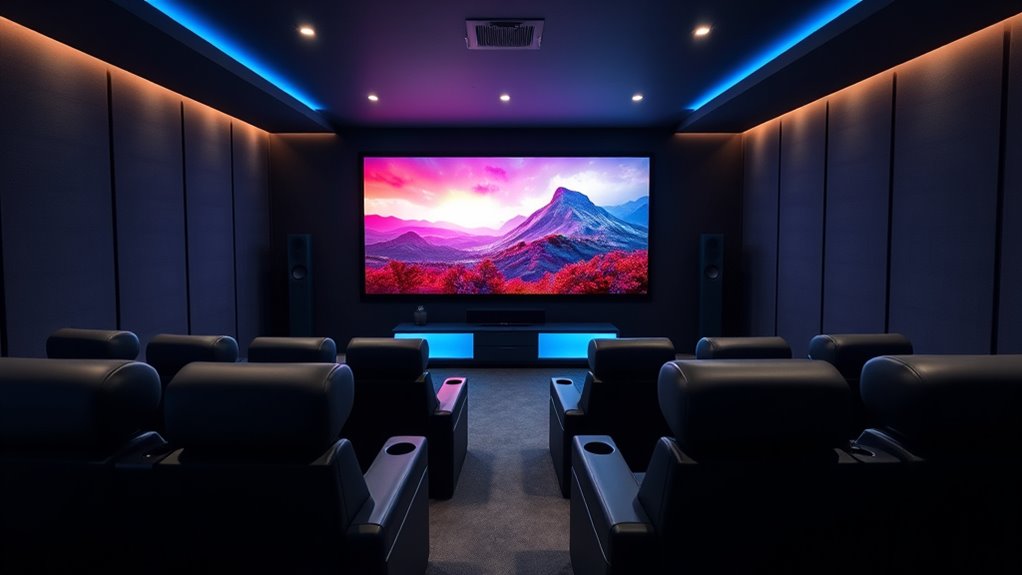

The Yamaha YHT-5960U is my best overall home theater system pick for its receiver-based setup, 8K HDMI support, and MusicCast connectivity. For room-filling effects, the ULTIMEA Skywave X70 offers a 7.1.4-channel layout, while the Klipsch Reference 5.2 system pairs dedicated speakers with an Onkyo receiver for a more traditional, expandable setup. The main tradeoff is between soundbar convenience and the flexibility of a receiver-and-speaker package. Room size, rear-speaker placement, and connection needs can matter as much as channel count. Read on for my full comparison and a guide to choosing a system that suits your space.

Get your wardrobe favorites delivered free with Prime
- Fast, free delivery on millions of items
- Prime Video, Amazon Music and more included
- Member-only deals all year
Key Takeaways
- Receiver-based systems lead on flexibility: The Yamaha YHT-5960U and Klipsch Reference 5.2 package suit buyers who want a component setup rather than a single soundbar unit.
- More channels need room to work: The ULTIMEA Skywave X70’s 7.1.4 layout targets immersive surround and height effects, but it makes the most sense when your room can accommodate the speakers.
- Soundbars reduce setup friction: Options such as the LG S40TR and Sony HT-S40R bundle a bar with subwoofer and rear-speaker components, avoiding the complexity of a separate AV receiver.
- Channel labels are not the whole story: A 5.1.2 system such as the ULTIMEA Dolby Atmos model adds height channels, while a conventional 5.1 system prioritizes front, center, rear, and bass coverage.
- The right pick depends on the existing setup: The Bose Surround Sound System is a more targeted choice for compatible Bose owners, while the Yamaha and Klipsch packages make more sense as full-system starting points.
| JBL Bar 700MK2 Soundbar with Subwoofer, Dolby Atmos Surround – Black |  | Best Wireless Surround Soundbar | System power: 780 W | Subwoofer: 10-inch wireless | Surround speakers: Detachable wireless | VIEW ON AMAZON | See Our Full Breakdown |
| Yamaha YHT-5960U Home Theater System with 8K HDMI and MusicCast |  | Best for Gaming and AV Connectivity | Channels: 5.1 | Power output: 80 W | HDMI version: HDMI 2.1 | VIEW ON AMAZON | See Our Full Breakdown |
| TCL S65K 5.1 Channel Soundbar System with Dolby Atmos, DTS:X, Wireless Subwoofer and Surround Speakers |  | Best for TCL TV Owners | Channels: 5.1 | Subwoofer driver: 6.5-inch with Bass Boost | Surround speakers: Wireless | VIEW ON AMAZON | See Our Full Breakdown |
| ULTIMEA Skywave X70 7.1.4ch Wireless Surround Sound System |  | Best for Wireless Height-Effect Immersion | Channels: 7.1.4 | Wireless transmission: Dual 5GHz | Subwoofer driver: 10-inch | VIEW ON AMAZON | See Our Full Breakdown |
| Klipsch Reference 5.2 Home Theater System with Onkyo TX-NR7100 |  | Best for Dedicated Theater Rooms | Speaker configuration: 5.2 | Floorstanding speakers: 2 x Klipsch R-625FA | Center channel: Klipsch R-52C | VIEW ON AMAZON | See Our Full Breakdown |
| LG S40TR 4.1 Channel Home Theater Soundbar with Wireless Rear Speakers and Subwoofer |  | Best for LG TV Owners | Channels: 4.1 | Audio formats: Dolby Audio, Dolby Digital, DTS Digital | Speaker setup: Soundbar, rear speakers, wireless subwoofer | VIEW ON AMAZON | See Our Full Breakdown |
| Ultimea Sound Bar with Wireless Subwoofer and App Control |  | Best for Customizable 2.1 Sound | Channels: 2.1 | Peak power: 240W | Frequency response: 45 Hz–18 kHz | VIEW ON AMAZON | See Our Full Breakdown |
| Sony HT-S40R 5.1ch Home Theater Soundbar System |  | Best for Straightforward 5.1 Surround | Channels: 5.1 | Power output: 600W | Connections: HDMI, optical, analog, Bluetooth, USB | VIEW ON AMAZON | See Our Full Breakdown |
| Ultimea 5.1.2ch Sound Bar with Dolby Atmos and Surround Sound System |  | Best for Atmos Height Effects | Channels: 5.1.2 | Audio format: Dolby Atmos | Speaker configuration: Up-firing speakers, rear surrounds, subwoofer | VIEW ON AMAZON | See Our Full Breakdown |
| Ultimea Poseidon M60 5.1CH Surround Sound Bar System with Dolby Atmos |  | Best for Atmos Without Rear Speakers | Channels: 5.1 | Audio technology: Dolby Atmos | Peak power: 300W | VIEW ON AMAZON | See Our Full Breakdown |
| Ultimea 7.1-Channel Surround Sound Bar with Subwoofer |  | Best for Dialogue-Focused Surround | Channel configuration: 7.1-channel surround | Surround speakers: 4 | Bass response: Down to 45 Hz | VIEW ON AMAZON | See Our Full Breakdown |
| Yamaha YHT-4950U 5.1-Channel Home Theater System with Bluetooth |  | Best Traditional Receiver Package | Channel configuration: 5.1 | Connectivity: HDMI, Ethernet, coaxial, optical, USB, auxiliary, Bluetooth | HDMI ports: 4 | VIEW ON AMAZON | See Our Full Breakdown |
| Bobtot 1000W Peak 5.1 Channel Home Theater System with 8-inch Subwoofer |  | Best for Karaoke and Casual Gatherings | Channel configuration: 5.1 and 2.1 | Peak power: 1000 W | Subwoofer size: 8 inches | VIEW ON AMAZON | See Our Full Breakdown |
| Bose Surround Sound System for Home Theater (Black, Model 809281-1100) with Deco Gear HDMI Cable |  | Best Bose Soundbar Add-On | Model: 809281-1100 | Speaker height: 3.7 inches | Connection type: Wireless via included receivers | VIEW ON AMAZON | See Our Full Breakdown |
| Yamaha YHT-4970U 5.1-Channel Home Theater System with Dolby Atmos |  | Best for High-Frame-Rate Video | Channel configuration: 5.1 | Audio formats: Dolby Atmos, DTS Virtual:X | Video support: 4K/120, 8K/60, Dolby Vision, HDR10+ | VIEW ON AMAZON | See Our Full Breakdown |
More Details on Our Top Picks
JBL Bar 700MK2 Soundbar with Subwoofer, Dolby Atmos Surround – Black
I’d choose the JBL Bar 700MK2 for a theater-style upgrade that avoids running speaker wire around the room. Its detachable wireless surrounds can be placed behind the seating when needed, while the 10-inch wireless subwoofer adds weight to action scenes and music. Dolby Atmos, DTS Virtual:X, and MultiBeam 3.0 offer a broader presentation than a basic soundbar, and PureVoice 2.0 is aimed at keeping dialogue distinct. Compared with the TCL S65K, JBL gives you more stated system power and a larger subwoofer; the TCL adds room calibration. The JBL’s tradeoffs are its substantial footprint and reliance on Wi-Fi for its full range of streaming options, so it suits a room with placement space and a stable network.
Pros:- Detachable wireless surround speakers reduce cable clutter and can be placed behind the listening position.
- A 10-inch wireless subwoofer is suited to fuller, more forceful bass.
- Dolby Atmos, DTS Virtual:X, and MultiBeam 3.0 support a spacious presentation.
- AirPlay, Google Cast, Spotify Connect, and Bluetooth provide several streaming options.
Cons:- The soundbar and subwoofer need more placement space than a compact setup.
- Full streaming functionality depends on Wi-Fi.
Best for: People who want detachable rear surrounds, powerful bass, and flexible music streaming without wiring a traditional speaker system.
Not ideal for: Small-room buyers who lack space for a large soundbar and subwoofer, or anyone who needs full streaming features without Wi-Fi.
- System power:780 W
- Subwoofer:10-inch wireless
- Surround speakers:Detachable wireless
- Audio formats:Dolby Atmos, DTS Virtual:X
- Sound technology:MultiBeam 3.0, PureVoice 2.0
- Connectivity:Bluetooth, Spotify Connect, AirPlay, Google Cast
Our verdict“Choose the JBL if you want a powerful, low-cable soundbar system with detachable surrounds and have room for its larger components.”
Yamaha YHT-5960U Home Theater System with 8K HDMI and MusicCast
The Yamaha YHT-5960U makes the most sense for buyers whose home theater also serves a modern gaming setup. Its HDMI 2.1 support includes 4K/120 and 8K video options, while ALLM and VRR address smoother, more responsive play with compatible gear. YPAO room calibration and matched speaker wire help with setup, though this is still a receiver-and-speaker system rather than a simple soundbar. Against the JBL Bar 700MK2, Yamaha offers more direct control over connected video sources, but it lacks the JBL’s stated Dolby Atmos support and detachable wireless surrounds. Its 5.1-channel layout is a clear limit for buyers seeking height effects or later expansion beyond the supplied configuration. I’d pick it for gaming connectivity, not for the most enveloping format support.
Pros:- HDMI 2.1 support includes 4K/120 and 8K video capabilities.
- ALLM and VRR support gaming features with compatible displays and sources.
- YPAO automatic calibration helps adapt speaker output to the room.
- Matched speaker wire is included to simplify wiring the 5.1 layout.
Cons:- The 5.1-channel configuration does not provide Dolby Atmos height channels.
- Receiver-based setup and its feature set may take more effort to configure than a soundbar.
Best for: Console and PC gamers who want a conventional 5.1 speaker system with HDMI 2.1 features and automatic room calibration.
Not ideal for: Listeners prioritizing Dolby Atmos height effects, wireless rear speakers, or a plug-and-play soundbar-style setup.
- Channels:5.1
- Power output:80 W
- HDMI version:HDMI 2.1
- Video support:4K60, 4K120AB, 8K60B, Dolby Vision, HLG, BT.2020
- HDCP:2.3
- Gaming features:ALLM, VRR
- Room calibration:YPAO automatic
- Speaker wire:Matched wire for each speaker
Our verdict“Pick the Yamaha when HDMI 2.1 gaming support matters more than Atmos playback or the simplicity of a wireless soundbar.”
TCL S65K 5.1 Channel Soundbar System with Dolby Atmos, DTS:X, Wireless Subwoofer and Surround Speakers
The TCL S65K is a strong fit for viewers who want a 5.1 soundbar system with wireless surrounds and room adjustment built in. Dolby Atmos and DTS:X support, paired with Ray Danz III acoustics, is intended to spread effects beyond the soundbar, while AI Auto Room Calibration adapts the sound to the listening space. Its center channel and tweeter target dialogue clarity, and the wireless subwoofer and surrounds limit cable runs. Compared with the JBL Bar 700MK2, TCL adds calibration and DTS:X, while JBL specifies a larger 10-inch subwoofer and higher system power. The TCL’s ChoruSound compatibility is limited to compatible TCL TVs, so buyers with another television won’t get that integration. Its larger component layout also needs room, and there’s no built-in voice assistant.
Pros:- Dolby Atmos and DTS:X support add immersive format options.
- Wireless surrounds and subwoofer reduce the need for long speaker cables.
- AI Auto Room Calibration adjusts audio for the listening space.
- A built-in center channel and tweeter focus on dialogue and high-frequency detail.
Cons:- Full ChoruSound features work only with compatible TCL TVs.
- The system needs space for its soundbar, surrounds, and subwoofer.
- No built-in voice assistant integration is listed.
Best for: TCL television owners who want wireless rear speakers, room calibration, and a soundbar-based 5.1 setup.
Not ideal for: Buyers with non-TCL TVs who specifically want ChoruSound integration, or shoppers seeking a voice assistant built into the system.
- Channels:5.1
- Subwoofer driver:6.5-inch with Bass Boost
- Surround speakers:Wireless
- Audio formats:Dolby Atmos, DTS:X
- Acoustics:Ray Danz III
- Room calibration:AI Sonic Auto Room Calibration
- HDMI connectivity:eARC and HDMI input
- TV compatibility:ChoruSound with compatible TCL TVs
Our verdict“The S65K is most compelling for TCL TV owners who want calibrated wireless surround without moving to a receiver-based system.”
ULTIMEA Skywave X70 7.1.4ch Wireless Surround Sound System
The ULTIMEA Skywave X70 is the most ambitious wireless layout in this group, with 7.1.4 channels designed to create surround and overhead effects without a conventional run of speaker cables. Its dual 5GHz transmission is intended to keep the wireless links stable, while the 10-inch subwoofer and 980W peak output point toward a forceful presentation. The ULTIMEA app adds EQ, presets, and OTA updates, giving enthusiasts more room to tune the system than the JBL Bar 700MK2’s described feature set. The tradeoff is that wireless performance depends on the surrounding 5GHz environment, and app-based adjustments may be more than casual viewers want. The listing also specifies a 12-month warranty. I’d favor this for buyers who want a highly configurable, multi-channel wireless setup.
Pros:- The 7.1.4-channel layout supports surround and height-effect audio.
- Dual 5GHz transmission is designed for wireless connectivity between system components.
- A 10-inch subwoofer and 980W peak power are geared toward substantial output and bass.
- The app offers EQ, presets, and OTA updates for ongoing adjustments.
Cons:- Wireless performance can depend on the 5GHz environment in the home.
- Extensive app customization may add setup work for buyers who want a basic system.
- The listed warranty is 12 months.
Best for: Home theater enthusiasts who want a 7.1.4-channel wireless system, app-based sound adjustments, and a large subwoofer.
Not ideal for: Buyers seeking a simple setup with minimal tuning, or those whose wireless environment may interfere with 5GHz connections.
- Channels:7.1.4
- Wireless transmission:Dual 5GHz
- Subwoofer driver:10-inch
- Peak power:980 W
- Amplifier:GaN
- Audio resolution:24-bit/192kHz
- Video support:4K HDR pass-through
- App features:EQ, presets, OTA updates
- Warranty:12 months
Our verdict“Choose the Skywave X70 if channel count and wireless tuning matter more to you than keeping setup and network demands simple.”
Klipsch Reference 5.2 Home Theater System with Onkyo TX-NR7100
The Klipsch Reference 5.2 bundle is the pick for a dedicated theater room where full-size speakers and strong bass take priority over a tidy footprint. It includes floorstanding fronts, a center channel, bookshelf surrounds, and two 12-inch powered subwoofers, all driven by an Onkyo TX-NR7100 receiver. That component-based arrangement gives buyers a more traditional speaker layout than the JBL Bar 700MK2 or TCL S65K, both of which use soundbar-centered designs. The receiver’s 9.2-channel capacity and 8K/4K support also leave room for a broader system configuration than the supplied 5.2 speaker package. In return, this bundle demands considerable floor space and more involved receiver setup. I’d skip it for a small living room or anyone who wants a quick, cable-light installation.
Pros:- The bundle includes matched front, center, surround, and subwoofer components for a 5.2 arrangement.
- Two 12-inch powered subwoofers provide substantial bass capacity.
- The Onkyo receiver supports 9.2 channels and 8K/4K video sources.
- Floorstanding and bookshelf speakers create a conventional separate-speaker layout.
Cons:- Floorstanding speakers and two subwoofers require significant room space.
- Receiver configuration and speaker wiring can be demanding for first-time home theater owners.
Best for: Home theater owners with a dedicated room, enough space for floorstanding speakers and dual subwoofers, and interest in a receiver-based system.
Not ideal for: Apartment dwellers or soundbar shoppers who need a compact setup, minimal cabling, and straightforward installation.
- Speaker configuration:5.2
- Floorstanding speakers:2 x Klipsch R-625FA
- Center channel:Klipsch R-52C
- Bookshelf speakers:2 x Klipsch R-41M
- Powered subwoofers:2 x Klipsch R-12SW, 12-inch, 400 W each
- AV receiver:Onkyo TX-NR7100
- Receiver channels:9.2
- Receiver power:220 W per channel at 6 ohms
- Video support:8K and 4K
Our verdict“This Klipsch bundle suits a spacious theater room where separate speakers and dual subwoofers matter more than compactness or easy setup.”
LG S40TR 4.1 Channel Home Theater Soundbar with Wireless Rear Speakers and Subwoofer
The LG S40TR is the most natural fit here for viewers with a compatible LG TV: WOW Interface and WOW Orchestra can link soundbar and TV controls and coordinate their audio. Its 4.1-channel layout, rear speakers, and subwoofer provide a more physical surround setup than the 2.1-channel Ultimea soundbar, which lacks rear speakers. Clear Voice Plus and AI Sound Pro also give dialogue and mixed content dedicated processing options. The tradeoff is that the rear speakers are not fully cable-free: they need a wired connection to each other, and one needs its own power connection. Some LG integration features only work with select TVs. I’d choose it over the Sony HT-S40R for LG-specific control, but buyers seeking fewer setup connections should skip both rear-speaker systems.
Pros:- Rear speakers and subwoofer create a more enveloping presentation than a 2.1 soundbar.
- WOW Interface and WOW Orchestra add useful integration with select LG TVs.
- Clear Voice Plus provides a dedicated option for improving dialogue clarity.
- Metal grille and compact soundbar dimensions suit a tidy TV area.
Cons:- Rear speakers need a wired connection between them.
- One rear speaker needs a separate AC power connection.
- Some TV integration features are limited to select LG models.
Best for: Owners of compatible LG TVs who want rear speakers, a subwoofer, and unified TV and soundbar controls.
Not ideal for: Buyers who want a cable-free rear-speaker setup or who own a TV that cannot use the LG WOW features.
- Channels:4.1
- Audio formats:Dolby Audio, Dolby Digital, DTS Digital
- Speaker setup:Soundbar, rear speakers, wireless subwoofer
- Sound features:AI Sound Pro, Clear Voice Plus, Smart Up-Mixer
- LG integration:WOW Interface, WOW Orchestra
- App control:LG Soundbar App
- Soundbar dimensions:28.4 x 2.5 x 3.4 inches
- Subwoofer dimensions:6.7 x 12.6 x 9.9 inches
Our verdict“Choose the S40TR if you have a compatible LG TV and want physical rear speakers; skip it if minimizing setup cables matters more.”
Ultimea Sound Bar with Wireless Subwoofer and App Control
The Ultimea 2.1 system suits buyers who want a straightforward soundbar-and-subwoofer setup but still want to tune how dialogue and bass come across. VoiceMX targets speech clarity, while the app’s 10-band EQ and 121 presets give more adjustment options than the Sony HT-S40R’s listed remote-based controls. Bluetooth 6.0 also makes the bar useful for streaming audio from a phone. Its wireless subwoofer allows flexible placement without an audio cable running back to the bar. The main compromise is the format: unlike the Sony or LG systems, this model has no rear speakers, so it cannot provide the same physical surround placement. The stated 240W is peak output, not continuous RMS power, so I would not use that figure alone to predict sustained volume.
Pros:- Wireless subwoofer gives more placement flexibility than a wired bass unit.
- VoiceMX offers a dedicated dialogue-enhancement feature.
- 10-band EQ and 121 presets allow extensive sound adjustment in the app.
- Bluetooth 6.0 supports phone-based audio streaming.
Cons:- The 2.1-channel layout lacks physical rear speakers found on the Sony HT-S40R and LG S40TR.
- Advanced EQ customization depends on the smartphone app.
- 240W is a peak power figure, not a stated continuous RMS rating.
Best for: Viewers in apartments or smaller rooms who want a wireless subwoofer, dialogue adjustments, and app-based sound tuning without rear speakers.
Not ideal for: Movie fans seeking physical rear-channel surround or buyers who do not want to use a smartphone app for detailed EQ changes.
- Channels:2.1
- Peak power:240W
- Frequency response:45 Hz–18 kHz
- Maximum SPL:95 dB
- Subwoofer:Wireless
- Bluetooth:Bluetooth 6.0
- App controls:10-band EQ, 121 presets
- Audio technologies:VoiceMX, BassMX
Our verdict“Pick this Ultimea for adjustable dialogue and bass in a simple 2.1 setup, not for room-filling rear surround.”
Sony HT-S40R 5.1ch Home Theater Soundbar System
The Sony HT-S40R is the clearest pick in this group for buyers who want a conventional 5.1 arrangement without app-based sound tuning. Its included rear speakers give movies more distinct placement behind the viewer than the LG S40TR’s 4.1 layout, while color-coded connections help make setup less confusing. HDMI, optical, analog, USB, and Bluetooth also cover common TV and playback sources. Sony lists 600W total output, although that figure alone does not describe how loud or balanced the system will sound in a particular room. Compared with the Atmos-focused Ultimea 5.1.2, the Sony does not list height-channel audio or HDMI eARC, so it is less suited to buyers prioritizing overhead effects and newer high-bandwidth connections. It is a practical surround choice, with a more basic feature set.
Pros:- 5.1-channel setup includes rear speakers for physical surround placement.
- Color-coded connections can simplify installation.
- HDMI, optical, analog, USB, and Bluetooth provide varied input options.
- Custom sound modes are available for movies, music, and dialogue-heavy content.
Cons:- No HDMI eARC or Wi-Fi support is listed.
- Does not list Dolby Atmos or height-channel speakers.
- Uses a remote control rather than a listed app with advanced EQ tools.
Best for: Movie watchers who want a clear 5.1 speaker layout, familiar connections, and guided physical setup.
Not ideal for: Buyers seeking Dolby Atmos height effects, HDMI eARC, Wi-Fi features, or app-based EQ customization.
- Channels:5.1
- Power output:600W
- Connections:HDMI, optical, analog, Bluetooth, USB
- Speaker setup:Soundbar with rear speakers
- Sound modes:Movie, music, dialogue
- Control method:Remote control
- Materials:Metal, plastic
- Color:Black
Our verdict“Choose the Sony for a familiar, connection-rich 5.1 setup, but look to the Ultimea 5.1.2 if Atmos and eARC are priorities.”
Ultimea 5.1.2ch Sound Bar with Dolby Atmos and Surround Sound System
For buyers focused on height effects, the Ultimea 5.1.2 has the most explicitly Atmos-oriented design among these five: up-firing speakers join rear surrounds and a subwoofer in a 5.1.2 layout. That gives it a different aim from the Sony HT-S40R, which offers 5.1 channels but does not list height drivers or Atmos. Its HDMI eARC connection supports lossless audio transmission from compatible sources, while CEC can let a TV remote handle connected-device control. App-based EQ and presets add more room for tuning than the Sony’s listed remote control. There is a firm format limitation, though: this model is not compatible with DTS. Buyers with DTS-heavy libraries or sources should check their playback chain carefully; the LG S40TR lists DTS Digital support and may be a safer match.
Pros:- 5.1.2 layout combines up-firing speakers, rear surrounds, and a subwoofer.
- Dolby Atmos support targets height effects beyond conventional 5.1 sound.
- HDMI eARC supports lossless audio transmission from compatible sources.
- App includes a 10-band EQ and 121 presets.
Cons:- Not compatible with DTS audio formats.
- Atmos playback benefits depend on compatible content and connection equipment.
- App-based adjustment may not suit buyers who prefer simple remote-only control.
Best for: Viewers with an eARC-equipped TV and Dolby Atmos content who want up-firing drivers, rear surrounds, and app-based tuning.
Not ideal for: Households with DTS-focused media or devices that require DTS compatibility.
- Channels:5.1.2
- Audio format:Dolby Atmos
- Speaker configuration:Up-firing speakers, rear surrounds, subwoofer
- HDMI connection:HDMI eARC
- TV control:CEC
- App control:10-band EQ, 121 presets
- DTS compatibility:Not compatible
Our verdict“Choose this model over the Sony HT-S40R for Atmos height channels and eARC, provided DTS compatibility is not a requirement.”
Ultimea Poseidon M60 5.1CH Surround Sound Bar System with Dolby Atmos
The Ultimea Poseidon M60 is for buyers who want Atmos branding and a dedicated subwoofer without placing separate rear speakers around the room. Its 5.1-channel design differs from the Ultimea 5.1.2, which includes up-firing speakers and rear surrounds for a more distributed setup; the M60 instead keeps the speaker layout simpler. VoiceMX and app-based EQ give viewers ways to tune speech and sound modes, while HDMI eARC supports high-bandwidth audio from compatible equipment. A wired wooden subwoofer can contribute dedicated bass, but it restricts placement compared with the wireless subs on the LG S40TR and Ultimea 2.1. The listed 300W is peak output, and the product data does not specify rear speakers, so buyers seeking physical sound behind them should choose a system built around them.
Pros:- Dolby Atmos support adds an immersive format to a simpler speaker arrangement.
- VoiceMX offers dialogue enhancement for quieter viewing.
- Wooden 5.25-inch subwoofer provides a dedicated bass component.
- HDMI eARC and Bluetooth 5.4 support TV audio and wireless streaming.
Cons:- Wired subwoofer connection limits placement flexibility compared with wireless-subwoofer systems.
- No separate rear speakers are listed, unlike the Sony HT-S40R and Ultimea 5.1.2.
- 300W is peak power, not a stated continuous output rating.
Best for: Viewers who want a soundbar, dedicated subwoofer, and Dolby Atmos support but do not want to position separate rear speakers.
Not ideal for: Buyers seeking physical rear-channel sound or flexible subwoofer placement without a cable connection.
- Channels:5.1
- Audio technology:Dolby Atmos
- Peak power:300W
- Frequency response:45 Hz–18 kHz
- Maximum SPL:99 dB
- Subwoofer:5.25-inch wooden subwoofer, wired
- Connectivity:HDMI eARC, Bluetooth 5.4
- Dimensions:31.5 x 3.54 x 2.76 inches
- Control methods:App, remote
Our verdict“Pick the Poseidon M60 for a simpler Atmos-capable setup with a dedicated subwoofer, but choose the Ultimea 5.1.2 for physical rear and height speakers.”
Ultimea 7.1-Channel Surround Sound Bar with Subwoofer
I’d choose the Ultimea when a soundbar-style system needs to create a more enveloping movie mix without moving up to a full AV receiver. Its four surround speakers and VocalMatrix processing aim to spread voices across the sound field, while VoiceMX targets dialogue that can get buried in action scenes. BassMX reaches down to 45 Hz, giving the subwoofer a defined low end rather than relying on volume alone. Compared with the Yamaha YHT-4950U, this package offers more surround channels and app-based EQ, but Yamaha gives buyers a conventional receiver and speaker setup. Here, the rear left speaker still needs a wired link, so placement is not fully wireless, and the supplied 10.1-pound weight may be a concern for a compact room. I’d shortlist it for flexible TV and gaming use, not a cable-free installation.
Pros:- VocalMatrix and VoiceMX processing are designed to keep dialogue clear across surround channels.
- Four surround speakers support a more enveloping presentation than a basic stereo bar.
- BassMX subwoofer response is specified down to 45 Hz.
- Bluetooth 6.0 and a 10-band app EQ offer flexible streaming and sound adjustments.
Cons:- The rear left speaker requires a wired connection, which limits placement flexibility.
- The supplied 10.1-pound weight and stated larger footprint may be awkward in smaller rooms.
Best for: Movie and console players who want dialogue-focused surround sound, multiple rear speakers, and app-based EQ without a separate AV receiver.
Not ideal for: Buyers who need a completely wireless rear-speaker arrangement or have limited room for the system and its cabling.
- Channel configuration:7.1-channel surround
- Surround speakers:4
- Bass response:Down to 45 Hz
- Bluetooth:Version 6.0; 15-meter range
- EQ and control:Ultimea app; 10-band EQ; 121 presets
- Mounting:Tabletop or wall mount
- Dimensions:15.75 × 2.76 × 3.54 inches
- Weight:10.1 lb
Our verdict“Choose the Ultimea if dialogue clarity and an expanded surround layout matter more than fully wireless rear-speaker placement.”
Yamaha YHT-4950U 5.1-Channel Home Theater System with Bluetooth
I’d pick the YHT-4950U for a buyer who wants a complete, conventional home theater kit: receiver, five speakers, subwoofer, and speaker wire arrive together. The YPAO room optimization helps tailor playback to the room, while four HDMI inputs and 4K HDR pass-through make it a straightforward hub for a TV and several sources. Against the Ultimea 7.1-Channel Surround Sound Bar, Yamaha gives up channel count and app-driven sound adjustment, but offers a separate AV receiver and a familiar wired speaker layout. That layout can support more deliberate placement, though it also means running wires to the speakers; it is not a quick, cable-light soundbar installation. Bluetooth adds music streaming, but the listed video support tops out at 4K/60. I’d choose it for a balanced starter theater, rather than for the latest high-frame-rate gaming connections.
Pros:- Includes an AV receiver, five speakers, subwoofer, and speaker wire.
- YPAO room optimization helps adapt speaker output to the listening space.
- Four HDMI ports provide connections for multiple video sources.
- Supports 4K/60 video with Dolby Vision and Hybrid Log-Gamma HDR.
Cons:- Wired speaker connections require cable routing around the room.
- Video support is limited to 4K/60, short of the YHT-4970U’s listed 4K/120 and 8K/60 capabilities.
Best for: First-time home theater buyers who want a receiver, five speakers, subwoofer, and room optimization in one coordinated package.
Not ideal for: Buyers seeking wireless speakers, 7.1-channel playback, or video pass-through above 4K/60.
- Channel configuration:5.1
- Connectivity:HDMI, Ethernet, coaxial, optical, USB, auxiliary, Bluetooth
- HDMI ports:4
- Video support:4K Ultra HD at 60 fps; Dolby Vision and Hybrid Log-Gamma HDR
- Frequency response:28 Hz–25 kHz
- AV receiver dimensions:17 × 6 × 12 inches
- Subwoofer dimensions:11 × 11 × 13 inches
- Included components:AV receiver, 5 speakers, subwoofer, speaker wire
Our verdict“Choose the YHT-4950U for a complete, receiver-based 5.1 system with room correction, provided wired speakers and 4K/60 fit your setup.”
Bobtot 1000W Peak 5.1 Channel Home Theater System with 8-inch Subwoofer
The Bobtot is the most party-oriented pick here: its dual microphone inputs and LED lighting add a use case the more conventional Yamaha YHT-4950U does not emphasize. For movies and games, it offers a 5.1 layout, an 8-inch subwoofer, and connections including HDMI ARC, optical, Bluetooth, USB, and SD card. The 1000W figure is specified as peak power, so I’d treat it as a headline rating rather than a guide to sustained output. Compared with Yamaha’s receiver-based package, Bobtot puts karaoke features and easy source variety first, while its built-in receiver keeps the system consolidated. The tradeoff is a wired satellite setup and Bluetooth limited to the subwoofer, which can restrict where sources and speakers go. At 14 kg, this is better for a dedicated gathering space than a tidy, minimal living room.
Pros:- Dual microphone inputs give the system a dedicated karaoke use.
- HDMI ARC, optical, coaxial, AUX, USB, and SD card support a wide range of sources.
- An 8-inch subwoofer and 5.1-channel configuration suit movie and game playback.
- LED lighting adds a party-focused feature absent from the Yamaha YHT-4950U.
Cons:- Bluetooth connectivity is limited to the subwoofer.
- Wired satellite speakers restrict placement and require cable routing.
- The 14 kg system is relatively bulky for a minimalist or space-constrained room.
Best for: Households that want a wired 5.1 setup for movies and games, plus microphone inputs and lighting for karaoke nights.
Not ideal for: Buyers prioritizing discreet styling, wireless satellite speakers, or Bluetooth streaming through the full speaker layout.
- Channel configuration:5.1 and 2.1
- Peak power:1000 W
- Subwoofer size:8 inches
- Connectivity:Bluetooth, HDMI ARC, optical, coaxial, AUX, USB, SD card
- Special features:LED lights, dual microphone inputs, built-in receiver
- Bluetooth range:33 feet
- Dimensions:22 × 12 × 22 inches
- Weight:14 kg
Our verdict“Choose Bobtot if karaoke and broad wired connectivity matter as much as movie sound, but skip it for a clean, wireless living-room setup.”
Bose Surround Sound System for Home Theater (Black, Model 809281-1100) with Deco Gear HDMI Cable
I’d treat this Bose set as a targeted upgrade, not a standalone home theater system. It adds two compact rear speakers to compatible Bose soundbars, creating dedicated rear-channel audio without a long audio cable running back to the bar. That makes it a different kind of purchase from the Yamaha YHT-4950U, which includes a receiver, front and center speakers, surrounds, and subwoofer as a complete package. Bose is the more discreet route for someone already invested in a supported soundbar, but each wireless receiver still needs AC power, and speaker cables connect the receivers to the speakers. Compatibility is limited to listed Bose models, so owners of other soundbars cannot use it as a universal surround kit. I’d buy it to expand an existing Bose setup, not as a first system or a replacement for a full speaker package.
Pros:- Adds true rear-channel speakers to compatible Bose soundbar systems.
- Included wireless receivers avoid long audio runs from the soundbar to the rear positions.
- Compact 3.7-inch speakers can fit on shelves or stands.
- Bundle includes power accessories, speaker cables, a screwdriver, and a 6-foot 4K HDMI cable.
Cons:- Requires a compatible Bose soundbar; it is not a complete or universal home theater system.
- Each wireless receiver still needs AC power, and speaker cables remain necessary.
Best for: Owners of a listed Bose Smart Soundbar who want dedicated rear-channel audio without running long audio cables from the soundbar.
Not ideal for: First-time home theater buyers and anyone without one of the specifically listed compatible Bose soundbars.
- Model:809281-1100
- Speaker height:3.7 inches
- Connection type:Wireless via included receivers
- Compatible soundbars:Bose Smart Ultra, Smart Soundbar 900, 700, 600, 300, Soundbar 500, SoundTouch 300
- Included speakers:2
- Included receivers:2 wireless receivers
- Power accessories:2 AC2 adapters and 2 power cords
- Bonus cable:6-foot 4K HDMI 2.0 cable
Our verdict“Choose this Bose set to add rear channels to a compatible Bose soundbar, not to build a complete home theater from scratch.”
Yamaha YHT-4970U 5.1-Channel Home Theater System with Dolby Atmos
I’d put the YHT-4970U ahead of the YHT-4950U for a buyer building around a newer gaming console or high-refresh display: its listed 4K/120 and 8K/60 support, HDMI eARC, and Dolby Vision and HDR10+ give the receiver more current video capabilities. The package includes an RX300A receiver, five speakers, a powered subwoofer, setup microphone, and cables, while automatic room correction helps tune playback to the room. Dolby Atmos and DTS Virtual:X are listed, but the physical speaker arrangement remains 5.1-channel; buyers wanting dedicated height speakers should not mistake format support for a larger speaker layout. Like the YHT-4950U, this is a wired receiver system rather than a compact soundbar. I’d choose it when video connections take priority, and pass if minimal cabling matters more than receiver flexibility.
Pros:- Listed support for 4K/120 and 8K/60 suits compatible newer displays and sources.
- Includes an AV receiver, five speakers, powered subwoofer, setup microphone, and cables.
- Dolby Atmos and DTS Virtual:X format support expands compatible audio options.
- Automatic room correction and Bluetooth multipoint add setup and streaming flexibility.
Cons:- The included speaker layout is 5.1, without dedicated height speakers.
- Speaker wire and a subwoofer cable require planning for a neat installation.
Best for: Console and display owners who want a complete wired 5.1 package with listed 4K/120, 8K/60, and HDMI eARC support.
Not ideal for: Buyers who want dedicated Atmos height speakers, wireless surround speakers, or a soundbar-style installation with minimal wiring.
- Channel configuration:5.1
- Audio formats:Dolby Atmos, DTS Virtual:X
- Video support:4K/120, 8K/60, Dolby Vision, HDR10+
- Connectivity:HDMI eARC/ARC, Bluetooth multipoint
- Receiver:RX300A
- Included speakers:2 front, 1 center, 2 surround
- Included bass and setup accessories:Powered subwoofer, setup microphone, speaker wire, subwoofer cable
- Features:Room correction, sound modes, custom presets
Our verdict“Choose the YHT-4970U for a wired 5.1 system with advanced video support, but not if you need physical height channels or a cable-light setup.”
How We Picked
I ranked these systems by how well their components serve a home theater setup, not by channel count alone. I weighed surround layout, subwoofer and rear-speaker inclusion, connection features named for each product, and the balance between setup simplicity and room to expand. I also looked at how clearly each option fits a buyer type, from someone replacing a TV’s built-in audio to someone building around a separate receiver.
The Yamaha YHT-5960U leads because its receiver-based design and stated 8K HDMI and MusicCast features make it a versatile centerpiece. The Klipsch package sits higher for buyers seeking a more substantial component-based setup, while the ULTIMEA Skywave X70 stands out for a larger surround layout. Soundbar bundles rank well when they offer a simpler path to included surround components; models with fewer stated details or narrower compatibility have a more specific role rather than a broad recommendation.
Factors to Consider When Choosing Home Theater System
Before choosing a system, I would match its design to the room and the way you plan to use it. These broader checks help prevent common mismatches that product feature lists alone may not reveal.
Match the System Type to Your Setup
A soundbar bundle usually suits a buyer who wants fewer components and a simpler connection to the TV. A receiver-based package takes more space and setup work, but it gives you a central hub for sources and can offer more room to adjust or expand the system. Do not choose a receiver package just because it appears more capable; it only helps if you are comfortable placing and connecting separate speakers. Likewise, a soundbar is not automatically the easier choice if its rear speakers need careful placement or extra wiring. Check what the box includes and what your existing TV and devices can connect to. I would treat system type as the first decision, then compare channels and features within that group.
Plan for the Room, Not Just the Channel Count
A higher channel count can add more speaker positions, but it cannot compensate for a room that has nowhere to place them. Rear channels work best when they can sit behind or beside the listening area rather than crowded beside the TV. Height-channel systems also depend on room layout and speaker design to create a convincing sense of overhead sound. In a small room, a simpler layout may be easier to place and can sound more cohesive than a crowded multi-speaker arrangement. Measure the available space and map speaker positions before deciding that more channels are an upgrade. If furniture or open-plan walls limit placement, favor a system whose layout fits the room you actually have.
Check TV Connections and Audio Formats
Connection compatibility can affect which sound features you can use, so check the TV’s HDMI ARC or eARC support and available digital audio connections. An eARC connection can carry more advanced audio formats than some older connection paths, while an optical connection may limit format support. A system’s stated support for Dolby Atmos or DTS:X only helps when the TV, source device, content, and connection can pass the relevant signal. Buyers often focus on the soundbar or receiver and overlook a streaming box or TV setting that blocks the format. Confirm how each of your main sources will connect before buying. If you use a game console, disc player, and streaming device, count the inputs you need rather than assuming the TV will handle every connection cleanly.
Decide How Much Setup You Want to Handle
Bundled soundbar systems tend to reduce the number of separate components, but wireless subwoofers and rear speakers still need power and sensible placement. A receiver-based system asks for more setup time: speaker wires, source connections, and configuration all become part of the job. That work can pay off for someone who likes adjusting a system or may add components later. For a first home theater setup, a bundle with the main speakers included can make the path from unboxing to surround sound more direct. Check whether the wireless label applies to audio transmission only, since speakers may still need power outlets. Choose the format you are willing to live with every day, not only the one with the longest feature list.
Choose a System You Can Grow Into
Expansion options vary widely, especially between a receiver-based package and a soundbar ecosystem. A separate AV receiver can provide a clearer path to adding or replacing speakers, though compatibility and available connections still matter. Soundbars may be simpler to own, but extra speakers are often limited to models made for that system. Avoid paying for a future expansion plan you are unlikely to follow; a well-matched complete setup is more useful than unused upgrade capacity. If you already own speakers or expect to add them later, check receiver support and speaker requirements before choosing a bundle. If you prefer a fixed, tidy setup, prioritize a system that includes the components you need from the start.
Frequently Asked Questions
Should I choose a soundbar system or a receiver-based home theater package?
I would choose a soundbar bundle if I wanted fewer separate components and a more straightforward setup. A receiver-based package such as the Yamaha YHT-5960U or Klipsch Reference 5.2 makes more sense when I want a component-centered system and value flexibility. The tradeoff is that a receiver package needs more space, connections, and setup time. Check whether you plan to adjust or expand the system before paying for that extra flexibility. If you mainly want TV and film sound with a simpler footprint, a soundbar package may fit better.
Will Dolby Atmos work with any TV and streaming device?
No; Atmos playback depends on the system, TV, source device, connection, and content all supporting a compatible signal path. A product name that includes Dolby Atmos does not mean every show or device will use height effects. I would check whether the TV has HDMI eARC or another connection supported by the system, then confirm the audio settings on each source. Some connection methods can limit which formats pass through. If your current devices do not support the needed path, you may hear surround sound without getting the full Atmos experience.
Are rear speakers worth the extra setup?
Rear speakers are worthwhile when you want sound effects to extend behind the listening position rather than stay near the TV. They need suitable placement, and wireless models may still require power outlets, so they are not free of setup work. Systems such as the LG S40TR and Sony HT-S40R include rear-speaker components, giving buyers a bundled route to surround sound. If the room has no practical place for rear speakers, a simpler soundbar may be the less frustrating fit. I would plan speaker positions before choosing a package built around them.
Is a 7.1.4 system a better choice than a 5.1 system for a small room?
Not automatically. A 7.1.4 layout such as the ULTIMEA Skywave X70 has more speaker positions, but a compact room may not have enough space to place them effectively. A well-positioned 5.1 system can be a better match when furniture, walls, or listening distance limit speaker placement. Height effects also depend on room layout and compatible content, not just the channel label. I would measure the room and mark possible speaker locations before choosing the larger layout. Pick the system whose speakers can be placed sensibly rather than selecting by channel count alone.
Can I add speakers to a soundbar system later?
Sometimes, but expansion depends on the specific soundbar and its supported speaker options. Many soundbar systems use components designed for that product family, while receiver-based packages generally offer a more direct route to speaker changes or additions. I would check the manufacturer’s compatibility information before assuming another brand’s speakers will work. If expansion is a strong priority, the Klipsch and Yamaha receiver packages are more natural starting points than a fixed soundbar bundle. If you prefer a simpler setup, buying a soundbar package with the rear speakers you want included can avoid that uncertainty.
Conclusion
For most buyers seeking a flexible full-system starting point, I recommend the Yamaha YHT-5960U as best overall. The TCL S65K is my best value pick for shoppers who want a bundled soundbar layout with surround components, while the Klipsch Reference 5.2 with Onkyo TX-NR7100 is my best premium choice for a component-based setup. Newcomers who want a simpler route to rear-speaker sound should compare the LG S40TR and Sony HT-S40R. For a larger immersive layout, I would shortlist the ULTIMEA Skywave X70; Bose owners looking to add compatible surround speakers should focus on the Bose Surround Sound System. Choose by room fit and setup preference first, then narrow the options by the sound features you will actually use.
Halloween Picks

10.5 ft Lighted Pumpkin and Ghost Halloween Inflatable Archway

8.5 Foot Halloween Inflatable Haunted House Castle with Skeleton, Ghost & Skulls

Spirit Halloween 54-Inch Sitting Scarecrow Animatronic
As an affiliate, we earn on qualifying purchases.