A home essential backup power kit can keep phones, lights, routers, and other priority devices running during an outage, but the right setup depends on how much power you need and how long you need it. My best overall pick is the Jackery HomePower 2000 Plus v2 for its substantial capacity and included solar panels; the BLUETTI Elite 300 kits stand out for buyers seeking a large battery with different solar-panel configurations. For a different approach, the WEN dual-fuel generator can suit households that need fuel-powered backup and are prepared for its noise, ventilation, and maintenance demands. The main tradeoff is between quiet, indoor-friendly battery power and longer-running generator power, with compact stations better suited to small loads than whole-home backup. Read on for how I compare all 14 options and match them to different outage needs.

Get your wardrobe favorites delivered free with Prime
- Fast, free delivery on millions of items
- Prime Video, Amazon Music and more included
- Member-only deals all year
Complete the kit


Key Takeaways
- The lineup splits into three practical groups: compact stations for phones and small electronics, larger battery systems for several household essentials, and fuel generators for buyers who can manage outdoor operation and fuel.
- The Jackery HomePower 2000 Plus v2 is my best overall pick because its substantial capacity and included solar panels offer a more useful starting point for multiple essentials than the compact stations.
- BLUETTI’s 3014Wh Elite 300 bundles differ mainly in solar configuration: compare the included panel setup with your available sunlight and space rather than assuming the battery capacity alone settles the choice.
- Small capacity is a genuine limit, not just a smaller version of home backup: the MARBERO M82, MARBERO 155Wh, and Jackery Explorer 300 are better matched to light loads than extended household outages.
- Battery and generator kits solve different problems: battery stations are quiet and avoid fuel exhaust at the point of use, while the WEN and PowerSmart generator options require outdoor operation, fuel planning, and routine upkeep.
| WEN Dual Fuel Portable Generator 4750 Surge Watts with Wheel Kit and Electric Start (DF475T) |  | Best for Fuel-Based Home Backup | Gasoline surge output: 4,750 W | Gasoline running output: 3,800 W | Propane surge output: 4,350 W | VIEW ON AMAZON | See Our Full Breakdown |
| MARBERO 155Wh Portable Power Station with 30W Solar Panel |  | Best Compact Kit for Essential Electronics | Capacity: 155Wh (42,000mAh) | Solar panel output: 30W | Solar charging time: 6–7 hours | VIEW ON AMAZON | See Our Full Breakdown |
| ZeroKor 300W Portable Power Station with 60W Solar Panel | 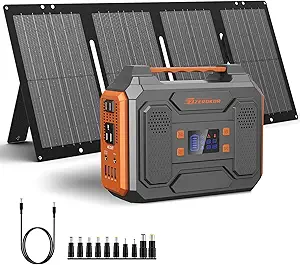 | Best for Flexible Recharging | Power station output: 300W | Solar panel output: 60W | Solar panel type: Monocrystalline | VIEW ON AMAZON | See Our Full Breakdown |
| MARBERO M823 237Wh Portable Power Station with 60W Solar Panel |  | Best Small Station for Longer Device Sessions | Battery capacity: 237Wh (64,000mAh) | Peak output: 375W | Solar panel output: 60W | VIEW ON AMAZON | See Our Full Breakdown |
| BLUETTI Solar Generator Elite 400 with 2x200W Solar Panel Included, 3840Wh |  | Best Premium Battery Backup Kit | Battery capacity: 3,840Wh | Battery chemistry: LiFePO4 | AC output: 2,600W | VIEW ON AMAZON | See Our Full Breakdown |
| Jackery HomePower 2000 Plus v2 Portable Power Station with Two 200W Solar Panels |  | Best Expandable Solar Backup Kit | Battery capacity: 2,048Wh | Expandable capacity: Up to 12kWh | Output: 2,400W in title; 2,200W in specifications | VIEW ON AMAZON | See Our Full Breakdown |
| PowerSmart 4000-Watt Portable Inverter Generator |  | Best Fuel-Powered Backup | Fuel type: Gasoline | Peak output: 4,000W | Runtime: Up to 8 hours at 25% load | VIEW ON AMAZON | See Our Full Breakdown |
| Anker SOLIX F3800 Portable Power Station with Transfer Kit, 3,840Wh, 6,000W |  | Best for High-Power Home Backup | Battery capacity: 3,840Wh | Expandable capacity: Up to 26.9kWh with additional battery packs | AC output: 6,000W | VIEW ON AMAZON | See Our Full Breakdown |
| BLUETTI Elite 30 V2 Portable Power Station, 288Wh, 600W |  | Best Compact UPS Backup | Battery capacity: 288Wh | Continuous output: 600W | Power Lifting mode: 1,500W | VIEW ON AMAZON | See Our Full Breakdown |
| MARBERO M82 Portable Power Station with 21W Solar Panel, 88Wh |  | Best Ultralight Emergency Kit | Battery capacity: 88Wh | Solar panel: 21W foldable panel included | Running output: 80W | VIEW ON AMAZON | See Our Full Breakdown |
| BLUETTI Elite 300 Solar Generator with 350W Solar Panel, 3014Wh |  | Best Overall for Home Backup | Battery capacity: 3,014Wh | Battery type: LiFePO4 | Battery cycles: 6,000+ | VIEW ON AMAZON | See Our Full Breakdown |
| BLUETTI Solar Generator Elite 300 & 2x200W Solar Panel 3014.4Wh LFP Battery |  | Best for Space-Constrained Storage | Battery capacity: 3,014.4Wh | Battery type: LiFePO4 | Battery cycles: 6,000+ | VIEW ON AMAZON | See Our Full Breakdown |
| BLUETTI Solar Generator Elite 300 & 500W Solar Panel 3014.4Wh LFP Battery |  | Best for Faster Solar Recharging | Battery capacity: 3,014.4Wh | Battery type: LiFePO4 | Battery cycles: 6,000+ | VIEW ON AMAZON | See Our Full Breakdown |
| Jackery Explorer 300 Portable Power Station with 40W Solar Panel |  | Best Compact Backup for Small Loads | Battery capacity: 292Wh | Peak output: 600W | Battery chemistry: LiFePO4 | VIEW ON AMAZON | See Our Full Breakdown |
| home essential backup power kit | Weight | Battery capacity |
|---|---|---|
| WEN Dual Fuel Portable Generat | — | — |
| MARBERO 155Wh Portable Power S | 3.7 lb | — |
| ZeroKor 300W Portable Power St | — | — |
| MARBERO M823 237Wh Portable Po | — | 237Wh (64,000mAh) |
| BLUETTI Solar Generator Elite | 86 lb | 3,840Wh |
| Jackery HomePower 2000 Plus v2 | 40.6 lbs | 2,048Wh |
| PowerSmart 4000-Watt Portable | 50.7 lbs | — |
| Anker SOLIX F3800 Portable Pow | 132.3 lbs | 3,840Wh |
| BLUETTI Elite 30 V2 Portable P | 9.5 lbs | 288Wh |
| MARBERO M82 Portable Power Sta | 2.3 lbs | 88Wh |
| BLUETTI Elite 300 Solar Genera | 58 lb | 3,014Wh |
| BLUETTI Solar Generator Elite | 58 lb | 3,014.4Wh |
| BLUETTI Solar Generator Elite | 58 lb | 3,014.4Wh |
| Jackery Explorer 300 Portable | 12.9 lb | 292Wh |
More Details on Our Top Picks
WEN Dual Fuel Portable Generator 4750 Surge Watts with Wheel Kit and Electric Start (DF475T)
For a home backup kit built around running appliances rather than just charging electronics, the WEN DF475T offers the most direct route in this group. Its gasoline output is 3,800 running watts, and the 120V/240V selector can suit compatible transfer-switch setups—something the small MARBERO and ZeroKor battery stations cannot match. Dual-fuel operation also gives you a propane option when gasoline storage is inconvenient, though output drops to 3,500 running watts on propane. Electric start and the included wheel kit make setup less laborious, but this is still a fuel-burning generator, not a quiet, indoor-safe battery system. Its 4-gallon tank runs up to 11 hours at half load; heavier loads shorten that interval. Choose it for longer outages and appliance loads, not silent overnight power.
Pros:- Gasoline output of 3,800 running watts supports substantially heavier loads than the small portable battery stations in this roundup.
- Dual-fuel operation offers a propane alternative when gasoline is unavailable or less convenient to store.
- Selectable 120V/240V output and an L14-30R outlet support compatible backup connections.
- Electric start and a wheel-and-handle kit ease starting and movement.
Cons:- Propane running output is lower than gasoline output, at 3,500 watts.
- Fuel use and runtime depend on load; the stated runtime is up to 11 hours only at half load.
- As a combustion generator, it needs safe outdoor operation and fuel management rather than indoor use.
Best for: Homeowners who need generator-level output for compatible appliances or a transfer-switch setup and can safely operate and store a fuel generator.
Not ideal for: Apartment residents, people who need quiet indoor backup for networking gear, or buyers who do not want to manage gasoline or propane.
- Gasoline surge output:4,750 W
- Gasoline running output:3,800 W
- Propane surge output:4,350 W
- Propane running output:3,500 W
- Voltage options:120V / 240V
- Engine:224cc 4-stroke OHV
- Fuel tank:4 gallons
- Runtime at half load:Up to 11 hours
- Outlets:Two 120V GFCI (5-20R), one 120V/240V L14-30R twist lock, one 12V DC cigarette-lighter plug
Our verdict“Choose the WEN if your home kit needs fuel-powered appliance backup and you can operate a generator outdoors.”
MARBERO 155Wh Portable Power Station with 30W Solar Panel
The MARBERO 155Wh kit is the lightest, simplest choice here for keeping phones and other low-draw electronics going, not for powering household appliances. At 3.7 pounds, it is far easier to carry than the 237Wh MARBERO M823, but its 100W-per-outlet limit and 155Wh capacity also leave less room for sustained use. The included 30W panel adds a way to recharge away from a wall outlet, although its modest output means solar replenishment is a slow process compared with the 60W panels bundled with the ZeroKor and M823. Multiple USB and DC connections help serve several small devices, while the built-in SOS-capable light adds emergency utility. I’d pick it for a grab-and-go electronics kit; I’d skip it for appliances, long outages, or buyers who want meaningful solar charging speed.
Pros:- At 3.7 pounds, it is easier to carry and store than the larger 237Wh MARBERO M823.
- The included 30W panel provides an off-grid charging option.
- USB, USB-C, DC, car, and AC outputs accommodate several small-device types.
- Built-in flashlight includes steady, SOS, and strobe modes.
Cons:- 155Wh capacity and 100W AC outlet limits rule out many household appliances.
- The 30W panel has limited output, so solar recharging can take time.
- Its smaller capacity offers less reserve than the ZeroKor and MARBERO M823.
Best for: People assembling a lightweight emergency pouch for phones, small USB devices, and occasional low-wattage electronics.
Not ideal for: Households seeking refrigerator or appliance backup, long device runtimes, or faster solar recharging.
- Capacity:155Wh (42,000mAh)
- Solar panel output:30W
- Solar charging time:6–7 hours
- AC outlets:2 × 100W
- Running wattage:100W
- Ports:1 QC3.0 USB-A, 2 USB-A, 1 USB-C, 3 DC outputs, 1 car port
- Weight:3.7 lb
- Dimensions:8.14 × 3.77 × 7.08 in
- Flashlight modes:Steady, SOS, strobe
Our verdict“Pick this compact kit for carrying and charging small electronics, not for keeping household appliances running.”
ZeroKor 300W Portable Power Station with 60W Solar Panel
The ZeroKor’s strongest case is not raw backup capacity—it is recharging flexibility. It can take power from an AC outlet, a car port, or a compatible solar panel, and the included 60W panel has twice the rated output of the 30W panel bundled with the compact MARBERO 155Wh kit. Its 300W output ceiling makes it more capable than that smaller MARBERO for compatible low-wattage devices, but it still cannot handle high-draw appliances. There is also a key planning gap: the supplied product information does not state battery capacity, so I can’t compare expected runtimes reliably with the 237Wh MARBERO M823. Protection against overload, heat, and electrical faults is useful in an emergency kit, but the panel junction box is not waterproof. Treat this as a small-device option, not a defined-duration home backup system.
Pros:- A 60W monocrystalline panel provides more rated solar output than the MARBERO 155Wh kit’s 30W panel.
- Supports recharging from an AC outlet, 12V car port, or compatible solar panel.
- AC, DC, and USB outputs cover several small-device charging needs.
- Includes short-circuit, over-current, over-voltage, overload, and overheating protection.
Cons:- The 300W maximum output excludes many household appliances.
- Battery capacity is not stated in the supplied product information, limiting runtime planning.
- The solar panel junction box is not waterproof.
Best for: Campers and outage planners who value multiple charging methods and need to power small devices within a 300W limit.
Not ideal for: Buyers who need a clearly specified battery runtime, waterproof solar-panel components, or backup for high-wattage home appliances.
- Power station output:300W
- Solar panel output:60W
- Solar panel type:Monocrystalline
- Solar panel conversion efficiency:20.5%
- AC outlets:2 (300W maximum)
- DC output:9V–12.6V, 10A maximum
- USB ports:3, up to 5V/3A
- Recharging methods:AC outlet, 12V car port, or 13V–23V solar panel
- Safety protections:Short-circuit, over-current, over-voltage, overload, and overheating protection
Our verdict“Choose the ZeroKor for flexible recharging of small devices, provided you can work around its unspecified battery capacity and non-waterproof panel junction box.”
MARBERO M823 237Wh Portable Power Station with 60W Solar Panel
Compared with the MARBERO 155Wh kit, the M823’s 237Wh battery gives you more stored energy for repeated phone, router, or other compatible low-power charging sessions. Its included 60W solar panel also has twice the rated output of the smaller MARBERO’s panel, while the ZeroKor offers a similar 60W panel but does not list battery capacity in the supplied information. Two pure sine wave AC outlets and a range of USB and DC connections make the M823 a more versatile small-device hub. Its 300W rated output remains the limiting factor: this is not a substitute for a generator or a large home-backup station, and the listing’s one-hour runtime gives little context without a stated load. I’d use it to extend electronics backup, not to promise appliance runtime.
Pros:- 237Wh capacity exceeds the MARBERO 155Wh model’s stored energy.
- Included 60W solar panel offers more rated output than the 30W panel in the smaller MARBERO kit.
- Pure sine wave AC outlets plus USB-A, USB-C, and DC outputs support varied small devices.
- Built-in light offers flashlight, strobe, and SOS modes.
Cons:- The 300W rated output is too low for many household appliances.
- The product warns that devices exceeding 300W may damage the unit.
- The listed one-hour runtime lacks a stated load, so it does not establish runtime for a specific device.
Best for: Households wanting a compact, specified-capacity station for phones, small electronics, and other compatible loads during short outages.
Not ideal for: Buyers expecting to run appliances above 300W or seeking a clearly explained runtime for a particular device.
- Battery capacity:237Wh (64,000mAh)
- Peak output:375W
- Solar panel output:60W
- AC outlets:2 pure sine wave outlets
- USB outputs:2 QC3.0 ports up to 18W each, 2 USB-A ports up to 15W each, 1 USB-C PD port up to 18W
- DC output:12–16.8V, 10A (14A maximum)
- Battery type:Lithium-ion
- Listed runtime:1 hour
Our verdict“Choose the M823 over the smaller MARBERO when you want more stated battery capacity for low-power electronics, not appliance backup.”
BLUETTI Solar Generator Elite 400 with 2x200W Solar Panel Included, 3840Wh
The BLUETTI Elite 400 is the most substantial battery-based option in this batch: its 3,840Wh capacity and 2,600W output are in a different class from the MARBERO and ZeroKor stations, which are aimed at smaller device loads. That combination is suited to supporting a refrigerator or other compatible equipment, while two 200W solar panels provide a much larger recharging setup than the 60W panels included with the compact stations. Its stated 15ms switchover also targets network gear and other devices that benefit from uninterrupted backup. The tradeoff is bulk: at 86 pounds, the trolley helps with movement but does not make it a lightweight kit. Solar charging is listed at about 9.5–19 hours from empty to full, and the panels ship separately. Compared with the WEN generator, it avoids fuel operation but has a finite stored-energy supply.
Pros:- 3,840Wh capacity and 2,600W output substantially exceed the small-device MARBERO and ZeroKor stations.
- Two included 200W solar panels provide a larger solar setup than the compact kits’ 30W or 60W panels.
- Stated 15ms switchover is suited to maintaining power for compatible networking and security devices.
- Trolley system supports moving the heavy station around a home.
Cons:- At 86 pounds, it is much heavier than the compact portable stations in this roundup.
- The solar panels ship separately, so the complete kit may not arrive together.
- Unlike the WEN fuel generator, it relies on stored battery energy and recharging for continued operation.
Best for: Homeowners seeking high-capacity, quiet battery backup for compatible appliances and electronics, with space to store and move an 86-pound unit.
Not ideal for: Buyers who need a lightweight portable station, immediate solar-panel delivery, or sustained backup beyond the battery’s stored energy without recharging.
- Battery capacity:3,840Wh
- Battery chemistry:LiFePO4
- AC output:2,600W
- Surge output:3,900W
- Solar panels included:2 × 200W
- Solar charging time:About 9.5–19 hours from 0–100%
- UPS switchover:≤15ms
- Weight:86 lb
- Total power outlets:9
Our verdict“Choose the Elite 400 for substantial battery-based home backup and solar recharging, if its weight and finite stored energy fit your setup.”
Jackery HomePower 2000 Plus v2 Portable Power Station with Two 200W Solar Panels
For a home backup kit that can start with essential loads and grow later, the Jackery HomePower 2000 Plus v2 offers a useful middle ground: its 2,048Wh LFP battery includes two 200W solar panels, and the system can expand to 12kWh with additional capacity. That gives it a stronger path to longer outages than the compact BLUETTI Elite 30 V2, while avoiding the Anker SOLIX F3800’s 132.3-pound starting weight. Smart energy management and priority routing are aimed at keeping selected circuits supplied, rather than simply adding outlets to a small portable battery. The tradeoffs are real: the listed output is inconsistent, with 2,400W in the title and 2,200W in the specifications, and the 40.6-pound unit is not a casual carry. I’d verify the output rating and plan where it will stay before choosing it.
Pros:- Two 200W solar panels are included for recharging when grid power is unavailable.
- Capacity can expand to 12kWh as backup needs grow.
- LFP battery is rated for 6,000+ cycles.
- Smart energy management and priority routing support essential-circuit backup.
Cons:- Output rating conflicts: the title lists 2,400W while the specifications list 2,200W.
- At 40.6 pounds, it is heavy for frequent carrying.
- Reaching the stated maximum capacity requires additional expansion equipment.
Best for: Homeowners who want solar included, backup for essential household loads, and room to expand capacity for longer outages.
Not ideal for: Buyers who need a clearly specified high output rating, a very light grab-and-go battery, or a complete long-duration system without purchasing expansion batteries.
- Battery capacity:2,048Wh
- Expandable capacity:Up to 12kWh
- Output:2,400W in title; 2,200W in specifications
- Battery type:LFP
- Included solar panels:Two 200W panels
- USB-C output:140W
- Weight:40.6 lbs
Our verdict“Choose the Jackery if you want included solar and a scalable home backup battery, but confirm its output rating before matching it to appliances.”
PowerSmart 4000-Watt Portable Inverter Generator
When the priority is sustained appliance power rather than silent, indoor-friendly battery backup, the PowerSmart 4000-Watt inverter generator fills a different role from the Jackery HomePower 2000 Plus v2. Its 3,200W rated output and gasoline supply can suit outage loads that would quickly drain a small battery, while less than 3% total harmonic distortion is a useful match for sensitive electronics. At 59 dBA from 23 feet at 25% load, it is quieter than many conventional generators, though it still produces engine noise and must be operated outdoors. Runtime is up to eight hours at a light 25% load, but the 1.3-gallon tank means more frequent refueling as demand rises. Parallel capability offers a route to more output, but the compatible generator and kit are separate considerations. I’d pick this over the BLUETTI Elite 30 V2 for higher-load needs, not for compactness or low-maintenance operation.
Pros:- Provides 3,200W rated output and 4,000W peak output for larger loads than compact battery stations.
- Less than 3% total harmonic distortion is suited to sensitive electronics.
- Parallel-ready for added output with compatible equipment.
- Includes AC, DC, and USB outlets.
Cons:- The 1.3-gallon fuel tank limits runtime between refills, especially at heavier loads.
- Requires outdoor operation and gasoline storage, unlike battery-powered options.
- The parallel kit is sold separately.
Best for: Households that can safely run a generator outdoors and need gasoline-powered output for multiple appliances during an outage.
Not ideal for: Apartment residents, buyers needing indoor-safe or near-silent backup, and anyone unwilling to store fuel or refuel during an outage.
- Fuel type:Gasoline
- Peak output:4,000W
- Runtime:Up to 8 hours at 25% load
- Fuel tank:1.3 gallons
- Noise level:59 dBA at 23 feet and 25% load
- Total harmonic distortion:Less than 3%
- Weight:50.7 lbs
Our verdict“Choose this generator for higher-load, fuel-based backup if you have a safe outdoor operating spot and accept refueling and engine noise.”
Anker SOLIX F3800 Portable Power Station with Transfer Kit, 3,840Wh, 6,000W
The Anker SOLIX F3800 is the strongest fit here for buyers who need more than a few small devices powered: its 6,000W AC output and 120V/240V support let it serve a wider range of household and RV equipment than the Jackery HomePower 2000 Plus v2. Its 3.84kWh base capacity is also larger than the Jackery’s, and expansion to 26.9kWh creates a substantial path to longer backup, though extra battery packs are required. App control over Wi-Fi or Bluetooth adds a convenient way to manage the system without standing beside it. This capability comes at a physical cost: 132.3 pounds makes it a stationary installation choice, not a unit to move around the house casually. Compared with the PowerSmart generator, it avoids gasoline and engine operation but depends on stored charge and add-on batteries for extended outages.
Pros:- 6,000W AC output supports a broad range of household and RV loads.
- 120V/240V output accommodates both standard and higher-voltage equipment.
- Capacity can expand to 26.9kWh with additional battery packs.
- Wi-Fi and Bluetooth app control offer remote system management.
Cons:- At 132.3 pounds, it is difficult to move and best treated as a stationary unit.
- Expansion to the stated maximum capacity requires additional battery packs.
- Battery backup duration depends on stored charge and recharging access during a prolonged outage.
Best for: Homeowners or RV users with 120V and 240V loads who want high output and plan to place the system near its backup connection.
Not ideal for: Buyers who need a lightweight portable station, want long runtimes without add-on batteries, or need a simple low-capacity device for phones and small electronics.
- Battery capacity:3,840Wh
- Expandable capacity:Up to 26.9kWh with additional battery packs
- AC output:6,000W
- Voltage:120V/240V
- Ports:NEMA 14-50 and L14-30
- Connectivity:Wi-Fi and Bluetooth app control
- Weight:132.3 lbs
- Warranty:5 years
Our verdict“Choose the F3800 for high-output, dual-voltage backup when you can accommodate its weight and budget for expansion batteries if needed.”
BLUETTI Elite 30 V2 Portable Power Station, 288Wh, 600W
For keeping a router, modem, or a few small electronics running through a brief interruption, the BLUETTI Elite 30 V2 is more practical than the large Anker SOLIX F3800. It weighs 9.5 pounds, offers 288Wh of capacity, and has a UPS switch rated at 10ms or less, so it can support connected equipment that needs a quick handoff. Fast wall charging—80% in 45 minutes—also makes it easier to replenish between short outages. Its limits matter for a home backup kit: the continuous output is 600W, and the 1,500W Power Lifting mode is not the same as continuous appliance power. The Jackery HomePower 2000 Plus v2 is a much better match for extended household backup, but it is far heavier and more costly to move around. I’d choose this BLUETTI for targeted electronics, not whole-room or appliance coverage.
Pros:- UPS switch time of 10ms or less suits connected electronics sensitive to power interruptions.
- Light 9.5-pound design is much easier to move than larger home backup stations.
- Wall charging reaches 80% in 45 minutes.
- Supports AC, solar, and car charging.
Cons:- 288Wh capacity provides limited runtime for sustained backup or higher-power devices.
- 600W is the continuous output; 1,500W Power Lifting mode is not continuous power.
- Not suited to backing up major appliances or multiple household circuits.
Best for: Remote workers and households wanting a compact UPS-style backup for a router, modem, laptop, or other modest-load electronics.
Not ideal for: Buyers who need to run refrigerators, kitchen appliances, or multiple household circuits for extended periods; its capacity and continuous output are limited.
- Battery capacity:288Wh
- Continuous output:600W
- Power Lifting mode:1,500W
- UPS switch time:10ms or less
- Wall charging:380W, adjustable to 200W
- Wall charge time:0–80% in 45 minutes; 0–100% in 70 minutes
- Weight:9.5 lbs
- AC voltage:120V
Our verdict“Choose the Elite 30 V2 for short UPS-style protection of small electronics, not for substantial home or appliance backup.”
MARBERO M82 Portable Power Station with 21W Solar Panel, 88Wh
The MARBERO M82 is the smallest-scale option in this group: at 2.3 pounds, it is easy to keep with an emergency bag or take on a short trip, and the included 21W foldable solar panel offers a way to recharge when outlets are unavailable. Its 88Wh capacity and 80W running output suit phones, lights, and other modest devices, not a refrigerator or the larger loads supported by the PowerSmart generator. Even compared with the BLUETTI Elite 30 V2, it gives up substantial capacity and continuous output in exchange for a lighter, simpler kit with solar included. That tradeoff makes sense for basic communications and lighting, but not for extended outage coverage. I’d treat it as a small-device reserve rather than the core of a home backup plan; its 120W surge rating does not change its 80W running limit.
Pros:- Includes a 21W foldable solar panel for off-grid recharging.
- Weighs just 2.3 pounds, making it easy to store or carry.
- AC, DC, and USB connections cover common small-device needs.
- Includes short-circuit, overcharge, overload, and over-voltage protection.
Cons:- 88Wh capacity limits how long it can power even modest devices.
- 80W running output rules out most household appliances.
- Solar recharging from a 21W panel is a small-scale option rather than a fast way to replenish the battery.
Best for: Campers, commuters, or households assembling a lightweight emergency kit for phones, small lights, and other low-power devices.
Not ideal for: Anyone seeking backup for appliances, long runtimes, or high-wattage electronics; its 88Wh capacity and 80W running limit are too small.
- Battery capacity:88Wh
- Solar panel:21W foldable panel included
- Running output:80W
- Surge output:120W
- AC voltage:110V
- Weight:2.3 lbs
- Power sources:Solar, battery, and AC
- Protection features:Short-circuit, overcharge, overload, and over-voltage protection
Our verdict“Choose the M82 kit for lightweight backup of small electronics, but pair it with a larger station if you need meaningful home outage coverage.”
BLUETTI Elite 300 Solar Generator with 350W Solar Panel, 3014Wh
For a home essential backup kit, I rank this Elite 300 first because its 3,014Wh LiFePO4 battery and 2,400W continuous output offer a stronger balance of stored energy and appliance support than the compact Jackery Explorer 300. It can run several essential devices, while its 4,800W surge capacity gives compatible equipment extra startup headroom. The included 350W panel provides a practical way to replenish the battery off-grid, though the stated solar recharge window of 8–17 hours depends on conditions and is slower than the 500W-panel Elite 300 bundle. The tradeoff is portability: at 58 lb, this is better treated as a movable backup unit than something to carry often. Its TT-30 and 12V/30A ports also make it more useful for compatible RV setups than a small device-focused station.
Pros:- 3,014Wh capacity gives essential devices more reserve than compact stations such as the Jackery Explorer 300.
- 2,400W continuous output and 4,800W surge support a broader range of compatible appliances.
- Includes a 350W solar panel for recharging without relying solely on wall power.
- LiFePO4 battery is rated for 6,000+ cycles, with TT-30 and 12V/30A RV ports.
Cons:- At 58 lb, it is cumbersome to carry regularly.
- Solar recharge is listed at approximately 8–17 hours, and actual time depends on sunlight and conditions.
- The solar panel ships separately, so the kit components may not arrive together.
Best for: Households seeking a substantial portable reserve for a refrigerator, communications gear, lights, and other compatible essentials, with occasional RV use.
Not ideal for: People who need a lightweight station to carry frequently, or buyers who want the fastest solar replenishment in this Elite 300 group.
- Battery capacity:3,014Wh
- Battery type:LiFePO4
- Battery cycles:6,000+
- Continuous output:2,400W
- Surge output:4,800W
- Included solar panel:350W
- Solar recharge time:Approximately 8–17 hours
- Weight:58 lb
- RV ports:TT-30 outlet and 12V/30A DC port
Our verdict“Choose this Elite 300 bundle for substantial home essentials coverage and RV-ready connections if you can accommodate its weight and variable solar recharge time.”
BLUETTI Solar Generator Elite 300 & 2x200W Solar Panel 3014.4Wh LFP Battery
This bundle pairs the same 3,014Wh Elite 300 capacity and 2,400W output as the 350W-panel version, but includes two 200W panels. I’d choose it when a compact power station matters more than a single-panel setup: the claimed space-saving design may make storing the unit easier than larger options such as the BLUETTI Elite 400. The listed 7–15-hour solar recharge window is broad, and the two panels still require outdoor space, suitable sunlight, and setup time. Like the other Elite 300 kits, it has a 4,800W surge rating, a TT-30 outlet, and a 12V/30A port, making it more capable for home essentials and RV connections than the 292Wh Jackery Explorer 300. Its 58-pound station is not truly lightweight, and the panels ship separately.
Pros:- 3,014.4Wh capacity and 2,400W output provide substantial reserve for compatible household essentials.
- Includes two 200W solar panels, with a stated recharge window of approximately 7–15 hours.
- Space-saving power-station design is easier to store than many larger-capacity alternatives.
- TT-30 outlet and 12V/30A DC port support compatible RV equipment without an adapter.
Cons:- The 58 lb power station is heavy to move regularly.
- Two panels require more setup and clear outdoor space than a compact panel arrangement.
- The panels ship separately, and solar recharge time varies with conditions.
Best for: Households with limited indoor storage that want a high-capacity station plus a two-panel solar kit for outage readiness or RV use.
Not ideal for: Buyers who need a light carry-anywhere unit, have little room to set up solar panels, or prefer the more direct single-panel configuration of the 350W Elite 300 bundle.
- Battery capacity:3,014.4Wh
- Battery type:LiFePO4
- Battery cycles:6,000+
- Continuous output:2,400W
- Surge output:4,800W
- Included solar panels:2 × 200W
- Solar recharge time:Approximately 7–15 hours
- Weight:58 lb
- RV ports:TT-30 outlet and 12V/30A DC port
Our verdict“Pick this bundle if compact station storage and included two-panel charging matter more than easy carrying or a simpler solar setup.”
BLUETTI Solar Generator Elite 300 & 500W Solar Panel 3014.4Wh LFP Battery
When restoring stored power from sunlight is a priority, this Elite 300 bundle is the strongest fit among the three large BLUETTI kits here: its included 500W panel has a stated 7–10-hour recharge window, compared with 8–17 hours for the 350W-panel package. The station itself keeps the shared Elite 300 strengths—3,014.4Wh capacity, 2,400W continuous output, and 4,800W surge—so it can support more home essentials than the much smaller Jackery Explorer 300. The higher panel wattage does not remove the need for good sunlight or suitable setup space, and the unit remains a 58 lb station rather than an easy carry. It also gives up the two-panel arrangement of the 2×200W bundle, which some buyers may prefer for panel placement flexibility.
Pros:- 500W included panel has a stated recharge time of approximately 7–10 hours.
- 3,014.4Wh capacity and 2,400W continuous output can support a broader set of compatible essentials than compact stations.
- 4,800W surge rating provides additional startup headroom for compatible loads.
- TT-30 and 12V/30A DC ports suit compatible RV appliances and equipment.
Cons:- The station weighs 58 lb, limiting convenient frequent transport.
- A 500W panel requires adequate outdoor space and favorable sunlight for the stated recharge window.
- The panel ships separately, and this bundle lacks the two-panel arrangement offered with the 2×200W Elite 300 kit.
Best for: Households preparing for outages who have space for a 500W solar panel and want a shorter stated solar recharge window from a 3kWh-class station.
Not ideal for: Buyers who prioritize a lightweight carry or want two separate panels for more flexible placement.
- Battery capacity:3,014.4Wh
- Battery type:LiFePO4
- Battery cycles:6,000+
- Continuous output:2,400W
- Surge output:4,800W
- Included solar panel:500W
- Solar recharge time:Approximately 7–10 hours
- Weight:58 lb
- RV ports:TT-30 outlet and 12V/30A DC port
Our verdict“Choose this Elite 300 bundle if you want the shortest stated solar recharge window in this group and can manage its weight and panel setup.”
Jackery Explorer 300 Portable Power Station with 40W Solar Panel
The Jackery Explorer 300 is the compact choice here, not a substitute for the 3,014Wh BLUETTI Elite 300 systems. Its 292Wh battery and 300W rated output are better suited to keeping phones, a router, lights, or other modest loads powered than running a refrigerator for an extended outage. In return, the station weighs 12.9 lb, making it far easier to move or store than the 58 lb BLUETTI units. The included 40W panel adds off-grid charging, but its stated time to reach 80% is about 7.5 hours, so it replenishes far less energy than the larger BLUETTI solar bundles. A 100W USB-C port, two AC outlets, and a car port give it useful device flexibility, while the low capacity and 600W peak limit its role in a home backup kit.
Pros:- At 12.9 lb, it is far easier to move and store than the 58 lb BLUETTI Elite 300 bundles.
- Two AC outlets, a 100W USB-C port, two USB-A ports, and a 120W car port support varied small devices.
- Includes a 40W solar panel for charging away from an outlet.
- LiFePO4 battery is rated for over 4,000 cycles to 70% capacity.
Cons:- 292Wh capacity is limited for extended outages or larger household appliances.
- 300W rated output and 600W peak output rule out many higher-draw loads.
- The 40W panel takes approximately 7.5 hours to reach 80% under the stated conditions, and the kit may ship separately.
Best for: Apartment dwellers, campers, and households wanting a portable reserve for phones, networking gear, lights, and other low-draw essentials.
Not ideal for: People expecting to power a refrigerator, multiple substantial appliances, or household loads for long outage periods; its capacity and output are far below the BLUETTI Elite 300 models.
- Battery capacity:292Wh
- Peak output:600W
- Battery chemistry:LiFePO4
- Charge cycles:Over 4,000 to 70% capacity
- Weight:12.9 lb
- Included solar panel:40W
- Solar charging time:Approximately 7.5 hours to 80% with the 40W panel
- USB-C port:100W PD
Our verdict“Choose the Jackery Explorer 300 for portable power for small essentials, but choose an Elite 300 if you need meaningful capacity for larger home backup loads.”

How We Picked
I compared each kit as a way to keep home essentials powered during an outage, not as a substitute for a complete home electrical system. The main criteria were stated battery capacity or generator output, the kinds of loads each unit could support, included solar equipment, portability, and how readily the setup could fit into a household backup plan. I also weighed practical ownership factors: charging options, likely storage demands, fuel and maintenance needs, and whether the bundle gives a buyer a useful starting point without separate equipment.
The ranking favors usable backup range and flexibility for common household essentials, while recognizing that a compact unit can be a better fit for a smaller job. Higher-capacity battery kits rank ahead for broader outage coverage, but they do not automatically suit every home: their size, charging needs, and price category can be excessive for phone-and-router backup. Generators are included for buyers who prioritize fuel-powered operation, but they rank differently because they must run outdoors and need fuel, ventilation planning, and upkeep. Where several products share a battery platform, I distinguish them by their included panel setup and likely buyer fit rather than treating bundle variations as identical.
Factors to Consider When Choosing Home Essential Backup Power Kit
I’d start with the outage tasks you actually need to cover, then work backward to the type and size of kit that can handle them. These factors help prevent two common mismatches: buying a small station for loads it cannot sustain, or paying for a large system when a modest backup plan would do.
1. List Essential Loads Before Choosing Capacity
Write down the devices you want to run and their wattage, then estimate how many hours each needs to operate. A router, phone, and LED lights create a very different demand from a refrigerator, medical device, or sump pump. Add up the loads you expect to run at the same time, not every appliance in the house. This helps separate a compact station for communications from a larger battery system meant to cover several essentials. Check both the unit’s running output and any limits on surge loads, since motors can draw more power when starting. If you cannot find reliable wattage information, check the device label or its manufacturer’s specifications before choosing a kit.
2. Decide Whether Battery or Fuel Power Fits Your Outage Plan
Battery stations offer quiet operation and can be used indoors according to the manufacturer’s instructions, making them a practical match for electronics and lighting. A generator can keep supplying power while fuel is available, but it must operate outdoors, away from doors, windows, and vents, because exhaust can cause carbon monoxide poisoning. Never run a fuel generator inside a home, garage, or other enclosed space. Think about fuel storage, local rules, noise, and routine maintenance before choosing that route. A battery may need a recharge after its stored energy is used, while a generator needs fuel and safe operating conditions. The right choice depends on how you expect to recharge or refuel during a long outage.
3. Treat Solar Panels as a Recharge Option, Not a Runtime Guarantee
Included panels can help restore a battery during an extended outage, but their output depends on sunlight, placement, weather, and the station’s accepted solar input. A panel’s rated wattage does not mean the battery will recharge at that rate throughout the day. Check the power station’s solar input limits and connector compatibility before adding panels or replacing the included set. Buyers with limited yard or balcony space may prefer a smaller panel arrangement, while a larger setup calls for suitable placement and safe cable routing. Plan for cloudy days by considering other charging methods supported by the unit. Solar is most useful when you have a realistic place and schedule for collecting sunlight.
4. Check Output Types and Connection Limits
Capacity is only part of the match: the unit also needs the right outlets for the devices you intend to connect. Count the AC outlets, USB ports, and other outputs you’ll need at once, and check each port’s power limit. A collection of USB ports may handle phones and small electronics but cannot replace household AC outlets for appliances. Be careful with extension cords and power strips; follow the unit’s instructions and avoid exceeding its overall output rating. If you want to connect a power station to household circuits, verify that the specific system supports that use and use an approved transfer arrangement installed or checked by a qualified professional. Never backfeed a home through a regular wall outlet.
5. Match Portability and Storage to Where You’ll Use It
A unit that stays in one place can be larger and heavier than one you need to move between rooms, carry in a vehicle, or store on a shelf. Check product dimensions and weight, and think about whether handles, wheels, or separate panel storage will work in your home. Solar kits often require room for both the power station and panels, so consider the full setup rather than the battery alone. Keep equipment in the temperature and moisture conditions allowed by its manufacturer, and leave access for inspection and charging. A smaller station can be easier to store and deploy, but that convenience comes with less stored energy. Choose around your real storage space and handling needs, not just the capacity figure.
6. Pay for Headroom Only When Your Loads Justify It
A larger system makes sense when it covers additional devices or gives you more time between recharges, not simply because its capacity number is higher. If your priority is a phone, router, and a few lights, a compact station may be easier to store and manage. If you need to support several household essentials, the larger BLUETTI and Jackery kits in this lineup are more relevant starting points. For generator buyers, compare usable output with the appliances’ running and startup demands, then plan for fuel and maintenance. Leave room in your decision for future needs, but avoid assuming a portable kit will power every home circuit. The best fit is the least complex setup that can reliably cover your planned loads.
Frequently Asked Questions
Can a portable power station run a refrigerator during an outage?
It may, but the answer depends on the refrigerator’s running draw, startup surge, and how long you need it powered. Compare those demands with the power station’s AC output and stored capacity; a large capacity figure alone does not confirm compatibility. A refrigerator cycles on and off, so actual runtime varies with its age, temperature settings, room conditions, and how often the door opens. Check the refrigerator’s label or manufacturer data, and allow a margin for startup demand. The compact stations in this roundup are generally a poor starting point for extended refrigerator backup compared with the high-capacity systems.
Can I connect one of these kits to my home’s electrical panel?
Do not assume a portable power station can feed a home panel just because it has AC outlets. Panel connection requires equipment designed for that purpose, such as a compatible transfer setup, and must prevent power from feeding back into utility lines. The Anker SOLIX F3800 listing includes a transfer kit, but buyers should still confirm what the kit supports and follow the manufacturer’s instructions. Have a qualified electrician review any connection to household circuits. Never plug a power station or generator into a wall outlet to energize home wiring.
Is a solar panel included with every kit enough to recharge the battery during a long outage?
Not necessarily; the included panel’s rated output is only one part of recharge time. Sun angle, cloud cover, shade, panel placement, and the power station’s solar input limit all affect how much energy reaches the battery. Household use may consume power faster than a panel can replace it, especially with larger loads. Review the manufacturer’s solar charging estimates and input specifications, then consider whether you have space to set up the panel in direct sunlight. It is wise to plan for a backup charging method rather than treating solar as guaranteed all-day power.
When is a fuel generator a better choice than a battery station?
A generator may fit buyers who need ongoing fuel-powered operation and have a safe outdoor location, access to fuel, and willingness to handle maintenance. A battery station is often a better match for quiet indoor use, overnight operation, and sensitive electronics, though it has finite stored energy. Generator exhaust must never enter a home, garage, or enclosed area, and carbon monoxide alarms are an important part of a household safety plan. Noise rules, fuel storage, and upkeep can also make a generator a poor fit for some homes. Compare the expected outage length and your safe operating options before choosing between the two.
How should I choose among the three BLUETTI Elite 300 solar bundles?
Start by comparing the exact battery capacity, included panel wattage, and the station’s solar input limits for each bundle, then check the manufacturer’s current specifications for the listing you plan to buy. The roundup includes a 350W panel kit, a two-panel 200W kit, and a 500W panel kit, so the main practical difference is the supplied solar arrangement rather than a different household load list. A larger panel rating can help collect more energy in suitable conditions, but it does not guarantee faster charging if the station caps solar input. Consider how much space you have for panel placement and whether the included configuration suits it. Choose the bundle that matches your charging conditions, not the largest panel figure by itself.
Conclusion
For a balanced home backup setup, my best overall recommendation is the Jackery HomePower 2000 Plus v2, which pairs substantial battery capacity with included solar panels. For a larger battery system with panel configurations to compare, the BLUETTI Elite 300 bundles are my best premium direction; match the panel setup to your available sunlight and space. The compact MARBERO and Jackery Explorer 300 options are better value when your plan is limited to light loads like phones, lights, and small electronics, rather than broad household backup. For beginners who want a manageable starting point for modest essentials, I’d favor a compact battery station over a fuel generator, while checking its capacity against the actual devices first. If you specifically need a fuel-powered option and can operate it safely outdoors, compare the WEN dual-fuel generator and PowerSmart inverter generator by output, fuel needs, and maintenance. Choose according to the devices you need to keep running and how you’ll recharge or refuel during the outage.
Halloween Picks

11.2-Foot Halloween Inflatable Pumpkin with LED Lights

8.5 Foot Halloween Inflatable Haunted House Castle with Skeleton, Ghost & Skulls

12.5-Foot Lighted Halloween Inflatable Archway
As an affiliate, we earn on qualifying purchases.