Medical geriatric recliner chairs can make supervised sitting and repositioning easier, but the right choice depends on mobility, fit, and how much support a care routine requires. I rank the VEVOR 4-Position Geriatric Reclining Chair with Trendelenburg as the best overall for its added positioning range and 500 lb capacity. The ProHeal 3-Position Geri Chair stands out for its wheels and tray, while the VivaComfort Bariatric Geri Chair is the lineup’s bariatric-focused option. The main tradeoff is between more positioning flexibility and a simpler chair that may better suit routine use; wheel and tray details also affect daily handling. Read on for the full breakdown, the selection criteria, and guidance on matching a chair to the user and care setting.

Get your wardrobe favorites delivered free with Prime
- Fast, free delivery on millions of items
- Prime Video, Amazon Music and more included
- Member-only deals all year
Key Takeaways
- The VEVOR 4-position chair leads this comparison because its Trendelenburg positioning and 500 lb capacity offer more flexibility than the lineup’s three-position models.
- Three-position designs are the practical core of the group: ProHeal, Lumex, VivaComfort, and two VEVOR options focus on reclining basics rather than the extra positioning range of the top pick.
- Mobility and accessories distinguish otherwise similar chairs. The ProHeal and VEVOR model with a detachable tray make wheels and tray configuration explicit parts of their appeal.
- Capacity alone does not settle bariatric fit. The VivaComfort is specifically bariatric-focused, while the two 500 lb VEVOR models state a capacity figure; buyers still need to check seat dimensions and user fit.
- The lineup favors care-setting functionality over compact simplicity. Before choosing, confirm the chair’s footprint, maneuvering space, and whether caregivers can operate its positions and accessories in the intended room.
| VEVOR 4-Position Geriatric Reclining Chair with Trendelenburg, 500 lb Capacity | 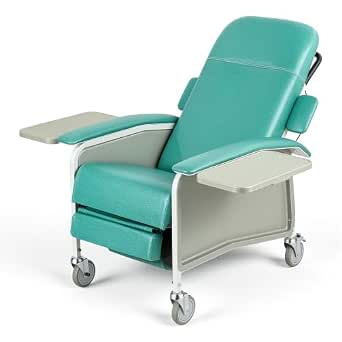 | Best for Care Positions | Positions: 4: upright, deep recline, elevated leg rest, and Trendelenburg | Weight capacity: 500 lbs | Frame: Powder-coated carbon steel | VIEW ON AMAZON | See Our Full Breakdown |
| ProHeal 3-Position Geri Chair with Wheels and Tray, Charcoal |  | Best for Compact Care Spaces | Positions: 3 | Seat dimensions: 20 x 20 inches | Seat back height: 36 inches | VIEW ON AMAZON | See Our Full Breakdown |
| Lumex 3-Position Medical Recliner with Wheels, Jade |  | Best for Contoured Seating | Reclining positions: 3: upright, partial-recline, and full-recline | Weight capacity: 250 lbs | Dimensions: 41 x 25 x 47 inches | VIEW ON AMAZON | See Our Full Breakdown |
| VivaComfort Bariatric Geri Chair with Recliner and Wheels |  | Best for Bariatric Support | Weight capacity: 500 lbs | Recline: Lever-controlled | Frame: Powder-coated steel | VIEW ON AMAZON | See Our Full Breakdown |
| VEVOR 3-Position Geri Reclining Chair with 500 lb Capacity |  | Best Value for High Capacity | Positions: 3: upright, deep recline, and elevated leg rest | Weight capacity: 500 lbs | Frame: Powder-coated carbon steel | VIEW ON AMAZON | See Our Full Breakdown |
| VEVOR 3-Position Geriatric Recliner Chair with Wheels and Detachable Tray |  | Best for Easy-Clean Home Care | Reclining positions: 3 | Weight capacity: 250 pounds | Frame: Carbon steel with rust-resistant white powder coating | VIEW ON AMAZON | See Our Full Breakdown |
| geriatric recliner chairs medical | Weight capacity | Frame | Item weight | Casters |
|---|---|---|---|---|
| VEVOR 4-Position Geriatric Rec | 500 lbs | Powder-coated carbon steel | 98.3 pounds | Four 5-inch casters; two rear wheels lockable |
| ProHeal 3-Position Geri Chair | 250 lbs | — | 105.8 lbs | 4, including 2 locking |
| Lumex 3-Position Medical Recli | 250 lbs | Steel | — | — |
| VivaComfort Bariatric Geri Cha | 500 lbs | Powder-coated steel | 97.8 pounds | Medical-grade locking casters |
| VEVOR 3-Position Geri Reclinin | 500 lbs | Powder-coated carbon steel | 87.5 pounds | Four 5-inch universal casters; two rear casters lock |
| VEVOR 3-Position Geriatric Rec | 250 pounds | Carbon steel with rust-resistant white powder coating | 86.6 pounds | — |
More Details on Our Top Picks
VEVOR 4-Position Geriatric Reclining Chair with Trendelenburg, 500 lb Capacity
The four-position range is the main reason to choose this VEVOR: alongside upright seating, deep recline, and elevated legs, it offers a Trendelenburg position for care situations that call for that position. Its 500 lb capacity also exceeds the 250 lb limit of the ProHeal 3-Position Geri Chair, making it a better fit for some higher-capacity needs. Two side trays give a seated person surfaces for meals or activities, while the wipe-clean PVC upholstery and locking rear casters support everyday care routines. The tradeoff is bulk: at 98.3 pounds and about 37 inches wide, it takes space and may need help to move. Choose the VEVOR 3-Position Geri Reclining Chair instead if Trendelenburg is not needed and a lighter chair is preferable.
Pros:- Four positions include Trendelenburg as well as deep recline and elevated-leg support.
- 500 lb capacity is higher than the ProHeal and Lumex chairs listed here.
- Two side trays offer separate surfaces for care tasks, meals, or activities.
- Rear locking casters and a push handle support caregiver positioning.
Cons:- At 98.3 lb, it may be difficult for one caregiver to move.
- Its 37.01-inch width and 50.39-inch height call for careful room and doorway measurements.
Best for: Care facilities or households needing Trendelenburg positioning, a 500 lb capacity, and two built-in tray surfaces.
Not ideal for: People furnishing a small room or needing to move a recliner frequently without assistance; its wide footprint and 98.3 lb weight can make placement difficult.
- Positions:4: upright, deep recline, elevated leg rest, and Trendelenburg
- Weight capacity:500 lbs
- Frame:Powder-coated carbon steel
- Upholstery:PVC leather with polyurethane and high-density board
- Casters:Four 5-inch casters; two rear wheels lockable
- Included accessories:Two side tray tables
- Dimensions:37.01 x 31.1 x 50.39 inches
- Item weight:98.3 pounds
Our verdict“Choose this VEVOR when Trendelenburg positioning and high capacity matter more than a compact footprint or easy solo handling.”
ProHeal 3-Position Geri Chair with Wheels and Tray, Charcoal
The ProHeal is the narrowest-dimensioned chair in this group at 24 inches wide, which can help when a care room has limited floor space. Its three positions cover upright sitting, reclining, and elevated-leg support, while a detachable activity tray can be removed when it is not needed. Compared with the VEVOR 4-Position Geriatric Reclining Chair, it lacks Trendelenburg and has half the stated weight capacity, but its 31.5 x 24 x 48-inch overall dimensions may suit tighter layouts. Stain-resistant padded upholstery and two locking casters support routine care use. The main compromise is a 250 lb capacity; at 105.8 pounds, it is also heavy despite its more compact width. This is a space-conscious pick, not a high-capacity one.
Pros:- 24-inch width can work better in tight spaces than the wider VEVOR four-position model.
- Three positions include elevated-leg support.
- Detachable tray can be taken off when access or open seating is preferred.
- Stain-resistant upholstery and two locking casters suit care routines.
Cons:- 250 lb weight capacity is lower than the 500 lb VEVOR and VivaComfort options.
- At 105.8 lb, it is heavy to reposition.
- No Trendelenburg position is listed.
Best for: Home-care households or facilities with limited floor space that need a removable tray and a chair rated for up to 250 lbs.
Not ideal for: Buyers needing a capacity above 250 lbs, Trendelenburg positioning, or a recliner that caregivers can move easily.
- Positions:3
- Seat dimensions:20 x 20 inches
- Seat back height:36 inches
- Weight capacity:250 lbs
- Product dimensions:31.5 x 24 x 48 inches
- Item weight:105.8 lbs
- Casters:4, including 2 locking
- Upholstery and frame:Stain-resistant upholstery; steel frame
Our verdict“Pick the ProHeal for a narrower care chair with a removable tray, provided its 250 lb capacity and heavy frame suit your needs.”
Lumex 3-Position Medical Recliner with Wheels, Jade
Where the VEVOR chairs emphasize high capacity and included trays, the Lumex 3-Position Medical Recliner focuses on seating support: multi-density foam, a contoured seat and back, and an adjustable articulating headrest. Those details may suit care settings where the occupant spends time sitting for meals or visits as well as resting. Its three positions progress from upright to partial and full recline, and the Flex-o-Later seat system adds a distinct seating feature not specified for the ProHeal. Its 250 lb capacity is far below the 500 lb VEVOR and VivaComfort chairs, and no tray is listed. The position lock also requires caregiver assistance, so this is not the choice for someone who needs to adjust recline independently. Think of it as a support-oriented care chair rather than a high-capacity, accessory-led option.
Pros:- Multi-density foam cushions and a contoured seat and back support extended sitting.
- Adjustable articulating headrest allows changes to head support.
- Three positions accommodate upright use, partial recline, and full recline.
- Wheels support movement between rooms.
Cons:- Position lock requires caregiver assistance.
- 250 lb weight capacity is below the VEVOR and VivaComfort 500 lb options.
- No tray or upholstery-cleaning details are specified.
Best for: Care facilities seeking contoured cushioning and an adjustable headrest for occupants who need support during seated activities and rest.
Not ideal for: Buyers who need a capacity above 250 lbs, a supplied tray, or independent recline adjustment without caregiver help.
- Reclining positions:3: upright, partial-recline, and full-recline
- Weight capacity:250 lbs
- Dimensions:41 x 25 x 47 inches
- Frame:Steel
- Seat system:Flex-o-Later
- Cushions:Multi-density foam
- Headrest:Adjustable articulating
- Upholstery color:Jade
Our verdict“Choose the Lumex when contoured seating and head support matter more than high capacity, a tray, or independent position adjustment.”
VivaComfort Bariatric Geri Chair with Recliner and Wheels
The VivaComfort makes its case with a 500 lb capacity, thick cushions, and a powder-coated steel frame. It is a straightforward choice for buyers who need a bariatric care chair and prefer a lever-controlled recline over the named three- or four-position systems on the VEVOR models. A foldable side tray and footrest add practical surfaces for meals, electronics, or therapy tasks, while locking medical-grade casters and a cushioned push handle assist caregiver movement. Compared with the VEVOR 4-Position Geriatric Reclining Chair, the listed details do not specify a Trendelenburg position or a defined number of recline positions, so buyers needing that positioning range should look there instead. The 97.8 lb weight also makes solo relocation a challenge. The supplied specifications do not state upholstery material or dimensions beyond the overall size, leaving fit and cleaning details less clear.
Pros:- 500 lb capacity suits higher-capacity needs.
- Thick cushions and a cushioned push handle add padded support.
- Foldable side tray and footrest serve meals and care activities.
- Locking medical-grade casters help secure the chair during use.
Cons:- The listed specifications do not state a number of recline positions or confirm Trendelenburg.
- At 97.8 lb, it may need more than one person to relocate.
- Upholstery material and cleaning details are not provided.
Best for: Bariatric care settings and households needing a 500 lb capacity, cushioned support, and a foldable tray and footrest.
Not ideal for: Buyers who need a documented Trendelenburg position, a defined multi-position recline range, or detailed upholstery-cleaning specifications.
- Weight capacity:500 lbs
- Recline:Lever-controlled
- Frame:Powder-coated steel
- Casters:Medical-grade locking casters
- Included features:Foldable side tray and footrest
- Dimensions:46.8 H x 31.1 W x 38.6 D inches
- Item weight:97.8 pounds
Our verdict“Choose VivaComfort for a 500 lb capacity and foldable tray-footrest setup, but select the VEVOR four-position chair if you need documented Trendelenburg positioning.”
VEVOR 3-Position Geri Reclining Chair with 500 lb Capacity
This VEVOR keeps the key high-capacity features while skipping the four-position model’s extra Trendelenburg setting. Its 500 lb capacity, three positions, push handle, locking rear casters, and included tray cover common care needs without the larger four-position chair’s 37.01-inch width. At 87.5 pounds, it is also lighter than that VEVOR and the ProHeal 3-Position Geri Chair, though it may still take assistance to move. The recline sequence covers upright sitting, deep recline, and elevated-leg support; buyers needing Trendelenburg should choose the four-position VEVOR instead. PVC leather upholstery and a padded seat are listed, but the description provides no assembly details, so setup planning is less certain. This is the more direct pick when capacity and basic recline options matter more than the widest positioning range.
Pros:- 500 lb capacity matches the higher-capacity VEVOR and VivaComfort chairs.
- Three positions include deep recline and elevated-leg support.
- Tray table, push handle, and two locking casters support routine caregiving.
- At 87.5 lb, it is lighter than the other listed wheeled chairs.
Cons:- No Trendelenburg position; the VEVOR four-position model offers that extra option.
- At 87.5 lb, it may still be difficult to move without assistance.
- Assembly details are not provided.
Best for: Home-care buyers who need a 500 lb capacity, an included tray, and three useful positions without the four-position model’s added Trendelenburg feature.
Not ideal for: Care teams requiring Trendelenburg positioning or buyers seeking a lightweight chair that one person can move with ease.
- Positions:3: upright, deep recline, and elevated leg rest
- Weight capacity:500 lbs
- Frame:Powder-coated carbon steel
- Upholstery:PVC leather
- Cushion structure:Polyurethane and high-density board
- Casters:Four 5-inch universal casters; two rear casters lock
- Dimensions:42.13 x 25.98 x 47.24 inches
- Item weight:87.5 pounds
- Included accessories:Tray table and push handle
Our verdict“Choose this VEVOR for high capacity and a tray in a simpler three-position design, and step up to the four-position version if Trendelenburg is needed.”
VEVOR 3-Position Geriatric Recliner Chair with Wheels and Detachable Tray
For home caregivers who need a mobile chair with a wipeable surface, this VEVOR pairs PVC-leather upholstery with a detachable HDPE tray and four casters. Its upright, deep-recline, and elevated-leg-rest positions cover several common seating needs, while the adjustable headrest adds support without requiring a more complex positioning system. Compared with the VEVOR 4-Position Geriatric Reclining Chair with Trendelenburg, this model is simpler and has a lower stated capacity of 250 pounds; it is not the choice for Trendelenburg positioning or higher-capacity needs. The tradeoff is a substantial 86.6-pound frame and assembly before use. Lockable rear wheels help steady the chair when parked, but caregivers should still confirm that the capacity and dimensions fit the intended user and room.
Pros:- Three positions include deep recline and elevated leg-rest support.
- PVC-leather upholstery and padded surfaces are designed for easier cleaning.
- Four casters, a push handle, and lockable rear wheels support caregiver movement and parking.
- Detachable HDPE tray can be removed and stored at the side.
Cons:- 250-pound capacity rules it out for users who need a higher-capacity chair.
- At 86.6 pounds, it may take effort to move, even with casters.
- Assembly is required before use.
Best for: Home-care families and care facilities seeking a wipe-clean, wheeled recliner with a removable tray for users within the 250-pound capacity.
Not ideal for: Care teams needing Trendelenburg positioning, a higher weight capacity, or a lightweight chair that is easy to move without assistance.
- Reclining positions:3
- Weight capacity:250 pounds
- Frame:Carbon steel with rust-resistant white powder coating
- Upholstery:PVC leather with polyurethane and high-density board
- Wheels:Four 5-inch casters; two front directional and two lockable rear universal wheels
- Tray material:HDPE
- Product dimensions:42.13 x 25.98 x 47.24 inches
- Item weight:86.6 pounds
- Model number:D574-BR
Our verdict“Choose this VEVOR for wipe-clean seating, a removable tray, and caregiver mobility, provided its 250-pound limit and three-position design meet the user’s needs.”

How We Picked
I compared the six chairs on factors that affect geriatric care: reclining positions, stated weight capacity, mobility, tray availability, and intended user fit. I gave more weight to features that can change day-to-day care, such as Trendelenburg positioning or a clearly stated higher capacity, than to color or cosmetic differences. I also treated wheeled mobility and a tray as practical benefits, while recognizing that they add decisions about room clearance, transfers, and storage.
The ranking favors the VEVOR four-position model for its wider stated positioning range and 500 lb capacity. The remaining chairs rank by how clearly their named features address distinct needs: the ProHeal combines wheels and a tray, Lumex offers a straightforward three-position medical recliner, VivaComfort targets bariatric use, and the two other VEVOR chairs provide three-position alternatives, including one with a detachable tray. Product names alone do not establish seat dimensions, clinical suitability, or ease of operation, so I recommend confirming those details with the seller and care team before purchase.
| geriatric recliner chairs medical | Frame | Upholstery |
|---|---|---|
| VEVOR 4-Position Geriatric Rec | Powder-coated carbon steel | PVC leather with polyurethane and high-density board |
| ProHeal 3-Position Geri Chair | — | — |
| Lumex 3-Position Medical Recli | Steel | — |
| VivaComfort Bariatric Geri Cha | Powder-coated steel | — |
| VEVOR 3-Position Geri Reclinin | Powder-coated carbon steel | PVC leather |
| VEVOR 3-Position Geriatric Rec | Carbon steel with rust-resistant white powder coating | PVC leather with polyurethane and high-density board |
Factors to Consider When Choosing Geriatric Recliner Chairs Medical
Choosing a medical geriatric recliner involves more than counting recline positions. I would first match the chair to the user’s body, transfer routine, and care environment, then compare the features that change how staff or family members use it. These checks can prevent a feature-rich chair from being a poor fit for the room or the person sitting in it.
Match Capacity to Seat Fit, Not Just a Weight Figure
A stated capacity is a limit, not a measure of comfort or usable space. Check seat width, seat depth, arm spacing, and the chair’s overall footprint against the user’s measurements and preferred posture. A bariatric-labeled chair may suit someone who needs more room, while a model listing 500 lb capacity still requires a seat-fit check. Avoid choosing by capacity alone, since a generous limit cannot compensate for a seat that is too narrow or deep. Ask the care provider whether the chair supports the user’s transfer needs and typical sitting duration. If measurements are missing, request them before ordering rather than assuming chairs in the same category fit alike.
Choose Positioning for the Care Routine
Three-position chairs may cover routine reclining needs, while an additional position can offer more flexibility for supervised care. Trendelenburg positioning is a specific function, not a general comfort feature, and its suitability should be confirmed with the responsible clinician. Consider who will operate the chair, how often positions change, and whether the controls are accessible to caregivers. More positions can add utility but may also mean a less simple operating routine. Do not assume that a feature name alone proves clinical suitability or ease of use. When the chair is part of a care plan, have the care team specify which positions are appropriate.
Plan for Transfers and Wheel Movement
Wheels can help caregivers reposition a chair, but they do not automatically make transfers safer or easier. Check how the wheels lock, whether the chair can pass through doorways, and how much room is needed to turn near a bed or table. Compare those needs with the actual route through the home or facility, including thresholds and tight corners. A chair that moves easily across open floors may still be difficult to maneuver in a small room. Ask whether the user will transfer independently or with assistance, since that changes where the chair should sit and how stable it must be during entry and exit. Confirm wheel and brake details in the product specifications before relying on them.
Decide Whether a Tray Helps or Gets in the Way
A tray can keep meals or personal items close, but it also adds a surface that may need cleaning, storage, and removal during transfers. Think about whether the tray will be used every day or only occasionally, and whether caregivers need to detach it quickly. A detachable design can offer more flexibility, though the tray still needs a safe storage spot when removed. Check whether the tray position suits the user’s reach and seated posture rather than assuming it will work for every body size. Avoid treating a tray as a substitute for an appropriate table or supervision. Match the accessory to the room’s routine, not just the product listing.
Measure the Room and Care Path Before Ordering
Medical recliners can take up more space than an ordinary living-room chair, especially when reclined or positioned for a transfer. Measure the doorway, turning area, and available floor space around the chair, then check the manufacturer’s dimensions in both upright and reclined configurations. Leave room for a caregiver to reach the user and operate the chair. A model with useful features may still be a poor purchase if it blocks access to a bed, bathroom route, or emergency path. Check whether the chair must be assembled in the room, since a large package may not fit through the same access points as the finished chair. Confirm return and service arrangements before choosing a model whose fit is uncertain.
Pay More for a Need You Can Name
Extra positioning, bariatric design, or added accessories are worthwhile only when they solve a real need. If the user requires routine reclining and the care team has no use for Trendelenburg positioning, a simpler three-position option may be easier to operate. If a wider fit is the priority, verify seat measurements rather than paying for a label alone. A tray or wheels can improve a particular routine, but they may be unnecessary in a fixed seating area. Ask the care team to identify the must-have functions before comparing models. This keeps the decision focused on fit, safety, and daily use instead of feature count.
Frequently Asked Questions
Is a four-position geriatric recliner automatically better than a three-position chair?
No. A fourth position may help when the care plan calls for a particular positioning option, as with the VEVOR model’s named Trendelenburg feature, but it does not make the chair a better fit for every user. A three-position chair may be simpler when routine reclining is all that is needed. Ask the care team whether the extra position is appropriate and likely to be used. Also compare operation, room clearance, and the user’s ability to tolerate each position. Choose the range that serves the care routine, not the largest number of positions.
Should I choose a bariatric chair or a chair with a 500 lb capacity?
Start with the user’s measurements and required support, then compare the manufacturer’s stated capacity and seat dimensions. In this roundup, VivaComfort is identified as bariatric-focused, while two VEVOR models list a 500 lb capacity. Those descriptions do not provide enough information by themselves to confirm seat width, depth, or fit. Request complete dimensions and check them against the user’s posture and transfer needs. A clinician or equipment specialist can help interpret the fit when the user has complex mobility or positioning needs.
Do wheels make a medical recliner easier to use at home?
Wheels can help a caregiver move a chair between nearby locations, but they may not be useful in every home layout. Door widths, thresholds, tight turns, and floor surfaces can limit movement, while brakes and stability matter during transfers. Check the wheel-lock details and the chair’s dimensions rather than relying on the word “wheels” in a product name. If the chair will stay in one location, mobility may matter less than access for caregivers around the seat. For assisted transfers, ask the care team how the chair should be positioned and secured.
What should I check before buying a recliner with a tray?
Confirm how the tray attaches, whether it detaches easily, and where it can be stored when not in use. The ProHeal includes a tray, and one VEVOR model specifies a detachable tray, but the product name does not establish tray dimensions or fit for a particular user. Consider reach, seated posture, cleaning needs, and whether the tray will interfere with transfers. Measure the available space around the chair so the tray does not obstruct a caregiver or walkway. If the tray is intended for meals, check that the user can sit safely and comfortably in the position where it will be used.
How can I tell whether one of these chairs is suitable for a specific medical condition?
A product description cannot establish clinical suitability for an individual condition. Reclining positions, seat geometry, and transfer setup may affect comfort and care, so involve the user’s clinician or rehabilitation specialist when positioning needs are specific. Ask which positions are appropriate, what support the user needs, and whether a standard geriatric recliner is suitable at all. Then verify those requirements against the manufacturer’s specifications and operating instructions. This is especially important when considering a specialized position or selecting a chair for a user with limited mobility.
Conclusion
Best overall: I would start with the VEVOR 4-Position Geriatric Reclining Chair with Trendelenburg for buyers who need its broader positioning range and stated 500 lb capacity. Best value: the ProHeal 3-Position Geri Chair is the practical pick when wheels and a tray are the main priorities without seeking a fourth position. Best premium-style or specific bariatric need: VivaComfort is the lineup’s clearly bariatric-focused choice, though I would confirm its seat measurements before deciding. Best for beginners: the Lumex 3-Position Medical Recliner offers a straightforward option for buyers who do not need the extra positioning feature or tray emphasis. For a detachable tray, compare the VEVOR three-position model with the ProHeal; for a capacity-led three-position alternative, review the other 500 lb VEVOR model. Before ordering any of them, I would check fit, room access, transfer needs, and suitability with the care team.
Halloween Picks

10 ft Halloween Inflatable Archway with Built-in LEDs

Halloween Inflatable Haunted House Maze – 20×20 ft with Removable Roof and Blower

Vexalify 11-Inch Halloween Pumpkin Fog Machine with 12-Color Lights
As an affiliate, we earn on qualifying purchases.