Choosing the right educational stem kits for kids can feel overwhelming given the sheer volume of options available. The Snap Circuits Jr. SC-100 stands out as the best overall pick for its unmatched balance of safety, durability, and clear educational value in electronics. For younger children just starting to explore science, the Doctor Jupiter My First Science Experiments Kit offers a gentler introduction with fewer frustration points. Meanwhile, the National Geographic Junior Chemistry Set provides the most structured learning path for kids aged 8 and up who need guidance beyond free play. The main tradeoff in this category often lies between project complexity and parental involvement; simpler kits promote independence but may lack depth, while advanced sets require more supervision. Read on to see how these and other top contenders stack up against each other.

Get your wardrobe favorites delivered free with Prime
- Fast, free delivery on millions of items
- Prime Video, Amazon Music and more included
- Member-only deals all year
Key Takeaways
- The Snap Circuits Jr. SC-100 remains the gold standard for electronics because its component design prevents short circuits, a common failure point in cheaper alternatives.
- Chemistry kits show a sharp divide in safety; Doctor Jupiter uses non-toxic household-adjacent materials, whereas National Geographic requires stricter parental oversight for chemical handling.
- Robotics kits like the Klever Kits 36-in-1 offer higher replay value through multiple builds, but they often suffer from loose connections that frustrate younger builders compared to snap-based systems.
- Wooden STEM kits, such as the Yutin 5-in-1, provide a tactile, screen-free alternative but lack the active feedback (lights, sounds, motion) that keeps many children engaged longer.
- Age recommendations are often optimistic; kits labeled for ages 6+ frequently require fine motor skills more typical of an 8-year-old, leading to premature abandonment by younger users.
| Snap Circuits Jr. SC-100 Electronics Kit, 100+ Projects, Ages 8+ |  | Best Overall | Model: SC-100 | Recommended Age: 8 years and up | Project Count: 100+ | VIEW ON AMAZON | See Our Full Breakdown |
| 5-in-1 STEM Robot Building Kit for Kids Ages 8+ | 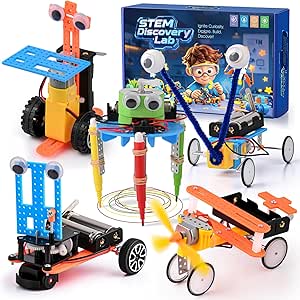 | Best for Independent Builders | Brand: gesboole | Project Count: 5 | Recommended Age: 6 to 13 years | VIEW ON AMAZON | See Our Full Breakdown |
| National Geographic Junior Chemistry Set with 50 Experiments |  | Best for Young Beginners | Brand: Blue Marble | Experiment Count: 50 | Recommended Age: 4 years and up | VIEW ON AMAZON | See Our Full Breakdown |
| BeAndge STEM Science and Robotics Kits for Kids, 5 Projects |  | Best for Energy Concepts | Brand: BeAndge | Project Count: 5 | Recommended Age: 6–14 years | VIEW ON AMAZON | See Our Full Breakdown |
| Dan&Darci Root Viewer Gardening Kit for Kids |  | Best for Nature Lovers | Brand: Dan&Darci | Educational Objective: Botany and plant growth | Recommended Age: 0–8 years | VIEW ON AMAZON | See Our Full Breakdown |
| Klever Kits 36-in-1 Motorized Robotics Kit for Kids Ages 8–13 |  | Best for Mechanical Engineering Basics | Brand: Klever Kits | Model Count: 36 | Motorized Models: 14 | VIEW ON AMAZON | See Our Full Breakdown |
| Doctor Jupiter My First Science Experiments Kit for Kids |  | Best for Early Childhood Science | Brand: Doctor Jupiter | Age Range: 4 years and up | Experiment Count: Over 100 | VIEW ON AMAZON | See Our Full Breakdown |
| Smartivity 2-in-1 Hydraulic Airplane and Dart Launcher STEM Kit |  | Best for Interactive Play | Brand: Smartivity | Age Range: 6–14 years | Part Count: 58 | VIEW ON AMAZON | See Our Full Breakdown |
| CYOEST STEM Pixel Art Kit for Kids Ages 5–12 |  | Best for Logic and Creativity | Brand: CYOEST | Age Range: 5–12 years | Pattern Count: Over 50 | VIEW ON AMAZON | See Our Full Breakdown |
| National Geographic Amazing Chemistry Set with 100+ Experiments |  | Best for Comprehensive Chemistry | Brand: Blue Marble / National Geographic | Age Range: 8 years and up | Kit Experiments: 15 | VIEW ON AMAZON | See Our Full Breakdown |
| Doctor Jupiter My First Science Experiments Kit for Kids Ages 4+ |  | Best for Early Childhood | Experiment Count: 50+ | Recommended Age: 4+ years | Safety Standard: ASTM F963-17 | VIEW ON AMAZON | See Our Full Breakdown |
| VLGOEM 66-Piece Electronics STEM Kit for Kids |  | Best Value for Electronics | Brand: VLGOEM | Piece Count: 66 | Recommended Age: 6 years and up | VIEW ON AMAZON | See Our Full Breakdown |
| Yutin 5-in-1 STEM Wooden Craft Kit for Kids Ages 8–12 |  | Best for Complex Assembly | Brand: Yutin | Set Count: 5 kits | Recommended Age: 8–12 years | VIEW ON AMAZON | See Our Full Breakdown |
| Poraxy 4-in-1 STEM Wooden Model Building Kit for Kids |  | Best Visual Appeal | Brand: Poraxy | Set Contents: Mini Ferris wheel, mini carousel, fiber optic lamp, night light lantern | Number of Models: 4 | VIEW ON AMAZON | See Our Full Breakdown |
| educational stem kits for kid | Brand | Recommended Age |
|---|---|---|
| Snap Circuits Jr. SC-100 Elect | — | 8 years and up |
| 5-in-1 STEM Robot Building Kit | gesboole | 6 to 13 years |
| National Geographic Junior Che | Blue Marble | 4 years and up |
| BeAndge STEM Science and Robot | BeAndge | 6–14 years |
| Dan&Darci Root Viewer Gardenin | Dan&Darci | 0–8 years |
| Klever Kits 36-in-1 Motorized | Klever Kits | 8–13 years |
| Doctor Jupiter My First Scienc | Doctor Jupiter | — |
| Smartivity 2-in-1 Hydraulic Ai | Smartivity | — |
| CYOEST STEM Pixel Art Kit for | CYOEST | — |
| National Geographic Amazing Ch | Blue Marble / National Geographic | — |
| Doctor Jupiter My First Scienc | — | 4+ years |
| VLGOEM 66-Piece Electronics ST | VLGOEM | 6 years and up |
| Yutin 5-in-1 STEM Wooden Craft | Yutin | 8–12 years |
| Poraxy 4-in-1 STEM Wooden Mode | Poraxy | 6–14 years |
More Details on Our Top Picks
Snap Circuits Jr. SC-100 Electronics Kit, 100+ Projects, Ages 8+
This kit stands out for its durability and educational depth, making it the most robust option in this lineup. Unlike the 5-in-1 STEM Robot Building Kit, which relies on screws and fragile plastic parts that can strip over time, Snap Circuits uses a snap-together grid system that eliminates the need for tools or soldering. This design choice significantly reduces frustration for beginners while allowing children to focus on circuit logic rather than mechanical assembly. The color-coded components help users visualize electrical flow, a concept often lost in build-only kits. While the 100+ projects offer immense replay value, the learning curve is steeper than simpler gardening kits. It is an investment in long-term engagement, though the initial setup requires careful attention to battery placement to ensure circuits function correctly.Pros:- Snap-together design eliminates need for tools or soldering
- Over 100 projects provide extensive replay value
- Color-coded components simplify understanding of circuit flow
- Durable plastic grid withstands repeated use
Cons:- Batteries are required but not included
- Abstract electrical concepts may confuse younger children
- Component count details are inconsistent in product descriptions
Best for: Parents seeking a long-lasting electronics kit that teaches circuit logic without the risk of broken screws or fragile parts.
Not ideal for: Children under 8 who may struggle with the abstract concepts of electricity and the fine motor skills needed for component placement.
- Model:SC-100
- Recommended Age:8 years and up
- Project Count:100+
- Assembly Method:Snap-together grid
- Tools Required:None
- Power Source:Batteries (not included)
- Included Components:Snap-grid, electrical parts, manual
- Educational Focus:Electronics and circuitry
Our verdict“The definitive choice for learning electronics through safe, tool-free experimentation.”
5-in-1 STEM Robot Building Kit for Kids Ages 8+
This kit excels at fostering problem-solving skills through mechanical assembly, offering a tactile experience distinct from the Snap Circuits Jr. SC-100. Where Snap Circuits focuses on electrical logic, this robot kit emphasizes motor skills and engineering by requiring users to assemble five distinct projects, including a crawler and doodle robot. The illustrated instructions support independent building, though younger children may need parental assistance with the screwdriver and small parts. Compared to the BeAndge STEM Science and Robotics Kits, this option provides a similar number of projects but with a focus on varied locomotion methods rather than power sources. The primary tradeoff is fragility; plastic screws can strip if over-tightened, limiting the kit’s longevity compared to snap-based systems.Pros:- Builds five distinct robot types with different functions
- Encourages independent assembly with clear illustrations
- Teaches mechanical engineering basics through hands-on building
- Includes necessary tools like a screwdriver
Cons:- Plastic screws are prone to stripping or breaking
- Batteries are not included in the package
- Age recommendations vary between 6–13 and 6–18
Best for: Kids aged 8+ who enjoy mechanical assembly and want to understand how robots move and interact with obstacles.
Not ideal for: Parents looking for a durable, long-term kit, as the plastic screws and parts are prone to wear and breakage.
- Brand:gesboole
- Project Count:5
- Recommended Age:6 to 13 years
- Included Tools:Screwdriver
- Power Source:Batteries (not listed as included)
- Model Number:STEM5-01
- Key Projects:Crawler, car, bot, doodle, flyer
- Unit Count:1
Our verdict“A solid entry-level robot kit for building confidence in mechanical assembly, provided users handle parts with care.”
National Geographic Junior Chemistry Set with 50 Experiments
Designed for children as young as four, this kit prioritizes safety and simplicity over complex assembly. Unlike the Snap Circuits Jr. SC-100, which requires understanding abstract electrical concepts, this chemistry set uses common household items like baking soda and vinegar to demonstrate immediate, visible reactions. The 20+ child-safe tools, including goggles and test tubes, make it feel like a real lab, which boosts engagement for preschoolers. However, it lacks the structural depth of the 5-in-1 STEM Robot Building Kit, as experiments are often one-off reactions rather than buildable models. While excellent for introducing scientific observation, the reliance on consumable household items means the kit’s value diminishes once the initial experiments are completed, unlike reusable electronic kits.Pros:- Suitable for ages 4 and up with simple instructions
- Uses safe, common household ingredients for experiments
- Includes over 20 specialized lab tools for realistic play
- Brand reputation provides trust in educational quality
Cons:- Experiments require additional household supplies not in box
- Less reusable than electronic or mechanical kits
- Limited depth for children over age 8
Best for: Preschool and early elementary children who need safe, visual introductions to science without complex assembly.
Not ideal for: Older children seeking long-term projects or deep technical understanding, as the experiments are relatively basic and consumable.
- Brand:Blue Marble
- Experiment Count:50
- Recommended Age:4 years and up
- Lab Tools Included:20+
- Power Source:None required
- Dimensions:11 x 4.22 x 9.64 inches
- Weight:0.72 kg
- Model Number:NGJRCHEMT
Our verdict“The best starting point for young children to develop a curiosity for science through safe, visual experiments.”
BeAndge STEM Science and Robotics Kits for Kids, 5 Projects
This kit distinguishes itself by teaching alternative energy sources, a niche not covered by the 5-in-1 STEM Robot Building Kit. By including a solar-powered car and a wind-powered car, it introduces children to how different energy inputs drive mechanical output. This adds a layer of scientific context often missing in standard robot builds. However, the experience is similar to the gesboole kit in that it relies on plastic assembly, which can be frustrating for small hands. The obstacle-avoidance robot adds complexity, but the lack of included AA batteries means immediate play is impossible without a trip to the store. It is a better choice than the Dan&Darci Root Viewer for kids interested in mechanics, but less durable than the Snap Circuits system.Pros:- Teaches concepts of solar and wind energy
- Includes diverse projects like tanks and gliders
- Encourages learning about coding and motor skills
- Compact design suitable for classroom use
Cons:- AA batteries are not included
- Plastic parts are fragile and prone to breakage
- Assembly instructions may require parental help
Best for: Families interested in teaching children about renewable energy and power sources through mechanical models.
Not ideal for: Those who want immediate out-of-the-box play, as AA batteries are not included and assembly can be tricky.
- Brand:BeAndge
- Project Count:5
- Recommended Age:6–14 years
- Power Sources:Solar, Wind, Battery
- Included Tools:Mini screwdriver
- Batteries Required:AA (not included)
- Material:Plastic
- Model Number:BA1011
Our verdict“An ideal choice for introducing renewable energy concepts through hands-on mechanical building.”
Dan&Darci Root Viewer Gardening Kit for Kids
This kit offers a unique biological perspective, contrasting sharply with the mechanical focus of the BeAndge STEM Science and Robotics Kits. Instead of building gadgets, children observe root growth in real time through a transparent planter, teaching patience and biological processes. It is far more passive than the Snap Circuits Jr. SC-100, requiring no assembly or technical understanding, which makes it accessible for very young children. However, the educational scope is limited to botany, lacking the broad STEM coverage of other options. The inclusion of only spring onion and cilantro seeds restricts long-term engagement, as there are no replacement seeds provided. It is a gentle introduction to science, but lacks the interactive complexity needed for older kids.Pros:- Transparent planter reveals root system growth
- Includes soil, seeds, and tracking stickers
- Teaches patience and biological observation
- No batteries or assembly required
Cons:- Limited to only two types of seeds
- No replacement seeds included for long-term use
- Less interactive than electronic or mechanical kits
Best for: Young children or classrooms focusing on biology and plant life cycles who prefer observation over construction.
Not ideal for: Kids who enjoy building, coding, or electronics, as this kit involves no assembly or technical problem-solving.
- Brand:Dan&Darci
- Educational Objective:Botany and plant growth
- Recommended Age:0–8 years
- Included Seeds:Spring onion, cilantro
- Dimensions:7.5 x 2 x 5.5 inches
- Weight:0.39 kg
- Assembly Required:No
- Power Source:None
Our verdict“A peaceful, observational kit for introducing young children to the basics of plant biology.”
Klever Kits 36-in-1 Motorized Robotics Kit for Kids Ages 8–13
This kit stands out for its balance of static and motorized builds, offering 14 powered models out of 36 total designs. Compared to the Smartivity 2-in-1 Hydraulic Airplane, which focuses on a single complex mechanism, the Klever Kits provide broader exposure to different mechanical principles, from walking legs to racing wheels. The inclusion of a sorting tray is a practical feature that mitigates the frustration often associated with loose plastic parts, making it more manageable for solo builders than many competitors. However, the sheer volume of 334 small pieces can be overwhelming for beginners, requiring patience that some children might lack. While it excels in teaching gear ratios and motor connections, it lacks the chemical or biological variety found in kits like the Doctor Jupiter Science Kit. It is best suited for kids who enjoy tangible, structural construction over abstract scientific observation.
Pros:- 14 motorized models demonstrate real-world mechanics like gears and motors
- Includes a sorting tray to keep the 334 parts organized during builds
- Video tutorials supplement the color instruction booklet for clearer guidance
- Offers high replay value with 36 distinct build options
Cons:- Small parts can be difficult to sort and assemble for younger users
- Only 39% of the models are motorized, limiting powered play
Best for: Children aged 8–13 who enjoy building structures and want to understand how motors drive mechanical movement.
Not ideal for: Younger children (under 8) or impatient builders, as sorting and assembling 334 small plastic parts requires significant focus.
- Brand:Klever Kits
- Model Count:36
- Motorized Models:14
- Part Count:334
- Material:Plastic, ABS
- Recommended Age:8–13 years
- Instruction Type:Color booklet and video tutorials
Our verdict“Choose this if your child loves building robots and wants to see their creations move.”
Doctor Jupiter My First Science Experiments Kit for Kids
Designed specifically for ages 4 and up, this kit bridges the gap between play and learning better than most STEM options. Unlike the National Geographic Chemistry Set, which targets older children with more complex chemical reactions, Doctor Jupiter uses safe, food-grade materials like essences and colors to introduce basic concepts like capillary action. The illustrated step-by-step instructions are crucial for pre-readers, allowing them to follow along with minimal adult intervention. However, the reliance on consumable ingredients means the kit has a finite lifespan, unlike the durable wooden or plastic models in the Smartivity or Klever Kits lines. While it offers over 100 experiments, many require restocking common household items, which can be a logistical hurdle for busy parents. It is ideal for introducing the scientific method to preschoolers without the risk of handling harsh chemicals.
Pros:- Safe, food-grade materials suitable for young children
- Illustrated instructions support pre-readers and early learners
- Over 100 experiments provide long-term engagement
- Includes essential lab tools like beakers and safety goggles
Cons:- Many experiments require frequent restocking of household ingredients
- Consumable nature means the kit does not last as long as construction kits
Best for: Preschoolers and early elementary students (ages 4–7) who need visual, hands-on introductions to science.
Not ideal for: Older children (8+) who may find the experiments too simple or the materials too basic for their skill level.
- Brand:Doctor Jupiter
- Age Range:4 years and up
- Experiment Count:Over 100
- Safety Standard:ASTM F963-17
- Included Tools:Beakers, flask, goggles, tray, and mixing tools
- Instruction Style:Illustrated step-by-step manual
- Educational Focus:Basic science concepts
Our verdict“This is the perfect starting point for young children to discover the joy of scientific observation.”
Smartivity 2-in-1 Hydraulic Airplane and Dart Launcher STEM Kit
This kit excels at turning engineering principles into immediate interactive play. Unlike the Klever Kits, which focus on building various static or motorized models, the Smartivity launcher is designed for repeated use after assembly, teaching hydraulics through the tangible action of launching darts. The use of engineered wood (MDF) offers a more premium, durable feel compared to the plastic components in many other STEM kits. However, the build process is singular; once assembled, there is less variety than in multi-model kits. Additionally, the description notes that paper airplanes and darts are not included, requiring parents to supply consumables, which adds a small ongoing cost. It is less comprehensive in scope than the CYOEST Pixel Art Kit, which offers 50+ patterns, but it provides a deeper dive into one specific mechanical system. This is for kids who want to build a toy they can actually use.
Pros:- Teaches hydraulic principles through an engaging, repeatable activity
- Durable MDF construction feels more substantial than plastic alternatives
- Lifetime replacement parts availability adds long-term value
- Encourages screen-free, active play after assembly
Cons:- Projectiles and paper are not included, requiring extra purchases
- Limited to one build type, offering less variety than multi-model kits
Best for: Kids aged 6–14 who prefer building a functional toy they can play with repeatedly over creating static models.
Not ideal for: Children who want variety in their builds, as this kit focuses on a single dual-function mechanism.
- Brand:Smartivity
- Age Range:6–14 years
- Part Count:58
- Material:MDF (Engineered Wood)
- Theme:Transportation
- Function:Hydraulic launcher for darts and planes
- Support:Lifetime replacement parts
Our verdict“Pick this if you want a single, high-quality build that transforms into a fun, interactive game.”
CYOEST STEM Pixel Art Kit for Kids Ages 5–12
This kit takes a unique approach to STEM by focusing on logical thinking and coding concepts without electronics. Compared to the Doctor Jupiter Science Kit, which emphasizes chemical reactions, the CYOEST kit develops spatial reasoning and pattern recognition through pixel art. The 50+ patterns across three difficulty levels allow for progressive skill development, making it suitable for a wide age range. The plastic blocks are tactile and help refine fine motor skills, which is a significant advantage over digital-only coding apps. However, the small size of the blocks makes them easy to lose, a drawback shared with many construction kits but particularly annoying with pixel art where precision matters. It lacks the ‘wow’ factor of motorized or chemical kits, relying instead on the satisfaction of visual completion. This is ideal for children who enjoy puzzles and structured creative projects.
Pros:- Teaches coding logic and problem-solving through visual patterns
- Three difficulty levels allow for growth as the child’s skills improve
- Supports fine motor skill development with small block placement
- Encourages creativity through open-ended design options
Cons:- Small plastic blocks are easily lost or scattered
- Limited information on specific coding curriculum integration
Best for: Children aged 5–12 who enjoy puzzles, pattern matching, and want an introduction to coding logic without screens.
Not ideal for: Kids who prefer large-scale building or messy, active experiments, as this is a quiet, precision-based activity.
- Brand:CYOEST
- Age Range:5–12 years
- Pattern Count:Over 50
- Difficulty Levels:3
- Challenge Types:4
- Components:Colored blocks, platform, instruction booklet
- Educational Focus:Logic, coding basics, creativity
Our verdict“Choose this for a quiet, brain-teasing activity that blends art with logical problem-solving.”
National Geographic Amazing Chemistry Set with 100+ Experiments
This set offers the most comprehensive chemistry education in this lineup, blending 15 kit-based experiments with 85 household activities. Unlike the Doctor Jupiter Kit, which uses food-safe ingredients for young children, this kit targets ages 8+ with more serious tools like test tubes and pipettes, introducing concepts like crystal growth and chemical reactions. The National Geographic branding often implies a higher standard of scientific accuracy and educational value, appealing to parents who prioritize rigor. However, the reliance on common household items for the bonus experiments means parents must constantly hunt for vinegar, baking soda, or other supplies, which can disrupt the learning flow. It is less portable and interactive than the Smartivity or Klever Kits builds, focusing more on observation than construction. This is the right choice for older kids who want to feel like real scientists in a lab setting.
Pros:- Includes materials for 15 experiments plus 85 guided household activities
- Professional-grade tools like test tubes and pipettes enhance realism
- Covers diverse topics including crystal growth and chemical reactions
- Strong educational backing from National Geographic
Cons:- Most bonus experiments require sourcing separate household items
- Less interactive and hands-on compared to construction kits
Best for: Children aged 8 and up who are interested in chemistry and want a serious, lab-style introduction to the subject.
Not ideal for: Younger children (under 8) due to the use of glass-like tools and the need for more complex cognitive processing.
- Brand:Blue Marble / National Geographic
- Age Range:8 years and up
- Kit Experiments:15
- Bonus Experiments:85
- Key Tools:Test tubes, beakers, pipettes
- Dimensions:8.78 x 3.19 x 11.93 inches
- Weight:1.8 pounds
Our verdict“This is the best option for older children ready to explore chemistry with serious, lab-style tools.”
Doctor Jupiter My First Science Experiments Kit for Kids Ages 4+
This kit stands out for preschool readiness by offering over 50 activities that focus on sensory play rather than complex construction. Unlike the Yutin 5-in-1 STEM Wooden Craft Kit, which requires fine motor skills and patience for assembly, Doctor Jupiter allows a four-year-old to participate immediately with minimal frustration. The illustrated manual is designed for shared reading, bridging the gap between adult supervision and child independence. However, the tradeoff is that many experiments rely on consumables like vinegar or baking soda, meaning the kit is not entirely self-contained. It serves as an excellent entry point for families who want to introduce scientific thinking without the barrier of difficult assembly, though parents should be prepared for potential messes that are absent in electronic kits.
Pros:- Includes over 50 distinct experiments to maintain novelty
- Illustrated steps support pre-readers and adults alike
- Focuses on sensory engagement suitable for young hands
Cons:- Frequent need for household consumables not included in box
- High mess potential compared to dry assembly kits
Best for: Parents of preschoolers who want low-barrier, messy play that introduces scientific observation through sensory experiences.
Not ideal for: Parents seeking a ‘set it and forget it’ activity, as most experiments require significant adult supervision and cleanup.
- Experiment Count:50+
- Recommended Age:4+ years
- Safety Standard:ASTM F963-17
- Instruction Format:Illustrated, step-by-step manual
- Primary Activity Type:Hands-on exploration
- Key Concept:STEM introduction
Our verdict“Ideal for families with children under six who prioritize immediate engagement over long-term construction projects.”
VLGOEM 66-Piece Electronics STEM Kit for Kids
The VLGOEM Electronics STEM Kit offers exceptional breadth, allowing for over 1,200 projects from just 66 snap-together pieces. This ratio of components to projects is superior to the Snap Circuits Jr. SC-100, which offers fewer projects despite a similar price point and complexity. The color-coded system removes the intimidation factor of traditional electronics, making it accessible for a six-year-old. A notable drawback is that batteries are not included, which can interrupt the learning flow if not planned for. While it lacks the tactile wooden aesthetic of the Poraxy 4-in-1 STEM Wooden Model Building Kit, it provides a deeper understanding of circuit logic and connectivity, making it better suited for children interested in how things work rather than just how they look.
Pros:- Over 1,200 projects from a single compact set
- No soldering or tools required for assembly
- Color-coded parts simplify circuit logic for beginners
Cons:- Batteries are not included in the package
- Plastic components may feel less durable than wood
Best for: Children ages 6+ who are curious about electricity and want a high volume of diverse projects without soldering.
Not ideal for: Users who prefer wooden aesthetics or those who do not have spare AA batteries on hand for immediate use.
- Brand:VLGOEM
- Piece Count:66
- Recommended Age:6 years and up
- Project Count:More than 1,200
- Tools Required:None
- Item Weight:2.3 pounds
- Dimensions:11.8 x 10.6 x 3.1 inches
Our verdict“The best choice for maximizing project variety and learning circuit fundamentals without complex tools.”
Yutin 5-in-1 STEM Wooden Craft Kit for Kids Ages 8–12
This kit targets a more mature skill set, requiring the assembly of five distinct mechanical models using screws and plywood. Compared to the Doctor Jupiter My First Science Experiments Kit, this demands significantly more patience and fine motor control, making it unsuitable for younger children. The inclusion of motor concepts provides a tangible lesson in mechanics, but the tradeoff is that batteries for the lights are not included, which may lead to initial disappointment. The ability to paint the models adds a creative layer absent in the VLGOEM Electronics Kit, allowing for personalization. It is a robust option for older kids who enjoy the process of building as much as the final product, though the multi-project format requires managing multiple instruction sets simultaneously.
Pros:- Five different buildable projects in one box
- Introduces basic motor and mechanical concepts
- Smooth surfaces and rounded corners for safety
Cons:- Batteries for LED components are not included
- Assembly time is substantial for five separate models
Best for: Older children ages 8-12 who enjoy detailed model building and want to customize their projects with paint.
Not ideal for: Children under eight or those with limited attention spans, as the assembly is lengthy and intricate.
- Brand:Yutin
- Set Count:5 kits
- Recommended Age:8–12 years
- Material:Plywood
- Included Projects:Ferris wheel, merry-go-round, windmill house, fiber optic lamp, star nightlight
- Assembly Method:Instructions and screws included
Our verdict“Perfect for older kids who want a multi-week project involving both mechanical assembly and artistic decoration.”
Poraxy 4-in-1 STEM Wooden Model Building Kit for Kids
The Poraxy 4-in-1 STEM Wooden Model Building Kit prioritizes visual impact through color-changing LED lights that cycle through seven hues. While similar to the Yutin 5-in-1 STEM Wooden Craft Kit, Poraxy offers fewer models but focuses more on the aesthetic finish of the lamp and night light. The laser-cut wood ensures precise fits, reducing the frustration often found in lower-quality wooden kits. However, the assembly still requires fine motor skills and patience, which can be a hurdle for younger children. It serves as a strong alternative for kids who are motivated by the final decorative result rather than the mechanical engineering process, offering a balance between construction and functional home decor that purely educational kits often lack.
Pros:- LED lights cycle through seven distinct colors
- Laser-cut wood pieces ensure smooth assembly
- Models function as decorative night lights
Cons:- Requires significant patience and fine motor skills
- Fewer total projects compared to larger sets
Best for: Kids who value the decorative outcome of their projects and enjoy building items that function as room decor.
Not ideal for: Children who dislike repetitive assembly tasks or those looking for deep mechanical engineering lessons.
- Brand:Poraxy
- Set Contents:Mini Ferris wheel, mini carousel, fiber optic lamp, night light lantern
- Number of Models:4
- Material:Laser-cut wood
- Lighting Features:Color-changing LED lights with 7 colors
- Recommended Age:6–14 years
- Model Number:PODIY002
Our verdict“A great pick for children who want a tangible, glowing result from their STEM efforts.”

How We Picked
I evaluated these kits based on educational depth, build quality, and age appropriateness. A kit scores high only if it teaches a specific concept (like circuit logic or chemical reaction) rather than just offering assembly instructions. I also prioritized durability and safety, excluding products with fragile components or materials that pose immediate risks without heavy supervision. The ranking reflects a balance between independent playability and learning outcomes, favoring kits that minimize frustration while maximizing curiosity.
Factors to Consider When Choosing Educational Stem Kits For Kids
Selecting a STEM kit requires looking past the box art to understand the actual user experience. This guide breaks down the critical factors that determine whether a kit will be played with once or used repeatedly.Age Appropriateness vs. Real-World Skill Levels
Manufacturers often label kits for younger ages than they actually support. A kit marked for ages 6+ might require reading comprehension or fine motor skills typical of an 8-year-old. Always check the complexity of the instructions; if a child cannot read independently, they will need constant help. For beginners, choose kits with visual, step-by-step diagrams rather than text-heavy manuals. This mismatch is the primary reason children abandon STEM kits early, so erring on the side of older age recommendations often yields better long-term engagement.
The Hidden Cost of Consumables and Replacement Parts
Many STEM kits, especially chemistry and electronics sets, rely on consumable components like batteries, chemicals, or fragile wires. Once these run out, the kit may become useless unless replacement parts are easily available and affordable. Kits using reusable snap-together components or household-adjacent materials offer better long-term value. Before buying, verify if the manufacturer sells replacement packs or if you can source parts locally. This factor often outweighs the initial purchase price when calculating total cost of ownership.
Screen-Free vs. App-Integrated Learning
Some modern kits integrate with mobile apps for coding or augmented reality experiences. While this can enhance learning, it introduces screen dependency and potential privacy concerns for younger children. Purely physical kits, like Snap Circuits or wooden models, promote tactile learning without digital distractions. Consider your family’s screen time policies before choosing. If you prefer digital integration, ensure the app is free of ads and unnecessary data collection. For pure STEM focus, physical manipulation often leads to better conceptual retention in young learners.
Safety Standards and Material Toxicity
Not all kits meet the same safety standards, particularly for chemistry sets. Look for ASTM F963 certification or equivalent safety markings on the packaging. Kits for children under 10 should strictly avoid hazardous chemicals or small, swallowable parts. Doctor Jupiter and similar beginner kits use safer, non-toxic ingredients compared to advanced sets that may require gloves and goggles. Always supervise young children during experiments, regardless of the kit’s safety claims, to mitigate risks of ingestion or misuse.
Educational Value: Conceptual Learning vs. Assembly Only
A common pitfall is buying kits that focus solely on assembly without explaining the underlying science. High-quality kits include educational guides that explain why a circuit works or what happens in a chemical reaction. Without this context, the activity becomes mere craft-making. Look for kits that encourage experimentation and modification rather than just following strict instructions. This distinction is critical for fostering genuine STEM curiosity rather than just completing a project.
Frequently Asked Questions
What is the best STEM kit for a child who has never done science experiments before?
The Doctor Jupiter My First Science Experiments Kit is ideal for absolute beginners because it uses safe, familiar materials and provides very clear, short instructions. Unlike complex chemistry sets, it focuses on simple cause-and-effect experiments that offer immediate visual rewards, which helps build confidence. It also minimizes the risk of frustration from complicated setups, allowing young children to experience the joy of discovery without needing constant parental intervention.How do I know if a robotics kit is too difficult for my 8-year-old?
Check the number of individual parts and the clarity of the assembly instructions. Kits with over 100 small pieces and text-heavy manuals are often frustrating for 8-year-olds. Look for kits that use large, snap-together components or have video tutorials available online. If the instructions rely solely on small printed diagrams, it is likely better suited for ages 10 and up. Starting with a simpler 5-project kit like the BeAndge allows you to gauge their interest before investing in a larger 36-piece set.Are wooden STEM kits less educational than electronic ones?
Not necessarily; they teach different skills. Wooden kits, like the Yutin 5-in-1, focus on structural engineering, physics, and fine motor skills, while electronic kits teach circuitry and logic. Wooden kits are often better for teaching spatial reasoning and mechanical principles. However, they lack the active feedback (lights, sounds) that many children find engaging. Choose wooden kits if your child enjoys building and mechanics, but consider electronic kits if they are drawn to interactive technology and immediate functional results.What should I do if my child loses a critical part from a STEM kit?
First, check if the manufacturer offers a replacement parts service; many reputable brands like Snap Circuits and National Geographic do. If not, look for generic components online that match the specifications, such as standard batteries or specific gear sizes. For custom plastic parts, you might need to improvise or contact customer support directly. This is why kits with standardized, reusable components are generally safer investments than those with proprietary, single-use pieces.Is it safe to let my child use a chemistry kit unsupervised?
No, you should never allow unsupervised use of any chemistry kit, even those labeled for older children. Parental supervision is required to ensure proper handling of materials, correct measurement, and safe disposal of waste. Younger children may not understand the difference between harmless and potentially irritating substances. Additionally, supervision allows you to guide the learning process, asking questions that deepen their understanding of the scientific principles behind the experiments.Conclusion
Choosing the right educational stem kits for kids depends largely on your child’s current skill level and interests. For the best overall balance of education and ease of use, the Snap Circuits Jr. SC-100 is the top recommendation for ages 8+. If you are looking for a best value option that offers extensive replayability, the Klever Kits 36-in-1 Motorized Robotics Kit is a strong contender, provided you can tolerate some assembly frustration. For beginners aged 4-6, the Doctor Jupiter My First Science Experiments Kit provides a safe, low-stress introduction to scientific thinking. Those seeking a premium, structured learning experience should consider the National Geographic Amazing Chemistry Set, which offers depth comparable to classroom labs. Finally, for children who prefer screen-free, tactile learning, the Yutin 5-in-1 STEM Wooden Craft Kit is an excellent choice for developing engineering intuition without batteries or apps.
Halloween Picks

27FT Giant Inflatable Pumpkin Lighted Outdoor Halloween Decor

Halloween Inflatable Haunted House Maze – 20×20 ft with Removable Roof and Blower

MGparty 14.5 ft Halloween Inflatable Walk-In Pumpkin House with LED Lights
As an affiliate, we earn on qualifying purchases.