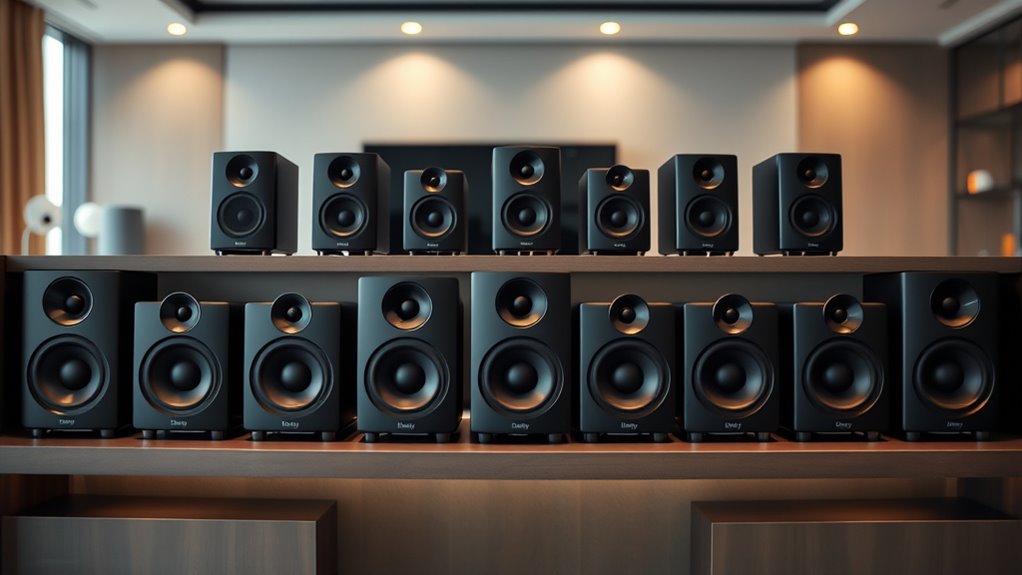

For a traditional home theater, my best overall pick is the Klipsch RP-500SA, a flexible pair of elevation speakers that can add height effects to a compatible surround setup. The Klipsch Reference Cinema 5.1.4 is a stronger fit if you want a matched surround package, while the ULTIMEA Poseidon M60 offers a simpler soundbar route. The main choice is between separate speakers that need compatible equipment and room placement, and integrated systems that trade flexibility for easier setup. Upfiring modules also depend on a suitable ceiling, so they may not deliver the same effect in every room. Read on for how each option fits a different setup and what to check before choosing.

Get your wardrobe favorites delivered free with Prime
- Fast, free delivery on millions of items
- Prime Video, Amazon Music and more included
- Member-only deals all year
Key Takeaways
- The RP-500SA is the most adaptable height-speaker pick: its pair can serve as upfiring modules or be positioned for height effects, giving compatible home theater owners more placement options than a fixed-format module.
- The Cinema System 5.1.4 is the clearest one-package theater path: it combines multiple surround and height channels, while the individual Klipsch and Polk modules require a compatible receiver and existing speakers.
- The soundbars favor setup simplicity over component choice: ULTIMEA’s Poseidon M60 and TCL’s S65K are complete TV audio systems, unlike passive height modules that depend on the rest of a theater chain.
- Not every Atmos-labeled speaker fills the same role: Sonos Era 300 is a wireless smart speaker, while the Klipsch, Sony, Polk, and ELAC modules are aimed at adding height channels to larger systems.
- Ceiling and room fit can outweigh the speaker model: reflected height effects rely on suitable surfaces, so direct placement or an integrated system may make more sense when ceiling shape or mounting options are limiting.
| Sony SS-CSEM2 Dolby Atmos Upfiring Height Speakers (Pair) |  | Best for Sony System Owners | Speaker type: Surround | Speaker size: 3.94 inches | Maximum output power: 100 watts | VIEW ON AMAZON | See Our Full Breakdown |
| ULTIMEA Poseidon M60 5.1-Channel Dolby Atmos Soundbar System |  | Best Value for a Simple Atmos Setup | Audio channels: 5.1 | Peak power: 300W | Drivers: 6 total | VIEW ON AMAZON | See Our Full Breakdown |
| Klipsch RP-140SA Dolby Atmos Elevation Speaker |  | Best Single Elevation Module | Model: RP-140SA | Audio output mode: Surround | Impedance: 8 ohms | VIEW ON AMAZON | See Our Full Breakdown |
| Klipsch RP-500SA Reference Premiere Dolby Atmos Surround Sound Speakers – Pair (Ebony) |  | Best Versatile Premium Pair | Tweeter: 1-inch titanium vented | Woofer: 5.25-inch spun copper cerametallic | Crossover: Switchable for Dolby Atmos or surround sound | VIEW ON AMAZON | See Our Full Breakdown |
| TCL S65K 5.1-Channel Soundbar System with Dolby Atmos and Wireless Subwoofer |  | Best All-in-One Home Theater Upgrade | Audio channels: 5.1 | Maximum output power: 630 watts | Subwoofer driver: 6.5 inches | VIEW ON AMAZON | See Our Full Breakdown |
| Polk Audio Monitor XT90 Height Speaker Pair, Midnight Black |  | Best for Polk-Based Upgrades | Speaker type: Height module | Quantity: 2 speakers | Woofer diameter: 4 inches | VIEW ON AMAZON | See Our Full Breakdown |
| Klipsch Reference Next Generation R-40SA Dolby Atmos Surround Speaker Pair |  | Best for Horn-Loaded Height Effects | Speaker count: 2 speakers (pair) | Dimensions: 7 x 5.75 x 12.7 inches | Horn: 90° x 90° Tractrix | VIEW ON AMAZON | See Our Full Breakdown |
| Klipsch Reference R-41SA Dolby Atmos Elevation Surround Speakers, 4-Pack |  | Best for Front-and-Rear Height Channels | Speaker count: 4 (2 pairs) | Impedance: 8 ohms | Power handling: 50 watts continuous / 100 watts peak | VIEW ON AMAZON | See Our Full Breakdown |
| ULTIMEA 7.1ch Dolby Atmos Surround Sound System for TV with 4 Surround Speakers and Subwoofer |  | Best All-in-One Home Theater System | System type: 7.1-channel Dolby Atmos soundbar system with subwoofer | Speaker package: Soundbar, 4 surround speakers, and subwoofer | Additional features: SurroundX, BassMX, app control, DSP | VIEW ON AMAZON | See Our Full Breakdown |
| Sonos Era 300 Wireless Smart Speaker with Dolby Atmos – Black |  | Best for Standalone Spatial Music | Drivers: Six | Supported audio formats: Dolby Atmos | Connectivity: Wi-Fi, Bluetooth, auxiliary | VIEW ON AMAZON | See Our Full Breakdown |
| Klipsch Reference Cinema System 5.1.4 with Dolby Atmos |  | Best Complete Home Theater System | Audio channels: 5.1.4 | Maximum output power: 300 watts | Speaker type: Satellite | VIEW ON AMAZON | See Our Full Breakdown |
| Klipsch R-41SA Dolby Atmos Home Speakers, Pair, Black |  | Best Flexible Atmos Add-On | Quantity: 2 speakers | Woofer diameter: 4 inches | Tweeter diameter: 1 inch | VIEW ON AMAZON | See Our Full Breakdown |
| ELAC Debut 2.0 A4.2 Dolby Atmos Module Speakers, Black (Pair) |  | Best Concentric-Driver Atmos Module | Package: Pair | Driver type: Concentric driver | Tweeter: 0.5-inch polymer | VIEW ON AMAZON | See Our Full Breakdown |
| dolby atmos speaker | Connectivity |
|---|---|
| Sony SS-CSEM2 Dolby Atmos Upfi | — |
| ULTIMEA Poseidon M60 5.1-Chann | HDMI eARC, Bluetooth 5.4 |
| Klipsch RP-140SA Dolby Atmos E | Wired |
| Klipsch RP-500SA Reference Pre | — |
| TCL S65K 5.1-Channel Soundbar | Bluetooth, USB, Wi-Fi, HDMI |
| Polk Audio Monitor XT90 Height | Wired |
| Klipsch Reference Next Generat | — |
| Klipsch Reference R-41SA Dolby | Coaxial; no wireless connectivity |
| ULTIMEA 7.1ch Dolby Atmos Surr | — |
| Sonos Era 300 Wireless Smart S | Wi-Fi, Bluetooth, auxiliary |
| Klipsch Reference Cinema Syste | Wired RCA; no wireless communication |
| Klipsch R-41SA Dolby Atmos Hom | — |
| ELAC Debut 2.0 A4.2 Dolby Atmo | — |
More Details on Our Top Picks
Sony SS-CSEM2 Dolby Atmos Upfiring Height Speakers (Pair)
The Sony SS-CSEM2 is a focused way to add height effects to a compatible Sony home theater: place the pair on CS-series speakers or mount them on a wall. Their compact cabinets and reinforced cellular cones suit rooms where larger elevation speakers would be awkward. Compared with the Klipsch RP-140SA, these are more explicitly tied to Sony receivers and CS speakers, so they make the most sense as an extension of that system rather than a flexible standalone choice. The tradeoff is compatibility: buyers with another receiver or speaker family should check fit before choosing them. Their listed 70 Hz frequency response also means they are best used as height channels alongside a full-range system, not as replacements for main speakers.
Pros:- Designed to add Dolby Atmos upfiring height effects
- Can sit on compatible Sony CS speakers or mount on a wall
- Compact 7.1 x 7 x 5.7-inch cabinets fit tighter setups
- Reinforced cellular cone is designed to reduce distortion
Cons:- Compatibility is centered on Sony AV receivers and CS speakers
- Listed 70 Hz frequency response makes them better suited to height-channel duty than full-range use
Best for: Sony AV receiver owners with CS-series speakers who want compact height channels for a home theater
Not ideal for: Shoppers building a mixed-brand system or looking for standalone speakers to deliver full-range sound
- Speaker type:Surround
- Speaker size:3.94 inches
- Maximum output power:100 watts
- Frequency response:70 Hz
- Impedance:6 ohms
- Mounting:Wall mount; can sit on compatible Sony CS speakers
- Dimensions:7.1 x 7 x 5.7 inches
- Compatibility:Sony AV receivers and CS speaker series
Our verdict“Choose the SS-CSEM2 if your Sony receiver and CS speakers are already the center of your home theater and you want a compact height-channel add-on.”
ULTIMEA Poseidon M60 5.1-Channel Dolby Atmos Soundbar System
The ULTIMEA Poseidon M60 bundles a soundbar, five built-in speakers, and a wired wooden subwoofer into a straightforward route to Dolby Atmos playback through HDMI eARC. Its VoiceMX dialogue enhancement and app controls give buyers ways to tune speech and surround levels without assembling separate speakers and an AV receiver. Compared with the TCL S65K, the M60 keeps its subwoofer wired and does not include rear speakers, so it is the simpler fit when a compact soundbar system matters more than wireless placement or separate surrounds. The app’s EQ and presets add useful control, but the system remains a one-box-front approach; buyers seeking distinct rear channels or a more expandable component theater should look elsewhere.
Pros:- HDMI eARC supports Dolby Atmos playback
- VoiceMX is designed to make dialogue clearer
- Companion app includes a 10-band EQ and surround adjustments
- Dedicated wooden subwoofer adds bass beyond the soundbar
Cons:- No rear speakers are included
- Wired subwoofer placement is limited by its cable
- Soundbar format offers less speaker-placement flexibility than a component theater
Best for: TV owners who want Dolby Atmos support, a dedicated subwoofer, and dialogue controls without building a receiver-based system
Not ideal for: Home theater buyers who want included rear speakers or need to place the subwoofer without a cable
- Audio channels:5.1
- Peak power:300W
- Drivers:6 total
- Frequency response:45 Hz–18 kHz
- Maximum SPL:99 dB
- Subwoofer:Wired wooden subwoofer with 5.3L cabinet
- Connectivity:HDMI eARC, Bluetooth 5.4
- App features:10-band graphic EQ, 121 sound presets, 13 surround levels
Our verdict“Pick the Poseidon M60 for a customizable, subwoofer-equipped Atmos soundbar when you value simple setup over separate rear speakers.”
Klipsch RP-140SA Dolby Atmos Elevation Speaker
The Klipsch RP-140SA is an elevation speaker for adding overhead effects to compatible floorstanding or bookshelf speakers in a wired home theater. Its floor or shelf mounting gives a system builder room to position it without requiring a wall installation. Compared with the Sony SS-CSEM2, the RP-140SA is described for use with compatible home theater speakers more broadly, while Sony’s pair is aimed at Sony receivers and CS-series speakers. The key limitation is that this listing is for a single speaker, so buyers planning a stereo height pair need to account for that. It also has no wireless connectivity; it suits an existing wired system where the receiver and placement plan are already in place, rather than a quick TV-audio upgrade.
Pros:- Adds Dolby Atmos effects to compatible home theater speakers
- Floor and shelf mounting provide placement flexibility
- Wired connection fits conventional receiver-based systems
Cons:- Sold as a single speaker, so a pair requires another unit
- No wireless connectivity
- Requires compatible speakers and a receiver-based setup
Best for: Home theater builders adding one wired elevation channel to a compatible floorstanding or bookshelf speaker setup
Not ideal for: Buyers who need a ready-to-use pair, wireless connection, or a complete Atmos system for a TV
- Model:RP-140SA
- Audio output mode:Surround
- Impedance:8 ohms
- Connectivity:Wired
- Mounting:Floor mount, shelf mount
- Dimensions:6 x 11.3 x 7 inches
- Weight:340 g
- Color:Black
Our verdict“Choose the RP-140SA when you need a single wired elevation module for an existing compatible home theater system.”
Klipsch RP-500SA Reference Premiere Dolby Atmos Surround Sound Speakers – Pair (Ebony)
The Klipsch RP-500SA pair suits home theater owners who want height effects now and the option to repurpose the speakers for surround duty. Its switchable crossover supports Dolby Atmos or surround configurations, while keyhole mounting offers an on-wall placement choice. The titanium vented tweeter, Tractrix horn, and spun copper woofer distinguish this pair from the simpler, single-unit Klipsch RP-140SA; the RP-500SA also includes two speakers. That flexibility comes with a setup demand: positioning matters for convincing height effects, and the stated 75W output may not satisfy buyers trying to fill a large room at high levels. This is the pick for a carefully planned component system, rather than someone looking for a plug-and-play soundbar.
Pros:- Switchable crossover supports Dolby Atmos or surround use
- Pair includes titanium vented tweeters and spun copper woofers
- Keyhole mounting supports on-wall installation
- Scratch-resistant finish suits visible placement
Cons:- 75W output may be limiting in large rooms
- Height effects depend on careful positioning
- Requires a compatible receiver and broader speaker system
Best for: Home theater owners who want a pair of premium height speakers that can later serve as surround speakers
Not ideal for: Large-room listeners seeking high output or TV owners who want a complete, simple Atmos system
- Tweeter:1-inch titanium vented
- Woofer:5.25-inch spun copper cerametallic
- Crossover:Switchable for Dolby Atmos or surround sound
- Mounting:Keyhole for on-wall installation
- Finish:Scratch resistant
- Output wattage:75 watts
- Configuration:Pair
Our verdict“Choose the RP-500SA if you want a well-equipped pair that can switch between Atmos height and surround roles in a planned home theater.”
TCL S65K 5.1-Channel Soundbar System with Dolby Atmos and Wireless Subwoofer
The TCL S65K is the most complete TV-focused system in this group: it combines Dolby Atmos and DTS:X with wireless surround speakers, a 6.5-inch wireless subwoofer, and AI Sonic room calibration. That package makes it more suitable for a home theater upgrade than the ULTIMEA Poseidon M60, which has a wired subwoofer and no rear speakers included. A center channel and dedicated tweeter are intended to keep dialogue distinct amid effects. The tradeoff is that the S65K is still a bundled soundbar system, not a set of individually chosen components, and it needs corded power. ChoruSound is described for compatible TCL TVs, so buyers with another television should not count on that feature; the listed wireless surround speakers are its stronger reason to choose it.
Pros:- Supports Dolby Atmos and DTS:X
- Includes wireless surround speakers and a wireless 6.5-inch subwoofer
- AI Sonic calibration adapts sound to the room
- Center channel and dedicated tweeter support dialogue clarity
Cons:- Requires corded electric power
- ChoruSound is described for compatible TCL TVs
- Bundled soundbar format offers less component flexibility than a receiver-based setup
Best for: TV owners seeking a bundled Atmos home theater with wireless surrounds, a wireless subwoofer, and room calibration
Not ideal for: Buyers building a receiver-based component system or those who expect TCL-specific ChoruSound features with another TV brand
- Audio channels:5.1
- Maximum output power:630 watts
- Subwoofer driver:6.5 inches
- Connectivity:Bluetooth, USB, Wi-Fi, HDMI
- Audio technologies:Dolby Atmos, DTS:X, DTS Virtual:X
- Speakers:Wireless surround speakers
- Calibration:AI Sonic Auto Room Calibration
- Power source:Corded electric
Our verdict“Pick the TCL S65K for a TV-centered home theater when included wireless surrounds and room calibration matter more than component-by-component flexibility.”
Polk Audio Monitor XT90 Height Speaker Pair, Midnight Black
The Polk Monitor XT90 is a focused way to add overhead effects to a compatible home theater, especially if you already own Polk speakers. Its pair of 4-inch woofers handles Dolby Atmos and DTS:X height channels, and you can place the modules atop compatible Polk speakers or mount them on a wall. Compared with the Klipsch R-40SA, the XT90 emphasizes flexible placement within the Polk lineup, while the Klipsch uses a horn-and-tweeter design and has a larger listed footprint. The tradeoff is that the XT90 depends on a compatible receiver with at least seven channels; it is not a standalone TV sound system. I’d skip it if you want wireless setup or a complete surround package, and its lack of water resistance rules out exposed outdoor use.
Pros:- Supports Dolby Atmos, DTS:X, and DTS Virtual:X formats
- Can sit atop compatible Polk speakers or be wall-mounted
- Works with 4- and 8-ohm amplifiers and receivers
Cons:- Requires a compatible AV receiver with at least 7 channels
- Wired connection means speaker cable is needed
- Not water resistant
Best for: Home theater owners with compatible Polk speakers and a 7-channel-or-better AV receiver who want dedicated height effects.
Not ideal for: TV owners seeking an all-in-one or wireless system, or buyers without a compatible multichannel receiver.
- Speaker type:Height module
- Quantity:2 speakers
- Woofer diameter:4 inches
- Compatible formats:Dolby Atmos, DTS:X, DTS Virtual:X
- Amplifier compatibility:4- and 8-ohm
- Mounting:Wall mount or placement atop compatible Polk speakers
- Connectivity:Wired
- Dimensions:6 x 7 x 8 inches
Our verdict“Choose the XT90 to add flexible Atmos height channels to a compatible Polk-based home theater; skip it if you need a complete or wireless system.”
Klipsch Reference Next Generation R-40SA Dolby Atmos Surround Speaker Pair
The Klipsch R-40SA suits home theater buyers who want a pair of dedicated Atmos speakers with Klipsch’s 90° x 90° Tractrix horn design. Its horn, aluminum tweeters, and spun-copper woofers are intended to bring definition to height effects, giving it a different character from the Polk Monitor XT90, whose listing focuses on flexible Polk-compatible placement and format support. The R-40SA’s listed dimensions—12.7 inches deep—also call for more shelf or speaker-top space than a compact module might. It is a passive speaker pair for a compatible home theater setup, so buyers still need the receiver, wiring, and other channels their system requires. I’d pass if you want an all-in-one TV solution or have a particularly tight room layout.
Pros:- 90° x 90° Tractrix horn design
- Aluminum tweeters and spun-copper woofers
- Purpose-built for Dolby Atmos overhead effects
- Pair format adds two height speakers to a compatible setup
Cons:- Requires a compatible home theater receiver and speaker wiring
- 12.7-inch depth may constrain placement in small rooms
- Does not provide a complete surround system on its own
Best for: Home theater builders with a compatible receiver who want a Klipsch horn-loaded pair for overhead effects.
Not ideal for: Buyers in small rooms with limited placement space, or anyone looking for a self-contained soundbar system.
- Speaker count:2 speakers (pair)
- Dimensions:7 x 5.75 x 12.7 inches
- Horn:90° x 90° Tractrix
- Tweeter:Aluminum
- Woofer:Spun copper
- Speaker type:Dolby Atmos-enabled surround speaker
Our verdict“Pick the R-40SA if you have room for a dedicated Klipsch height pair and want its horn-loaded design in a compatible home theater.”
Klipsch Reference R-41SA Dolby Atmos Elevation Surround Speakers, 4-Pack
This four-speaker R-41SA set is the pick for buyers building both front and rear height channels in one step. Each passive speaker combines a 4-inch spun-copper woofer with a horn-loaded tweeter, and the modules can sit on compatible speakers or mount on a wall. That gives the set broader height-channel coverage than the two-speaker Klipsch R-40SA pair, but it also means more wiring and amplifier planning. The 8-ohm impedance and 50-watt continuous handling call for a compatible receiver or amplifier; no wireless connection is listed. I’d choose this for a wired, component-based Atmos room, not a renter seeking a simple setup or someone who only needs a single pair of height modules.
Pros:- Four speakers can serve front and rear height positions
- Each speaker has a 4-inch woofer and 1-inch tweeter
- Can be wall-mounted or placed atop compatible speakers
- Magnetic removable grilles and MDF cabinets
Cons:- Requires a compatible receiver or amplifier and speaker wire
- No Bluetooth or wireless connectivity
- Four-speaker setup needs more placement and wiring than a pair
Best for: Home theater builders who have a compatible receiver and want four matching speakers for front and rear height effects.
Not ideal for: Buyers who need wireless speakers, have no way to run speaker wire, or only need a two-speaker height upgrade.
- Speaker count:4 (2 pairs)
- Impedance:8 ohms
- Power handling:50 watts continuous / 100 watts peak
- Woofer and tweeter:4-inch woofer; 1-inch tweeter
- Horn:90° x 90° Tractrix
- Mounting:Wall mount or placement atop compatible speakers
- Dimensions per speaker:7 x 5.75 x 13 inches
- Connectivity:Coaxial; no wireless connectivity
Our verdict“Choose this set when your wired Atmos home theater needs four matching height speakers; opt for a pair if you only need two channels.”
ULTIMEA 7.1ch Dolby Atmos Surround Sound System for TV with 4 Surround Speakers and Subwoofer
The ULTIMEA 7.1-channel system is the most complete route here for TV owners who want a home theater package rather than separate passive height speakers. Its soundbar, four surround speakers, and subwoofer are paired with wireless rear speakers, reducing the cable run across the room; app controls add a 10-band equalizer and multiple presets for tailoring sound. By contrast, the Klipsch R-41SA four-pack supplies height speakers only, leaving the receiver and rest of the system to the buyer. ULTIMEA’s listed recommended room range is 108 to 270 square feet, so larger spaces may not be a good fit. Full tuning depends on the app, and this corded system is not waterproof. I’d favor it for a contained TV room, not a large open-plan theater.
Pros:- Bundles soundbar, four surround speakers, and subwoofer
- Wireless rear speakers reduce room-spanning cable clutter
- App offers a 10-band equalizer and multiple audio presets
- Designed for Dolby Atmos surround playback
Cons:- Recommended for rooms of 108 to 270 square feet
- Full audio customization requires app control
- Not waterproof
Best for: TV and projector owners furnishing a 108-to-270-square-foot room who want a bundled surround system with wireless rear speakers.
Not ideal for: Buyers with large open-plan rooms, those who want receiver-based component upgrades, or listeners who avoid app control.
- System type:7.1-channel Dolby Atmos soundbar system with subwoofer
- Speaker package:Soundbar, 4 surround speakers, and subwoofer
- Additional features:SurroundX, BassMX, app control, DSP
- Equalizer:10-band EQ; 121 presets listed
- Subwoofer diameter:4 inches
- Mounting:Tabletop or wall mount
- Power source:Corded electric
- Recommended room size:108 to 270 square feet
Our verdict“Choose ULTIMEA for a bundled Atmos TV setup in a medium-sized room; look elsewhere if your home theater is large or component-based.”
Sonos Era 300 Wireless Smart Speaker with Dolby Atmos – Black
The Sonos Era 300 takes a different path from the dedicated home theater modules in this roundup: it is a wireless smart speaker built for spacious, Dolby Atmos-capable audio, with six strategically positioned drivers. Wi-Fi, Bluetooth, auxiliary input, and voice control make it more flexible for music listening than the passive Polk Monitor XT90, which requires an AV receiver and speaker wiring. That flexibility does not make the Era 300 a complete multichannel home theater package, though, so buyers seeking front and rear height channels should look at a receiver-based system or the bundled ULTIMEA setup. Full functionality depends on Wi-Fi, and the product data lists a limited color selection. I’d choose it for a smart listening space where Atmos music matters, not as a direct substitute for a full theater system.
Pros:- Six drivers are positioned for spacious, multidirectional sound
- Supports Dolby Atmos audio
- Wi-Fi, Bluetooth, and auxiliary connectivity
- Voice control and software updates are listed features
Cons:- Wi-Fi is needed for full functionality
- One smart speaker does not provide a complete multichannel home theater
- Product data lists only black as the color
Best for: Listeners who want a single smart speaker for streaming and Dolby Atmos music, with Wi-Fi and Bluetooth available.
Not ideal for: Home theater builders seeking a matched set of height speakers or a complete surround system from one purchase.
- Drivers:Six
- Supported audio formats:Dolby Atmos
- Connectivity:Wi-Fi, Bluetooth, auxiliary
- Speaker type:Wireless smart speaker
- Features:Voice control, software updates
- Color:Black
Our verdict“Choose the Era 300 for flexible smart listening and Atmos music, but select a dedicated speaker set or bundled system for full home theater channels.”
Klipsch Reference Cinema System 5.1.4 with Dolby Atmos
For a buyer building a complete home theater around height effects, this 5.1.4 package stands apart from the R-41SA and ELAC A4.2, which are add-on pairs that need compatible equipment and other speakers. Four Dolby Atmos satellites provide front and rear height channels, while the system’s 300-watt maximum output and Tractrix horn tweeters are intended to bring clear, directional sound to a full surround setup. That convenience comes with a bigger commitment: its listed 30 kg weight, wired RCA connection, and separate components call for room, placement, and cable planning. The 4-inch subwoofer may also be less suited to buyers seeking deep, room-shaking bass than a larger subwoofer option. I’d choose this when one coordinated surround package matters more than wireless setup or compactness.
Pros:- Includes four Dolby Atmos satellites for front and rear height channels
- 5.1.4 channel layout provides a complete surround system
- Tractrix horns and aluminum tweeters are designed for detailed, directed sound
- Built-in digital subwoofer amplifier with up to 300 watts maximum output
Cons:- Wired RCA connection gives less setup flexibility than wireless systems
- The 4-inch subwoofer may not satisfy buyers seeking powerful deep bass
- The 30 kg listed weight and multiple components require space and cable planning
Best for: Home theater buyers who want a full 5.1.4 surround system with front and rear height effects in one package
Not ideal for: Listeners who need wireless connections, a compact setup, or a larger subwoofer for stronger deep bass
- Audio channels:5.1.4
- Maximum output power:300 watts
- Speaker type:Satellite
- Tweeter technology:Tractrix 90° × 90° horn with aluminum tweeters
- Subwoofer diameter:4 inches
- Connectivity:Wired RCA; no wireless communication
- Mounting type:Wall mount
- Item weight:30 kg
Our verdict“Choose this Klipsch package for a full wired home theater with Dolby Atmos height channels; skip it if wireless convenience or compact bass hardware matters more.”
Klipsch R-41SA Dolby Atmos Home Speakers, Pair, Black
The R-41SA pair suits buyers who already have a receiver and speakers and want to add Dolby Atmos height or surround channels without replacing their setup. Its Tractrix horns, aluminum LTS tweeters, and spun-copper IMG woofers distinguish it from the ELAC Debut 2.0 A4.2, whose concentric driver is its defining design feature. The Klipsch pair offers a clear path to a wired, component-based system, with gold-plated binding posts for connecting to compatible gear. Its 50-watt continuous power handling also makes it a more modest choice than a complete high-output system such as the Klipsch Reference Cinema 5.1.4. These are add-on speakers, not a standalone Atmos solution, and placement and receiver compatibility matter. I’d favor them for an existing setup where flexible channel placement is useful.
Pros:- Can serve as Dolby Atmos overhead or surround speakers
- Tractrix horns and LTS tweeters are designed for detailed sound
- Reinforced MDF cabinets help reduce vibration
- Gold-plated binding posts support a wired component setup
Cons:- Requires a compatible receiver and other speakers to form a home theater system
- Wired connection limits placement flexibility
- 50-watt continuous power handling is less suited to buyers seeking a high-output complete system
Best for: Home theater owners with a compatible AV receiver who want a pair of wired speakers for Atmos height or surround duties
Not ideal for: Buyers starting from scratch, seeking wireless speakers, or wanting a standalone Atmos system
- Quantity:2 speakers
- Woofer diameter:4 inches
- Tweeter diameter:1 inch
- Frequency response:83 Hz
- Impedance:8 ohms
- Power handling:50 W continuous / 100 W peak
- Horn:90° × 90° Tractrix
- Cabinet material:MDF
Our verdict“Pick the R-41SA pair to add flexible wired Atmos channels to a receiver-based setup, but look elsewhere for a complete or wireless system.”
ELAC Debut 2.0 A4.2 Dolby Atmos Module Speakers, Black (Pair)
The ELAC Debut 2.0 A4.2 is a focused Atmos add-on pair for a home theater that already has compatible amplification and the rest of its speaker system. Its concentric driver combines a 0.5-inch polymer tweeter with a 4-inch aramid-fiber woofer, a design intended to keep high and low frequencies coming from a shared point. That sets it apart from the Klipsch R-41SA, which uses separate horn-loaded tweeters and woofers and offers more listed connection and power details. ELAC’s product data does not specify power handling or connectivity, so buyers should confirm system compatibility before choosing it. It is not a standalone solution, and the supplied information notes that setup may call for professional help. I’d consider it when its driver design fits an existing Atmos system, rather than when a full package is the priority.
Pros:- Concentric driver combines tweeter and woofer in one design
- 4-inch woven aramid-fiber woofer is specified for the pair
- Designed as an add-on for dimensional home theater sound
- Sold as a pair for adding Atmos modules to an existing setup
Cons:- Requires a compatible Dolby Atmos receiver or processor
- Not designed to work as a standalone speaker system
- Product data does not specify connectivity or power handling
Best for: Home theater owners with a compatible Atmos receiver who want a pair of add-on modules with a concentric driver design
Not ideal for: First-time home theater buyers who need a complete system, or shoppers who require clearly listed power and connection specifications
- Package:Pair
- Driver type:Concentric driver
- Tweeter:0.5-inch polymer
- Woofer:4-inch woven aramid fiber
- Color:Black
- System role:Dolby Atmos add-on module speakers
Our verdict“Choose the ELAC pair if its concentric-driver approach suits your existing Atmos setup; skip it if you need a complete system or fuller technical specifications.”

How We Picked
I ranked these options by how directly they help a buyer build or improve a Dolby Atmos listening setup, with special attention to home theater channel coverage, setup demands, and flexibility. A complete package such as the Klipsch Reference Cinema 5.1.4 has an advantage for buyers starting from scratch, while individual height modules rank well when their installation choices and pairing potential are clear. Soundbars are judged as integrated alternatives: their appeal is simpler setup, but they offer less freedom to choose each speaker in the system.
I also weighed room compatibility, the need for a receiver or other components, and how distinct each product’s role is. Products with similar intended use are separated by format and placement options rather than brand alone; several Klipsch entries, for example, are closely related elevation speakers, so fit and system role matter more than assuming one is universally better. Product names and category labels do not establish performance in every room, so I avoid claims that depend on listening tests or undocumented technical details.
| dolby atmos speaker | Connectivity |
|---|---|
| Sony SS-CSEM2 Dolby Atmos Upfi | — |
| ULTIMEA Poseidon M60 5.1-Chann | HDMI eARC, Bluetooth 5.4 |
| Klipsch RP-140SA Dolby Atmos E | Wired |
| Klipsch RP-500SA Reference Pre | — |
| TCL S65K 5.1-Channel Soundbar | Bluetooth, USB, Wi-Fi, HDMI |
| Polk Audio Monitor XT90 Height | Wired |
| Klipsch Reference Next Generat | — |
| Klipsch Reference R-41SA Dolby | Coaxial; no wireless connectivity |
| ULTIMEA 7.1ch Dolby Atmos Surr | — |
| Sonos Era 300 Wireless Smart S | Wi-Fi, Bluetooth, auxiliary |
| Klipsch Reference Cinema Syste | Wired RCA; no wireless communication |
| Klipsch R-41SA Dolby Atmos Hom | — |
| ELAC Debut 2.0 A4.2 Dolby Atmo | — |
Factors to Consider When Choosing Dolby Atmos Speakers
Before choosing a model, decide what part of your system you are buying: height speakers, a full surround package, or a complete TV audio system. That decision determines the extra equipment, wiring, and room planning you will need.
Start With Your Existing System
Check whether you already own an AV receiver, front speakers, and surround speakers before comparing standalone height modules. A passive pair adds only part of an Atmos system, so buying it first can leave you needing several more components. If you are starting from zero, a complete package or soundbar can reduce the number of compatibility decisions. Owners of an established receiver-based theater have more reason to add separate modules, since they can match them to the system they already use. Confirm the receiver supports the channel layout you want, rather than assuming that an Atmos label on a speaker guarantees full system support. Keep a list of what you own and what is still missing; it helps reveal the true setup cost and complexity without relying on a single product’s name.
Choose Reflected or Direct Height Effects
Upfiring modules bounce sound off the ceiling, so the result depends on the room as much as the speaker. A flat, suitably positioned ceiling gives reflected sound a clearer path; a very high, angled, or open ceiling may weaken the effect. Direct placement, such as mounting a height speaker, avoids relying on a reflection but adds installation work and requires a safe, practical mounting location. Many modules support different positions, but check each model’s instructions and your receiver’s setup options before planning around that flexibility. A common mistake is choosing an upfiring design for a room whose ceiling cannot support the intended path. If you cannot place speakers as recommended, prioritize a system whose installation options suit the room you actually have.
Compare Complete Systems With Add-On Speakers
A soundbar system groups several functions into a simpler TV-focused setup, which can suit renters or anyone who wants fewer separate boxes and speaker cables. A component theater takes more planning, but it lets you choose the receiver, speaker positions, and future upgrades independently. Neither format guarantees the same result in every room, and the word Atmos alone does not tell you how many channels are discrete or how speakers are arranged. Read the channel configuration and included component list carefully before comparing systems. Check whether a subwoofer and surround speakers are included, and note whether any required receiver or source equipment is sold separately. Choose the format based on how much control you want over placement and upgrades, not just the shortest product description.
Plan for Placement, Wiring, and Household Use
Speaker placement affects both sound coverage and how easily the room can be used day to day. Before buying, map likely locations for the front, surround, and height channels, then check cable routes, power access, and any wall or shelf constraints. Wireless links can reduce some cable runs, but they do not remove every power or placement requirement. A compact room may make a full surround layout awkward, while a dedicated theater room can accommodate a broader setup. Also consider whether speakers will need to coexist with a TV stand, doors, walkways, or existing furniture. A simple sketch often catches space conflicts before they turn into installation compromises.
Spend on the Bottleneck in Your Room
Paying for a more elaborate speaker set makes little sense if the receiver cannot power or configure it, or if the room cannot support the planned layout. For a first system, a coherent package may be more useful than buying premium height modules while leaving other channels unfinished. If your core theater is already in place, a dedicated module can be a focused upgrade. Buyers who value streaming and one-device convenience may prefer a wireless smart speaker, but that is a different use case from expanding a conventional surround array. Review compatibility, included accessories, and placement needs before treating a higher-end model as an automatic upgrade. Put your budget toward the part of the system that is currently limiting your setup.
Frequently Asked Questions
Can I add a Dolby Atmos speaker pair to any home theater receiver?
No. The receiver needs to support Dolby Atmos processing and the channel layout you plan to configure. Check its manual for supported height or presence speaker terminals, because an extra set of speaker outputs does not always mean those outputs can run as Atmos channels. You may also need to assign the terminals in the receiver’s setup menu and recalibrate the system. Confirm the speaker’s connection and placement requirements before ordering.
Will upfiring Atmos speakers work with a vaulted ceiling?
They may work less predictably because the reflected sound path depends on the ceiling’s angle, height, and surface. Check the speaker maker’s placement guidance and your room dimensions before choosing an upfiring setup. If the ceiling cannot return sound toward the listening area, directly mounted height speakers may be a better fit, provided installation is practical. A soundbar or other integrated option may also simplify a room where overhead placement is difficult. The room layout should guide this choice more than the Atmos label.
Should I choose a soundbar system or separate Atmos modules?
Choose a soundbar system if you want a more contained TV audio setup and do not want to assemble a receiver-based theater. Separate modules make more sense when you already have compatible front and surround speakers and want to add height channels. The soundbar route usually limits component-by-component upgrades, while separate speakers require more setup and compatibility checks. Compare the complete included channel layout, not just the number in the product title. Your existing equipment and willingness to manage placement should decide the format.
Do I need a subwoofer and surround speakers for Atmos?
A height speaker pair by itself does not create a complete surround system. The effect depends on the full speaker layout and compatible processing, while a subwoofer and surround channels address other parts of the listening experience. Some listed systems include more of the setup in one package, whereas standalone modules assume other components are already present. Check the included items and channel configuration so you know what still needs to be added. Buyers starting from scratch should compare complete system needs before selecting an add-on pair.
Can I use a Sonos Era 300 as a height speaker in a receiver-based setup?
The Era 300 is a wireless smart speaker with Dolby Atmos support, but that does not make it interchangeable with a passive elevation module in a conventional receiver system. Check the current Sonos compatibility guidance for the specific home theater arrangement you have in mind. If your goal is to add channels to a receiver-based setup, choose a speaker explicitly intended for that role and confirm receiver compatibility. If your priority is a wireless smart speaker experience, evaluate the Era 300 as its own system choice. The distinction is between Atmos playback support and serving as a configurable height channel in another system.
Conclusion
For a receiver-based home theater upgrade, I would start with the Klipsch RP-500SA because its placement flexibility gives it a distinct role among the height modules. For best value in a simpler TV setup, compare the ULTIMEA Poseidon M60 with the TCL S65K by checking which channel layout and included components match your room. The Klipsch Reference Cinema 5.1.4 is my best complete-package pick for someone seeking a more fully assembled theater system, while the Poseidon M60 is the more approachable beginner option for soundbar-first buyers. For a focused height-speaker addition, the Sony SS-CSEM2, Polk XT90, ELAC A4.2, and Klipsch Reference modules suit buyers who already have compatible gear; pick among them by placement, receiver support, and room fit. Choose the Era 300 for a wireless smart-speaker need, rather than assuming it fills the same role as a receiver-connected height pair.
Halloween Picks
halloween
As an affiliate, we earn on qualifying purchases.