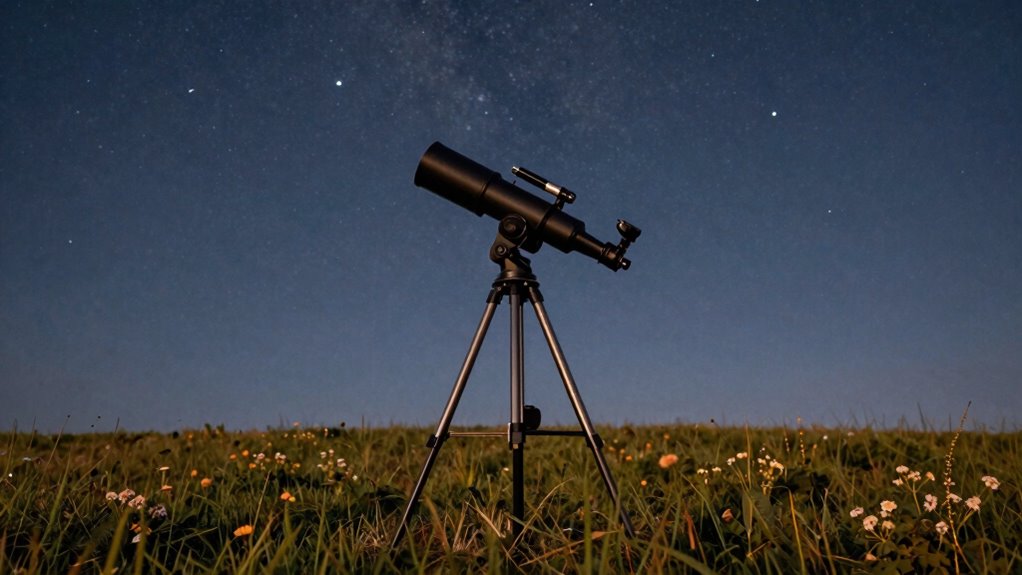

Looking up through a finely crafted telescope connects you to a long tradition of wonder and exploration. It’s a luxurious experience that invites you to slow down and savor the universe’s beauty. The precision and craftsmanship of quality telescopes make celestial details sharper and more awe-inspiring. This act of observation feels almost ceremonial, linking you to centuries of human curiosity. Keep exploring, and you’ll discover how this timeless practice continues to elevate your own sense of wonder.
Key Takeaways
- Modern telescopes evoke awe by revealing intricate celestial details, fostering a sense of wonder and curiosity.
- The act of stargazing through finely crafted instruments connects us to centuries-old traditions of exploration.
- High-quality optics and precise engineering make each observation more detailed, enhancing the luxurious experience.
- Stargazing encourages patience and mindfulness, offering a peaceful retreat from everyday hustle.
- Viewing the universe through a telescope elevates the act to a ceremonial, indulgent practice of discovery.
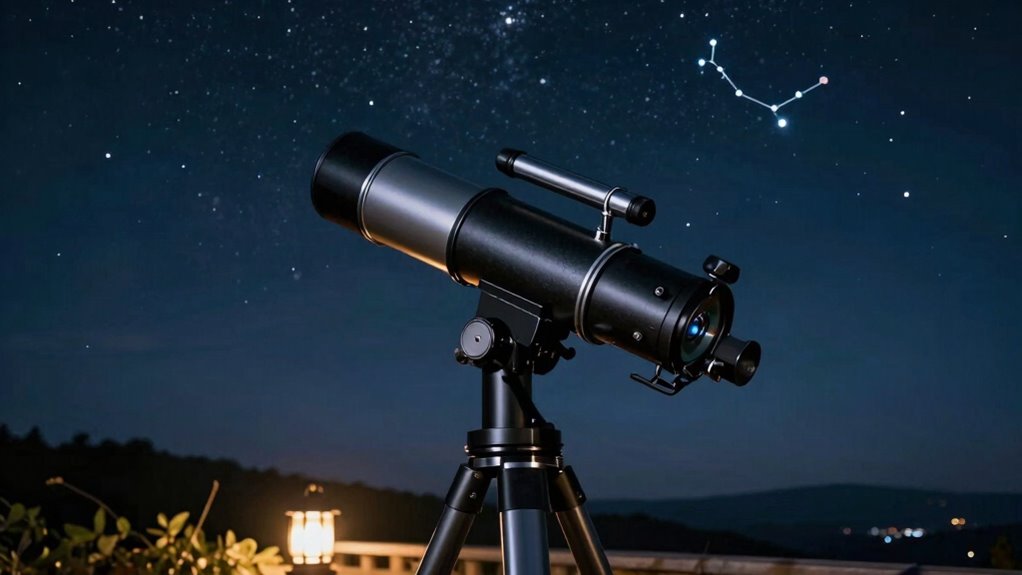
Have you ever looked through a telescope and felt a surge of awe at the vastness of the universe? That moment of wonder isn’t just about seeing distant stars or planets; it’s about reconnecting with a deep-rooted human tradition. Stargazing traditions stretch back thousands of years, where ancient civilizations charted celestial movements to tell stories, mark seasons, or navigate unknown lands. Today, when you peer through a modern telescope, you’re part of that timeless practice. It’s a ritual that bridges past and present, making the act of looking up feel almost ceremonial. This sense of connection adds a layer of luxury to the experience—like stepping into a private universe designed just for you.
Telescope craftsmanship plays a major role in elevating this experience. The precision involved in creating these devices is nothing short of art. Whether it’s a compact refractor or a large reflecting telescope, every element is carefully engineered to maximize clarity and light-gathering power. When you handle a well-crafted telescope, you can feel the quality in its build—smooth movements, sturdy fittings, and finely tuned lenses. This meticulous craftsmanship transforms a simple instrument into a vessel of discovery, turning stargazing from a casual hobby into something more indulgent. It’s not just about seeing the night sky; it’s about experiencing it through a tool built with care and expertise, making the act of observation feel like a special event. The optical quality of the lenses further enhances the visual experience, revealing intricate details that might otherwise go unnoticed.
Looking up with a telescope isn’t just about scientific curiosity; it’s an act of luxury because it invites you to slow down and savor the moment. It’s a break from the rush of everyday life, a chance to immerse yourself in the quiet majesty of the cosmos. When you align your telescope, you’re engaging in a tradition that’s centuries old—one that invites patience and focus. The glow of distant stars and the rings of Saturn become intimate whispers from the universe, accessible only through the craftsmanship of a finely made instrument. The careful engineering behind optical precision enhances the clarity and detail of what you observe, making each session feel more special. In this way, stargazing becomes an indulgence, a ritual that elevates your connection to the universe and reminds you that, even in our modern world, looking up is a luxurious act of wonder.
high quality refractor telescope for beginners
As an affiliate, we earn on qualifying purchases.
As an affiliate, we earn on qualifying purchases.
Frequently Asked Questions
What Is the History Behind the Largest Telescopes?
You learn that the largest telescopes have a rich history marked by continuous telescope innovation, pushing the boundaries of galactic discoveries. Starting with early designs like the 100-inch Hooker telescope in 1917, advancements led to the massive Keck telescopes and the upcoming Extremely Large Telescope. These giants enable astronomers to peer deeper into space, revealing cosmic mysteries and expanding our understanding of the universe.
How Do Amateur Telescopes Compare to Professional Ones?
You’ll find amateur telescopes are quite capable, especially in areas with clear skies, offering good views of planets and stars. While they have smaller aperture sizes compared to professional ones, they’re perfect for personal stargazing. The key is sky clarity; a larger aperture enhances detail, but even modest telescopes can reveal stunning celestial features if the sky is clear. You’ll enjoy a rich experience with the right conditions and equipment.
What Are the Best Telescopes for Beginners?
You should start with a beginner-friendly telescope like a refractor or Dobsonian, which are easy to use and great for celestial navigation. Look for models with stable mounts and decent magnification. As you progress, explore astrophotography techniques to capture stunning images. These telescopes help you learn the night sky comfortably, making stargazing both educational and luxurious, perfect for your first steps into astronomy.
How Does Light Pollution Affect Astronomical Observations?
Ironically, your urban glow makes astronomical observations tougher. Light pollution washes out the night sky, reducing sky darkness and obscuring stars. It’s frustrating because the more city lights you have, the less you see. Even the best telescopes struggle against this glow, making celestial beauty harder to appreciate. To truly enjoy stargazing, you need darker skies, away from artificial lights, where the universe’s true brilliance can shine through.
Can Telescopes Be Used for Space Exploration?
Yes, you can use telescopes for space exploration. Modern telescope technology, especially those designed for deep space, allows you to explore distant galaxies, nebulae, and planets. These advanced telescopes, whether ground-based or space-based, capture detailed images and data, helping you understand the universe better. By using powerful telescopes, you can uncover mysteries of deep space, making exploration accessible and exciting for both scientists and enthusiasts alike.
Conclusion
Looking up at the night sky is like opening a treasure chest, revealing wonders that remind us of the universe’s endless mysteries. Even with our modern gadgets, the simple act of gazing through a telescope offers a luxurious escape into the cosmos. It’s a gentle reminder that sometimes, the most extraordinary sights are just a glance away—waiting patiently, like a secret whispered by the stars, inviting you to dream beyond the horizon.