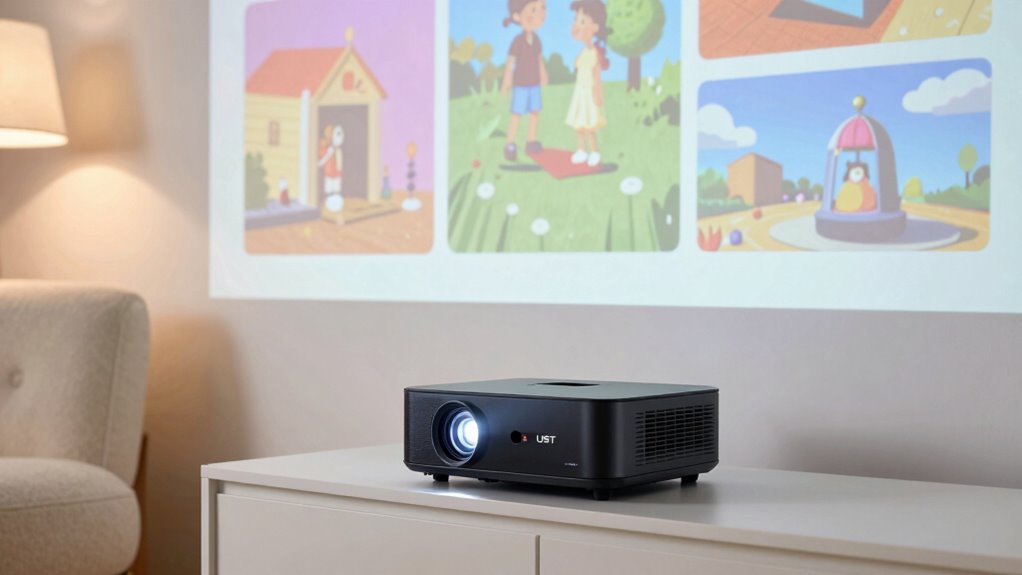

A UST (ultra short throw) projector sits inches from your wall and delivers a 100-inch-plus picture without ceiling mounts or cable runs, which is exactly why it has become the fastest-growing segment in home theater. The JMGO O2S Ultra stands out as my best overall pick thanks to its class-leading 3600 ISO lumens of triple-laser brightness and sharp image processing, while the Hisense PX3-PRO makes the most sense for gamers with its 240Hz refresh rate and the XGIMI AURA 2 balances refinement and price better than almost anything else here. The main tradeoff you face in this category is brightness and color volume versus cost, followed by the choice between true 4K triple-laser models and cheaper single-laser or 1080p units — and whether a renewed premium unit beats a new midrange one. Ambient-light performance, built-in streaming platforms, and throw ratio also separate these models more than spec sheets suggest. Read on for the full breakdown of all 15 projectors and which buyer each one actually suits.

Get your wardrobe favorites delivered free with Prime
- Fast, free delivery on millions of items
- Prime Video, Amazon Music and more included
- Member-only deals all year
Key Takeaways
- Brightness was the single biggest differentiator: the JMGO O2S Ultra (3600 ISO lumens) and Hisense PX3-PRO (3000 lumens) held up in daytime rooms, while single-laser models like the Hisense PL2 washed out without blackout curtains.
- Only the Hisense PX3-PRO and PT1 offer 240Hz refresh rates, making them the clear picks for competitive gamers — every other projector in this lineup caps at 60Hz.
- The two renewed Epson LS800 units deliver the best raw brightness-per-dollar here, but you accept renewed-condition risk and no triple-laser color volume in exchange.
- The Optoma ML1080UST is the only genuinely portable UST option, trading 4K resolution and peak brightness for a form factor no other pick can match.
- AWOL Vision’s three entries (Aetherion Max, LTV-3000 Pro, Aetherion Pro) offer strong 3D and color performance, but their smart platforms are weaker than Google TV models from Hisense, XGIMI, and WEMAX.
| WEMAX Nova Pro 4K Ultra Short Throw Projector with Google TV, 2100 ISO Lumens |  | Best Value All-Rounder | Resolution: 4K UHD (3840 x 2160) | Light Source: ALPD Laser | Brightness: 2100 ISO lumens | VIEW ON AMAZON | See Our Full Breakdown |
| XGIMI AURA 2 Ultra Short Throw 4K Laser Projector with Google TV, 2300 ISO Lumens |  | Best for Movie Nights | Resolution: 4K | Brightness: 2300 ISO lumens | Contrast Ratio: 1,000,000:1 | VIEW ON AMAZON | See Our Full Breakdown |
| AWOL Vision Aetherion Max 4K Triple Laser UST Projector |  | Best for Bright Rooms and Gaming | Resolution: 4K | Brightness: 3300 ISO lumens | Light Source: RGB Triple Laser | VIEW ON AMAZON | See Our Full Breakdown |
| Hisense PX3-PRO Ultra Short Throw Triple Laser Projector, 4K UHD, 3000 Lumens, 240Hz, Google TV |  | Best Color Accuracy | Resolution: 4K UHD | Light Source: TriChroma triple laser | Brightness: 3000 lumens | VIEW ON AMAZON | See Our Full Breakdown |
| Hisense PL2 4K Ultra Short Throw Laser Projector |  | Best Budget Entry Point | Resolution: 4K UHD | Brightness: 2700 lumens | Light Source: X-Fusion laser, 25,000+ hour life | VIEW ON AMAZON | See Our Full Breakdown |
| JMGO O2S Ultra 4K Ultra Short Throw Triple Laser Projector |  | Best Bright All-in-One UST | Resolution: 4K UHD | Light Source: RGB Triple Laser | Brightness: 3600 ISO Lumens | VIEW ON AMAZON | See Our Full Breakdown |
| Hisense PT1 Ultra Short Throw Triple Laser Projector |  | Best for Gamers and Home Theater Fans | Resolution: 4K UHD | Brightness: 2500 ANSI Lumens | Color Coverage: 110% BT.2020 (TriChroma laser) | VIEW ON AMAZON | See Our Full Breakdown |
| ViewSonic LS740HD 5500 Lumens 1080p Laser Projector |  | Best for Bright Spaces and Installations | Resolution: 1920x1080p | Brightness: 5500 ANSI Lumens | Throw Ratio: 1.1-1.5 (standard throw) | VIEW ON AMAZON | See Our Full Breakdown |
| Epson Lifestudio Grand Plus Ultra Short Throw Laser Projector |  | Best for Connected Gaming Setups | Projection Type: Ultra short throw laser | Display Technology: 3-chip 3LCD with Epson 4K Display Technology | Color Brightness: 4,000 lumens (IDMS rated) | VIEW ON AMAZON | See Our Full Breakdown |
| Optoma ML1080UST Photon Go 1080p Ultra Short Throw Portable Laser Projector |  | Best Portable UST Pick | Native Resolution: 1920 x 1080 | Light Source: RGB triple laser (20,000-hour life) | Brightness: 650 ANSI lumens | VIEW ON AMAZON | See Our Full Breakdown |
| AWOL Vision LTV-3000 Pro 4K 3D Ultra Short Throw Triple Laser Projector |  | Best for Home Theater Enthusiasts | Light Source: Triple laser | Resolution: 4K UHD | HDR Formats: Dolby Vision, HDR10+ | VIEW ON AMAZON | See Our Full Breakdown |
| Epson EpiqVision Ultra LS800 Ultra Short Throw 3-Chip 3LCD Smart Streaming Laser Projector (Renewed, Black) |  | Best Brightness Value | Resolution: 4K PRO-UHD | Brightness: 4,000 lumens (color and white) | Technology: 3-Chip 3LCD, laser | VIEW ON AMAZON | See Our Full Breakdown |
| Epson EpiqVision Ultra LS800 Ultra Short Throw 3LCD Laser Projector, 4K PRO-UHD, HDR, Android TV, Yamaha Speakers, White (Renewed) |  | Best for Light-Colored Interiors | Resolution: 4K PRO-UHD | Brightness: 4,000 lumens | Technology: 3-Chip 3LCD laser | VIEW ON AMAZON | See Our Full Breakdown |
| AWOL Aetherion Pro 4K Ultra Short Throw Projector |  | Best for Big-Screen Gamers | Resolution: 4K | Brightness: 2,600 ISO lumens | Max Screen Size: 200 inches | VIEW ON AMAZON | See Our Full Breakdown |
| XGIMI MIRA 4K Triple Laser Ultra Short Throw Projector |  | Best Compact Pick | Native Resolution: 3840 x 2160 (4K) | Brightness: 2,000 ISO lumens | Throw Ratio: 0.175:1 | VIEW ON AMAZON | See Our Full Breakdown |
| ust projector | Brightness | Resolution | Smart Platform | Light Source |
|---|---|---|---|---|
| WEMAX Nova Pro 4K Ultra Short | 2100 ISO lumens | 4K UHD (3840 x 2160) | Google TV with Netflix | ALPD Laser |
| XGIMI AURA 2 Ultra Short Throw | 2300 ISO lumens | 4K | Google TV with licensed Netflix | Laser (Dual Light 2.0) |
| AWOL Vision Aetherion Max 4K T | 3300 ISO lumens | 4K | — | RGB Triple Laser |
| Hisense PX3-PRO Ultra Short Th | 3000 lumens | 4K UHD | Google TV | TriChroma triple laser |
| Hisense PL2 4K Ultra Short Thr | 2700 lumens | 4K UHD | Google TV | X-Fusion laser, 25,000+ hour life |
| JMGO O2S Ultra 4K Ultra Short | 3600 ISO Lumens | 4K UHD | Google TV with native Netflix | RGB Triple Laser |
| Hisense PT1 Ultra Short Throw | 2500 ANSI Lumens | 4K UHD | Google TV | — |
| ViewSonic LS740HD 5500 Lumens | 5500 ANSI Lumens | 1920x1080p | — | — |
| Epson Lifestudio Grand Plus Ul | — | — | — | — |
| Optoma ML1080UST Photon Go 108 | 650 ANSI lumens | — | Google TV with Netflix and Disney+ | RGB triple laser (20,000-hour life) |
| AWOL Vision LTV-3000 Pro 4K 3D | — | 4K UHD | — | Triple laser |
| Epson EpiqVision Ultra LS800 U | 4,000 lumens (color and white) | 4K PRO-UHD | Android TV | — |
| Epson EpiqVision Ultra LS800 U | 4,000 lumens | 4K PRO-UHD | Android TV | — |
| AWOL Aetherion Pro 4K Ultra Sh | 2,600 ISO lumens | 4K | — | — |
| XGIMI MIRA 4K Triple Laser Ult | 2,000 ISO lumens | — | Google TV | — |
More Details on Our Top Picks
WEMAX Nova Pro 4K Ultra Short Throw Projector with Google TV, 2100 ISO Lumens
The Nova Pro makes the most sense for buyers who want the core UST experience — big 4K laser projection inches from the wall — without paying flagship prices. A 150-inch image from roughly 19 inches away puts it in the same placement class as the pricier XGIMI AURA 2, though its 2100 ISO lumens trail the AURA 2’s 2300 and the AWOL Aetherion Max’s 3300, so daytime viewing demands curtains or an ALR screen. What this pick does deliver is a complete package: Google TV with native Netflix, Wi-Fi 6, HDMI 2.1, and dual 15W Dolby Audio speakers that genuinely hold their own in a small room. Compared with the Hisense PL2, it adds a wider app ecosystem and stronger motion handling via MEMC. The tradeoff is brightness — in a sun-drenched living room, the AWOL Aetherion Max is the better fit.
Pros:- 150-inch 4K image from only ~19 inches away, no ceiling mount needed
- Google TV with native Netflix and Google Assistant voice control out of the box
- HDMI 2.1 and Wi-Fi 6 keep it ready for consoles and modern streaming
- Dual 15W Dolby Audio/DTS-HD speakers eliminate the need for a starter soundbar
Cons:- Brightness requires a dark room or ALR screen for best picture quality
- Tabletop-only design limits installation flexibility
- 3000:1 contrast is modest next to the XGIMI AURA 2’s dynamic range
Best for: Budget-conscious buyers setting up a dedicated or semi-dark media room who want streaming built in
Not ideal for: Bright, open living spaces — 2100 ISO lumens struggles against daytime light without an ALR screen
- Resolution:4K UHD (3840 x 2160)
- Light Source:ALPD Laser
- Brightness:2100 ISO lumens
- Throw Ratio:0.23:1
- Screen Size:80–150 inches
- Smart Platform:Google TV with Netflix
- Audio:Dual 15W speakers, Dolby Audio, DTS-HD
- Connectivity:HDMI 2.1, USB, optical, Wi-Fi 6, Bluetooth
Our verdict“A well-rounded, fairly priced UST laser projector for viewers who can control room lighting and want streaming handled internally.”
XGIMI AURA 2 Ultra Short Throw 4K Laser Projector with Google TV, 2300 ISO Lumens
Where the AURA 2 pulls ahead of the field is home-theater polish rather than raw muscle. Its 1,000,000:1 dynamic contrast ratio and Dolby Vision support give dark-scene detail that the WEMAX Nova Pro’s 3000:1 contrast simply can’t match, and IMAX Enhanced certification signals a picture tuned for cinematic playback rather than casual TV. The built-in harman/kardon speakers with Dolby Atmos are a step above typical UST audio, making this the strongest pick if you’d rather skip a receiver entirely. Intelligent Screen Adaption 5.0 also handles keystone and focus automatically, which is friendlier than the manual fussing the Hisense PX3-PRO can require. The catch: at 2300 ISO lumens it sits well below the AWOL Aetherion Max’s 3300, so it belongs in a light-controlled room where its contrast advantage can actually shine.
Pros:- 1,000,000:1 contrast with Dolby Vision delivers exceptional dark-room image depth
- harman/kardon speakers with Dolby Atmos rival a compact soundbar
- Google TV with licensed Netflix works immediately, no workarounds
- 20 ms latency and MEMC keep gaming and fast motion smooth
Cons:- Brightness trails triple-laser rivals like the AWOL Aetherion Max by a wide margin
- Premium feature set carries a premium price relative to simpler UST models
- IMAX Enhanced content requires extra setup steps to activate
Best for: Film-focused buyers building a dedicated home theater who prioritize contrast and HDR fidelity over daytime brightness
Not ideal for: Sports fans watching afternoon games in bright rooms — the brightness ceiling is a real limitation
- Resolution:4K
- Brightness:2300 ISO lumens
- Contrast Ratio:1,000,000:1
- Light Source:Laser (Dual Light 2.0)
- HDR Support:Dolby Vision, IMAX Enhanced
- Audio:Dolby Atmos, harman/kardon speakers
- Gaming Latency:20 ms
- Smart Platform:Google TV with licensed Netflix
Our verdict“The pick for cinephiles who watch in controlled lighting and want theater-grade contrast and audio in one box.”
AWOL Vision Aetherion Max 4K Triple Laser UST Projector
The Aetherion Max is the most capable all-around performer here, and its 3300 ISO lumens of triple-laser brightness is the reason. This is one of the few UST projectors that handles daytime viewing without blackout curtains — something neither the XGIMI AURA 2 nor the WEMAX Nova Pro can claim. Gamers get an even bigger story: 1ms latency at 240Hz, VRR, ALLM, and three HDMI 2.1a ports plus DisplayPort make it functionally a giant-screen gaming monitor, far beyond the 240Hz-but-simpler feature set of the Hisense PX3-PRO. Its 110% Rec.2020 color gamut and Dolby Vision/HDR10+ support round out a genuinely premium image. The tradeoffs are predictable: it commands a flagship price, and reaching its 200-inch maximum demands an enormous flat wall and, ideally, an ALR screen — an added cost the spec sheet doesn’t include.
Pros:- 3300 ISO lumens enables true daytime viewing without blackout curtains
- 1ms latency, 240Hz, VRR, ALLM, and 3x HDMI 2.1a for enthusiast gaming
- 110% Rec.2020 triple-laser color with Dolby Vision and HDR10+
- Anti-RBE technology removes nearly all rainbow-effect artifacts
Cons:- Best bright-room image still requires a separately purchased ALR screen
- Flagship pricing puts it well above value options like the WEMAX Nova Pro
- 200-inch projection demands substantial dedicated wall space
Best for: Serious gamers and households with bright, multi-use living rooms who need daytime-capable brightness
Not ideal for: Budget buyers or those with modest wall space — the 200-inch capability and premium price go to waste in a small room
- Resolution:4K
- Brightness:3300 ISO lumens
- Light Source:RGB Triple Laser
- Contrast:6000:1 native / 60000:1 viewing
- Gaming:1ms at 240Hz, VRR, ALLM
- Inputs:3x HDMI 2.1a, DisplayPort 1.4a
- Max Screen Size:200 inches
- Throw Ratio:0.2:1
- Warranty:2 years with U.S.-based support
Our verdict“The no-compromise pick for gamers and bright-room setups where brightness and latency matter more than price.”
Hisense PX3-PRO Ultra Short Throw Triple Laser Projector, 4K UHD, 3000 Lumens, 240Hz, Google TV
Between the brightness champion and the value picks sits the PX3-PRO, a triple-laser projector whose standout trait is factory color calibration at ΔE≈0.9 — accuracy that most UST models, including the WEMAX Nova Pro, don’t publish at all. For viewers who care about skin tones and subtle color gradation looking right without professional tuning, this is the strongest argument in the lineup. Its 3000 lumens and 110% BT.2020 coverage land it near the AWOL Aetherion Max’s capability for daytime viewing, though its gaming credentials stop at 240Hz without the Aetherion’s 1ms/VRR package. The Xbox-oriented design makes it a natural console companion, and 4K AI upscaling helps older content hold up at 150 inches. Placement is the main frustration: it demands a flat wall or proper screen and careful positioning, and the built-in audio, while capable, still benefits from an external system.
Pros:- ΔE≈0.9 factory color accuracy with 110% BT.2020 triple-laser coverage
- 3000 lumens handles mixed lighting better than most mid-range UST models
- 240Hz refresh rate and Xbox-focused features suit console gaming
- 4K AI upscaling improves lower-resolution sources on large screens
Cons:- Requires careful positioning and a flat wall or dedicated screen
- No VRR or 1ms-class latency, lagging the AWOL Aetherion Max for competitive gaming
- Built-in speakers underdeliver for a full Atmos-style theater experience
Best for: Image-quality purists and Xbox owners who want reference-grade color without paying for the Aetherion Max’s full gaming suite
Not ideal for: Viewers with uneven or textured walls — UST placement magnifies every surface imperfection
- Resolution:4K UHD
- Light Source:TriChroma triple laser
- Brightness:3000 lumens
- Color Gamut:110% BT.2020, ΔE≈0.9
- Projection Size:80–150 inches
- Refresh Rate:240Hz
- Smart Platform:Google TV
- HDR & Audio:Dolby Vision, Dolby Atmos, IMAX Enhanced
Our verdict“The color-accuracy pick for detail-oriented viewers who game casually and want a calibrated image out of the box.”
Hisense PL2 4K Ultra Short Throw Laser Projector
For shoppers testing whether a UST projector fits their life at all, the PL2 is the lowest-risk entry in this lineup. It covers the fundamentals — 4K resolution, 80–150 inch projection, Dolby Vision and Atmos, and Google TV — at a price point that undercuts the WEMAX Nova Pro and the Hisense PX3-PRO alike. Its 2700 lumens actually exceed the Nova Pro’s output, which makes it a surprisingly capable daytime performer for the money. The 25,000+ hour X-Fusion laser means roughly a decade of typical viewing without a lamp replacement, a long-term cost advantage worth weighing against the brighter triple-laser options. What you give up is color depth — a single-laser design can’t match the PX3-PRO’s BT.2020 triple-laser gamut — and the published specs conflict on whether the true maximum is 120 or 150 inches, so plan on the smaller figure if your wall size is tight.
Pros:- Most accessible price point for a true 4K UST laser projector
- 2700 lumens outshines pricier rivals like the WEMAX Nova Pro
- 25,000+ hour laser rated for roughly a decade of typical use
- Google TV, Dolby Vision, and Dolby Atmos included out of the box
Cons:- Single-laser design produces narrower color than the PX3-PRO or Aetherion Max
- Conflicting specs on maximum screen size (120 vs 150 inches) create sizing uncertainty
- 3000:1 contrast limits dark-scene detail in movie watching
Best for: First-time projector buyers who want a taste of 100-inch-plus 4K viewing at the lowest entry cost
Not ideal for: Enthusiasts who obsess over color gamut and contrast — single-laser output can’t match triple-laser rivals
- Resolution:4K UHD
- Brightness:2700 lumens
- Light Source:X-Fusion laser, 25,000+ hour life
- Contrast Ratio:3000:1
- Projection Size:80–150 inches
- Smart Platform:Google TV
- HDR & Audio:Dolby Vision, Dolby Atmos
- Connectivity:Wi-Fi 6E, Bluetooth, Ethernet, HDMI
Our verdict“A sensible, low-commitment way into the UST category for casual viewers who stream in the evenings.”
JMGO O2S Ultra 4K Ultra Short Throw Triple Laser Projector
The JMGO O2S Ultra stands out for pairing a genuinely bright 3,600 ISO lumen triple laser engine with the complete entertainment package: Google TV, native Netflix, and 20W Dynaudio speakers tuned for Dolby Atmos and DTS:X. Compared with the Hisense PT1, it gives up some color gamut coverage and the 240Hz refresh rate, but it counters with noticeably higher brightness that holds up better in rooms you can’t fully darken. The 4,000:1 native contrast and Dolby Vision support translate into punchy highlights and shadow detail that cheaper single-laser UST models struggle to match. The main tradeoff is placement sensitivity — like most UST projectors, it demands a flat, flush wall and precise positioning, and film buffs will still want a proper sound system over the built-ins.
Pros:- 3,600 ISO lumens handles moderately lit rooms better than most UST rivals
- Native Netflix on Google TV means no external streaming stick
- Dolby Vision plus Dolby Atmos and DTS:X support in one box
- 150-inch image from inches away with 4K UHD clarity
Cons:- Demands a perfectly flat wall and careful placement to avoid image distortion
- 20W Dynaudio speakers won’t replace a dedicated surround setup
Best for: Buyers who want a bright, do-everything UST projector for living rooms with some ambient light and no external soundbar
Not ideal for: Dedicated home theater owners with surround systems and light-controlled rooms, who don’t need the brightness or onboard audio
- Resolution:4K UHD
- Light Source:RGB Triple Laser
- Brightness:3600 ISO Lumens
- Throw Ratio:0.16:1
- Screen Size:Up to 150 inches
- Native Contrast Ratio:4000:1
- HDR Support:Dolby Vision
- Smart Platform:Google TV with native Netflix
- Audio:20W Dynaudio, Dolby Atmos, DTS:X
Our verdict“The strongest pick here for buyers who want maximum brightness and streaming convenience from a single UST unit without adding boxes.”
Hisense PT1 Ultra Short Throw Triple Laser Projector
Where the Hisense PT1 separates itself from brighter rivals like the JMGO O2S Ultra is in the details enthusiasts care about: a 240Hz refresh rate for competitive gaming, IMAX Enhanced and Filmmaker Mode certifications, and a TriChroma laser engine covering 110% of the BT.2020 color space — some of the widest color reproduction you’ll find in this lineup. At 2,500 ANSI lumens it’s dimmer than the JMGO, which matters in daytime viewing, but in a controlled room the color accuracy and motion clarity are superior. The honest catch is that this projector really wants an ALR screen sold separately to reach its potential, adding real cost to the setup. Pair it with a Hisense ALR screen and it becomes a genuine theater piece rather than a casual living-room gadget.
Pros:- 240Hz refresh rate is rare among UST projectors and great for gaming
- 110% BT.2020 color coverage delivers reference-grade color accuracy
- IMAX Enhanced and Filmmaker Mode certifications for serious movie watching
- Built-in Google TV with a massive app ecosystem
Cons:- ALR screen required for best daytime viewing and sold separately
- 2,500 ANSI lumens is modest next to brighter options like the JMGO O2S Ultra
Best for: Gamers and cinephiles with a light-controlled room who will invest in an ALR screen for maximum color and motion performance
Not ideal for: Casual buyers on a budget who want a plug-and-play image in a bright room without buying a specialty screen
- Resolution:4K UHD
- Brightness:2500 ANSI Lumens
- Color Coverage:110% BT.2020 (TriChroma laser)
- Contrast Ratio:3000:1
- Projection Size:80″ – 150″
- Refresh Rate:240Hz
- HDR Support:Dolby Vision, HDR10+
- Smart Platform:Google TV
- Certifications:IMAX Enhanced, Filmmaker Mode
Our verdict“The enthusiast’s choice in this batch — buy it for gaming and home theater in a dark room, and budget for the ALR screen it deserves.”
ViewSonic LS740HD 5500 Lumens 1080p Laser Projector
Full transparency: the ViewSonic LS740HD is the odd one out here — it’s a standard-throw projector (1.1-1.5 ratio), not a true UST, and its resolution tops out at 1080p. So why does it appear? Its 5,500 ANSI lumens outshine everything else in this roundup by a wide margin, making it the right answer when image size and ambient light, not pixel count, are the problem — think church halls, classrooms, or backyard events. Unlike the Optoma ML1080UST, it can’t sit inches from the wall, but it compensates with a 1.3x optical zoom, keystone correction, and 360-degree plus portrait mounting that installers genuinely use. The tradeoffs are real: it’s physically large, setup leans technical, and casual viewers will find it more projector than they need for movie nights.
Pros:- 5,500 ANSI lumens easily the brightest image in this roundup
- 1.3x optical zoom and keystone correction simplify awkward installations
- 360-degree and portrait projection modes for creative mounting
- Laser light source built for long-term, maintenance-light operation
Cons:- Standard throw ratio means it needs distance from the screen, unlike true UST models
- 1080p resolution lags behind the 4K UST competition for home cinema
Best for: Installers and presenters who need a massive, daylight-visible image in large venues or outdoor settings
Not ideal for: Living-room movie watchers who need a true ultra short throw and 4K resolution from inches off the wall
- Resolution:1920x1080p
- Brightness:5500 ANSI Lumens
- Throw Ratio:1.1-1.5 (standard throw)
- Projection Size:80″ to 150″
- Zoom:1.3x optical, 0.8x-2.0x digital
- Keystone:Horizontal and Vertical
- Projection Modes:360-degree, portrait
Our verdict“Choose this only if brightness and installation flexibility matter more than 4K and ultra short throw — otherwise stick with a genuine UST model.”
Epson Lifestudio Grand Plus Ultra Short Throw Laser Projector
Epson takes a different technical route than the laser-single-chip crowd: the 3-chip 3LCD design in the Lifestudio Grand Plus means color and white brightness are equal at 4,000 lumens each, avoiding the rainbow artifacts some DLP-based UST projectors can produce. Compared with the JMGO O2S Ultra, its HDR support stops at HDR10 rather than Dolby Vision, but it counters with three HDMI ports plus ALLM and high-frame-rate support — the most connection-flexible gaming setup in this batch. Bose-branded audio with deep bass rounds out a family-entertainment package that doesn’t need a soundbar on day one. The honest caveats: it’s a big unit that dominates whatever surface it sits on, and 4K here is pixel-shifting rather than native, so purists chasing maximum sharpness may prefer a true 4K panel.
Pros:- Three HDMI ports plus ALLM make it the best-connected gaming option here
- 3LCD design eliminates rainbow artifacts and keeps color brightness high
- Bose audio with deep bass works well without external speakers
- 150-inch image from close to the wall with HDR10
Cons:- 4K achieved via pixel-shifting rather than a native 4K imager
- HDR10 only — no Dolby Vision like the JMGO O2S Ultra or Hisense PT1
Best for: Households running multiple consoles, a PC, and a streaming box who want them all plugged in at once on a huge screen
Not ideal for: Home theater purists who prioritize native 4K sharpness and Dolby Vision over connectivity and convenience
- Projection Type:Ultra short throw laser
- Display Technology:3-chip 3LCD with Epson 4K Display Technology
- Color Brightness:4,000 lumens (IDMS rated)
- White Brightness:4,000 lumens (ISO rated)
- Maximum Image Size:150 inches
- HDR:HDR10
- Audio:Bose technology
- HDMI Ports:3
- Gaming Features:ALLM and high-frame-rate support
Our verdict“The pick for multi-device gamers and families who value inputs, ALLM, and dependable brightness over the last word in image purity.”
Optoma ML1080UST Photon Go 1080p Ultra Short Throw Portable Laser Projector
The Optoma ML1080UST is the only projector in this lineup you can genuinely toss in a bag — it has a built-in battery, onboard Google TV with Netflix and Disney+, and an ultra short throw that lets you project up to 100 inches from under a foot away, so you don’t even need a clear path across a room. Obviously, portability demands compromise: at 650 ANSI lumens it’s a fraction of the brightness of the JMGO O2S Ultra, so this is a lights-off, after-dark machine. The 1080p native resolution also trails every 4K UST here. But that massive 2,500,000:1 contrast rating and triple laser color make small-screen movie nights look far richer than typical portable projectors, and the 1.5-hour battery covers most films — just barely, and plugged-in use is the realistic norm.
Pros:- Built-in battery makes it the only truly portable option in this batch
- Ultra short throw works against walls in cramped rooms and campsites
- Google TV with Netflix and Disney+ built in — no casting needed
- Automatic focus and keystone correction simplify impromptu setups
Cons:- 1.5-hour battery life won’t reliably finish longer films
- 650 ANSI lumens and 1080p resolution lag far behind 4K UST rivals
Best for: Travelers, campers, and dorm-dwellers who want a big-screen movie experience anywhere without carrying cables and speakers
Not ideal for: Anyone setting up a permanent living-room theater, since the brightness and 1080p resolution fall well short of 4K UST models
- Native Resolution:1920 x 1080
- Light Source:RGB triple laser (20,000-hour life)
- Brightness:650 ANSI lumens
- Image Size:60 – 100 inches
- Throw Distance:0.34 – 0.81 feet
- Contrast Ratio:2,500,000:1
- Battery Life:Up to 1.5 hours
- Speakers:20-watt built-in stereo
- Smart Platform:Google TV with Netflix and Disney+
Our verdict“Buy it for big-screen entertainment on the move; skip it if this is your main home theater projector.”
AWOL Vision LTV-3000 Pro 4K 3D Ultra Short Throw Triple Laser Projector
This option stands out for buyers who want a genuine cinema experience rather than just a big picture. The built-in center channel speaker is the differentiator here — dialogue anchors to the screen instead of firing from a distant soundbar, something none of the other picks in this lineup offer. Compared with the Epson LS800, the LTV-3000 Pro goes further on format support, adding Dolby Vision, HDR10+, and active 3D, plus a wider 107% BT.2020 gamut from its triple laser array. The tradeoff is brightness: at a lower output than Epson’s 4,000 lumens, it performs best in a darkened room or paired with an ALR screen. Placement also demands cabinet depth, and 3D requires buying shutter glasses separately.
Pros:- Built-in center channel speaker keeps dialogue anchored to the screen
- Full format coverage: Dolby Vision, HDR10+, 4K UHD, and active 3D
- 107% BT.2020 triple laser color gamut for rich, accurate color
- Control4 and PJ Link IP integration for custom smart home setups
Cons:- Needs a dark room or an ALR screen to look its best
- Requires deep cabinet space or an optional motorized slider for placement
Best for: Dedicated home theater owners who watch in controlled lighting and want 3D plus top-tier HDR formats
Not ideal for: Bright living rooms without an ALR screen, or viewers who never use 3D and don’t want to pay for it
- Light Source:Triple laser
- Resolution:4K UHD
- HDR Formats:Dolby Vision, HDR10+
- Max Screen Size:150 inches
- Color Gamut:107% BT.2020, 147% DCI-P3
- Throw Distance:8.54 in for 100 in image
- Control Integration:PJ Link IP, Control4-compatible
Our verdict“A home theater centerpiece for dark-room viewers who want cinema formats and 3D in one box.”
Epson EpiqVision Ultra LS800 Ultra Short Throw 3-Chip 3LCD Smart Streaming Laser Projector (Renewed, Black)
For buyers whose living room has windows and lamps, this pick makes the most sense. The 4,000-lumen output is the highest in this roundup — noticeably ahead of the AWOL LTV-3000 Pro and far beyond the XGIMI MIRA’s 2,000 ISO lumens — and the 3-chip 3LCD design avoids the rainbow artifacts some DLP units produce. Being renewed lowers the entry cost, but it is a refurbished unit, so buyers accepting that tradeoff get flagship-tier brightness. Built-in Android TV and Yamaha 2.1ch speakers mean no extra boxes or soundbar for casual viewing. Note that full HDR performance depends on source devices, and the matching ALR screen is sold separately.
Pros:- 4,000 lumens handles well-lit rooms better than any other pick here
- 3-chip 3LCD eliminates rainbow artifacts common to single-chip DLP
- Built-in Android TV and Yamaha 2.1ch audio remove the need for extra devices
- Renewed pricing undercuts new flagship UST projectors
Cons:- Renewed condition means shorter certainty about lifespan and cosmetic condition
- ALR screen sold separately and effectively required for daytime contrast
Best for: Bright, multi-use living rooms where daytime viewing matters more than absolute black levels
Not ideal for: Buyers who insist on a brand-new sealed unit, or purists who want native 4K panels rather than 4K PRO-UHD processing
- Resolution:4K PRO-UHD
- Brightness:4,000 lumens (color and white)
- Technology:3-Chip 3LCD, laser
- Max Image Size:150-inch class
- Smart Platform:Android TV
- Audio:2.1ch Yamaha speakers
- Condition:Renewed
Our verdict“The smart buy for bright-room viewers who prioritize lumens over pristine refurb-free ownership.”
Epson EpiqVision Ultra LS800 Ultra Short Throw 3LCD Laser Projector, 4K PRO-UHD, HDR, Android TV, Yamaha Speakers, White (Renewed)
This is functionally the same machine as the black LS800 above — same 4,000 lumens, 3-chip 3LCD engine, Android TV, and Yamaha audio — so the choice between them comes down to aesthetics and listing specifics rather than performance. The white chassis blends into Scandinavian-style rooms, white media consoles, and wall-mounted setups where a black box would dominate. Compared with the AWOL Aetherion Pro, it trades gaming features and 200-inch capability for raw brightness and 3LCD color stability, which suits movie and sports viewing over competitive gaming. The same caveats apply: it is a renewed unit, and careful placement plus ventilation are needed since UST projectors sit close to walls.
Pros:- Identical 4,000-lumen 3LCD performance to the black LS800
- White finish integrates with light-colored interiors and consoles
- All-in-one streaming and Yamaha 2.1ch sound
- Compact footprint suits smaller home theater layouts
Cons:- Renewed condition carries the usual refurbishment uncertainty
- Spare product documentation makes setup details harder to verify before purchase
Best for: Buyers with white or light-toned decor who want LS800 brightness without a black eyesore on the console
Not ideal for: Gamers who need 1 ms latency and VRR, or anyone unwilling to accept refurbished condition
- Resolution:4K PRO-UHD
- Brightness:4,000 lumens
- Technology:3-Chip 3LCD laser
- Throw Type:Ultra short throw
- Screen Size Class:150 inches
- Smart Platform:Android TV
- Color:White
- Condition:Renewed
Our verdict“The LS800 for design-conscious buyers — same punch, friendlier finish, same refurb caveats.”
AWOL Aetherion Pro 4K Ultra Short Throw Projector
This model is better suited to players than movie-only households. With 1 ms latency, VRR, ALLM, and Dolby Vision Gaming, it out-features every gaming-capable rival here — even the Hisense PX3-PRO’s 240Hz refresh can’t match the full latency-plus-VRR package — making fast-paced titles feel responsive on a wall-sized display. Its 200-inch maximum image also edges out the LTV-3000 Pro and both Epson LS800s, both capped at 150 inches, while IRIS contrast up to 60,000:1 delivers deep blacks for dark-room film sessions. The 2,600 ISO lumens sit below Epson’s output, so daytime viewing without an ALR screen is weaker. Anti-RBE technology minimizes rainbow artifacts, a real consideration for sensitive viewers choosing between DLP and 3LCD.
Pros:- 1 ms latency, VRR, and ALLM make it the strongest gaming UST in this lineup
- 200-inch maximum image exceeds the 150-inch ceiling of most rivals here
- IRIS dynamic contrast up to 60,000:1 for deep blacks
- Dolby Vision, HDR10+, HDR10, and HLG support with Anti-RBE technology
Cons:- 2,600 ISO lumens limit punch in bright rooms
- No built-in smart platform mentioned, so external streaming may be needed
Best for: Console and PC gamers who want low-latency big-screen play plus Dolby Vision film nights in a dark room
Not ideal for: Daytime sports watchers in sunlit rooms — its 2,600 lumens trail the Epson LS800 by a wide margin
- Resolution:4K
- Brightness:2,600 ISO lumens
- Max Screen Size:200 inches
- Viewing Contrast:Up to 60,000:1
- Color Gamut:110% Rec.2020
- Gaming Features:1 ms latency, VRR, ALLM, Dolby Vision Gaming
- Warranty:2 years
Our verdict“The gamer’s UST — 1 ms response and 200-inch scale for those who play as much as they watch.”
XGIMI MIRA 4K Triple Laser Ultra Short Throw Projector
This option stands out for tighter spaces rather than maximum spectacle. Its 0.175:1 throw ratio is the shortest here — a 100-inch image from just 7.6 inches away, versus 8.54 inches for the AWOL LTV-3000 Pro — which matters when a shallow console or narrow alcove limits placement. The 36W Harman Kardon audio outclasses typical built-in projector sound, and Google TV with automatic focus and screen alignment makes first-time setup genuinely painless. Compared with the XGIMI AURA 2, the MIRA covers a similar streaming-and-sound brief in a smaller envelope. The honest tradeoff is scale: 2,000 ISO lumens and a 120-inch ceiling mean it cannot match the Aetherion Pro’s 200 inches or the LS800’s daytime brightness.
Pros:- Shortest throw in the lineup — 100 inches from 7.6 inches away
- 36W Harman Kardon sound with Dolby Audio eliminates a soundbar for casual use
- Google TV, auto focus, and auto screen alignment simplify setup
- 1 ms input lag, VRR, and ALLM for gaming
Cons:- 120-inch maximum image limits big-theater ambitions
- 2,000 ISO lumens restrict daytime viewing quality
Best for: Apartment dwellers and bedroom-cinema buyers with shallow consoles who want 80–120 inches without complexity
Not ideal for: Owners wanting a 150-inch-plus theater image or bright-room viewing — it caps at 120 inches and modest lumens
- Native Resolution:3840 x 2160 (4K)
- Brightness:2,000 ISO lumens
- Throw Ratio:0.175:1
- Image Size:80–120 inches
- Audio:36W Harman Kardon with Dolby Audio
- Smart Platform:Google TV
- Gaming Features:1 ms input lag, VRR, ALLM
Our verdict“The easiest UST to live with in small rooms, provided 120 inches is big enough.”

How We Picked
I ranked these projectors around the factors that actually determine satisfaction with a UST: real-world brightness (ISO/ANSI lumens and triple-laser versus single-laser light sources), color accuracy and contrast, smart platform quality, input lag and refresh rate for gaming, and how forgiving each model is of imperfect walls and rooms. Because UST projectors are placed so close to the screen, I also weighed throw ratio flexibility, built-in sound quality, and how well each unit handles ambient light — the difference between a 2100-lumen and 3600-lumen model is far more visible at 120 inches than spec comparisons suggest.
The ranking order reflects a simple logic: models that deliver a complete living-room experience — bright triple-laser picture, capable smart TV platform, and modern gaming features — sit at the top, while models that excel in one dimension but compromise elsewhere (portability, 1080p resolution, renewed condition) fill specialized roles lower down. I deliberately kept several niche picks in the lineup because a dedicated gaming projector or a portable laser unit can be the right answer for the right buyer, even when it loses the overall brightness race.
| ust projector | Smart Platform |
|---|---|
| WEMAX Nova Pro 4K Ultra Short | Google TV with Netflix |
| XGIMI AURA 2 Ultra Short Throw | Google TV with licensed Netflix |
| AWOL Vision Aetherion Max 4K T | — |
| Hisense PX3-PRO Ultra Short Th | Google TV |
| Hisense PL2 4K Ultra Short Thr | Google TV |
| JMGO O2S Ultra 4K Ultra Short | Google TV with native Netflix |
| Hisense PT1 Ultra Short Throw | Google TV |
| ViewSonic LS740HD 5500 Lumens | — |
| Epson Lifestudio Grand Plus Ul | — |
| Optoma ML1080UST Photon Go 108 | Google TV with Netflix and Disney+ |
| AWOL Vision LTV-3000 Pro 4K 3D | — |
| Epson EpiqVision Ultra LS800 U | Android TV |
| Epson EpiqVision Ultra LS800 U | Android TV |
| AWOL Aetherion Pro 4K Ultra Sh | — |
| XGIMI MIRA 4K Triple Laser Ult | Google TV |
Factors to Consider When Choosing Ust Projector
Before settling on a specific model, it helps to understand what actually separates a satisfying UST purchase from an expensive disappointment. These are the factors I weighed most heavily, along with the mistakes buyers make with each one.Brightness and Light Source Type
Brightness claims are the most misleading spec in this category because manufacturers mix ISO and ANSI measurements, and a triple-laser light source produces visibly richer color than a single laser at the same lumen figure. As a rule, anything under 2500 lumens demands light control — blackout curtains or evening viewing — while 3000-plus lumen models like the JMGO O2S Ultra and Hisense PX3-PRO survive a sunlit living room. Triple-laser (RGB) projectors also avoid the rainbow artifacts that bother some viewers on single-laser DLP units. If your room has uncontrolled windows, prioritize brightness over almost every other feature; a dimmer projector with better contrast will still look washed out at 2 p.m. The most common mistake I see is buyers choosing based on resolution alone, then discovering their 4K image is unwatchable during the day.
Throw Ratio and Screen Size
Throw ratio determines how close the projector must sit to produce a given image, and small differences matter enormously with UST placement. Most models here produce a 100-inch image from roughly 8 to 12 inches from the wall, but units like the Hisense PX3-PRO and PT1 stretch to 150 inches, which demands a very wide, very flat wall. Measure your wall before buying, not after: a 150-inch image needs nearly 11 feet of unbroken width, which most living rooms don’t have. Also confirm the projector’s placement flexibility — models with more keystone and memory-zoom options are far easier to position on a media console. And remember that a UST magnifies every wall imperfection, so a dedicated UST ALR screen is almost always a worthwhile add-on rather than an optional luxury.
Gaming Performance
If console or PC gaming is part of your plan, refresh rate and input lag deserve more attention than color specs. Only a few models here — the Hisense PX3-PRO and PT1 with 240Hz support — are built for competitive gaming, while standard 60Hz units feel noticeably less responsive in fast titles. Casual gamers can happily save money on a 60Hz model, but competitive players will feel the difference immediately. Check HDMI 2.1 bandwidth as well, since 4K at 120Hz requires it. Another overlooked point: gaming on a UST means the projector sits below the screen, so nothing blocks the fan intake during long sessions — a real issue with units that exhaust heat toward the wall.
Smart Platform and Streaming
Every projector here has some smart platform, but they are not equal. Models running Google TV (WEMAX Nova Pro, XGIMI AURA 2, Hisense PX3-PRO and PT1) offer the broadest app support and cleanest interface, while weaker platforms force you into workarounds or an external streaming stick. This matters more than it seems because a UST projector replaces a television, and fumbling with an attached stick undermines the clean, cable-free setup that justifies the format. Also consider whether the platform supports the streaming services you actually use — some lesser-known platforms lack major apps entirely. Buyers who already own an Apple TV or Roku can deprioritize this factor and save money on a projector with a bare-bones OS.
New Versus Renewed Premium
This lineup includes two renewed Epson LS800 units, and that raises a genuine decision: a renewed flagship versus a new midrange model. The renewed EpiqVision Ultra LS800 offers 4000 lumens and excellent 3LCD color at a price point where new projectors give you half the brightness. The tradeoffs are warranty length, unknown lamp-hour history, and the possibility of cosmetic wear. Renewed units make the most sense for buyers in dedicated, light-controlled theaters where brightness headroom is the priority and cosmetic risk is tolerable. If you want predictable ownership and full manufacturer support, a new triple-laser unit like the Hisense PL2 or XGIMI MIRA is the safer path even with lower peak output.
Room and Screen Reality Check
The most expensive mistake in UST ownership has nothing to do with the projector: it is the surface you project onto. A UST’s extreme angle means it demands an ALR (ambient-light-rejecting) screen rated for ultra short throw — a standard ALR screen will reject the image itself and create hotspots. Budget for that screen as part of the projector cost, because pairing a premium laser projector with a bare painted wall wastes most of its contrast. Ceiling height matters too, since UST units must sit below the image, which rules out placement on high shelves. Finally, check fan noise placement: in a quiet bedroom theater, even a modest fan can become audible during dialogue-heavy scenes, so look for units with dedicated quiet modes if you watch at low volume.
Frequently Asked Questions
Can a UST projector replace my TV for everyday viewing?
For most households, yes, provided you pick a bright enough model and pair it with a proper ALR screen. Units like the JMGO O2S Ultra and Hisense PX3-PRO produce enough light for daytime news and sports, and their Google TV platforms behave like a normal smart TV. Where a UST falls short is instant-on convenience — laser projectors take several seconds to reach full brightness, and fans run audibly during quiet scenes. If you watch in a bright, multi-use living room for many hours daily, prioritize the 3000-plus lumen models; dimmer units work better as dedicated movie-night devices than as true TV replacements.
Do I really need a special screen for an ultra short throw projector?
You can project onto a flat wall, but you will lose a large share of the contrast you paid for, especially with any ambient light. A standard ALR screen is actually the wrong choice here — those screens are designed for long-throw angles and will reject much of a UST projector’s image. You need a screen specifically rated for ultra short throw, which uses a different lenticular structure to reflect the steep incoming angle while rejecting overhead light. Factor this into your total budget: a quality UST ALR screen is a meaningful extra cost, but it is the difference between a washed-out picture and one that looks like a high-end television.
Is 1080p still acceptable in a UST projector in 2026?
It depends entirely on screen size and viewing distance. At 100 inches viewed from 10 feet or more, the pixel difference between the 1080p ViewSonic LS740HD or Optoma ML1080UST and a 4K model is subtle for film and casual content. Where 1080p shows its age is with text, gaming HUDs, and sitting closer than roughly 1.5 times screen width. The better question is why you are choosing 1080p: if it is for portability or installation flexibility, as with the Optoma, the tradeoff can be worth it. If it is purely to save money on a fixed living-room install, a 4K unit like the Hisense PL2 is usually the smarter long-term buy since you will likely keep the projector for many years.
Are the renewed Epson LS800 projectors a safe buy?
They can be an excellent value, but you need the right expectations. A renewed LS800 gives you 4000 lumens and 3-chip 3LCD color at a price where new projectors offer half the brightness, and Epson’s 3LCD design avoids rainbow artifacts entirely. The risks are shorter warranty coverage, unknown usage history, and cosmetic imperfections. I would recommend a renewed LS800 to a buyer setting up a dedicated theater room who wants maximum brightness headroom and accepts some condition uncertainty. For a main living-room display that the whole household relies on daily, a new unit with full manufacturer support — like the XGIMI AURA 2 or WEMAX Nova Pro — is the lower-stress choice.
How much should refresh rate influence my decision?
Only two models in this lineup — the Hisense PX3-PRO and PT1 at 240Hz — offer high refresh rates, and that feature matters far more for some buyers than others. Competitive gamers playing fast shooters or fighting games will genuinely feel the difference in motion clarity and responsiveness. Everyone else, including casual gamers and movie watchers, gets no benefit from 240Hz, since films stream at 24fps and most streaming content is 60fps. My guidance: if you play ranked or competitive games regularly, treat 240Hz as a must-have and narrow your choice to those two Hisense models. If gaming is occasional, spend your budget on brightness and color instead, because you will notice those every single day.
Conclusion
After comparing all 15 models, my recommendations break down cleanly by buyer type. The JMGO O2S Ultra is my best overall pick — its 3600 ISO lumens of triple-laser output handle real living rooms, and it doesn’t compromise on smart features or picture processing. The Hisense PL2 is the best value for buyers who want true 4K laser projection without flagship pricing, while the AWOL Vision Aetherion Max is the best premium choice for enthusiasts building a dedicated theater around color volume and 3D performance.
For beginners, the WEMAX Nova Pro is the easiest path into UST ownership: Google TV works out of the box, 2100 ISO lumens are adequate in a dimmable room, and setup is forgiving. Specific needs narrow it further — gamers should go straight to the Hisense PX3-PRO for its 240Hz panel, portability-focused buyers have only one real option in the Optoma ML1080UST, and brightness-per-dollar hunters should seriously consider the renewed Epson LS800 units if they can accept condition uncertainty. Whatever you choose, budget for a UST-rated ALR screen — it is the single accessory that determines whether these projectors look like a gimmick or a genuine television replacement.