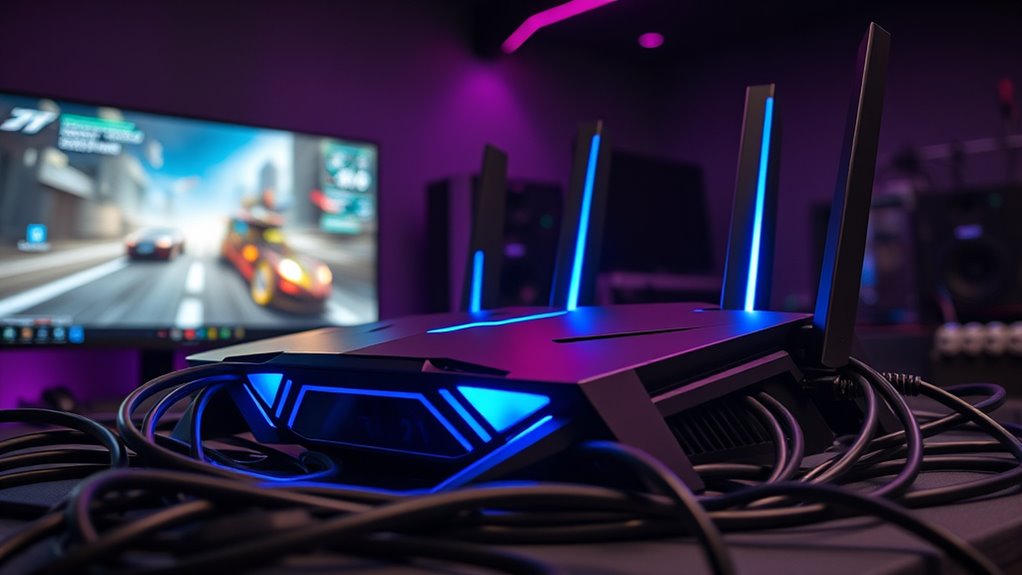

When choosing a gaming router, the key factors are fast speeds, low latency, reliable connections, and strong security. The NETGEAR Nighthawk RS90 stands out as the best overall pick thanks to its WiFi 7 support and solid performance. For those prioritizing cutting-edge technology, the TP-Link AXE5400 Tri-Band WiFi 6E Router offers impressive speeds and future-proofing. However, the main tradeoffs in this category often come down to price versus features—more advanced models tend to cost significantly more, while budget options may lack the bandwidth or stability needed for demanding games. Keep reading for a full breakdown of these options to find your ideal gaming router.
Key Takeaways
- WiFi 6E and WiFi 7 routers deliver the fastest speeds and lowest latency, crucial for competitive gaming.
- Multiple bands (tri-band or quad-band) help reduce network congestion, especially for busy households.
- High port counts and multi-Gig Ethernet improve wired stability and reduce lag for gaming consoles and PCs.
- Premium features like mesh support and advanced security are often limited to high-end models.
- Choosing a router with easy setup and management tools can save time and reduce frustration.
| NETGEAR Nighthawk Dual-Band WiFi 7 Router (RS90) |  | Best Overall for High-Speed Flexibility | WiFi Speed: up to 3.6 Gbps | Bands: Dual-Band 2.4 GHz + 5 GHz | Coverage: up to 2,000 sq. ft. | VIEW ON AMAZON | See Our Full Breakdown |
| TP-Link AXE5400 Tri-Band WiFi 6E Router (Archer AXE75) |  | Best for Future-Proof Whole-Home Coverage | WiFi Speed: up to 5400 Mbps | Bands: Tri-Band (6 GHz, 5 GHz, 2.4 GHz) | Max 6 GHz Speed: 2402 Mbps | VIEW ON AMAZON | See Our Full Breakdown |
| TP-Link BE6500 Dual-Band WiFi 7 Router (BE400) with 2.5Gbps Ports, USB 3.0, Covers Up to 2,400 sq. ft., Supports 90 Devices, Quad-Core CPU, HomeShield Security |  | Best for High-Speed Connectivity with Device Support | WiFi Speed: up to 5.8 Gbps | Bands: Dual-Band | Coverage Area: up to 2,400 sq. ft. | VIEW ON AMAZON | See Our Full Breakdown |
| TP-Link Tri-Band BE11000 Wi-Fi 7 Gaming Router Archer GE650 |  | Best for High-Speed Gaming and Customization | Wi-Fi Bands: Tri-band (6 GHz, 5 GHz, 2.4 GHz) | Maximum Speed: 11 Gbps | Processor: 1.5 GHz quad-core | VIEW ON AMAZON | See Our Full Breakdown |
| MSI Radix AXE6600 WiFi 6E Tri-Band Gaming Router |  | Best for Intelligent Gaming Optimization | Tri-band: 2.4GHz + 5GHz + 6GHz | WiFi Standard: WiFi 6E | Maximum Speed: 6.6 Gbps | VIEW ON AMAZON | See Our Full Breakdown |
| TP-Link AX5400 WiFi 6 Router (Archer AX73) – Dual Band Gigabit Wireless Internet Router for Streaming and Long Range Coverage |  | Best Value for Large Homes and Streaming | Max WiFi Speed: 5400 Mbps | Bands: Dual Band | Antennas: 6× Antennas | VIEW ON AMAZON | See Our Full Breakdown |
| NETGEAR Nighthawk WiFi 7 Router (BE9300) |  | Best for Speed and Device Capacity in a WiFi 7 Package | Wireless Speed: 9.3Gbps | Coverage: 2,500 sq. ft. | Device Capacity: 100 devices | VIEW ON AMAZON | See Our Full Breakdown |
| ASUS ROG Rapture GT-BE98 Pro WiFi 7 Gaming Router – Quad-Band, 30Gbps, Mesh |  | Best for High-End Gaming and Maximum Speed | Maximum Speed: 30 Gbps | Bands: Quad-band | Channels: 320MHz in 6 GHz band | VIEW ON AMAZON | See Our Full Breakdown |
| TP-Link AX1800 WiFi 6 Router (Archer AX21 V5) |  | Best Budget WiFi 6 for Gaming and Everyday Use | Technology: WiFi 6 (802.11ax) | Bands: Dual-Band | Total Bandwidth: 1.8 Gbps | VIEW ON AMAZON | See Our Full Breakdown |
| TP-Link Tri-Band WiFi 7 Router (Archer BE550) – 6-Stream, 2.5G Ports, EasyMesh, VPN |  | Best for Seamless Multi-Device Gaming and Streaming | WiFi Standard: WiFi 7 | Maximum Speed: 5760 Mbps | Bands: Tri-band | VIEW ON AMAZON | See Our Full Breakdown |
| TP-Link Tri-Band BE19000 Wi-Fi 7 Gaming Router Archer GE800 |  | Best Overall for High-End Gaming and Heavy Network Demands | Wi-Fi Standard: Wi-Fi 7 | Max Speed: 19 Gbps | Number of Streams: 12 | VIEW ON AMAZON | See Our Full Breakdown |
| TP-Link Dual-Band WiFi 7 Gaming Router Archer GE400 |  | Best Value for High-Performance Gaming on a Budget | WiFi Bands: Dual-band (2.4 GHz and 5 GHz) | Maximum Speed: 6.5 Gbps | Number of Antennas: 6 | VIEW ON AMAZON | See Our Full Breakdown |
| GL.iNet GL-MT6000 Flint 2 Wi-Fi 6 Gaming Router with Dual 2.5G Ports |  | Best for Customization and Security in Gaming Networks | Wi-Fi Standard: Wi-Fi 6 | Max Speed: 6 Gbps | Dual Ports: 2.5G ports | VIEW ON AMAZON | See Our Full Breakdown |
| ASUS TUF Gaming BE6500 WiFi 7 Router – Dual-Band, Up to 6.5 Gbps Wireless, Game Accelerator, Multi-Link Operation (MLO), (x4) 2.5GbE Ports, Mesh + VPN Compatible, Subscription-Free Network Security |  | Best for Gamers Who Need Speed, Stability, and Security Without Extra Cost | WiFi Standard: WiFi 7 | Maximum Speed: 6.5 Gbps | Bands: Dual-Band | VIEW ON AMAZON | See Our Full Breakdown |
| ASUS ROG Rapture GT-AX11000 Pro Tri-Band WiFi 6 Gaming Router |  | Best for Large-Scale Gaming and Extensive Coverage | Wi-Fi Standard: Wi-Fi 6 | Maximum Speed: 10 Gbps | Frequency Band: Tri-Band | VIEW ON AMAZON | See Our Full Breakdown |
| gaming router | Bands |
|---|---|
| NETGEAR Nighthawk Dual-Band Wi | Dual-Band 2.4 GHz + 5 GHz |
| TP-Link AXE5400 Tri-Band WiFi | Tri-Band (6 GHz, 5 GHz, 2.4 GHz) |
| TP-Link BE6500 Dual-Band WiFi | Dual-Band |
| TP-Link Tri-Band BE11000 Wi-Fi | — |
| MSI Radix AXE6600 WiFi 6E Tri- | — |
| TP-Link AX5400 WiFi 6 Router | Dual Band |
| NETGEAR Nighthawk WiFi 7 Route | — |
| ASUS ROG Rapture GT-BE98 Pro W | Quad-band |
| TP-Link AX1800 WiFi 6 Router | Dual-Band |
| TP-Link Tri-Band WiFi 7 Router | Tri-band |
| TP-Link Tri-Band BE19000 Wi-Fi | — |
| TP-Link Dual-Band WiFi 7 Gamin | — |
| GL.iNet GL-MT6000 Flint 2 Wi-F | — |
| ASUS TUF Gaming BE6500 WiFi 7 | Dual-Band |
| ASUS ROG Rapture GT-AX11000 Pr | — |
More Details on Our Top Picks
NETGEAR Nighthawk Dual-Band WiFi 7 Router (RS90)
The NETGEAR Nighthawk RS90 stands out for delivering robust WiFi 7 speeds up to 3.6 Gbps, making it an excellent choice for gamers and streamers who need reliable, fast connections. Unlike the TP-Link BE6500, which supports WiFi 7 but with slightly lower speeds and coverage, the RS90 offers a straightforward setup and extensive Ethernet options, though it requires a separate modem. Its dual-band setup simplifies compatibility but may limit performance in congested environments compared to tri-band options. The security features are solid with WPA3 and NETGEAR Armor, providing peace of mind. The main tradeoff is its dependence on a separate modem, which could add complexity for some users. This router suits households seeking high speed and flexibility without needing integrated modem functionality.
Pros:- High-speed WiFi 7 performance up to 3.6 Gbps
- Easy setup via app or web browser
- Secure network with WPA3 and Armor
Cons:- Requires a separate modem, adding to setup complexity
- Coverage can vary depending on home layout
Best for: High-demand households needing fast wireless speeds and multiple wired connections, with existing modems.
Not ideal for: Users seeking an all-in-one modem-router or those with small homes where coverage is less critical.
- WiFi Speed:up to 3.6 Gbps
- Bands:Dual-Band 2.4 GHz + 5 GHz
- Coverage:up to 2,000 sq. ft.
- Ethernet Ports:1 x 2.5 Gig WAN, 4 x Gigabit LAN
- Security:WPA3, NETGEAR Armor
- Processor:Quad-core 2.0 GHz
Our verdict“Ideal for users with existing modems who prioritize raw speed and wired connectivity in large homes.”
TP-Link AXE5400 Tri-Band WiFi 6E Router (Archer AXE75)
The TP-Link AXE75 offers tri-band WiFi 6E with speeds reaching 5400 Mbps, making it well-suited for homes with multiple high-demand devices. Its 6 GHz band provides lower latency, ideal for gaming, unlike the MSI Radix AXE6600, which emphasizes gaming-specific features but at a higher price. The support for OneMesh means seamless coverage in larger or multi-floor homes, but the advanced features like VPN and parental controls could be daunting for casual users. While its dual-core CPU and 512 MB RAM promise reliable performance, its complexity may be overkill for simple setups. This router targets tech-savvy households that want the latest WiFi standards and broad coverage without sacrificing speed.
Pros:- Tri-band WiFi 6E with 5400 Mbps speeds
- Supports OneMesh for seamless coverage
- Strong security with WPA3 and VPN options
Cons:- Complex setup for non-technical users
- Requires a modem for most ISPs
Best for: Tech enthusiasts and large households needing fast, low-latency WiFi with extensive coverage.
Not ideal for: Less technical users or those on a tight budget who prefer plug-and-play simplicity.
- WiFi Speed:up to 5400 Mbps
- Bands:Tri-Band (6 GHz, 5 GHz, 2.4 GHz)
- Max 6 GHz Speed:2402 Mbps
- Processor:Dual-Core 1.0 GHz
- Memory:512 MB
- Security:WPA3, VPN Support
Our verdict“Best for those seeking cutting-edge WiFi technology combined with broad, reliable coverage in large homes.”
TP-Link BE6500 Dual-Band WiFi 7 Router (BE400) with 2.5Gbps Ports, USB 3.0, Covers Up to 2,400 sq. ft., Supports 90 Devices, Quad-Core CPU, HomeShield Security
The TP-Link BE6500 leverages WiFi 7 to deliver speeds up to 5.8 Gbps across dual bands, making it suitable for busy households with many devices. Its coverage of up to 2,400 sq. ft. and support for 90 devices set it apart from simpler routers like the ASUS TUF BE6500. The multiple high-speed ports, including dual 2.5 Gbps, enhance wired performance, while HomeShield security adds peace of mind. However, the setup process can be complex for those unfamiliar with advanced network configurations, and its premium price might be a barrier for casual users. This model excels in fast, reliable multi-device environments, especially when wired connections are a priority.
Pros:- Supports WiFi 7 with speeds up to 5.8 Gbps
- Extensive coverage and device support
- Multiple 2.5 Gbps ports for wired devices
Cons:- Setup may require technical knowledge
- Premium price point
Best for: Large households or small businesses needing high-speed WiFi and multiple wired options.
Not ideal for: Novice users or those with smaller homes where coverage needs are limited.
- WiFi Speed:up to 5.8 Gbps
- Bands:Dual-Band
- Coverage Area:up to 2,400 sq. ft.
- Ports:1 x 2.5 Gbps WAN, 1 x 2.5 Gbps LAN, 3 x 1 Gbps LAN
- Security:HomeShield
- Processor:Quad-Core CPU
Our verdict“Ideal for tech-savvy households or small offices requiring fast WiFi and wired connections in a sizable area.”
TP-Link Tri-Band BE11000 Wi-Fi 7 Gaming Router Archer GE650
The TP-Link Archer GE650 pushes speeds beyond 10 Gbps with tri-band WiFi 7, making it a powerhouse for gaming and intensive streaming. It features multiple gigabit ports, including 2× 5G WAN/LAN, supporting up to 100 devices, and includes game acceleration technology for lag-free gameplay—an advantage over the MSI Radix AXE6600, which emphasizes AI QoS but at a higher cost. Its RGB lighting and sleek design cater to gamers wanting style alongside performance. The complex setup could deter casual users, and its size might be a concern for limited space. It’s best suited for serious gamers or streamers who want maximum speed and configurability, willing to invest in premium features.
Pros:- Extremely fast speeds over 10 Gbps
- Multiple gigabit ports for wired devices
- Game acceleration and customizable RGB lighting
Cons:- Setup can be complex for non-technical users
- Premium price and large size
Best for: Hardcore gamers and streamers seeking ultra-fast speeds and detailed network customization.
Not ideal for: Average users or those with limited space who don’t need top-tier gaming features.
- Wi-Fi Bands:Tri-band (6 GHz, 5 GHz, 2.4 GHz)
- Maximum Speed:11 Gbps
- Processor:1.5 GHz quad-core
- Ports:2× 5G WAN/LAN, 3× 2.5G LAN
- Supported Devices:Up to 100
- Security:HomeShield, DoS, SPI firewall
Our verdict“Best for dedicated gamers or streamers demanding maximum speed and network customization in a premium package.”
MSI Radix AXE6600 WiFi 6E Tri-Band Gaming Router
The MSI Radix AXE6600 combines WiFi 6E’s high speeds up to 6.6 Gbps with AI QoS for automatic data prioritization, making it ideal for gamers who want a reliable, long-range connection without manual adjustments. Its 1.8 GHz quad-core processor ensures smooth performance across multiple devices, while the RGB Mystic Light adds aesthetic appeal. Unlike the TP-Link AXE75, which emphasizes coverage, the Radix focuses on intelligent performance optimization for gaming latency. The setup may be intimidating for newcomers, and the premium price reflects its advanced features. It’s best for gamers who want a blend of speed, reliability, and smart network management—especially in larger setups.
Pros:- Supports WiFi 6E with speeds up to 6.6 Gbps
- AI QoS for automatic data prioritization
- Customizable RGB lighting enhances gaming aesthetics
Cons:- Setup complexity may challenge beginners
- Higher price point for premium features
Best for: Competitive gamers and enthusiasts seeking intelligent, high-speed WiFi 6E with long-range stability.
Not ideal for: Casual users or those new to networking who prefer simple plug-and-play devices.
- Tri-band:2.4GHz + 5GHz + 6GHz
- WiFi Standard:WiFi 6E
- Maximum Speed:6.6 Gbps
- Processor:1.8 GHz quad-core
- Features:AI QoS, RGB Mystic Light
- Supported Devices:Up to 100
Our verdict“Perfect for gamers who prioritize smart network management and high-speed WiFi in demanding environments.”
TP-Link AX5400 WiFi 6 Router (Archer AX73) – Dual Band Gigabit Wireless Internet Router for Streaming and Long Range Coverage
The TP-Link AX5400 stands out for delivering high-speed WiFi 6 performance with speeds up to 5400 Mbps, making it a strong choice for households with multiple devices. Compared to the NETGEAR Nighthawk WiFi 7, it offers slightly lower maximum speeds but excels in coverage, thanks to its six antennas and beamforming technology, which extend signal reach across large spaces. This router supports MU-MIMO and OFDMA, ensuring smooth streaming and gaming even with many devices connected. However, it requires a separate modem and might be challenging for users unfamiliar with network setups. Its USB sharing feature adds convenience, but advanced security features may need some configuration. This pick makes the most sense for users who prioritize extensive coverage and reliable performance over cutting-edge WiFi standards.
Pros:- High-speed WiFi up to 5400 Mbps for smooth streaming and gaming
- Wide coverage with six antennas and beamforming technology
- Supports multiple devices simultaneously with MU-MIMO and OFDMA
- Includes USB port for media sharing and cloud storage
Cons:- Requires a modem for most ISPs; no integrated modem
- Advanced features may be complex to set up for non-technical users
Best for: Large households needing broad coverage and multiple device support for streaming and gaming
Not ideal for: Users seeking the absolute fastest speeds or built-in modem functionality for simple setup
- Max WiFi Speed:5400 Mbps
- Bands:Dual Band
- Antennas:6× Antennas
- Technology:WiFi 6, HE160, 4T4R
- Ports:1× USB 3.0
- Operating Temperature:0℃40℃ (32℉ 104℉)
Our verdict“This router is ideal for large homes where coverage and stable performance matter more than the latest WiFi standard.”
NETGEAR Nighthawk WiFi 7 Router (BE9300)
The NETGEAR Nighthawk BE9300 offers blistering speeds up to 9.3Gbps, positioning it as a top-tier choice for gamers and streamers who need ultra-fast connections. Unlike the TP-Link AX5400, it prioritizes speed over coverage, making it best suited for smaller areas or users with high-speed internet plans. Its support for up to 100 devices and a coverage of 2,500 sq. ft. makes it versatile for busy households, while its easy setup via the Nighthawk app helps less tech-savvy users. However, it requires a separate modem and is limited to U.S. use, which could be restrictive for international buyers. Its 2.5 Gigabit port ensures fast multi-gig connections, but the high price and complex setup might deter casual users. This router is best for those who want top speeds and high device capacity in a compact form.
Pros:- Blazing fast WiFi 7 speeds up to 9.3Gbps
- Supports up to 100 devices simultaneously
- Covers up to 2,500 sq. ft. with reliable signal
- Includes a 2.5 Gigabit internet port for fast multi-gig connections
Cons:- Requires a separate modem; no integrated modem
- Limited to U.S. use and relatively high price
Best for: Gamers and streamers seeking maximum speed and device support within a moderate coverage area
Not ideal for: Users needing extensive coverage across large properties or integrated modem features
- Wireless Speed:9.3Gbps
- Coverage:2,500 sq. ft.
- Device Capacity:100 devices
- Internet Port:2.5 Gigabit
- WiFi Standard:WiFi 7
- Dimensions:4″ W x 5.9″ D x 9.8″ H
Our verdict“This router is perfect for speed-focused users in smaller to medium-sized homes who want the latest WiFi 7 technology.”
ASUS ROG Rapture GT-BE98 Pro WiFi 7 Gaming Router – Quad-Band, 30Gbps, Mesh
The ASUS ROG Rapture GT-BE98 Pro delivers speeds up to 30 Gbps with quad-band WiFi 7, making it stand out for serious gamers who demand the fastest possible connection. Its multiple high-speed wired ports and external dual-feeding antennas enhance coverage and connection stability, especially in complex setups. Compared to the NETGEAR BE9300, it offers more advanced gaming-specific features like multi-link operation and game acceleration, catering to competitive online players. The setup can be complex for users unfamiliar with high-end networking gear, and the premium price might be a barrier for casual gamers. However, for those seeking the best in speed and low latency, this router provides a clear edge. It’s best suited for high-performance gaming environments that can leverage its extensive features and speed.
Pros:- Extremely fast speeds up to 30 Gbps with WiFi 7
- Quad-band support with 320MHz channels for optimal performance
- Multiple high-speed wired ports, including 10G
- Enhanced mesh and multi-link features for seamless coverage
Cons:- High price and complex setup for non-technical users
- Premium features may be underutilized in small or basic networks
Best for: Hardcore gamers and tech enthusiasts needing maximum throughput and advanced mesh coverage
Not ideal for: Average users or those with simple home setups who won’t utilize the advanced features
- Maximum Speed:30 Gbps
- Bands:Quad-band
- Channels:320MHz in 6 GHz band
- MIMO:4096-QAM
- Ethernet Ports:1 x 10G, 3 x 2.5G
- Features:Mesh, Multi-link Operation, Game Acceleration
Our verdict“This router is best for gamers and enthusiasts who need the fastest WiFi 7 speeds and are comfortable with complex setups.”
TP-Link AX1800 WiFi 6 Router (Archer AX21 V5)
The TP-Link AX1800 retains its position as a solid entry-level WiFi 6 router, offering speeds up to 1.8 Gbps suitable for casual gaming, streaming, and browsing. Compared with higher-end options like the ASUS ROG GT-BE98 Pro, it sacrifices some speed and advanced features but remains an excellent choice for users who want reliable WiFi 6 performance without a hefty price tag. Its dual-band setup and four high-gain antennas provide decent coverage, and support for OFDMA ensures multiple devices can connect efficiently. However, it doesn’t support the 6 GHz band, limiting future-proofing and peak performance in high-traffic environments. Setup is straightforward, making it ideal for beginners. This router is best for budget-conscious gamers or families seeking dependable WiFi 6 at a lower cost.
Pros:- Affordable WiFi 6 performance up to 1.8 Gbps
- Supports multiple devices with OFDMA technology
- Good coverage with four high-gain antennas
- Simple setup and compatibility with major ISPs
Cons:- Does not support WiFi 6E or 6 GHz band for future upgrades
- Lower maximum speeds compared to premium gaming routers
Best for: Budget-minded gamers and small households requiring solid WiFi 6 coverage without complex configurations
Not ideal for: Power users seeking WiFi 6E or higher speeds for demanding gaming or streaming
- Technology:WiFi 6 (802.11ax)
- Bands:Dual-Band
- Total Bandwidth:1.8 Gbps
- 5 GHz Speed:up to 1200 Mbps
- 2.4 GHz Speed:up to 574 Mbps
- Antennas:4 high-gain
Our verdict“This router offers reliable WiFi 6 in a budget-friendly package, perfect for casual gamers and families.”
TP-Link Tri-Band WiFi 7 Router (Archer BE550) – 6-Stream, 2.5G Ports, EasyMesh, VPN
The TP-Link Archer BE550 offers impressive tri-band WiFi 7 speeds up to 5760 Mbps, making it ideal for households with demanding gaming, streaming, and download needs. Its EasyMesh support allows for expandable coverage, and the full suite of 2.5G ports ensures future-proof wired connections. Compared to the ASUS GT-BE98 Pro, it emphasizes ease of use and multi-device handling, though setup might challenge non-technical users. Its security features with TP-Link HomeShield and VPN support add peace of mind. The high-performance channels and multi-link operation optimize online gaming and simultaneous activities. However, the complexity of configuration and higher price tag could deter casual users or those with simpler needs. This router best suits tech-savvy households seeking robust, flexible WiFi 7 performance.
Pros:- High speeds up to 5760 Mbps with WiFi 7
- Full tri-band setup for dedicated gaming and streaming traffic
- Supports EasyMesh for seamless coverage expansion
- Multiple 2.5G ports for fast wired connections
Cons:- Setup complexity for non-technical users
- Price may be high for basic users
Best for: Power users with multiple smart devices and high-bandwidth gaming or streaming needs
Not ideal for: Users with simple internet use or those seeking a plug-and-play experience
- WiFi Standard:WiFi 7
- Maximum Speed:5760 Mbps
- Bands:Tri-band
- Ports:1 x 2.5G WAN, 4 x 2.5G LAN
- Coverage:Up to 2,000 sq. ft.
- Features:EasyMesh, VPN, Beamforming
Our verdict“This router is perfect for advanced households seeking maximum flexibility, speed, and future-ready features for gaming and streaming.”
TP-Link Tri-Band BE19000 Wi-Fi 7 Gaming Router Archer GE800
The TP-Link Archer GE800 stands out as the premier choice for gamers who demand maximum speed and customization. Its impressive 19 Gbps capacity across three bands, combined with 12 streams and eight antennas, ensures a robust, interference-free connection suitable for intense gaming sessions and large households. Compared with the ASUS ROG Rapture GT-AX11000 Pro, it offers a more advanced Wi-Fi 7 experience, but at a significantly higher price point. While the GE800’s high-end features deliver exceptional performance, this makes it less accessible for casual users or those with simpler network needs. The RGB lighting and real-time performance panel add flair and control, but could be considered unnecessary for purely functional setups. Overall, this router is perfect for dedicated gamers and tech enthusiasts willing to invest in top-tier hardware.
Pros:- Maximum Wi-Fi 7 speed capacity up to 19 Gbps for extreme gaming performance
- Multiple high-speed ports, including two 10 Gbps connections, for versatile wired setups
- Customizable RGB lighting and sleek design for aesthetics and personalization
- Easy setup and management through a dedicated mobile app
Cons:- Premium price may be prohibitive for budget-conscious buyers
- Feature-rich interface could be overwhelming for beginners
Best for: Gamers and tech-savvy users who want cutting-edge speed and customization for demanding setups
Not ideal for: Casual users or small households with basic internet needs, due to its premium cost and complexity
- Wi-Fi Standard:Wi-Fi 7
- Max Speed:19 Gbps
- Number of Streams:12
- Antennas:8
- Ports:2×10G + 4×2.5G
- Processor:Quad-core
- RAM:2GB
- Lighting:RGB
- Security:HomeShield
Our verdict“This router makes the most sense for gamers and enthusiasts seeking top-tier performance and advanced features, despite the high price.”
TP-Link Dual-Band WiFi 7 Gaming Router Archer GE400
The TP-Link Archer GE400 offers impressive dual-band WiFi speeds up to 6.5 Gbps, making it well-suited for online gaming and streaming without breaking the bank. Unlike the GE800, it omits Wi-Fi 7 in favor of dual-band WiFi 6, but still provides dedicated gaming ports and traffic prioritization to minimize lag. Its coverage of up to 2,600 sq. ft. and multiple wired ports make it versatile for most medium-sized homes. However, it lacks support for WiFi 6E or Wi-Fi 7, so future-proofing is limited compared to premium models. The absence of mesh compatibility might be a drawback in larger setups, but for gamers seeking strong performance at a lower price, this router hits a sweet spot. It’s ideal for budget-conscious gamers who still want high speeds and gaming optimization.
Pros:- High-speed dual-band WiFi up to 6.5 Gbps for smooth gaming and streaming
- Dedicated gaming port and traffic prioritization for reduced lag
- Extensive coverage of up to 2,600 sq. ft. with beamforming technology
- Multiple wired ports for flexible device connections
Cons:- Lacks support for WiFi 6E or WiFi 7, limiting future upgrades
- Not compatible with mesh WiFi systems like Deco
Best for: Budget-conscious gamers wanting solid WiFi 6 performance with dedicated gaming features
Not ideal for: Users seeking future-proofing or mesh system compatibility, as it doesn’t support WiFi 6E or WiFi 7
- WiFi Bands:Dual-band (2.4 GHz and 5 GHz)
- Maximum Speed:6.5 Gbps
- Number of Antennas:6
- Coverage:Up to 2,600 sq. ft.
- Number of Devices:Up to 90
- Ports:1×2.5 Gbps WAN/LAN, 1×2.5 Gbps LAN, 3×1 Gbps LAN
- Security:TP-Link HomeShield
- Mesh Compatibility:EasyMesh (not Deco)
Our verdict“This router is an excellent choice for gamers on a budget who want high speeds and dedicated gaming features without the latest Wi-Fi standards.”
GL.iNet GL-MT6000 Flint 2 Wi-Fi 6 Gaming Router with Dual 2.5G Ports
The GL.iNet GL-MT6000 Flint 2 is tailored for tech-savvy gamers who need flexible control and strong security. Supporting Wi-Fi 6 speeds up to 6 Gbps and featuring dual 2.5G ports, it excels in fast wired and wireless connections. Its pre-installed OpenWrt firmware allows extensive customization, making it appealing to those who want to fine-tune their network performance or set up VPNs for secure gaming. Compared with the GE400, it offers more control over settings but requires a more involved setup process, which could challenge beginners. VPN support with high speeds adds a layer of privacy that’s ideal for gamers who prioritize security. However, its complex initial setup and firmware update needs may deter casual users. This router suits advanced users seeking a customizable, secure, and high-performance device.
Pros:- Supports Wi-Fi 6 with speeds up to 6 Gbps for fast wireless performance
- Dual 2.5G ports for high-speed wired connections
- Pre-installed OpenWrt for deep customization and advanced control
- VPN support capable of handling up to 900Mbps
Cons:- Initial setup requires firmware updates and technical knowledge
- Complex configuration might be challenging for less experienced users
- VPN speeds may vary depending on network conditions
Best for: Tech-savvy gamers and network enthusiasts who want extensive control and security features
Not ideal for: Beginners or casual users who prefer plug-and-play simplicity over customization
- Wi-Fi Standard:Wi-Fi 6
- Max Speed:6 Gbps
- Dual Ports:2.5G ports
- RAM:1GB DDR4
- Storage:8GB eMMC
- VPN Speed:up to 900Mbps
Our verdict“This router is best suited for experienced users needing advanced customization, security, and high-speed wired/wireless connectivity.”
ASUS TUF Gaming BE6500 WiFi 7 Router – Dual-Band, Up to 6.5 Gbps Wireless, Game Accelerator, Multi-Link Operation (MLO), (x4) 2.5GbE Ports, Mesh + VPN Compatible, Subscription-Free Network Security
The ASUS TUF Gaming BE6500 combines WiFi 7 performance with gamer-centric features, supporting speeds up to 6.5 Gbps and multiple 2.5GbE ports. Its Multi-Link Operation (MLO) technology enhances stability and reduces latency, making it suitable for competitive gaming. Unlike the GE800, it offers a more balanced feature set with security options included without subscriptions, appealing to users who want fast, reliable connections without additional costs. Setup may be complex for non-technical users, especially with advanced features like MLO and mesh, but the performance benefits are clear. While it doesn’t match the raw speed of the GE800, its combination of stability, security, and speed makes it a solid choice for dedicated gamers who want reliable, fast internet at home.
Pros:- WiFi 7 speeds up to 6.5 Gbps for fast gaming and streaming
- Multiple 2.5GbE ports for wired devices
- Game Accelerator and Multi-Link Operation for lower latency
- Mesh and VPN compatibility with subscription-free security
Cons:- Setup complexity may challenge non-technical users
- Premium price might be high for casual or infrequent gamers
Best for: Serious gamers seeking speed, stability, and integrated security without subscription fees
Not ideal for: Casual users or those unfamiliar with network configuration who prefer simple setup
- WiFi Standard:WiFi 7
- Maximum Speed:6.5 Gbps
- Bands:Dual-Band
- Ports:4×2.5GbE
- Features:Game Accelerator, MLO, Mesh, VPN
- Security:Subscription-Free
Our verdict“This router offers a compelling mix of speed, stability, and security for dedicated gamers willing to invest in advanced features.”
ASUS ROG Rapture GT-AX11000 Pro Tri-Band WiFi 6 Gaming Router
The ASUS ROG Rapture GT-AX11000 Pro offers tri-band WiFi 6 with support for speeds up to 10 Gbps combined, making it ideal for expansive gaming setups or large households. Its tri-band configuration ensures dedicated channels for gaming, streaming, and general use, outperforming dual-band options like the GE400 in complex environments. The 10G port and multiple antennas promote fast, reliable wired and wireless connections over large areas. While the setup is more involved compared to simpler routers, the extensive coverage and high speed justify the effort for gamers who need a stable, far-reaching network. The inclusion of ASUS RangeBoost Plus technology enhances signal strength and coverage, but the premium price and complexity may be excessive for casual users with smaller spaces.
Pros:- Tri-band WiFi 6 supporting up to 10 Gbps total speeds
- Multiple antennas and ASUS RangeBoost Plus for broad coverage
- Includes 10G port for ultra-fast wired connections
- Designed for large-area coverage with stable, reliable connections
Cons:- Complex setup process may be daunting for non-technical users
- High price point may be overkill for basic needs
Best for: Large households or gamers with extensive setups needing high-speed, reliable coverage
Not ideal for: Casual users or small apartments where a simpler, less expensive router suffices
- Wi-Fi Standard:Wi-Fi 6
- Maximum Speed:10 Gbps
- Frequency Band:Tri-Band
- Number of Ports:8
- Special Features:WPS, RangeBoost Plus
- Network Type:Wireless
Our verdict“This router is perfect for large spaces or demanding gamers who need extensive coverage and maximum speed, despite its complexity and cost.”

How We Picked
To determine the best gaming routers, I focused on performance, especially latency and speed, since these directly impact gaming quality. I also prioritized build quality and ease of setup, as a complicated installation can deter less tech-savvy users. Future-proofing features like WiFi 6E and WiFi 7 support played a key role, ensuring the router remains relevant for years to come. Cost-to-value ratio was considered, balancing features against price to recommend options suitable for different budgets. Lastly, I looked at extra features such as multiple Ethernet ports, security, and mesh compatibility, which can enhance the overall gaming experience.| gaming router | Bands |
|---|---|
| NETGEAR Nighthawk Dual-Band Wi | Dual-Band 2.4 GHz + 5 GHz |
| TP-Link AXE5400 Tri-Band WiFi | Tri-Band (6 GHz, 5 GHz, 2.4 GHz) |
| TP-Link BE6500 Dual-Band WiFi | Dual-Band |
| TP-Link Tri-Band BE11000 Wi-Fi | — |
| MSI Radix AXE6600 WiFi 6E Tri- | — |
| TP-Link AX5400 WiFi 6 Router | Dual Band |
| NETGEAR Nighthawk WiFi 7 Route | — |
| ASUS ROG Rapture GT-BE98 Pro W | Quad-band |
| TP-Link AX1800 WiFi 6 Router | Dual-Band |
| TP-Link Tri-Band WiFi 7 Router | Tri-band |
| TP-Link Tri-Band BE19000 Wi-Fi | — |
| TP-Link Dual-Band WiFi 7 Gamin | — |
| GL.iNet GL-MT6000 Flint 2 Wi-F | — |
| ASUS TUF Gaming BE6500 WiFi 7 | Dual-Band |
| ASUS ROG Rapture GT-AX11000 Pr | — |
Factors to Consider When Choosing Gaming Routers
Choosing the right gaming router involves balancing several factors to match your specific needs. Beyond raw speed, consider how the router handles multiple devices, latency, and wired versus wireless setups. It’s also worth evaluating future-proofing features and security options to protect your gaming sessions and home network. Keep in mind that spending more on a premium model can improve stability and reduce lag, but this isn’t necessary for casual gamers. Understanding these key considerations can help you avoid common pitfalls and make a smarter investment.Performance and Speed
For gaming, the most critical aspect is a router’s speed and ability to handle high-bandwidth tasks without lag. Look for WiFi 6E or WiFi 7 support, as these standards provide faster speeds and lower latency—essential for competitive play. However, even the fastest routers won’t perform well if your internet connection is slow or unstable. A router’s real-world performance also depends on its processor and RAM, which influence how well it manages multiple data streams during intense gaming sessions.
Latency and Connection Stability
Low latency is vital for responsive gaming, especially in fast-paced multiplayer titles. Routers with Quality of Service (QoS) features can prioritize gaming traffic over less critical activities, reducing lag spikes. Wired connections generally provide more consistent performance than WiFi, so consider models with multiple gigabit or multi-Gig Ethernet ports for direct links. Also, look for features like Multi-Link Operation (MLO) on WiFi 6E/7 models, which can improve stability by routing data through multiple bands or links.
Coverage and Device Management
Large homes or households with many devices need a router that can cover extensive areas and handle congestion. Tri-band and quad-band routers distribute traffic more evenly, preventing slowdowns. Mesh compatibility allows multiple units to work seamlessly across larger spaces. Additionally, user-friendly management apps can help optimize network settings, monitor device activity, and troubleshoot issues—saving time and reducing frustration during setup or troubleshooting.
Future-Proofing and Security
Investing in a router with WiFi 6E or WiFi 7 ensures compatibility with upcoming devices and better performance as new standards emerge. Security features like WPA3 encryption, built-in firewalls, and automatic updates protect your gaming sessions from cyber threats. Some models include advanced security suites or subscription-free options, which are worth considering if you prioritize privacy and safety. Remember, future-proofing may come at a higher initial cost but can extend the lifespan of your investment.
Price and Value
Gaming routers span a wide price range, often reflecting their feature sets. While high-end models offer cutting-edge technology and maximum performance, they come with a hefty price tag. Budget-friendly options can still deliver decent performance for casual gamers but might lack features like multi-Gig ports or advanced QoS. Consider your gaming habits and network demands carefully—spending more makes sense if you play competitive online games or stream high-quality content simultaneously. Always weigh the features you need against the price to avoid overspending on unnecessary extras.
Frequently Asked Questions
Is WiFi 6E worth it for gaming?
WiFi 6E offers access to the 6 GHz band, which provides less interference and higher speeds compared to older standards. For gamers, this means lower latency and more stable connections, especially in congested environments. However, to realize these benefits, both your gaming device and your internet plan need to support WiFi 6E. If your setup is compatible, investing in a WiFi 6E router can improve your overall gaming experience, but if not, a high-quality WiFi 6 or WiFi 7 model may deliver similar performance at a lower cost.
Should I prioritize wired or wireless connections for gaming?
Wired connections generally offer lower latency, higher stability, and fewer interruptions—making them ideal for competitive gaming or streaming. If possible, connect gaming consoles, PCs, or streaming devices directly to your router via Ethernet cables. Wireless connections are more convenient and work well in most home environments, especially with WiFi 6E/7 routers that reduce interference. For most casual or less latency-sensitive gaming, a strong WiFi signal is sufficient, but for serious gamers, a wired setup provides the consistent performance that competitive play demands.
What features should I look for in a gaming router?
Key features include support for WiFi 6E or WiFi 7, multiple bands to manage traffic efficiently, and Quality of Service (QoS) settings to prioritize gaming traffic. Ethernet ports with multi-Gig support can enhance wired connections. Security features like WPA3 encryption and built-in firewalls protect your network from threats. Additionally, user-friendly management apps, mesh compatibility, and advanced settings like VPN support can improve usability and security. Focus on these capabilities based on your gaming style and household setup to find the best fit.
Are high-end gaming routers worth the extra cost?
High-end routers often provide faster speeds, lower latency, and more robust features such as multiple multi-Gig ports, advanced security, and better coverage. If you play fast-paced online games, stream high-quality content, or have many devices competing for bandwidth, investing in a premium model can reduce lag and improve overall stability. However, for casual gamers or smaller households, a mid-range router with WiFi 6 might suffice. Balancing your specific needs against the price helps ensure you don’t overspend on features you won’t fully utilize.
Conclusion
For competitive gamers and tech enthusiasts, the NETGEAR Nighthawk RS90 offers the best overall performance with WiFi 7 support and advanced features. Casual gamers or households looking for value should consider the TP-Link AX5400 (Archer AX73), which balances speed and affordability. If you’re new to gaming routers, models like the ASUS TUF Gaming BE6500 provide straightforward setup and solid performance without breaking the bank. For those needing extensive coverage or specialized features, premium options like the ASUS ROG Rapture GT-AX11000 Pro deliver top-tier performance but come with a higher price tag. Your choice ultimately depends on your gaming intensity, household size, and budget.