For most homes, the ECOVACS WINBOT W2S is my best overall pick for its balance of cleaning features and practical usability. The WINBOT W3 OMNI stands out for buyers who want a self-cleaning station, while the compact WINBOT MINI 2 better suits smaller panes and tighter spaces. Across window cleaning robots, the main tradeoff is between easier maintenance and a simpler setup, with size, spray design, and station features shaping the fit. I compare all 15 options by their intended strengths, practical differences, and likely compromises. Read on for the full breakdown and advice on choosing a robot that suits your windows.

Get your wardrobe favorites delivered free with Prime
- Fast, free delivery on millions of items
- Prime Video, Amazon Music and more included
- Member-only deals all year
Key Takeaways
- Station features separate the premium picks: The WINBOT W3 OMNI and W2S Omni add more than basic window cleaning, but their extra equipment makes the most sense for frequent use or larger cleaning routines.
- Compact models have a specific advantage: The WINBOT MINI 2 and WINBOT MINI are aimed at smaller or awkward panes, not buyers seeking the broadest all-purpose fit.
- Dual-spray designs recur among non-ECOVACS alternatives: The EAEGE, WA9C Pro, and Anminto make spray coverage a key part of their pitch, though buyers should still weigh controls, upkeep, and window compatibility.
- Brand families are easy to confuse: The W2S, W2S Omni, W2S PRO, and W2 PRO Omni have distinct names and configurations; compare the included station and accessories rather than assuming they are interchangeable.
- Round-square and suction-led models target different priorities: HUTT 10 emphasizes its hybrid form, while the X6 foregrounds suction; neither specification alone settles how well a model fits a buyer’s window layout.
| ECOVACS WINBOT W2S Window Cleaning Robot |  | Best for App-Controlled Cleaning Options | Minimum compatible glass size: 11.8 × 15.7 in (30 × 40 cm) | Compatible glass thickness: At least 0.12 in (3 mm) | Compatible tilt angle: ±45° | VIEW ON AMAZON | See Our Full Breakdown |
| Tosima X1 Window Cleaning Robot | 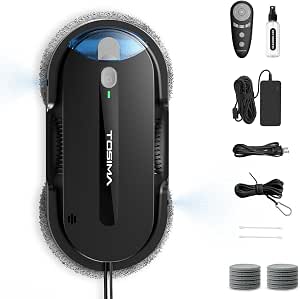 | Best for a Visible Water Supply | Water tank capacity: 85 ml | Cleaning path width: 8 inches | Minimum window size: 30 × 30 cm | VIEW ON AMAZON | See Our Full Breakdown |
| EAEGE Automatic Window Cleaning Robot with Dual Spray |  | Best for Basic Remote-Controlled Cleaning | Surface recommendation: Glass | Water tank capacity: 50 ml | Suction power: 3000 Pa | VIEW ON AMAZON | See Our Full Breakdown |
| ECOVACS WINBOT MINI 2 Compact Window Cleaning Robot |  | Best for Small and Hard-to-Reach Glass | Dimensions: 8.46 × 8.46 × 2.17 in | Minimum window size: 8.66 × 9.84 in | Suction power: 8000 Pa | VIEW ON AMAZON | See Our Full Breakdown |
| ECOVACS WINBOT MINI Window Cleaning Robot |  | Best for Routine Light Cleaning | Brand: ECOVACS | Model: WINBOT MINI | Dimensions: 8.46 × 8.46 × 2.17 in | VIEW ON AMAZON | See Our Full Breakdown |
| TOSIMA WA9C Pro Window Cleaning Robot with Dual Spray |  | Best for Safety Features | Surface recommendation: Glass windows | Suction force: 2600–3200 Pa | Backup battery: Up to 25 minutes | VIEW ON AMAZON | See Our Full Breakdown |
| ECOVACS WINBOT W3 OMNI Robot Window Cleaner with Self-Cleaning Station |  | Best for Low-Handling Pad Care | Surface recommendation: Glass | Navigation: Win-SLAM 5.0 with obstacle avoidance | Spray system: Triple-nozzle | VIEW ON AMAZON | See Our Full Breakdown |
| HUTT 10 Premium Round-Square Window Cleaning Robot |  | Best for Wet Cleaning and Dry Polishing | Surface recommendation: Glass | Suction power: Up to 6500 Pa | Cleaning pressure: 55 N | VIEW ON AMAZON | See Our Full Breakdown |
| X6 Window Cleaning Robot with 6400 Pa Suction |  | Best for Multi-Surface Coverage | Surface compatibility: Glass, tile walls, and mirrors; description also lists skylights | Suction: Variable, up to 6400 Pa | Shape: Round | VIEW ON AMAZON | See Our Full Breakdown |
| ECOVACS WINBOT MINI Window Cleaning Robot |  | Best for Small-Space Routine Cleaning | Design: Lightweight and compact | Spray system: Dual nozzles with ultrasonic spray | Safety: Nine-stage protection system and anti-slipping system | VIEW ON AMAZON | See Our Full Breakdown |
| ECOVACS WINBOT W2S Omni Window Cleaning Robot with 6-in-1 Multifunction Station |  | Best for Edge and Corner Cleaning | Recommended surface: Glass | Water tank capacity: 80 mL | Maximum suction: 8,000 Pa | VIEW ON AMAZON | See Our Full Breakdown |
| Tosima W5 Window Cleaning Robot |  | Best for Remote-Controlled Simplicity | Recommended surface: Glass windows | Maximum suction: 6,400 Pa | Cleaning path width: 6 inches | VIEW ON AMAZON | See Our Full Breakdown |
| ECOVACS WINBOT W2 PRO Omni Window Cleaning Robot with Multifunction Station |  | Best for Long Cleaning Sessions | Recommended surface: Glass | Battery life: Up to 110 minutes | Power operation: Battery and plugged-in operation | VIEW ON AMAZON | See Our Full Breakdown |
| Anminto Automatic Window Cleaning Robot with Dual Spray |  | Best for Windows, Mirrors, and Glass Doors | Recommended surface: Glass | Suction power: 3,000 Pa | Water capacity: 50 mL | VIEW ON AMAZON | See Our Full Breakdown |
| ECOVACS WINBOT W2S PRO Window Cleaning Robot |  | Best for High-Suction, Mode-Specific Cleaning | Recommended surface: Glass | Suction power: 10,000 Pa | Spray nozzles: 3 | VIEW ON AMAZON | See Our Full Breakdown |
| window cleaning robot | Cleaning modes |
|---|---|
| ECOVACS WINBOT W2S Window Clea | 7 |
| Tosima X1 Window Cleaning Robo | — |
| EAEGE Automatic Window Cleanin | — |
| ECOVACS WINBOT MINI 2 Compact | 5 |
| ECOVACS WINBOT MINI Window Cle | 3 |
| TOSIMA WA9C Pro Window Cleanin | N-shaped, Z-shaped, and manual |
| ECOVACS WINBOT W3 OMNI Robot W | Fast, Intensive, and Zone |
| HUTT 10 Premium Round-Square W | — |
| X6 Window Cleaning Robot with | — |
| ECOVACS WINBOT MINI Window Cle | 3 |
| ECOVACS WINBOT W2S Omni Window | — |
| Tosima W5 Window Cleaning Robo | — |
| ECOVACS WINBOT W2 PRO Omni Win | — |
| Anminto Automatic Window Clean | Three automatic modes and manual control |
| ECOVACS WINBOT W2S PRO Window | Fast, Thorough, Edge, Heavy-Duty, Deep, and Zone |
More Details on Our Top Picks
ECOVACS WINBOT W2S Window Cleaning Robot
The WINBOT W2S suits buyers who want more control over how a window is cleaned, with seven app-selected modes and WIN-SLAM 4.0 route planning. Its TruEdge scrubbers and edge mode target borders that can be missed by a basic pass, while three spray nozzles distribute cleaning solution across the glass. Compared with the smaller WINBOT MINI 2, the W2S offers more modes, but its stated minimum glass size is larger, so it is less suited to small panes. The cord also keeps it dependent on an outlet throughout a cleaning session. A safety battery temporarily maintains suction if power is interrupted, but that is not cordless operation. I would choose it for compatible, broad flat glass and skip it for obstructed frames or irregular surfaces.
Pros:- Seven app-controlled cleaning modes provide flexibility for different cleaning needs.
- WIN-SLAM 4.0 plans routes rather than relying on an unstructured cleaning pass.
- TruEdge scrubbers and an edge mode target borders and corners.
- Three wide-angle nozzles apply cleaning solution automatically.
Cons:- Must remain connected to an electrical outlet while cleaning.
- Requires compatible flat, smooth glass and can be affected by obstacles or complex frames.
Best for: Homeowners with larger, smooth glass panes who want multiple app-controlled cleaning modes and edge-focused scrubbing.
Not ideal for: People cleaning small panes, complex or obstructed frames, or windows without a nearby outlet.
- Minimum compatible glass size:11.8 × 15.7 in (30 × 40 cm)
- Compatible glass thickness:At least 0.12 in (3 mm)
- Compatible tilt angle:±45°
- Cleaning modes:7
- Navigation:WIN-SLAM 4.0
- Spray system:Three wide-angle nozzles
- Power source:Corded electric
- Noise level:68 dB
- Safety feature:Battery temporarily maintains suction during power interruption
Our verdict“Choose the WINBOT W2S for large compatible panes and app-based mode selection; pick the WINBOT MINI 2 instead for smaller glass.”
Tosima X1 Window Cleaning Robot
The Tosima X1 is a practical fit for people who want to see how much solution remains without guessing: its 85 ml visible tank is larger than the EAEGE model’s 50 ml reservoir. Dual-nozzle ultrasonic atomization handles spray distribution, and remote control keeps operation straightforward without relying on an app. Its 30 × 30 cm minimum window size gives it flexibility across smaller panes, while the 8-inch cleaning path is suited to regular glass-cleaning jobs. The tradeoff is familiar for corded robots: it needs an outlet, and Tosima specifies a safety tether attached to a fixed object. Its 65 dB operating noise may also be noticeable nearby. I’d favor it over the EAEGE when tank visibility and capacity matter more than a stated suction figure or included microfiber cloths.
Pros:- Visible 85 ml water tank makes remaining solution easy to monitor.
- Dual-nozzle ultrasonic atomization distributes water across the cleaning path.
- Remote control offers direct operation without app setup.
- Works on windows as small as 30 × 30 cm.
Cons:- Requires a safety tether secured to a fixed object.
- Corded electric operation requires access to an outlet.
- The 65 dB noise level may be noticeable during cleaning.
Best for: People who clean several windows in one session and want a visible, relatively large reservoir with simple remote operation.
Not ideal for: Buyers who need a cordless robot, quiet operation, or an app-based interface.
- Water tank capacity:85 ml
- Cleaning path width:8 inches
- Minimum window size:30 × 30 cm
- Spray system:Dual-nozzle ultrasonic atomization
- Control method:Remote control
- Power source:Corded electric
- Noise level:65 dB
- Operating temperature:0 °C to 40 °C
- Warranty:2 years
Our verdict“Choose the Tosima X1 if a visible, larger tank and remote control matter more than quieter or cordless operation.”
EAEGE Automatic Window Cleaning Robot with Dual Spray
The EAEGE Automatic Window Cleaning Robot keeps its setup focused: dual spray, edge detection, three cleaning paths, and a remote control. Its 3000 Pa suction and 4 m safety rope provide concrete setup details that are not listed for the Tosima X1, though the EAEGE’s 50 ml tank is smaller than Tosima’s 85 ml reservoir. The supplied 10 microfiber cloths are useful for keeping replacement cloths on hand. This is still a corded cleaner, and its stated operating limits narrow its fit: it is not recommended for curved glass, thick trim, or horizontal surfaces. Stubborn marks may also need manual pre-cleaning, so I would treat it as a maintenance tool rather than a way to rescue neglected windows. For smooth, appropriately angled glass, it offers a simpler alternative to the seven-mode WINBOT W2S.
Pros:- Three cleaning paths and edge detection support different passes across smooth glass.
- Dual spray works with a 50 ml water tank.
- Includes a 4 m safety rope and UPS backup.
- Comes with 10 microfiber cloths.
Cons:- Must stay plugged in during operation.
- Stubborn stains may require manual pre-cleaning.
- Not recommended for curved glass, thick trim, or horizontal surfaces.
Best for: Buyers with smooth windows who want a straightforward remote-controlled robot, a defined safety-rope length, and spare cloths.
Not ideal for: People with curved glass, thick window trim, horizontal glass, or stubborn buildup they do not want to pre-clean.
- Surface recommendation:Glass
- Water tank capacity:50 ml
- Suction power:3000 Pa
- Battery backup:15–20 minutes
- Power source:Corded electric
- Safety rope length:4 m
- Cleaning paths:3
- Control method:Remote control
- Included cloths:10 microfiber cloths
Our verdict“Pick the EAEGE for basic remote-controlled cleaning on suitable smooth glass, but choose the Tosima X1 for a larger visible tank.”
ECOVACS WINBOT MINI 2 Compact Window Cleaning Robot
The WINBOT MINI 2 is the strongest fit here when window size is the main constraint. At 8.46 inches square, with a minimum window size of 8.66 × 9.84 inches, it can reach panes that are below the W2S’s stated minimum. Its edge-cleaning brushes and wings reach close to borders, while five modes and app-based route planning offer more control than the three-mode WINBOT MINI. The 8000 Pa suction and backup attachment protection add reassurance for elevated glass, though the safety rope still needs anchoring. Its compact footprint does not make it a heavy-soil specialist: the product calls for pad cleaning or repeat cycles on heavily soiled glass. I’d choose it over the standard MINI for its extra modes and small-pane compatibility, but not for buyers who want a single-pass solution for neglected windows.
Pros:- Compact body and low minimum window size suit small or narrow glass areas.
- Edge-cleaning brushes and wings reach within 1 mm of edges.
- Five cleaning modes and app navigation offer more options than the standard WINBOT MINI.
- Backup attachment protection lasts over 30 minutes during a power interruption.
Cons:- Heavily soiled glass may need multiple cycles or a cleaned pad.
- The safety rope must be anchored before operation.
- Requires a 110 V power supply.
Best for: Apartment residents and homeowners with small panes, mirrors, or narrow glass sections who want app control and edge-focused cleaning.
Not ideal for: People tackling heavily soiled glass in one pass or unwilling to anchor a safety rope before use.
- Dimensions:8.46 × 8.46 × 2.17 in
- Minimum window size:8.66 × 9.84 in
- Suction power:8000 Pa
- Cleaning modes:5
- Spray technology:Ultrasonic atomization; droplets as small as 10 microns
- Cleaning pressure:14 N
- Backup attachment protection:Over 30 minutes during power interruption
- Safety rope strength:Up to 1600 N
- Control:App control with Bluetooth directional control
Our verdict“Choose the WINBOT MINI 2 for small, framed or frameless glass and extra cleaning modes; skip it if your main job is heavy grime.”
ECOVACS WINBOT MINI Window Cleaning Robot
The ECOVACS WINBOT MINI is the simpler compact option for regular upkeep: it targets dust, fingerprints, and light marks with three cleaning modes, app control, and dual-nozzle ultrasonic spray. Its washable filter helps reduce the need for disposable replacements, and the compact 8.46-inch-square body suits smaller homes and glass surfaces. Compared with the WINBOT MINI 2, this model has fewer cleaning modes and lacks the listed 8000 Pa suction figure and extended backup-attachment specification, so the MINI 2 makes a stronger case for buyers who want more detailed controls and small-pane capabilities. The standard MINI’s tradeoff is cleaning ambition: heavier buildup can call for a refreshed pad or additional cycles. I’d choose it for straightforward maintenance, not as a substitute for hands-on prep when windows are badly soiled.
Pros:- Compact form suits smaller homes and glass surfaces.
- Three modes and app control keep routine operation straightforward.
- Washable filter can be reused.
- Dual nozzles use ultrasonic spray for everyday cleaning.
Cons:- Designed mainly for dust, smudges, and light marks rather than heavy buildup.
- Heavier dirt may require a refreshed pad or additional cleaning cycles.
- Offers fewer cleaning modes than the WINBOT MINI 2.
Best for: Apartment dwellers and first-time robot-cleaner buyers who want app-controlled maintenance for everyday dust and light smudges.
Not ideal for: People with neglected windows, heavy deposits, or a need for multiple specialized cleaning modes.
- Brand:ECOVACS
- Model:WINBOT MINI
- Dimensions:8.46 × 8.46 × 2.17 in
- Form factor:Compact
- Usage:Indoor
- Cleaning modes:3
- Control type:App control
- Filter type:Washable
- Spray system:Dual nozzles with ultrasonic spray
Our verdict“Choose the WINBOT MINI for uncomplicated upkeep of lightly soiled glass; opt for the MINI 2 if you want more modes and listed backup protection.”
TOSIMA WA9C Pro Window Cleaning Robot with Dual Spray
The TOSIMA WA9C Pro stands out for buyers who want several layers of fall protection while cleaning glass. Its suction monitoring, drop sensor, safety rope, and up-to-25-minute backup battery address the risks of placing a robot on a high or hard-to-reach window. Four spray nozzles support wet cleaning, while N- and Z-shaped paths give it more route flexibility than a basic automatic cleaner. Compared with the X6 Window Cleaning Robot, the WA9C Pro specifies lower suction at 2600–3200 Pa, but its safety monitoring is clearly emphasized in the supplied features. The tradeoff is a tethered setup: it needs AC power for normal operation, and overhead use still requires anchoring the rope. I’d favor it for cautious users, not anyone seeking a cordless workflow.
Pros:- Four spray nozzles support water delivery from both sides.
- N-shaped, Z-shaped, and manual modes offer route flexibility.
- Suction monitoring, a drop sensor, and a safety rope add fall protection.
- Backup battery can maintain attachment for up to 25 minutes during a power outage.
Cons:- Requires an AC power cable during normal cleaning.
- The safety rope must be anchored for overhead use.
- Specified suction is lower than the X6’s listed 6400 Pa.
Best for: Homeowners cleaning elevated glass who want backup attachment power, active suction monitoring, and a safety rope.
Not ideal for: People who need cordless operation or cannot securely anchor a safety rope for overhead cleaning.
- Surface recommendation:Glass windows
- Suction force:2600–3200 Pa
- Backup battery:Up to 25 minutes
- Cleaning path width:8 inches
- Cleaning modes:N-shaped, Z-shaped, and manual
- Control:Remote control
- Power source:Battery powered; AC cable required for normal operation
- Included accessories:Remote, four cleaning mops, replacement nozzles, and safety rope
Our verdict“Choose the WA9C Pro if layered safety features matter more than cordless convenience or higher listed suction.”
ECOVACS WINBOT W3 OMNI Robot Window Cleaner with Self-Cleaning Station
The ECOVACS WINBOT W3 OMNI is the lineup’s most hands-off choice for pad maintenance: its station washes the cleaning pads after use, cutting down on the manual rinse-and-reset routine that comes with options like the HUTT 10 Premium. On the glass, a triple-nozzle spray system, edge-cleaning scrubber, and Win-SLAM 5.0 navigation with obstacle avoidance are aimed at thorough, controlled passes. Fast, Intensive, and Zone modes let users choose between routine cleaning and focused work. The tradeoffs are a narrow surface focus and app-dependent control; it is designed for indoor glass, not a multi-surface job, and buyers who prefer a remote should look at the TOSIMA WA9C Pro. The listed 12.22 kg weight also makes the station-and-robot package less appealing to anyone prioritizing a light, simple setup.
Pros:- Station washes the cleaning pads after use, reducing manual pad cleanup.
- Triple-nozzle spray helps loosen dirt during cleaning.
- Edge-cleaning scrubber is designed to reach corners.
- Fast, Intensive, and Zone modes support different cleaning needs.
Cons:- Designed for glass surfaces, limiting its usefulness across other household surfaces.
- Requires app control rather than offering the listed remote control of the WA9C Pro.
- Listed weight of 12.22 kg makes the setup less convenient to move and store.
Best for: Households with substantial indoor glass who want automated pad washing and app-based cleaning modes.
Not ideal for: Buyers seeking a lightweight, remote-controlled cleaner for mirrors, tile, or other non-glass surfaces.
- Surface recommendation:Glass
- Navigation:Win-SLAM 5.0 with obstacle avoidance
- Spray system:Triple-nozzle
- Cleaning modes:Fast, Intensive, and Zone
- Pad care:Station washes cleaning pads after use
- Battery life:130 minutes
- Control:App control
- Dimensions:10.63 × 2.99 × 10.63 inches
- Weight:12.22 kg
Our verdict“Pick the WINBOT W3 OMNI if automatic pad washing is your priority and you mainly clean indoor glass.”
HUTT 10 Premium Round-Square Window Cleaning Robot
The HUTT 10 Premium earns its place for a distinctive two-stage approach: a round wet-cleaning pad tackles grime, then a square pad handles dry polishing. Automatic route mapping and 14 sensors support edge detection, while its listed suction reaches 6500 Pa. That makes it a more specialized option than the ECOVACS WINBOT MINI, which is positioned for routine dust and light stains rather than a wet-and-polish workflow. The HUTT also lists use on mirrors, shower doors, and sliding doors, extending its usefulness beyond windows. Its limits are practical: the 80 ml tank covers up to 60 m² per refill, cleaning liquid is not included, and traction depends on keeping the tracks and pads clean and appropriately dry. I’d choose it for varied glass surfaces, not for users who want minimal upkeep.
Pros:- Round wet-cleaning and square dry-polishing pads provide distinct cleaning stages.
- Automatic mapping and 14 sensors support route planning and edge detection.
- Backup battery can maintain adhesion for up to 30 minutes during a power interruption.
- Listed for windows, mirrors, shower doors, and sliding doors.
Cons:- Cleaning liquid is not included.
- Tracks and pads need regular care to maintain traction.
- The 80 ml tank is listed for up to 60 m² per refill, so larger jobs may require a refill.
Best for: People cleaning windows, mirrors, shower doors, and sliding doors who value separate wet-cleaning and dry-polishing pads.
Not ideal for: Buyers wanting minimal pad and track maintenance or uninterrupted coverage across large areas without refilling.
- Surface recommendation:Glass
- Suction power:Up to 6500 Pa
- Cleaning pressure:55 N
- Water tank:80 ml
- Coverage per refill:Up to 60 m² (646 sq ft)
- Battery backup:Up to 30 minutes
- Noise level:65 dB
- Weight:1.3 kg
- Minimum glass surface:30 × 30 cm
Our verdict“Choose the HUTT 10 Premium for multi-surface glass care and wet-to-dry polishing, if you’re comfortable maintaining its pads and tracks.”
X6 Window Cleaning Robot with 6400 Pa Suction
The X6 Window Cleaning Robot is the broadest-surface pick here: its listed compatibility includes glass, tile walls, mirrors, and skylights, while smart navigation and edge detection help it handle different placements. Variable suction up to 6400 Pa and dual spray nozzles are paired with a UPS backup claimed to keep the unit attached for up to 30 minutes during an outage. Compared with the glass-focused ECOVACS WINBOT W3 OMNI, the X6 makes more sense when cleaning extends beyond windows, though it lacks that model’s self-washing pad station. There are also cleaning compromises: heavily soiled glass may need two passes, and pads must be cleaned or replaced promptly to reduce smears. Corded power can restrict reach, so this is better for accessible outlets than distant exterior panes.
Pros:- Listed for glass, tile walls, mirrors, and skylights.
- Variable suction up to 6400 Pa works with dual spray nozzles.
- Smart navigation and edge detection support automated coverage.
- UPS backup and safety cable provide added fall protection.
Cons:- Dirty windows may need multiple cleaning passes.
- Pads need timely cleaning or replacement to help prevent smears.
- Corded power can limit reach and placement.
Best for: Homeowners who want one robot for windows, skylights, mirrors, and tile walls and can work near an outlet.
Not ideal for: People cleaning heavily soiled glass in one pass or areas beyond the reach of its power cable.
- Surface compatibility:Glass, tile walls, and mirrors; description also lists skylights
- Suction:Variable, up to 6400 Pa
- Shape:Round
- Water capacity:85 ml
- Power source:Corded electric
- Voltage:24 V
- UPS backup:Up to 30 minutes
- Safety cable capacity:At least 150 lbs
- Warranty:1 year
Our verdict“Choose the X6 if you need a corded robot for several smooth surfaces rather than glass alone.”
ECOVACS WINBOT MINI Window Cleaning Robot
The ECOVACS WINBOT MINI is the straightforward choice for routine care on small windows: its compact, lightweight design and automatic path planning suit dust, fingerprints, and light stains without the extra setup of the ECOVACS WINBOT W3 OMNI and its pad-washing station. Dual ultrasonic spray nozzles and three cleaning modes give it more than a basic dry wipe, while a nine-stage protection system and anti-slipping system address attachment safety. Quiet operation is a plus in apartments or shared rooms. Its simpler role comes with a clear ceiling: the supplied description targets everyday mess, so heavily soiled panes may need multiple cycles or a freshly cleaned pad. Compared with the HUTT 10 Premium, it also lacks the listed wet-and-dry pad system and broad surface recommendations. I’d keep it for maintenance, not deep cleaning.
Pros:- Compact, lightweight design suits small windows and limited storage.
- Automatic operation and intelligent path planning simplify routine cleaning.
- Dual ultrasonic spray nozzles support everyday cleaning.
- Nine-stage protection and an anti-slipping system add safety features.
Cons:- Heavily soiled glass may require multiple cycles.
- The cleaning pad may need cleaning for better results.
- Its stated use focuses on glass and light, routine mess rather than broader cleaning tasks.
Best for: Apartment residents and small-window owners who want a compact robot for frequent dust, fingerprint, and light-stain cleanup.
Not ideal for: People with heavily soiled or large glass areas who want deeper cleaning in fewer cycles.
- Design:Lightweight and compact
- Spray system:Dual nozzles with ultrasonic spray
- Safety:Nine-stage protection system and anti-slipping system
- Navigation:Intelligent path planning
- Cleaning modes:3
- Recommended use:Routine cleaning of dust, fingerprints, and light stains
- Operation:Automatic, low-noise
Our verdict“Pick the WINBOT MINI for quiet, compact upkeep of small glass areas, but choose a stronger cleaning setup for stubborn grime.”
ECOVACS WINBOT W2S Omni Window Cleaning Robot with 6-in-1 Multifunction Station
I’d choose the WINBOT W2S Omni for windows where cleaning close to frames and corners matters as much as covering the main pane. Its TruEdge scrubbing, four-edge detection, and WIN-SLAM 4.0 navigation target those harder-to-reach areas, while three wide-angle nozzles spread water across the glass. The station also gives this model a more organized setup than the WINBOT W2S PRO: it handles charging, cable management, storage, and control, and the robot can run cordless for up to 110 minutes or stay connected to AC power for longer sessions. The tradeoff is that cordless runtime still limits how much glass it can cover per charge, and it is made for glass rather than other surfaces. I’d skip it if I wanted a simpler, smaller setup or needed a robot for mixed materials.
Pros:- TruEdge scrubbing and four-edge detection focus on cleaning near frames and corners.
- Cordless and AC-powered operation accommodates shorter jobs and longer sessions.
- Multifunction station combines charging, cable management, storage, and control.
- Three wide-angle spray nozzles distribute water across the glass.
Cons:- Cordless cleaning is limited to up to 110 minutes per charge.
- Designed for glass, so it is not suited to other surface materials.
Best for: People with framed, frameless, or tilted glass windows who want edge-focused cleaning and an all-in-one station for storage and cable handling.
Not ideal for: Buyers cleaning non-glass surfaces or very large areas in one cordless session, since it is glass-specific and battery operation lasts up to 110 minutes.
- Recommended surface:Glass
- Water tank capacity:80 mL
- Maximum suction:8,000 Pa
- Battery life:Up to 110 minutes
- Power modes:Cordless and AC-powered
- Navigation:WIN-SLAM 4.0
- Spray nozzles:Three wide-angle nozzles
- Control:App control
Our verdict“Choose the WINBOT W2S Omni if edge cleaning and a cable-managing station matter more than unrestricted cordless runtime.”
Tosima W5 Window Cleaning Robot
The Tosima W5 is a straightforward pick for buyers who want both automatic navigation and the option to steer a window robot with a remote. Its dual-spiral cleaning and dual-spray system are aimed at loosening dirt as the robot moves, while adaptive suction reaches up to 6,400 Pa. A safety rope and backup battery add protection if power is interrupted; that backup, however, lasts up to 25 minutes, far shorter than the up-to-110-minute battery operation of the ECOVACS WINBOT W2S Omni. The W5’s listed cleaning path width is six inches, so it may take more passes than buyers expect on broad panes. I’d favor it for controlled, occasional glass cleaning, but skip it if long battery operation or cleaning surfaces beyond glass is a priority.
Pros:- Remote and button controls give buyers a manual option alongside automatic navigation.
- Dual spray and dual-spiral cleaning help loosen dirt and stains.
- Adaptive suction reaches up to 6,400 Pa.
- Safety rope and emergency backup battery provide added protection during power loss.
Cons:- Backup battery life is up to 25 minutes, considerably shorter than the W2S Omni’s stated cordless runtime.
- Designed for glass windows rather than a range of surface materials.
- The listed six-inch cleaning path may mean more coverage passes on wide panes.
Best for: Buyers who want automatic window cleaning with a remote for choosing or adjusting the robot’s movement.
Not ideal for: People with extensive glazing who need long backup operation, or anyone hoping to clean non-glass surfaces.
- Recommended surface:Glass windows
- Maximum suction:6,400 Pa
- Cleaning path width:6 inches
- Battery life:Up to 25 minutes
- Battery voltage:14.8 volts
- Safety rope capacity:Up to 220 kg
- Controls:Button and remote control
- Warranty:1 year
Our verdict“Pick the Tosima W5 if remote steering and dual-spray cleaning matter more than extended backup runtime.”
ECOVACS WINBOT W2 PRO Omni Window Cleaning Robot with Multifunction Station
The WINBOT W2 PRO Omni suits buyers who want flexibility to clean away from an outlet without giving up the option of continuous plugged-in operation. Battery mode runs for up to 110 minutes, while WIN-SLAM 4.0 path planning and triple-nozzle spray support a planned, wet-cleaning route across glass. Its 12-stage protection system includes anti-fall and edge-cleaning features, and the multifunction station gives it a more organized home than a basic robot setup. Compared with the WINBOT W2S Omni, the supplied details here do not specify its TruEdge scrubbing or four-edge detection, so I’d favor the W2S Omni when corner-focused cleaning is the deciding factor. The W2 PRO’s own limitation is its finite battery runtime and glass-only use.
Pros:- Battery operation lasts up to 110 minutes, with plugged-in operation available for longer sessions.
- WIN-SLAM 4.0 plans cleaning paths across glass.
- Triple-nozzle spray supports wet cleaning.
- 12-stage protection includes anti-fall and edge-cleaning features.
Cons:- Battery mode is limited to up to 110 minutes per charge.
- Designed for glass surfaces, limiting use elsewhere.
- Unlike the W2S Omni, the supplied product details do not specify TruEdge scrubbing or four-edge detection.
Best for: Homeowners who clean multiple indoor glass windows and want both cordless flexibility and continuous plugged-in operation.
Not ideal for: Buyers whose main concern is specialized frame-and-corner scrubbing, or those who need a cleaner for materials other than glass.
- Recommended surface:Glass
- Battery life:Up to 110 minutes
- Power operation:Battery and plugged-in operation
- Navigation:WIN-SLAM 4.0
- Spray nozzles:Triple-nozzle spray
- Safety system:12-stage protection
- Control:App control
- Usage:Indoor
Our verdict“Choose the W2 PRO Omni for flexible power and a station-based setup, but compare the W2S Omni if corner scrubbing is your priority.”
Anminto Automatic Window Cleaning Robot with Dual Spray
The Anminto Automatic Window Cleaning Robot makes sense for a household that wants one device for windows, mirrors, and glass doors, rather than a robot focused only on window panes. It combines AI path planning and edge detection with dual water nozzles, microfiber pads, three automatic modes, and manual control by infrared remote. A safety rope and up-to-30-minute backup operation offer protection if power drops. Compared with the Tosima W5, Anminto lists broader glass uses and a longer backup period, though the W5 specifies higher maximum suction at 6,400 Pa; Anminto lists 3,000 Pa. It also needs a power connection for normal operation, and its 50 mL tank is modest. I’d pass if extended cordless cleaning is essential.
Pros:- Listed for windows, mirrors, and glass doors.
- AI path planning and edge detection guide the cleaning route.
- Dual nozzles and microfiber pads support wet cleaning.
- Safety rope and up-to-30-minute backup operation add protection during outages.
Cons:- Requires a power connection for normal operation.
- The 50 mL water capacity may require refilling during larger jobs.
- Its listed 3,000 Pa suction is lower than the Tosima W5’s maximum 6,400 Pa.
Best for: Households that want a robot for several glass surfaces, including mirrors and glass doors, with remote or automatic control.
Not ideal for: People who need long cordless cleaning sessions or a larger water reservoir for extensive glass coverage.
- Recommended surface:Glass
- Suction power:3,000 Pa
- Water capacity:50 mL
- Cleaning modes:Three automatic modes and manual control
- Control:Infrared remote control
- Backup operation:Up to 30 minutes during power outages
- Cleaning features:AI path planning, edge detection, and dual nozzles
- Color:White
Our verdict“Choose Anminto for cleaning several kinds of glass around the home, but not if you need strong suction or extended cordless operation.”
ECOVACS WINBOT W2S PRO Window Cleaning Robot
The WINBOT W2S PRO stands apart from the station-based W2S Omni by pairing a higher listed 10,000 Pa suction with six cleaning modes, including Edge, Heavy-Duty, Deep, and Zone. That gives buyers more ways to match a run to the glass and the job, while triple-spray wet wiping and edge brushes target everyday smudges near frames and corners. WIN-SLAM 4.0 handles route planning, and the 10-stage safety system adds a layer of protection during operation. The tradeoff is its corded-only power: its listed 30-minute battery life does not change the stated corded power source, so buyers should plan around the cable and safety tether. Like the other ECOVACS models here, it is intended for glass, not mixed household surfaces.
Pros:- Listed 10,000 Pa suction is higher than the W2S Omni’s 8,000 Pa.
- Six modes let buyers select settings for different cleaning tasks.
- Triple-spray wiping and edge brushes focus on smudges near frames and corners.
- WIN-SLAM 4.0 navigation and a 10-stage safety system support planned cleaning.
Cons:- Corded electric power means a cable and safety tether are part of the setup.
- The listed battery life is 30 minutes, shorter than the up-to-110-minute cordless operation of the W2S Omni.
- Designed for glass surfaces rather than other household materials.
Best for: Buyers with glass windows who want strong listed suction and distinct modes for edge, zone, heavy-duty, and deeper cleaning.
Not ideal for: People who need cordless freedom or a multifunction station for charging, storage, and cable management.
- Recommended surface:Glass
- Suction power:10,000 Pa
- Spray nozzles:3
- Cleaning modes:Fast, Thorough, Edge, Heavy-Duty, Deep, and Zone
- Battery life:30 minutes
- Power source:Corded electric
- Water capacity:4.1 fluid ounces
- Control method:App control
Our verdict“Choose the W2S PRO for high listed suction and task-specific modes, but pick the W2S Omni for cordless operation and station convenience.”

How We Picked
I ranked these window cleaning robots by how clearly each option serves a practical buyer need: all-around household use, compact access, reduced hands-on maintenance, or a feature-led alternative. I weighed the stated cleaning approach, spray configuration, form factor, station and accessory setup, and the likely work required before and after a cleaning cycle. A feature mattered most when it changed the buyer’s routine, not simply because it sounded advanced.
The order favors the W2S as the broadest starting point, then places specialized models according to who benefits from their extra equipment or smaller footprint. Similar-looking products are separated by their named configuration and intended role, rather than treated as duplicates. Because the lineup includes repeated WINBOT MINI listings and several closely named W2-series variants, I avoid assuming unlisted performance differences; buyers should verify the exact model and included components before choosing.
Factors to Consider When Choosing Window Cleaning Robots
Choosing among window cleaning robots starts with the glass you have and the amount of setup you will tolerate. I would check practical fit before comparing feature lists: a compact robot may suit a narrow pane, while a station model may be excessive if cleaning is occasional. These broader checks can help prevent a mismatch that no headline feature can fix.
Match the Robot to Window Size and Layout
Measure the usable glass area and note narrow panes, divided lights, corners, and nearby handles before selecting a model. A compact design can reach spaces where a larger unit is awkward, but it may take more repositioning across broad windows. Large uninterrupted panes may favor a more general-purpose shape and a straightforward routine. Also check whether the manufacturer describes support for the window types you own, rather than assuming that every smooth-looking surface is suitable. Buyers often focus on total glass area and overlook the number of separate panes, which can add repeated setup time. If your windows vary widely, favor versatility over a design optimized for just one difficult spot.
Treat Spray Design as a Maintenance Choice
Spray systems influence how moisture reaches the glass, but the presence of dual spray alone does not tell you how much manual work a model needs. Look for clear instructions on filling, cleaning, and replacing any parts that contact cleaning solution. Think about whether you prefer to manage solution yourself or want a simpler routine with fewer components. A common mistake is to assume more spray outlets always mean a cleaner result; placement, pad condition, and suitable solution also matter. Homes with frequent fingerprints or outdoor residue may value repeatable coverage more than a feature list with extra settings. Check cleaning-solution compatibility before using anything other than the specified type.
Decide Whether a Multifunction Station Earns Its Space
A station can reduce handling or centralize parts of the cleaning routine, but it also adds equipment to store and set up. It is most attractive when you clean many windows regularly or want accessories kept together. For a handful of windows cleaned occasionally, a simpler robot may be easier to put away and bring out. Check what the station actually does in the exact package; similar W2-series names do not guarantee identical accessories or functions. Buyers sometimes pay for a station based on its name without checking its footprint, included components, or maintenance tasks. Choose by the work it removes from your routine, not by the number of functions advertised.
Check Safety and Window Compatibility Before Use
Window robots operate on vertical glass, so attachment and power arrangements deserve attention before cleaning begins. Read the specific model’s instructions for supported panes, frame conditions, and any required safety cable or backup measures. Do not assume that a suction figure or a broad claim about grip covers every surface or outdoor condition. Frames, seals, surface texture, and access to an outlet can affect whether a setup is practical. A frequent error is buying for an inaccessible exterior pane without checking how the manufacturer expects the robot to be secured. If your windows are unusually shaped or damaged, confirm compatibility with the maker before relying on automation.
Compare the Full Routine, Not Just Cleaning Features
The time a robot saves depends on preparation, moving it between panes, washing or replacing pads, and storing the unit afterward. Map those steps against your usual window-cleaning routine rather than focusing only on the cleaning cycle. A compact model may simplify handling but need more repositioning; a station may streamline repeated sessions but take up room. Consider who will operate it and whether controls and setup instructions suit that person. Buyers can overestimate convenience when they count only the minutes the robot is moving. For occasional cleaning, easy storage and simple maintenance may matter more than advanced automation.
Choose Features That Match Your Cleaning Frequency
Frequent cleaning can justify paying for equipment that reduces repeated setup or maintenance, while occasional use often favors a simpler configuration. Consider your local dust, pollen, rain marks, and the number of windows you actually clean throughout the year. Premium stations and extra modes add value only when they solve a recurring task for you. A feature-rich model can also mean more parts to store and maintain. Before choosing, make a short list of your two most common cleaning frustrations and prioritize features that address those directly. This keeps a high-spec purchase from becoming a complicated tool for a small job.
Frequently Asked Questions
Should I choose a WINBOT with a station or a simpler robot?
I would choose a station-equipped model if you clean many windows in one session and its functions reduce tasks you regularly perform. For occasional cleaning, a simpler robot can be easier to store and set up. Compare the exact package contents across the W2S, W2S Omni, W2S PRO, and W2 PRO Omni, since similar names do not mean the same configuration. Check the station’s footprint and care requirements as well as its advertised functions. The right choice is the one that makes your real cleaning routine easier, not the one with the longest feature list.
Are compact window cleaning robots a good choice for a whole house?
They can work for a whole house if the windows are mostly small or awkwardly divided, but compact size may mean more repositioning on large panes. Think about the total number of separate glass sections, not just the number of windows. A smaller unit can be easier to handle around tight spaces, while a broader all-purpose model may be less repetitive across open glass. Check the model’s stated compatibility and dimensions before buying. If your home has a mix of pane sizes, prioritize the layout you clean most often.
Does dual spray mean a robot will clean better?
Not by itself. Dual spray describes part of the delivery setup, but the result also depends on pad condition, the solution used, the glass, and the cleaning routine. Models such as the EAEGE, TOSIMA WA9C Pro, and Anminto foreground dual spray, so compare how each handles filling and maintenance rather than treating the shared feature as proof of equal performance. Follow the manufacturer’s solution guidance and keep pads clean. If you rarely deal with heavy marks, a simpler setup may be more useful than extra spray hardware.
Can a window cleaning robot handle every type of glass?
No model should be assumed to suit every pane, frame, or surface. Check the exact product instructions for approved window types, surface conditions, and any restrictions before operating it. Pay particular attention to unusual shapes, divided panes, textured glass, damaged seals, and exterior access. Suction claims do not replace compatibility guidance or required safety precautions. If your glass is unusual, ask the manufacturer about that specific surface before purchase.
How do I choose between the WINBOT W2S, W2S Omni, W2S PRO, and W2 PRO Omni?
Start by comparing the exact product listing and included equipment, especially station functions, accessories, and the power or control setup. The names are close enough that choosing by series label alone can lead to the wrong configuration. Decide whether you want a straightforward robot or a station-centered setup, then check which named model actually provides that package. Also compare the stated window compatibility and the routine for cleaning pads and storing components. If a listing leaves a difference unclear, confirm it with the manufacturer before ordering.
Conclusion
For the broadest household fit, I recommend the ECOVACS WINBOT W2S as my best overall choice. Buyers who want a premium, station-led routine should compare the WINBOT W3 OMNI with the W2S Omni and W2 PRO Omni by their exact included functions. For a simpler value-minded direction, I would start with the Tosima X1 and compare its setup against your needs rather than paying for station features you may not use. Beginners should favor a model with a clear setup, manageable storage, and window compatibility that matches their home; the standard WINBOT MINI may suit a smaller or less complicated cleaning area. For tight panes, look at the WINBOT MINI 2; for buyers drawn to dual spray, compare the EAEGE, WA9C Pro, and Anminto on upkeep and package details. Check the exact model name and included components before making a final choice.
Fall Picks
fall essentials
As an affiliate, we earn on qualifying purchases.